QUESTION PAPER
2024 BOARD EXAM
CBSE Class 12 PCM Physics Board Paper 2024 — Set 4
2024
Physics
Class 12 PCM
CBSE EXAMINATION PAPER-2024
PHYSICS
(Solved)
General Instructions :
Read the following instructions carefully and follow them :
- This question paper contains 38 questions. All questions are compulsory.
- This question paper is divided into 5 sections.
- Section A – questions number 1 to 2 are case based questions
- Section B – questions number 3 to 18 are multiple choice questions
- Section C – questions number 19 to 24 are very short answer
- Section D – questions number 25 to 32 are short answer
- Section E – questions number 33 to 38 are long answer
- There is no overall choice given in the question paper. However, an internal choice has been provided in few questions.
- Use of calculator is NOT allowed.
Section A
(1) When Ge is doped with pentavalent impurity, the energy required to free the weakly bound electron from the dopant is about (A) 0.001 eV (B) 0.01 eV (C) 0.72eV (D) 1.1eV
(2) At a given temperature, the number of intrinsic charge carriers in a semiconductor is 2.0 x 10¹⁰cm⁻³. It is doped with pentavalent impurity atoms. As a result, the number of holes in it becomes 8 x 10³ cm⁻³. The number of electrons in the semiconductor is 2×10²⁴ m⁻³ 4×10²³ m⁻³ 1×10²² m⁻³ 5×10²² m⁻³
(3) (a) During the formation of a p-n junction — (A) electrons diffuse from p-region into n-region and holes diffuse from n-region into p-region. (B) both electrons and holes diffuse from n-region into p-region. (C) electrons diffuse from n-region into p-region and holes diffuse from p-region into n-region. (D) both electrons and holes diffuse from p-region into n-region.
(4) An ac voltage V = 0.5 sin (100 π t) volt is applied, in turn, across a half-wave rectifier and a full-wave rectifier. The frequency of the output voltage across them respectively will be (A) 25 Hz, 50 Hz (B) 25 Hz, 100 Hz (C) 50 Hz, 50 Hz (D) 50 Hz, 100 Hz
(5) (b) Initially during the formation of a p-n junction — (A) diffusion current is large and drift current is small. (B) diffusion current is small and drift current is large. (C) both the diffusion and the drift currents are large. (D) both the diffusion and the drift currents are small.
(1) The radii of curvature of two surfaces of a convex lens are R and 2R. If the focal length of this lens is 4/3R, the refractive index of the material of the lens is: 5/3 4/3 3/2 7/5
(2) A thin converging lens of focal length 20 cm and a thin diverging lens of focal length 15 cm are placed coaxially in contact. The power of the combination is -5/6D -5/3D 4/3D 3/2D
(3) The focal length of an equiconvex lens (A) increases when the lens is dipped in water. (B) increases when the wavelength of incident light decreases. (C) increases with decrease in radius of curvature of its surface. (D) decreases when the lens is cut into two identical parts along its principal axis.
(4) (a) A thin convex lens L of focal length 10 cm and a concave mirror M of focal length 15 cm are placed coaxially 40 cm apart as shown in figure. A beam of light coming parallel to the principal axis is incident on the lens. The final image will be formed at a distance of (A) 10cm, left of lens (B) 10cm, right of lens (C) 20cm, left of lens (D) 20cm, right of lens
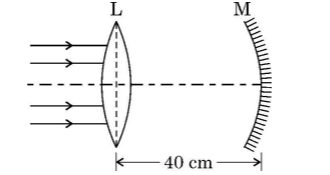 [1 Mark]
(5) A beam of light coming parallel to the principal axis of a convex lens L₁, of focal length 16 cm is incident on it. Another convex lens L₂, of focal length 12 cm is placed coaxially at a distance 40 cm from L₁,. The nature and distance of the final image from L₂, will be (A) real, 24cm (B) virtual, 12 cm (C) real, 32 cm (D) virtual, 18 cm
Section B
Two charges + q each are kept ‘2a’ distance apart. A third charge -2q is placed midway between them. The potential energy of the system is-
Two identical small conducting balls B₁, and B₂, are given -7 pC and + 4 pC charges respectively. They are brought in contact with a third identical ball B₃, and then separated. If the final charge on each ball is -2 pC, the initial charge on B₃, was
The quantum nature of light explains the observations on photoelectric effect as-
A straight wire is kept horizontally along east-west direction. If a steady current flows in wire from east to west, the magnetic field at a point above the wire will point towards.
The magnetic susceptibility for a diamagnetic material is
A galvanometer of resistance 100 Ω is converted into an ammeter of range (0 — 1 A) using a resistance of 0.1 Ω. The ammeter will show full scale deflection for a current of about
A circular loop A of radius R carries a current I. Another circular loop B of radius r (=R/20) is placed concentrically in the plane of A. The magnetic flux linked with loop B is proportional to
Figure shows the variation of inductive reactance X_L of two ideal
inductors of inductance L₁, and L₂, with angular frequency ω. The value of L₁/L₂ is
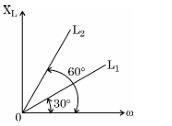
The phase difference between electric field 𝐄⃗ and magnetic field 𝐁⃗ in an
electromagnetic wave propagating along z-axis is
A coil of N turns is placed in a magnetic field 𝐁⃗ such that 𝐁⃗ is perpendicular to the plane of the coil. 𝐁⃗ changes with time as
B = B₀ cos (2πt/T) where T is time period. The magnitude of emf induced in the coil will be maximum at....
Here, n = 1, 2, 3, 4, ...
In Balmer series of hydrogen atom, as the wavelength of spectral lines decreases, they appear
Assertion (A) : The temperature coefficient of resistance is positive for metals and negative for p-type semiconductors.
Reason (R) : The charge carriers in metals are negatively charged,whereas the majority charge carriers in p-type semiconductors are positively charged.
Assertion (A) : When electrons drift in a conductor, it does not mean that all free electrons in the conductor are moving in the same direction.
Reason (R) : The drift velocity is superposed over large random velocities of electrons.
Assertion (A) : Electrons are ejected from the surface of zinc when it is irradiated by yellow light.
Reason (R) : Energy associated with a photon of yellow light is more than the work function of zinc.
Assertion (A) : In interference and diffraction of light, light energy reduces in one region producing a dark fringe. It increases in another region and produces a bright fringe.
Reason (R) : This happens because energy is not conserved in the phenomena of interference and diffraction.
The radius (rₙ) of nᵗʰ orbit in Bohr model of hydrogen atom varies with n as
Section C
Draw the circuit diagram of a p-n junction diode in
(i) forward biasing and (ii) reverse biasing. Also draw its I-V characteristics in the two cases.
A proton and α-particle are accelerated through different potentials V₁ and V₂ respectively so that they have the same de Broglie wavelengths. Find V₁ / V₂.
A ray of light is incident normally on one face of an equilateral glass prism of refractive index μ. When the prism is completely immersed in a transparent medium, it is observed that the emergent ray just grazes the adjacent face. Find the refractive index of the medium.
Two electric heaters have power ratings P₁ and P₂ at voltage V. They are connected in series to a dc source of voltage V. Find the power consumed by the combination. Will they consume the same power if connected in parallel across the same source?
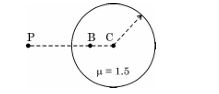
An air bubble is trapped at point B (CB = 20 cm) in a glass sphere of radius 40 cm and refractive index 1.5 as shown in figure. Find the nature and position of the image of the bubble as seen by an observer at point P.
In normal adjustment, for a refracting telescope, the distance between objective and eye piece lens is 1.00 m. If the magnifying power of the telescope is 19, find the focal length of the objective and the eyepiece lens.
Section D
(a) Differentiate between nuclear fission and fusion.
(b) The fission properties of ₉₄Pu²³⁹ are very similar to those of ₉₂ U²³⁵. How much energy (in MeV), is released if all the atoms in 1 g of pure ₉₄Pu²³⁹ undergo fission? The average energy released per fission is 180 MeV.
Draw the graph showing variation of scattered particles detected (N) with the scattering angle (θ) in Geiger-Marsden experiment. Write two conclusions that you can draw from this graph. Obtain the expression for the distance of closest approach in this experiment.
The electric field in a region is given by 𝐄⃗ =(10x+4)𝑖̂
where x is in m and E is in N/C. Calculate the amount of work done in taking a unit charge from
i) (5m, 0) to (10 m, 0)
ii) (5m, 0) tom, 10 m)
Find the current in branch BM in the network shown.
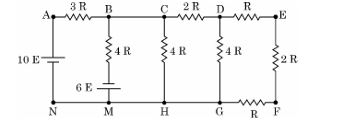
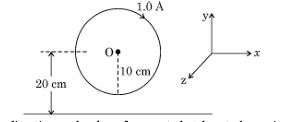
A circular loop of radius 10 cm carrying current of 1.0 A lies in x-y plane. A long straight wire lies in the same plane parallel to x-axis at a distance of 20 cm as shown in figure. Find the direction and value of current that has to be maintained in the wire so that the net magnetic field at O is zero. 3
Name the electromagnetic waves with their wavelength range which are
used for
i) FM radio broadcast
ii) detection of fracture in bones
iii) treatment of muscular strain
(a) (i) Define mutual inductance. Write its SI unit.
(ii) Derive an expression for the mutual inductance of a system of two long coaxial solenoids of same length l, having turns N₁, and N₂, and of radii r₁, and r₂> r₁.
(b) What are ferromagnetic materials? Explain ferromagnetism with the help of suitable diagrams, using the concept of magnetic domain.
Section E
(a) (i) Draw a ray diagram for the formation of the image of an object by a convex mirror. Hence, obtain the mirror equation.
(ii) Why are multi-component lenses used for both the objective and the eyepiece in optical instruments ?
(iii) The magnification of a small object produced by a compound microscope is 200. The focal length of the eyepiece is 2 cm and the final image is formed at infinity. Find the magnification produced by the objective.
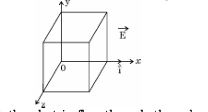
(i)Using Gauss’s law, show that the electric field 𝐄⃗ at a point due to a uniformly charged infinite plane sheet is given by 𝐸⃗=𝜎/2𝜖0𝑛̂ where symbols have their usual meanings.
(ii)Electric field E in a region is given by
𝐄⃗ = (5x² + 2)𝑖̂
where E is in N/C and x is in meters.
A cube of side 10 cm is placed in the region as shown in figure.
Calculate (1) the electric flux through the cube, and (2) the net charge enclosed by the cube.
meters.
(i) Mention the factors on which the resonant frequency of a series LCR circuit depends. Plot a graph showing variation of impedance of a series LCR circuit with the frequency of the
applied a.c. source.
(ii) With the help of a suitable diagram, explain the working of a step-up transformer.
(iii) Write two causes of energy loss in a real transformer.
(i) Differentiate between a wavefront and a ray.
(ii) State Huygen’s principle and verify laws of reflection using suitable diagram.
(iii) In Young’s double slit experiment, the slits S₁ and S₂, are 3 mm apart and the screen is placed 1.0 m away from the slits. It is observed that the fourth bright fringe is at a distance of 5 mm from the second dark fringe. Find the wavelength of light used.
(i) A dielectric slab of dielectric constant ‘K' and thickness ‘t’ is inserted between plates of a parallel plate capacitor of plate separation d and plate area A. Obtain an expression for its
capacitance.
(ii) Two capacitors of different capacitances are connected first (1) in series and then (2) in parallel across a de source of 100 V. If the total energy stored in the combination in the two cases are 40 mJ
and 250 mJ respectively, find the capacitance of the capacitors.
(i) With the help of a diagram, briefly explain the construction and working of ac generator.
(ii) An electron is revolving around a proton in an orbit of radius r with a speed v. Obtain expression for magnetic moment associated with the electron.
Paper Details
CBSE Board Exam 2024
Class
Class 12 PCM
Subject
Physics
Year
2024
Set
Set 4
Other Years — Physics