QUESTION PAPER
2025 BOARD EXAM
CBSE Class 12 PCM Physics Board Paper 2025 — Set 7
2025
Physics
Class 12 PCM
CBSE EXAMINATION PAPER-2025
PHYSICS
(Solved)
General Instructions :
Read the following instructions carefully and follow them :
- This question paper contains 38 questions. All questions are compulsory.
- This question paper is divided into 5 sections.
- Section A – questions number 1 to 2 are case based questions
- Section B – questions number 3 to 18 are multiple choice questions
- Section C – questions number 19 to 24 are very short answer
- Section D – questions number 25 to 32 are short answer
- Section E – questions number 33 to 38 are long answer
- There is no overall choice given in the question paper. However, an internal choice has been provided in few questions.
- Use of calculator is NOT allowed.
Section A
In a metallic conductor, an electron, moving due to thermal motion, suffers collisions with the heavy fixed ions but after collision, it will emerge out with the same speed but in random directions. If we consider all the electrons, their average velocity will be zero. When an electric field is applied, electrons move with an average velocity, known as drift velocity (v_d). The average time between successive collisions is known as relaxation time (τ). The magnitude of drift velocity per unit electric field is called mobility (μ).
An expression for current through the conductor can be obtained in terms of drift velocity, number of electrons per unit volume (n), electronic charge (-e), and the cross-sectional area (A) of the conductor. This expression leads to an expression between current density (J) and the electric field (𝐄⃗). Hence, an expression for resistivity (ρ) of a metal is obtained. This expression helps us to understand increase in resistivity of a metal with increase in its temperature, in terms of change in the relaxation time (τ) and change in the number density of electrons (n).
(1) Consider two cylindrical conductors A and B, made of the same metal connected in series to a battery. The length and the radius of B are twice that of A. If μ_A and μ_B are the mobility of electrons in A and B respectively, then μ_B/μ_A is: (A) 1/2 (B) 1/4 (C) 2 (D) 1
(2) A wire of length 0.5 m and cross-sectional area 1.0 × 10⁻⁷ m² is connected to a battery of 2 V that maintains a current of 1.5 A in it. The conductivity of the material of the wire (in Ω⁻¹ m⁻¹) is: (A) 2·5 *10⁴ (B) 3·0 *10⁵ (C) 3·75 *10⁶ (D) 5·0 *10⁷
(3) The temperature coefficient of resistance of nichrome is 1·70 *10⁻⁴ C⁻¹. In order to increase resistance of a nichrome wire by 8·5%, the temperature of the wire should be increased by : (A) 250°C (B) 500°C (C) 850°C (D) 1000°C
(4) (a) Consider the contribution of the following two factors I and II in resistivity of a metal : I. Relaxation time of electrons II. Number of electrons per unit volume The resistivity of a metal increases with increase in its temperature because : (A) I decreases and II increases. (B) I increases and II is almost constant. (C) Both I and II increase. (D) I decreases and II is almost constant.
(5) A steady current flows in a copper wire of non-uniform cross-section. Consider the following three physical quantities : I. Electric field II. Current density III. Drift speed Then at the different points along the wire : (A) II and III change, but I is constant. (B) I and II change, but III is constant. (C) I and III change, but II is constant. (D) All I, II and III change.
When light travels from an optically denser medium to an optically rarer medium, at the interface it is partly reflected back into the same medium and partly refracted to the second medium. The angle of incidence corresponding to an angle of refraction 90° is called the critical angle (i_c) for the given pair of media. This angle is related to the refractive index of medium 1 with respect to medium 2. Refraction of light through a prism involves refraction at two plane interfaces. A relation for the refractive index of the material of the prism can be obtained in terms of the refracting angle of the prism and the angle of minimum deviation. For a thin prism, this relation reduces to a simple equation. Laws of refraction are also valid for refraction of light at a spherical interface. When an object is placed in front of a spherical surface separating two media, its image is formed. A relation between object and image distance, in terms of refractive indices of two media and the radius of curvature of the spherical surface can be obtained. Using this relation for two surfaces of a lens, 'lens maker formula' is obtained.
(1) A small bulb is placed at the bottom of a tank containing a transparent liquid (refractive index n) to a depth H. The radius of the circular area of the surface of liquid, through which light from the bulb can emerge out, is R. Then (R/H) is: (A)1/√n²-1 (B)/√n²-1 (C)1/√n²+1 (D)/√n²+1
(2) (a) A parallel beam of light is incident on a face of a prism with refracting angle 60°. The angle of minimum deviation is found to be 30°. The refractive index of the material of the prism is close to : (A) 1·3 (B) 1·4 (C) 1·5 (D) 1·6
(3) A double-convex lens, made of glass of refractive index 1.5, has a focal length of 10 cm. The radius of curvature of its each face is: (A) 10 cm (B) 15 cm (C) 20 cm (D) 40 cm
(4) An object is placed in front of a convex spherical glass surface (n = 1.5 and radius of curvature R) at a distance of 4R from it. As the object is moved slowly close to the surface, the image formed is: (A) always real (B) always virtual (C) first real and then virtual (D) first virtual and then real
(5) The angle of minimum deviation for a ray of light incident on a thin prism, made of crown glass (n = 1·52) is Dₘ. If the prism was made of dense flint glass (n = 1·62) instead of crown glass, the angle of minimum deviation will : (A) decrease by 4% (B) increase by 4% (C) decrease by 19% (D) increase by 19%
Section B
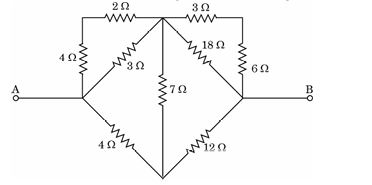
The effective resistance between points A and B in the given circuit is:
A rectangular coil of area A is kept in a uniform magnetic field 𝐁⃗ such that the plane of the coil makes an angle α with 𝐁⃗. The magnetic flux linked with the coil is:
An alternating current is given by I = I₀ cos(100π)t. The least time the current takes to decrease from its maximum value to zero will be:
A capacitor and an inductor are connected in series across an ac source of voltage of variable frequency. The frequency is increased continuously. The nature of the circuit before and after the resonance will be:
A metal rod of length 50 cm is held vertically and moved with a velocity of 10 m/s towards east. The horizontal component of the earth's magnetic field at the place is 0.4 G. The emf induced across the ends of the rod is:
The frequency of a photon of energy 1.326 eV is:
The dimensions of 'self-inductance' are:
A p-n junction diode is forward biased. As a result,
Isotones are the nuclides having :
Assertion (A) : A charged particle is moving with velocity v in x-y plane, making an angle θ (0 <θ < π/2) with x-axis. If a uniform magnetic field B is applied in the region, along y-axis, the particle will move in a helical path with its axis parallel to x-axis.
Reason (R) : The direction of the magnetic force acting on a charged particle moving in a magnetic field is along the velocity of the particle.
Assertion (A) : A ray of light is incident normally on the face of a prism. The emergent ray will graze along the opposite face of the prism when the critical angle at glass-air interface is equal to the angle of the prism. Reason (R) : The refractive index of a prism depends on angle of the prism.
Assertion (A) : EM waves do not require a medium for their propagation.
Reason (R) : EM waves are transverse waves.
Assertion (A) : The minimum negative potential applied to the anode in a photoelectric experiment at which photoelectric current becomes zero, is called cut-off voltage.
Reason (R) : The threshold frequency for a metal is the minimum frequency of incident radiation below which emission of photoelectrons does not take place.
Section C
A cell of emf E and internal resistance r is connected across a resistor of variable resistance R. Show graphically the variation of
(a) the terminal voltage across the cell
(b) the current supplied by the cell,
with R as it is increased from 0 to the maximum value.
Using the mirror equation and the formula of magnification, deduce that ''the virtual image produced by a convex mirror is always diminished in size and is located between the pole and the focus."
Write two differences in the patterns of double-slit interference experiment and single-slit diffraction experiment.
light waves from two pinholes illuminated by two sodium lamps do not produce interference patterns. Explain why
A convex lens of focal length 10 cm, a concave lens of focal length 15 cm and a third lens of unknown focal length are placed coaxially in contact. If the focal length of the combination is +12 cm, find the nature and focal length of the third lens, if all lenses are thin. Will the answer change if the lenses were thick ?
Section D
Three cells A, B and C of emfs 2 V, 3 V and 5 V respectively are connected in parallel to each other. Their internal resistances are 5Ω, 5Ω and 1Ω respectively. Calculate the currents flowing through the cells A, B and C.
(i) Write Biot-Savart's law in vector form.
(ii) Two identical circular coils A and B, each of radius R, carrying currents I and √3 I respectively, are placed concentrically in XY and YZ planes respectively. Find the magnitude and direction of the net magnetic field at their common centre.
(a) State Faraday's law of electromagnetic induction and explain the role of negative sign in its expression.
(b) Explain, with an example, thet Lenz's law is consistent with the law of conservation of energy.
(a) Differentiate between 'conduction current' and 'displacement current', giving one similarity and one dissimilarity between them.
(b) Explain the existence of electromagnetic waves in free space, using the concept of displacement current.
(a) Define 'work function' of a metal. How can its value be determined from a graph between stopping potential and frequency of the incident radiation ? (b) The work function of a metal is 2·4 eV. A stopping potential of 0·6 V is required to reduce the photocurrent to zero, in a photoelectric experiment. Calculate the wavelength of light used.
Write the mathematical forms of three postulates of Bohr's theory of the hydrogen atom. Using them prove that, for an electron revolving in the nth orbit,
(a) the radius of the orbit is proportional to n², and
(b) the total energy of the atom is proportional to (1/n²)
Explain the process of formation of 'depletion layer' and 'potential barrier' in a p-n junction region of a diode, with the help of a suitable diagram. Which feature of junction diode makes it suitable for its use as a rectifier ?
(i) A rectangular loop of sides l and b carries a current I clockwise. Write the magnetic moment 𝐦⃗of the loop and show its direction in a diagram.
(ii) The loop is placed in a uniform magnetic field 𝐁⃗ and is free to rotate about an axis which is perpendicular to 𝐁⃗. Prove that the loop experiences no net force, but a torque 𝐫⃗= 𝐦⃗ * 𝐁⃗.
Section E
(i) A parallel plate capacitor with plate area A and plate separation d has a capacitance C₀ . A slab of dielectric constant K having area A and thickness (d/4) is inserted in the capacitor, parallel to the plates. Find the new value of its capacitance.
(ii) You are provided with a large number of 1 μF identical capacitors and a power supply of 1200 V. The dielectric medium used in each capacitor can withstand up to 200 V only. Find the minimum number of capacitors and their arrangement, required to build a capacitor system of equivalent capacitance of 2 μF for use with this supply.
(i) With the help of a labelled diagram, explain the principle of working of a moving coil galvanometer. Write the purpose of using (i) radial magnetic field, and (ii) soft iron core, in it.
(ii) Define current sensitivity of a galvanometer. ''Increasing the current sensitivity may not necessarily increase the voltage sensitivity.'' Given reason.
(i) Explain with the help of a labelled ray diagram the formation of final image by an astronomical telescope at infinity. Write the expression for its magnifying power.
(ii) The total magnification produced by a compound microscope is 20. The magnification produced by the eyepiece is 5. When the microscope is focussed on a certain object, the distance between the objective and eyepiece is observed to be 14 cm. Calculate the focal lengths of the objective and the eyepiece. (Given that the least distance of distinct vision = 25 cm)
(i) An electric dipole of dipole moment p consists of point charges q and -q, separated by 2a. Derive an expression for electric potential in terms of its dipole moment at a point at a distance x (>> a) from its centre and lying
(I) along its axis, and (II) along its bisector line.
(ii) An electric dipole of dipole moment 𝑃⃗ = (0.8𝑖̂+0.6𝑗̂) ×10⁻²⁹ cm is placed in an electric field 𝐸⃗=1.0×10⁷𝑘̂ V/m. Calculate the magnitude of the torque acting on it and the angle it makes with the x-axis, at this instant.
(i) (I) Write Ampere's cricuital law in mathematical form and explain the terms used.
(II) As the current carrying solenoid is made longer, the magnetic field produced outside it approaches zero. Why ?
(III) A flexible loop of irregular shape carrying current when located in an external magnetic field, changes to a circular shape. Give reason.
(ii) A galvanometer of resistance G is converted into a voltmeter to measure up to V volts, by connecting a resistance R₁ in series with the coil. If R₁ is replaced by R₂, then it can only measure up to V/2 volt. Find the value of the resistance R₃ (in terms of R₁ and R₂) needed to convert it into a voltmeter that can read up to 2 V.
(i) Two coherent light waves, each of intensity I₀ superpose each other and produce interference pattern on a screen. Obtain the expression for the resultant intensity at a point where the phase difference between the waves is φ. Write its maximum and minimum possible values.
(ii) In a single slit diffraction experiment, the aperture of the slit is 3 mm and the separation between the slit and the screen is 1·5 m. A monochromatic light of wavelength 600 nm is normally incident on the slit. Calculate the distance of (I) first order minimum, and (II) second order maximum, from the centre of the screen.
Paper Details
CBSE Board Exam 2025
Class
Class 12 PCM
Subject
Physics
Year
2025
Set
Set 7
Other Years — Physics