Class 8 . Mathematics . Ganita Prakash Part I . A Story of Numbers
Chapter 3: A Story of Numbers
Ch 3
Mathematics
Class 8
Reema’s Curiosity
Early Numerals and the Need to Count
Why people counted
- Counting needs: Early people counted food, livestock, traded goods and ritual offerings.
- Timekeeping: Counting days helped people anticipate events such as lunar phases and the beginning of seasons.
- Different representations: People in different places used different ways to write numbers; they did not use today’s digits.
- Mesopotamia: Around 4,000 years ago, a civilisation in western Asia, including much of present-day Iraq and neighbouring countries, used its own numeral symbols.

The Indian Number System
Origins and features
- Origin: The structure of modern spoken number names and written numerals developed in India.
- Number names: The *Yajurveda Samhita* lists names based on powers of ten: one (*eka*), ten (*dasha*), hundred (*shata*), thousand (*sahasra*) and ten thousand (*āyuta*), continuing to and beyond.
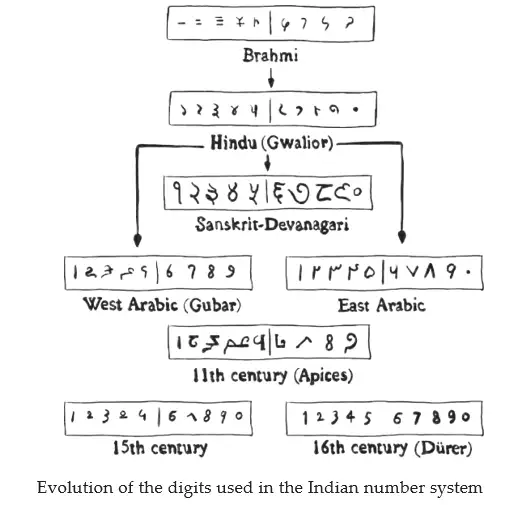
- Ten digits: The Indian system uses the digits through ; their written shapes evolved over time.
- Place and absolute value: A digit has an absolute value and a value determined by its position. This makes it possible to express numbers and calculate efficiently.
| Time | Development |
|---|---|
| Around 2,000 years ago | The ten-digit Indian system, including zero, developed in India. |
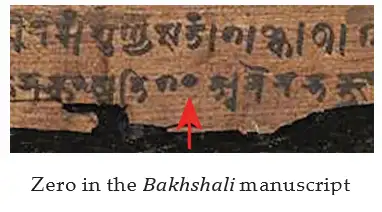
| Around the 3rd century CE | The Bakhshali manuscript gives the earliest known instance described here of numbers written using ten digits; zero was shown as a dot. |
| Around 499 CE | Aryabhata fully explained the Indian system of ten symbols and used it for elaborate scientific calculations. |
| Around 800 CE | The Indian number system had reached the Arab world. |
| Around 825 CE | Al-Khwārizmī’s *On the Calculation with Hindu Numerals* helped popularise the system. |
| Around 830 CE | Al-Kindi’s *On the Use of the Hindu Numerals* helped popularise the system. |
| Around 1100 CE | Hindu numerals had spread from the Arab world to Europe and parts of Africa. |
| Around 1200 CE | The Italian mathematician Fibonacci strongly advocated for Europe to adopt Indian numerals. |
| European Renaissance to the 17th century | Indian numerals became widely accepted in Europe; avoiding them increasingly hindered scientific progress. |
| Later | The system spread to every continent and is now used worldwide. |
How the Numerals Spread and Got Their Names
Spread of Indian numerals
- Originated and developed in India
- Transmitted to the Arab world by around 800 CE
- Spread from the Arab world to Europe and parts of Africa by around 1100 CE
- Eventually adopted worldwide
Names and European adoption
- “Arabic numerals”: Europeans used this name because they learned the numerals through the Arab world.
- “Hindu numerals”: Arab scholars, including Al-Khwārizmī and Al-Kindi, used this name to refer to their Indian origin.
- Other common names: “Indian numerals” and “Hindu-Arabic numerals” are also used.
- Meaning of Hindu: Here it refers to geography and people, not religion.
- Delayed adoption: Roman numerals were deeply ingrained in European thinking and writing, so Indian numerals did not become widely used there for several centuries.
- Importance: Ten symbols combining place value and absolute value made number-writing and calculation much more efficient.
What is the earliest known evidence described here for writing numbers with ten digits, including zero?
Why are the numerals commonly called “Hindu-Arabic” numerals?
Quick recap
- People counted food, animals, goods, offerings and days; different groups represented numbers in different ways.
- The modern ten-digit number system developed in India, using digits from to and place value.
- The Bakhshali manuscript, around the 3rd century CE, records zero as a dot; Aryabhata later explained and used the system.
- Indian numerals spread to the Arab world and then to Europe and parts of Africa before becoming global.
- European use was delayed because Roman numerals were deeply established; Fibonacci advocated adoption around 1200 CE.
- “Hindu-Arabic” reflects the numerals’ Indian origin and their transmission through the Arab world.
The Mechanism of Counting
Counting by One-to-One Matching
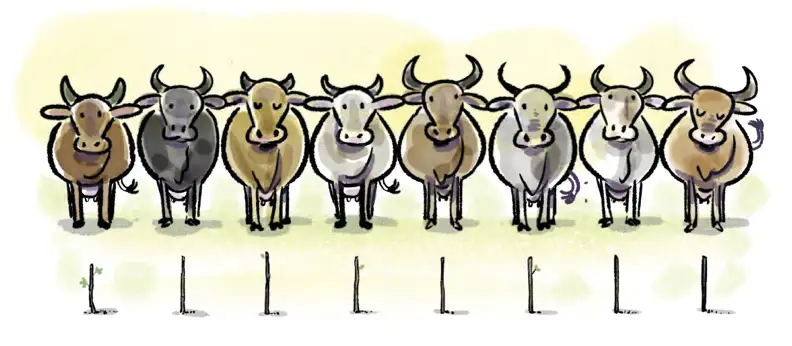
How can sticks help check that all cows have returned?
- Place one stick beside each cow in the herd.
- Check that every cow has a stick and every stick is matched to a cow.
- If no cow or stick is left unmatched, all the cows have returned.
Number Systems and Their Representations
Number system — A number system is a standard sequence of objects, names or written symbols in a fixed order, used to count collections through one-to-one matching.
| Method | Examples | Strength or limitation |
|---|---|---|
| Objects | One stick per object: |, ||, ||| | Can continue without end, but large collections need many sticks. |
| Names or sounds | English letters in order: 1 = a, 2 = b, 3 = c, …, 26 = z | Convenient for counting, but the alphabet alone represents only 26 positions. |
| Written symbols | Roman numerals: I, IV, V, IX, X | Used widely in Europe before the Hindu number system; representing arbitrarily large numbers requires more symbols. |
Extending a Sequence
- Letters: A limited alphabet can be extended by using strings of letters; for example, one possible system uses “aa” for the position after “z”.
- Written symbols: Roman numerals represent numbers such as 1 = I, 4 = IV, 5 = V, 9 = IX and 10 = X.
- Challenge: Since numbers have no end, a useful system should provide an unending sequence that remains easy to use.
Names, Numerals and Number Systems
Numeral — A numeral is a written symbol or group of symbols used to represent a number.
Key Points
- Examples: 0, 1, 5, 36 and 193 are numerals in the Hindu number system.
- Connected forms: Written numerals and spoken number names usually go together; smaller numbers have names as well as written symbols.
- Different representations: Number systems have used physical objects, names and written symbols; some groups used several forms, including the Chinese.
Two groups are matched cow by cow. The first group has cows left unmatched. Which group has more cows?
What limitation does the sequence of English letters from a to z have when used alone for counting?
Quick recap
- One-to-one matching pairs each object with a distinct item in an ordered sequence.
- Unmatched objects reveal which collection is larger or whether a count does not match.
- A number system is an ordered standard sequence of objects, names or written symbols.
- Sticks can form an unending sequence but are cumbersome for large collections; a single alphabet is limited.
- Roman numerals include I, IV, V, IX and X, but very large numbers need additional symbols.
- Numerals are written representations of numbers, such as 0, 1, 5, 36 and 193.
Some Early Number Systems
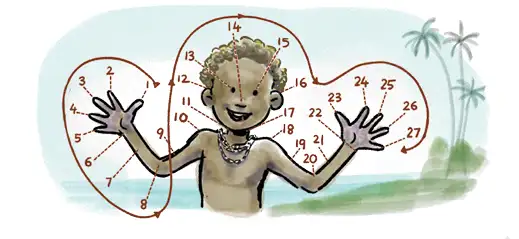
Counting with Body Parts
Body-part counting — A counting system that uses parts of the body as a fixed sequence for representing numbers.
- How it works: Each body part or position represents a number in an agreed order.
- Example: A group in Papua New Guinea used body parts and the hands as a sequence extending to .
Tally Marks
Tally marks — Notches or marks made on a surface to represent the objects being counted, one mark per object.
- Surfaces: Tallies could be cut into bones or walls; the method works like counting with sticks, but uses marks instead.
- Representation: The total number of marks equals the number of objects counted.
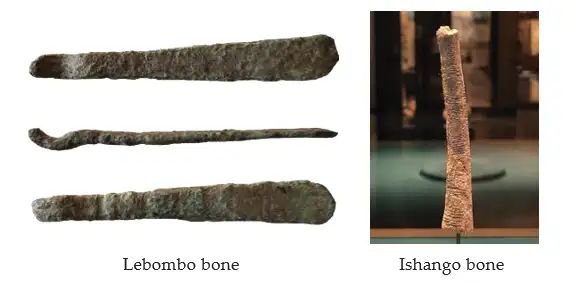
- Archaeological evidence: Marked bones found by archaeologists are more than years old and may be early counting records.
| Bone | Place and estimated age | Possible use or feature |
|---|---|---|
| Ishango bone | Democratic Republic of Congo; about – years old | Notches in columns; possibly linked to a calendrical system. |
| Lebombo bone | South Africa; about years old | Has 29 notches; may have been a tally stick or lunar calendar. |
Number Names Built by Counting in Twos
Grouped counting — A way of representing numbers by counting repeated groups of a chosen size and combining them with any remainder.
| Number | Name | How the name is formed |
|---|---|---|
| urapon | One | |
| ukasar | One group of two | |
| ukasar-urapon | Two plus one | |
| ukasar-ukasar | Two plus two | |
| ukasar-ukasar-urapon | Two plus two plus one | |
| ukasar-ukasar-ukasar | Two plus two plus two |
- Pattern: The Gumulgal formed number names by repeating the word for two, adding the word for one when needed.
- Limit: They used the word ras for any number greater than .
How is the number 5 named in the Gumulgal system?
- Write five as groups of two, then one leftover unit.
- Replace each two with ukasar and the leftover one with urapon.
For group size , a number can be represented by complete groups and a remainder , where . Common group sizes in number systems include , , , and .
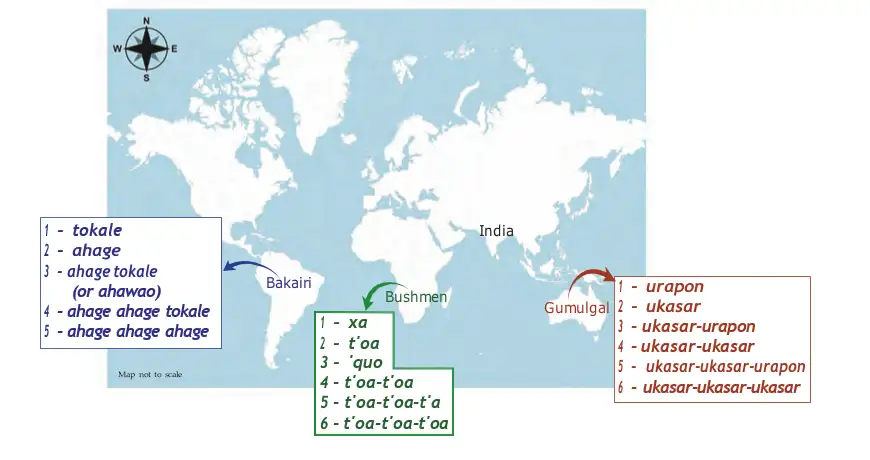
- Similar systems: The Bakairi, Bushmen, and Gumulgal had equivalent number systems despite living far apart, with no known contact between them.
- Possible explanation: One theory is that they inherited the system from common ancestors, whose descendants later migrated to different regions.
- Efficiency: Grouping numbers can represent collections more compactly than making one tally mark for every object.
- Perception: People often find it difficult to recognise a group of five or more objects at a glance, which may have encouraged grouping tallies into sets.
Replacing repeated tallies with a symbol for a fixed-size group makes counting more efficient, but a single group size can still be cumbersome for very large numbers.
- Examples of group sizes: People have used groups of , , , and ; the Roman system includes counting by fives.
- Limitation: If only groups of five are used, representing a large number requires many repeated group symbols; this motivates more refined number systems.
Represent a Number Using Groups
- Choose the fixed group size.
- Find how many complete groups fit into the number.
- Represent any leftover units as a remainder smaller than the group size.
- Use the system's group word or symbol for each complete group.
Express 6 using groups of two and give its Gumulgal name.
If a tally system replaces every group of five marks with one group symbol, how many group symbols represent 15 objects?
In a system that represents numbers only with groups of five, how could 1345 be represented? Why is this cumbersome?
Quick recap
- Body-part counting uses body positions as an ordered number sequence.
- Tally marks represent one object per mark; the Ishango and Lebombo bones are ancient examples.
- Gumulgal number names up to six are built by repeating units of two, with an extra one when needed.
- Grouped counting is more efficient than one tally per object; group sizes include 2, 5, 10, and 20.
- One group size alone becomes cumbersome for large numbers, encouraging more advanced systems.
The Roman Numerals
Roman Symbols and Number Construction.
Roman numeral system — A number system that represents values using letter symbols and groups of landmark values.
Each landmark value has a basic symbol; the symbols can be combined to represent other numbers.
| Symbol | Value |
|---|---|
When a numeral is formed by adding landmark values, its value is their sum.
Writing a number in Roman numerals
- For numbers up to , take as many tens as possible, then a five if possible, then the remaining ones.
- For larger numbers, split the number into landmark values from greatest to least.
- Replace each value with its symbol and write the symbols in order.
Write in Roman numerals.
- Split into tens, a five, and ones.
- Write the corresponding symbols in order.
Write in Roman numerals.
Write in Roman numerals.
Write in Roman numerals.
Development and spread
- Origins: The Roman system is thought to have evolved from the ancient Greek number system in Rome around the th century BCE.
- Spread: It spread through Europe as the Roman Empire expanded.
- Historical caution: Number systems did not necessarily develop as improvements on earlier systems; their histories are complex and not always clearly known.
Arithmetic with Roman Numerals
Roman numeral arithmetic — Arithmetic in the Roman system is cumbersome, particularly multiplication and division, because symbol values must be combined and regrouped.
To add Roman numerals, combine their symbol values and exchange groups for larger landmark values where possible.
Adding Roman numerals by regrouping
- Count the occurrences of each symbol in both numerals.
- Regroup the symbols into landmark values, starting with the largest.
- Write the resulting symbols in descending order.
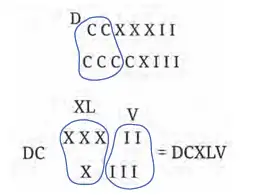
Add by regrouping Roman numeral symbols.
- Count the symbols in the two numerals.
- Regroup of the s as one ; write the remaining , , and as , , and .
- Write the resulting symbols in order.
Do not assume subtractive notation was used consistently: the lecture gives both and for .
Quick recap
- Roman landmark symbols are , , , , , , and .
- The system groups numbers using a sequence of landmark values, which contributes to its relative efficiency.
- For numbers up to , group into tens, then a five if possible, then ones; use descending landmark values for larger numbers.
- represents and represents , but was also sometimes written as .
- Roman arithmetic involves combining and regrouping symbols; calculations were also performed with an abacus.
- The system is thought to have developed in Rome around the th century BCE and spread through Europe.
The Idea of a Base
The Egyptian Number System
Egyptian number system — An ancient additive number system developed around BCE, using repeated symbols for landmark numbers that are powers of .
How the Egyptian system works
- Landmarks start at ; each next landmark is times the previous one: .
- Powers of ten give the landmark sequence: .
- Representation starts with the largest landmark not greater than the number, then uses smaller landmarks to express the remainder.
- Additive example: ; the corresponding symbols are repeated.

Base-n Systems
Base- number system — A number system whose first landmark is and where each next landmark is obtained by multiplying the previous one by the same positive integer .
The landmark numbers are the powers of , beginning with . The Egyptian system is base , also called decimal; the system built by grouping in fives is base .
Use the powers of the base as the available group sizes.
Using landmark symbols
- Symbols: assign a distinct symbol to each landmark and repeat it for each group used.
- Efficient grouping: in base , use at most groups of any one landmark before moving to a larger landmark.
- Representability: every whole number can be represented because the landmark can be repeated.
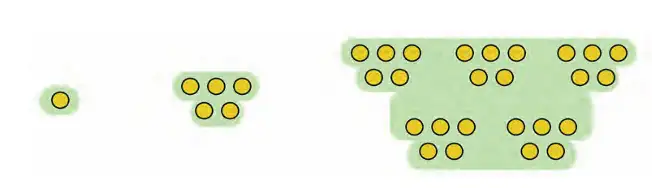
Convert a number using landmark groups
- List the landmark powers up to the largest one not exceeding the number.
- Starting with the largest landmark, take as many groups as possible without exceeding the number.
- Continue with smaller landmarks until the remainder is zero, then write the corresponding symbols.
Represent in the base- landmark-symbol system.
- Express in the base- landmark-symbol system, where the symbols for , , and are a circle, square, and triangle.
- The largest usable landmark is ; take one group.
- Use three groups of from the remainder.
- Use three groups of for the remaining amount.
- Combine the landmark groups.

Express using base- landmark groups.
Find the first four landmark numbers of a base- system.
Is there a whole number that cannot be represented using base- landmark groups? Explain.
Quick recap
- Egyptian numerals use additive groups of powers of .
- A base- system uses a fixed positive integer to generate its landmarks.
- The base- landmarks are .
- Base is the decimal system; grouping by creates a base- system.
- Build a representation by taking groups from the largest usable landmark downwards.
- Every whole number can be represented because the landmark is available.
Advantages of a Base-n System
Addition and Regrouping
In a base- system, units of one landmark make one unit of the next landmark. This consistent rule makes addition systematic.
Why Regrouping Is Consistent
- Landmarks: Each landmark is times the previous one.
- Addition: Combine like landmarks, then regroup every items as one item of the next landmark.
- Egyptian example: Its landmarks are powers of ; strokes make one ten-symbol, and ten-symbols make one hundred-symbol.
Use this whenever a landmark has at least units.
Add Numbers Using Landmarks
- Add the quantities at each matching landmark.
- Regroup every set of units as one unit of the next landmark.
- Continue until each landmark has fewer than units.
Add the Egyptian numerals representing and .
- Add the Egyptian numerals representing and ; this gives tens and strokes.
- Regroup strokes as one ten, leaving strokes and tens.
- Regroup tens as one hundred.
| Point | Base-n system | Roman system |
|---|---|---|
| Regrouping | A fixed group of units makes the next landmark. | Grouping and rearranging do not follow one fixed group size. |
| Arithmetic | Consistent regrouping supports systematic addition and multiplication. | Regrouping is more complicated, and multiplication is difficult. |
Multiplication and Landmark Numbers
The product of any two landmark numbers in a base- system is another landmark number.
Why Multiplication Is Easier
- Egyptian system: Its landmarks are powers of ; multiplying a landmark by gives the next landmark.
- General base: Multiplying two landmarks produces another landmark because each is a power of the base.
- Advantage: This structure simplifies multiplication compared with systems such as Roman numerals.
Use this to multiply landmark numbers in any base.
Multiplication distributes over addition, including when a number has more than two terms.
Multiply each term by the factor, then add the products.
Use the distributive property to find multiplied by .
- Write as a sum of landmark values.
- Multiply each term by and add.
Find using the decomposition .
In base , find .
- A base- system uses powers of as landmarks and regroups every units into the next landmark.
- Landmark products remain landmarks, and the distributive property helps multiply numbers written as sums.
- The Hindu number system is built on the base-system structure.
Quick recap
- Landmark numbers in a base- system are powers of .
- Every units of a landmark regroup as one unit of the next landmark.
- Base systems use a consistent grouping rule, unlike Roman numerals.
- The product of two landmark powers is another landmark power: .
- The distributive property is .
- The Hindu number system is based on the efficient structure of a base system.
Abacus that Makes Use of the Decimal System
Decimal Place-Value Abacus
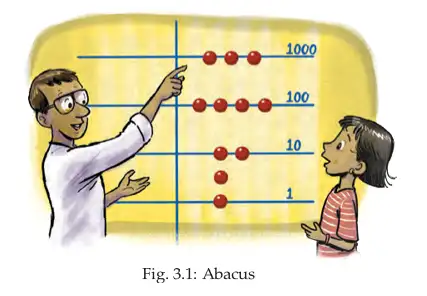
A number is the sum of its digits multiplied by their place values.
Representing a number
- Split the number into its place-value parts.
- Place the required counters on each matching line.
- For a digit of or more, use the five-value counter and add unit counters for any remainder.
How is represented on the abacus?
- Expand by place value.
- Set counters for each digit; show ones as a five-value counter and one unit counter.
Adding by Regrouping
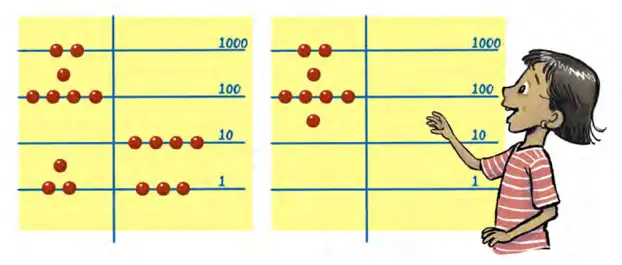
Whenever a place-value line totals counters, replace them with counter on the next higher line. For example, ones become ten.
Adding on the abacus
- Represent the numbers with matching place-value lines.
- Combine the counters, starting with the ones line.
- Regroup every counters as counter on the next line.
- Read the final counters as the sum.
Find using place-value regrouping.
- Add the ones; regroup ones as ten.
- Combine the tens, including the carried ten.
- The hundreds and thousands remain unchanged.
Represent using place-value counters.
Add using regrouping.
Do not leave counters on one line: regroup them as counter on the next higher place-value line.
Quick recap
- Each abacus line represents a power of .
- Counters record the number of units of each place value.
- A five-value counter represents units on its line.
- Add by combining counters in matching place-value lines.
- Regroup counters as counter in the next higher place.
Shortcomings of the Egyptian System
The Main Shortcoming
Limitation of the Egyptian system — The Egyptian system needed a new symbol for every higher power of , so representing ever-larger numbers required an unending supply of symbols.
Key points
- Strength: It represented numbers up to a crore, or , and allowed relatively easy computations.
- Limitation: Larger numbers required symbols for higher powers of that were not yet available.
- Regrouping: A group of symbols for one power of can be replaced by one symbol for the next power.
Ten symbols representing the same power of can be regrouped as one symbol representing the next power of .
Do not claim that an Egyptian symbol can occur or more times in a standard representation: regrouping those symbols gives the next higher-power symbol.
Representing Numbers in Other Bases
Base- place-value system — A base- system uses the digits from to , and each place represents a power of .
A base- numeral is the sum of each digit multiplied by the power of matching its place.
Use digits ; the places from right to left are units, fours, sixteens, and so on.
| Decimal | Base 4 | Decimal | Base 4 |
|---|---|---|---|
Convert a decimal number to base 4
- Divide the decimal number by and record the remainder.
- Keep dividing each quotient by until the quotient is .
- Read the remainders from last to first to write the base-4 numeral.
Write in base .
- Convert decimal to base by successive division.
- Divide the quotient by and record the next remainder.
- Read the remainders upwards: then .
Since , multiplying a base-5 numeral by shifts every digit one place left; append a zero.
Can a symbol occur or more times in a standard Egyptian numeral? Explain.
Write decimal in base .
Multiply by .
Quick recap
- The Egyptian system represented numbers effectively up to , but larger powers needed new symbols.
- Ten symbols for regroup as one symbol for .
- A base- numeral uses digits through and place values that are powers of .
- Base uses digits ; for example, .
- In base , multiplying by means appending a zero to the numeral.
Place Value Representation
The Mesopotamian Number System
Sexagesimal system — A positional number system with base , in which successive place values are powers of .
Key Features
- Development: Early Mesopotamian numerals used distinct symbols for landmark numbers; later, the system developed into the base- Babylonian system.
- Symbols: A forked vertical wedge stood for and an angled, less-than-shaped wedge for ; combinations represented numbers from to .
- Possible reasons for base : Suggested explanations include ease of representing fractions, links to cycles such as a -day lunar month, and earlier landmark numbers .
- Legacy: The base- system survives in time units: hour minutes and minute seconds.
Building a Place-Value System
Positional number system — A number system in which a symbol's position determines the place value it represents.
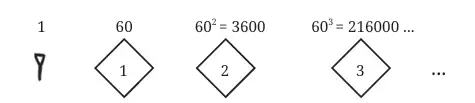
Each place has a coefficient from to ; units of a place regroup as unit of the next place.
Use this to express a number as a sum of place-value groups.
Convert a Number into Base- Place Groups
- Divide by ; the remainder gives the units-place coefficient.
- Divide the quotient repeatedly by to find the higher-place coefficients.
- Write the coefficients from the highest place to the units place, retaining for an empty place.
Represent and in Mesopotamian base- place groups.
- For , group the number into s and units.
- For , split it into groups of , , and .
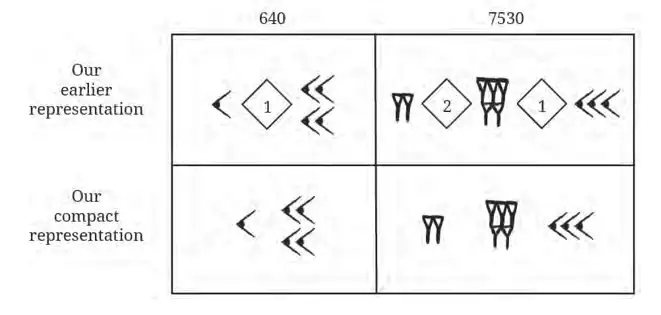
Regrouping and Compact Writing
- Regrouping: A coefficient of or more must be carried to the next place.
- Example: .
- Compact notation: Mesopotamians omitted separate symbols for powers of ; the rightmost group counted units, the next counted s, then s, and so on.
- Possible origin: Some scholars suggest the similar earlier symbols for and may have helped lead to positional writing.
Zero as a Placeholder and Remaining Ambiguities
Why a Placeholder Was Needed
- Ambiguity: Without clear, consistent spacing, the same wedge groups could be assigned to different powers of ; blank places were especially hard to identify.
- Placeholder: Later Mesopotamians used a symbol to mark an empty place, functioning like as a placeholder in modern notation.
- Importance: Marking an empty place clarifies the positions of the other groups.
- Limitation: The placeholder was mainly used within numerals, not at the end, so it was not used to write as we do.
Do not let a place coefficient reach : regroup it into the next place. Also, do not assume blank spaces in historical Mesopotamian numerals always made the place values clear.
Write as base- place groups.
Write as base- place groups.
Write as base- place groups.
Quick recap
- The later Mesopotamian system used base and is called sexagesimal.
- Its place values from right to left are .
- Each place coefficient is less than ; every units regroup as one unit in the next place.
- Place value lets a finite set of symbols represent an unending sequence of numbers.
- A placeholder marks an empty place and helps make positional notation unambiguous.
- Mesopotamian notation retained ambiguities, including limited use of its placeholder at the end of numerals.
The Mayan Number System
The Mayan number system
The first places are , , and ; the third place is , not . Some scholars suggest this may be connected with Mayan calendars.
Represent a number in Mayan numerals
- Break the number into its Mayan place values, starting with s, then s and units.
- Write each place value as a vertical group, using dots, bars, or the seashell zero.
- Stack the groups with units at the bottom; retain zero groups when a place is empty.
Represent using Mayan numerals.
- Split into twenties and units.
- Show as three dots in the twenties place; show as three bars and two dots in the units place.
Do not use as the Mayan third place: it is , so the places begin .
Chinese rod numerals
Rod numeral orientation alternates between adjacent place values: units are zongs, tens hengs, hundreds zongs, thousands hengs, and so on.
Read a Chinese rod numeral
- Identify the place value and corresponding rod orientation of each digit.
- Record a blank space as a skipped place with digit zero.
- Add the place values to obtain the number.
What number is represented by the rod numeral with groups heng, zong, heng, and zong?
- Read the four groups as heng, zong, heng, and zong.
- Match the groups to thousands, hundreds, tens, and units.
- Add the place values.
Represent using Mayan numerals.
A Chinese rod numeral has heng in the thousands place, a blank hundreds place, heng in the tens place, and zong in the units place. What number does it represent?
Quick recap
- Mayan dots mean , bars mean , and a seashell symbol is a placeholder for zero.
- Mayan numerals are stacked vertically; their places begin .
- Mayan third place is , not , so the system is not a regular base- system.
- Chinese rod numerals are decimal and alternate heng and zong forms by place value.
- Chinese rod numerals use blank spaces for skipped places and have no zero symbol.
- Rod numerals developed by at least the 3rd century AD and remained in use until the 17th century.
The Hindu Number System
How Number Representation Evolved
- Number systems: Across history, people used objects, names, and written symbols to count and represent quantities.
- Key developments: Grouping numbers and using bases made representations more efficient; place value further allowed numbers to be written with a limited set of symbols.
Place Value and the Hindu Number System
A numeral is the sum of each digit multiplied by the power of for its position.
Write as a sum of its place values.
- Expand by the place value of each digit.
- Evaluate each place value and add.
Zero: A Digit and a Number
Brahmagupta’s use of zero together with negative numbers gives the integers, a set closed under addition, subtraction and multiplication: operating on any two integers using these operations produces another integer.
Why the System Matters
Write the base- numeral in expanded form. What does the zero indicate?
State what happens when is added to a number and when is multiplied by a number.
Quick recap
- The Hindu number system is a base- place-value system using digits through .
- A digit’s position gives its value as a power of .
- Zero is both a positional placeholder and a number with arithmetic properties.
- A symbol for zero existed in India at least as early as BCE.
- Aryabhata used zero in calculations in CE; Brahmagupta codified arithmetic with it in CE.
- Integers are closed under addition, subtraction and multiplication.
Summary
Number Systems and Numerals
Numeral — A written symbol or group of symbols used to represent a number.
Key distinction
- Number is the quantity; a numeral is the written representation of that quantity.
- Example: The numeral represents the number seven.
Identify the number and numeral
- Identify the quantity being described.
- Identify the written symbol or group of symbols representing it.
In , identify the number and the numeral.
- In the written numeral , the quantity represented is forty-two.
- So, forty-two is the number and is its numeral.
Landmark Numbers, Bases and Place Value
Base- number system — A number system whose landmark numbers are the powers of .
Positional number system — A system in which a symbol's position determines the landmark number associated with it.
Key points
- Reference role: Landmark numbers act as anchors that help people orient themselves and understand quantities.
- Place-value systems: These use a symbol's position to determine the landmark number associated with it.
- Historical examples: Place-value representations were used in Mesopotamian (Babylonian), Mayan, Chinese and Indian civilisations.
The Hindu Number System
Key features
- Digits: It uses ten digits, including , which is treated on par with the other digits.
- Zero: Using as a number helps represent all numbers unambiguously with a finite set of symbols.
- Computation: The system enables efficient computation.
- Origin and spread: It originated in India around 2,000 years ago and later spread across the world; it is considered one of human history's greatest inventions.
What is a base- number system?
Why is the Hindu number system useful?
Name two civilisations, other than the Indian civilisation, that used place-value representations.
What role does play in the Hindu number system?
Quick recap
- A number system is a standard fixed-order way to represent numbers; written representations are numerals.
- Landmark numbers are recognisable reference points for understanding quantities.
- A base- system uses powers of as landmark numbers.
- In a positional system, a symbol's position determines its associated landmark number.
- Place-value representations were used in Babylonian, Mayan, Chinese and Indian civilisations.
- The Hindu number system uses ten digits, including , and supports unambiguous representation and efficient computation.
Formula sheet
Mathematics — ALL CHAPTERS
1
A Square And A Cube
2
Power Play
3
A Story of Numbers
4
Quadrilaterals
5
Number Play
6
We Distribute, Yet Things Multiply
7
Proportional Reasoning-1
1
Fractions in Disguise
2
The Baudhayana-Pythagoras Theorem
3
Proportional Reasoning-2
4
Exploring Some Geometric Themes
5
Tales by Dots and Lines
6
Algebra Play
7
Area