Class 8 . Mathematics . Ganita Prakash Part I . Proportional Reasoning 1
Chapter 7: Proportional Reasoning-1
Ch 7
Mathematics
Class 8
Observing Similarity in Change
Proportional Change and Similar Images
Proportional change — Two quantities change proportionally when both are multiplied by the same factor.
Image dimensions
- Similar appearance: An image keeps its shape when its width and height are both multiplied by the same factor.
- Different appearance: If width and height change by different factors, the image becomes distorted.
- Important: Equal differences do not guarantee similarity; compare multiplication factors instead.
| Image | Width (mm) | Height (mm) |
|---|---|---|
| A | 60 | 40 |
| B | 40 | 20 |
| C | 30 | 20 |
| D | 90 | 60 |
| E | 60 | 60 |
An image preserves its shape if the width and height are multiplied by the same scale factor. Images A, C, and D are similar: compared with A, C uses factor for both dimensions, and D uses factor for both.
Why B and E look different
- Image B: Relative to A, its width factor is , while its height factor is ; the factors differ.
- Image E: Relative to A, its width factor is , while its height factor is ; the factors differ.
- Conclusion: B and E are distorted because their dimensions have not changed proportionally.
Compare each new dimension with its original dimension. Equal ratios mean the dimensions changed by the same factor.
Test whether two images are similar
- Find the width scale factor by dividing the new width by the original width.
- Find the height scale factor by dividing the new height by the original height.
- Compare the factors; if equal, the dimensions changed proportionally and the shape is preserved.
Does image D preserve the shape of image A?
- Compare image D with image A using their widths and heights.
- Calculate the width and height scale factors.
- The factors are equal, so both dimensions changed proportionally.
Do not conclude that two images are similar just because width and height have the same numerical difference. Check whether their scale factors are equal.
Image P is mm wide and mm high. Image Q is mm wide and mm high. Are they similar?
An image is cm wide and cm high. It is enlarged to cm wide. What height preserves its shape?
Image R is mm wide and mm high. Image S is mm wide and mm high. Is S a proportional change of R?
Quick recap
- Proportional change means multiplying related dimensions by the same factor.
- Similar images preserve shape even when their sizes differ.
- Compare new-to-original width and height ratios to test similarity.
- Equal scale factors mean proportional change; unequal factors mean distortion.
- Equal amounts added or subtracted do not necessarily preserve shape.
Ratios
Understanding Ratios
Terms of a ratio — The numbers being compared in a ratio are called its terms; in , the terms are and .
Example: Width-to-height ratios
- Image A: Width-to-height ratio is ; this means mm of width for every mm of height.
- Image C: Its ratio is .
- Image D: Its ratio is .
Proportional Ratios
Ratios are proportional if both terms of one ratio are multiplied or divided by the same non-zero factor to get the other ratio. Their simplest forms are then equal.
Divide both terms by their greatest common factor.
Check whether two ratios are proportional
- Reduce each ratio to its simplest form by dividing both terms by their greatest common factor.
- Compare the simplest forms; if they match, the ratios are proportional.
Are and proportional? What factor changes the first ratio into the second?
- Check whether and are proportional by simplifying them.
- Simplify the first ratio by dividing both terms by .
- Simplify the second ratio by dividing both terms by .
- The simplest forms match, so the ratios are proportional. The factor from to is .
Do not change only one term when scaling a ratio; multiply or divide both terms by the same non-zero factor.
By what factor should be multiplied to get ?
Are and proportional?
Quick recap
- A ratio compares two quantities in a stated order.
- The numbers in a ratio are its terms.
- Proportional ratios are made by scaling both terms by the same non-zero factor.
- To test proportionality, reduce each ratio to simplest form and compare.
- For width-to-height ratios, , , and are equivalent.
Ratios in their Simplest Form
Simplifying Ratios
Ratio in simplest form — A ratio is in its simplest form when its terms have no common factor other than .
Divide both terms of a ratio by their highest common factor (HCF) to obtain its simplest form.
Examples from the lecture
- Image A: The HCF of and is , so .
- Image D: The HCF of and is , so .
- Image B: ; this is not the same as .
- Image E: ; this is also not the same as .
Here, is the HCF of and .
Reduce a ratio to simplest form
- Find the HCF of the two terms.
- Divide both terms by that HCF.
- Write the resulting ratio; its terms now have no common factor other than .
Write in its simplest form.
- Find the HCF of the terms in .
- Divide both terms by .
Proportional Ratios
Proportional ratios — Two ratios are proportional when they are equal, or equivalently, when they have the same simplest form.
The symbol indicates that two ratios are proportional.
Recognising proportions
- Same simplest form: and both simplify to , so .
- Same simplest form: and both simplify to , so .
- Different simplest forms: Ratios such as and are not proportional.
Reduce to simplest form.
Are and proportional?
Quick recap
- Simplify a ratio by dividing both terms by their HCF.
- A ratio is in simplest form when its terms have no common factor other than .
- Ratios with the same simplest form are proportional.
- Use to show that two ratios are proportional.
- and because each ratio simplifies to .
Problem Solving with Proportional Reasoning Part-1
Recognising Proportional Ratios
Proportional ratios — Two ratios are proportional (equivalent) when they represent the same comparison; their simplest forms are equal.
Multiplying or dividing both terms of a ratio by the same non-zero factor preserves the ratio. Ratios and are proportional when .
Use to scale a ratio or test whether two ratios are proportional.
Test whether two ratios are proportional
- Reduce each ratio to simplest form by dividing both terms by their HCF.
- Compare the simplified ratios; matching ratios are proportional.
Are the ratios and proportional?
- The first ratio is already in simplest form.
- Divide both terms of the second ratio by their HCF, .
- The simplified ratios match, so they are proportional.
Using ratios to compare situations
- Compound wall: Nitin’s length-to-cement ratio is ; Hari’s is . Their ratios are proportional, so both used the same amount of cement per foot.
- Teacher–student ratio: . Another school has the same proportional ratio only if its simplified ratio is also .
- Rectangles: If two rectangles have proportional width-to-height ratios, they have the same shape, though their sizes can differ.
Scaling Ratios and Finding Missing Terms
Scaling a ratio — A ratio remains proportional when both terms are multiplied or divided by the same factor.
If one term changes by a factor, the other term must change by that same factor. The factor may be a fraction, not only an integer.
For an equivalent ratio, apply the same multiplier to both terms.
Find a missing term in an equivalent ratio
- Match the known term with its corresponding term in the original ratio.
- Find the scale factor using the known terms.
- Apply the same factor to the other term.
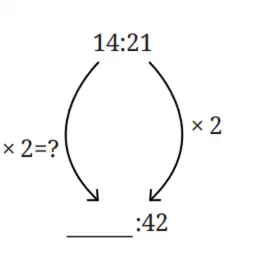
Fill in the missing terms so each ratio is proportional to : , , and .
- To obtain from , multiply by ; multiply the first term by as well.
- To change to , use the factor and apply it to .
- To change to , divide both terms by their HCF, .
Same proportion in a recipe
- Lemonade: The recipe uses spoons of sugar for glasses. Scaling the glasses from to multiplies by , so sugar also scales by : spoons.
- Wording check: The source’s calculation treats as the target number of glasses. If “ more glasses” is read literally, the total is glasses and the sugar needed is spoons.
Adding the Same Amount Does Not Preserve a Ratio
Changing both terms by addition — Adding or subtracting the same number from both terms usually changes the ratio; this is not the same as scaling both terms by one factor.
When two people’s ages increase by the same number of years, their age ratio generally changes because the same amount is added, not a common factor multiplied.
Add the same elapsed time to both ages, then simplify the new ratio.
Neelima is years old and her mother is ten times her age. What is their age ratio then and when Neelima is ?
- When Neelima is , her mother is ten times her age.
- Nine years later, Neelima is and her mother is .
- The simplified ratios differ, so their age ratio has changed.
Comparing Proportions in Mixtures
Mixture strength — Compare the coffee-to-milk ratio with the regular mixture to determine whether coffee is stronger, regular, or lighter.
A higher coffee-to-milk ratio means stronger coffee; a lower ratio means lighter coffee. An equal ratio has the same proportion as the regular mixture.
Manjunath’s regular coffee-to-milk ratio is . Compare each mixture with this ratio.
Classify a mixture
- Write and simplify the mixture’s coffee-to-milk ratio.
- Compare its coffee proportion with the regular proportion.
- A greater, equal, or smaller proportion means stronger, regular, or lighter coffee respectively.
Compare the regular coffee ratio with the mixtures and . Which is stronger or lighter?
- For the stronger sample, simplify and compare its ratio with regular coffee.
- For the lighter sample, simplify and compare its ratio with regular coffee.

| Coffee decoction (mL) | Milk (mL) | Classification |
|---|---|---|
| Stronger: | ||
| Lighter: | ||
| Stronger: | ||
| Regular: | ||
| Lighter: |
A wall ft long uses bags of cement. Another wall is ft long and uses bags. Are the length-to-cement ratios proportional?
A drink uses scoops of syrup for cups of water. How many scoops are needed for cups of water to keep the same proportion?
The regular coffee mixture has ratio . Is a mixture with ratio stronger, lighter, or regular?
Quick recap
- Proportional ratios simplify to the same ratio and can be formed by scaling both terms equally.
- To find a missing term, calculate the scale factor from the known terms and apply it to the other term.
- For the same sweetness or mixture proportion, both quantities must change by a common factor.
- Adding the same amount to both terms generally changes the ratio, so age ratios change over time.
- Compare coffee-to-milk ratios: a larger ratio is stronger, an equal ratio is regular, and a smaller ratio is lighter.
Problem Solving with Proportional Reasoning Part-2
Proportions and Equivalent Ratios
For non-zero denominators, exactly when the cross-products are equal: .
Multiply or divide both terms by the same non-zero number to obtain an equivalent ratio.
Finding a Missing Term
- Write the two ratios as equal fractions.
- Use cross-products and solve for the unknown.
Complete so it is proportional to .
- Find the missing term so the ratio is proportional to the given ratio.
- Simplify the given ratio.
- Scale both terms by the same factor.
Proportional Shapes and Drawings
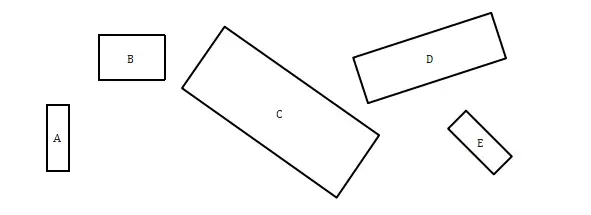
If both dimensions are multiplied by the same scale factor, the width-to-height ratio stays unchanged.
Checking Whether Rectangles Are Similar
- Measure each rectangle’s width and height.
- Write each width-to-height ratio in the same order.
- The rectangles are similar if the ratios are equal.
How can a rectangle be enlarged without changing its proportions?
- Let a rectangle have width and height as shown; enlarge both dimensions by the same factor.
- Multiply each dimension by the scale factor.
- Check that the ratio is unchanged.
Changing only one dimension distorts a shape. To preserve its proportions, scale every corresponding length by the same factor.
Ratios in Patterns and Human Figures
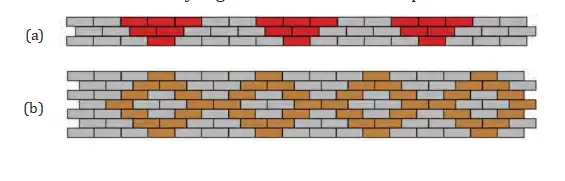
Writing and Simplifying a Part-to-Part Ratio
- Count or measure the two parts in the order asked.
- Divide both terms by their greatest common factor.
How do you find the simplest grey-to-coloured brick ratio?
- Represent the counts of grey and coloured bricks in one repeating section.
- Let the greatest common factor of the counts be d.
- Divide both counts by the same factor to write the simplest ratio.
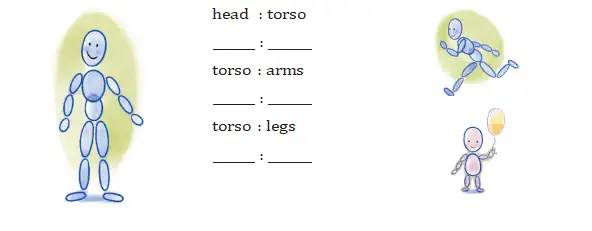
Give three ratios proportional to .
Complete the ratios proportional to : , , , and .
If classmates draw different-sized rectangles with the same width-to-height ratio, are their drawings necessarily wrong?
Quick recap
- Two ratios form a proportion when they are equal; cross-products can test this.
- Equivalent ratios are made by multiplying or dividing both terms by the same non-zero number.
- Find a missing term by equating the ratios and using cross-products or a common scale factor.
- Similar rectangles have equal width-to-height ratios.
- Scale all corresponding lengths by the same factor to preserve a shape’s proportions.
- For patterns and body parts, keep the order of quantities consistent and simplify ratios when possible.
Trairasika - The Rule of Three Part-1
Proportional Scaling
Proportional quantities — Two quantities are proportional when multiplying one by a factor multiplies the other by the same factor.
- Same factor: If the first quantity changes by a factor of , the corresponding quantity must also change by .
- Four-term proportion: means the ratio equals the ratio .
- Direction matters: Keep corresponding quantities in the same order in both ratios.
If the first quantity changes from to and the corresponding quantity from to , use the same factor for both.
Find a proportional quantity
- Find the factor by which the known quantity changes.
- Multiply the corresponding original quantity by the same factor.
A cook prepares kg of rice for students. How much rice is needed for students?
- Find the change factor from the original number of students to the new number.
- Apply the same factor to the original rice quantity.
The Rule of Three and Cross Multiplication
Rule of Three — A method for finding a fourth quantity when three quantities form a proportion.
- Proportion: In , the fourth quantity is found by cross multiplying.
- Cross products: A proportion is true when the products of opposite terms are equal.
- Rule: Multiply the phala by the ichchhā, then divide by the pramāṇa to find the ichchhāphala.
- Historical terms: Āryabhaṭa (199 CE) used pramāṇa (measure), phala (fruit), ichchhā (requisition), and ichchhāphala (yield).
If , then . Therefore, the unknown fourth term is , provided .
For pramāṇa : phala :: ichchhā : ichchhāphala, let the four corresponding quantities be , , , and .
Solve a Rule of Three problem
- Write the two ratios in the same order and use matching units.
- Cross multiply the terms.
- Divide by the coefficient of the unknown.
A car travels km in minutes. At the same speed, how far does it travel in hours?
- Convert the time to minutes so both time quantities use the same unit.
- Set up the proportion and cross multiply.
- Solve for the distance.
Do not compare quantities with different units in a proportion. Convert them first; for example, change hours to minutes before comparing times.
Compare Ratios and Prices
Equivalent ratios — Two ratios are proportional when they have the same value, or when their cross products are equal.
- Compare fairly: Express corresponding quantities in the same units before comparing ratios.
- Compare prices: To decide which product is more expensive, compare prices for the same weight or quantity.
- Unit price: Find the price for one unit of weight, then compare the results.
Let be the price and the weight. Use a common unit of weight when comparing prices.
A g tea packet costs Rs. in Himachal Pradesh; a kg packet costs Rs. in Meghalaya. Are the weight-to-price ratios proportional, and which tea is more expensive?
- Convert the Meghalaya packet weight to grams and compare the weight-to-price ratios.
- Find each tea's price for one kilogram.
- Compare prices for the same weight.
If notebooks cost Rs. , what is the cost of notebooks at the same rate?
A cyclist travels km in hours. At the same speed, how far will the cyclist travel in hours?
A g product costs Rs. , while a kg product costs Rs. . Which is more expensive per kilogram?
Quick recap
- In proportional quantities, both quantities change by the same factor.
- For , cross multiplication gives .
- The Rule of Three finds the unknown fourth quantity from three known quantities.
- Convert units before forming or comparing ratios.
- Compare prices fairly by calculating the cost for the same weight or quantity.
- Āryabhaṭa's Rule of Three uses pramāṇa, phala, ichchhā, and ichchhāphala.
Trairasika - The Rule of Three Part-2
Direct Proportion and the Rule of Three
Direct proportion — Two quantities are directly proportional when multiplying one by a factor multiplies the other by the same factor.
For directly proportional quantities, the ratio of corresponding values remains constant.
Use when the quantities are directly proportional and three corresponding values are known.
Solve a Direct-Proportion Problem
- Identify the quantities and check that they change in the same ratio.
- Write corresponding values in the same order.
- Solve for the unknown using the Rule of Three.
Direct-Proportion Applications
- Travel distance: At constant speed, distance travelled is directly proportional to time.
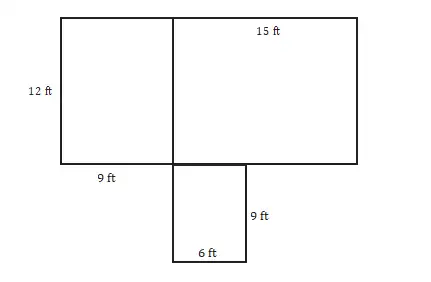
- Wall construction: If wall height and thickness are the same, brick count is proportional to the total length of all walls, including inner partitions.
- Example: A -ft wall needs bricks; a -ft wall of the same height and thickness needs bricks.
How far does Earth travel around the Sun in one week?
- Earth travels about million km in year. Assume weeks in a year.
- The distance is directly proportional to time, so divide the yearly distance by .
Inverse Proportion: Speed and Travel Time
Inverse proportion — Two quantities are inversely proportional when one increases as the other decreases, while their product remains constant.
For a fixed journey, speed and travel time are inversely proportional: increasing speed reduces the time.
Use this relation when the journey distance is unchanged.
Find Time at a New Speed
- Find the fixed distance using the original speed and time.
- Divide the distance by the new speed to find the new time.
- Check that a higher speed gives a shorter travel time.
If a 2-hour journey at 50 km/h is made at 75 km/h instead, how long will it take?
- At km/h for hours, the journey distance is km.
- At km/h, divide the same distance by the new speed.
Do not set up as a direct proportion: speed increases while travel time decreases. Use the fixed-distance relationship instead.
Checking Whether Price Is Proportional to Quantity
Proportional price — Price is proportional to quantity when the price per unit is the same for every size.
Equal unit prices mean price and quantity are proportional.
Test Price Proportionality
- Calculate the price per unit for each quantity.
- Compare the unit prices; equal values indicate proportionality.
| Container | Volume | Price |
|---|---|---|
| Sachet | mL | Rs. |
| Small bottle | mL | Rs. |
| Medium bottle | mL | Rs. |
| Large bottle | mL | Rs. |
Are shampoo volume and price proportional for the sachet and small bottle?
- Compare the sachet and small-bottle volume ratios and price ratios.
- The ratios differ, so price is not proportional to volume for these sizes.
Choosing Product Sizes
- Unit price: A larger container is not automatically cheaper per unit; compare prices per measure.
- Packaging: Larger containers may reduce packaging used per amount of product; smaller sizes may be easier to carry and store.
- Recommendation: Customers can compare unit prices and choose a size they can use; companies can reduce unnecessary packaging to lower ecological impact.
- Other products: Apply the same test to different measures of products such as rice or flour.
A house has outer walls and an inner partition. A 10-ft wall needs approximately 1,450 bricks. How many bricks are needed for all the walls shown in the plan?
For a fixed journey, a vehicle travels at 60 km/h for 3 hours. How long will it take at 90 km/h?
Is price proportional to quantity if 500 g costs Rs. 40 and 1 kg costs Rs. 75?
Quick recap
- In direct proportion, corresponding ratios remain constant; the Rule of Three finds an unknown value.
- At constant speed, distance and time are directly proportional.
- For a fixed journey, speed and time are inversely proportional: .
- Prices are proportional to quantities only when the unit price stays constant.
- For the house problem, include the inner partition when adding the total wall length.
Sharing, but Not Equally!
Dividing a Quantity in a Given Ratio
Key idea
- Equal sharing: Dividing 12 counters equally gives .
- Unequal sharing: If one person gets 5 of 12 counters, the other gets 7; their ratio is .
- Group count: In a share of , the two parts contain and equal-sized groups, so the total is groups.
- Example: Sharing 12 counters in the ratio gives 3 groups and 1 group, or 9 counters and 3 counters.
- Example: Sharing 42 counters in the ratio gives 7 groups of 6, or 24 counters and 18 counters.
- Rice and dal: A 6-cup mixture in the ratio contains 4 cups of rice and 2 cups of urad dal.
Use this when the whole quantity is and the required ratio is .
Divide a quantity in a given ratio
- Add the ratio terms to find the total number of groups.
- Divide the total quantity by the number of groups to find the size of one group.
- Multiply the group size by each ratio term to find the parts.
What is each person’s share of the profit?
- Prashanti and Bhuvan invested Rs. 75,000 and Rs. 25,000; they share a Rs. 4,000 profit in the investment ratio.
- Simplify the investment ratio.
- There are 4 equal profit groups, so each group is worth Rs. 1,000.
- Calculate each share.
Do not divide the total by just one ratio term. Divide by the sum of the terms, then multiply by each term.
Changing the Ratio in a Mixture
Key idea
- Find the starting amounts: Use the original ratio and total quantity to calculate each ingredient.
- Track what changes: If only one ingredient is added, the other ingredient’s quantity remains unchanged.
- Use the target ratio: Match the unchanged ingredient to its target ratio term, then calculate the required amount of the added ingredient.
If the target ratio is and the amount matching is known, use this to find the amount matching .
Adjust a mixture to a new ratio
- Find the original quantity of each ingredient using the starting ratio.
- Keep unchanged the quantity of any ingredient that is not added or removed.
- Use the target ratio to calculate the required quantity of the other ingredient.
- Subtract the amount already present to find how much must be added.
How much cement should be added to make the ratio of sand to cement 5:2?
- A 40 kg sand-cement mixture has sand and cement in the ratio 3:1. Find its starting amounts.
- Sand remains at 30 kg. For a sand-to-cement ratio of 5:2, calculate the required cement.
- Subtract the cement already present.
Divide Rs. 4,500 in the ratio 2:3.
A 240 mL solution has acid and water in the ratio 1:5. How much of each does it contain?
A bucket of orange paint is made from red and yellow paint in the ratio 3:5. Add another bucket of yellow paint of equal capacity. What is the new red-to-yellow ratio?
Quick recap
- To split a total in a ratio, divide by the sum of the ratio terms to find one group.
- Multiply the group size by each ratio term to find each share.
- A share of 12 gives 9 and 3; a share of 42 gives 24 and 18.
- Investment profits can be shared in the same ratio as the investments.
- When adjusting a mixture, first find its starting ingredient quantities.
- If one ingredient is added, keep the other amount fixed and use the target ratio to calculate the new amount.
Unit Conversions
Common Unit Conversions
Unit conversion — Changing a measurement from one unit to another without changing the quantity being measured.
Multiply the given measurement by the factor that converts its original unit into the required unit. For areas, convert using square units; for example, .
| Quantity | Conversion |
|---|---|
| Length | |
| Area | |
| Land area | |
| Land area | |
| Volume | |
| Volume |
If is the given measurement, is the conversion factor, and is the converted measurement, use this formula. Choose the factor so the original unit changes to the required unit.
Converting Units
- Identify the starting unit and the required unit.
- Choose the conversion factor relating those units.
- Multiply and check that the result has the required unit.
How much manure should the farmer buy?
- A plot is . Find the manure needed if the rate is tonnes per acre.
- Convert the plot area to acres.
- Multiply the area in acres by the manure rate.
Temperature Conversion
Temperature conversion — Converting a temperature between the Celsius and Fahrenheit scales using a fixed offset and scale factor.
The freezing point of water is , which equals .
Use the first formula to convert Celsius to Fahrenheit and the second to convert Fahrenheit to Celsius.
Converting Temperature
- Identify the given temperature scale and the target scale.
- Substitute the value into the matching conversion formula.
- Calculate the result and include the target scale.
What is in Fahrenheit?
- Convert to Fahrenheit.
- Evaluate the expression.
Do not omit the when converting Celsius to Fahrenheit: the correct formula is , not .
A bucket holds . If a tap fills a mug in seconds, how long will it take to fill the bucket?
Convert hectares to acres.
If one acre costs Rs. , what is the cost of at the same rate?
Quick recap
- Choose a conversion factor that changes the unit but preserves the measured quantity.
- and .
- and .
- For Celsius to Fahrenheit, use .
- For Fahrenheit to Celsius, use .
- Always check that the final unit matches what the question asks for.
Summmary
Ratios
Ratio — A ratio compares two quantities; for every units of the first quantity, there are units of the second.
In , and are the terms of the ratio; is the first term and is the second term.
Use this notation to compare the first quantity with the second.
Read a ratio
- Identify the first and second quantities in order.
- Read the ratio as the number of units of the first quantity compared with the second.
What is the ratio of juice to water?
- A mixture has cups of juice for every cups of water. Write the ratio of juice to water.
- The first term represents juice and the second term represents water.
Proportions
Proportion — Two ratios are proportional when their corresponding terms change by the same factor.
The ratios and are proportional, written , exactly when the cross-products are equal: .
Use this to check whether two ratios form a proportion.
Check a proportion
- Multiply the first term of the first ratio by the second term of the second ratio.
- Multiply the second term of the first ratio by the first term of the second ratio.
- The ratios are proportional if the products are equal.
Are and proportional?
- Test whether and are proportional.
- Calculate the cross-products.
- The cross-products are equal, so the ratios are proportional.
Dividing a Quantity in a Given Ratio
Division in the ratio — Dividing a quantity in the ratio means splitting it into two parts whose ratio is .
The two parts are proportional to and , and together they add up to .
Use these formulas to find the first and second parts of .
Split a quantity in a ratio
- Add the ratio terms to find the total number of equal shares.
- Multiply the total quantity by the first ratio term divided by the sum.
- Multiply the total quantity by the second ratio term divided by the sum.
What are the two parts when is divided in the ratio ?
- Divide in the ratio .
- Find the total number of shares.
- Calculate the first part.
- Calculate the second part.
Check whether and are proportional.
Divide in the ratio .
Quick recap
- A ratio compares two quantities in the stated order.
- The terms of are and .
- Ratios and are proportional exactly when .
- For a total divided in the ratio , the first part is .
- The second part is ; the two parts add up to .
Formula sheet
Mathematics — ALL CHAPTERS
1
A Square And A Cube
2
Power Play
3
A Story of Numbers
4
Quadrilaterals
5
Number Play
6
We Distribute, Yet Things Multiply
7
Proportional Reasoning-1
1
Fractions in Disguise
2
The Baudhayana-Pythagoras Theorem
3
Proportional Reasoning-2
4
Exploring Some Geometric Themes
5
Tales by Dots and Lines
6
Algebra Play
7
Area