Class 8 . Mathematics . Ganita Prakash Part I . We Distribute Yet Things Multiply
Chapter 6: We Distribute, Yet Things Multiply
Ch 6
Mathematics
Class 8
Some Properties of Multiplication Part-1
Distributive Property
For integers , , and , . Also, .
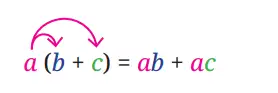
Use these rules to expand brackets.
Expanding a bracket
- Multiply the outside factor by each term inside the brackets.
- Keep the signs of the terms inside the brackets.
- Add the resulting products.
Expand and evaluate .
- Expand using the distributive property.
- Evaluate the two products.
Increments in Products
Each increase or decrease is measured relative to the original product .
Finding the change in a product
- Write the new product using the changed factors.
- Expand using the distributive property.
- Subtract the original product and simplify; a negative result means a decrease.
For , find the change when both factors increase by , and when the first increases by while the second decreases by .
- When both numbers increase by , expand the new product.
- The increase is the extra amount beyond the original product.
- When the first number increases and the second decreases by , find the signed change.
Do not assume that changing one factor up and the other down always increases the product. The change is , which can be negative.
Algebraic Identities
This identity follows by distributing multiplication across both brackets.
Checking an identity
- Choose the side with brackets.
- Expand using the distributive property.
- Simplify and compare with the other side.
Show that is an identity.
- Distribute across the bracket.
- Write the product in simplified form.
Expand and simplify .
For and , find the change in when increases by and decreases by .
Expand and state the change from .
Quick recap
- Distributivity: for integers.
- Increasing one factor of by increases the product by the other factor.
- Increasing both factors by changes by .
- Changing to changes the product by .
- A negative signed change means the product decreases.
- An identity is true for every allowed value of its variables.
Some Properties of Multiplication Part-2
Multiplying Two Binomials
Product change — When each of two factors changes by a given amount, distribute every term in one bracket across every term in the other.
For initial factors and , changed by and , respectively, the new product is . Its change from the original product is .
Using positive and negative changes
- Increase/decrease: Represent a decrease by a negative change; for example, decreasing by means adding .
- One increased, one decreased: .
- One decreased, one increased: .
- Both decreased: .
- Signs: Apply the usual integer multiplication rules to each pair of terms.
Use this identity for increases or decreases by taking or as negative when needed.
Expand two binomials
- Multiply each term in the first bracket by each term in the second.
- Use the signs of the terms to determine the sign of each product.
- Combine like terms, if any; subtract the original product to find the change.
Find the expanded product and its change from for .
- Expand the product when the first factor increases by and the second decreases by .
- Multiply each term in the first bracket by each term in the second.
- Subtract the original product to find the change.
Do not treat a decrease as a positive change: replace it with a negative term before distributing, then apply integer sign rules.
Distributing Across Several Terms
Like terms — Like terms have exactly the same variable part, including the same letters raised to the same powers; their coefficients can be added or subtracted.
A factor outside a bracket multiplies every term inside it. Simplify each product, then combine only like terms.
Simplifying the resulting terms
- Powers: Multiply repeated variables using exponent rules, such as .
- Order of factors: Multiplication is commutative, so and .
- Like terms: Add their coefficients, for example, .
- Unlike terms: Terms such as and cannot be combined.
Expand and simplify
- Multiply the outside factor by every term inside the bracket.
- Simplify numerical factors and powers in each product.
- Group and combine terms with matching variable parts.
Expand and simplify .
- Distribute across all three terms.
- Simplify each product, using .
- No further combination is possible because the variable parts differ.
Do not combine terms merely because they contain the same letters; their powers must also match. For example, and are unlike terms.
Products of Polynomial Expressions
Polynomial product — To multiply two expressions with several terms, distribute each term of one expression across every term of the other, then collect like terms.
Expanding and combining like terms gives the square identity . Multiplying this result by gives the cube identity .
Multiply two multi-term expressions
- Multiply each term in the first expression by each term in the second.
- Simplify powers and reorder variable factors where needed.
- Combine all like terms and write the simplified result.
Expand and simplify .
- Distribute each term of across the three terms in the second bracket.
- Combine the two pairs of like terms.
- Write the fully simplified product.
Expand and state the change from .
Expand and find the change from .
Expand and simplify .
Quick recap
- Expand as ; the product change is .
- Represent decreases with negative terms and apply the integer sign rules.
- Distribute an outside factor to every term inside a bracket.
- Combine only like terms: their variable parts, including powers, must match.
- The expansions are and .
A Pinch of History
The Distributive Property in History
Early Uses and First Explicit Statement
- Ancient mathematics: Distributive calculations were used implicitly in ancient Egypt, Mesopotamia, Greece, China and India.
- Euclid: Used the property implicitly in geometric form.
- Āryabhaṭa: Used it implicitly in algebraic form.
- Brahmagupta: Gave the first explicit statement in *Brahmasphuṭasiddhānta*, Verse 12.55.
- Khaṇḍa-guṇanam: Brahmagupta’s term for “multiplication by parts”; split one factor into parts, multiply each part by the other factor, then add.
- Verse 12.56: Describes a fast multiplication method based on the distributive property.
Expanding Products Using Distribution
Distributive property — Multiplication distributes over addition or subtraction by multiplying each term inside the brackets.
To expand a product of two sums, multiply every term in the first bracket by every term in the second bracket, then combine like terms.
Expand a Product of Brackets
- Multiply each term in the first bracket by each term in the second.
- Keep track of the signs when multiplying negative terms.
- Combine like terms, if any.
Expand .
- Multiply every term in the first bracket by every term in the second.
- The four resulting terms are unlike, so none can be combined.
When a Product Stays Unchanged
Unchanged product condition — If one number is increased by and the other decreased by , the product stays the same only when the original numbers satisfy a particular relation.
For original numbers and , require .
Test Whether the Product Is Unchanged
- Let the original numbers be and .
- Set the changed product equal to the original product and expand.
- Simplify to find the relation between the original numbers.
Give a pair of numbers whose product remains unchanged under the stated changes.
- Choose ; the condition gives .
- Compare the original and changed products.
A Pattern of Difference-of-Powers Identities
Multiplying by a sum of descending powers of and ascending powers of makes the middle terms cancel.
Add the next term to the sum; the product becomes the next difference of powers.
Expand .
- Distribute across the sum.
- Distribute across the same sum.
- Add the results; all middle terms cancel.
Expand .
Find three pairs of numbers whose product stays unchanged when one is increased by and the other decreased by .
Write and verify the next identity after .
Quick recap
- History: Many ancient civilisations used the distributive property implicitly.
- Brahmagupta: Verse 12.55 explicitly described khaṇḍa-guṇanam, or multiplication by parts.
- Expansion: Multiply each term in one bracket by every term in the other, then combine like terms.
- Unchanged product: The original numbers must satisfy for the changes and .
- Identity pattern: .
Fast Multiplications Using the Distributive Property
Multiplying by
For a number with digits , the digits of its product by come from the endpoints and the adjacent sums , with carries handled from right to left.
Use this form to turn the multiplication into a shifted addition.
One-line method for multiplying by
- Write the number once shifted one place left, then add the original number.
- Equivalently, write the endpoints and the sums of neighbouring digits.
- Add from right to left, carrying when a sum is at least .
Find .
- Split into the shifted product and the original number.
- Add from the units place, carrying each time a column total reaches .
Do not write adjacent-digit sums without carrying. For example, a sum of contributes in that place and carries to the next place.
Multiplying by , , and Similar Numbers
For a positive integer , multiplying by adds the original number to the same number shifted places left.
Use the matching shift for each multiplier.
One-line method for and
- Identify the shift: uses two places; uses three places.
- Write the original number shifted by that many places, then add the original.
- Add overlapping digits and carry from right to left.
Find .
- Rewrite as .
- Add the shifted number and the original.
Multiplying by , , and Similar Numbers
Use subtraction from the next power of .
Quick method for and
- Replace the multiplier by one less than a power of .
- Multiply by that power of , then subtract the original number.
- Subtract carefully, keeping place values aligned.
Find .
- Rewrite as .
- Subtract the original number from its hundredfold.
Find .
Find .
Find .
Quick recap
- Use the distributive property to turn special multiplications into addition or subtraction.
- For multiplication by , add neighbouring digits and handle carries from right to left.
- For , add the original number to its -place shift.
- For , subtract the original number from its -place shift.
- Align place values correctly and always check carries or borrowing.
Special Cases of the Distributive Property
Square of a Sum
Use this identity to expand or evaluate a squared sum.
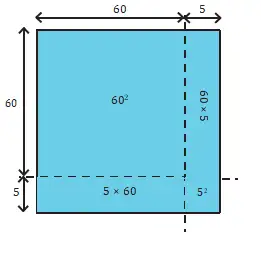
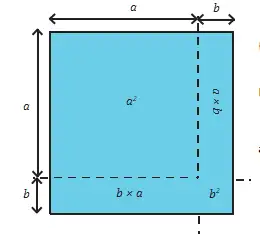
Applying the distributive property gives .
Expand a Squared Sum
- Identify the two terms being added.
- Square each term and add twice their product.
- Simplify the resulting terms.
Find using the square-of-a-sum identity.
- Write as and use the square-of-a-sum identity.
- Square both terms and add twice their product.
- Add the terms.
Examples of Squared Sums
- Area example: square units; hence .
- Algebraic examples: and .
- Variable example: .
- Choice of method: Use the identity for speed, or multiply the brackets using the distributive property.
Square of a Difference
The middle term is negative; the final squared term remains positive.
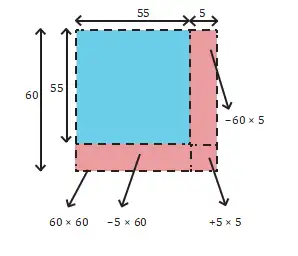
Using distribution, . It also follows from .
Expand a Squared Difference
- Identify the first term and the term being subtracted.
- Square both terms, then subtract twice their product.
- Simplify, keeping the last squared term positive.
Find using the square-of-a-difference identity.
- Write as .
- Use the square-of-a-difference identity.
- Evaluate.
Examples of Squared Differences
- Area example: square units; hence .
- Numerical example: .
- Numerical example: .
- Algebraic examples: and .
Do not write . The last term is positive because .
Expand .
Expand .
Expand .
Quick recap
- The square of a sum is .
- The square of a difference is .
- The middle term is twice the product of the two terms: positive for a sum and negative for a difference.
- For numerical squares, rewrite the number using nearby values with easy squares, such as or .
- The area examples give and .
- In , the final term is , not .
Investigating Patterns
Pattern 1: Twice a Sum of Squares
Twice a sum of squares — For any numbers and , twice the sum of their squares can be written as the sum of the squares of their sum and difference.
Key idea
- Expansion: and .
- Cancellation: Adding these expansions cancels the mixed terms and .
- Example: .
Adding the two square expansions leaves twice each original square.
Use to express twice a sum of squares as another sum of squares.
Express as a sum of two squares.
- Apply the identity to the pair and .
- Evaluate the squares to verify the equality.
Pattern 2: Difference of Two Squares
Difference of two squares — The difference of two squares factors into the sum and difference of their square roots.
Key idea
- Pattern: .
- Distributive check: ; the mixed terms cancel.
- Use: Numbers equally spaced around a common centre form a difference-of-squares product.
Multiplying the sum and difference cancels the mixed terms.
Use to calculate a product of the form or factor .
Multiply numbers around a common centre
- Identify the common centre and equal distance .
- Apply the difference-of-squares identity.
- Evaluate the squares and subtract.
Calculate and using the identity.
- Write and as numbers equally spaced around .
- Use the difference-of-squares identity.
- For , use centre and distance .
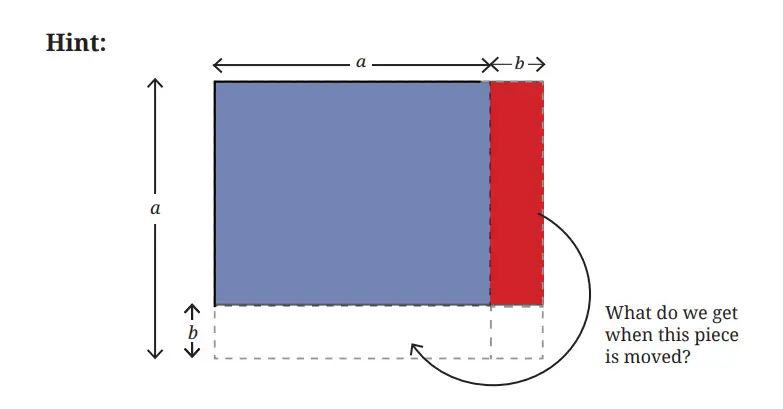
Geometric interpretation
- Areas: For , subtracting the area of a square of side from one of side gives .
- Rearrangement: This remaining area can form a rectangle with sides and , whose area is .
Using the Identity to Square Numbers
Quick squaring identity — A square can be found by multiplying two numbers equally above and below it, then adding the square of their offset.
This follows by adding to both sides of the difference-of-squares identity.
Choose an offset that makes one factor convenient to multiply.
Choosing an offset
- Choice: Pick so that or is a convenient number, such as a multiple of or .
- Examples: For , use ; for , use to reach .
Find a square using a nearby round number
- Choose an offset that makes a nearby factor easy to calculate.
- Multiply the numbers equally above and below .
- Add the square of the offset.
Use the identity to calculate and .
- For , choose .
- Multiply and add the offset square.
- For , choose to make one factor .
- Evaluate the product and add .
Do not confuse with : , whereas . Also, because .
Which is greater, or ? Justify your answer.
Express as a difference of two squares.
Use the quick-squaring identity to find , , , , and .
Do Patterns 1 and 2 hold only for counting numbers?
Quick recap
- Twice a sum of squares satisfies .
- The square expansions contain opposite mixed terms, which cancel when added.
- The difference of two squares factors as .
- Numbers equally spaced around multiply to .
- A square can be calculated using .
- These identities hold for negative integers and fractions as well as counting numbers.
Mind the Mistake, Mend the Mistake
Checking Algebraic Simplifications
Algebraic simplification — Rewriting an expression as an equivalent, simpler expression by applying algebraic rules correctly.
Distribute a multiplier to every term inside brackets. Square each term and include the middle term when squaring a binomial. Combine only like terms, and preserve all signs and variable factors.
Use these identities to expand brackets and binomials.
| No. | Check | Correct result or reason |
|---|---|---|
| 1 | Correct | |
| 2 | Mistake | |
| 3 | Mistake | ; this is not a square. |
| 4 | Mistake | |
| 5 | Correct | |
| 6 | Mistake | |
| 7 | Correct | |
| 8 | Mistake | cannot be combined: the terms are unlike. |
| 9 | Mistake | |
| 10 | Correct | |
| 11 | Mistake | |
| 12 | Correct |
How to Find and Mend an Error
- Expand each bracket by multiplying its outside factor by every term inside.
- When removing brackets after a minus sign, reverse the sign of every term.
- Expand squares and products fully before simplifying.
- Combine only terms with identical variable parts and powers.
- Check that every original term and factor appears in the result.
Find and correct the error in .
- Distribute each multiplier to both terms in its bracket.
- Combine like terms, keeping the constants separate from the variable terms.
Do not combine unlike terms, such as and , or omit the middle term when squaring a binomial. The middle term in is .
Correct the simplification .
Simplify .
Expand and simplify .
Quick recap
- Distribute an outside factor to every term inside brackets.
- A minus sign before brackets changes the sign of every term inside.
- A binomial square includes a middle term: or .
- Combine only like terms; unlike terms must remain separate.
- Check that all signs, terms, and variable factors are preserved.
This Way or That Way, All Ways Lead to the Bay Part-1
Counting the Dot Pattern
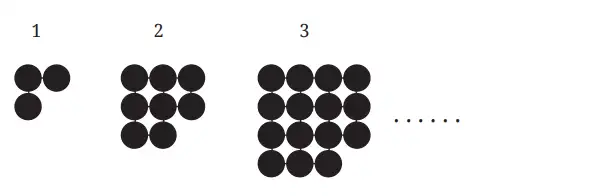
Expressions that look different can represent the same quantity if they simplify to the same value for every .
Use any of these equivalent forms to count the dots.
Find the dot count at a given step
- Substitute the step number for in the formula.
- Evaluate the square and multiplication, then add.
How many circles are there at Step 15?
- Find the number of circles at Step 15.
- Substitute for .
- Add to obtain the total.
Do not assume different-looking expressions give different counts. Expand and simplify them before comparing.
Counting the Square Tiles
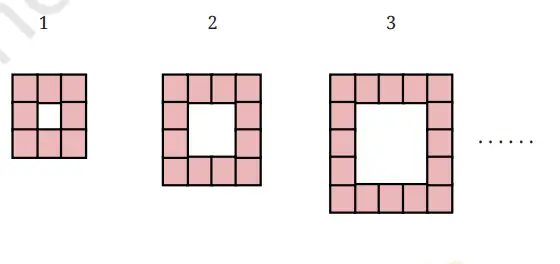
A square with side length tiles contains tiles in total.
Use this when Step 1 is the single centre tile and each step adds one surrounding layer.
Find the tile count
- Find the side length at Step .
- Square the side length to get the total tiles.
- Expand if a polynomial expression is needed.
How many tiles are there at Step 4?
- Find the number of tiles at Step 4.
- Calculate the side length.
- Square the side length.
How many circles are in Step 10 of the dot pattern?
Show that and give the same dot count.
How many square tiles are there in Step 10?
Quick recap
- The dot count at Step is .
- Equivalent expressions can count the same pattern in different ways.
- , and all simplify to .
- For the square-tile pattern, Step has side length .
- The tile count at Step is .
This Way or That Way, All Ways Lead to the Bay Part-2
Finding Areas in Different Ways
Area by decomposition — A composite region’s area can be found by splitting it into simpler shapes or subtracting unwanted parts from a larger shape.
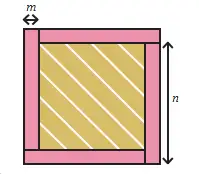
| Method | Expression |
|---|---|
| Whole square minus four rectangles | |
| Interior square directly, side |
The two methods give the same area because .
Use this identity to expand the total square.
Show that the two expressions for the interior area are equal.
- Expand the large square and subtract the four equal rectangles.
- Collect like terms and recognise a square of a difference.
Equivalent Expressions for the Slanting Region
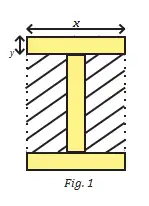
| Method | Area expression | Simplified form |
|---|---|---|
| Square minus inner rectangle (Anusha) | ||
| Outer rectangle minus three rectangles (Vaishnavi) | ||
| Twice a rectangle, using the stated dimensions (Aditya) |
The stated Aditya expression does not simplify to : . Therefore it is not equivalent to Anusha’s and Vaishnavi’s expressions in general; the stated dimensions or the claimed result must be inconsistent.
Using the equivalent expressions and , find the area when and .
- Simplify Vaishnavi’s expression.
- Substitute and into the matching area expression.
Algebraic Identities and Products
Algebraic identity — An algebraic identity is an equality that is true for every permitted value of its variables.
Use these to expand squares and products efficiently.
Choosing an identity
- For a square, identify the two terms being added or subtracted.
- For factors with the same terms and opposite signs, use difference of squares.
- If the expression does not match an identity directly, distribute each factor and collect like terms.
| Expression | Expanded result |
|---|---|
Calculate without multiplying directly.
- Write the factors as a sum and difference around .
- Apply the difference-of-squares identity.
- Evaluate and subtract.
Quick calculations using identities
- Square near a round number: .
- Square of a difference: .
- Product near a square: .
Words, Calendar Patterns, and Consecutive Numbers
Translating words into algebra
- Two more than a square number: If the number is , the expression is .
- Sum of squares of consecutive numbers: For and , it is .
- Calendar block: A block can be labelled , , , and .
In any calendar block, the diagonal products differ by ; the product of the top-right and bottom-left entries is larger.
The square of the middle integer minus the product of the other two is always .
A sum multiplied by half of itself gives half the square of that sum.
For integers, an even square is a multiple of , and an odd square is more than a multiple of .
Why do the diagonal products in a calendar square always differ by the same amount?
- Label the calendar square using its consecutive dates and week spacing.
- Expand the products on both diagonals.
- Subtract to compare the diagonal products.
Testing algebraic statements
- Statement (i) is false: , not always .
- Statement (ii) is false: , which is congruent to modulo .
- Statement (iii) is true: even and odd squares follow the forms above.
- Statement (iv) is not generally true as stated: ; this is not always less than a square.
If two numbers leave remainders and on division by , their sum, first-minus-second difference, and product leave remainders , , and respectively.
Comparing products without full multiplication
- Compare around : and ; therefore is larger.
- Compare around : and ; therefore is larger.
For three consecutive integers, square the middle one and subtract the product of the other two. What is the result?
Two numbers leave remainders and when divided by . Find the remainders of their sum, first-minus-second difference, and product.
Composite Regions and Growing Patterns
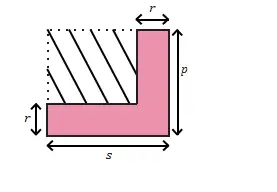
Area of a composite region — Use labelled dimensions to split a region into rectangles or subtract excluded pieces from an enclosing rectangle.
Finding a composite area
- Mark the dimensions of each required rectangular part from the diagram.
- Find each rectangle’s area using length times width.
- Add the required areas or subtract excluded areas, then substitute the given values.
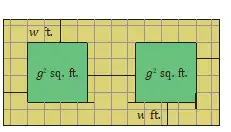
Park path and tile patterns
- Park path: Tiled area equals the total area of the park minus the areas of the two green plots; use the diagram’s dimensions to form the total-area expression.
- Growing tiles: Count the basic units in successive steps, identify how many units are added each time, and express the count for step .
- Unavailable dimensions: The exact area formula and step-count expressions depend on details in the diagrams; do not infer them from labels alone.
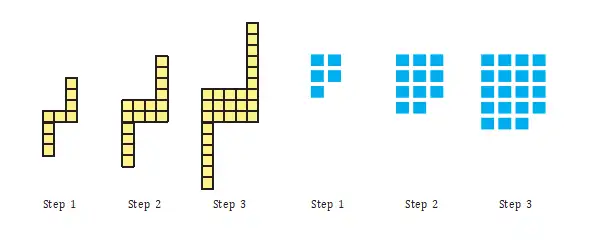
Describe a reliable way to find the number of basic units in Step and Step of a growing tile pattern.
- Different area methods must agree after their expressions are simplified; check every expansion.
- Use for factors equally spaced around a convenient number.
- Translate number patterns into algebra and verify claims by expanding both sides.
Quick recap
- A composite area can be calculated by splitting shapes or subtracting unwanted regions.
- The frame area identity is .
- The stated Aditya expression expands to , not .
- Use square and difference-of-squares identities to simplify products and calculate efficiently.
- Calendar diagonal products differ by ; the middle-square pattern for three consecutive integers gives .
- For composite-area and tile-pattern questions, use the dimensions and counts supplied by the diagram.
Summary
Multiplying Two Binomials
Product of two binomials — Multiply every term in one binomial by every term in the other, then add the products.
For two binomials, distribution gives four pairwise products: , , , and .
Expand two binomials
- Multiply the first term of each binomial.
- Multiply each outer and inner pair of terms.
- Multiply the remaining pair and add all four products.
Expand .
- Multiply every term in the first bracket by every term in the second.
- Simplify and combine like terms.
Do not omit any of the four pairwise products when expanding two binomials.
Special Algebraic Identities
Special algebraic identity — An identity is an equality that holds for all permitted values of its variables.
The square of a sum has a positive middle term; the square of a difference has a negative middle term; a sum times its matching difference gives a difference of squares.
Use a special identity
- Identify whether the expression is a squared sum, squared difference, or sum times difference.
- Match the two terms to the variables in the relevant identity.
- Substitute and simplify, keeping the middle-term sign correct.
Expand .
- Recognize the expression as the square of a difference.
- Apply the square-of-a-difference identity with and .
- Simplify.
In , the last term is ; only the middle term is negative.
Choosing a solution method
- Different approaches: A problem may be solved in more than one way, with each valid method reaching the same answer.
- Creativity: Finding different methods to approach and solve the same problem is a creative process.
Expand .
Expand .
Simplify .
Quick recap
- Distribute each term across the other binomial: .
- The square of a sum is .
- The square of a difference is .
- A sum times its matching difference gives .
- Different valid methods can solve the same problem and produce the same answer.
Formula sheet
Mathematics — ALL CHAPTERS
1
A Square And A Cube
2
Power Play
3
A Story of Numbers
4
Quadrilaterals
5
Number Play
6
We Distribute, Yet Things Multiply
7
Proportional Reasoning-1
1
Fractions in Disguise
2
The Baudhayana-Pythagoras Theorem
3
Proportional Reasoning-2
4
Exploring Some Geometric Themes
5
Tales by Dots and Lines
6
Algebra Play
7
Area