Class 8 . Mathematics . Ganita Prakash Part I . Quadrilaterals
Chapter 4: Quadrilaterals
Ch 4
Mathematics
Class 8
Introduction
Recognising Quadrilaterals
A quadrilateral has sides and angles. Its sides form a closed boundary that does not cross itself; it may be convex or concave. Each angle is formed between two sides.
Recognising quadrilaterals
- Sides: Each side must be a straight line segment.
- Angles: A quadrilateral’s angles are formed between consecutive sides.
- Concave shapes: A concave figure can still be a quadrilateral if it meets the definition.
- Not quadrilaterals: Open figures, figures with curved sides, or boundaries that cross themselves do not qualify.
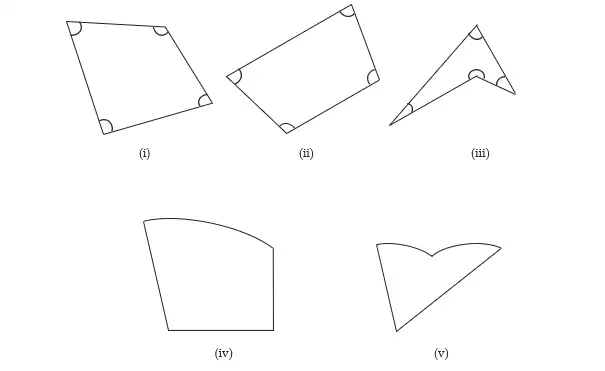
Use this defining count to check a quadrilateral.
How to identify a quadrilateral
- Check that the boundary is closed.
- Check that it is made of straight line segments and does not cross itself.
- Count the sides; exactly four means it is a quadrilateral.
Is the described concave figure a quadrilateral?
- A closed concave figure has four straight sides and does not cross itself. Check its side count.
- It is closed, has straight sides, and has exactly four sides, so it meets the definition.
Do not assume every four-sided outline is a quadrilateral: it must be closed, have straight sides, and not cross itself.
A closed figure has four straight sides and no crossing. Is it a quadrilateral?
A closed outline has three straight sides and one curved side. Is it a quadrilateral?
Next in this chapter
- Familiar quadrilaterals: Rectangles and squares are the first types studied.
Quick recap
- A quadrilateral is a closed figure made of four straight line segments.
- It has sides and angles; each angle lies between two sides.
- A quadrilateral may be concave, but its boundary must not cross itself.
- Open shapes, curved sides, and self-crossing boundaries do not qualify.
- The word comes from Latin *quadri* (four) and *latus* (sides).
- Rectangles and squares are familiar types of quadrilaterals.
Rectangles and Square
Rectangles and Their Diagonals
- Rectangle: A quadrilateral with four right angles; its opposite sides are equal and parallel.
- Diagonals: A rectangle’s diagonals are equal in length and bisect each other.
- Construction: Equal diagonals that bisect each other form a rectangle, whatever the angle between them.
Quick recap
- A rectangle has four right angles and equal opposite sides.
- The diagonals of a rectangle are equal.
- The diagonals intersect at their midpoints and bisect each other.
- If one diagonal is cm, the other is also cm, and each is split into two cm halves.
Deduction 3: What are the angles between the diagonals?
Equal, Bisecting Diagonals
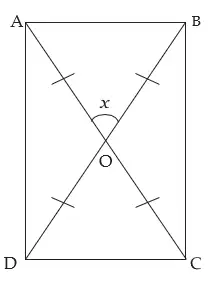
If a quadrilateral’s diagonals are equal and bisect each other, the quadrilateral is a rectangle. The angle between the diagonals can be any value; the diagonals need not be perpendicular.
Finding the Angles
Use the triangle angle sum to find the base angles, then add them to get each quadrilateral angle.
Prove the Quadrilateral Is a Rectangle
- Use equal diagonals and the fact that they bisect each other to show the four half-diagonal segments are equal in pairs.
- Let one intersection angle be ; the adjacent angle is .
- Apply the triangle angle sum to the two isosceles triangles and add their base angles.
- The remaining vertices have the same angle relationships, so all four angles are right angles.
- By SAS, the opposite triangle pairs are congruent; corresponding opposite sides are equal.
The congruent triangle pairs show that opposite sides of the quadrilateral are equal: and .
Do not assume the diagonals must meet at . The theorem requires them to be equal and to bisect each other; the angle between them may vary.
Find the angles when the diagonals meet at .
- In a quadrilateral with equal diagonals that bisect each other, the angle between the diagonals is . Find the base angles and , and the quadrilateral’s angles.
- The base angles of are equal, so use the triangle angle sum to find .
- The adjacent intersection angle is ; use it to find the equal base angles of .
- Each quadrilateral angle is .
The diagonals meet at an angle of . Find , , and each quadrilateral angle.
One base angle of is . Find and the base angle in .
A quadrilateral’s diagonals are equal and bisect each other. What can you conclude?
Practical Use
- Construction: To form a rectangular frame using diagonal strips, make the strips equal and join them at their midpoints.
- Applications: The lecture notes this method is used by carpenters in Europe and by farmers in Mozambique when making rectangular house bases.
Quick recap
- Equal diagonals that bisect each other make a quadrilateral a rectangle.
- The intersection angles are and , in vertically opposite pairs.
- The isosceles-triangle base angles are and .
- Each quadrilateral angle is .
- The opposite triangle pairs are congruent, so and .
- The diagonals do not have to be perpendicular.
The Process of Finding Properties
Deduction, Observation and Conjecture
- Deduction: Use geometric reasoning and known properties to justify that a statement always holds.
- Observation: Construct or measure examples to notice patterns and form a conjecture.
- Verification: Examples can suggest a property, but a proof establishes that it is always true.
Rectangle Definitions
Rectangle: equal, bisecting diagonals — A rectangle is a quadrilateral whose diagonals are equal in length and bisect each other.
Meaning of the diagonal condition
- Equal diagonals have the same length.
- Bisect each other means the diagonals intersect at the midpoint of each.
Why Four Right Angles Define a Rectangle
Rectangle: four right angles — A rectangle is a quadrilateral in which all four angles measure .
If the interior angles on the same side of a transversal add to , the two lines are parallel.
Use this angle sum to establish parallel opposite sides.
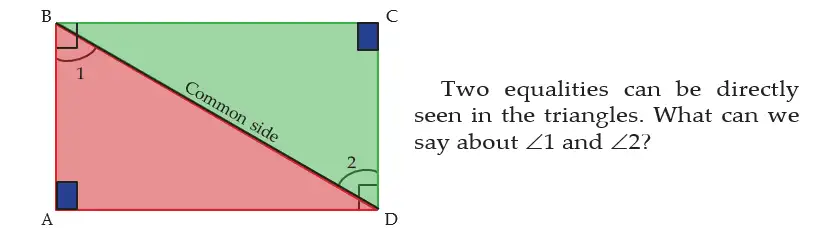
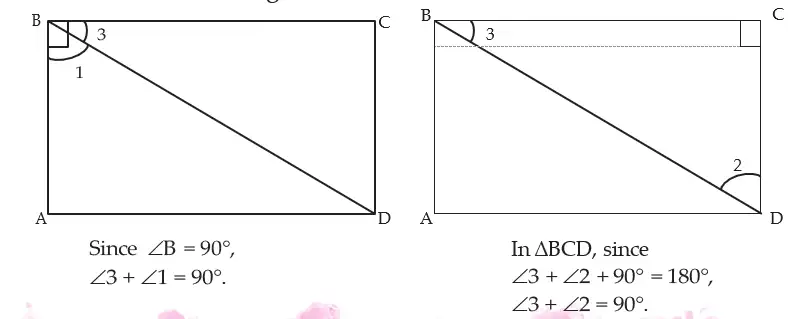
Deduce the opposite sides are equal
- Let have four right angles and draw diagonal .
- By the same-side interior angle converse, the opposite sides are parallel.
- Using with transversal , the marked angles and are equal.
- The triangles also have equal right angles and the common side ; therefore they are congruent by AAS.
- Corresponding sides of congruent triangles are equal.
Show that a quadrilateral with four right angles has equal opposite sides.
- In quadrilateral , all angles are . Draw diagonal .
- The same-side interior angles show that both pairs of opposite sides are parallel.
- Since , the marked angles made by transversal are equal.
- The two triangles have equal angles at and , equal angles at and , and common side ; hence they are congruent by AAS.
- Match corresponding sides to obtain both pairs of equal opposite sides.
A rectangle has four right angles, equal opposite sides, parallel opposite sides, and diagonals that are equal and bisect each other.
For rectangle , let diagonals and meet at .
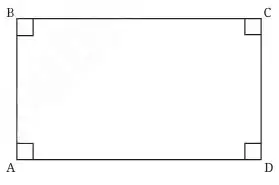
Do not treat measurements of a few examples as proof, or claim triangles are congruent without matching corresponding angles/sides. The vertex order in a congruence statement must match the correspondence.
A student measures the diagonals of several rectangles and finds that they bisect each other. Is this enough to prove that the diagonals of every rectangle bisect each other?
In a rectangle, cm and cm. Find and .
Quick recap
- Deduction proves that a geometric property always holds; measurement alone supports only a conjecture.
- A rectangle may be defined by four right angles, or by equal diagonals that bisect each other.
- With four right angles, same-side interior angle sums establish that both pairs of opposite sides are parallel.
- After drawing a diagonal, AAS congruence proves that the opposite sides are equal.
- A rectangle has opposite sides equal and parallel; its diagonals are equal and bisect each other.
A Special Rectangle
Square: A Special Rectangle
| Property | Square | Rectangle |
|---|---|---|
| Angles | All are | All are |
| Sides | All four sides are equal | Opposite sides are equal |
| Diagonals | Equal; bisect each other at right angles | Equal; bisect each other |
Every square is a rectangle because it has four right angles. A rectangle is a square only if all four of its sides are equal.
Do not assume every rectangle is a square: a rectangle also needs all four sides equal to be a square.
Representing the Sets
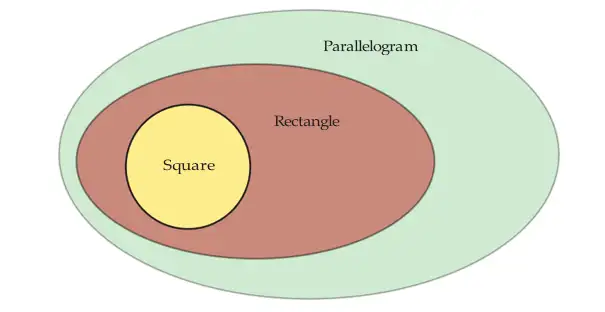
Venn diagram — A Venn diagram represents a set as points inside a closed curve, usually an oval or circle.
- Square set: Each point in its region represents a square.
- Subset relation: The region for squares lies inside the region for rectangles because every square is a rectangle.
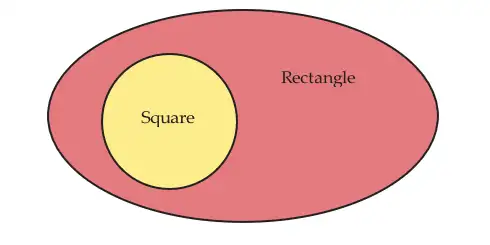
Square Diagonals and Construction
The diagonals of a square are equal, bisect each other, and intersect at right angles.
In square , diagonals and meet at . Since they bisect each other, ; also, and is common. Thus, by SSS. Their equal angles at form a straight angle, so each is .
Equal diagonals that bisect each other at right angles determine a square when their endpoints are joined in order.
Construct a square with diagonal 8 cm
- Draw diagonal of length cm and mark its midpoint .
- Draw a perpendicular to through .
- On this perpendicular, mark and on opposite sides of , each cm from .
- Join the endpoints in order to form the square.
In square , diagonals meet at . Find and .
- In square , diagonals meet at . Identify congruent triangles using SSS.
- The corresponding angles at are equal.
- These adjacent angles form a straight angle.
- Equal angles adding to are each right angles.
A rectangle has four right angles and four equal sides. What is it?
A quadrilateral has equal diagonals that bisect each other at right angles. What shape is formed when the endpoints are joined in order?
Construct a square with a diagonal of cm. How far from the midpoint should each endpoint of the other diagonal be marked?
Quick recap
- A square has four equal sides and four right angles.
- Every square is a rectangle, but not every rectangle is a square.
- In a Venn diagram, the set of squares lies inside the set of rectangles.
- Square diagonals are equal, bisect each other, and intersect at right angles.
- To construct a square from its diagonal, draw equal diagonals that bisect perpendicularly; place the second diagonal’s endpoints on opposite sides of the midpoint.
Properties of a Square
Square — A square is a quadrilateral with four equal sides and four right angles.
Properties of a Square
A square is a special rectangle, so it has all rectangle properties as well as these diagonal and angle-bisector properties.
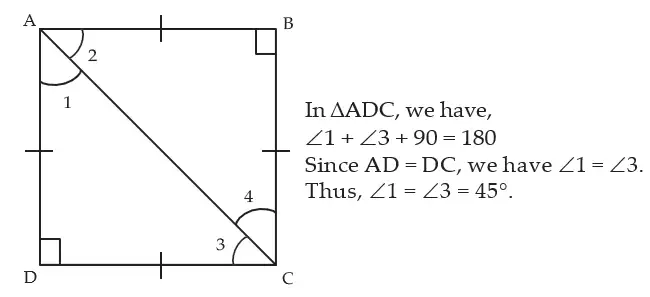
For square , with diagonals and intersecting at :
Each diagonal divides the two corner angles it meets into equal halves.
Finding Angles in a Square
- Use the fact that every corner of a square is a right angle.
- A diagonal through a corner bisects that right angle.
- At the intersection of the diagonals, use their perpendicularity.
In square , diagonals and intersect at . Find , , and .
- In square , diagonals and intersect at . Find , , and .
- Diagonal bisects the right angle at .
- Diagonal bisects the right angle at .
- The diagonals are perpendicular.
Do not confuse the angles where the diagonals meet with the corner angles: the diagonals meet at , while each diagonal splits a corner angle into two angles.
The diagonals of square intersect at . If cm, find and .
A diagonal of a square makes an angle of with one side at a vertex. What angle does it make with the other side at that vertex?
Quick recap
- A square has four equal sides and four right angles.
- Its opposite sides are parallel.
- Its diagonals are equal, bisect each other, and intersect at right angles.
- Each diagonal bisects the corner angles it passes through into two angles.
Angles in a Quadrilateral
Angle Sum of a Quadrilateral
The sum of the four interior angles of any quadrilateral is .
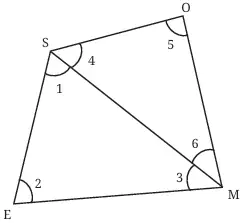
Why the angle sum is 360°
- Draw a diagonal to split the quadrilateral into two triangles.
- The angles of the two triangles add to two triangle angle sums.
- Together, those triangle angles contain all four interior angles of the quadrilateral.
Use this to find a missing interior angle when the other three are known.
Find the fourth angle of a quadrilateral if the other angles are 75°, 110°, and 95°.
- Let the three known angles be 75°, 110°, and 95°. Subtract their sum from the quadrilateral angle sum.
- Add the three known angles.
- Find the missing angle.
Do not assume three right angles can be paired with a non-right fourth angle: the fourth angle must be .
Three angles of a quadrilateral are , , and . Find the fourth angle.
Can a quadrilateral have three right angles and a fourth angle of ? Explain.
Quick recap
- A diagonal divides a quadrilateral into two triangles.
- Each triangle has an angle sum of .
- The interior angles of a quadrilateral sum to .
- Find a missing angle by subtracting the other three angles from .
- If three angles are right angles, the fourth angle is also a right angle.
More Quadrilaterals with Parallel Opposite Sides Part-1
Parallelograms
Parallelogram — A quadrilateral in which both pairs of opposite sides are parallel.
Key relationships
- Opposite sides: Both pairs are parallel; the angles do not have to be right angles.
- Rectangle: A rectangle is a parallelogram with all four angles equal to .
- Classification: Every square is a rectangle, and every rectangle is a parallelogram.
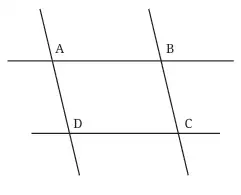
For quadrilateral , both pairs of opposite sides are parallel.
Constructing a parallelogram from two adjacent sides
- Draw two adjacent sides with the given lengths and included angle.
- Through each free endpoint, draw a line parallel to the other adjacent side.
- Mark the intersection of the parallel lines as the fourth vertex.
Construct a parallelogram with adjacent sides of lengths cm and cm and included angle .
- Draw the first side.
- At , make the given included angle and draw the second side.
- Through , draw a line parallel to ; through , draw a line parallel to . Their intersection is .
Angles of a Parallelogram
Each pair of adjacent angles in a parallelogram adds up to , because they are interior angles on the same side of a transversal through parallel sides.
The opposite angles of every parallelogram are equal. If one angle is , its opposite angle is also ; the other two angles are each .
For parallelogram , adjacent angles are supplementary and opposite angles are equal.
Reasoning for opposite angles
- Start: Let one angle be ; an adjacent angle is .
- Use adjacency again: The angle next to that angle is .
- Conclusion: The first and third angles are opposite, so opposite angles are equal.
In parallelogram , if , find the other three angles.
- The angle adjacent to is supplementary to it.
- The angle opposite equals .
- The angle opposite equals .
Do not assume every parallelogram is a rectangle: only rectangles have all angles equal to .
In a parallelogram, one angle is . Find all four angles.
Two adjacent angles of a parallelogram are and . Find and the angles.
Quick recap
- A parallelogram has two pairs of parallel opposite sides.
- A rectangle is a parallelogram with four right angles; a square is a rectangle.
- A parallelogram can be constructed by drawing two pairs of parallel lines.
- Adjacent angles of a parallelogram sum to .
- Opposite angles of a parallelogram are equal.
- If one angle is , the opposite angle is and each adjacent angle is .
More Quadrilaterals with Parallel Opposite Sides Part-2
Opposite sides and angles
Parallelogram — A quadrilateral with both pairs of opposite sides parallel.
In parallelogram , and . A diagonal divides it into two congruent triangles.
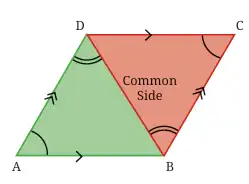
Why the triangles are congruent
- Triangles: Compare and ; they share side .
- Angles: One angle pair is equal as opposite angles; another pair is equal as alternate angles because .
- Congruence: The triangles are congruent by AAS; corresponding sides give and .
Match corresponding vertices in order: maps , , and . Writing gives a different, incorrect correspondence.
Opposite angles are equal, and adjacent angles are supplementary.
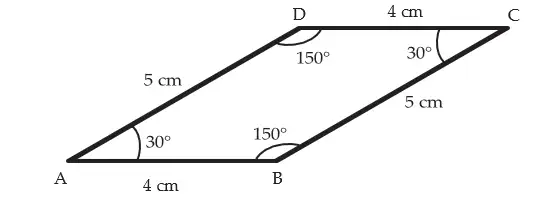
Use these equalities for the opposite sides of a parallelogram.
Opposite angles are equal; adjacent angles are supplementary.
Finding unknown sides and angles
- Identify the given side or angle and its position in the parallelogram.
- Use equality of opposite sides or opposite angles.
- Use the supplementary relationship for adjacent angles when needed.
Find the remaining sides and angles.
- In parallelogram , let , , and . Find the other sides and angles.
- Opposite sides are equal.
- Opposite angles are equal; adjacent angles add to .
Diagonals of a parallelogram
In parallelogram , diagonals and intersect at ; then and . Thus, is the midpoint of both diagonals.
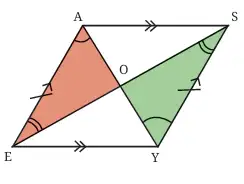
Why the diagonals bisect
- Triangles: Compare and .
- Equal sides: because they are opposite sides of the parallelogram.
- Alternate angles: Since , transversal gives , and transversal gives .
- Congruence: The equal side and the two alternate-angle pairs give by ASA; hence and .
Match corresponding vertices in order: maps , , and . The order does not show this correspondence.
If the diagonals of parallelogram meet at , each diagonal is divided into two equal segments.
Other facts about parallelogram diagonals
- Length: The diagonals of a parallelogram are not necessarily equal.
Using the diagonal-bisection property
- Mark the intersection point of the diagonals.
- Set the two parts of each diagonal equal.
- Add the equal halves to find a full diagonal, or use a known half to find the other.
Find and .
- The diagonals of parallelogram intersect at . If and , find the full diagonal lengths.
- The diagonals bisect each other.
- Add the two halves of each diagonal.
In parallelogram , and . Find and .
A parallelogram has one angle of . Find the other three angles.
The diagonals of parallelogram intersect at . If and , find and .
Quick recap
- Opposite sides of a parallelogram are parallel and equal.
- Opposite angles are equal; adjacent angles add to .
- A diagonal divides a parallelogram into congruent triangles.
- The diagonals bisect each other: each is divided into two equal parts at their intersection.
- The diagonals of a parallelogram need not be equal.
- Write congruent triangles in an order that matches corresponding vertices.
Quadrilaterals with Equal Side Lengths
Rhombus and Its Place Among Quadrilaterals
- Rhombus: A quadrilateral with all four sides equal; it is also a parallelogram.
- Relationship: A square is both a rhombus and a rectangle, but not every rhombus or rectangle is a square.
Angles and Diagonal Properties
A rhombus has opposite sides parallel; hence it is a parallelogram. Its opposite angles are equal and each pair of adjacent angles is supplementary.
The diagonals of a rhombus bisect each other, bisect the vertex angles, and intersect at right angles.
Use the supplementary-angle rule for adjacent angles and equality for opposite angles.
Find the angles of a rhombus
- Use the given angle and the fact that opposite angles are equal.
- Find each adjacent angle by subtracting the given angle from a straight angle.
- Use the opposite-angle equality to complete the four angles.
Find the remaining angles of a rhombus if one angle is .
- A rhombus has . Opposite angles are equal, so .
- Adjacent angles are supplementary, so .
- The angle opposite is equal to it.
Construct a parallelogram whose diagonals are cm and cm and intersect at an angle of .
Construct a rhombus whose diagonals are cm and cm.
Do not assume a rhombus has four right angles or equal diagonals. Those are not true for every rhombus; they hold for a square.
Quick recap
- A rhombus has four equal sides and is a parallelogram.
- Opposite angles are equal; adjacent angles sum to .
- Each diagonal bisects the other and bisects the vertex angles.
- The diagonals of a rhombus intersect at but are not generally equal.
- For a rhombus with one angle , the angles are .
- A square is both a rectangle and a rhombus.
Playing with Quadrilaterals
Making quadrilaterals from diagonals
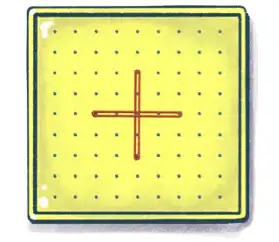
If a quadrilateral's diagonals are equal, perpendicular, and bisect each other, the quadrilateral is a square.
Use the diagonal conditions to distinguish a square from a rhombus.
Identify a quadrilateral from its diagonals
- Check whether the diagonals bisect each other.
- Check whether they meet at right angles.
- If both conditions hold, compare their lengths: equal lengths indicate a square; unequal lengths indicate a rhombus.
What quadrilateral is formed?
- A quadrilateral has equal diagonals that bisect each other at right angles.
- The diagonals are equal, perpendicular, and bisect each other, so the quadrilateral is a square.
Perpendicular diagonals alone do not prove that a quadrilateral is a square. Check that they bisect each other and are equal; if they bisect at right angles but are unequal, the quadrilateral is a rhombus.
Making quadrilaterals by joining triangles
- Activity: Join two triangle cutouts along a side to form a quadrilateral.
- Classification: Examine the resulting sides and angles, and use geometric reasoning to identify the quadrilateral.
Joining equilateral triangles
A quadrilateral with all four sides equal is a rhombus. A kite has two pairs of equal adjacent sides.
Joining isosceles triangles
Read the side lengths in order around the outside of the quadrilateral.
Joining scalene triangles
Classify a shape formed from two triangles
- Identify the matching side along which the triangles are joined.
- List the four outside side lengths in order.
- All four equal sides indicate a rhombus; two pairs of equal adjacent sides indicate a kite.
What quadrilateral is formed?
- Join two isosceles triangles with sides along their sides.
- The four outside sides are each long.
- All four sides are equal, so the quadrilateral is a rhombus.
One diagonal is extended equally at both ends. The diagonals are now perpendicular, unequal, and still bisect each other. What quadrilateral is formed?
Two triangles with side lengths are joined along an side. What quadrilateral is formed?
Two identical scalene triangles with sides are joined along a matching side. What kinds of quadrilaterals can result?
Quick recap
- Equal perpendicular diagonals that bisect each other form a square.
- Perpendicular diagonals that bisect each other form a rhombus; unequal lengths make it a non-square rhombus.
- Two equilateral triangles joined along a side form a rhombus.
- The isosceles triangles form a rhombus or a kite, depending on the shared side.
- Joining identical scalene triangles along any matching side gives a kite.
Kite and Trapezium
Kite
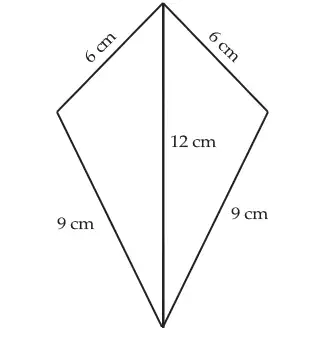
In kite , diagonal bisects the angles at and , and bisects at right angles.
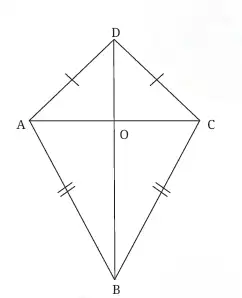
For kite with :
Construct a kite from its diagonals
- Draw the diagonal that is to be bisected, for example cm.
- Construct its perpendicular bisector and mark the intersection as .
- On the perpendicular bisector, mark and so that cm.
- Join and to both and to complete the kite.
Prove that the symmetry diagonal of a kite bisects its two vertex angles.
- In kite , show that bisects and .
- Compare triangles and : they have three corresponding equal sides.
- The triangles are congruent by SSS, so their corresponding angles are equal.
- Therefore, bisects both angles.
Do not assume every kite has four equal sides. Only the two pairs of adjacent sides are guaranteed equal.
Trapezium
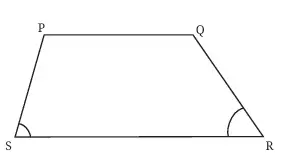
If , the angles along each leg are supplementary:
Find unknown trapezium angles
- Identify the parallel sides and the two legs.
- Pair the interior angles along each leg.
- Subtract each known angle from to find its paired angle.
Find the remaining angles of an isosceles trapezium if one base angle is .
- In isosceles trapezium , let , , and .
- The base angles opposite the equal legs are equal, so .
- Angles along each leg are supplementary.
- The four angles are .
Isosceles trapezium — An isosceles trapezium is a trapezium whose non-parallel sides are equal.
In an isosceles trapezium, the angles opposite the equal non-parallel sides are equal. The other pair is also equal because each is supplementary to one of these equal angles.
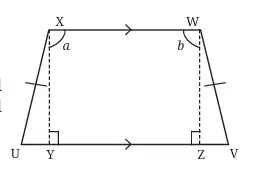
For and equal legs and :
Relationship between kites and other quadrilaterals
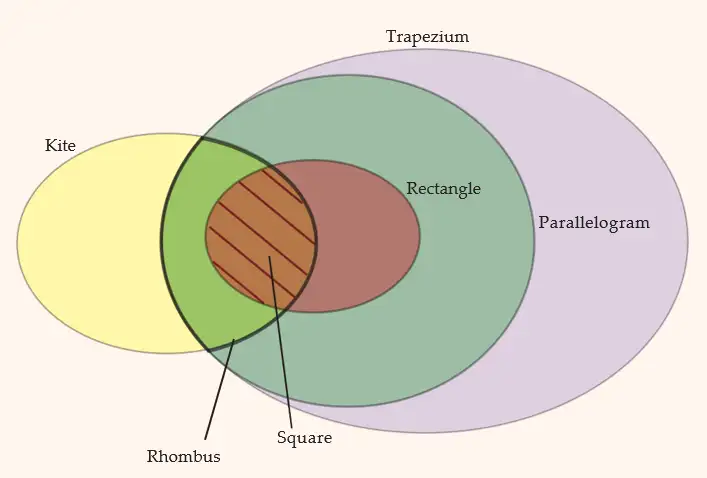
- Kite and parallelogram: A quadrilateral that is both is a rhombus.
- Kite and rectangle: A quadrilateral that is both is a square.
- Set relationship: Every rhombus is a kite, but not every kite is a rhombus.
In a kite, and diagonal bisects it. Find .
In trapezium , and . Find .
An isosceles trapezium has one base angle of . Find its other three angles.
Quick recap
- Kite: It has two pairs of equal adjacent sides.
- Kite diagonals: One diagonal bisects the other at right angles and bisects two vertex angles.
- Trapezium: It has at least one pair of parallel opposite sides.
- Trapezium angles: Consecutive interior angles along each leg add to .
- Isosceles trapezium: Equal legs give equal angles at each base.
- Special cases: A rhombus is both a kite and a parallelogram; a square is both a kite and a rectangle.
Summary
Rectangle
Rectangle — A quadrilateral with four right angles.
Opposite sides are equal and parallel. The diagonals are equal and bisect each other.
For rectangle , diagonals and meet at .
Use rectangle properties
- Check that all four angles are right angles.
- Use equal opposite sides and equal diagonals that bisect each other to find missing lengths.
The diagonals of rectangle meet at . If cm, find .
- The diagonals of rectangle meet at . If cm, find .
- The diagonals bisect each other, so the full diagonal is twice its half.
Square
Square — A quadrilateral with four right angles and four equal sides.
Opposite sides are parallel. Diagonals are equal, bisect each other at right angles, and bisect the square’s angles.
For square , diagonals meet at .
Use square properties
- Check that all four sides are equal and all four angles are right angles.
- Apply the equal, perpendicular diagonals and their angle-bisecting properties.
A square has side length cm. Find its perimeter.
- A square has side length cm. Find its perimeter.
- A square has four equal sides.
Parallelogram
Parallelogram — A quadrilateral in which both pairs of opposite sides are parallel.
Opposite sides are equal; opposite angles are equal; adjacent angles add to ; diagonals bisect each other.
For parallelogram , diagonals meet at .
Find an adjacent angle
- Subtract the known angle from to find its adjacent angle.
- The opposite angle equals the known angle.
Adjacent angles of a parallelogram are and . Find .
- Adjacent angles of a parallelogram are and . Find .
- Adjacent angles are supplementary.
- Subtract from .
Rhombus
Rhombus — A quadrilateral with all four sides equal in length.
Opposite sides are parallel; opposite angles are equal; adjacent angles add to . Diagonals bisect each other at right angles and bisect the angles.
For rhombus , diagonals meet at .
Use rhombus diagonals
- Use the fact that the diagonals bisect each other.
- Use their right-angle intersection and angle-bisecting properties when finding missing measures.
The diagonals of rhombus meet at . If cm, find .
- The diagonals of rhombus meet at . If cm, find .
- The diagonals bisect each other.
Kite and Trapezium
Kite — A quadrilateral with two distinct pairs of equal adjacent sides.
For kite , the equal adjacent pairs share vertices and .
Trapezium — A quadrilateral with at least one pair of parallel opposite sides.
For trapezium , at least one pair of opposite sides is parallel.
Classify a kite or trapezium
- For a kite, check for two distinct pairs of equal adjacent sides.
- For a trapezium, check for at least one pair of parallel opposite sides.
Classify quadrilateral with side lengths cm in order, where the equal pairs are adjacent and distinct; classify quadrilateral if .
- Classify quadrilateral with side lengths cm in order, where the equal pairs are adjacent and distinct; classify quadrilateral if .
- The two distinct pairs of equal adjacent sides make a kite.
- One pair of parallel opposite sides makes a trapezium.
Angle Sum of a Quadrilateral
Quadrilateral angle sum — The interior angles of every quadrilateral add up to .
For quadrilateral :
Find a missing interior angle
- Add the three known interior angles.
- Subtract their sum from .
Three angles of a quadrilateral are , and . Find the fourth angle.
- Three angles of a quadrilateral are , and . Find the fourth angle.
- Add the known angles.
- Subtract the sum from the total angle sum.
Do not assume that every quadrilateral with equal diagonals is a rectangle, or that a rectangle’s diagonals bisect its angles; neither is a general rectangle property.
One angle of a parallelogram is . Find its adjacent angle and opposite angle.
The diagonals of a rectangle meet at . If cm, find .
Three interior angles of a quadrilateral are , and . Find the fourth angle.
Quick recap
- A rectangle has four right angles; opposite sides are equal and parallel, and equal diagonals bisect each other.
- A square has four equal sides and four right angles; its diagonals are equal, perpendicular, bisect each other and bisect the angles.
- A parallelogram has opposite sides parallel and equal; opposite angles are equal, adjacent angles sum to , and diagonals bisect each other.
- A rhombus has four equal sides; its diagonals bisect each other at right angles and bisect the angles.
- A kite has two distinct pairs of equal adjacent sides; a trapezium has at least one pair of parallel opposite sides.
- The interior angles of every quadrilateral sum to .
Formula sheet
Mathematics — ALL CHAPTERS
1
A Square And A Cube
2
Power Play
3
A Story of Numbers
4
Quadrilaterals
5
Number Play
6
We Distribute, Yet Things Multiply
7
Proportional Reasoning-1
1
Fractions in Disguise
2
The Baudhayana-Pythagoras Theorem
3
Proportional Reasoning-2
4
Exploring Some Geometric Themes
5
Tales by Dots and Lines
6
Algebra Play
7
Area