Class 8 . Mathematics . Ganita Prakash Part II . Fractions in Disguise

Chapter 1: Fractions in Disguise

Ch 1

Mathematics

Class 8

Lecture 1

Fractions as Percentages-Part1

Reference video · Lecture 1Fractions as Percentages-Part1

Meaning of Percentages

Percentage of a quantity

To find p%p\% of a quantity ss, multiply ss by p100\frac{p}{100}.

p100×s\frac{p}{100}\times s

Converting Fractions to Percentages

Fraction as a percentage
ab×100%\frac{a}{b}\times 100\%

Use this to express a fraction as a percentage.

Convert a fraction to a percentage

  1. Multiply the fraction by 100%100\%.
    ab×100%\frac{a}{b}\times 100\%
  2. Simplify the result and write it as a percentage.
Worked example

Red paint makes up 34\frac{3}{4} of a colour mixture. What percentage of the mixture is red?

  1. Convert the red-paint fraction to a percentage.
    34×100%\frac{3}{4}\times 100\%
  2. Simplify.
    34×100%=75%\frac{3}{4}\times 100\%=75\%
Answer: 75%75\% of the mixture is red.
⚠ Common mistake

Do not write a fraction’s numerator as the percentage unless the denominator is 100100; first convert the fraction or multiply by 100%100\%.

Practice

Express 25\frac{2}{5} as a percentage.

Hint: Make the denominator 100100, or multiply by 100%100\%.
Key step: 25×100%=40%\frac{2}{5}\times100\%=40\%.
Solution: 25=40%\frac{2}{5}=40\%.
Practice

A mixture is 34\frac{3}{4} red. What percentage is yellow?

Hint: The red and yellow parts together make the whole, or 100%100\%.
Key step: 100%−75%=25%100\%-75\%=25\%.
Solution: Yellow makes up 14=25%\frac{1}{4}=25\% of the mixture.

Quick recap

  • %\% means “out of 100100”; for example, 25%=2510025\%=\frac{25}{100}.
  • A percentage is a fraction whose denominator is 100100.
  • Find p%p\% of ss by calculating p100×s\frac{p}{100}\times s.
  • Convert a fraction to a percentage by multiplying it by 100%100\%.
  • Complementary parts of a whole add to 100%100\%.
Lecture 2

Fractions as Percentages-Part2

Reference video · Lecture 2Fractions as Percentages-Part2

Expressing Percentages as Fractions

Definition

Percentage as a fraction — z%=z100z\% = \frac{z}{100}; simplify the fraction when possible.

Percentage to fraction
z%=z100z\% = \frac{z}{100}

Place the percentage number over 100100, then simplify.

Convert a percentage to a fraction

  1. Write the percentage number as the numerator and 100100 as the denominator.
    z%=z100z\% = \frac{z}{100}
  2. Reduce the fraction to lowest terms if possible.
    24100=625\frac{24}{100} = \frac{6}{25}
Worked example

Express 24%24\% as a fraction in simplest form.

  1. Write 24%24\% as a fraction over 100100.
    24%=2410024\% = \frac{24}{100}
  2. Simplify by dividing the numerator and denominator by 44.
    24100=24÷4100÷4=625\frac{24}{100} = \frac{24 \div 4}{100 \div 4} = \frac{6}{25}
Answer: 625\frac{6}{25}

Converting Fractions to Percentages

Definition

Percentage of a whole — The percentage tells how large the part is compared with the whole, on a scale of 100100.

Fraction to percentage
ab×100%\frac{a}{b} \times 100\%

Use the fraction whose numerator is the part and denominator is the whole.

Convert a fraction to a percentage

  1. Identify the part and the whole, and form their fraction.
    ab\frac{a}{b}
  2. Multiply the fraction by 100%100\%.
    ab×100%\frac{a}{b} \times 100\%
  3. Simplify or calculate the result.
    1580×100%=18.75%\frac{15}{80} \times 100\% = 18.75\%
Worked example

In a school of 8080 students, 1515 walk to school. What percentage walk?

  1. Use the number who walk as the part and all students as the whole.
    1580\frac{15}{80}
  2. Multiply by 100%100\% and evaluate.
    1580×100%=18.75%\frac{15}{80} \times 100\% = 18.75\%
Answer: 18.75%18.75\% of the students walk to school.
⚠ Common mistake

Do not use the whole alone as the numerator. Form partwhole\frac{\text{part}}{\text{whole}} first, then multiply by 100%100\%.

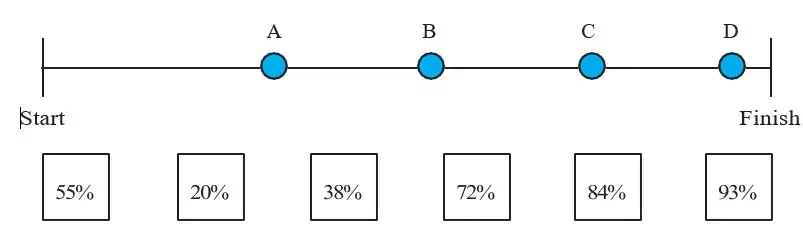
A start-to-finish number line shows runners A–D; estimate the percentage of the race each has completed.
Practice

Convert 35,714,920,72150,13\frac{3}{5}, \frac{7}{14}, \frac{9}{20}, \frac{72}{150}, \frac{1}{3} and 511\frac{5}{11} to percentages.

Hint: Multiply each fraction by 100%100\% and simplify.
Key step: ab×100%\frac{a}{b} \times 100\%
Solution: 35=60%\frac{3}{5}=60\%; 714=50%\frac{7}{14}=50\%; 920=45%\frac{9}{20}=45\%; 72150=48%\frac{72}{150}=48\%; 13=3313%\frac{1}{3}=33\frac{1}{3}\%; 511=45511%≈45.45%\frac{5}{11}=45\frac{5}{11}\% \approx 45.45\%.
Practice

Nandini has 2525 marbles, of which 1515 are white. What percentage are white?

Hint: Use white marbles as the part and all marbles as the whole.
Key step: 1525×100%\frac{15}{25} \times 100\%
Solution: 1525×100%=60%\frac{15}{25} \times 100\% = 60\% of her marbles are white.

Comparing Quantities with Percentages

Fraction and percentage comparisons
ComparisonResult
50%50\% and 5%5\%50%>5%50\% > 5\%
510\frac{5}{10} and 50%50\%510=50%\frac{5}{10} = 50\%
311\frac{3}{11} and 61%61\%311<61%\frac{3}{11} < 61\%
30%30\% and 13\frac{1}{3}30%<1330\% < \frac{1}{3}
Worked example

Which biscuit variety is more sugary if Variety 1 contains 934\frac{9}{34} sugar and Variety 2 contains 1345\frac{13}{45} sugar?

  1. Convert each sugar fraction to a percentage, rounding to two decimal places.
    934×100%≈26.47%,1345×100%≈28.89%\frac{9}{34} \times 100\% \approx 26.47\%, \qquad \frac{13}{45} \times 100\% \approx 28.89\%
  2. Compare the percentages; the larger one represents the more sugary variety.
    28.89%>26.47%28.89\% > 26.47\%
Answer: Variety 2 is more sugary because 28.89%>26.47%28.89\% > 26.47\%.
Practice

Insert >>, << or ==: (i) 50% __ 5%50\%\ \_\_\ 5\%; (ii) 510 __ 50%\frac{5}{10}\ \_\_\ 50\%; (iii) 311 __ 61%\frac{3}{11}\ \_\_\ 61\%; (iv) 30% __ 1330\%\ \_\_\ \frac{1}{3}.

Hint: Compare each quantity on the same scale.
Key step: 510=50%\frac{5}{10}=50\% and 311≈27.27%\frac{3}{11}\approx 27.27\%
Solution: (i) 50%>5%50\%>5\%; (ii) 510=50%\frac{5}{10}=50\%; (iii) 311<61%\frac{3}{11}<61\%; (iv) 30%<1330\%<\frac{1}{3}.

Percentages Around Us

  • Everyday use: Percentages express proportions in a familiar “out of 100” form.
  • Examples: They are used for test scores, discounts, ingredient shares, sales targets, taxes, and price changes.
  • Comparisons: Converting quantities to percentages can make proportions easier to compare.

Quick recap

  • A percentage is a fraction per 100100: z%=z100z\% = \frac{z}{100}.
  • Convert a fraction to a percentage by multiplying it by 100%100\%.
  • For a part of a whole, use partwhole×100%\frac{\text{part}}{\text{whole}} \times 100\%.
  • Percentages provide a common scale for comparing quantities with different denominators.
  • The base-1010 system makes percentage-to-decimal conversion straightforward.
  • Percentages describe many everyday proportions and statistical findings.
Lecture 3

Percentage of Some Quantity

Reference video · Lecture 3Percentage of Some Quantity

Finding a Percentage of a Quantity

Definition

Percentage of a quantity — The amount equal to a given percentage of a quantity is found by multiplying the quantity by the percentage written as a fraction of 100100.

Comparing percentages

Percentages alone cannot compare amounts when they refer to different-sized wholes. Find each actual amount first; for example, compare the sugar weights, not just the sugar percentages.

Percentage of a quantity
p100×q\frac{p}{100}\times q

Use this to find p%p\% of a quantity qq.

Calculate and compare amounts

  1. Write the percentage as a fraction with denominator 100100.
    p100\frac{p}{100}
  2. Multiply it by the size of the quantity.
    p100×q\frac{p}{100}\times q
  3. For a comparison, calculate the actual amount for each quantity and compare the results.
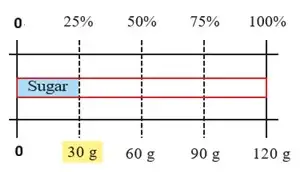
    A1 versus A2A_1\text{ versus }A_2
Scaling the sugar amount in biscuits from 100,g to 120,g.
Scaling the sugar amount in biscuits from 100 g100\,\text{g} to 120 g120\,\text{g}.
Worked example

Who consumed more sugar: Madhu or Madhav?

  1. Madhu ate 120 g120\,\text{g} of biscuits containing 25%25\% sugar.
    25100×120=30 g\frac{25}{100}\times120=30\,\text{g}
  2. Madhav ate 95 g95\,\text{g} of biscuits containing 35%35\% sugar.
    35100×95=33.25 g\frac{35}{100}\times95=33.25\,\text{g}
  3. Compare the actual sugar amounts.
    33.25 g>30 g33.25\,\text{g}>30\,\text{g}
Answer: Madhav consumed more sugar: 33.25 g33.25\,\text{g}, compared with Madhu’s 30 g30\,\text{g}.

Free-Hand Percentage Calculations

Definition

Free-hand calculation — A free-hand calculation uses simple percentage equivalents and combinations to find an amount mentally.

Percentage relationships

The same relationships hold for any quantity yy; they can simplify mental calculations.

Breaking percentages into easy parts
(a+b)% of y=a100y+b100y(a+b)\%\text{ of }y=\frac{a}{100}y+\frac{b}{100}y

For the same quantity yy, split or combine percentages before calculating.

Common percentages of selected quantities
Percentage1001002002005050808010103535287287
25%25\%2525505012.512.520202.52.58.758.7571.7571.75
10%10\%101020205588113.53.528.728.7
20%20\%2020404010101616227757.457.4
5%5\%5510102.52.5440.50.51.751.7514.3514.35

Calculate mentally using easy percentages

  1. Find an easy percentage, such as 10%10\%, 5%5\%, or 25%25\%.
    10100y,5100y,25100y\frac{10}{100}y,\quad\frac{5}{100}y,\quad\frac{25}{100}y
  2. Double, halve, add, or subtract these values to build the required percentage.
    20%=2×10%,25%=20%+5%20\%=2\times10\%,\quad25\%=20\%+5\%
  3. For a percentage near 100%100\%, subtract the missing percentage from the whole quantity.
    75%=100%−25%75\%=100\%-25\%
Worked example

Find 15%15\% of 287287 mentally.

  1. Split 15%15\% into 10%+5%10\%+5\% of 287287.
    15% of 287=10% of 287+5% of 28715\%\text{ of }287=10\%\text{ of }287+5\%\text{ of }287
  2. Calculate the 10%10\% part.
    10100×287=28.7\frac{10}{100}\times287=28.7
  3. Calculate the 5%5\% part and add.
    5100×287=14.35;28.7+14.35=43.05\frac{5}{100}\times287=14.35;\quad28.7+14.35=43.05
Answer: 15%15\% of 287287 is 43.0543.05.
⚠ Common mistake

Do not compare percentages alone when the quantities differ. Calculate each percentage of its own whole, then compare the resulting amounts.

Practice

A 35%35\% sugar biscuit weighs 80 g80\,\text{g}. How much sugar does it contain?

Hint: Find 35%35\% of 8080.
Key step: 35100×80\frac{35}{100}\times80
Solution: 35100×80=28 g\frac{35}{100}\times80=28\,\text{g}. It contains 28 g28\,\text{g} of sugar.
Practice

Find 75%75\% of 200200 using a simple mental method.

Hint: Use 75%=100%−25%75\%=100\%-25\%.
Key step: 200−14×200200-\frac14\times200
Solution: 25%25\% of 200200 is 5050, so 75%75\% of 200=200−50=150200=200-50=150.
Practice

Find 55%55\% of 8080 by combining easy percentages.

Hint: Use 55%=50%+5%55\%=50\%+5\%.
Key step: 12×80+5100×80\frac12\times80+\frac{5}{100}\times80
Solution: 50%50\% of 8080 is 4040 and 5%5\% is 44, so 55%55\% of 80=4480=44.

Quick recap

  • Find p%p\% of qq by calculating p100×q\frac{p}{100}\times q.
  • Compare actual amounts, not percentages of different-sized quantities.
  • 25%=1425\%=\frac14, so finding 25%25\% means taking one quarter.
  • 20%20\% is twice 10%10\%, and 25%=20%+5%25\%=20\%+5\%.
  • Use complements such as 75%=100%−25%75\%=100\%-25\% for quick mental calculations.
Lecture 4

Percentage of Some Quantity - Fractions, Decimals & Percentages (FDP Trio)

Reference video · Lecture 4Percentage of Some Quantity - Fractions, Decimals & Percentages (FDP Trio)

The FDP Trio: Fractions, Decimals and Percentages.

Definition

Equivalent forms — A fraction, decimal and percentage can represent the same part of a whole.

Percentage conversion

To convert a percentage to a fraction, write it over 100100 and simplify; its decimal form is the percentage divided by 100100.

p%=p100=dp\%=\frac{p}{100}=d
Common FDP equivalents
PercentageFractionDecimal
50%50\%12\frac{1}{2}0.50.5
100%100\%1111
25%25\%14\frac{1}{4}0.250.25
75%75\%34\frac{3}{4}0.750.75
10%10\%110\frac{1}{10}0.10.1
1%1\%1100\frac{1}{100}0.010.01
5%5\%120\frac{1}{20}0.050.05
43%43\%43100\frac{43}{100}0.430.43
Convert a percentage to a decimal
d=p100d=\frac{p}{100}

Divide by 100100, or move the decimal point two places left.

Worked example

Show that multiplying a number by 0.50.5 finds 50%50\% of it.

  1. Write 50%50\% as a fraction and decimal.
    50%=50100=12=0.550\%=\frac{50}{100}=\frac{1}{2}=0.5
Answer: 50%50\% of 24=12×24=0.5×24=1224=\frac{1}{2}\times24=0.5\times24=12.

Finding a Percentage of a Quantity

Definition

Percentage of a quantity — Finding p%p\% of a quantity means taking p100\frac{p}{100} of that quantity.

Equivalent calculation methods

A percentage of a quantity can be found by fraction multiplication, decimal multiplication or proportional reasoning.

Percentage of a quantity
p100×Q\frac{p}{100}\times Q

Here, pp is the percentage number and QQ is the whole quantity.

Three useful approaches

  • Fraction method: Simplify p100\frac{p}{100}, then multiply by the quantity.
  • Decimal method: Convert the percentage to a decimal, then multiply.
  • Proportion method: If pp out of 100100 corresponds to a quantity, scale both parts equally.
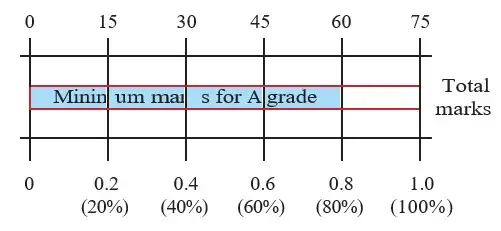
A marks scale relates the total marks to percentages and highlights the minimum marks needed for an A grade.
Worked example

The maximum mark is 7575. A student needs at least 80%80\% to earn an A grade. What is the minimum score?

  1. Use the fraction form of 80%80\% and multiply by the maximum marks.
    80% of 75=80100×75=45×75=6080\%\text{ of }75=\frac{80}{100}\times75=\frac{4}{5}\times75=60
  2. Check using the decimal form.
    0.8×75=600.8\times75=60
  3. Scale the score proportionally from 100100 marks to 7575 marks.
    80100=x75,x=80×75100=60\frac{80}{100}=\frac{x}{75},\quad x=\frac{80\times75}{100}=60
Answer: The student must score at least 6060 marks.

Converting a Ratio into a Percentage

Definition

Ratio part as a percentage — To find the percentage represented by one part of a ratio, divide that part by the total number of parts and multiply by 100100.

Ratio to percentage

For a ratio a:ba:b, the first component is aa+b\frac{a}{a+b} of the total, not ab\frac{a}{b} of the total.

f=aa+b,P=100f%f=\frac{a}{a+b},\quad P=100f\%
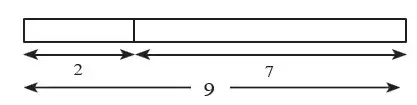
The mixture is divided into 2 millet parts and 7 water parts, making 9 equal parts in total.
The mixture is divided into 22 millet parts and 77 water parts, making 99 equal parts in total.
Percentage and amount from a ratio
P=aa+b×100%,M=aa+b×VP=\frac{a}{a+b}\times100\%,\quad M=\frac{a}{a+b}\times V

For ratio parts a:ba:b and total mixture amount VV, the first part has percentage PP and amount MM.

Mixture reasoning

  • Total parts: Add all ratio terms before finding a component's fraction.
  • Estimate first: A fraction such as 29\frac{2}{9} is a little more than 15\frac{1}{5}, so its percentage is a little above 20%20\%.
  • Complement: The component percentages add to 100%100\%.
Worked example

Millet and water are mixed in the ratio 2:72:7. What percentage of the mixture is millet, and how much millet is needed for 500500 ml?

  1. Find the total ratio parts and the millet fraction.
    2+7=9,292+7=9,\quad \frac{2}{9}
  2. Convert the millet fraction to a percentage; the water percentage is the remainder.
    29×100%=22.22…%,100%−22.22…%=77.78…%\frac{2}{9}\times100\%=22.22\ldots\%,\quad 100\%-22.22\ldots\%=77.78\ldots\%
  3. Find the millet in a 500500 ml batch.
    29×500=111.11…\frac{2}{9}\times500=111.11\ldots
Answer: Millet is approximately 22.22%22.22\% of the mixture; about 111.1111.1 ml is needed.

Finding the Remaining Quantity

Definition

Remaining percentage — The remaining percentage is 100%100\% minus the percentage already completed.

Scaling from a known percentage

If p%p\% of a whole equals kk, then the whole is 100kp\frac{100k}{p}; a remaining r%r\% equals rkp\frac{rk}{p}.

W=100kp,R=rkpW=\frac{100k}{p},\quad R=\frac{rk}{p}
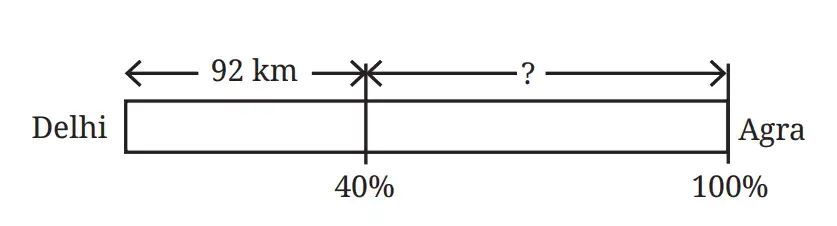
The route bar shows 40% completed as 92 km and the remaining 60% still to travel.
The route bar shows 40%40\% completed as 9292 km and the remaining 60%60\% still to travel.
Remaining distance
R=100−pp×KR=\frac{100-p}{p}\times K

Here, p%p\% is the completed part and KK is the distance already travelled.

Solve a known-percentage remainder problem

  1. Subtract the completed percentage from 100%100\% to get the remaining percentage.
    r=100−pr=100-p
  2. Use proportional reasoning to scale the known amount to the remaining percentage.
    R=rp×KR=\frac{r}{p}\times K
  3. Alternatively, find the whole first and subtract the known amount.
    W=100p×KW=\frac{100}{p}\times K
Worked example

A cyclist has completed 40%40\% of a journey and covered 9292 km. How many kilometres remain?

  1. Find the percentage of the journey still to travel.
    100%−40%=60%100\%-40\%=60\%
  2. Scale the known 40%40\% distance of 9292 km to 60%60\%.
    6040×92=138\frac{60}{40}\times92=138
  3. Check by finding the total route and subtracting the distance already covered.
    92×10040=230,230−92=138\frac{92\times100}{40}=230,\quad230-92=138
Answer: 138138 km remain.
⚠ Common mistake

For a ratio such as 2:72:7, do not use 27\frac{2}{7} as the millet fraction of the mixture; use 22+7\frac{2}{2+7} because the whole contains both parts.

Practice

Find 10%10\% of 360360.

Hint: Convert 10%10\% to a decimal or fraction.
Key step: 10%=0.110\%=0.1.
Solution: 0.1×360=360.1\times360=36.
Practice

A drink contains juice and water in the ratio 3:53:5. What percentage of the drink is juice?

Hint: Add the ratio parts to find the total.
Key step: There are 3+5=83+5=8 total parts.
Solution: 38×100%=37.5%\frac{3}{8}\times100\%=37.5\% juice.
Practice

25%25\% of a journey is 6060 km. How far remains?

Hint: The remaining part is 75%75\%.
Key step: Scale 6060 km from 25%25\% to 75%75\%.
Solution: 7525×60=180\frac{75}{25}\times60=180 km remain.

Quick recap

  • Convert a percentage to a fraction by writing it over 100100; divide by 100100 for its decimal form.
  • Find p%p\% of a quantity by multiplying it by p100\frac{p}{100}.
  • For a ratio, divide a component by the sum of all parts to get its fraction of the whole.
  • Convert a ratio fraction to a percentage by multiplying by 100100.
  • Estimate first and check that component percentages add to 100%100\%.
  • For a remainder, subtract the known percentage from 100%100\% and scale the known quantity proportionally.
Lecture 5

Percentage of Quantity and Percentages Above 100

Reference video · Lecture 5Percentage of Quantity and Percentages Above 100

Expressing One Quantity as a Percentage of Another

Percentage of a reference quantity
AW×100\frac{A}{W}\times 100

Use this to express an amount AA as a percentage of a reference quantity WW.

Find what percentage a quantity is

  1. Identify the amount and the reference whole.
    A,  WA,\;W
  2. Divide the amount by the reference whole.
    AW\frac{A}{W}
  3. Multiply by 100100 and state the result as a percentage.
    AW×100\frac{A}{W}\times 100
Worked example

What percentage of his Rs. 5,000 target did Kishanlal achieve with sales of Rs. 3,500?

  1. Kishanlal sold Rs. 3,500 against a target of Rs. 5,000.
    35005000×100\frac{3500}{5000}\times 100
  2. Simplify and calculate.
    35005000×100=0.7×100=70%\frac{3500}{5000}\times 100=0.7\times 100=70\%
Answer: He achieved 70%70\% of his target, so he was 30%30\% short.

Percentages Greater Than 100

Percentage above or below a reference
AW×100\frac{A}{W}\times 100

The same comparison formula works for amounts below, equal to, or above the reference whole.

Kishanlal's sales compared with a Rs. 5,000 daily target
DaySalesTarget achieved
1Rs. 2,00040%40\%
2Rs. 3,50070%70\%
3Rs. 5,000100%100\%
4Rs. 6,000120%120\%
5Rs. 7,800156%156\%
6Rs. 9,550191%191\%
7150%150\% of targetRs. 7,500
8210%210\% of targetRs. 10,500
Worked example

What percentage of his target did Kishanlal achieve with sales of Rs. 6,000?

  1. For sales of Rs. 6,000 against a Rs. 5,000 target, find the excess.
    6000−5000=10006000-5000=1000
  2. Express the excess as a percentage of the target.
    10005000×100=20%\frac{1000}{5000}\times 100=20\%
  3. Add the extra percentage to the full target percentage.
    100%+20%=120%100\%+20\%=120\%
Answer: He achieved 120%120\% of the target, which is 20%20\% more than the target.
⚠ Common mistake

Do not say 120%120\% is 120%120\% more than the target; it means the full target plus 20%20\% extra.

Find the quantity when its percentage is known

  1. Write the percentage as a fraction of 100100.
    p%=p100p\%=\frac{p}{100}
  2. Divide the given amount by that fraction to recover the whole.
    W=Ap/100W=\frac{A}{p/100}
  3. To find a percentage of a quantity, multiply the quantity by the percentage fraction.
    p100×Q\frac{p}{100}\times Q

Finding a Percentage of a Quantity

Find p%p\% of a quantity
p100×Q\frac{p}{100}\times Q

Use QQ for the given quantity and pp for the percentage number.

Worked example

What is 25%25\% of 160160?

  1. Find 25%25\% of 160160.
    25100×160\frac{25}{100}\times 160
  2. Simplify and multiply.
    14×160=40\frac{1}{4}\times 160=40
Answer: 4040
Practice

A farmer harvested 260 kg260\text{ kg} of wheat last year and 650 kg650\text{ kg} this year. This year's harvest is what percentage of last year's?

Hint: Divide this year's harvest by last year's harvest, then multiply by 100100.
Key step: 650260×100\frac{650}{260}\times 100
Solution: 650260×100=250%\frac{650}{260}\times 100=250\%. This year's harvest is 2.52.5 times last year's.
Practice

Find 62%62\% of 360360.

Hint: Write 62%62\% as 62100\frac{62}{100} and multiply by 360360.
Key step: 62100×360\frac{62}{100}\times 360
Solution: 62100×360=223.2\frac{62}{100}\times 360=223.2.
Practice

Workers pick berries from 20%20\% of a plantation in 1818 days. How many days will the whole plantation take at the same rate?

Hint: Find how many 20%20\% portions make up 100%100\%.
Key step: 100%÷20%=5100\%\div 20\%=5 equal portions
Solution: 5×18=905\times 18=90 days. This assumes the rate stays constant, so each equal portion takes the same time.

Quick recap

  • A quantity as a percentage of a whole is AW×100\frac{A}{W}\times 100.
  • 100%100\% equals the reference whole; below 100%100\% is less and above 100%100\% is more.
  • 120%120\% means the whole plus 20%20\% extra; 250%250\% means 2.52.5 times the whole.
  • Kishanlal's sales were 40%40\%, 70%70\%, 100%100\%, 120%120\%, 156%156\%, and 191%191\% of target on Days 1–6.
  • At a Rs. 5,000 target, 150%150\% is Rs. 7,500 and 210%210\% is Rs. 10,500.
  • To find p%p\% of QQ, calculate p100×Q\frac{p}{100}\times Q.
  • For proportional work or time questions, state that the rate is assumed constant.
Lecture 6

Using Percentages-Part1

Reference video · Lecture 6Using Percentages-Part1

Comparing Proportions

  • Common scale: Convert quantities with different totals into percentages before comparing them.
  • Method: Divide the part by the whole and multiply by 100.
  • Example: Eesha scored 84% in English and 87.5% in Science, so her Science score was better proportionally.

Quick recap

  • Convert parts of different-sized totals into percentages before comparing them.
  • Calculate an increase or decrease as a percentage of the original amount.
  • Profit and loss percentages use cost price as the base unless another base is stated.
  • A discount is calculated on marked price; selling price is the amount paid after discount.
  • Gross profit is sales revenue minus cost, while net profit is gross profit minus expenses.
  • The same profit can be a different percentage depending on whether the base is cost or sales.
Lecture 7

Using Percentages-Part2

Reference video · Lecture 7Using Percentages-Part2

Taxes and Percentage Applications

Percentage change

A percentage change is measured against the original value. Profit margin on cost and profit margin on revenue use different bases.

Percentage, Profit and Price Change
q=ab×100%;mc=PC×100%;ms=PS×100%;q=dv×100%;V1=V0(1±r100)q=\frac{a}{b}\times100\%;\quad m_c=\frac{P}{C}\times100\%;\quad m_s=\frac{P}{S}\times100\%;\quad q=\frac{d}{v}\times100\%;\quad V_1=V_0\left(1\pm\frac{r}{100}\right)

Let aa be a part, bb the whole, PP the profit, CC the cost, SS the selling price or revenue, and rr the rate in percent.

Solve Percentage Change Problems

  1. Identify the original value and calculate the change.
    d=∣V1−V0∣d=|V_1-V_0|
  2. Divide the change by the original value and multiply by 100.
    q=dV0×100%q=\frac{d}{V_0}\times100\%
  3. For a reverse percentage, divide the known final value by its multiplier.
    V0=V11±r/100V_0=\frac{V_1}{1\pm r/100}
Worked example

A receipt lists three bulbs at Rs. 150 each, with CGST and SGST both at 9%9\%. Is the total of Rs. 531 correct?

  1. Calculate the subtotal for three bulbs.
    3×150=4503\times150=450
  2. Find CGST at 9%9\% of the subtotal.
    0.09×450=40.500.09\times450=40.50
  3. Find SGST at 9%9\% of the subtotal.
    0.09×450=40.500.09\times450=40.50
  4. Add the subtotal and both taxes.
    450+40.50+40.50=531450+40.50+40.50=531
Answer: Yes. The correct total is Rs. 531.00.
⚠ Common mistake

Use the original value as the base for percentage increase or decrease. Check whether a profit margin is based on cost or revenue.

Practice

Petrol rose from Rs. 60 to Rs. 100. Find the percentage increase.

Hint: Compare the increase with the original price.
Key step: The increase is Rs. 40, and the original price is Rs. 60.
Solution: (100−60)÷60×100%=6623%(100-60)\div60\times100\%=66\frac{2}{3}\%.
Practice

A car costs Rs. 4,40,000 after a 15%15\% discount. Find its original price.

Hint: The discounted price is 85%85\% of the original.
Key step: Divide the discounted price by 0.850.85.
Solution: 4,40,000÷0.85≈Rs. 5,17,647.064,40,000\div0.85\approx\text{Rs. }5,17,647.06.
Practice

Two buffaloes are each sold for Rs. 80,000. One sale gives a 5%5\% profit and the other a 10%10\% loss. Find the overall result.

Hint: Find each cost price from its selling price, then compare total cost with Rs. 1,60,000.
Key step: The costs are 80,000/1.0580,000/1.05 and 80,000/0.9080,000/0.90.
Solution: Total cost is about Rs. 1,65,079.37, so the overall loss is about Rs. 5,079.37, or 3.08%3.08\% of total cost.

Growth and Compounding

Compound growth

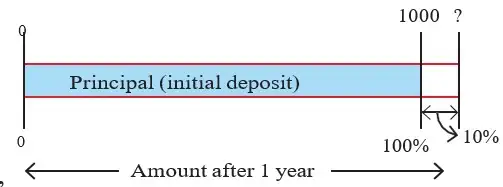
With compounding, each period's interest is calculated on the balance at the start of that period. The balance is multiplied by the same growth factor each period.

Simple and Compound Growth
As=P(1+rn);Ac=P(1+r)nA_s=P(1+rn);\quad A_c=P(1+r)^n

Here PP is the principal, rr is the annual interest rate as a decimal, nn is the number of years, and AA is the total amount received.

Calculate Interest Growth

  1. Identify the principal, annual rate as a decimal, and number of years.
    P,r,nP,\quad r,\quad n
  2. For regular interest payouts, calculate interest on the original principal each year.
    As=P(1+rn)A_s=P(1+rn)
  3. For compounding, multiply the balance by the growth factor once per year.
    Ac=P(1+r)nA_c=P(1+r)^n
A principal of 1,000 increases by 10% after one year.
A principal of 1,000 increases by 10%10\% after one year.
Worked example

Compare the total amount received from Rs. 6,000 for three years at 10%10\% per annum with regular payouts and with annual compounding.

  1. With regular payouts, Rs. 600 interest is paid each year and the principal remains Rs. 6,000.
    6000+3(600)=78006000+3(600)=7800
  2. With compounding, the first year's interest is added to the principal.
    6000×1.10=66006000\times1.10=6600
  3. Use Rs. 6,600 as the balance for the second year.
    6600×1.10=72606600\times1.10=7260
  4. Use Rs. 7,260 as the balance for the third year.
    7260×1.10=79867260\times1.10=7986
  5. Compare each total received with the original deposit to find the percentage gain.
    78006000×100%=130%;79866000×100%=133.1%\frac{7800}{6000}\times100\%=130\%;\quad\frac{7986}{6000}\times100\%=133.1\%
Answer: Regular payouts give Rs. 7,800, a 30%30\% gain. Compounding gives Rs. 7,986, a 33.1%33.1\% gain.
Regular Interest Payout vs Compounding
PointRegular payoutCompounding
Interest baseOriginal principal remains unchangedPrincipal grows as interest is added
Rs. 6,000 at 10%10\% for 3 yearsRs. 600 paid each year; total received Rs. 7,800Final amount Rs. 7,986
Gain over principal30%30\%33.1%33.1\%
⚠ Common mistake

In compound growth, do not calculate each year's interest on the original principal. Add each year's interest to the balance before calculating the next year's interest.

Quick recap

  • For a percentage increase or decrease, use the original value as the base.
  • A discount of r%r\% leaves (100−r)%(100-r)\% of the original price.
  • A percentage increase of r%r\% multiplies a value by 1+r/1001+r/100.
  • Regular interest payouts use the original principal; compounding uses the growing balance.
  • At annual rate rr, compound growth for nn years is P(1+r)nP(1+r)^n.
  • To find overall profit or loss, compare total cost with total selling price.
Lecture 8

Using Percentages-Part3

Reference video · Lecture 8Using Percentages-Part3

Interest With and Without Compounding

Amount and interest without compounding
I=prt,A=p(1+rt)I=prt,\qquad A=p(1+rt)

Use when interest is calculated on the original principal each year.

Calculate interest without compounding

  1. Convert the annual percentage rate to a decimal.
    r=rate100r=\frac{\text{rate}}{100}
  2. Multiply the principal, decimal rate and number of years to find interest.
    I=prtI=prt
  3. Add interest to the principal to get the total amount.
    A=p+IA=p+I
Worked example

What is the amount after 3 years?

  1. Find the amount on Rs. 6,000 at 10% per year for 3 years without compounding.
    p=6000,r=0.10,t=3p=6000,\quad r=0.10,\quad t=3
  2. Calculate the interest on the original principal.
    I=6000×0.10×3=1800I=6000\times0.10\times3=1800
  3. Add the interest to the principal.
    A=6000+1800=7800A=6000+1800=7800
Answer: The amount is Rs. 7,800; the interest is Rs. 1,800.

Compound Interest and Growth

Amount and interest with annual compounding
A=p(1+r)t,I=p(1+r)t−pA=p(1+r)^t,\qquad I=p(1+r)^t-p

Use for repeated annual growth at the same decimal rate.

Calculate compounded growth

  1. Convert the rate to a decimal and find the annual growth multiplier.
    r=rate100,1+rr=\frac{\text{rate}}{100},\quad 1+r
  2. Raise the multiplier to the number of years and multiply by the starting amount.
    A=p(1+r)tA=p(1+r)^t
  3. If interest is required, subtract the original principal.
    I=A−pI=A-p
Worked example

What is the expected population after 3 years?

  1. A city has a population of 1.5 crore, rising by 3% per year. Find the expected population after 3 years.
    p=1.5 crore,r=0.03,t=3p=1.5\text{ crore},\quad r=0.03,\quad t=3
  2. Apply the compound-growth multiplier.
    A=1.5(1.03)3 croreA=1.5(1.03)^3\text{ crore}
  3. Evaluate the result.
    A=1.6390905 crore≈1.639 croreA=1.6390905\text{ crore}\approx1.639\text{ crore}
Answer: Approximately 1.639 crore people.
⚠ Common mistake

Do not use p(1+rt)p(1+rt) for compounding: that formula keeps the principal fixed. For annual compounding, use p(1+r)tp(1+r)^t.

Decline and Depreciation

Value after repeated decline
V=p(1−d)tV=p(1-d)^t

Here, dd is the decimal rate of decline per period.

Calculate depreciation or repeated decline

  1. Convert the percentage decline to a decimal.
    d=decline rate100d=\frac{\text{decline rate}}{100}
  2. Find the fraction of value that remains after each period.
    1−d1-d
  3. Raise the remaining-value factor to the number of periods and multiply by the initial value.
    V=p(1−d)tV=p(1-d)^t
Worked example

What is the TV’s value after one year?

  1. A TV costs Rs. 21,000 and depreciates by 5% in one year.
    p=21000,d=0.05p=21000,\quad d=0.05
  2. Find the fraction of its value remaining.
    1−d=1−0.05=0.951-d=1-0.05=0.95
  3. Multiply by the original value.
    V=21000×0.95=19950V=21000\times0.95=19950
Answer: Rs. 19,950.

Example of population decline

  • Village population: A population of 1,250 falling by 10% each decade is multiplied by 0.90.9 per decade.
  • After 3 decades: 1250(0.9)3=911.251250(0.9)^3=911.25, so the expected population is around 910.
Practice

Rs. 20,000 is deposited for 2 years at 10% per year. Compare the final amounts with and without annual compounding.

Hint: Use A=p(1+rt)A=p(1+rt) without compounding and A=p(1+r)tA=p(1+r)^t with compounding.
Key step: The simple-interest amount is Rs. 24,000; the compounded amount is 20000(1.1)220000(1.1)^2.
Solution: Without compounding: 20000(1+0.10×2)=Rs. 2400020000(1+0.10\times2)=\text{Rs. }24000. With annual compounding: 20000(1.1)2=Rs. 2420020000(1.1)^2=\text{Rs. }24200. Compounding gives Rs. 200 more.
Practice

Rs. 50,000 is invested for 3 years at 7% per year. Find the interest without compounding and how much more interest annual compounding gives.

Hint: Calculate both interest amounts, then subtract the simple interest from the compound interest.
Key step: Compare 50000(0.07)(3)50000(0.07)(3) with 50000(1.07)3−5000050000(1.07)^3-50000.
Solution: Without compounding, interest is 50000(0.07)(3)=Rs. 1050050000(0.07)(3)=\text{Rs. }10500. With compounding, interest is 50000(1.07)3−50000=Rs. 11252.1550000(1.07)^3-50000=\text{Rs. }11252.15. Compounding gives Rs. 752.15 more.
Practice

Giridhar borrows Rs. 12,500 at 12% per year without compounding for 3 years. Raghava borrows the same amount at 10% per year, compounded annually, for 3 years. Who pays more interest, and by how much?

Hint: Find each person’s interest using the appropriate formula.
Key step: Giridhar’s interest is 12500(0.12)(3)12500(0.12)(3); Raghava’s is 12500(1.10)3−1250012500(1.10)^3-12500.
Solution: Giridhar pays Rs. 4500\text{Rs. }4500. Raghava pays 12500(1.10)3−12500=Rs. 4137.5012500(1.10)^3-12500=\text{Rs. }4137.50. Giridhar pays Rs. 362.50 more.

Quick recap

  • Without compounding: I=prtI=prt and A=p(1+rt)A=p(1+rt); interest is calculated on the original principal.
  • With annual compounding: A=p(1+r)tA=p(1+r)^t and I=A−pI=A-p.
  • No compounding gives linear growth; compounding gives exponential growth.
  • For a repeated percentage decline, multiply by the remaining fraction: V=p(1−d)tV=p(1-d)^t.
  • Convert percentage rates to decimals before using the formulas.
  • A 5% decline leaves 95% of the value; a 10% decline leaves 90%.
Lecture 9

Using Percentages-Part4

Reference video · Lecture 9Using Percentages-Part4

Compare percentages using the correct base

Gain or discount percentage
changeoriginal amount×100%\frac{\text{change}}{\text{original amount}}\times 100\%

Use the original amount as the base.

Worked example

Which contest option gives the greater percentage gain?

  1. Option A: deposit Rs. 100 and receive Rs. 300, so the gain is Rs. 200.
    300−100100×100%=200%\frac{300-100}{100}\times 100\%=200\%
  2. Option B: deposit Rs. 1000 and receive Rs. 1500, so the gain is Rs. 500.
    1500−10001000×100%=50%\frac{1500-1000}{1000}\times 100\%=50\%
Answer: Option A gives a 200%200\% gain; Option B gives a 50%50\% gain. Choose A for the greater percentage gain.

Comparing a fixed discount with a percentage discount

  • Rs. 180 purchase: 20%20\% is Rs. 36, so the Rs. 50 discount is better.
  • Rs. 225 purchase: 20%20\% is Rs. 45, so the Rs. 50 discount is better.
  • Rs. 300 purchase: 20%20\% is Rs. 60, so the 20%20\% discount is better.
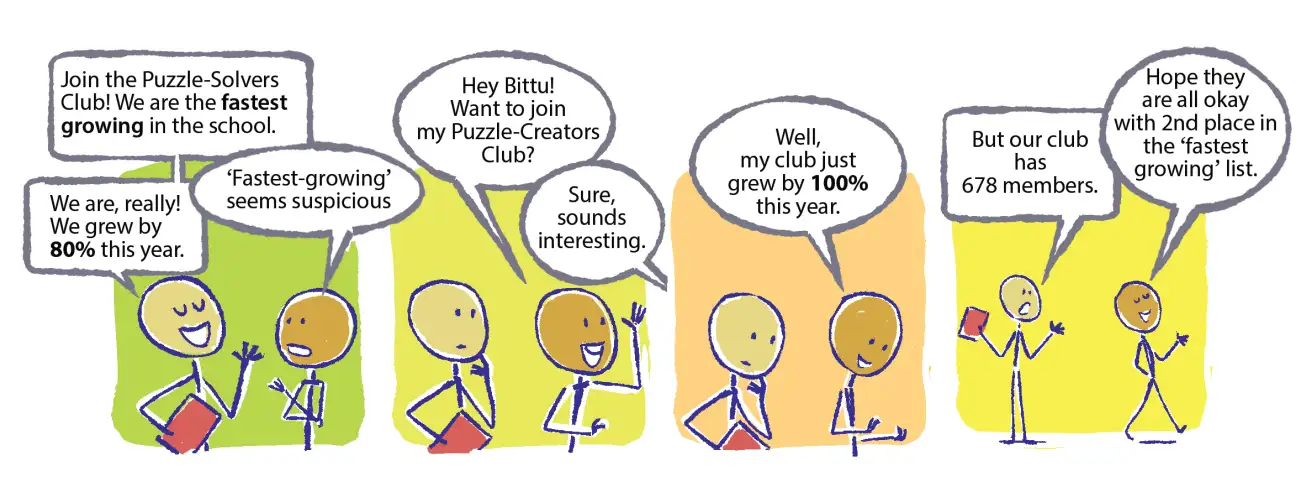
Percentage growth compares change with the starting membership; raw numbers alone do not show which group grew faster.

Successive discounts and percentage changes

Successive percentage changes
Afinal=Ainitial(1±r1100)(1±r2100)A_{\text{final}}=A_{\text{initial}}\left(1\pm\frac{r_1}{100}\right)\left(1\pm\frac{r_2}{100}\right)

Multiply the starting amount by each change multiplier in turn.

Worked example

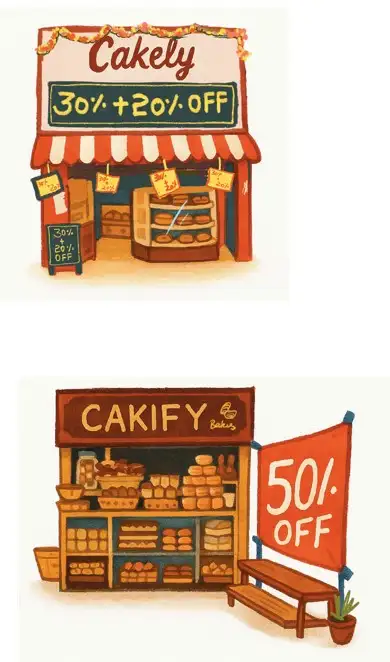
Which bakery gives the cheaper cake: 30%30\% followed by 20%20\%, or 50%50\% off?

  1. For a Rs. 200 cake, apply the first discount of 30%30\%.
    200(1−0.30)=140200(1-0.30)=140
  2. Apply the next discount of 20%20\% to Rs. 140.
    140(1−0.20)=112140(1-0.20)=112
  3. Compare with a single 50%50\% discount.
    200(1−0.50)=100200(1-0.50)=100
Answer: The successive discounts leave a price of Rs. 112; the single 50%50\% discount leaves Rs. 100. The 50%50\% offer is cheaper. The successive discounts equal an overall discount of 44%44\%, not 50%50\%.
The advertised 30% and 20% discounts are applied successively, while the other offer is a single 50% discount.
The advertised 30%30\% and 20%20\% discounts are applied successively, while the other offer is a single 50%50\% discount.
⚠ Common mistake

Do not add successive percentage discounts directly: 30%+20%30\%+20\% off a price is not a 50%50\% discount.

Profit margin followed by a discount

Profit or loss percentage
Profit or loss percentage=∣SP−CP∣CP×100%\text{Profit or loss percentage}=\frac{|\text{SP}-\text{CP}|}{\text{CP}}\times100\%

Use the cost price as the base for both percentages.

Worked example

Does a 50%50\% discount cancel a 50%50\% profit margin?

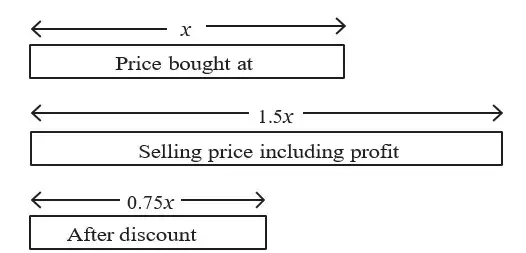
  1. Let the cost price be Rs. 100. A 50%50\% profit margin makes the marked selling price Rs. 150.
    100(1+0.50)=150100(1+0.50)=150
  2. A 50%50\% discount on Rs. 150 leaves an SP of Rs. 75.
    150(1−0.50)=75150(1-0.50)=75
  3. Compare the SP with the CP to find the loss percentage.
    100−75100×100%=25%\frac{100-75}{100}\times100\%=25\%
  4. If the discounted SP is Rs. 12,000, find the CP and loss.
    0.75x=12000,x=16000,16000−12000=40000.75x=12000,\quad x=16000,\quad 16000-12000=4000
  5. For no profit or loss, discount Rs. 150 down to Rs. 100.
    150(1−d)=100,d=13=3313%150(1-d)=100,\quad d=\frac{1}{3}=33\frac{1}{3}\%
Answer: No. The result is a 25%25\% loss. If the discounted selling price is Rs. 12,000, the loss is Rs. 4,000. A discount of 3313%33\frac{1}{3}\% on the marked price gives no profit or loss.
A 50% markup followed by a 50% discount leaves the final price at 34 of the cost price.
A 50%50\% markup followed by a 50%50\% discount leaves the final price at 34\frac{3}{4} of the cost price.

Comparing quantities and finding a percentage of a percentage

Percentage of a percentage and symmetry
a100×b100×100%=ab100%,x% of y=y% of x\frac{a}{100}\times\frac{b}{100}\times100\%=\frac{ab}{100}\%,\qquad x\%\text{ of }y=y\%\text{ of }x

Use these relationships to compare quantities or combine percentage shares.

Worked example

If Ariba has 120%120\% as many marbles as Arun, what percentage of Ariba's marbles does Arun have?

  1. Take Arun's marbles as 100100 units. Ariba has 120120 units.
    A=1.2RA=1.2R
  2. Express Arun's amount as a fraction of Ariba's amount.
    RA=100120=56\frac{R}{A}=\frac{100}{120}=\frac{5}{6}
  3. Convert that fraction to a percentage.
    56×100%=8313%\frac{5}{6}\times100\%=83\frac{1}{3}\%
Answer: Arun has 8313%83\frac{1}{3}\% as many marbles as Ariba.

Useful percentage products

  • Grade 8 girls: 60%60\% of the 40%40\% who are Grade 8 gives 24%24\% of all excursion students.
  • For 160 students: 24%24\% of 160 is 38.438.4; the given figures do not produce a whole-number student count.
  • Examples: 5%5\% of 40 equals 40%40\% of 5; likewise, 25%25\% of 12 equals 12%12\% of 25.

Applications of percentage multipliers

New value after a percentage change
Anew=Aold(1±r100)A_{\text{new}}=A_{\text{old}}\left(1\pm\frac{r}{100}\right)

Apply one multiplier for each change in sequence.

Worked example

The monthly population changes are +5%+5\%, −2%-2\%, and −3%-3\%. Is the final population greater or less than the initial population?

  1. Start with a population of pp and apply the three monthly changes.
    p(1.05)(0.98)(0.97)p(1.05)(0.98)(0.97)
  2. Multiply the factors to compare the result with the initial population.
    1.05×0.98×0.97=0.9987121.05\times0.98\times0.97=0.998712
Answer: The final population is 0.998712p0.998712p, so it is slightly less than pp. The correct expression is p(1.05)(0.98)(0.97)p(1.05)(0.98)(0.97).
Other percentage applications
SituationCalculationResult
Population in 2025 is 250%250\% of 50 lakhs2.5×502.5\times50 lakhs125 lakhs
Mobile price Rs. 8,250 with 18%18\% GST8250(1.18)8250(1.18)Rs. 9,735
World population: 8.2 billion; Germany: 83 million83÷8200×100%83\div8200\times100\%About 1%1\%
India: 1.46 billion of 8.2 billion1460÷8200×100%1460\div8200\times100\%About 18%18\%
Bangladesh: 175 million of 8.2 billion175÷8200×100%175\div8200\times100\%About 2%2\%
USA: 347 million of 8.2 billion347÷8200×100%347\div8200\times100\%About 4%4\%
Bus fare rises 3%3\% then 4%4\%1.03×1.04=1.07121.03\times1.04=1.0712Overall rise: 7.12%7.12\%
Rectangle length rises 10%10\%; area stays constant1÷1.10=10111\div1.10=\frac{10}{11} for breadthBreadth decreases by 111=9111%\frac{1}{11}=9\frac{1}{11}\%

Profit, deals, and percentage-based quantities

  • Pencils: if the SP of 3 pencils equals the CP of 5, each pencil sells for 53\frac{5}{3} of its CP; profit is 6623%66\frac{2}{3}\%.
  • Buy 1, get 1 free: receive 2 items for the price of 1; effective discount is 50%50\%.
  • Buy 2, get 1 free: receive 3 items for the price of 2; effective discount is 3313%33\frac{1}{3}\%.
  • Buy 3, get 1 free: receive 4 items for the price of 3; effective discount is 25%25\%.
  • Four items at Rs. 100 each: Shop A costs Rs. 200 for four items, so it is the cheapest of these offers.
  • 99 left-handed people out of 100: 50 left-handed people must leave; then 4949 of 5050 people are left-handed, or 98%98\%.
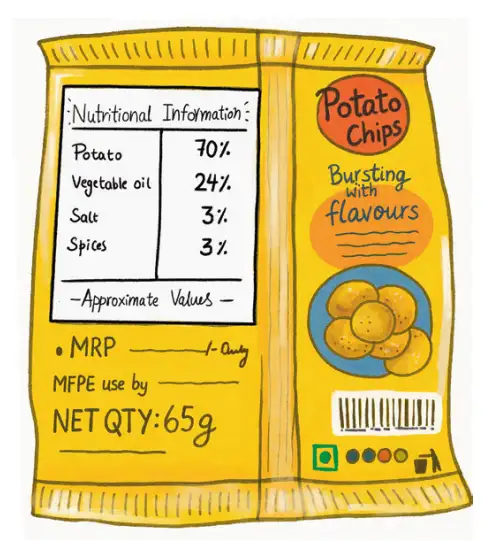
Multiply each ingredient's percentage by the packet's total mass of 65 g to find its weight; ingredient percentages are not supplied in the text.
✎ Exam tip

For a graph question, read the plotted percentages and compare only what the graph supports. A graph of computer-use rates cannot establish how many people are in each age group; the plotted values are not provided here.

Practice

A product costs Rs. 800. It is marked up by 25%25\% and then discounted by 20%20\%. Find the final price and the profit or loss percentage.

Hint: Apply each percentage to the price at that stage.
Key step: 800(1.25)(0.80)800(1.25)(0.80)
Solution: Marked price =800(1.25)=1000=800(1.25)=1000. Final price =1000(0.80)=800=1000(0.80)=800. The final price equals the cost price, so there is no profit or loss.
Practice

A town's population is 40,000. It increases by 10%10\% and then decreases by 10%10\%. Find the final population and compare it with the original.

Hint: Use one increase multiplier and one decrease multiplier.
Key step: 40000(1.10)(0.90)40000(1.10)(0.90)
Solution: 40000(1.10)(0.90)=39,60040000(1.10)(0.90)=39,600. The population is 400400 less than the original, a net decrease of 1%1\%.
Practice

A quantity is reduced by 20%20\%. What percentage increase of the reduced quantity restores the original amount?

Hint: Let the original amount be 100 units.
Key step: 80(1+r)=10080(1+r)=100
Solution: After the reduction, 80 units remain. The increase needed is 20÷80×100%=25%20\div80\times100\%=25\%.

A shopkeeper offers a 30%30\% discount after marking an item up by 35%35\%. Is the result a profit or a loss?

Answer: For CP 100100, the marked price is 135135 and the discounted SP is 135(0.70)=94.5135(0.70)=94.5. This is a 5.5%5.5\% loss.

What is the overall percentage discount for “Buy 2 and get 1 free”?

Answer: You receive 3 items but pay for 2, so the free part is 13\frac{1}{3} of the total value. The discount is 3313%33\frac{1}{3}\%.

Quick recap

  • Calculate every percentage relative to its stated base.
  • Apply successive discounts or changes one at a time using multipliers.
  • Profit and loss percentages use cost price as the base.
  • Reverse comparisons require reversing the ratio, not subtracting from 100%100\%.
  • x%x\% of yy equals y%y\% of xx; percentage shares can be multiplied.
  • A 10%10\% increase followed by a 10%10\% decrease does not return to the starting value.
Lecture 10

Summary

Reference video · Lecture 10Summary

Percentages and Conversions

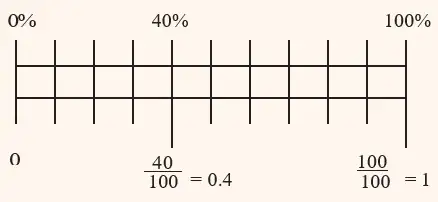
Equivalent positions for 0%, 40%, and 100% as fractions and decimals.
Equivalent positions for 0%0\%, 40%40\%, and 100%100\% as fractions and decimals.
Percentage conversions
x%=x100x\%=\frac{x}{100}

To convert a fraction or decimal to a percentage, multiply by 100100; to convert a percentage to a fraction, divide by 100100.

Convert a fraction or decimal to a percentage

  1. For a fraction, divide the numerator by the denominator; for a decimal, use it directly.
  2. Multiply the result by one hundred and attach the percentage symbol.
    p×100%p\times 100\%
Worked example

Express 410\frac{4}{10} as a percentage.

  1. Convert the fraction to a decimal.
    410=0.4\frac{4}{10}=0.4
  2. Multiply by one hundred to write it as a percentage.
    0.4×100%=40%0.4\times100\%=40\%
Answer: 40%40\%

Finding and Comparing Percentages

Definition

Percentage of a quantity — A percentage of a quantity is the corresponding fraction of that whole quantity.

Common percentage applications

  • Part of a whole: Find an exact quantity when its percentage of the total is known.
  • Ratios: Convert each part of a ratio into a percentage of the sum of all parts.
  • Change: Express an increase or decrease as a percentage of the original quantity.
  • Transactions and tax: Profit, loss and tax rates are commonly stated as percentages.
Percentage applications
Q=p100TSa=aa+b×100%R=CO×100%U=LK×100%X=r100V\begin{aligned}Q&=\frac{p}{100}T\\S_a&=\frac{a}{a+b}\times100\%\\R&=\frac{C}{O}\times100\%\\U&=\frac{L}{K}\times100\%\\X&=\frac{r}{100}V\end{aligned}

Here, pp is the percentage, TT the total, a:ba:b the ratio, CC the amount of change, OO the original quantity, LL the profit or loss, KK the cost price, rr the tax rate, and VV the price before tax.

Solve a percentage application

  1. Identify the whole, original amount, or cost price that forms the base.
  2. Choose the relevant percentage relationship and substitute the known values.
    Percentage=PartWhole×100%\text{Percentage}=\frac{\text{Part}}{\text{Whole}}\times100\%
  3. Calculate the required amount or percentage, then check that the base is correct.
Worked example

Express the parts of the ratio 3:23:2 as percentages of the whole.

  1. Add the ratio parts to find the total number of parts.
    3+2=53+2=5
  2. Find the percentage represented by the first part.
    35×100%=60%\frac{3}{5}\times100\%=60\%
  3. Find the percentage represented by the second part.
    25×100%=40%\frac{2}{5}\times100\%=40\%
Answer: The two shares are 60%60\% and 40%40\%.
⚠ Common mistake

For percentage change, profit, or loss, use the original amount or cost price as the base—not the changed amount or selling price.

Compounded Growth

Definition

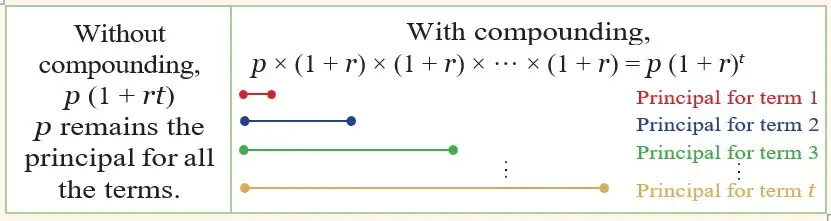
Compounding — Compounding means each term's interest is added to the amount, so later interest is calculated on the increased amount.

Compound amount

For principal PP, rate r%r\% per term, and tt terms, the amount after compounding is A=P(1+r100)tA=P\left(1+\frac{r}{100}\right)^t.

A=P(1+r100)tA=P\left(1+\frac{r}{100}\right)^t

Find a compound amount

  1. Identify the principal, rate per term, and number of terms.
  2. Substitute them into the compound amount formula.
    A=P(1+r100)tA=P\left(1+\frac{r}{100}\right)^t
  3. Evaluate the multiplier for all terms and state the final amount.
Worked example

Find the amount on Rs. 1000 compounded at 10%10\% per term for 22 terms.

  1. Substitute the principal, rate, and number of terms.
    A=1000(1+10100)2A=1000\left(1+\frac{10}{100}\right)^2
  2. Evaluate the growth factor and calculate the amount.
    A=1000(1.1)2=1000(1.21)=1210A=1000(1.1)^2=1000(1.21)=1210
Answer: The amount is Rs. 1210.
With compounding, interest is added to the amount at each term, making later growth larger than growth without compounding.

Estimation and mental computation

  • Plan: Use a rough diagram to represent the quantities and their relationships.
  • Estimate: Approximate values first to judge whether the answer is reasonable.
  • Compute: Use convenient fractions or mental arithmetic where possible.
Practice

Find 25%25\% of 240240.

Hint: Write the percentage as a fraction of one hundred.
Key step: 25100×240\frac{25}{100}\times240
Solution: 25100×240=60\frac{25}{100}\times240=60. The answer is 6060.
Practice

A quantity increases from 8080 to 100100. Find the percentage increase.

Hint: Compare the increase with the original quantity.
Key step: 100−80=20100-80=20
Solution: Percentage increase =2080×100%=25%=\frac{20}{80}\times100\%=25\%.

Quick recap

  • A percentage is a fraction out of 100100; fractions and decimals convert readily to percentages.
  • Find a percentage of a quantity by multiplying the whole by the percentage fraction.
  • Convert ratio parts into percentages using the sum of all ratio parts as the whole.
  • Measure percentage increase or decrease against the original quantity.
  • Profit, loss, and tax rates can all be expressed as percentages.
  • In compounding, each term's interest is added before the next term's interest is calculated.
  • Use rough diagrams, estimates, and mental calculations to plan and check percentage problems.

Formula sheet

Fraction as a percentage
ab×100%\frac{a}{b}\times 100\%
Percentage to fraction
z%=z100z\% = \frac{z}{100}
Fraction to percentage
ab×100%\frac{a}{b} \times 100\%
Percentage of a quantity
p100×q\frac{p}{100}\times q
Breaking percentages into easy parts
(a+b)% of y=a100y+b100y(a+b)\%\text{ of }y=\frac{a}{100}y+\frac{b}{100}y
Convert a percentage to a decimal
d=p100d=\frac{p}{100}
Percentage of a quantity
p100×Q\frac{p}{100}\times Q
Percentage and amount from a ratio
P=aa+b×100%,M=aa+b×VP=\frac{a}{a+b}\times100\%,\quad M=\frac{a}{a+b}\times V
Remaining distance
R=100−pp×KR=\frac{100-p}{p}\times K
Percentage of a reference quantity
AW×100\frac{A}{W}\times 100
Percentage above or below a reference
AW×100\frac{A}{W}\times 100
Find p%p\% of a quantity
p100×Q\frac{p}{100}\times Q
Percentage, Profit and Price Change
q=ab×100%;mc=PC×100%;ms=PS×100%;q=dv×100%;V1=V0(1±r100)q=\frac{a}{b}\times100\%;\quad m_c=\frac{P}{C}\times100\%;\quad m_s=\frac{P}{S}\times100\%;\quad q=\frac{d}{v}\times100\%;\quad V_1=V_0\left(1\pm\frac{r}{100}\right)
Simple and Compound Growth
As=P(1+rn);Ac=P(1+r)nA_s=P(1+rn);\quad A_c=P(1+r)^n
Amount and interest without compounding
I=prt,A=p(1+rt)I=prt,\qquad A=p(1+rt)
Amount and interest with annual compounding
A=p(1+r)t,I=p(1+r)t−pA=p(1+r)^t,\qquad I=p(1+r)^t-p
Value after repeated decline
V=p(1−d)tV=p(1-d)^t
Gain or discount percentage
changeoriginal amount×100%\frac{\text{change}}{\text{original amount}}\times 100\%
Successive percentage changes
Afinal=Ainitial(1±r1100)(1±r2100)A_{\text{final}}=A_{\text{initial}}\left(1\pm\frac{r_1}{100}\right)\left(1\pm\frac{r_2}{100}\right)
Profit or loss percentage
Profit or loss percentage=∣SP−CP∣CP×100%\text{Profit or loss percentage}=\frac{|\text{SP}-\text{CP}|}{\text{CP}}\times100\%
Percentage of a percentage and symmetry
a100×b100×100%=ab100%,x% of y=y% of x\frac{a}{100}\times\frac{b}{100}\times100\%=\frac{ab}{100}\%,\qquad x\%\text{ of }y=y\%\text{ of }x
New value after a percentage change
Anew=Aold(1±r100)A_{\text{new}}=A_{\text{old}}\left(1\pm\frac{r}{100}\right)
Percentage conversions
x%=x100x\%=\frac{x}{100}
Percentage applications
Q=p100TSa=aa+b×100%R=CO×100%U=LK×100%X=r100V\begin{aligned}Q&=\frac{p}{100}T\\S_a&=\frac{a}{a+b}\times100\%\\R&=\frac{C}{O}\times100\%\\U&=\frac{L}{K}\times100\%\\X&=\frac{r}{100}V\end{aligned}

Mathematics — ALL CHAPTERS

1

A Square And A Cube

View

2

Power Play

View

3

A Story of Numbers

View

4

Quadrilaterals

View

5

Number Play

View

6

We Distribute, Yet Things Multiply

View

7

Proportional Reasoning-1

View

1

Fractions in Disguise

View

2

The Baudhayana-Pythagoras Theorem

View

3

Proportional Reasoning-2

View

4

Exploring Some Geometric Themes

View

5

Tales by Dots and Lines

View

6

Algebra Play

View

7

Area

View