Class 8 . Mathematics . Ganita Prakash Part II . Algebra Play
Chapter 6: Algebra Play
Ch 6
Mathematics
Class 8
Algebra Play
Think-of-a-Number Tricks
Doubling, adding , dividing by , then subtracting the original number always gives .
For any starting number and chosen result , doubling , adding , dividing by , and subtracting always gives .
Explain or design a number trick
- Let the starting number be and choose the desired result .
- Double the number and add .
- Divide by , then subtract the starting number.
Why does the original number trick always give the same answer?
- Represent the starting number by and follow the original trick.
- Simplify the final expression; the starting number cancels.
Do not assume a trick always works from one test number; simplify its expression in terms of to prove the result.
A Date-Guessing Trick
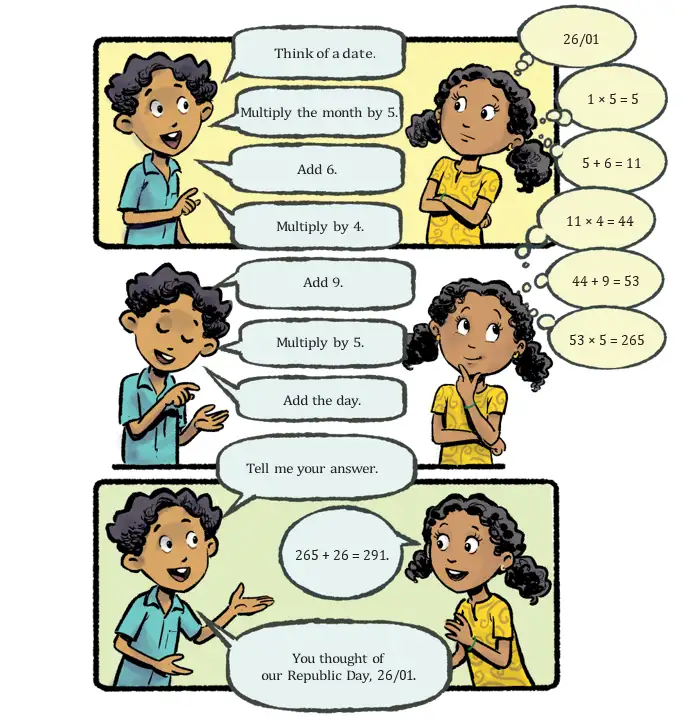
After the operations, subtract to get .
Decode a date
- Subtract from the reported answer .
- Read the last two digits as the day , including a leading zero if needed.
- Read the remaining leading part as the month number .
- Convert the month number to its month name and state the date.
What dates produced the reported answers and ?
- For reported answer , subtract the fixed amount and split the result.
- For reported answer , subtract the fixed amount and split the result.
- Convert the month numbers and to month names.
Do not read all of as the day: separate its final two digits from the month part. A result such as 29 February is a valid calendar date only in a leap year.
Change the original trick so that the final answer is always . What number should be added after doubling?
Decode the date for reported answer .
Decode the dates for reported answers and .
Quick recap
- Represent an unknown starting number by a letter such as .
- Algebra shows whether a number trick's result depends on the starting number.
- To make the double-divide-subtract trick give , add after doubling.
- The date trick gives ; subtract to decode it.
- In , the final two digits give the day and the leading part gives the month.
Number Pyramids
The Number-Pyramid Rule
Use this when the number above and one number below it are known.
Filling Missing Numbers
- Fill any box whose two lower neighbours are known by adding them.
- If a box above and one of its lower neighbours are known, subtract to find the missing neighbour.
- If several lower numbers are unknown, assign variables and use the pyramid rules to form equations.
- Solve the equations, then check that every adjacent pair adds to the number above.
A pyramid has at the top and bottom row . Find the missing numbers.
- Let the middle numbers be and , and the missing bottom number be . Write the three pyramid rules.
- Substitute the expressions for the middle numbers into the top rule.
- Combine like terms and solve for .
- Use the bottom-to-middle rules to find both middle numbers.
- Check that the two middle numbers add to the top number.
Connecting the Bottom Row to the Top
For bottom numbers , the middle numbers are and . Adding them gives the top number.
For bottom row , combine adjacent sums without building every row.
Find the top number directly for bottom row .
Find the top number for bottom row .
Number Pyramids and the Virahanka-Fibonacci Sequence
Virahanka-Fibonacci sequence — A sequence in which each term is the sum of the two preceding terms; here it begins .
If the bottom row contains the first Virahanka-Fibonacci numbers, every number in the pyramid is also in the sequence. Each upward row skips ahead by two sequence positions, so the top is the th term.
Place the first four Virahanka-Fibonacci numbers in the bottom row of a four-row pyramid. What are the numbers in the pyramid and the top number?
- For , the top is ; all the other pyramid numbers are also in the sequence.
- For an -row pyramid whose bottom row is , the top is .
Quick recap
- Each number equals the sum of the two numbers directly below it; subtract to work backward.
- A three-row pyramid with bottom has top .
- A four-row pyramid with bottom has top .
- For the -top example, the missing bottom number is and the middle row is .
- With the first Virahanka-Fibonacci numbers on the bottom, all boxes are sequence numbers and the top is .
Exploring Grids
Calendar Magic
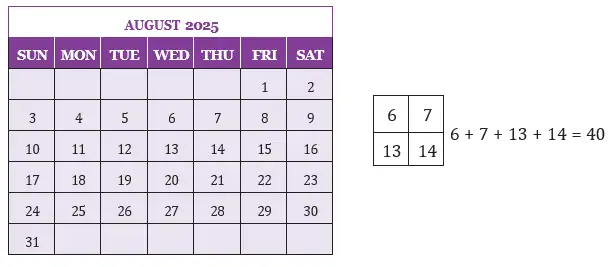
A 2 × 2 calendar grid — A calendar square of four dates has consecutive numbers across each row and dates 7 apart down each column.
Date pattern
- Across: The date to the right is 1 greater.
- Down: The date below is 7 greater.
- Let be the top-left date: The four dates are , , , and .
- Grid total: Knowing the total lets us form an equation and recover the dates.
Use this when the sum of the four dates is known.
Find dates from the grid sum
- Set the expression for the grid total equal to the given sum.
- Solve for the top-left date.
- Substitute into the four-date pattern.
Find the four dates if their sum is 36.
- The grid total is 36. Let its top-left date be .
- Subtract 16 from both sides.
- Divide by 4 to find the top-left date.
- Complete the grid using the date pattern.
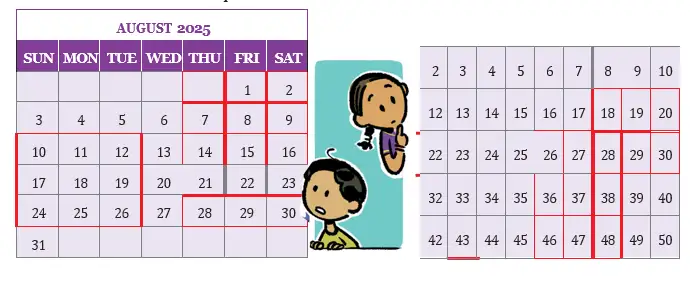
Do not use 1 for the date difference down a column: calendar dates increase by 7 vertically and by 1 horizontally.
A 2 × 2 calendar grid has sum 40. Find its four dates.
Algebra Grids
Algebra grid puzzle — A grid puzzle uses shapes to represent unknown numbers and row totals to give equations.
How the grid gives equations
- Same shape: Treat each occurrence of the same shape as the same unknown value.
- Row total: Add the values shown in a row and set the sum equal to its final-column total.
- Solve: Use the row equations together to find the unknown shape values.
- Fill in: Substitute the values into any empty cells and check each row total.
For a row with two shapes and a total, the shape values must add to that total.
Solve a shape grid
- Assign a variable to each different shape.
- Write an equation for each row using its total.
- Solve the equations and substitute the values back into the grid.
- Check that every completed row adds to its stated total.
Show how to find the shape values from the two row totals.
- Suppose the grid has rows with two circles and a square, total , and one circle and a square, total . Let the circle and square values be and .
- Subtract the second row equation from the first to find the circle value.
- Substitute the circle value into the second row equation.
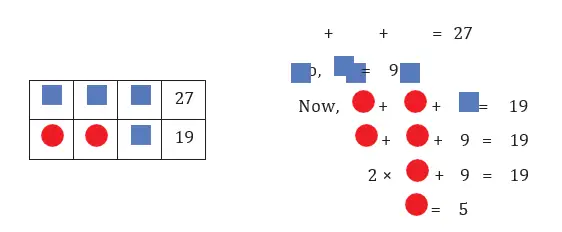
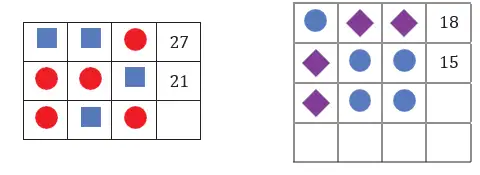
A row contains two squares and one circle, with total . If the square is and the circle is , write the row equation.
Quick recap
- Across a calendar row, dates increase by 1; down a column, they increase by 7.
- A 2 × 2 calendar grid with top-left date has total .
- Use a known calendar-grid sum to form an equation and find the four dates.
- In shape grids, assign an unknown to each shape and translate row totals into equations.
- Solve the equations, fill the grid, and check the totals.
The Largest Product
Finding the Largest Product
Largest product — The largest product is the greatest value obtained by arranging the given digits in a two-digit number and a one-digit multiplier, using each digit once.
For digits , the largest product is made by using as the multiplier and arranging the other digits in decreasing order as the two-digit number: .
Why the rule works
- List the arrangements: There are six ways to choose the two-digit number and multiplier.
- Pair by multiplier: Within each pair, the number with the larger tens digit gives the larger product.
- Compare the three remaining products: They are , , and .
- Eliminate one option: Since , .
- Compare the last two: and . The tens contributions match, while .
Use when the three digits satisfy .
Compare arrangements systematically
- Order the digits from smallest to largest: .
- Group the six arrangements into pairs with the same multiplier, then keep the larger multiplicand in each pair.
- Compare the three remaining products; the greatest is .
Arrange in to get the largest product.
- With digits , the three best candidates after pairing are , , and .
- Compare the last two by place value: their tens contributions are equal, but the remaining contribution is larger for .
Do not assume the greatest two-digit number gives the greatest product. Compare how the multiplier affects each arrangement; the largest digit is the multiplier in the maximum arrangement.
Use once each to make the largest product in .
Use once each to make the largest product in .
Quick recap
- Pair arrangements that have the same multiplier; keep the larger multiplicand.
- For digits , the maximum arrangement is .
- The largest digit is the multiplier; put the other digits in decreasing order.
- Compare candidate products carefully rather than choosing the largest two-digit number.
Decoding Divisibility Tricks
Reversing a Two-Digit Number
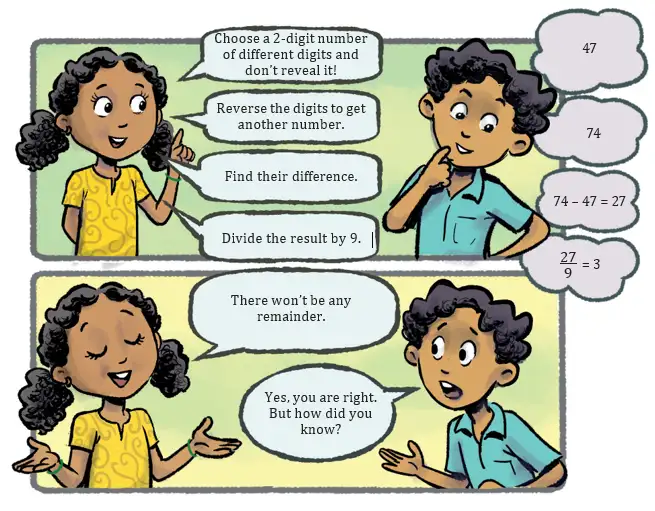
Two-digit number — If its tens digit is and its units digit is , the number is ; reversing its digits gives .
The absolute difference is , so it is divisible by . Their sum is , so it is divisible by .
Use the difference formula for the quotient after division by .
What do the difference and sum show for and its reverse?
- Reverse and find the difference.
- Divide the difference by ; the quotient equals the difference between the digits.
- The sum of the number and its reverse is divisible by .
Cycling the Digits of a Three-Digit Number
For the digits , the sum of , and is . Since , the sum is always divisible by both and .
Write each three-digit number using its place values.
Show that the cyclic sum for is divisible by and by .
- Cycle the digits of to get and .
- Add the numbers and factor the result.
Repeating a Three-Digit Number
Repeated-digit number — Writing a three-digit number twice makes the six-digit number .
Because , the repeated number is divisible successively by , and ; the final quotient is the original number .
What remains after dividing successively by , and ?
- Repeat to form the six-digit number.
- Divide by , then by , then by .
Modelling Word Problems with Equations
Equation model — Represent an unknown quantity with a variable, translate the conditions into equations, and solve for the variable.
Setting up a word-problem equation
- Choose a variable for the unknown quantity.
- Convert each given condition into an equation.
- Solve and check that the result satisfies the original conditions.
For horses and hens, use legs per horse and per hen.
A farm has horses and hens altogether and legs. Find each kind.
- If all animals were hens, they would have legs.
- The extra legs come from replacing hens with horses; each replacement adds legs.
- There are horses, so the remaining animals are hens.
Other useful equation models
- Age relation: If a mother is times her daughter's age now and will be times her age in years, then ; the daughter is years old.
- Cow counts: If Gauri has cows and Naina has twice as many, the transfer condition is ; Gauri has and Naina has .
- Profit: Profit equals revenue minus all costs; for items at price , fixed cost and unit cost , use .
Repeated Doubling and Equal Withdrawals
Doubling-and-withdrawal process — At each stage, the remaining amount doubles and then a fixed amount is removed.
If the starting amount is and the equal withdrawal is at each stage, the amount left after three stages is .
If the same number of flowers is placed at each shrine and none remain after the third, what is the smallest starting amount?
- For equal shrine offerings, let the offering at each shrine be and let the starting number of flowers be .
- Having no flowers left means the final amount is zero.
- The least positive whole-number solution is obtained by taking .
Adding the Sequence of Fractions
Fraction pattern — Each denominator is the sum of consecutive odd numbers and equals a multiple of .
For the pair of odd numbers and , their sum is .
Evaluate the sum of the five listed fractions.
- Simplify the five fractions using their denominators.
- Use the common denominator to add them.
A dosa cart has a fixed daily rent of Rs. 5000 and a cost of Rs. 10 per dosa. Find the selling price needed to make Rs. 2000 profit when dosas are sold. If the price is Rs. 50, how many dosas must be sold for the same profit?
Karim starts with some coins. His coins double each time he circles a tree, then he pays the genie coins. After three rounds, he has coins. How many did he start with?
A mother is five times her daughter's age. In six years, she will be three times her daughter's age. Find the daughter's present age.
- Reversing two digits gives a difference divisible by and a sum divisible by .
- The sum of three cyclic arrangements is ; a repeated three-digit number is .
- Translate each word condition into an equation before solving, and check the result in the original situation.
Quick recap
- A two-digit number and its reverse differ by and add to .
- The sum of the three cyclic arrangements of is , divisible by and .
- Repeating a three-digit number gives .
- Model animal counts, ages, transfers and profit conditions with equations.
- After three doubling stages with equal withdrawals , the remaining amount is .
- The fraction terms simplify to ; the five-term sum is .
Summary
The Role and Uses of Algebra
- Modelling: Algebra represents numerical situations and helps us understand them.
- Justification: It is an indispensable tool for proving mathematical statements.
- Applications: Algebra helps analyse number tricks, pyramids, grids, divisibility patterns, and problems involving numbers.
Quick recap
- Algebra models numerical situations using symbols and expressions.
- It is used throughout mathematics, science, and beyond.
- Algebra helps justify mathematical statements.
- Applications include number tricks, pyramids, grids, digit arrangements, and divisibility tricks.
Formula sheet
Mathematics — ALL CHAPTERS
1
A Square And A Cube
2
Power Play
3
A Story of Numbers
4
Quadrilaterals
5
Number Play
6
We Distribute, Yet Things Multiply
7
Proportional Reasoning-1
1
Fractions in Disguise
2
The Baudhayana-Pythagoras Theorem
3
Proportional Reasoning-2
4
Exploring Some Geometric Themes
5
Tales by Dots and Lines
6
Algebra Play
7
Area