Class 8 . Mathematics . Ganita Prakash Part II . Area
Chapter 7: Area
Ch 7
Mathematics
Class 8
Rectangle And Square
Equal-Area Parts of a Square
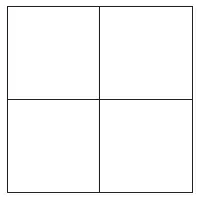
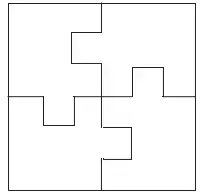
When a square is divided into four equal-area regions, each region has one-fourth of the square’s area.
A square has side length and is divided into four equal-area parts. Find the area of each part.
- Find the area of a square with side length .
- Divide the total area equally among four parts.
Area of Rectangles, Squares and Triangles
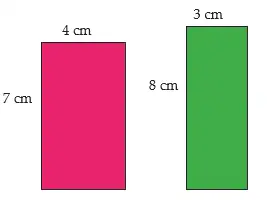
Use these formulas for rectangular and square regions.
Use when a diagonal divides a rectangle into two congruent triangles.
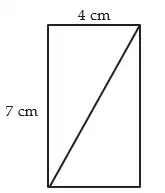
A diagonal divides a by rectangle into two triangles. Find each triangle’s area. Which has more area: this rectangle or an by rectangle?
- Find the area of the rectangle measuring by .
- The diagonal divides it into two equal-area triangles.
- Compare the two rectangle areas to decide which needs more colouring powder.
Perimeter Is Not a Measure of Area
| Point | Perimeter | Area |
|---|---|---|
| Measures | Boundary length | Surface covered |
| Units | Length units, such as | Square units, such as |
The perimeter is the sum of all boundary lengths.
Compare the perimeters and areas of rectangles measuring by and by .
- Find the perimeter and area of a by rectangle.
- Find the perimeter and area of a by square.
- The first region has the larger perimeter but the smaller area.
Areas of Paths and Composite Regions
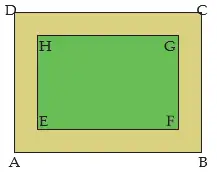
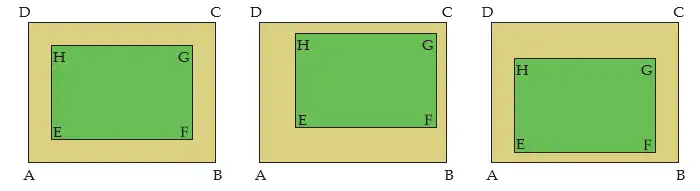
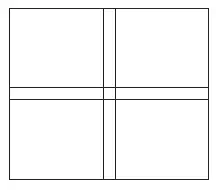
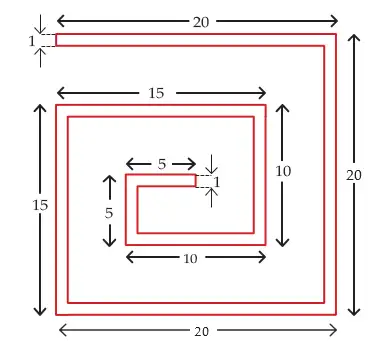
Use subtraction for a border and add strip areas while removing the overlap once for a crosspath.
For constant width , divide the bent tube’s area by to find the matching straight tube’s length.
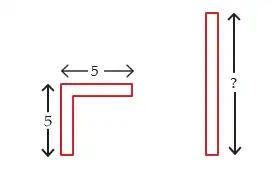
Finding the Area of a Composite Path
- Identify the component rectangles or the inner and outer boundaries.
- Find the areas of the required rectangles.
- Add non-overlapping sections, or subtract the inner area from the outer area.
- For crossing strips, subtract the common overlap once.
A by plot has crossing paths of widths and , each running across the full plot. Find the crosspath area.
- A by plot has a -wide path along its length and a -wide path along its width.
- Find the area of their shared overlap.
- Add the strip areas and subtract the overlap counted twice.
Effect of Doubling Side Lengths
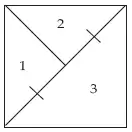
For a scale factor , the area is multiplied by .
A square has side length . Find the increase in its area when its side length is doubled.
- Find the original area of a square with side .
- Double the side and calculate the new area.
- Subtract the original area from the new area.
A rectangle has area and width . Find its length.
A rectangular park is by . Its surrounding outer rectangle is by . Find the path area.
A square has area . Find its area after its side length is doubled, and calculate the increase.
Quick recap
- Area counts the square units covering a region; the count can be fractional.
- Rectangle area is length times width; square area is side squared.
- A rectangle’s diagonal divides it into two equal-area triangles.
- Equal areas may have different perimeters, and equal perimeters may enclose different areas.
- Find a border’s area by subtracting the inner area from the outer area; for crossing strips subtract their overlap once.
- Doubling all lengths multiplies area by four, making the increase three times the original area.
- For a constant-width bent tube, divide its area by its width to find an equal-area straight tube’s length.
Triangle
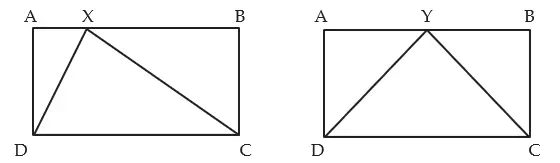
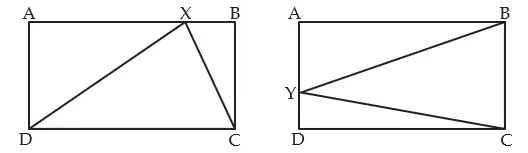
Comparing Areas in Identical Rectangles
Key result
- Equal areas: In each comparison, the named triangles are each half the area of their enclosing rectangle.
- Identical rectangles: Since the rectangles have equal areas, the triangles also have equal areas.
- Key idea: A triangle with the same base and perpendicular height as a rectangle has half its area.
Area of a Triangle
Area of a triangle — The area of a triangle is half the product of a chosen base and its perpendicular height.
A triangle with a given base and corresponding perpendicular height has half the area of a rectangle with the same base and height. The formula applies to all triangles.
Use a base and its perpendicular height.
Finding a triangle's area
- Choose a side as the base.
- Find the perpendicular height corresponding to that base.
- Substitute the base and height in the formula.
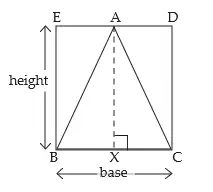
If the altitude falls outside the triangle, subtract the areas of the two enclosing triangles: . Thus, the area formula also works when the altitude is outside the triangle.
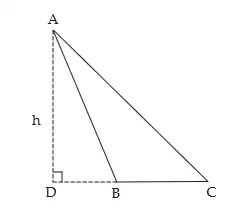
Do not use a sloping side as the height unless it is perpendicular to the chosen base; height is always a perpendicular distance.
Using Different Base-Height Pairs
Same triangle, same area
- Different choices: The same triangle's area can be calculated using any side and its corresponding perpendicular height.
- Equating areas: If two base-height pairs describe the same triangle, their products are equal: .
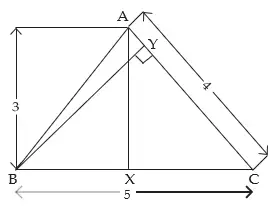
In , units, units, and units. Find the perpendicular height to .
- Calculate the area using base units and height units.
- Use units as the base and as its perpendicular height.
- Equate the area expressions and solve for .
Equal-Area Triangles
Equal-area triangles — Triangles have equal areas when their base-height products are equal.
Triangles with equal corresponding bases and equal heights have equal areas. Equal areas do not require the triangles to be congruent.
For equal-area triangles, compare the products of corresponding base and height.
Comparing triangle areas
- Choose a useful base in each triangle.
- Compare the corresponding bases and perpendicular heights.
- If both measurements match, conclude that the areas are equal.
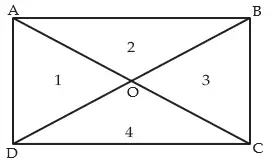
Show that the diagonals of rectangle divide it into four triangles of equal area.
- The diagonals bisect each other, so the two halves of diagonal are equal.
- For the adjacent triangles using and as bases, the perpendicular heights to are equal.
- Their base-height products are equal; applying the same comparison to the other adjacent pairs gives four equal areas.
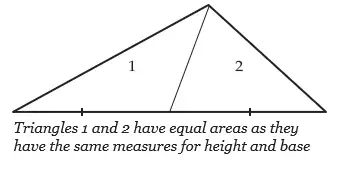
Find the area of a triangle with base cm and perpendicular height cm.
A triangle has area and base cm. Find its perpendicular height.
A median divides a triangle of area into two triangles. Find the area of each smaller triangle.
Quick recap
- In each identical-rectangle comparison, the named triangles each have half their rectangle's area, so their areas are equal.
- Triangle area is , using a base and its perpendicular height.
- The area formula works for every triangle, even when the altitude falls outside it.
- Different base-height pairs for the same triangle give the same area.
- A median divides a triangle into two equal-area triangles.
- The diagonals of a rectangle form four equal-area triangles, which need not be congruent.
Triangle Between Parallel Lines
Equal Areas on a Common Base
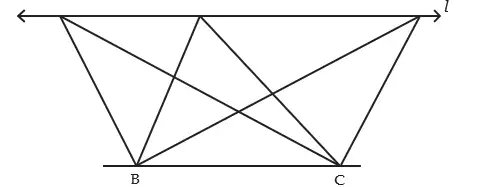
Use the perpendicular height to calculate area.
Minimum Perimeter by Reflection
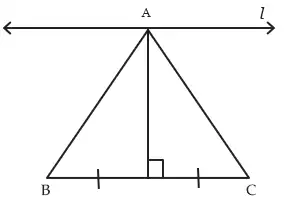
Reflect across the upper parallel line to . For any apex on that line, , so . The path from to is shortest when , , and lie on one straight line. This intersection lies directly above the midpoint of , so the minimum-perimeter apex is on the perpendicular bisector of .
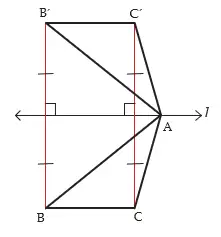
Locate the minimum-perimeter apex
- Reflect one base endpoint, such as , across the parallel line to get .
- Draw the straight line from the other endpoint to .
- Choose the intersection of that line with the parallel line as the apex .
- This point is directly above the midpoint of .
Use reflection to explain why the minimum-perimeter apex lies above the midpoint of the base.
- Let be any point on the parallel line and reflect in that line to obtain .
- Because lies on the reflecting line, its distances to and are equal.
- Thus the two sloping sides have the same total length as the route from through to .
- The route is shortest when it is straight, so take where crosses the parallel line; this is above the midpoint of .
Equal-Area Constructions and Midpoint Triangle
A rectangle of base and height has the same area as a triangle with base and height . A triangle of base and height has the same area as a rectangle with base and height .
In isosceles triangle , . If the area of is square units, find the area of .
If and are the midpoints of and , what fraction of the area of is the area of ?
Describe how to transform a rectangle into a triangle of equal area, keeping the base the same.
Do not use a sloping side as the height: area uses the perpendicular distance between the parallel lines. The minimum-perimeter result needs the reflection and straight-path argument, not just a guess.
- Same base and same perpendicular height give equal triangle areas.
- Reflect an endpoint to replace a broken route with a straight-line shortest-path problem.
- The minimum-perimeter apex is directly above the midpoint of the common base.
Quick recap
- Triangles on the same base and between the same parallel lines have equal areas.
- Use the perpendicular distance between the lines as the triangle height.
- A reflection turns the two non-base sides into a broken route whose shortest form is straight.
- The minimum-perimeter apex lies above the midpoint of the base.
- A same-base triangle equal in area to a rectangle must have twice the rectangle's height.
- The triangle formed by joining two side midpoints has one-quarter the area of the original triangle.
Area Of Any Polygon
Finding Area by Dividing a Polygon into Triangles
Triangulation — Triangulation is dividing a polygon into non-overlapping triangles so its area can be found by adding their areas.
A simple polygon with sides can be divided into triangles using valid diagonals. For a concave polygon, choose diagonals that lie inside the polygon; diagonals from an arbitrary vertex may not work.
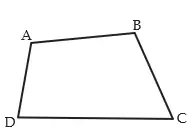
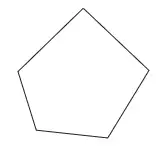
Use the perpendicular height corresponding to the chosen base.
Add the areas of the triangles that make up the polygon.
Finding the Area of a Polygon
- Divide the polygon into non-overlapping triangles using valid diagonals.
- For each triangle, identify a base and its perpendicular height.
- Find each triangle's area and add the results.
Find the area of the quadrilateral.
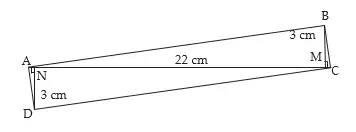
- In quadrilateral , diagonal . The perpendicular distances of and from are each . Find the area.
- The diagonal forms two triangles; calculate their areas using as the base.
- Add the two triangle areas.
Applications and Useful Facts
A rectangle measures . Points and lie on the two sides meeting at , with and . Find the area outside triangle .
A square is divided by its diagonals into four triangular regions. Two opposite triangles are blue. What fraction of the square is blue?

Describe a method to make a quadrilateral whose area is half that of a given quadrilateral.
A triangle's height must be perpendicular to its chosen base; a slant side is not automatically the height. For a concave polygon, do not assume diagonals from any chosen vertex will divide it correctly.
Quick recap
- Divide a polygon into non-overlapping triangles and add their areas.
- A simple polygon with sides can be triangulated into triangles using valid diagonals.
- Use for each triangle, with the height perpendicular to its base.
- A regular hexagon can be divided into six congruent triangles.
- Joining the midpoints of a quadrilateral's sides gives an inner quadrilateral with half its area.
Parrallelogram
Dissecting a Parallelogram into a Rectangle
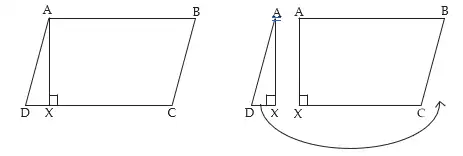
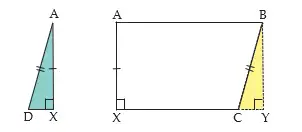
Area of a Parallelogram
The area equals the product of any base and its corresponding perpendicular height.
Why the formula works
- Equal areas: The parallelogram and the rearranged rectangle have the same area.
- Matching dimensions: In the construction, is the height and , the chosen base.
- Any side can be the base: Use that side’s corresponding perpendicular height.
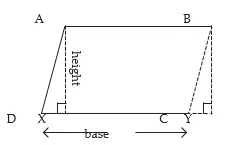
Use the perpendicular height corresponding to the chosen base.
Finding the Area
- Choose a side as the base.
- Find the perpendicular distance to the opposite parallel side.
- Multiply the base by its corresponding height and use square units.
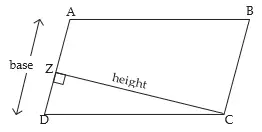
How can the area be found using either of two different sides as the base?
- Let a parallelogram have base and corresponding perpendicular height . Write its area formula.
- If another side is selected as the base, use its own corresponding perpendicular height.
Do not multiply two side lengths unless one is the perpendicular height. A sloping side is not generally the height.
A rectangle and a non-rectangular parallelogram have the same side lengths, cm and cm. Which has the greater area?
Why can any side of a parallelogram be chosen as the base when finding its area?
Quick recap
- Dissection cuts and rearranges a figure without changing its area.
- A parallelogram can be rearranged into a rectangle of equal area.
- Area of a parallelogram is .
- The height must be perpendicular to the chosen base.
- Any side may be used as the base with its corresponding height.
Rhombus
Area of a Rhombus by Dissection
Rhombus — A rhombus is a parallelogram with all four sides equal.
Key Properties
- Parallelogram property: The area can also be found using base × perpendicular height.
- Diagonals: They bisect each other at right angles, dividing the rhombus into four right triangles.
- Isosceles triangles: Since all sides of the rhombus are equal, triangles and are isosceles.
- Dissection: The triangles can be rearranged into a rectangle with the same area as the rhombus.
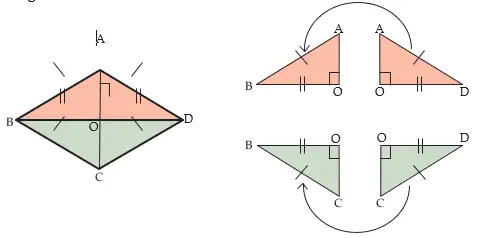
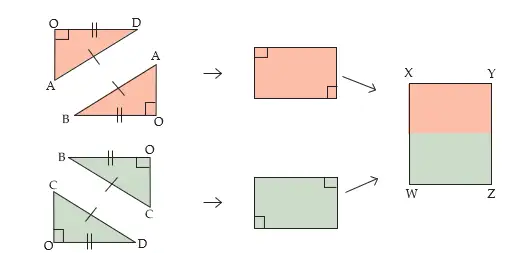
The equal-area rectangle formed by dissection has sides equal to diagonal and half of diagonal . Thus, the rhombus area is half the product of its diagonals.
Use this when both diagonal lengths are known.
Finding area from the diagonals
- Identify the lengths of the two diagonals.
- Multiply the diagonal lengths.
- Divide their product by .
Find the area of a rhombus whose diagonals are and .
- Substitute diagonal lengths of and into the area formula.
- Multiply the diagonals, then take half.
Deriving the Formula from Triangles
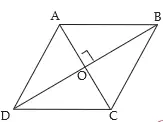
The rhombus is the union of triangles and . Each has base ; their perpendicular heights are and . Since , adding their areas gives the same diagonal formula.
Find the area of a rhombus with diagonals and .
A rhombus has area and one diagonal is . Find the other diagonal.
Do not multiply the diagonals without dividing by ; the area is .
Quick recap
- A rhombus has four equal sides and is also a parallelogram.
- Its diagonals bisect each other at right angles.
- Triangles and are isosceles because the rhombus sides are equal.
- The area is half the product of the diagonal lengths: .
- Adding the areas of triangles and gives the same diagonal formula.
Trapezium
Finding the Area by Decomposition
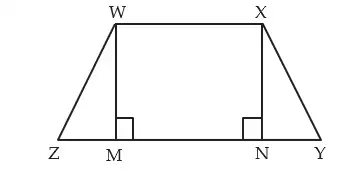
Split into a Rectangle and Two Triangles
- Construction Drop perpendiculars from the ends of the shorter parallel side to the longer parallel side; the middle part is a rectangle.
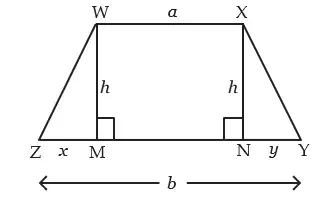
- Let the parallel sides be and , the height be , and the two outer base segments be and .
- Area pieces The two triangles have combined area ; the rectangle has area .
- Base relation The longer parallel side is , so .
Use the perpendicular height and the lengths of both parallel sides.
Adding the rectangle and two triangles gives . Since , this simplifies to .
Why the Formula Works for Any Orientation
Rearrangement Using Two Copies
- Arrange Two identical trapeziums can be joined to form a parallelogram.
- Parallelogram base Its base is the sum of the trapezium’s parallel sides, ; its height remains .
- Area relation The parallelogram has twice the area of one trapezium, so one trapezium has area .
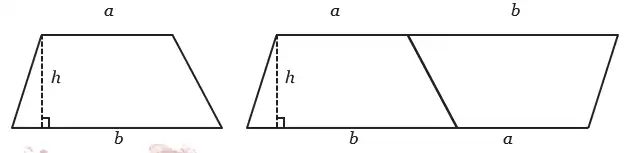
Find the area of a trapezium whose parallel sides are 9 cm and 15 cm and whose height is 8 cm.
- A trapezium has parallel sides of lengths 9 cm and 15 cm, and height 8 cm. Substitute into the area formula.
- Add the parallel sides and multiply by half the height.
Do not use a sloping side as the height. The height must be perpendicular to both parallel sides.
Find the area of a trapezium with parallel sides 11 cm and 17 cm and height 5 cm.
A trapezium has area and parallel sides 10 cm and 20 cm. Find its height.
A trapezium has area , height 7 cm, and one parallel side 12 cm. Find the other parallel side.
Quick recap
- A trapezium’s height is the perpendicular distance between its parallel sides.
- Split it into a rectangle and two triangles to derive its area.
- The area is .
- Two identical trapeziums can be rearranged into a parallelogram of base and height .
- Use only the perpendicular height, not a sloping side.
Area In Real Life
Area of Everyday Surfaces
Area — Area is the amount of surface covered by a two-dimensional shape.
Choosing a unit
- Use: Area measures surfaces such as sheets, tabletops, classrooms, houses and land.
- Scale: Use smaller units such as for small objects and larger units such as or for bigger areas.
- Compare: Convert areas to the same unit before comparing them.
Use for rectangular surfaces such as an A4 sheet.
Converting Inches and Square Inches
| Conversion | Rule |
|---|---|
| Inches to centimetres | |
| Centimetres to inches | |
| Feet to inches |
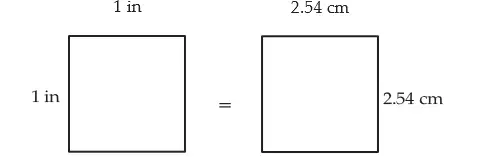
When a length unit is multiplied by a factor, the corresponding area unit is multiplied by the square of that factor.
Useful area conversions
- Square inches to square centimetres: Multiply by ; for example, .
- Square centimetres to square inches: Divide by .
- Square feet to square inches: Since , .
Convert between square units
- Identify the conversion factor between the length units.
- Square the factor to convert the area units.
- Multiply when converting to a smaller unit; divide when converting to a larger unit.
Convert to .
- Convert to square inches.
- Divide by the number of square centimetres in one square inch.
Measuring Larger Areas
| Area scale | Useful unit or conversion |
|---|---|
| Classrooms and houses | or |
| Land | |
| Villages, towns, cities and large regions | |
| Square kilometres to square metres |
Local area units and comparisons
- Local units: Area may also be measured in regional units such as bigha, gaj, katha, dhur, cent and ankanam.
- Compare areas: Express both areas in the same unit, then divide the larger area by the smaller one to find how many times larger it is.
An A4 sheet measures by . Find its area.
Convert to centimetres.
Convert to inches.
Do not use the length conversion factor unchanged for area: square it. For instance, , not .
Quick recap
- Area measures the surface covered; a rectangle has area .
- and .
- ; multiply or divide by this factor for area conversions.
- and .
- .
- Choose units suited to the surface and compare areas only after converting to the same unit.
Summary
Area of a Triangle
Area of a triangle — The area of a triangle is half the product of its base and perpendicular height.
Use the perpendicular height corresponding to the chosen base.
Use when the base and its perpendicular height are known.
Finding triangle area
- Identify the base and its perpendicular height.
- Substitute both measurements into the formula and calculate.
Find the area of a triangle with base 10 cm and perpendicular height 6 cm.
- For base 10 cm and perpendicular height 6 cm, substitute into the formula.
- Calculate the area.
Area of a Polygon by Triangulation
Triangulation — Triangulation finds a polygon's area by dividing it into triangles and adding their areas.
The polygon's area equals the sum of the areas of the non-overlapping triangles that cover it.
Find each triangle's area, then add them.
Triangulating a polygon
- Divide the polygon into non-overlapping triangles.
- Find each triangle's area and add the results.
Find the polygon's area if its three triangular parts have areas 8 cm², 12 cm², and 5 cm².
- A polygon is divided into three triangles with areas 8 cm², 12 cm², and 5 cm².
- Add the triangle areas to get the polygon's area.
Area of a Parallelogram
Area of a parallelogram — A parallelogram's area is the product of its base and perpendicular height.
The height is measured perpendicular to the chosen base.
Use when the base and perpendicular height are known.
Finding parallelogram area
- Identify the base and its perpendicular height.
- Multiply the base by the height.
Find the area of a parallelogram with base 9 cm and height 4 cm.
- For base 9 cm and perpendicular height 4 cm, substitute into the formula.
- Calculate the area.
Area of a Rhombus
Area of a rhombus — A rhombus's area is half the product of the lengths of its diagonals.
The two diagonal lengths are multiplied, then the product is halved.
Use when both diagonals are known.
Finding rhombus area
- Identify the lengths of both diagonals.
- Multiply the diagonals and divide by 2.
Find the area of a rhombus with diagonals 8 cm and 6 cm.
- For diagonals 8 cm and 6 cm, substitute into the formula.
- Calculate the area.
Area of a Trapezium
Area of a trapezium — A trapezium's area is half its height multiplied by the sum of its parallel sides.
Add the lengths of the parallel sides first; the height is the perpendicular distance between them.
Use the two parallel side lengths and the perpendicular height.
Finding trapezium area
- Identify the two parallel sides and the perpendicular height.
- Add the parallel sides, multiply by the height, then divide by 2.
Find the area of a trapezium with parallel sides 5 cm and 9 cm and height 4 cm.
- For parallel sides 5 cm and 9 cm, and height 4 cm, substitute into the formula.
- Calculate the area.
Find the area of a triangle with base 12 cm and perpendicular height 5 cm.
Find the area of a rhombus with diagonals 10 cm and 7 cm.
Find the area of a trapezium with parallel sides 6 cm and 10 cm and height 3 cm.
Quick recap
- Triangle area: half the base times its perpendicular height.
- Polygon area: divide it into triangles and add their areas.
- Parallelogram area: base times perpendicular height.
- Rhombus area: half the product of its diagonals.
- Trapezium area: half the height times the sum of the parallel sides.
Formula sheet
Mathematics — ALL CHAPTERS
1
A Square And A Cube
2
Power Play
3
A Story of Numbers
4
Quadrilaterals
5
Number Play
6
We Distribute, Yet Things Multiply
7
Proportional Reasoning-1
1
Fractions in Disguise
2
The Baudhayana-Pythagoras Theorem
3
Proportional Reasoning-2
4
Exploring Some Geometric Themes
5
Tales by Dots and Lines
6
Algebra Play
7
Area