Class 8 . Mathematics . Ganita Prakash Part II . The Baudhayana Pythagoras Theorem
Chapter 2: The Baudhayana-Pythagoras Theorem
Ch 2
Mathematics
Class 8
Doubling a Square
Constructing a Square with Double the Area
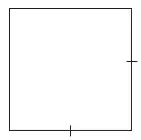
Doubling a square — Constructing a new square whose area is twice the area of a given square.
- Baudhāyana’s result: In the Śulba-Sūtra, c. 800 BCE, Baudhāyana states in Verse 1.9 that a square on a square’s diagonal has double its area.
- Not by doubling the side: Doubling each side multiplies the area by four, since area depends on the square of the side.
- Construction idea: Draw a square using the original square’s diagonal as its side.
For a square with side and diagonal , the Pythagorean theorem gives . The square built on the diagonal therefore has twice the original area.
Use this relation to compare the areas of the new and original squares.
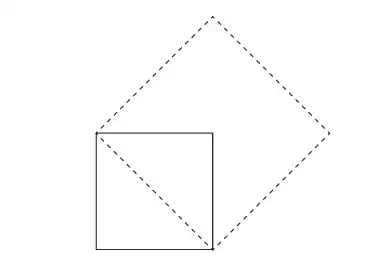
Geometric Explanation
East-west and north-south lines — Baudhāyana’s east-west and north-south lines are horizontal and vertical lines that are perpendicular to each other.
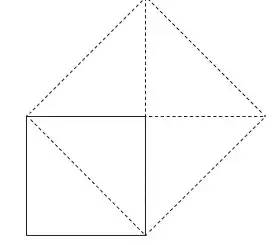
Compare the areas using triangles
- Angle bisectors: The original square’s horizontal and vertical sides bisect angles of the square built on its diagonal, so their extensions pass through that square’s vertices.
- Original square: It contains the area of two of the small congruent triangles.
- Square on the diagonal: It contains four small triangles congruent to those in the original square.
- Area comparison: Four equal-area triangles have twice the area of two, so the diagonal-square has double the original area.
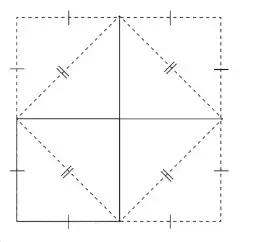
Repeated Doubling and Paper Rearrangement
- Repeated construction: Building a square on the diagonal of each new square doubles the area at every step.
- Triangle count: Successive squares can be represented by , , then congruent small triangles, so each has twice the area of the one before.
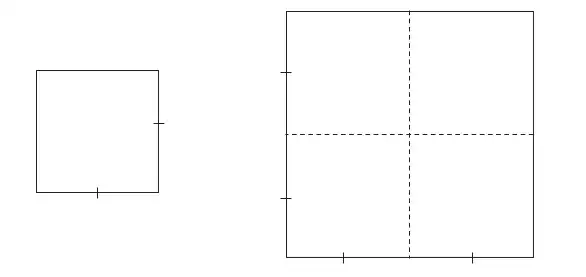
- Paper rearrangement: Pieces cut from two identical squares can be arranged to form a square with twice the area.
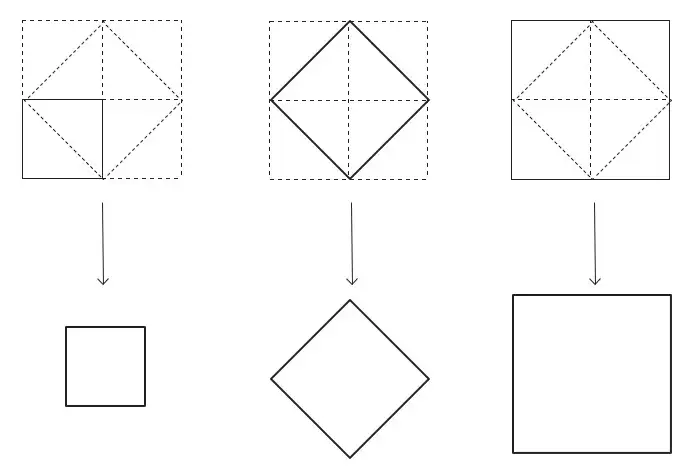
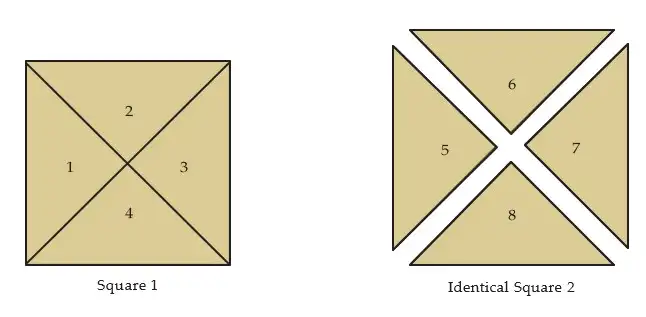
Construct the double-area square
- Draw the given square and mark its diagonal.
- Use the diagonal as the side of a new square.
- The new square has twice the original area.
A square has side length units. Find the side length and area of the square constructed on its diagonal.
- A square has side length units. Find the side length and area of the square constructed on its diagonal.
- Apply the Pythagorean theorem to find the diagonal.
- The area of the new square is the diagonal squared.
- Compare it with the original square’s area.
Do not double the side length to double the area: doubling the side makes the area times as large. Use the original square’s diagonal instead.
A square has side length cm. Find the diagonal and the area of the square constructed on it.
A square has area cm. What is the area of the square constructed on its diagonal?
Quick recap
- Baudhāyana’s Śulba-Sūtra, c. 800 BCE, Verse 1.9, gives the diagonal construction for doubling a square’s area.
- For side and diagonal , .
- A square on the diagonal has twice the original square’s area.
- Doubling a side makes the area four times as large.
- The original square has the area of two congruent small triangles, while the diagonal-square has four.
- East-west and north-south lines are perpendicular horizontal and vertical lines.
- Repeating the diagonal construction doubles the area at each step.
Halving A Square
Constructing a Square with Half the Area
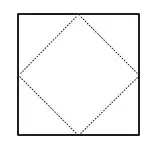
The inner quadrilateral is a square: its diagonals are equal, perpendicular, and bisect one another. Equivalently, the four corner triangles are congruent, so the inner sides are equal.
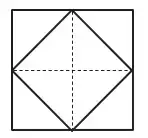
The diagonals of the midpoint square are each the length of the original side, and they meet at right angles. Its area is therefore half the original square’s area.
Use this for the inner square, whose diagonals are perpendicular and equal to the original side.
If the original square has side , the required square has side .
Constructing the half-area square
- Mark the midpoint of every side of the original square.
- Join the midpoints in order to make the inner square.
- Use the original square’s side as both diagonals of the inner square.
A square has side cm. Find the side and area of the square formed by joining its side midpoints.
- Find the side and area of the midpoint square when the original side is cm.
- The midpoint square’s diagonals are each cm, so calculate its area.
- Use the diagonal side relation to find its side length.
Do not halve the side to halve the area: halving the side gives area . Four such smaller squares fit in the original square.
Paper-Folding Explanation
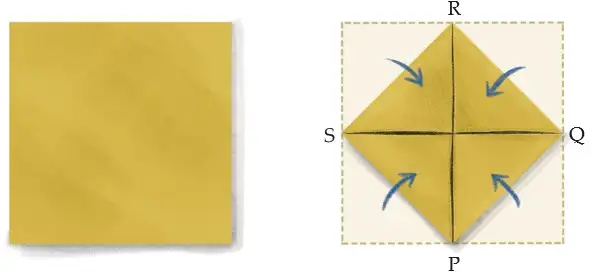
Why folding gives the same result
- Vertices: The crease lines pass through the original square’s side midpoints, which become the vertices of .
- Diagonals: Connecting opposite vertices gives two diagonals equal to the original side; they cross at right angles and bisect each other.
- Conclusion: These diagonal properties show that is a square, and its area is .
The original square has side cm. Find the midpoint square’s side and area.
A midpoint square has area . Find the side of the original square.
Quick recap
- Join the four side midpoints of a square to form a tilted inner square.
- The inner square’s diagonals are perpendicular, equal, and each equal to the original side.
- The midpoint square has half the original area: .
- Its side is , not .
- Halving the side gives one-quarter the area; four such squares fill the original.
Hypotenuse of an Isosceles Right Triangle
The Unit Isosceles Right Triangle
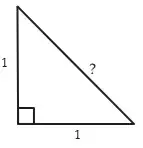
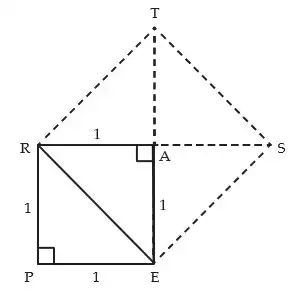
Key idea
- Area relation: Two identical right triangles with legs of length form a square of area ; the square on the hypotenuse has twice that area.
- Hypotenuse: If its length is , then the square on it has area square units.
- Length: Since side lengths are positive, units.
- Unit convention: Unless stated otherwise, all lengths are measured in a fixed unit.
Use the doubled-area relation for the square on the hypotenuse.
Find the unit triangle’s hypotenuse
- Relate the area of the square on the hypotenuse to the square of side .
- Take the positive square root to get the side length.
Find the hypotenuse of an isosceles right triangle whose equal sides are each unit.
- For equal sides of length , use the right-triangle relation.
- Simplify and take the positive square root.
Do not confuse with ; the hypotenuse is .
Bounds and Decimal Representation of
For positive numbers, comparing their squares gives bounds for their square roots. Since , we have .
| Comparison | Bound |
|---|---|
| , , , , |
Why the decimal does not terminate
- Fraction assumption: Suppose , where are counting numbers with no common factor. Then .
- Contradiction: In , the prime occurs an odd number of times on the right and an even number of times in the square .
- Conclusion: cannot be written as a fraction; it is irrational, so its decimal expansion does not terminate.
- Decimal form:
- Proof attribution: Euclid gave this proof in *Elements*, around BCE.
Bound a square root using decimal squares
- Choose two nearby positive decimals.
- Square both decimals and check that the target lies between the squares.
- The square root lies between the chosen decimals.
Show that lies between and .
- Square the endpoints.
- Since is between these squares, the positive square root is between the endpoints.
General Relation for an Isosceles Right Triangle
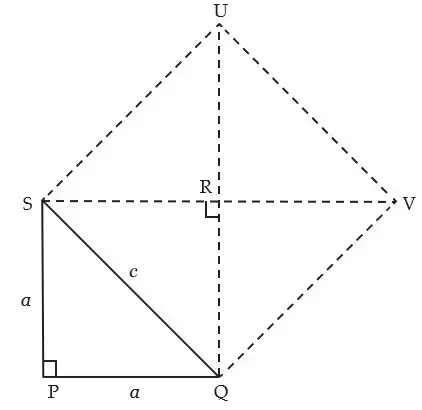
The square on the hypotenuse has twice the area of the square on either equal leg.
Use the positive square root because side lengths are positive.
Use the relation
- Substitute the known leg or hypotenuse into the relation.
- If the leg is known, solve for ; if the hypotenuse is known, solve for .
- For decimal bounds, compare with nearby decimal squares.
Find bounds for the hypotenuse when each equal side is units. Also find the equal sides when the hypotenuse is units.
- For equal sides of length , substitute .
- Write the hypotenuse as a square root and compare with perfect squares.
- Thus the hypotenuse is between and units.
- For hypotenuse , solve the same relation for .
An isosceles right triangle has equal sides of length . Find bounds for its hypotenuse to one decimal place.
The hypotenuse of an isosceles right triangle is . Find its other two sides.
If each equal side is , find bounds for the hypotenuse to one decimal place.
Quick recap
- For unit legs, the hypotenuse is units because its square is .
- ; compare decimal squares with to find closer bounds.
- cannot be expressed as a fraction, so its decimal expansion does not terminate.
- For equal legs and hypotenuse , .
- Use to find the hypotenuse and to find either equal leg.
Combining Two Different Square Part-1
Combining Two Different Squares
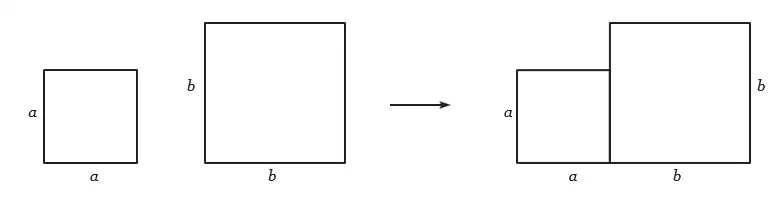
Combining two squares — Forming one square whose area equals the sum of the areas of two given squares.
Key idea
- Equal squares: If each has side , the combined area is ; the new square’s side is the diagonal of either original square.
- Different squares: Use their side lengths as the perpendicular sides of a right triangle.
- Result: The hypotenuse is the side of a square whose area equals the sum of the two original square areas.
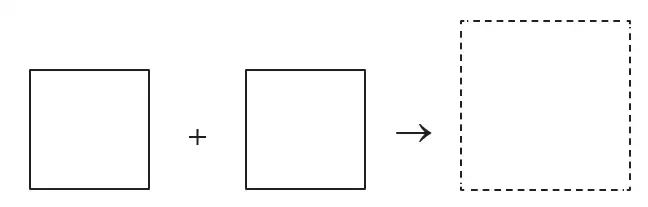
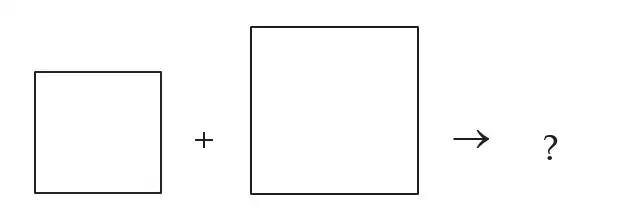
In a right triangle, the square on the hypotenuse has area equal to the sum of the squares on the perpendicular sides. Baudhāyana states this result in the Śulba-Sūtra, Verse 1.12.
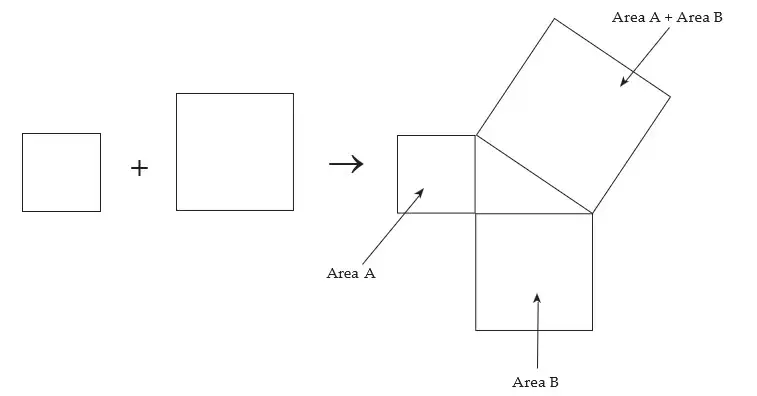
Use when the perpendicular sides are the side lengths of the two given squares.
Constructing the combined square
- Take the two square side lengths as the perpendicular sides of a right triangle.
- Use the area relationship to find the hypotenuse.
- Construct a square with the hypotenuse as its side; its area is the sum of the original square areas.
Why the Rearrangement Works
Geometric explanation
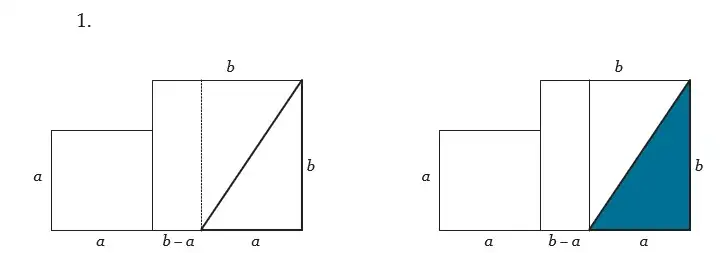
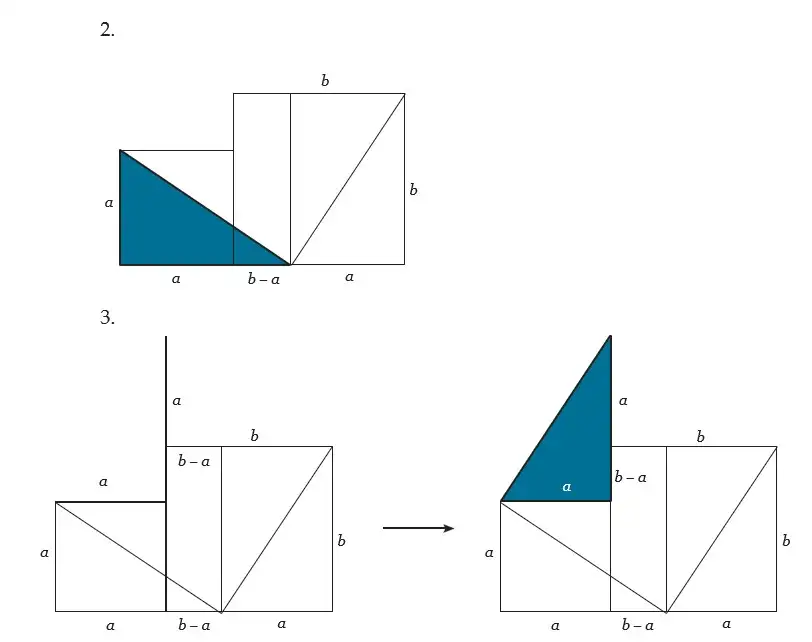
- Baudhāyana’s construction: In the Śulba-Sūtra, Verse 2.1, he explains how to mark a rectangular portion of the larger square using a side of the smaller one; the rectangle’s diagonal gives the combined-square side.
- Right triangle: The rectangle’s sides are and , so its diagonal is the hypotenuse .
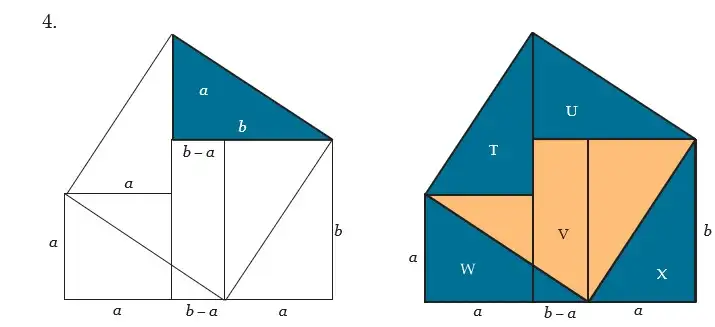
- Rearrangement: Four congruent copies of this right triangle are rearranged to form a four-sided figure on the hypotenuse, without changing the total area.
- Equal sides: The sides of the new four-sided figure are hypotenuses of congruent triangles, so all four sides are equal.
- Right angles: If the triangle’s acute angles are and , then ; each inner angle is .
- Conclusion: Equal sides and four right angles make the new figure a square; its area equals the sum of the original two square areas.
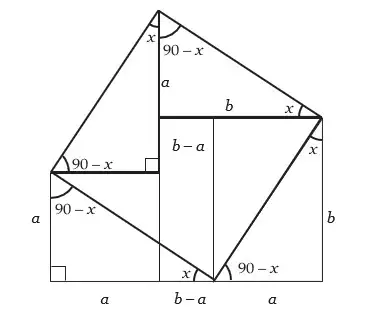
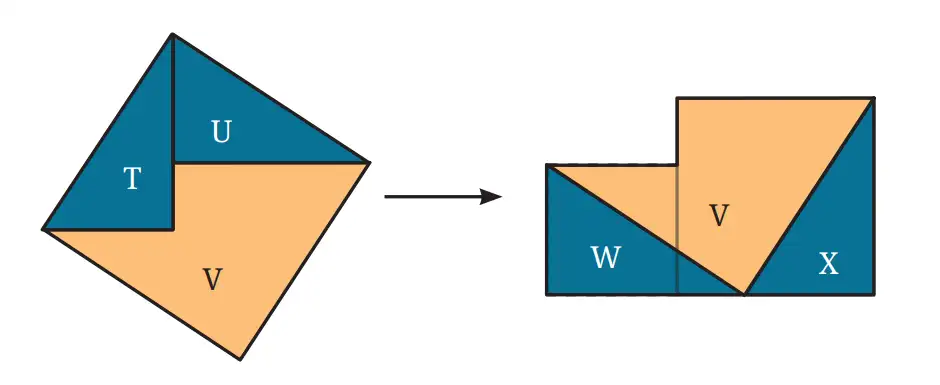
Find the side length and area of the square formed from squares with side lengths and units.
- Use the square side lengths as the perpendicular sides.
- Apply the theorem to find the hypotenuse squared.
- Take the positive square root to get the combined square’s side.
- Check that the combined area equals the sum of the original areas.
Do not add the side lengths to get the new side. Add the square areas, then take the square root: .
Two squares have side lengths cm and cm. Find the side length of the square with their combined area.
A right triangle has perpendicular sides of lengths m and m. What is the area of the square on its hypotenuse?
Quick recap
- The square on a right triangle’s hypotenuse has area .
- To combine two square areas, use their side lengths as perpendicular sides of a right triangle.
- The hypotenuse is the side length of the square with the combined area.
- Baudhāyana states the theorem in Śulba-Sūtra Verse 1.12 and gives a geometric explanation in Verse 2.1.
- The rearrangement preserves area; equal sides and four right angles establish that the resulting figure is a square.
Combining Two Different Square Part-2
Baudhayana–Pythagoras Theorem
For a right-angled triangle with hypotenuse and shorter sides and , the sum of the squares on the shorter sides equals the square on the hypotenuse.
Use the first form to find the hypotenuse; rearrange it to find a shorter side.
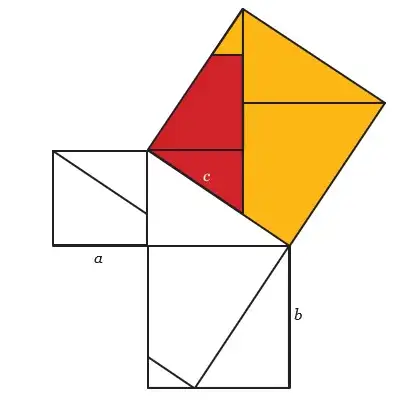
Find a missing side
- Identify the hypotenuse; it is always opposite the right angle and is the longest side.
- Substitute the known side lengths into the theorem.
- Rearrange for the unknown side, then take the positive square root.
Find the hypotenuse.
- A right triangle has shorter sides of and . Let its hypotenuse be .
- Apply the theorem.
- Add the squares.
- Take the positive square root.
Do not use the hypotenuse as one of the shorter sides: it is the side opposite the right angle. When finding a shorter side, subtract the other shorter-side square from .
Constructing squares with multiplied areas
- Triple the area: For a given square of side , use its diagonal, of length , and a side as the legs of a right triangle. Its hypotenuse is , so the square on it has area .
- Five times the area: Use lengths and as the legs of a right triangle. Its hypotenuse is , so the square on it has area .
A right triangle has shorter sides and . Find its hypotenuse.
A right triangle has hypotenuse and one shorter side . Find the other shorter side.
Find the missing side in each right triangle: (i) ; (ii) ; (iii) ; (iv) ; (v) .
Quick recap
- In a right triangle, , where is the hypotenuse.
- The theorem states that the area of the square on the hypotenuse equals the combined areas of the squares on the shorter sides.
- Find the hypotenuse with .
- Find a shorter side by subtracting the other shorter-side square from .
- A - right triangle has hypotenuse .
- Right-triangle constructions can produce squares with three or five times a given square’s area.
Right–Triangles Having Integer Side lengths
Baudhayana Triples
Baudhayana triple — Three positive integers that are the side lengths of a right triangle and satisfy form a Baudhayana triple.
Names and Examples
- Other names: Baudhayana-Pythagoras triples, Pythagorean triples, or right-angled triangle triples.
- Examples: , , , , and .
- Side roles: is the hypotenuse; the two legs and can be interchanged.
- All sides at most : , , , , and .
Use this equation to test whether three positive integers form a Baudhayana triple.
Verify that is a Baudhayana triple.
- Test the two smaller sides against the largest side.
- The equation holds, so the three integers form a Baudhayana triple.
Scaling Triples
If is a Baudhayana triple, then is also a Baudhayana triple for every positive integer .
Multiply all three side lengths by the same positive integer.
Is a Baudhayana triple?
- Scale by .
- Check the Pythagorean equation.
Primitive Triples
Primitive Baudhayana triple — A Baudhayana triple is primitive if its three side lengths have no common factor greater than .
Classifying and Reducing Triples
- Primitive examples with sides at most : , and .
- Non-primitive examples: , and share a factor greater than .
- Reduction: If all sides share a factor , dividing each by preserves the equation.
- Strategy: Find primitive triples first, then scale them to obtain other triples.
If is a Baudhayana triple and divides all three sides, then is also a Baudhayana triple.
| Primitive triple | Scaled versions for |
|---|---|
| , , , , | |
| , , , , | |
| , , , , |
Scaling by preserves the Baudhayana-triple property but makes the result non-primitive, since all three sides share the factor .
Show that reducing gives another Baudhayana triple.
- Find the common factor of the three sides.
- Divide every side by .
- Check the reduced triple.
Generating Triples from Odd Squares
The sum of the first positive odd numbers is .
If is an odd integer with , set . The identity gives a Baudhayana triple.
Use an Odd Square to Generate a Triple
- Choose an odd square with odd root .
- Solve for the position of this odd number.
- Use the identity to read off the three side lengths.
Generate a Baudhayana triple using the odd square .
- Use the odd square and find its position among the odd numbers.
- Apply the identity with .
- Read off the triple and verify it.
What the Odd-Square Method Produces
- Examples: Roots give , , , , , and ; reorder the legs if needed.
- Primitive: Every triple from this method is primitive: the first and third sides differ by , so they have no common factor greater than 1; the middle side is coprime to them.
- Not exhaustive: The method does not generate every primitive triple; for example, is primitive, but neither leg is one less than the hypotenuse.
- Pattern: One leg generated by the method is always exactly less than the hypotenuse.
Use the odd-square method with to generate a Baudhayana triple.
Does the odd-square method give a non-primitive triple when ?
Give a primitive Baudhayana triple that the odd-square method does not generate.
Quick recap
- A Baudhayana triple satisfies .
- Multiplying all three sides by the same positive integer gives another triple and infinitely many triples.
- A primitive triple has no common factor greater than ; dividing a triple by a common factor preserves the property.
- The first odd numbers sum to , and the th odd number is .
- An odd square , for odd , gives the triple .
- The odd-square method produces primitive triples, but does not generate every primitive triple.
A Long-Standing Open Problem
From Baudhāyana Triples to Fermat’s Question
Does contradict Fermat’s Last Theorem?
- Check whether give a solution for exponent .
- The example is a solution only for exponent , not an exception to the theorem for .
State Fermat’s Last Theorem using its equation.
A student claims that is a counterexample to Fermat’s Last Theorem. Is the claim correct?
Quick recap
- Baudhāyana triples show that some squares are sums of two squares.
- Fermat asked whether the same pattern holds for cubes and higher powers.
- Fermat’s Last Theorem says has no positive-integer solutions for .
- The exponent is excluded; for example, .
- Andrew Wiles resolved to prove the theorem in 1963 and proved it in 1994.
Further Applications of the Baudhāyana-Pythagoras Theorem
Solving a Problem About a Lotus
In a right triangle, the square of the hypotenuse equals the sum of the squares of the other two sides.
Use when the stem is assumed to be perpendicular to the water surface in its original position.
Solve the lake problem
- Identify the three sides of the right triangle.
- Substitute into the theorem and simplify.
- Solve for the underwater length.
A lotus stem rises one unit above the water. Its tip touches the water three units from its original position. Find the lake's depth.
- Let the underwater length be ; the full stem is one unit longer.
- Apply the theorem using the horizontal distance and underwater length as the legs.
- Expand and cancel the matching terms.
- Solve for the depth.
Diagonals and Side Lengths
For a square of side , use the first formula. For a rhombus with diagonals and , use the second.
Find a rhombus side from its diagonals
- Halve both diagonal lengths.
- Use the two halves as the perpendicular legs of a right triangle.
- Take the positive square root to find the side.
Find the side of a rhombus whose diagonals are units and units.
- Halve the diagonals.
- Apply the theorem to the right triangle formed by the half-diagonals and a side.
- Take the positive square root.
In a right triangle, the hypotenuse is longer than either leg because its square is the sum of two positive squares.
Baudhayana Triples and Integer Rectangles
Every Baudhayana triple is either primitive or a scaled version of a primitive triple.
| Rectangle sides | Diagonal |
|---|---|
Give an integer-sided rectangle with an integer diagonal using the triple .
- Check whether the three integers satisfy the right-triangle condition.
- Use them as the rectangle's sides and diagonal.
Constructing a Square from a Difference of Areas
If , a right triangle with hypotenuse and one leg has a remaining leg whose square is the required area.
Construct a square whose area equals the difference between the areas of squares with sides units and units.
- Use as the hypotenuse and as one leg.
- Find the area of the required square.
- The side of the required square is the remaining leg.
Squares with Vertices on a Grid
For integer side-vector components and , the square's area is ; a non-degenerate square requires .
Can grid squares have areas and square units?
- Choose integer grid steps of one unit horizontally and two units vertically.
- Find the square's area from the side vector.
- For area , the only available integer squares not exceeding it are and ; no two of them sum to .
Area of an Equilateral Triangle
Use these formulas for an equilateral triangle of side .
Find the area of an equilateral triangle with side length units.
- The altitude bisects the side opposite it.
- Use the theorem to find the height.
- Calculate the triangle's area.
Find the diagonal of a square with side length cm.
Is every Baudhayana triple primitive? Explain using the triple .
Can a square with all vertices on grid points have area square units?
Quick recap
- Model the lotus problem as a right triangle: , so the lake is units deep.
- A square with side has diagonal ; a rhombus side follows from its perpendicular half-diagonals.
- The hypotenuse is always the longest side of a right triangle.
- Every Baudhayana triple is primitive or an integer multiple of a primitive triple; such triples give integer-sided rectangles with integer diagonals.
- The difference of two square areas can be constructed as the square on the remaining leg of a right triangle.
- Grid-square areas are positive sums of two integer squares, and an equilateral triangle has area .
Summary
The Baudhayana-Pythagoras Theorem
A right-angled triangle has shorter sides of lengths and . Find its hypotenuse.
- Use the theorem with the two legs and .
- Add the squares and take the positive square root.
Do not use the theorem with the hypotenuse as one of the two shorter sides; first identify the side opposite the right angle.
Isosceles Right Triangle and
An isosceles right triangle has legs of length . Find its hypotenuse.
- Apply the isosceles right-triangle relation with .
- Use for an approximate length.
Baudhayana-Pythagoras Triples
Check whether is a Baudhayana-Pythagoras triple.
- Square the first two entries and add.
- Square the third entry and compare.
Fermat’s Last Theorem
Do satisfy the equation ?
- Evaluate the left-hand side for exponent .
- Compare it with the right-hand side.
A right-angled triangle has legs of lengths and . Find the hypotenuse.
Check whether is a Baudhayana-Pythagoras triple.
Can positive integers satisfy ?
Quick recap
- For a right-angled triangle, the sum of the squares of the legs equals the square of the hypotenuse: .
- An isosceles right triangle with legs has hypotenuse .
- lies between and and cannot be expressed as a fraction of positive integers.
- A positive-integer solution to is a Baudhayana-Pythagoras triple.
- Scaling a triple by a positive integer produces another triple, so infinitely many can be constructed.
- Fermat’s Last Theorem states that has no positive-integer solutions for ; Andrew Wiles proved it in .
Formula sheet
Mathematics — ALL CHAPTERS
1
A Square And A Cube
2
Power Play
3
A Story of Numbers
4
Quadrilaterals
5
Number Play
6
We Distribute, Yet Things Multiply
7
Proportional Reasoning-1
1
Fractions in Disguise
2
The Baudhayana-Pythagoras Theorem
3
Proportional Reasoning-2
4
Exploring Some Geometric Themes
5
Tales by Dots and Lines
6
Algebra Play
7
Area