Class 8 . Mathematics . Ganita Prakash Part I . Power Play
Chapter 2: Power Play
Ch 2
Mathematics
Class 8
Experiencing the Power Play
Repeated Folding and Exponential Growth
- Doubling: Each fold doubles the paper’s thickness, so growth is multiplicative.
- Formula: After n folds, thickness is 0.001 × 2ⁿ cm.
- Rapid growth: After 30 folds, the thickness is about 10.7 km; after 46 folds, it exceeds 700,000 km.
Quick recap
- Every fold doubles the thickness.
- After folds, thickness is .
- In folds, the thickness is multiplied by .
- Ten folds multiply thickness by .
- After folds, thickness is about .
- After folds, thickness is more than .
Exponential Notation and Operations
Writing Repeated Multiplication as Powers
Exponential notation — A repeated product of the same factor is written as a power: means that is multiplied by itself times.
Base, exponent, and reading powers
- Base: The repeated factor; in , the base is .
- Exponent (power): Counts how many times the base is used as a factor; in , it is .
- Reading: is “ squared,” is “ cubed,” and is “5 to the power 4” or “the fourth power of 5.”
- Powers of 5: Expressions such as are called powers of 5.
- Multiple bases: ; count each repeated factor separately.
- Signs: A negative base raised to an odd power gives a negative result; raised to an even power it gives a positive result.
- Zero base: For a positive counting number , .
Use when one factor is repeated.
Convert a repeated product to a power
- Identify the repeated factor.
- Count how many times it occurs; this is the exponent.
- Write the factor as the base and the count as its exponent.
Write the thickness of a sheet after 10 folds in exponential form.
- A sheet doubles in thickness with each fold. If its initial thickness is , after 10 folds:
- So the thickness is multiplied by .
Folding and powers
- Doubling: After folds, the thickness is the initial thickness multiplied by .
- Example: Starting at cm, after 7 folds the thickness is cm.
Do not confuse repeated addition with repeated multiplication: , but .
Prime Factors in Exponential Form
Prime factorisation — Writing a number as a product of prime numbers, with repeated primes grouped as powers.
- Exponent: The exponent of each prime tells how many times that prime occurs.
- Form: A prime factorisation can be written as , where and are primes.
Find a prime factorisation
- Divide the number by prime numbers until the quotient is .
- List all prime factors, including repetitions.
- Group matching primes and write each group as a power.
Express as a product of prime powers.
- Write as a product of its prime factors.
- Group the equal primes and count each group.
Multiplying Powers with the Same Base
Product of powers — When powers with the same base are multiplied, keep the base and add the exponents.
For powers with the same base, the combined exponent is the sum of the original exponents.
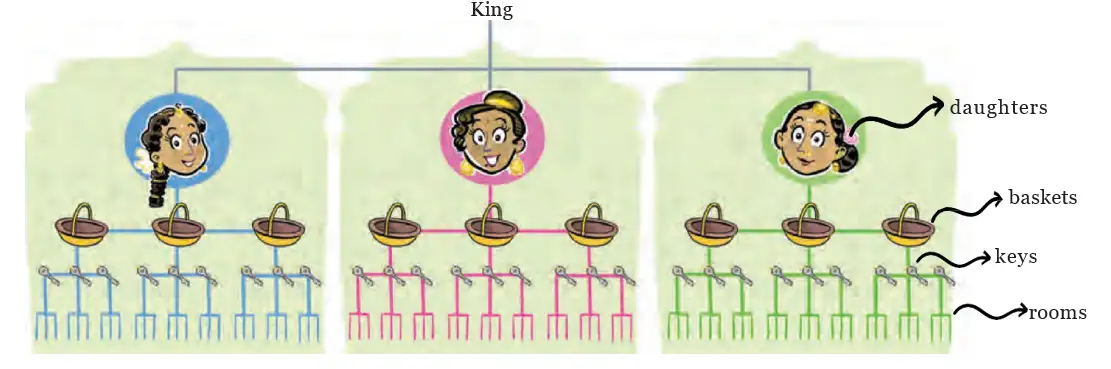
Repeated multiplication in a branching pattern
- Rooms: Three choices at each of four stages give rooms.
- Diamonds: The seven stages in the story give diamonds.
- Evaluation: Split the seven factors into groups of four and three: .
Use this law only when the bases are the same.
Simplify a product of powers
- Check that the powers have the same base.
- Keep the base unchanged and add the exponents.
Evaluate using the product law.
- Split the seven factors of into groups of four and three.
- Evaluate and multiply the grouped powers.
Do not add exponents when the bases differ. The product law requires the same base.
A Power Raised to a Power
Power of a power — A power raised to another power means the original power is multiplied by itself repeatedly.
When a power is raised to another power, multiply the exponents. The order of the exponents does not change the result.
Use when a power is enclosed in parentheses and raised to another exponent.
Rewrite as a power of a power
- Find two factors whose product is the original exponent.
- Use those factors as the inner and outer exponents.
Write as a power of a power in two ways and evaluate it.
- Group ten factors of into five pairs.
- Alternatively, group them into two groups of five.
- Both forms evaluate to the same number.
For , multiply the exponents; do not add them. The result is .
Write in exponential form.
Express as a product of prime powers.
Simplify and evaluate .
Quick recap
- means that is used as a factor times; is the base and is the exponent.
- Expressions such as are called powers of 5.
- A negative base raised to an odd exponent is negative; with an even exponent it is positive.
- Prime factorisation groups repeated prime factors into powers.
- For the same base, multiply powers by adding exponents: .
- For a power raised to a power, multiply exponents: .
Magical Pond
Repeated Doubling and Powers
Use when the starting amount is lotus on day .
Find the amount after repeated doubling
- Identify the starting amount and the number of doublings.
- Write the starting amount multiplied by once for each doubling.
- For the pond, compare consecutive days: the amount on day is half the amount on day .
A pond has one lotus on day 1, and the number doubles daily. Write the number of lotuses on days 30 and 29 in exponential form.
- Assume there is lotus on day ; write the amount on day .
- The amount on day is half the day- amount.
Powers with the Same Exponent
For a counting-number exponent :
Simplify powers with the same exponent
- Check that the exponents are equal.
- Multiply or divide the bases, keeping the exponent unchanged.
- Evaluate the resulting power if required.
Simplify .
- Apply the product law to combine the bases.
- Evaluate the power.
Do not add the bases or multiply the exponents in ; combine the bases and keep the exponent: .
Counting Combinations

Use for choices made across separate stages.
Count combinations
- List each stage of choice.
- Count the options at each stage.
- Multiply to get the total number of combinations.
Roxie has 7 dresses, 2 hats and 3 pairs of shoes. How many different outfits can she make?
- Multiply the choices for dresses, hats and shoes.
- Evaluate the product.
Passwords and Repeated Choices
If each of slots has choices, the total is .
Count possible passwords
- Find the number of choices for one slot.
- Find the number of slots.
- Raise the choices per slot to the number of slots.
How many five-digit passwords can be made using digits to ?
- There are digit choices for each of the five slots.
- Write the product as a power and evaluate.
Simplify and write the answer in exponential form.
Estu has 4 dresses and 3 caps. How many different dress-and-cap combinations are possible?
A lock has 6 slots, and each slot can contain any letter from A to Z. How many passwords are possible?
Quick recap
- A pond that doubles daily and is full on day was half full on day .
- With lotus on day , the amount on day is .
- For equal exponents, and .
- For independent choices across stages, multiply the number of options at each stage.
- A password with slots and choices per slot has possibilities.
- Allow leading zeros when counting password codes.
The Other Side of Powers
Dividing Powers and the Zero Exponent
Use these rules for equal non-zero bases.
Simplifying a quotient of powers
- Confirm the bases match and are non-zero.
- Subtract the exponents in numerator-minus-denominator order.
- Evaluate the resulting power if needed.
Evaluate .
- Apply the division law.
- Use the zero-exponent rule.
Negative Exponents
The base must be non-zero.
Write as a fraction.
- Rewrite as a reciprocal.
- Evaluate the denominator.
- Simplify the fraction.
A negative exponent does not make the value negative: , not .
Exponent Rules and Power Lines
These are the general forms presented in the lecture; its extension to all integer exponents is posed as a question.
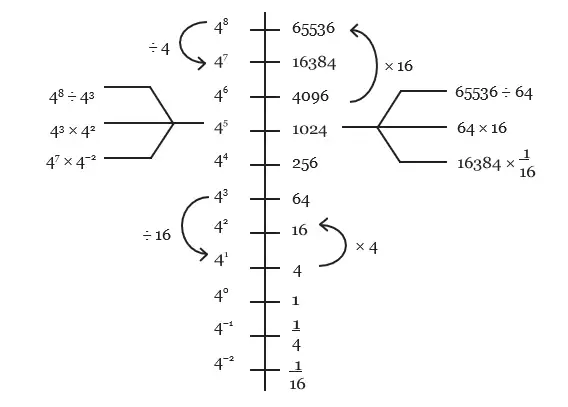
How many times larger is than ?
- Divide the powers to compare their sizes.
- Evaluate the power difference.
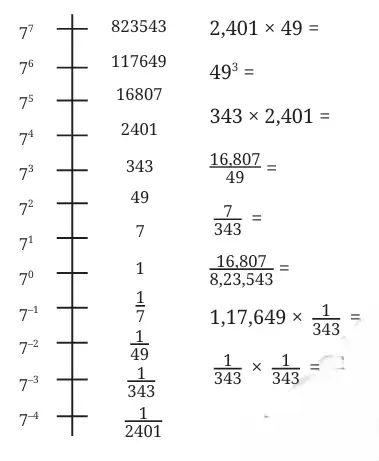
Simplify .
Write as a fraction.
How many times larger is than ?
Quick recap
- For equal non-zero bases, divide powers by subtracting exponents.
- A non-zero number raised to zero equals .
- A negative exponent means take the reciprocal: .
- For like bases, multiply by adding exponents; raise a power to a power by multiplying exponents.
- To compare powers on a power line, divide them and use the exponent difference.
- The lecture poses, but does not establish, whether the general exponent rules extend to all integers.
Powers of 10
Place Value as Powers of 10
Powers of 10 — Powers of express the place value of each digit, including digits after the decimal point.
Place-value powers
- Whole-number places: Moving left from the ones place gives .
- Decimal places: Moving right after the decimal point gives .
- Powers: ; negative powers are reciprocals, such as .
Multiply each digit by the power of for its place, then add the terms.
Expand a number using powers of 10
- Match each digit to the power of for its place.
- Multiply each digit by its place-value power.
- Add the products; a zero digit contributes zero.
Write as a sum using powers of .
- Write as a sum using powers of .
- Assign each digit its place-value power.
- The hundredths-place digit is zero, so its term contributes nothing.
Write as a sum using powers of .
Scientific Notation
Scientific notation (standard form) — A number is written as , where and is an integer.
Reading and interpreting standard form
- Coefficient: is at least and less than ; it gives the leading digits.
- Exponent: The integer indicates the scale of the number and is often more important than the coefficient.
- Precision: More digits in the coefficient can indicate a more precise estimate; is more precise than .
- Examples: , , and .
- Large quantities: The Sun-to-Milky-Way-centre distance is about ; the galaxy has about stars; Earth's mass is about .
Use this form to write very large or very small numbers compactly.
To make the coefficient lie between and , moving the decimal point left gives a positive exponent; moving it right gives a negative exponent.
Write a number in scientific notation
- Place the decimal point after the first non-zero digit.
- Count the places moved: left means a positive exponent; right means a negative exponent.
- Write the coefficient multiplied by to that exponent.
Write in scientific notation.
- Write in scientific notation.
- Move the decimal point places left to leave one non-zero digit before it.
- Check that the coefficient is in the required range.
Comparing distances
- Compare exponents first: A number with exponent is smaller than numbers with exponent .
- Compare equal exponents: Compare the coefficients; , so the Sun-to-Saturn distance is less than the Saturn-to-Uranus distance.
| Distance | Scientific notation |
|---|---|
| Sun to Saturn | |
| Saturn to Uranus | |
| Sun to Earth |

Write in standard form.
Which is the smallest: the Sun-to-Saturn, Saturn-to-Uranus or Sun-to-Earth distance?
Do not leave the coefficient outside ; for example, write as , not .
Quick recap
- Whole-number places use powers ; decimal places use negative powers.
- Scientific notation has the form , where and is an integer.
- For large numbers, moving the decimal point left produces a positive exponent.
- The exponent shows scale; the coefficient's digits can indicate precision.
- Compare numbers in scientific notation by exponents first, then coefficients if the exponents match.
Did You Ever Wonder
Making Reasonable Estimates
A Quick Estimation Method
- Make an instinctive guess before calculating.
- Describe how the quantities are related.
- Make reasonable assumptions for missing information.
- Calculate an estimate and compare it with your first guess.
Estimating the Worth of a Weight-Based Donation
Tulābhāra or Tulābhāram — An offering of goods equal in weight to a person; it is still practised in many places in Southern India.
- Purpose: Tulābhāra symbolises bhakti (surrendering oneself), expresses gratitude, and can support the community.
- Context for estimates: Roxie is 13 years old and Estu is 11; their actual weights and the goods’ prices must be assumed or found.
- Worth: Donation worth depends on the person’s weight and the cost per kilogram of the good.
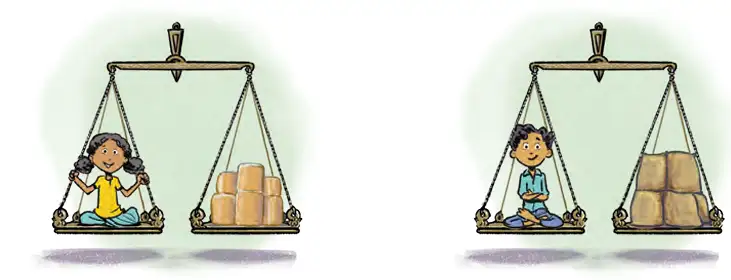
Use when the price per kilogram is known or reasonably estimated.
Using these assumptions, estimate the worth of jaggery equal to Roxie’s weight and wheat equal to Estu’s weight.
- Assume Roxie weighs 45 kg and jaggery costs Rs. 70 per kg.
- Assume Estu weighs 50 kg and wheat costs Rs. 50 per kg.
Estimating Coins and Offerings
- Coins or notes: To match a person’s weight, divide the person’s mass by the mass of one coin or note; multiply the item count by its denomination to find the money’s value.
- Notebooks: Estimate the number by dividing the donation’s value by the cost of one notebook.
- Annadāna: Estimate the number of people served by dividing the donation value by the estimated meal cost per person.
- Assumptions matter: Coin or note mass, item prices, and per-person costs may need to be estimated.
Use consistent units for mass and divide a total by the value or mass of one item/person.
Estimating Walking Time and Distance
- Pādayātra: Estimate journey duration from the distance and a reasonable average distance walked per day.
- Circumnavigation: Estimate how many times a person could walk around Earth by dividing total walking distance by Earth’s circumference.
- Given circumference: Use 40,000 km for the distance around Earth.
- Idealisation: A non-stop lifetime-walking estimate is a mathematical model, not a realistic walking schedule.

Use average speed or daily distance to estimate travel time, and divide total distance by Earth’s circumference for circuits.
Assume Roxie weighs and one-rupee coins weigh each. How many coins match her weight, and what is their total value?
If a pādayātra covers about and walkers average per day, estimate the journey duration.
Assume someone walks continuously at for years, using days per year. If Earth’s circumference is , estimate the number of circuits.
Do not treat an estimate as exact: state your assumptions, use consistent units, and remember that different reasonable assumptions can produce different answers.
Quick recap
- Estimate by guessing first, modelling the quantities, making reasonable assumptions, and calculating.
- Donation worth = weight in kilograms × cost per kilogram.
- Tulābhāra or Tulābhāram is a weight-equal offering still practised in parts of Southern India; it expresses bhakti, or surrendering oneself, gratitude, and community support.
- For coins, notes, notebooks, or meals, divide the total mass or value by the mass, price, or cost per person.
- Travel time = distance ÷ speed; Earth circuits = total distance ÷ 40,000 km.
- Estimates depend on assumptions, so keep units consistent and treat results as approximate.
Linear Growth vs. Exponential Growth
Linear Growth
If the starting value is and the fixed increase is , then after steps the value is .
Use when the same amount is added at each step.
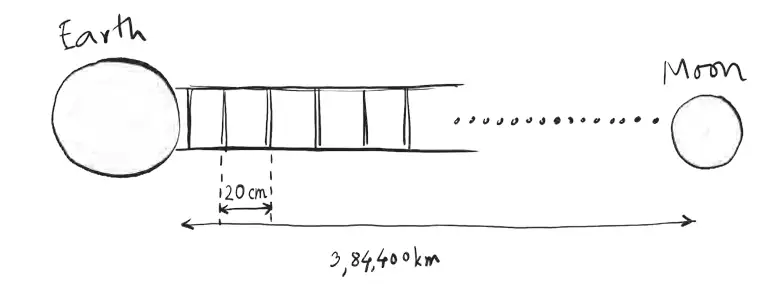
Find the number of ladder steps
- Convert the total distance into the same unit as the step length.
- Divide the total distance by the length of one step.
- Write the result in Indian place-value notation.
How many steps are needed to cover ?
- Find the number of steps in the Earth–Moon distance of .
- Divide by the length of one step.
Exponential Growth
If the starting value is and the fixed multiplier is , then after steps the value is .
For doubling, the multiplier is .
What expression gives the paper's thickness after folds?
- A paper starts at thickness units and doubles with every fold. Write its thickness after folds.
- There are factors of , so use the exponential rule.
| Point | Linear growth | Exponential growth |
|---|---|---|
| Change each step | Add the same amount | Multiply by the same factor |
| Pattern | Additive | Multiplicative |
| Lecture example | added per ladder step | Paper thickness doubles with each fold |
Examples from the Chapter
- Exponential growth examples: “The Stones that Shine”, “Magical Pond” and “How Many Combinations”.
- Key contrast: Covering the Earth–Moon distance takes linear steps, but the paper-folding example uses doublings.
Do not confuse adding the same amount with multiplying by the same factor: fixed addition is linear growth; repeated multiplication is exponential growth.
A pattern starts at and increases by each step. What is its value after steps, and what type of growth is it?
A quantity starts at and doubles at each step. What is its value after steps, and what type of growth is it?
Quick recap
- Linear growth adds the same fixed amount at each step.
- Exponential growth multiplies by the same fixed factor at each step.
- Linear rule: ; exponential rule: .
- A -step ladder to the Moon needs steps.
- In the paper-folding example, each fold doubles thickness; folds correspond to repeated multiplication by .
Getting a Sense for Large Numbers Part-1
Powers of 10 and scientific notation
Power of 10 — A power of describes a place-value scale in the base-ten number system.
Key ideas
- Positive powers: For a positive whole number , is followed by zeros.
- Zero power: ; for example, rhinos can be written as .
- Scientific notation: Write a number as , where and is an integer.
- Approximation: A count can be rounded to a nearby power of , such as .
| Name | Indian system | International system |
|---|---|---|
| Lakh / million | lakh | million |
| Crore | crore | — |
| Arab / billion | arab | billion |
| Kharab / trillion | kharab arab | trillion billion |
| Neel | neel | trillion |
| Padma / quadrillion | padma | quadrillion |
Use this form to express very large counts compactly.
Writing a number in scientific notation
- Place the decimal after the first non-zero digit.
- Count how many places the decimal moved; this is the exponent of .
- Check that the coefficient is at least and less than .
How can the estimated global starling population of billion be written in scientific notation?
- Write the estimated global starling population of billion in scientific notation.
Examples of very large populations and quantities
Population estimates
- Estimates: These counts are approximate and may refer to different years.
- Scale: The exponent shows the order of magnitude; the coefficient gives the count at that scale.
| Count or quantity | Estimate |
|---|---|
| Northern white rhinos (mid-2025) | |
| Hainan gibbons (early 2024) | |
| Kakapo (mid-2025) | |
| Komodo dragons | Fewer than ; approximately |
| Maned wolves (2005 estimate) | More than ; approximately |
| African elephants (2018 estimate) | lakh |
| American alligators (2025 estimate) | million |
| Camels worldwide | More than crore / million ; India has about lakh |
| Horses worldwide | About crore / million ; about half are in America |
| Water buffaloes worldwide | More than crore / million ; most are in Asia |
| Starlings worldwide | arab / billion |
| Humans worldwide (2025) | arab / billion |
| Chickens living at any time | About billion |
| Trees worldwide (2023 estimate) | kharab / trillion |
| Mosquitoes worldwide (2023 estimate) | neel / trillion |
| Antarctic krill | neel / trillion |
| Beetles and earthworms | About padma / quadrillion each |
| Ants worldwide | padma / quadrillion ; ants alone outweigh all wild birds and wild mammals combined |
| Grains of sand on Earth's beaches and deserts | Supposed estimate: ; enough to give every ant little sand castles |
| Stars in the observable universe | About |
| Drops of water on Earth | About , assuming drops per millilitre |
Comparing and combining large counts
Comparison using powers of 10 — Division compares two large counts, while multiplication combines counts or scales a quantity.
Key rules
- Division: Divide the total counts to find how many of one group correspond to each member of another.
- Multiplication: If each item contributes the same amount, multiply the number of items by the amount per item.
- Powers of 10: When multiplying, add exponents; when dividing, subtract exponents.
Use these rules when the numbers are expressed as coefficients multiplied by powers of .
Comparing two large counts
- Write both counts in scientific notation.
- Divide the coefficients and subtract the exponents.
- State the result with its meaning and units.
With about people and African elephants, how many people are there for every elephant?
- Divide the approximate number of people by the number of African elephants.
- Divide the coefficients and subtract the exponents.
- Interpret the result as people per elephant.
Using ants and people, estimate the number of ants per person in scientific notation.
If a flock of starlings contains birds, how many flocks could there be among starlings?
If each of the trees has about leaves, estimate the total number of leaves.
The number of sheets needed to reach the Moon cannot be found from the information given: the Moon's distance and the thickness of each sheet are also needed.
Quick recap
- A power of expresses place value, and .
- Scientific notation is , where .
- One lakh is , one crore is , and one arab or billion is .
- One trillion is , one neel is , and one padma or quadrillion is .
- Divide scientific-notation counts to compare them; subtract the exponents.
- Multiply counts to scale a quantity; add the exponents.
- The estimated ants outweigh all wild birds and wild mammals combined; the sand estimate suggests little sand castles for every ant.
Getting a Sense for Large Numbers Part-2
Representing and Comparing Large Times
Scientific notation — A concise way to write a number as , where and is an integer.
Each increase of in the exponent multiplies the value by . Powers of help estimate, represent and compare very large quantities.
Useful Time Conversions
- Seconds: minute seconds; hour seconds; day seconds.
- Year: Using days, year seconds.
- Scale examples: seconds is about days; seconds is about years.
Use these relationships to convert times and express them compactly.
Writing a Time in Scientific Notation
- Choose a unit and convert the time to that unit if needed.
- Compare the number with nearby powers of to estimate its scale.
- Write it as , with .
- Round the leading number when only an estimate is required.
How many hours old is Roxie if she is days old?
- Roxie is days old. Convert days to hours.
- Multiply by the number of hours in a day.
- Write the result in scientific notation.
A Timeline of Timescales
| Time scale | Approximate equivalent | Examples |
|---|---|---|
| – seconds | About – seconds | A ball thrown upward falls back in a few seconds; blood circulates through the body in about – seconds. |
| seconds | About minutes | Making tea takes about – minutes, or – seconds. Light takes about minutes, or seconds, to reach Earth from the Sun. |
| seconds | About minutes | A satellite in low Earth orbit takes about minutes ( seconds) to hours to orbit Earth. |
| – seconds | About hours– days | Food takes about – hours to pass through the stomach. An adult mayfly lives about a day, or seconds. |
| – seconds | About – days | seconds is less than a fortnight. |
| seconds | About days, or months | Sleeping in a year takes about four months. Mangalyaan took days ( seconds) to reach Mars. |
| seconds | About years | The lifespan of most dogs is about – years. |
| seconds | About years | Halley's comet takes about – years ( seconds) to orbit the Sun. Neptune takes about Earth-years ( seconds) to orbit the Sun; a Neptunian day is about hours. |
| seconds | About years | The Chola dynasty ruled for more than years, about seconds, between the third century BCE and the twelfth century CE. |
| – seconds | About – years | The oldest known living tree is about years old ( seconds). The last peak ice age was about – years ago (– seconds). |
| – seconds | About – years | Early Homo sapiens appeared about – lakh years ago, or – seconds. |
| – seconds | About – million years | The Steppe Mammoth is estimated to have appeared about – lakh years ago. |
| seconds | About million years | A Kelenken guillermoi fossil is dated to about million years ago, or seconds. |
| seconds | About crore years | The Himalayas are about crore years old ( seconds) and continue to grow a few millimetres each year. Dinosaurs went extinct about crore years ago ( seconds). |
| – seconds | About – crore years | Dinosaurs first appeared more than crore years ago ( seconds). The Sun takes about crore years ( seconds) to orbit the Milky Way. Plants began growing on land about crore years ago ( seconds). |
| seconds | About billion years | Bacteria appeared about billion years ago; Earth is about billion years old. The Milky Way formed about billion years ago and the Universe about billion years ago. |
Comparing Extreme Times
- Rapid growth: seconds is less than a fortnight, while seconds is about years.
- Universe comparison: seconds is about billion years, much longer than the Universe's age of about billion years.
- Why estimate: Comparing an unfamiliar large quantity with a familiar timescale helps make its size easier to imagine.
A fossil is estimated to be million years old. Approximately how many seconds is this?
Plants began growing on land about million years ago. Express this time in seconds using scientific notation.
About how many days are there in seconds?
Do not confuse the exponent with the number of days: seconds is about days, not days.
Quick recap
- Scientific notation writes a number as , where .
- day is seconds; using days, year is about seconds.
- seconds is about days; seconds is about years.
- Successive powers of help place everyday, historical, biological and astronomical times on one scale.
- The Milky Way and the Universe formed about billion and billion years ago, respectively.
- Relating huge quantities to familiar times helps estimate and compare them.
A Pinch of History
Ancient Names for Very Large Numbers
- Historical systems: Ancient texts developed names to express extremely large numbers and powers of ten.
- Purpose: These names made very large quantities easier to describe and discuss.
Indian Number Names
Multiplying by increases the exponent of by .
International Number Names
How the international sequence grows
- Pattern: Each next name is times the previous one, so the exponent rises by .
- Name prefixes: After million (), prefixes such as bi-, tri- and quadri- mark successive groups of three powers: billion (), trillion (), quadrillion ().
Multiplying by increases the exponent of by .
What is the units digit of ?
- Rewrite the divisor as a power of .
- Simplify using the quotient rule for powers.
- Powers of have units digits in a repeating cycle; is divisible by .
Extremely Large Numbers
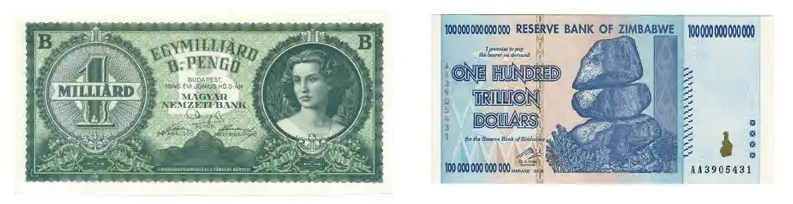
A code uses digits – and must uniquely identify each of billion packets. What is the minimum code length?
There are about million bee colonies, each with about bees. Write the total number of bees in scientific notation.
Is the product of two cube numbers always a cube number? Are all numbers of the form , where is prime, both fourth and sixth powers?
Quick recap
- Ancient Indian works recorded names for powers of ten reaching as high as .
- In the Indian sequence, each next listed name is times the previous value, raising the exponent by .
- In the international sequence, each next name is times the previous value, raising the exponent by .
- Million through decillion correspond to through in steps of three exponent units.
- A googol is and a googolplex is .
- Exponent laws and place-value counts help compare and express very large numbers.
Summary
Modelling and Growth
Mathematical modelling — Mathematical modelling represents a real situation using assumptions, approximations and calculations to answer a question.
Growth patterns
- Modelling flow: Understand the situation → make a guess → choose assumptions or approximations → calculate and interpret the result.
- Additive growth: The same amount is added in each time step; growth is usually steady.
- Multiplicative growth: A quantity is repeatedly multiplied by a fixed factor; it can grow rapidly.
- Comparison: Starting from , adding five times gives , while doubling five times gives .
Here is the starting quantity, is the fixed addition, is the multiplying factor, and is the number of steps.
Compare two growth patterns
- Identify the starting quantity and the number of time steps.
- For additive growth, repeatedly add the fixed amount; for multiplicative growth, repeatedly multiply by the fixed factor.
- Calculate both results and compare their sizes.
How do adding 1 and doubling compare after five steps, starting from 1?
- Start with and compare adding each step with doubling, after five steps.
- Find the result for additive growth.
- Find the result for multiplicative growth.
Powers and Exponent Laws
Exponent — For a positive integer , means multiplying by itself times.
For integer exponents, multiply or divide powers using the rules below; bases in denominators and zero-exponent rules must be nonzero.
Simplify using exponent laws
- Identify whether the powers have the same base or the same exponent.
- Apply the matching exponent law.
- Check that any base being divided by is nonzero.
Simplify .
- Combine the powers with the same base by adding their exponents.
- Evaluate the resulting power.
Scientific Notation
Scientific notation — Scientific notation writes a number as , where and is an integer.
Key points
- Coefficient: The number must be at least and less than .
- Exponent: The integer records the power of needed to recover the original number.
- Large numbers: A positive exponent is used when the decimal point moves left to produce the coefficient.
Use this form when expressing very large or very small numbers compactly.
Write a number in scientific notation
- Move the decimal point to make a number from up to, but not including, .
- Count how many places the decimal point moved.
- For a large number, use that count as a positive exponent of .
Write in scientific notation.
- Move the decimal point in eight places left to obtain a coefficient in the required range.
- Use the number of places moved as the exponent of .
Simplify .
Write in scientific notation.
Exponent shortcuts
Same base: multiply → add exponents; divide → subtract exponents; raise a power → multiply exponents.
Quick recap
- Model a situation by making assumptions, approximations and calculations.
- Additive growth adds a fixed amount; multiplicative growth repeatedly multiplies by a factor.
- A power represents repeated multiplication, and exponent laws simplify calculations.
- For a nonzero base, the zero power is and a negative power is a reciprocal.
- Scientific notation has the form , with and integer .
- Thought experiments help compare the size and speed of growth of quantities.
Formula sheet
Mathematics — ALL CHAPTERS
1
A Square And A Cube
2
Power Play
3
A Story of Numbers
4
Quadrilaterals
5
Number Play
6
We Distribute, Yet Things Multiply
7
Proportional Reasoning-1
1
Fractions in Disguise
2
The Baudhayana-Pythagoras Theorem
3
Proportional Reasoning-2
4
Exploring Some Geometric Themes
5
Tales by Dots and Lines
6
Algebra Play
7
Area