Class 8 . Mathematics . Ganita Prakash Part I . Number Play
Chapter 5: Number Play
Ch 5
Mathematics
Class 8
Sum of Consecutive Number Part-1
Writing Numbers as Sums of Consecutive Numbers
Key examples and observations
- Examples: , , and .
- Multiple representations: .
- Odd numbers: An odd number greater than can be written as the sum of two consecutive positive integers.
- Even numbers: Some even numbers can be written as sums of consecutive numbers, such as and above.
For an odd positive integer , the two consecutive positive integers are obtained by taking half a step below and above .
Can a number have more than one representation as a sum of consecutive numbers?
- Write in the consecutive-sum forms shown in the examples.
- It can also be expressed as three consecutive numbers.
- A representation using five consecutive numbers is also possible.
Parity of Signed Sums
Parity rules
- Same parity: Odd odd and even even are even; odd even is odd.
- Addition and subtraction: For any integers and , and have the same parity.
- Sign switch: Changing to changes the expression by in magnitude, an even number.
- Consequence: Expressions made from the same numbers using different plus and minus signs all have the same parity.
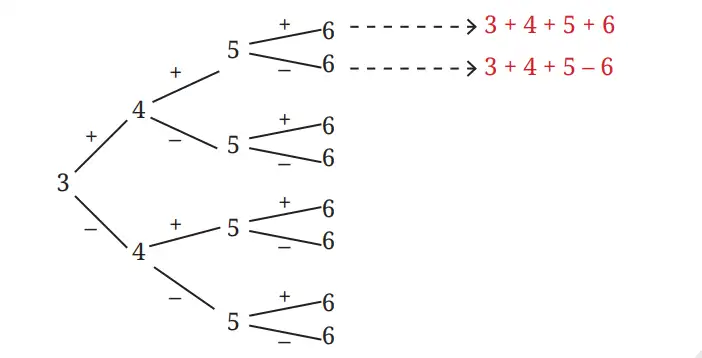
For fixed integers , every expression has the same parity as . Switching any sign changes the value by an even number.
Every signed expression formed from four consecutive integers is even, because their all-positive sum is even and all sign choices have the same parity.
Proving that sign choices have the same parity
- Start with one signed expression.
- Switch the sign of and compare the expressions.
- The change is even, so the parity is unchanged; repeat for each sign that differs.
What parity do the signed expressions formed from have?
- Use the four consecutive numbers . Fix the first number as positive; the other three signs give eight choices.
- Evaluate all eight expressions.
- Each result is even, as expected for four consecutive numbers.
Do not assume signed sums of any four numbers are always even. They all have the same parity, but that parity depends on the all-positive sum, which may be odd or even.
If a negative sign in is changed to a positive sign, how does the value change?
What can be said about the parity of all expressions ?
Explain why every signed expression formed from four consecutive integers is even.
Quick recap
- Consecutive numbers follow one another, and a number can have more than one consecutive-sum representation.
- An odd positive integer greater than is the sum of two consecutive positive integers.
- Switching the sign of a term changes a signed sum by an even number.
- All sign combinations of the same numbers have the same parity.
- The signed expressions from four consecutive integers are all even.
Sum of Consecutive Number Part-2
Breaking Even
| Expression | Parity |
|---|---|
| Even | |
| Even | |
| Even | |
| Odd | |
| Odd | |
| Odd | |
| Even | |
| Odd |
Use this when the expression can be factored to show a factor of .
Test whether an expression is always even
- Factor the expression, if possible, and check whether it has a factor of .
- If it does not, examine the variables' parity or test integer values.
- One odd result is enough to show that the expression is not always even.
Why is always even, and what is its value when and ?
- Show that is always even, then evaluate it for and .
- Factor out ; the remaining expression is an integer for integer .
- Substitute the given values and simplify.
Do not decide an expression is always even from one even example; test its structure or find a counterexample with an odd result.
Pairs to Make Fours
Even numbers modulo 4 — Every even number is either a multiple of or is more than a multiple of .
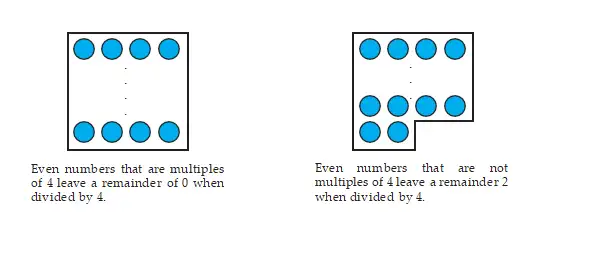
Two even numbers add to a multiple of when both are multiples of or both leave remainder when divided by . If they are of different types, their sum leaves remainder .
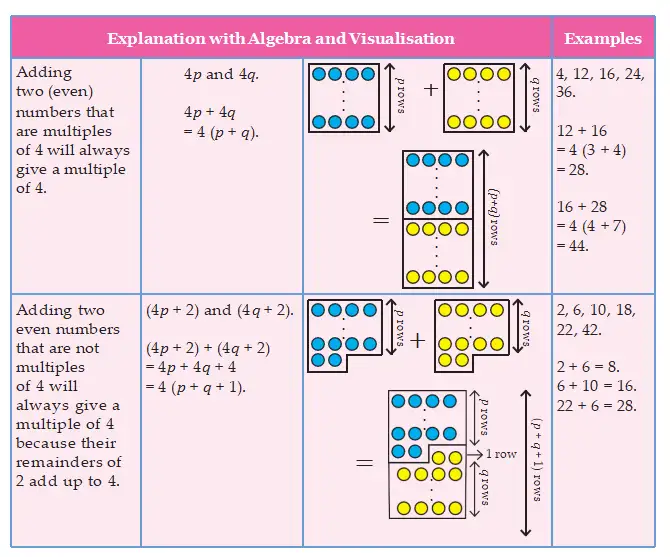
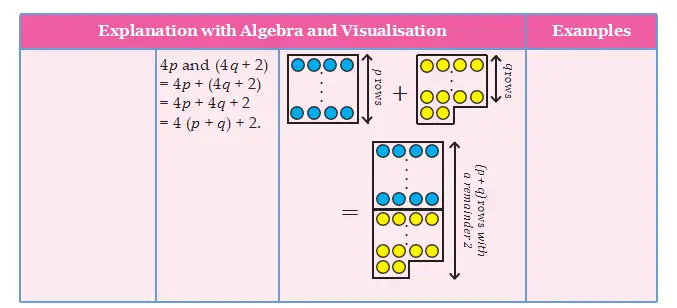
Here and are integers.
Decide whether two even numbers sum to a multiple of
- Write each even number as either or .
- If both have the same form, their sum is divisible by .
- If they have different forms, the sum has remainder when divided by .
Is the sum of and divisible by ?
- Check whether is divisible by .
- Write each addend in the form .
- Add and factor the result as a multiple of .
Is always even for integers ?
Do and add to a multiple of ?
- A factor of proves an integer expression is even.
- Two even numbers sum to a multiple of when they have the same remainder on division by .
Quick recap
- An integer expression with a factor of is always even.
- A single odd output disproves a claim that an expression is always even.
- has the same parity as .
- Every even number has the form or .
- Two even numbers of the same form add to a multiple of .
- Adding one number of each form gives remainder modulo .
Sum of Consecutive Number Part-3
Divisibility: Always, Sometimes, or Never
If divides both and , then it divides their sum and difference. If is divisible by , every multiple of is divisible by , and is divisible by every factor of .
If a number is divisible by both and , then is divisible by , since its prime factorisation contains all the prime factors required by that LCM.
Parity and divisibility examples
- Odd plus even: The result is odd, so it can never be a multiple of , since every multiple of is even.
- Two even numbers: Their sum is sometimes a multiple of ; for instance, , while .
- Not divisible by : It may still be divisible by (for example, ), so the statement that it is not divisible by is sometimes true.
- Two numbers not divisible by : Their sum may or may not be divisible by ; for example, but .
- Multiple of plus multiple of : The sum is always a multiple of ; a multiple of plus a multiple of is only sometimes a multiple of .
Write multiples as and to apply the sum and difference rule.
Test an always/sometimes/never claim
- Translate the divisibility condition into a multiple or factor statement.
- Use a general rule to prove the claim, or find examples and counterexamples.
- Classify it as always true, sometimes true, or never true.
Is the statement always true, sometimes true, or never true?
- Classify: If a number is divisible by both and , it must be divisible by .
- Find the least common multiple of the two divisors.
- Every common multiple must be divisible by , but is not divisible by ; the number does work.
- Thus the claim works for some numbers but not all.
Being divisible by two numbers guarantees divisibility by their LCM, not necessarily by their product; for example, divisibility by and only guarantees divisibility by .
Representing Numbers by Their Remainders
Remainder form — A number that leaves remainder when divided by is times a whole-number quotient, plus .
For a non-negative integer , division by a positive integer gives , where is a whole number and .
Such numbers are more than multiples of . The equivalent form uses .
Key remainder patterns
- Remainder on division by : The number is a multiple of , of the form .
- Remainder on division by : The number is of the form ; examples are .
- Equivalent pattern: The same numbers are less than multiples of , so they can also be written as for .
Write a number pattern from a remainder
- Identify the divisor and the required remainder .
- Write the number as the divisor times a whole-number quotient, plus the remainder.
- Check that the remainder is less than the divisor.
What algebraic expression describes the numbers?
- Write all non-negative numbers that leave remainder on division by .
- Use the divisor and remainder in the division form.
- Substitute successive whole-number values for .
Consecutive Numbers and Combined Conditions
Consecutive integers — Consecutive integers follow one another with a difference of .
For four consecutive integers, start with ; for five consecutive integers whose greatest is , work backwards from .
A number that leaves remainder when divided by both and is more than a common multiple of and ; hence it has the form .
Solve simultaneous remainder conditions
- Translate each remainder condition into a congruence or a divisibility statement.
- Combine compatible conditions using common multiples or by testing the resulting pattern.
- Check the smallest candidates against every condition before stating the least solution.
The sum of four consecutive numbers is . Find the numbers.
- Let four consecutive integers be represented by a starting number and the next three integers.
- Set their sum equal to and simplify.
- Solve for the starting integer.
- List the four consecutive integers.
Useful combined-remainder results
- Remainders on division by both and : All such numbers are .
- Remainders on division by : The number plus is divisible by all three divisors, so it is a multiple of ; the least positive solution is .
- Remainder arithmetic modulo : If leaves remainder and leaves remainder , their sum leaves remainder , and their difference leaves remainder .
- Pebble puzzle: The number is odd, leaves remainder on division by both and , is divisible by , and is below ; the solution is .
Classify each claim as always, sometimes, or never true: (a) the sum of a multiple of and a multiple of is a multiple of ; (b) the sum of a multiple of and a multiple of is a multiple of ; (c) two numbers not divisible by have a sum not divisible by .
A number is below , odd, divisible by , and leaves remainder on division by both and . Find it.
(a) Three numbers each leave remainder when divided by . Must their sum be divisible by ? (b) Find the least positive number leaving remainders on division by , respectively.
Quick recap
- If divides two numbers, it divides both their sum and their difference.
- A number divisible by two divisors is divisible by their LCM.
- A number with remainder on division by has the form , where .
- Remainder on division by is represented by or, for , by .
- Represent consecutive integers using a starting variable plus successive increments of .
- Combine remainder conditions using common multiples, and check candidates against every condition.
Checking Divisibility Quickly
Divisibility by 2, 4, 5 and 10
Place-value form — A number can be written as a sum of its place values; its final digit is the units digit.
Write , where is the units digit. The remaining place-value part is divisible by , so the units digit determines divisibility by , and . For and , use the last two and last three digits respectively, since is divisible by and by .
Use these decompositions to see why only the final digit or digits need checking.
Which of , , , and divide ?
- Check the relevant final digits of .
- Its units digit is : it is divisible by , but not by or .
- Its final two digits are , and its final three digits are ; neither meets the test for or .
Divisibility and Remainders for 9
Digit-sum test for 9 — A whole number is divisible by if and only if the sum of its digits is divisible by .
Each place value leaves remainder when divided by , so a number and its digit sum have the same remainder upon division by .
The number and its digit sum have the same remainder modulo .
Find divisibility or the remainder for 9
- Add the digits of the number.
- For divisibility, check whether the digit sum is a multiple of .
- For the remainder, divide the digit sum by and use its remainder; you may repeat digit-summing to simplify.
- A final digit sum of means remainder , not remainder .
Find the remainders when and are divided by .
- For , add the digits to get .
- Since leaves remainder when divided by , so does .
- For , add the digits to get , then add those digits to get .
- The digit sum leaves remainder when divided by , so does .
Do not conclude that a final digit sum of gives remainder ; it gives remainder . Divisibility by and divisibility of the digit sum by are equivalent, so both their converse statements are also true.
Without dividing, determine which of , , , and are divisible by .
Find the smallest positive multiple of with no odd digits, and the multiple of closest to .
How many multiples of are there strictly between and ?
Quick recap
- Use the units digit to test divisibility by , and .
- Use the last two digits for divisibility by and the last three digits for divisibility by .
- A number is divisible by exactly when its digit sum is divisible by .
- A number and its digit sum leave the same remainder upon division by .
- Repeated digit-summing is valid; a final digit sum of means remainder .
A Shortcut for Divisibility by 3
Divisibility by 3
Divisibility test for 3 — A whole number is divisible by exactly when the sum of its digits is divisible by .
Key points
- Reason: Since , every power of is also congruent to modulo . The number and its digit sum therefore have the same remainder when divided by .
- Relation to 9: Every number divisible by is divisible by , but the reverse is not always true; for example, , , and are divisible by but not by .
The number and its digit sum have the same remainder modulo .
Test a number for divisibility by 3
- Add all the digits of the number.
- Check whether the digit sum is a multiple of .
- If it is, the original number is divisible by ; otherwise, it is not.
Is divisible by ?
- Add the digits of .
- Since is divisible by , is also divisible by .
Divisibility by 11
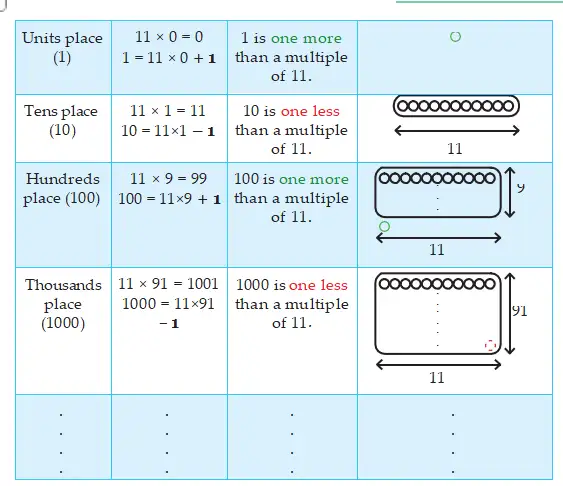
Divisibility test for 11 — A number is divisible by exactly when its alternating sum of digits is a multiple of .
Key points
- Reason: Since , powers of alternate between and modulo . The number and its alternating sum therefore have the same remainder modulo .
- Place values: Hundreds are more than a multiple of ; tens are less. The pattern continues, alternating for higher place values.
- Example: For , the alternating sum from the units digit is , so is divisible by .
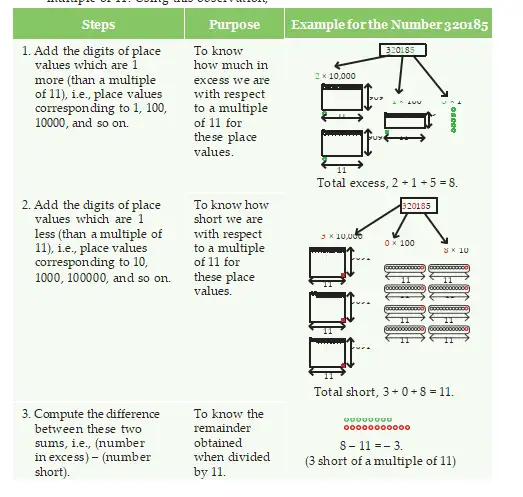
Start with the units digit and alternate plus and minus signs. The result gives the same remainder modulo as the original number.
Test a number for divisibility by 11
- Starting from the units digit, assign alternating plus and minus signs.
- Calculate the signed sum.
- If the result is a multiple of , the number is divisible by .
- For the remainder, add or subtract multiples of until the result is between and .
What is the remainder when is divided by ?
- Find the remainder when is divided by .
- Form the alternating sum, starting at the units digit.
- Add to obtain a remainder between and .
| Divisor | Quick test |
|---|---|
| The units digit is even. | |
| The sum of the digits is divisible by . | |
| The number formed by the last two digits is divisible by . | |
| The units digit is or . | |
| The number is divisible by both and . | |
| The number formed by the last three digits is divisible by . | |
| The sum of the digits is divisible by . | |
| The units digit is . | |
| The alternating sum of the digits is divisible by . |
Is divisible by ?
Find the remainder when is divided by .
For , decide divisibility by and .
Quick recap
- A number is divisible by when its digit sum is divisible by .
- The digit-sum test works because .
- For divisibility by , alternate plus and minus signs across the digits, starting at the units digit.
- A multiple-of- alternating sum means the original number is divisible by .
- The alternating sum gives the remainder modulo ; adjust by multiples of to get a remainder from to .
- Use final digits and digit sums for quick tests of divisibility by and .
More on Divisibility Shortcuts/Divisibility Shortcuts for Other Numbers
Divisibility Shortcuts for Other Numbers
Use when the target number can be split into coprime factors.
Test divisibility using factors
- Split the target into coprime factors.
- Apply a known divisibility test to each factor.
- If both tests pass, the number is divisible by the target.
Is divisible by ?
- Check whether is divisible by .
- The last digit is even, so is divisible by .
- The digit sum is divisible by .
- Both coprime factors divide the number, so divides .
Do not assume divisibility by two non-coprime factors guarantees divisibility by their product: is divisible by and , but not by .
Which of and are divisible by ?
Digital Roots
A number and its digit sum have the same remainder when divided by ; repeated digit sums preserve this. The digital root also gives the same remainder as the number when divided by . For positive numbers, remainder corresponds to digital root .
Digital-root patterns
- Consecutive numbers: Digital roots cycle through , then repeat.
- Multiples of : Every positive multiple of has digital root .
- Multiples of : Their digital roots cycle as .
- Multiples of : Their digital roots cycle as .
- Multiples of : Their digital roots cycle as .
- One more than a multiple of : The digital roots cycle as .
- Parity: Digital root does not determine whether a number is even or odd; for example, and both have digital root but different parity.
For positive , a remainder of gives digital root ; otherwise, the digital root is the remainder. The digital root of is .
Find a digital root
- Add the digits of the number.
- If the sum has more than one digit, add its digits again.
- The final single digit is the digital root.
Find the digital root of and of more than this number.
- Find the digital root of .
- Add the digits of the sum until one digit remains.
- The digital root is ; adding advances the remainder modulo by .
- Therefore, the digital root of is .
Adding changes the remainder modulo by the remainder of modulo ; digital roots then follow the -to- cycle.
| Digital root | Numbers |
|---|---|
A sequence starts at a number with digital root and repeatedly adds . Find its first four digital roots.
Find the digital root of . Also, find the digital root of more than an -digit number with digital root .
Quick recap
- For coprime factors, testing divisibility by each factor is enough: use and for , and and for .
- Testing and does not guarantee divisibility by , because they share a factor of .
- A digital root is found by repeatedly adding digits and tracks the number's remainder modulo .
- Digital roots of consecutive numbers repeat in the cycle through ; positive multiples of have digital root .
- Adding advances a digital root by ; digital root does not determine parity.
Digits in Disguise
Cryptarithms
Cryptarithm — A number puzzle in which each letter represents one fixed digit, different letters represent different digits, and a number cannot begin with zero.
Write each letter-number using place value; for example, the two-digit number equals .
Useful cryptarithm reasoning
- Columns: Start with the units column and track any carry into the next column.
- Range: A two-digit number multiplied by stays two-digit only if the number is at most ; for example, but .
- Units digit: Match the units digits first. In , the multiplier is also the units digit of .
- Leading digit: In , a three-digit product requires . Also, must be even and less than .
- Distinctness: Reject any arithmetic solution that assigns the same digit to different letters.
Solving a cryptarithm
- Write each number using its place value.
- Use the units column and possible carries to restrict the digits.
- Use the number of digits and the leading-digit rule to narrow the choices.
- Check the arithmetic and confirm that different letters have different digits.
Find the digits in .
- Rewrite using place value.
- Rearrange the equation.
- The digit solution gives distinct values and checks in the original sum.
Cryptarithm solutions
- Addition: gives ; has solutions , , and ; gives .
- Two-digit products: gives ; gives .
- Products with a repeated pattern: gives ; gives .
- Further products: gives or ; gives .
- Repeated letters: gives ; gives .
- Three- and four-digit products: gives ; gives .
Do not change a letter's digit from one column to another: each letter has one fixed digit, and different letters must have different digits.
Divisibility and Number Patterns
Divisibility test — A quick rule for deciding whether a number is divisible by another number without performing the full division.
| Divisor | Test |
|---|---|
| The last digit is even. | |
| or | The digit sum is divisible by or , respectively. |
| The number formed by the last two digits is divisible by . | |
| The last digit is or . | |
| The number is divisible by both and . | |
| The alternating sum of the digits is divisible by . | |
| The number is divisible by both and . | |
| The number is divisible by both and . | |
| The number is divisible by both and . |
A number is divisible by exactly when its digit sum is divisible by . Reversing or shuffling its digits preserves the digit sum, so the rearranged number is also divisible by .
If the numbers are and , their sum is divisible by exactly when is even—that is, when and have the same parity.
Number patterns and classifications
- Remainders: The two numbers are and . Their sum is , which is divisible by only when is odd; Snehal's claim is not always true.
- Multiples of : Doubling any multiple of always gives another multiple of .
- Consecutive integers: The product of two consecutive integers is always even; it is divisible by only if one of them is a multiple of .
- Consecutive products: The product of four consecutive integers is always divisible by ; the product of five consecutive integers is always divisible by .
- Always true: The product of a multiple of and a multiple of is divisible by . The sum of three consecutive even numbers is divisible by .
- Digit rearrangement: If is divisible by , then is also divisible by : the digit sum is unchanged and the last digit remains .
- Expression test: , which is never divisible by for integer .
- Three-number sums: A sum is divisible by exactly when the sum of the three remainders upon division by is divisible by .
- Multiples of : Since is divisible by , five multiples between and are , , , , and .
- Multiples-set relationship: Every multiple of is a multiple of , and every multiple of is a multiple of .
If the middle number is , the five numbers in order are:
For the first to be divisible by , the second by , and the third by , all such sequences have this form:
Testing divisibility with digit conditions
- Break the divisor into factors with known divisibility tests.
- Apply each test separately, such as an even last digit and a digit sum divisible by .
- List the digit choices that satisfy all conditions, then check each pair.
Find all digit pairs for which is divisible by .
- For to be divisible by , it must be even and its digit sum must be divisible by .
- The possible digit sums give the following values for .
- Combine these conditions to list the valid digit pairs.
If is divisible by , find all possible digits .
Find all digit pairs for which is divisible by .
Give a six-digit number divisible by whose reversed digits form a number divisible by .
For divisibility by a composite number such as , check all required conditions: an even last digit alone is not enough; the number must also be divisible by .
What is the relationship between multiples of , , and ?
Quick recap
- A cryptarithm assigns a fixed, distinct digit to each letter; leading digits cannot be zero.
- Solve cryptarithms with place value, column arithmetic, carries, and digit-length limits.
- Rearranging digits preserves divisibility by because the digit sum does not change.
- Divisibility by requires an even number and a digit sum divisible by .
- The sum of two multiples of is divisible by exactly when their quotients by have the same parity.
- Use algebraic forms and divisibility tests to check remainder claims and number patterns.
Summary
Divisibility Properties
Divisibility — The notation means that is divisible by ; equivalently, for some integer .
If , then divides every multiple of , and every factor of divides . If and , then divides both their sum and difference. If and , then .
Here, is an integer, and is any factor of .
Apply divisibility properties
- To show a divisor divides a sum or difference, first check that it divides both numbers.
- If two numbers both divide a number, find their LCM to identify the largest divisor guaranteed by this property.
- For the multiple rule, multiply the given divisible number by an integer.
Use divisibility properties to find a common divisor of and , and the LCM of divisors and of .
- Since divides both numbers, it divides their sum and difference.
- Evaluate the sum and difference.
- Since and both divide , their LCM also divides .
Divisibility Tests for 3, 9 and 11
| Divisor | Test |
|---|---|
| The sum of the digits is divisible by . | |
| The sum of the digits is divisible by . | |
| The difference between the sums of alternate digits is divisible by , including when the difference is . |
Write a number in place-value form. For divisibility by or , each power of leaves remainder , so the number has the same remainder as its digit sum. For divisibility by , powers of alternate between remainders and , so the number has the same remainder as its alternating digit sum.
Check divisibility using digits
- For or , add the digits and test whether their sum is divisible by the chosen divisor.
- For , alternately add and subtract the digits, then test whether the result is divisible by .
Test whether is divisible by , , and .
- Add the digits of to test divisibility by and .
- The digit sum is divisible by , but not by .
- Find the alternating sum to test divisibility by .
- The alternating sum is divisible by , so the original number is too.
For , do not simply add all the digits. Alternate addition and subtraction, then check whether the result is a multiple of .
If divides both and , what can you conclude about and ?
Test for divisibility by , , and .
Quick recap
- If , every multiple of is divisible by , and every factor of divides .
- A common divisor of two numbers divides their sum and difference.
- If and both divide , then .
- For and , divisibility is tested by adding the digits.
- For , divisibility is tested by the alternating sum of the digits.
- The tests follow from the remainders of powers of when divided by , , and .
Formula sheet
Mathematics — ALL CHAPTERS
1
A Square And A Cube
2
Power Play
3
A Story of Numbers
4
Quadrilaterals
5
Number Play
6
We Distribute, Yet Things Multiply
7
Proportional Reasoning-1
1
Fractions in Disguise
2
The Baudhayana-Pythagoras Theorem
3
Proportional Reasoning-2
4
Exploring Some Geometric Themes
5
Tales by Dots and Lines
6
Algebra Play
7
Area