Class 9 . Science . Exploration . Atomic Foundations of Matter
Chapter 9: Atomic Foundations of Matter
Ch 9
Science
Class 9
Introduction
Atoms and Compounds
Atomic stability and compound properties
- Octet stability: Atoms with eight electrons in their valence shell are stable; atoms can lose, gain or share electrons to attain an octet.
- Compound properties: Elements may not retain their properties when they form a compound.
- Example: Hydrogen and oxygen are gases, but the water they form is a liquid at ordinary temperatures.
- Different behaviour: Hydrogen is combustible and oxygen supports combustion; water neither burns nor supports burning and can extinguish fire.
Mass During Physical and Chemical Changes
Conservation of mass — The total mass remains unchanged during a physical or chemical change when all substances involved are accounted for.
Mass in physical changes
- Dissolving salt: The mass of the solution equals the combined masses of the water and salt.
- General rule: Total mass remains unchanged during physical changes, such as dissolving salt or tearing paper.
- Formation of water: The mass of water formed equals the sum of the masses of hydrogen and oxygen that combined to form it.
Mass in chemical changes
- Reaction example: Vinegar or lemon juice reacts with baking soda (sodium hydrogencarbonate), producing carbon dioxide and other substances.
- Open setup: When the gas escapes, the measured final mass is lower than the initial mass.
- Closed setup: When the flask and balloon keep the gas contained, total mass before and after the reaction is the same.
- Reason: The apparent mass difference in an open setup is due to escaping carbon dioxide, not a loss of mass during the reaction.
- Measurement: Small variations within the balance’s experimental error (about ±1 in the last digit) can be treated as no change in mass.
| Point | Open setup | Closed setup |
|---|---|---|
| Gas produced | Carbon dioxide escapes | Balloon retains the gas |
| Measured final mass | Lower than the initial reading | Same as the initial reading |
| What the result shows | Escaping gas causes the apparent mass decrease | Total mass remains unchanged when all substances are included |
For mass-conservation questions, check whether the system is open or closed: escaping gas changes the measured mass of an open setup.
Quick recap
- Atoms can gain, lose or share electrons to attain a stable valence-shell octet.
- Compounds can have properties different from those of their constituent elements.
- Total mass remains unchanged during physical changes such as dissolving salt.
- The mass of water formed equals the combined masses of hydrogen and oxygen.
- Vinegar or lemon juice and baking soda produce carbon dioxide and other substances.
- Escaping carbon dioxide makes the measured final mass lower in an open setup.
- When the gas is retained in a closed setup, total mass before and after the reaction is unchanged.
Law of Conservation of Mass
The Law of Conservation of Mass
- Law: Matter can neither be created nor destroyed in a chemical reaction.
- Verification: The total mass of the reactants equals the total mass of the products.
- Proposed by: Antoine Lavoisier in 1789.
Sodium Sulfate and Barium Chloride
- Reaction: Mixing sodium sulfate and barium chloride solutions forms a white precipitate of barium sulfate and sodium chloride.
- Mass: The total mass remains unchanged when the reactants form these products.
Measuring Mass When a Gas Is Produced
If a substance seems to lose mass in an open container, the law is not necessarily violated: a gas may have escaped and gone unmeasured.
Checking Mass Conservation
Using the Law in Mass Calculations
A student burns of ethanol in an open beaker, leaving no residue. Is mass conservation violated?
What mass of water forms when of hydrogen reacts completely with of oxygen?
Quick recap
- In every chemical reaction, total reactant mass equals total product mass.
- Antoine Lavoisier proposed the law in 1789.
- Sodium sulfate and barium chloride form a white barium sulfate precipitate.
- A closed setup is needed to measure mass correctly when gases could escape.
- Add all reactant and product masses to verify conservation.
- Missing mass in an open container may be matter that escaped as gas.
Law of Constant Proportions
Fixed Composition of Compounds
Law of Constant Proportions — A compound always contains its elements in a fixed ratio by mass, regardless of its source or method of preparation.
- Also called: Law of Definite Proportions or Proust’s Law; proposed by Joseph Proust.
- Water: Hydrogen and oxygen are always present in the mass ratio ; therefore, of water contains hydrogen and oxygen.
- Copper carbonate: Copper, carbon and oxygen have the same proportions by mass, regardless of how or where the compound is obtained.
| Compound | Composition by mass |
|---|---|
| Water | Hydrogen : oxygen = |
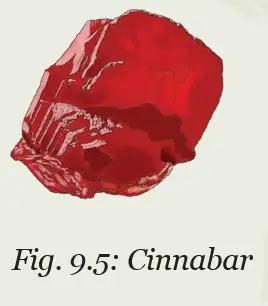
| Cinnabar | Mercury : sulfur is approximately |
Using a Fixed Mass Ratio
- Method: Use the compound’s mass ratio to find the mass of an element needed for a given mass of another element.
- Sodium chloride: Sodium : chlorine = . For sodium, chlorine required is .
- Equivalent ratios: Ratios such as and are equivalent, since both simplify to .
A compound contains sulfur and oxygen by mass. If it contains sulfur, what mass of oxygen is present?
Carbon monoxide contains carbon and oxygen in the mass ratio . How much oxygen combines with carbon?
| Point | Compound | Mixture |
|---|---|---|
| Composition by mass | Fixed and definite | Can vary |
| Reason | Elements combine chemically in definite proportions | Substances are physically mixed, so their proportions need not be fixed |
Connection to Dalton’s Atomic Theory
- Fixed composition: The two laws discussed in this chapter formed the basis of Dalton’s Atomic Theory and helped explain why substances combine in fixed proportions.
- During reactions: Atoms are indivisible and are neither created nor destroyed; they merely rearrange. This explains why there is no loss or gain of mass during a chemical reaction.
- Ratio check: Copper and oxygen ratios of and support the law because they are equivalent and represent the same proportion.
Why does the Law of Definite Proportions apply to compounds but not mixtures?
- A compound’s mass composition stays fixed regardless of its source or preparation.
- When comparing ratios, simplify them: equivalent ratios describe the same proportion.
- Dalton explained fixed composition and conservation of mass through atoms rearranging without being created or destroyed.
Quick recap
- The Law of Constant Proportions is also called the Law of Definite Proportions or Proust’s Law.
- A compound always has its elements in a fixed ratio by mass, independent of source or preparation.
- Water has hydrogen : oxygen = by mass; water contains hydrogen and oxygen.
- Cinnabar contains approximately mercury and sulfur by mass.
- Compounds have fixed composition, whereas mixtures can have variable proportions.
- Dalton’s theory explains fixed composition and conservation of mass by atoms rearranging without being created or destroyed.
Dalton’s Atomic Theory
Dalton’s Postulates
Postulate — A fundamental assumption accepted without formal proof, used as a basis for developing further ideas.
Key postulates
- Matter: All matter consists of tiny particles called atoms, which take part in chemical reactions.
- Indivisibility: Atoms are indivisible particles; they cannot be created or destroyed in a chemical reaction.
- Same element: Atoms of one element are identical in mass and chemical properties.
- Different elements: Atoms of different elements differ in mass and chemical properties.
- Compound formation: Atoms combine in simple whole-number ratios to form compounds.
- Fixed composition: A given compound always contains the same kinds and relative numbers of atoms.
Examples
- Water formation: Hydrogen and oxygen atoms combine to form water; the atoms are not destroyed or changed into other kinds of atoms.
- Magnesium burning: Magnesium combines with oxygen in air to form white magnesium oxide powder.
Assertion: of hydrogen combines with of oxygen to form of water. Reason: Dalton’s theory states that atoms combine in a simple whole-number ratio by mass. Choose the correct relationship.
Quick recap
- Matter is made of atoms that participate in chemical reactions.
- Dalton proposed that atoms are indivisible and are not created or destroyed in chemical reactions.
- Atoms of the same element are identical in mass and chemical properties; atoms of different elements differ.
- Atoms combine in simple whole-number ratios to form compounds.
- A compound has a fixed kind and relative number of atoms.
- Magnesium combines with oxygen to form white magnesium oxide.
How Atoms Combine part 1
Molecules and Chemical Bonding
Why atoms form bonds
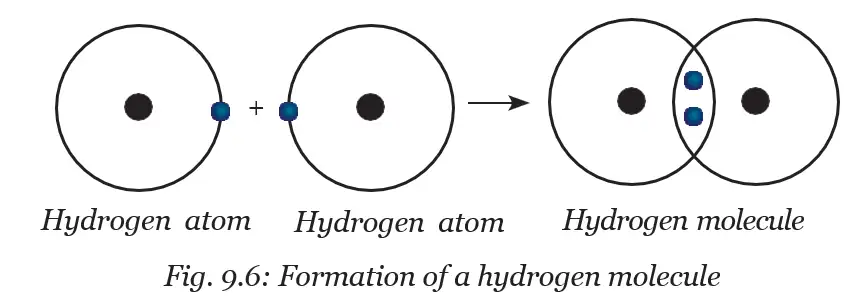
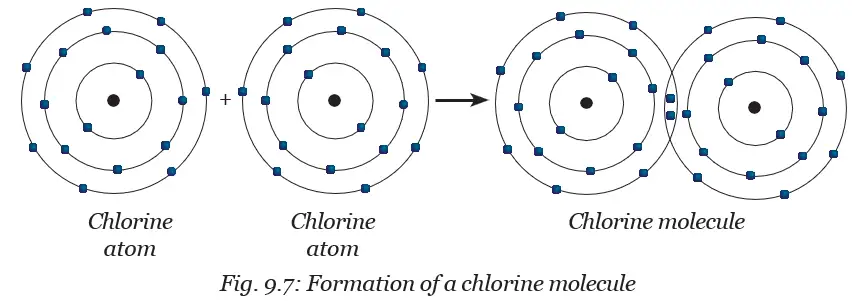
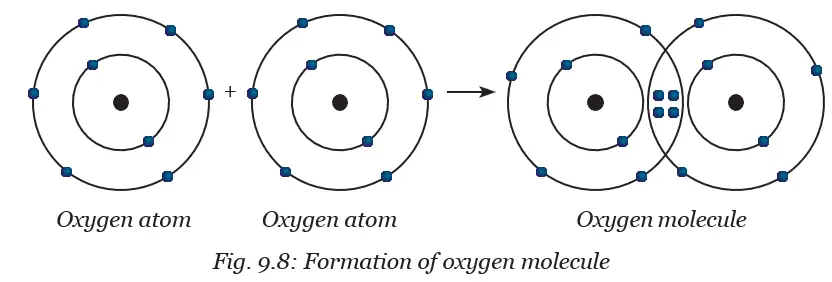
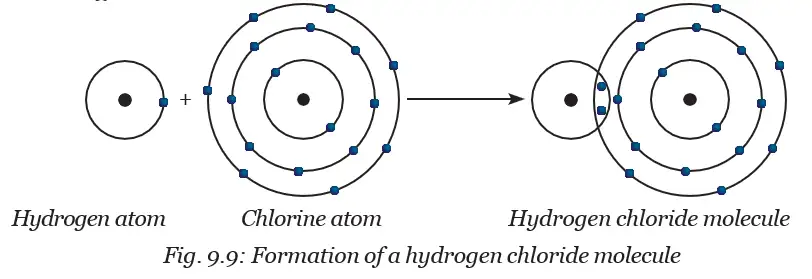
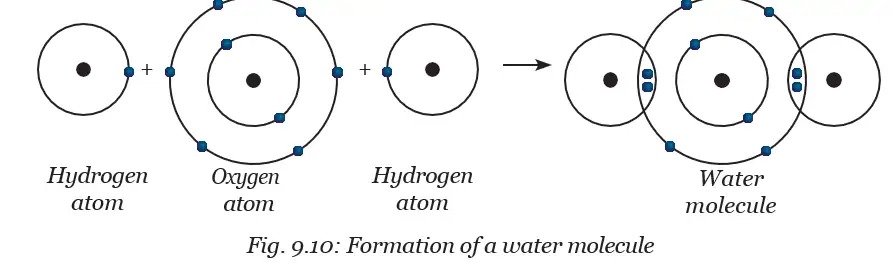
- Stable outer shells: Atoms are generally stable with 8 valence electrons; the first shell is stable with 2.
- Achieving stability: Atoms with incomplete outer shells may share, gain or lose electrons.
- Lower energy: When atoms combine, the system's energy becomes lower than that of the separate atoms, making it more stable.
- Chemical bond: The force that holds atoms together in a stable arrangement.
Covalent Bonding: Molecules of Elements
Covalent Bonding: Molecules of Compounds
Stable atoms and nuclear energy
- Neon: Its atomic number is 10, so its outer shell is complete; it neither needs to share nor transfer electrons.
- Nuclear energy: Enormous energy can be released when atomic nuclei split or combine to form new elements.
- Uses: Nuclear energy supports electricity generation, medicine, research and space exploration; power plants use reaction heat to make steam that drives turbines.
- India: Raja Ramanna made major contributions to India's nuclear energy programme and its peaceful use.
Naming Covalent Compounds
| Formula | Name | Naming point |
|---|---|---|
| Carbon monoxide | Omit mono- before the first element. | |
| Carbon dioxide | Two oxygen atoms; no mono- before carbon. | |
| Carbon disulfide | Two sulfur atoms. | |
| Phosphorus trichloride | Three chlorine atoms. | |
| Sulfur hexafluoride | Six fluorine atoms. | |
| Dinitrogen tetroxide | Two nitrogen and four oxygen atoms. | |
| Dinitrogen pentoxide | Two nitrogen and five oxygen atoms. | |
| Hydrogen sulfide | No prefix before hydrogen. |
Common names
- Water: is commonly called water, rather than hydrogen monoxide.
- Ammonia: is commonly called ammonia; its systematic prefix name is nitrogen trihydride.
How does a covalent bond form?
Why does neon generally not form covalent bonds?
How are covalent compounds named?
Quick recap
- Molecules may contain atoms of the same element or different elements; some stable elements exist as single atoms.
- Atoms combine to reach stable outer shells and lower the system's energy; the attractive force between them is a chemical bond.
- Covalent bonds form by sharing electron pairs: one pair makes a single bond and two pairs make a double bond.
- Examples of covalent molecules include , , , and .
- Prefixes such as mono-, di- and tri- indicate atom counts in covalent compound names.
- Neon has a complete outer shell; nuclear energy is released by changes in atomic nuclei.
How Atoms Combine part 2
Bonding by Electron Transfer
Ionic bond — The electrostatic attraction between oppositely charged ions that holds them together.
How ions form
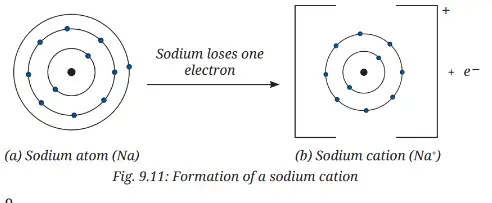
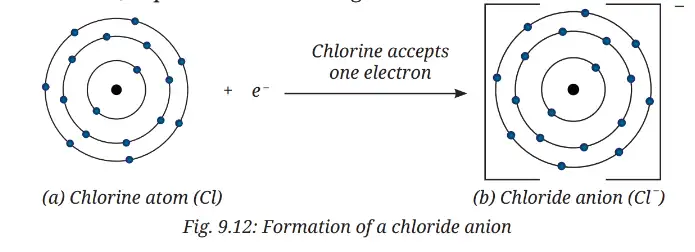
- Electron configuration: Atoms with fewer than four valence electrons generally lose them; atoms with more than four generally gain or share electrons to become stable.
- Cation: Losing electrons leaves an atom positively charged; sodium loses one electron to form , with 11 protons and 10 electrons.
- Anion: Gaining electrons makes an atom negatively charged; chlorine gains one electron to form .
- Ion: A charged atom or group of atoms; cations and anions are collectively called ions.

Ionic Compounds and Crystal Structures
Crystal arrangement
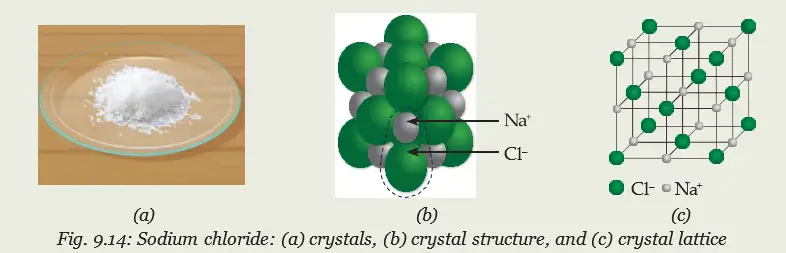
- Ionic compounds: Usually form extended three-dimensional crystals rather than separate, single units.
- Sodium chloride: Each is surrounded by six ions, and each by six ions.
- Crystal structure: Ions occupy a regular, repeating three-dimensional arrangement; a crystal lattice represents ions as points or dots.
Ions with multiple charges
- Sulfur: Has six valence electrons and gains two to complete its outer shell, forming .
- Oxygen: Gains two electrons to form the oxide ion, .
- Magnesium chloride: One magnesium atom donates two electrons; two chlorine atoms each accept one, giving one and two ions.
Naming Ionic Compounds and Common Ions
Naming rules
- Order: Write the cation’s name first, followed by the anion’s name.
- Simple anions: Their names generally end in “-ide,” as in chloride, oxide and sulfide.
- Typical combination: Metals generally form cations and non-metals form anions; their ionic compounds include sodium chloride, calcium oxide and magnesium sulfide.
- Polyatomic ions: These are groups of atoms carrying a charge; their names generally do not end in “-ide.”
| Ion name | Formula | Valency |
|---|---|---|
| Sodium | 1 | |
| Lithium | 1 | |
| Potassium | 1 | |
| Silver | 1 | |
| Calcium | 2 | |
| Barium | 2 | |
| Iron (ferrous) | 2 | |
| Iron (ferric) | 3 | |
| Copper (cuprous) | 1 | |
| Copper (cupric) | 2 | |
| Magnesium | 2 | |
| Zinc | 2 | |
| Aluminum | 3 | |
| Fluoride | 1 | |
| Chloride | 1 | |
| Bromide | 1 | |
| Iodide | 1 | |
| Oxide | 2 | |
| Sulfide | 2 |
| Ion name | Formula | Valency |
|---|---|---|
| Hydroxide | 1 | |
| Nitrate | 1 | |
| Hydrogencarbonate | 1 | |
| Carbonate | 2 | |
| Sulfate | 2 | |
| Ammonium | 1 |
Valency — The combining capacity of an ion, represented here by the magnitude of its charge.
Do not confuse an ion’s charge with the overall charge of an ionic compound: the formula has balanced total positive and negative charges.
Why does sodium become a cation when it loses one electron?
What ions form when magnesium combines with chlorine, and what is the compound’s formula?
Quick recap
- Electron transfer: Atoms may lose or gain valence electrons to form stable ions.
- Cations and anions: Losing electrons produces positive ions; gaining electrons produces negative ions.
- Ionic bond: Opposite charges attract and hold the ions together.
- Crystal lattice: Ionic compounds generally form repeating three-dimensional arrangements.
- Formula balance: Combine ions in ratios that make the compound’s total charge zero.
- Naming: Name the cation first; simple anion names usually end in “-ide,” while polyatomic ion names generally do not.
Writing Chemical Formulae
Valency and Common Ions
| Ion name | Formula | Valency |
|---|---|---|
| Sodium | 1 | |
| Lithium | 1 | |
| Potassium | 1 | |
| Silver | 1 | |
| Calcium | 2 | |
| Barium | 2 | |
| Iron(II) / ferrous | 2 | |
| Iron(III) / ferric | 3 | |
| Copper(I) / cuprous | 1 | |
| Copper(II) / cupric | 2 | |
| Magnesium | 2 | |
| Zinc | 2 | |
| Aluminium | 3 | |
| Fluoride | 1 | |
| Chloride | 1 | |
| Bromide | 1 | |
| Iodide | 1 | |
| Oxide | 2 | |
| Sulphide | 2 | |
| Hydroxide | 1 | |
| Nitrate | 1 | |
| Hydrogencarbonate | 1 | |
| Carbonate | 2 | |
| Sulphate | 2 | |
| Ammonium | 1 |
Formulae of Covalent Compounds
Covalent compound formula — A formula showing the relative numbers of atoms combined in a covalent compound.
Writing a covalent formula
- Write the symbols of the constituent elements.
- Write the valency of each element.
- Cross over the valencies to become subscripts of the other element.
- Do not write a subscript of 1.
| Compound | Element valencies | Formula |
|---|---|---|
| Hydrogen chloride | H: 1; Cl: 1 | |
| Hydrogen sulphide | H: 1; S: 2 | |
| Carbon tetrachloride | C: 4; Cl: 1 |
Formulae of Ionic Compounds
Ionic compound formula — A formula showing the simplest whole-number ratio of cations and anions in a neutral compound.
Writing an ionic formula
- Write the cation symbol first, followed by the anion symbol.
- Use the charge numbers only; cross them over as subscripts.
- Reduce the subscripts to the simplest whole-number ratio, if possible.
- The resulting formula has no ion charges and is electrically neutral.
| Compound | Ion charges | Formula and ratio |
|---|---|---|
| Calcium chloride | , | ; one calcium ion to two chloride ions |
| Aluminium oxide | , | |
| Magnesium oxide | , | Crossing gives ; reduce to |
Do not leave crossed subscripts unreduced: is not the simplest formula; write .
Using polyatomic ions
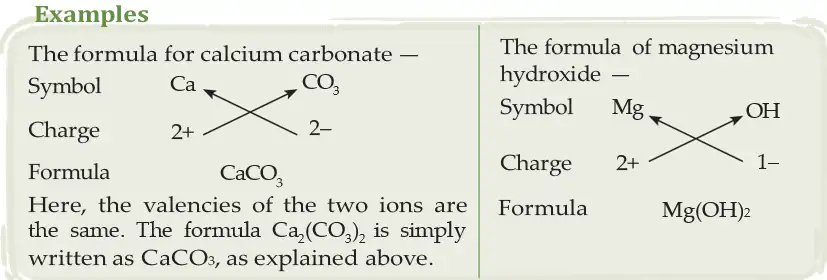
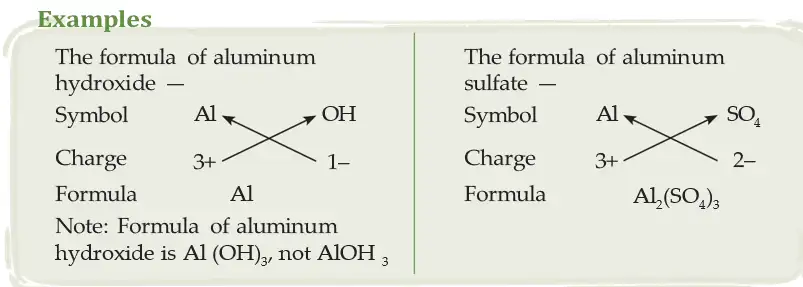
- Polyatomic ions stay together as a group when writing a formula.
- Brackets are needed when more than one of the same polyatomic ion is present; put the subscript outside the brackets.
- One group needs no brackets when only one polyatomic ion is present.
- Examples: calcium carbonate is ; magnesium hydroxide is .
| Compound | Ion charges | Formula |
|---|---|---|
| Aluminium hydroxide | , | |
| Aluminium sulphate | , |
Name these compounds: , , and .
Write the formulae for sodium hydrogencarbonate, sulphur dioxide, ferric chloride and cuprous oxide.
Write formulae for with , and with .
Quick recap
- For covalent compounds, cross the element valencies and omit any subscript of 1.
- For ionic compounds, write the cation first and cross over the charge numbers.
- Reduce ionic subscripts to the simplest whole-number ratio.
- A compound formula is neutral overall; ion charges are not written in the formula.
- Use brackets around a polyatomic ion when more than one of that ion is needed.
Properties of the Ionic and the Covalent Compounds
Solubility and Electrical Conductivity
Ionic compounds — Compounds made of charged ions held together by strong electrostatic attractions.
| Property | Ionic compounds | Covalent compounds |
|---|---|---|
| Solubility | Generally soluble in water; insoluble in kerosene and petrol. | Many are insoluble in water but dissolve in kerosene or petrol. Some, such as sugar, dissolve in water. |
| Conductivity in solid state | Do not conduct: ions are held in fixed positions. | Generally do not conduct electricity. |
| Conductivity in water | Conduct when dissolved because ions can move freely. | Usually do not conduct; dissolving does not necessarily produce ions. |
| Conductivity when molten | Conduct because the ions become free to move. | Usually do not conduct electricity. |
| Melting and boiling points | Generally high because of strong attractions between ions. | Usually low. |
Examples
- Ionic: Sodium chloride and copper sulfate are generally water-soluble and conduct electricity in aqueous solution.
- Covalent: Camphor and naphthalene are insoluble in water, dissolve in kerosene or petrol, and do not conduct electricity.
- Covalent exception: Sugar dissolves in water but does not form ions, so its solution does not conduct electricity.
Dissolving in water does not by itself guarantee electrical conductivity: the dissolved substance must produce mobile ions.
Molecular Mass of Covalent Compounds
Molecular mass — The sum of the atomic masses of all atoms present in one molecule, expressed in atomic mass units (u).
Multiply each element’s atomic mass by the number of its atoms, then add the results.
Worked calculations
- Water, : .
- Carbon dioxide, : .
- Ionic compounds: Their ions form three-dimensional crystals; ionic compounds do not form molecules.
A solid compound does not conduct electricity, but its aqueous solution does. What type of bond is present?
Element has two valence electrons and reacts with oxygen. Predict the compound’s formula, bond type and aqueous conductivity.
Find the molecular masses of nitric acid, , and methane, .
Quick recap
- Ionic compounds are generally water-soluble and insoluble in kerosene and petrol.
- Ionic solids do not conduct; their molten or aqueous forms conduct because ions can move.
- Covalent compounds usually do not conduct electricity, even when dissolved; sugar is a water-soluble example.
- Ionic compounds generally have high melting and boiling points; covalent compounds usually have low ones.
- Molecular mass is the sum of the atomic masses of all atoms in a molecule.
- Ionic compounds form three-dimensional crystals rather than molecules.
Formula Unit Mass of Ionic Compounds
Formula Units and Their Mass
Formula unit — The simplest whole-number ratio of ions in an ionic compound.
Formula unit mass — The mass of one formula unit, expressed in atomic mass units ().
Multiply each element’s atomic mass by its number of atoms in the formula unit, then add the contributions.
Counting atoms in a formula
- Subscripts show the number of atoms of an element.
- Parentheses: A subscript outside parentheses multiplies every atom inside them.
Examples
- Sodium oxide, : With and , formula unit mass .
- Calcium nitrate, : With , , and , formula unit mass .
Find the formula unit mass of potassium chloride, , given and .
Find the formula unit mass of magnesium hydroxide, , given , , and .
Quick recap
- A formula unit represents the simplest whole-number ratio of ions in an ionic compound.
- Formula unit mass is the total mass of the atoms in one formula unit, measured in .
- Multiply each atomic mass by its atom count and add the results.
- A subscript outside parentheses multiplies every atom within them.
- has formula unit mass ; has formula unit mass .
At a Glance
Laws of Chemical Combination
Law of Conservation of Mass — Mass can neither be created nor destroyed during a chemical reaction; the total mass remains constant.
- Key idea: The total mass of the reactants equals the total mass of the products.
Law of Definite Proportions — A compound always contains the same elements combined in a fixed ratio by mass, regardless of its source or how it is formed.
Molecules and Chemical Bonds
Molecule — An electrically neutral entity made of more than one atom that can exist independently and shows all its chemical properties.
- Stability: Atoms combine to form molecules of elements or compounds to become stable.
- Chemical bond: The force that holds atoms together.
| Point | Covalent bond | Ionic bond |
|---|---|---|
| How it forms | Atoms share electrons. | Electrons transfer between atoms. |
| Result | Atoms are held together by shared electrons. | The atom losing electrons forms a cation; the atom gaining electrons forms an anion. |
Chemical Formulas
- Covalent compound: Its chemical formula shows the elements present and the number of atoms of each element.
- Ionic compound: Its chemical formula shows the simplest whole-number ratio of atoms of different elements.
Mass of Molecules and Ionic Compounds
Molecular mass — The total mass of a molecule, calculated by adding the atomic masses of all atoms in it.
Formula unit mass — The sum of the atomic masses of all atoms in one formula unit, representing the simplest whole-number ratio of ions in an ionic compound.
How do molecular mass and formula unit mass differ?
Quick recap
- Mass is conserved in every chemical reaction.
- A compound contains its elements in a fixed ratio by mass.
- Molecules are neutral, independently existing entities made of more than one atom and show the substance’s chemical properties.
- Atoms combine to form molecules to become stable; chemical bonds hold atoms together.
- Covalent bonds involve sharing electrons, while ionic bonds involve electron transfer.
- Covalent formulas show element identities and atom counts; ionic formulas show simplest whole-number ratios.
- Molecular mass and formula unit mass are sums of the relevant atomic masses.
Science — ALL CHAPTERS
1
Exploration: Entering the World of Secondary Science
2
Cell: The Building Block of Life
3
Tissues in Action
4
Describing Motion Around Us
5
Exploring Mixtures and their Separation
6
How Forces Affect Motion
7
Work, Energy, and Simple Machines
8
Journey Inside the Atom
9
Atomic Foundations of Matter
10
Sound Waves: Characteristics and Applications
11
Reproduction: How Life Continues
12
Patterns in Life: Diversity and Classification
13
Earth as a System: Energy, Matter, and Life