Class 9 . Science . Exploration . Patterns in Life Diversity and Classification
Chapter 12: Patterns in Life: Diversity and Classification
Ch 12
Science
Class 9
India as a Biodiversity Hotspot
Biodiversity and Its Importance
Biodiversity — The immense variety of living organisms and the habitats in which they live.
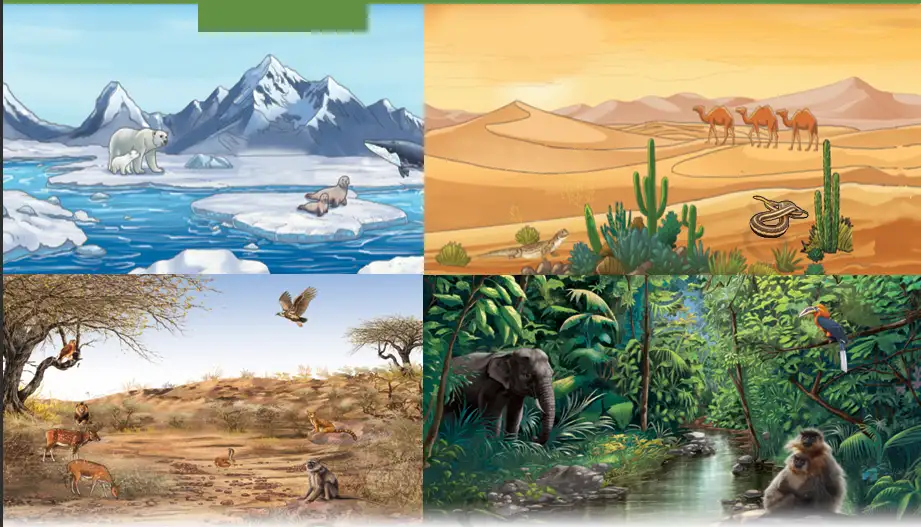
Why biodiversity matters
- Ecosystem roles: Algae release much of the oxygen we breathe; fungi and bacteria decompose waste and help make soil fertile.
- Pollination and food: Birds, bees, and bats pollinate flowers; plants capture sunlight and make food that supports nearly all life.
- Human needs: People depend on biodiversity for food, shelter, medicines, and livelihoods.
- Crop resilience: Diverse crop varieties can provide drought tolerance, pest resistance, or the ability to grow in nutrient-poor soil.
- Food security: Crop diversity reduces the risk of widespread crop failure.
Classification — The systematic grouping of organisms according to shared characteristics and evolutionary relationships.
How classification helps
- Study of diversity: Grouping organisms makes their similarities, differences, and relationships easier to understand.
- Practical uses: Classification supports ecosystem management, biodiversity conservation, and sustainable farming.
- Farming: Recognising differences among organisms helps farmers make use of useful crop traits and address problems such as crop damage.
India as a Biodiversity Hotspot
India's varied habitats
- Landscapes: India includes northern mountains, western deserts, North-Eastern rainforests, southern plateaus, and long coastlines along the Arabian Sea and Bay of Bengal.
- Habitat variety: Different soils and climates, including temperature and rainfall, support a wide variety of species.
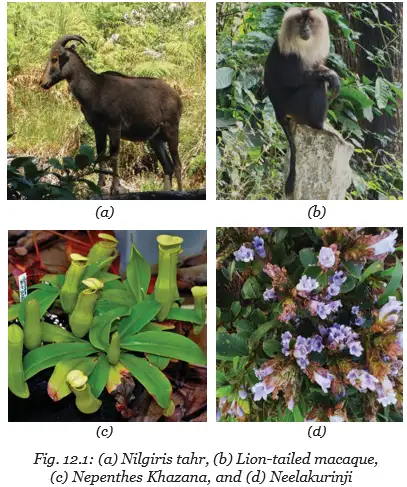
Endemic species — Species that are naturally restricted to a particular region and are not found naturally anywhere else.
Examples of endemic species in India
- Examples: Nilgiri tahr, lion-tailed macaque, the Indian pitcher plant *Nepenthes khasiana*, and Neelakurinji.
Biodiversity hotspot — A region with many endemic species that has also undergone significant habitat loss.
Hotspots and conservation
- Examples in and around India: Western Ghats, Indo-Burma (including North-East India), the Himalayas, and Sundaland (including the Nicobar Islands).
- Importance: Hotspots are especially rich in the number and variety of organisms; protecting them helps conserve biodiversity, food webs, and healthy ecosystems.
How Biodiversity Evolved
Change in biodiversity over time
- Variation: Individuals differ in small ways.
- Survival and reproduction: Some differences help organisms survive and reproduce when conditions change.
- Accumulation: Helpful differences accumulate over many generations.
- New forms: Over vast spans of time, these changes give rise to new forms of life.
- Overall: Present-day biodiversity is the result of continuous change shaped by interactions between organisms and their surroundings.
- Study: Classification provides a systematic framework for studying biological diversity.
India's Scientific Contributions
- Sangam Tinai: This traditional classification of landscapes reflected a detailed cultural and literary understanding of landscapes and their living things.
- Sacred groves: Protecting these places helped preserve locally diverse habitats.
- Ecological significance: These traditions aligned with present-day ecological principles, although they were not expressed as a formal ecological theory.
What is a biodiversity hotspot, and why is it important to protect one?
How can biodiversity support food security?
Quick recap
- Biodiversity is the variety of living organisms and their habitats, and it supports ecosystems and human needs.
- Classification groups organisms by shared characteristics and evolutionary relationships to help study and manage diversity.
- Endemic species are naturally restricted to a particular region; examples in India include the Nilgiri tahr and Neelakurinji.
- Biodiversity hotspots have many endemic species and significant habitat loss; India-associated examples include the Western Ghats and Himalayas.
- Evolution: Variations that aid survival and reproduction can accumulate over generations and lead to new forms of life.
- Indian traditions: Sangam Tinai and sacred groves reflect landscape knowledge and helped preserve local habitats.
How to Classify Organisms?
Classification of Organisms
Classification — The systematic organisation of Earth's living diversity into groups based on shared features.
Why organisms are grouped
- Grouping criteria: Organisms can be grouped in different ways depending on the feature chosen.
- Multiple groups: The same organism may fit into more than one group under different criteria.
- Scientific approach: Scientists begin with broad, easily observed features and then examine more detailed ones.
- Shared features: Similar inherited features can indicate that organisms evolved from common ancestors.
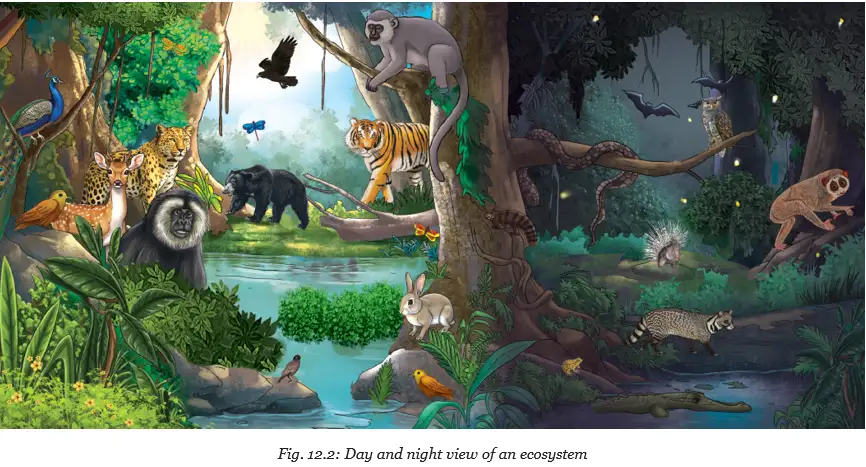
Criteria Used to Classify Living Organisms
| Criterion | Features examined |
|---|---|
| External features | Visible traits such as shape, size and body organisation. |
| Mode of nutrition | Whether the organism is autotrophic or heterotrophic. |
| Internal structures | Skeletal patterns; presence or absence of organs; and types of tissues. |
| Cell structure | Unicellular or multicellular; prokaryotic or eukaryotic; and presence or absence of a cell wall. |
| Ecological role | Whether the organism is a producer, consumer or decomposer. |
| Reproduction | Whether reproduction is asexual, sexual or both. |
| Genetic similarity | Similarities in inherited features, studied in detail using DNA. |
Classification and ancestry
- DNA comparisons: Genetic similarities help scientists identify relationships and distinguish groups.
- Common ancestry: Similar inherited characteristics can suggest that organisms share a common ancestor.
- Evidence strength: Classification uses several characteristics; genetic evidence helps reveal relationships in greater detail.
What is classification, and why can an organism belong to different groups?
Name four criteria scientists use to classify organisms.
Quick recap
- Classification organises living diversity systematically using shared characteristics.
- The same organism can be grouped differently when the criterion changes.
- Scientists examine broad visible features and then more detailed characteristics.
- Classification criteria include body features, nutrition, structures, cells, ecological role and reproduction.
- Genetic similarities studied through DNA help reveal relationships.
- Similar inherited features may indicate a common ancestor.
The Need for Classification
Why Classification Is Needed
Organising Biodiversity
- Need: Earth has millions of organisms, so studying them without an organised system would be difficult.
- Purpose: Grouping organisms makes information easier to organise and helps scientists study and understand life systematically.
- Analogy: Just as arranging books by subject or author helps readers find them, grouping organisms helps us study their diversity.
Pakke Tiger Reserve: A Case of Biodiversity
Hornbills and Their Habitat
- Species richness: Pakke Tiger Reserve in Arunachal Pradesh has nearly 300 recorded bird species; India has about 1,300.
- Hornbills: Four species found there are the Rufous-necked, Oriental Pied, Great and Wreathed Hornbills.
- Habitat needs: These large birds nest in cavities in large, old trees and feed on specific fruits.
- Distribution: Hornbill species occur in different parts of the forest according to tree size and fruit availability.
- Conservation link: Losing large, old trees can reduce nesting places and threaten hornbill populations.

Biological Classification
Biological classification — The scientific system of grouping living organisms based on their similarities and/or differences.
Basis for Grouping
- Features compared: Organisms may be grouped by external features, internal structures such as tissues and organs, and cellular organisation.
- What it reveals: Classification helps organise information, identify similarities and differences, and understand relationships among organisms.
Importance of Biological Classification
- Systematic study: Makes the study of living organisms more organised and manageable.
- Comparison: Clarifies similarities and differences among living beings.
- Relationships: Helps reveal how organisms are related and how they interact.
- Identification and naming: Supports the identification and naming of newly discovered organisms.
- Conservation: Helps identify organisms threatened with extinction and supports biodiversity conservation.
- Common language: Enables scientists worldwide to discuss organisms using a shared system.
Define biological classification and state its importance.
Quick recap
- Classification groups organisms systematically using similarities and differences.
- Grouping criteria include external features, internal structures and cellular organisation.
- Classification benefits include easier study, comparison and understanding relationships.
- Naming and conservation are supported by identifying new and threatened organisms.
- Pakke has nearly 300 bird species, including four hornbill species dependent on large, old trees and specific fruits.
Biological Classification Systems Over Time
Early Approaches to Classification
Early approaches
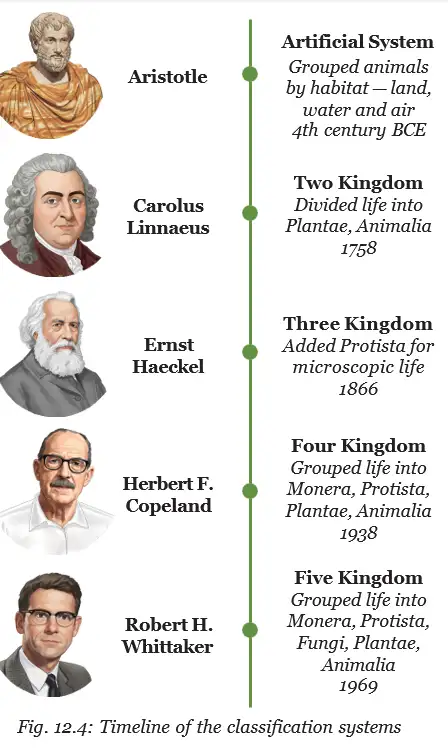
- Aristotle (around the 4th century BCE): Grouped animals by habitat—land, water and air—and by external appearance.
- Limitation: This approach relied mainly on easily observed external features.
- Indian contributions: The Rigveda and Brihat Samhita classified animals by habitat—terrestrial, aquatic and aerial—as well as by behaviour patterns and ecological roles.
The Two-Kingdom System
Two kingdoms
- Introduced: Scientists proposed this system in the 18th century, dividing all living organisms into Plantae and Animalia.
- Plantae: Organisms that generally do not move from place to place and synthesise their own food.
- Animalia: Organisms that move from place to place and depend on other organisms for food.
- Problem: Unicellular organisms such as Amoeba, Paramecium and bacteria did not fit clearly into either kingdom.
From Three Kingdoms to Five
Why the kingdoms changed
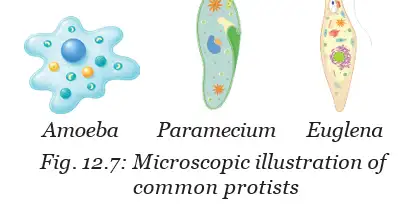
- Three kingdoms: Protista was added for microscopic, unicellular organisms. Amoeba and Paramecium are unicellular and heterotrophic, unlike multicellular plants and animals.
- Four kingdoms: Improved microscopes revealed that bacteria lack a true, membrane-bound nucleus, unlike Amoeba. Bacteria were placed in Monera; Protista includes mostly unicellular organisms with a true nucleus.
- Fungi: Mushrooms do not move like plants and obtain food heterotrophically by absorption. Many absorb nutrients from dead and decaying matter; some are symbiotic or parasitic.
- Five kingdoms: Fungi became a separate kingdom, giving Monera, Protista, Fungi, Plantae and Animalia. This system is associated with Whittaker.
| Stage | Groups | Key basis or reason |
|---|---|---|
| Aristotle | Animals grouped by land, water and air habitats | Habitat and external appearance |
| Two kingdoms | Plantae, Animalia | Broad division of living organisms; unicellular organisms caused confusion |
| Three kingdoms | Plantae, Animalia, Protista | Protista added for unicellular microscopic organisms |
| Four kingdoms | Plantae, Animalia, Protista, Monera | Bacteria separated because they lack a true nucleus |
| Five kingdoms | Monera, Protista, Fungi, Plantae, Animalia | Fungi separated because of their heterotrophic, absorptive nutrition |
Why were bacteria placed in a separate kingdom from Protista?
Why were fungi placed in a separate kingdom?
Quick recap
- Aristotle grouped animals by habitat and external appearance around the 4th century BCE.
- The Rigveda and Brihat Samhita classified animals by terrestrial, aquatic and aerial habitats, behaviour and ecological roles.
- The 18th-century system divided organisms into Plantae and Animalia.
- Protista was added for unicellular microscopic organisms.
- Monera was separated from Protista because bacteria lack a true nucleus.
- Fungi were separated based on their heterotrophic, absorptive nutrition; the five kingdoms are Monera, Protista, Fungi, Plantae and Animalia.
Five Kingdom Classification part1
Basis of Five Kingdom Classification
- Criteria: The five kingdoms are distinguished by cell type, cell structure, level of organisation and mode of nutrition.
- Purpose: These shared features provide a systematic way to group organisms and understand their diversity.
Kingdom Monera
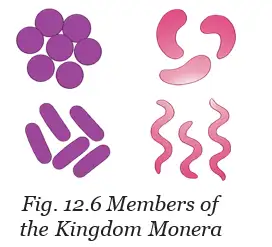
Cyanobacteria and Their Importance
Cyanobacteria and Oxygen in the Atmosphere
- Cyanobacteria photosynthesise
- Oxygen is released
- Oxygen accumulates in the atmosphere about 2.5 billion years ago
- Earth becomes suitable for other forms of life
What criteria form the basis of five kingdom classification?
State two useful roles of bacteria.
Quick recap
- Five kingdom classification considers cell type, cell structure, organisation and nutrition.
- Monera includes unicellular prokaryotes such as bacteria and cyanobacteria.
- Bacteria live in diverse environments; some are useful and some cause disease.
- Some bacteria aid biogas production, nutrient cycling and pollutant breakdown.
- Cyanobacteria photosynthesised and contributed oxygen to Earth’s atmosphere about 2.5 billion years ago.
- Stromatolites containing ancient cyanobacteria fossils are found in Rajasthan and Madhya Pradesh.
Five Kingdom Classification part 2
Kingdom Protista
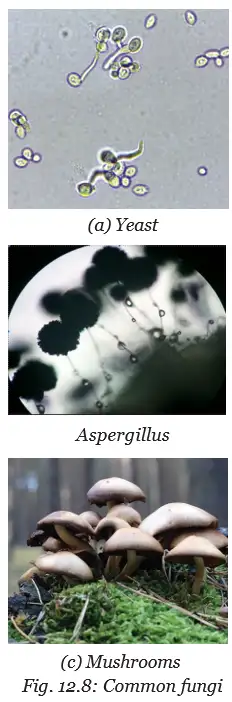
Kingdom Fungi
| Fungus | Key fact or use |
|---|---|
| Yeast | Unicellular fungus; classified as fungi because its cell wall is made of chitin. |
| Bread mould | A common fungus. |
| Mushrooms | Macroscopic fungi that reproduce by spores. |
| Aspergillus and Penicillium | Some species are used to make enzymes and antibiotics. |
Fungi, ecosystems and people
- Decomposition: Fungi recycle nutrients by breaking down dead plants and animals; without them, decay would slow, harming soil fertility and ecological balance.
- Wild mushrooms: They can be nutritious foods and may have medicinal value; communities, including tribal communities in India, preserve traditional knowledge to distinguish edible from poisonous kinds.
- Cultivation: Mushroom farming can support livelihoods because it needs little space and investment and has a short growing cycle of about 30–45 days.
Why are fungi important decomposers?
Why is yeast classified under fungi despite being unicellular?
Quick recap
- Protists are microscopic, unicellular eukaryotes, commonly found in water or moist places.
- Protists may be autotrophic or heterotrophic and have important roles in aquatic food chains and nutrient cycling.
- Fungi have chitin cell walls and absorb nutrients; most are multicellular, but yeast is unicellular.
- Many fungi are saprophytes; others are mutualistic or parasitic.
- Fungi often reproduce by spores and help decompose dead matter and recycle nutrients.
- Mushrooms can be food, medicine and a livelihood resource; cultivation has a short 30–45-day cycle.
Five Kingdom Classification part 3
Kingdom Plantae

Thallophyta
Thallophyta — A group of simple plants with an undifferentiated body called a thallus.
Key features
- Habitat: Mostly found in water or moist environments.
- Thallus: The simple body allows direct exchange of gases, water and nutrients with its surroundings.
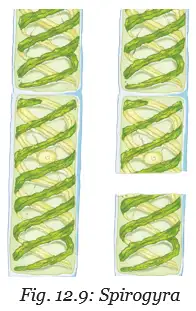
- Example: Spirogyra is a thallophyte; it has characteristic spiral chloroplasts.
- Limitation: Thallophytes are not adapted to living on land.
Lichens: Symbiosis and bioindicators
Lichen — A symbiotic association between an autotrophic alga and a heterotrophic fungus.
Roles and uses
- Algal partner: Photosynthesises and provides food; the fungal partner provides protection.
- Air quality: Lichens change colour with air pollutants, so they act as natural bioindicators.
- Uses: Some lichens are used as spices, medicines and sources of dyes for wool and silk.
- Safety: Some lichens are poisonous, so correct identification is important.
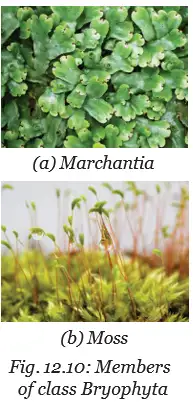
Bryophyta
Bryophyta — Simple land plants with root-like rhizoids that remain dependent on water for reproduction.
Key features
- Body: More differentiated than a thallus, but lacks true roots, stems and leaves.
- Structures: Rhizoids anchor the plant; simple stem-like and leaf-like structures may be present.
- Habitat: They grow in moist, shady places, often forming green mats on soil, rocks and walls.
- Reproduction: Water is needed for reproduction; hence bryophytes are called the amphibians of the plant kingdom.
- Examples: Marchantia and moss.
Pteridophyta
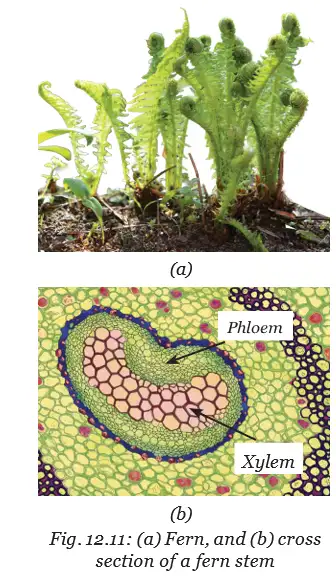
Pteridophyta — Vascular plants with true roots, stems and leaves that reproduce without seeds.
Key features
- Plant body: Ferns have true roots, stems and leaves.
- Transport: Vascular tissues carry materials throughout the plant: xylem transports water and phloem transports food.
- Reproduction: They still require water for reproduction and do not produce seeds.
- Example: Ferns are pteridophytes.
Gymnosperms
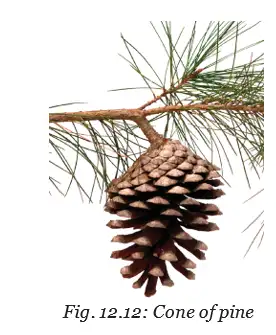
Gymnosperms — Seed-producing plants whose seeds are not enclosed in fruits.
Key features
- Habitat: Pines and cycads are adapted to cold and dry regions.
- Leaves: Needle-like or scale-like leaves reduce water loss and help withstand harsh conditions.
- Seeds: Seeds protect the developing embryo and contain stored food; they are often exposed on cones.
- Fertilisation: Gymnosperms do not require aquatic conditions for fertilisation.
Angiosperms
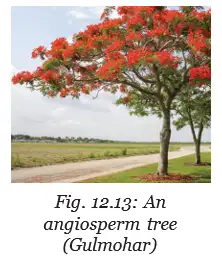
Angiosperms — Flowering plants whose seeds are enclosed within fruits.
Key features
- Organisation: They have the most complex body organisation, with well-developed roots, stems and leaves.
- Flowers: Flowers support sexual reproduction and attract pollinators, making reproduction more efficient.
- Fruits: Fruits enclose seeds and help disperse them to new locations.
- Dispersal: Seeds may be spread by insects, birds, other animals, wind or water.
- Diversity: Flowers, fruits and effective dispersal help angiosperms live in many environments; they are the most diverse plant group.
Comparison of the five plant groups
| Group | Key features | Survival advantage | Challenge |
|---|---|---|---|
| Thallophyta | Undifferentiated thallus; absorbs water and nutrients and exchanges gases directly. | Simple body suits aquatic life and dispersal in water. | Not adapted to living on land. |
| Bryophyta | Slight body differentiation; rhizoids but no true roots, stems or leaves; no vascular tissue; reproduction needs water. | Can colonise moist land; called plant amphibians. | Remain dependent on moisture. |
| Pteridophyta | True roots, stems and leaves; xylem and phloem; no seeds; reproduction needs water. | Live on land and transport water and food throughout the plant. | Reproduction still depends on water. |
| Gymnosperms | Seeds exposed, often on cones; needle-like leaves; fertilisation does not need water. | Seeds support continuity of life; leaves suit dry conditions. | Seeds are not enclosed in fruits. |
| Angiosperms | Well-developed plant body; flowers; seeds enclosed in fruits. | Flowers support reproduction; fruits protect and help disperse seeds. | Pollination depends on agents, and reproduction involves complex processes. |
Plant adaptations from water to land
- Thallophytes: simple bodies adapted mainly to water
- Bryophytes: colonise moist land but need water for reproduction
- Pteridophytes: develop transport tissues and true roots, stems and leaves, but still need water for reproduction
- Gymnosperms: produce seeds and reproduce without aquatic conditions; seeds are exposed
- Angiosperms: develop flowers and fruits; seeds are enclosed and can disperse widely
Plants, knowledge and society
- Hortus Malabaricus: This early scientific book on Indian plants was compiled in the 17th century by Hendrik van Rheede, with Itty Achudan and other local experts.
- Significance: It describes hundreds of plant species and their medicinal uses, demonstrating how traditional knowledge can work with science.
Why are bryophytes called the amphibians of the plant kingdom?
How do pteridophytes transport water and food?
Distinguish gymnosperms from angiosperms by their seeds.
Quick recap
- Plantae includes multicellular, autotrophic eukaryotes with cellulose-rich cell walls.
- Thallophytes have simple thalli and are mainly aquatic; Spirogyra is an example.
- Bryophytes have rhizoids and need moisture, especially water for reproduction.
- Pteridophytes have true roots, stems, leaves and vascular tissues but no seeds.
- Gymnosperms produce exposed seeds and do not need aquatic conditions for fertilisation.
- Angiosperms produce flowers and fruits, with seeds enclosed in fruits; they are the most diverse plant group.
Five Kingdom Classification part 4
Kingdom Animalia
Animals — Multicellular, heterotrophic eukaryotes that depend on other organisms for food.
General features
- Most animals show locomotion, rapid responses to stimuli and coordinated behaviour.
- These abilities help them find food, avoid predators and interact with their surroundings.
Classification by Notochord
Notochord — A flexible, rod-shaped internal supporting structure found in chordates at least at some stage of life.
Animal groups
- No notochord → non-chordates (invertebrates)
- Notochord present → chordates
- Chordates → protochordates and vertebrates
Key distinction
- In some chordates, the notochord acts as a precursor to the vertebral column.
- Invertebrates lack a notochord and range from simple body plans to complex organ systems.
Invertebrates: Increasing Body Organisation
- Body-plan changes: Across invertebrate groups, structural features support different ways of feeding, moving and gaining protection.
- Survival: These features help explain how animals live in varied environments, although new adaptations may also bring challenges.
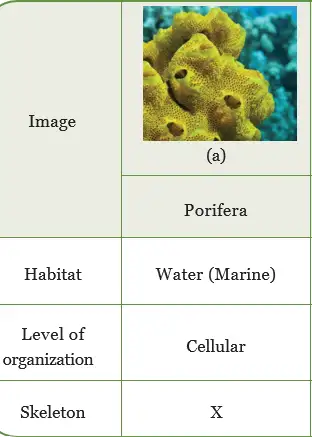
Porifera: Pore-Bearers
Sponges
- Organisation: Multicellular, but without tissues or organs.
- Pores: Water flows through the body, bringing food particles and oxygen to cells and carrying away wastes.
- Lifestyle: Aquatic and fixed in one place; examples are sponges.
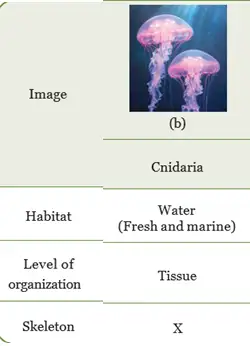
Cnidaria: True Tissues and Active Feeding
Features
- Organisation: Tissue-level organisation, with specialised cells performing particular functions.
- Feeding: Tentacles capture prey, unlike sponges that rely on water currents to bring food through pores.
- Digestive opening: One opening serves for both food intake and waste removal.
- Examples: Hydra, jellyfish and corals.
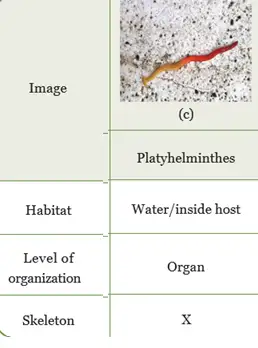
Platyhelminthes: Flatworms
Bilateral symmetry — A body arrangement that can be divided into two similar halves along one plane.
Features and adaptations
- Body plan: Flattened body with distinct head-tail and front-back regions; bilateral symmetry supports coordinated, directional movement.
- Gas exchange: Gases diffuse across the flattened body, so specialised respiratory organs are absent.
- Digestive opening: A single opening is used for food intake and waste elimination.
- Parasitic forms: Many flatworms use hooks and suckers to attach to host tissues and obtain nutrients.
Host — An organism that a parasite lives in or on.
Preventing parasitic worm infections
- Transmission: Some parasitic worms enter through contaminated food or water and may live in the alimentary canal, taking nutrients from the host.
- Prevention: Wash hands, maintain personal hygiene and sanitation, cook food properly, and drink boiled or filtered water.
Nematoda: Roundworms
Features
- Body: Elongated and cylindrical, enabling movement through soil, water or host tissues.
- Openings: Two openings—a mouth and an anus.
- Organisation: Organ-system level; males and females are distinct.
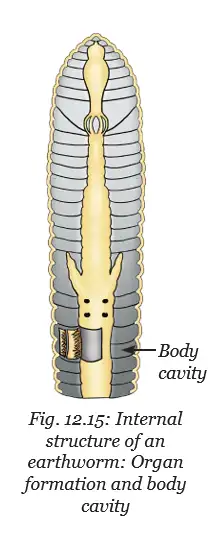
Annelida: Segmented Worms
Features
- Body: Cylindrical and divided into segments; a body cavity is present.
- Organisation: Organ-system level; muscles enable locomotion and a nerve cord supports control and coordination.
- Segmentation: Provides greater flexibility and more precise control of movement.
- Example: Earthworm.
Arthropoda: Jointed Appendages
Features
- Examples: Insects, crabs and spiders.
- Body: Segmented, with different segments specialised for different functions.
- Organisation: Organ-system level.
- Exoskeleton: A hard external covering that protects the body, reduces water loss and supports powerful muscles.
- Survival benefit: The exoskeleton helps arthropods live in dry and exposed environments.
How does a beetle’s external skeleton help it survive?
Mollusca: Soft-Bodied Animals
Features
- Organisation: Organ-system level, with a soft body.
- Body parts: Typically a distinct head, muscular foot and hump; the body is described as segmented in this lecture.
- Protection: Many molluscs have a shell that protects the soft body.
- Examples: Snails, squids and octopuses; the basic body plan can vary with environmental demands.
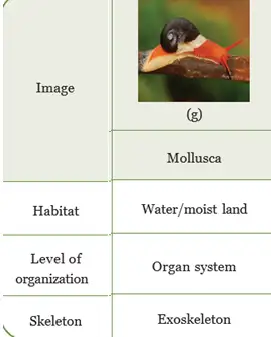
Echinodermata: Internal Support
Features
- Examples: Starfish and sea urchins.
- Skeleton: A hard internal skeleton made of calcium carbonate provides protection and supports controlled movement.
- Classification: They lack a notochord despite having internal skeletal support.
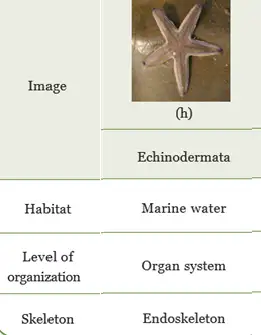
Looking across invertebrates
- Increasing complexity: Body organisation becomes more complex from sponges to echinoderms.
- Structural changes: New features improve feeding, movement and protection, supporting survival in diverse environments.
Protochordates
The notochord appears
- Notochord: Present at least once during the life cycle; it provides internal support without restricting movement.
- Significance: Protochordates are primitive chordates that help explain the appearance of the notochord in animal body organisation.
- Example: Amphioxus.
Vertebrates: Animals with a Backbone
Vertebral column — An internal skeletal structure (backbone) that supports the body and protects vital organs, including the brain and spinal cord.
Vertebrate features and groups
- Internal framework: Supports larger body size, efficient movement and complex organ systems.
- Other features: Advanced sensory abilities and coordinated behaviour.
- Five groups: Fish, amphibians, reptiles, birds and mammals; broadly classified by habitat use, body covering and reproduction.
Biodiversity as a Natural Barrier
How diverse ecosystems reduce harm
- Disaster protection: Biodiversity can create physical, biological and chemical barriers against environmental challenges.
- Mangroves: During the 1999 Orissa super cyclone, villages with more mangroves experienced less destruction.
- Disease: Rich biodiversity is generally linked to lower tick-borne disease risk; in the Western Ghats, diverse animal hosts can act as a biological barrier to Monkey Fever (Kyasanur Forest Disease, KFD).
- Pollution control: Soil microorganisms and plant roots absorb, transform or break down pollutants; mangrove soils trap sediments and heavy metals before they spread into rivers and oceans.
Biodiversity and ecosystem protection
- High diversity of trees in mangroves → physical barrier during storms → reduced destruction in nearby villages.
- Diverse animal hosts → virus cannot replicate in many hosts → biological barrier to KFD risk.
- Soil organisms, roots and mangroves → pollutants transformed or trapped → improved water quality and less pollution spread.
How do mangrove forests help protect people and ecosystems?
Quick recap
- Animals are multicellular heterotrophs; the notochord separates chordates from non-chordates.
- Invertebrate body organisation progresses from pore-bearing sponges to internally supported echinoderms.
- Cnidarians have tissues and tentacles; flatworms show bilateral symmetry and may be parasitic.
- Roundworms have two openings; annelids are segmented; arthropods have organ-system organisation and a protective exoskeleton.
- Molluscs have soft bodies, while echinoderms have a calcium-carbonate internal skeleton.
- Protochordates have a notochord at some life stage; vertebrates possess a backbone.
- Biodiversity can reduce disaster damage, disease risk and pollution spread.
Adaptations as Outcomes of Structural Change
Structural adaptations and survival
- Structural adaptations: Body features help animals meet environmental challenges and survive in different habitats.
- Examples: Fish use fins and gills; birds have feathers and hollow bones; camels store fat, while polar bears have thick fur.
- Care of young: Mammary glands in mammals help nourish their young.
The hierarchical nature of classification
Taxonomic levels, broad to specific
- Kingdom
- Phylum
- Class
- Order
- Family
- Genus
- Species
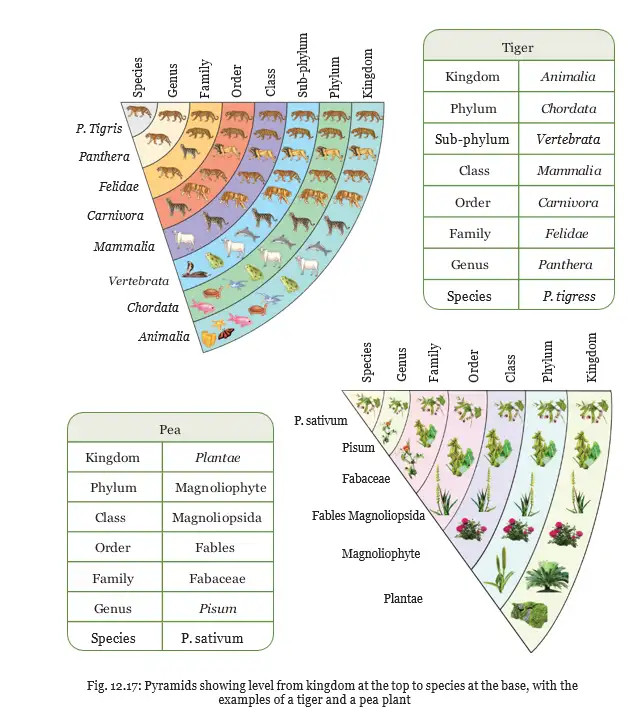
Why the hierarchy is useful
- Address analogy: like a house address, classification narrows down the location of an organism.
- Identification: moving from kingdom towards species helps identify an organism more precisely.
- Examples: the hierarchy can be used to classify organisms such as a tiger or a pea plant.
How do structural adaptations support survival? Give examples.
Write the taxonomic levels in order from broadest to most specific.
What happens to shared features as we move to lower levels of classification?
Quick recap
- Structural adaptations are body features that support survival in an environment.
- Fish have fins and gills; birds have feathers and hollow bones.
- Camels store fat, polar bears have thick fur, and mammary glands support the survival of mammalian young.
- Classification proceeds from broad groups to specific groups.
- The order is Kingdom → Phylum → Class → Order → Family → Genus → Species.
- Lower classification levels contain organisms with more shared features and are nested within higher groups.
Scientific Naming -The Binomial System
Binomial Nomenclature
Rules for Writing Scientific Names
- Order and capitalisation: Write the genus first with a capital initial; write the species name second, in lowercase.
- Formatting: Print scientific names in italics; underline them when handwritten.
- Examples: Tiger — *Panthera tigris*; mango — *Mangifera indica*.
The Three-Domain System
- Genetic evidence: DNA comparisons revealed relationships among organisms that earlier classification systems could not fully explain.
- Three domains: Carl Woese proposed Bacteria, Archaea and Eukarya in 1977, highlighting the diversity of microscopic life.
Classification Changes with New Evidence
- Early systems: Aristotle grouped animals by habitat and appearance; in the 18th century, organisms were divided into Plantae and Animalia.
- New kingdoms: Protista was added for unicellular organisms, Monera for bacteria without a true nucleus, and Fungi for organisms that absorb nutrients.
- Five kingdoms: The resulting system consists of Monera, Protista, Fungi, Plantae and Animalia.
- Changing evidence: Microscopes and genetic studies revealed new differences and relationships, leading scientists to revise classification systems.
Quick recap
- Binomial nomenclature gives each organism a universal, two-part scientific name.
- The genus comes first and begins with a capital letter; the species name follows in lowercase.
- Print scientific names in italics and underline them when handwritten.
- Similar DNA can indicate common ancestry; Carl Woese proposed Bacteria, Archaea, and Eukarya as the three domains in 1977.
- Classification changes as new evidence and technologies improve scientific understanding.
- Birbal Sahni's fossil-plant studies helped connect present-day plants with their ancestors.
Fossils as Evidence and Biodiversity Under Threat
Fossils as Evidence
Fossils — Preserved remains of plants and animals found in layers of rocks, sand and mud.
What fossils tell us
- Natural records: Fossils provide evidence of how life has changed over millions of years.
- Rock layers: Older layers generally contain simpler organisms; newer layers show more complex forms.
- Examples: Fossils of dinosaurs, early humans and ancient plants have been discovered in India.
Biodiversity Under Threat
Biodiversity — The variety of living organisms, each of which plays an important role in nature.
| Organism | Role |
|---|---|
| Plants | Produce food and oxygen. |
| Animals | Pollinate flowers and disperse seeds. |
| Microorganisms | Recycle nutrients. |
Threats and effects
- Human activities: Pollution, deforestation, overuse of resources and climate change reduce biodiversity.
- Dependence between species: If one species disappears, species that depend on it may also decline or disappear.
How species loss can affect other species
- A species disappears.
- Other species that depend on it may decline.
- Those dependent species may eventually disappear.
Discovering and Naming Species
- Comparison: Scientists compare a newly discovered organism with already known species.
- Species names: A name may reflect the place of discovery or honour a scientist.
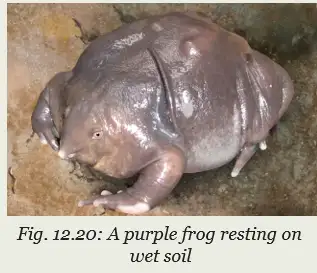
The Purple Frog
- Name and location: The Purple Frog, *Nasikabatrachus sahyadrensis*, is from Kerala; its species name refers to the Sahyadri Hills.
- Life pattern: It lives underground for most of the year and emerges during the monsoon to breed.
- Scientific importance: Fossils indicate that it belongs to an ancient frog family; its discovery helped scientists understand ancient amphibian groups.
- Conservation: Its discovery highlighted the need to conserve biodiversity in the Western Ghats.
Purple Frog Discovery
- 2003The Purple Frog was discovered, helping scientists understand ancient amphibian groups.
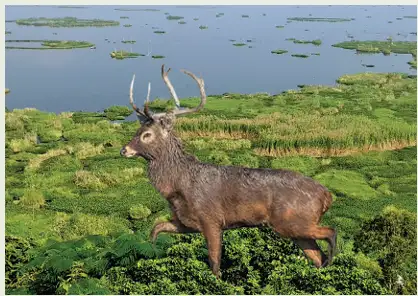
Phumdis and the Sangai Deer
Phumdis — Floating grasslands in Loktak Lake, made of floating beds of soil with rooted vegetation and rich organic matter.
Phumdis and the Sangai
- Location: Phumdis occur in Loktak Lake, in Keibul Lamjao National Park, Manipur.
- Structure: Their thickness ranges from a few centimetres to about two metres.
- Sangai: The endangered dancing deer is endemic to Manipur and depends on this small, specialised habitat.
- Threat: Phumdis are degenerating; habitat loss can significantly affect the Sangai population.
- Conservation: Efforts are underway to conserve both the phumdis and the Sangai deer. Protecting this habitat is essential.
Sangai Status
- 1951The Sangai deer was declared extinct.
- 1953Naturalists rediscovered the deer, identifying it by distinctive features including its hooves and elongated patterns.
Sangai Conservation Status
- IUCN listing: The Sangai is listed in the IUCN Red Data list.
- Key priority: Conserving phumdis is important for protecting the Sangai and its habitat.
How do fossils provide evidence that life has changed over time?
Why is the Purple Frog important to scientists and conservation?
Why must phumdis be conserved to protect the Sangai?
Quick recap
- Fossils are preserved remains that record changes in life over millions of years.
- Older rock layers generally contain simpler organisms than newer layers.
- Plants, animals and microorganisms support nature through different roles.
- Pollution, deforestation, resource overuse and climate change reduce biodiversity.
- Scientists compare newly discovered organisms with known species; names may reflect a place or honour a scientist.
- The Purple Frog is from Kerala; the Sangai deer depends on threatened phumdis in Manipur.
At a Glance
Why Organisms Are Classified
- Organisation: Classification makes the study of the Earth’s many organisms systematic and manageable.
- Relationships: It helps compare organisms, understand how they are related and study their interactions.
- Applications: Classification supports identification, shared scientific communication and biodiversity conservation.
Whittaker’s Five-Kingdom Classification
- Five kingdoms: Whittaker’s system groups life into Monera, Protista, Fungi, Plantae and Animalia.
- Basis: The groups reflect features such as cell type, cell structure, number of cells and mode of nutrition.
Classification within Plantae
- Plant kingdom: Plantae consists of multicellular, autotrophic eukaryotes whose cells have a cellulose cell wall.
- Major groups: Plants are classified as Thallophyta, Bryophyta, Pteridophyta, Gymnosperms and Angiosperms.
- Adaptations: These groups show changes in body structure, transport and reproduction that help plants survive in different environments.
Classification within Animalia
| Group | Classification |
|---|---|
| Non-chordates (invertebrates) | Porifera, Cnidaria, Platyhelminthes, Nematoda, Annelida, Arthropoda, Mollusca and Echinodermata |
| Protochordates | Possess a notochord at least once during their life; show a transition from invertebrates to vertebrates |
| Vertebrates | Fish, amphibians, reptiles, birds and mammals |
What are the five kingdoms in Whittaker’s classification?
On what basis are chordates and non-chordates distinguished?
Quick recap
- Organisms are classified using cell structure, cell number, nutrition and ecological role.
- Whittaker’s five kingdoms are Monera, Protista, Fungi, Plantae and Animalia.
- Plantae is divided into the five classes Thallophyta, Bryophyta, Pteridophyta, Gymnosperm and Angiosperm.
- Animalia is divided into non-chordates and chordates based on notochord formation.
- Non-chordate phyla include Porifera, Cnidaria, Platyhelminthes, Nematoda, Annelida, Arthropoda, Mollusca and Echinodermata.
- Protochordates possess a notochord at least once; vertebrates include fish, amphibians, reptiles, birds and mammals.
- Classification helps explain organism relationships, the history of life and biodiversity conservation.
Science — ALL CHAPTERS
1
Exploration: Entering the World of Secondary Science
2
Cell: The Building Block of Life
3
Tissues in Action
4
Describing Motion Around Us
5
Exploring Mixtures and their Separation
6
How Forces Affect Motion
7
Work, Energy, and Simple Machines
8
Journey Inside the Atom
9
Atomic Foundations of Matter
10
Sound Waves: Characteristics and Applications
11
Reproduction: How Life Continues
12
Patterns in Life: Diversity and Classification
13
Earth as a System: Energy, Matter, and Life