Class 9 . Science . Exploration . Sound Waves Characteristics and Applications
Chapter 10: Sound Waves: Characteristics and Applications
Ch 10
Science
Class 9
Production of Sound
Sound and Its Production
Sound — Sound is a form of energy produced by vibrating objects.
Key ideas
- Energy conversion: Other forms of energy can change into sound energy; energy is neither created nor destroyed.
- Vibration: The periodic to-and-fro motion, or oscillation, of an object.
- Sound in space: Sound cannot travel through the vacuum of space because it needs a medium.

Vibrations and Sources of Sound
Source of sound — The object that produces sound is called its source.
How objects produce sound
- Rule: As long as an object vibrates, it produces sound; when its vibration stops, the sound stops.
- Examples: Plucking a stretched string or striking a metal object makes it vibrate and produce sound.
- Air column: Blowing into a bansuri makes the air inside its hollow pipe vibrate.
- Musical instruments: Sound can come from vibrating strings, membranes, air columns, or other parts; some instruments have more than one vibrating part.
Sonority — Sonority is the property of some metals to produce sound when struck.
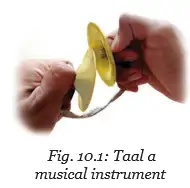
Sound Produced by Humans and Animals
Vocal sounds
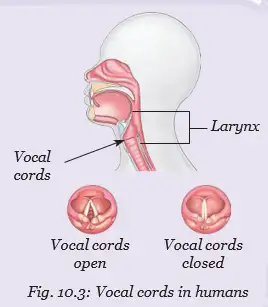
- Humans and some animals: Sound is produced by vibrating vocal cords, tightly stretched muscular flaps inside the larynx (voice box) in the throat.
- Speech and music: The tongue, lips, mouth, and nasal cavity help shape human vocal sound into speech or music.
- Other animal sounds: Grasshoppers and crickets produce sound by rubbing or striking body parts, such as their wings or legs.
Tuning Fork
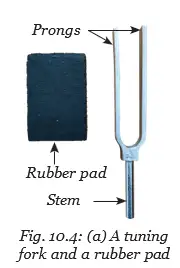
Tuning fork — A tuning fork is a U-shaped metal bar with a stem, usually made of steel or aluminium.
How it works
- Prongs (tines): The two sides of the U-shaped fork; striking a prong gently on a soft pad makes it vibrate.
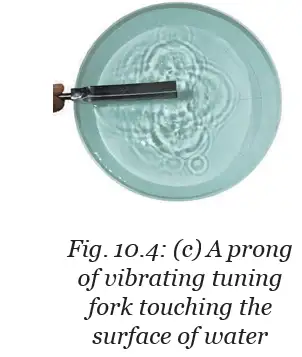
- Evidence of vibration: Vibrating prongs produce sound and create ripples when they touch water.
Quick recap
- Sound is energy produced by vibrating objects, and vibration is periodic to-and-fro motion.
- Sound needs a medium and cannot travel through the vacuum of space.
- The source produces sound; strings, membranes, air columns, and other parts can vibrate to produce it.
- Sonority is the property of some metals to produce sound when struck.
- Human vocal cords and those of some other animals vibrate to produce sound; grasshoppers and crickets can make sounds by rubbing or striking body parts.
- A tuning fork produces sound when its prongs vibrate, and the vibrations can make water ripple.
Propagation of Sound
Sound Travels Through a Medium
- Sound propagation: Sound travels from its source through a material medium.
- Media: Solids, liquids and gases can all transmit sound.
Sound Needs a Medium
Sound in Outer Space
- Outer space is nearly a vacuum, so sound cannot travel through it.
- Astronauts cannot directly hear each other speaking or hear objects clank during spacewalks; they communicate using devices in their spacesuits.
Assertion: A bell is almost inaudible after most of the air is pumped out of its jar. Reason: Sound requires a medium to travel. Are both statements true, and does the reason explain the assertion?
Quick recap
- Sound propagates through solids, liquids and gases.
- Medium means the material through which sound travels.
- Vacuum contains no matter, so sound cannot propagate through it.
- Bell-jar test: Removing air makes the bell fainter; letting air back in restores the sound.
- Space communication uses devices because sound cannot travel through the near vacuum of space.
Sound Waves
How Sound Travels
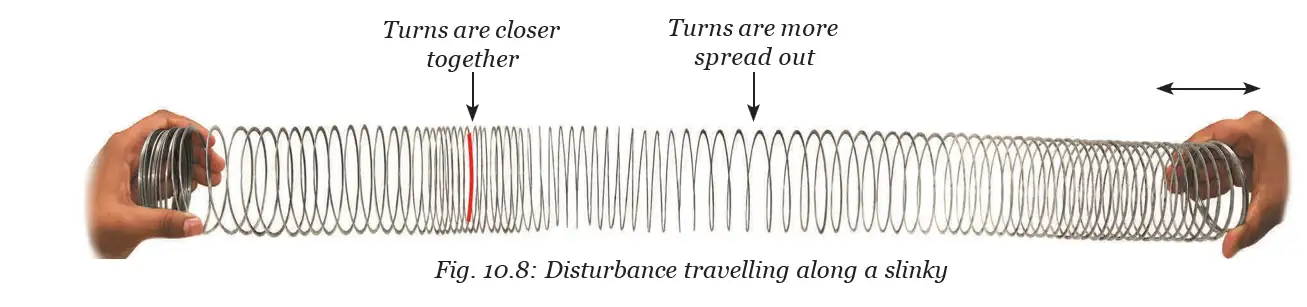
Compressions and Rarefactions
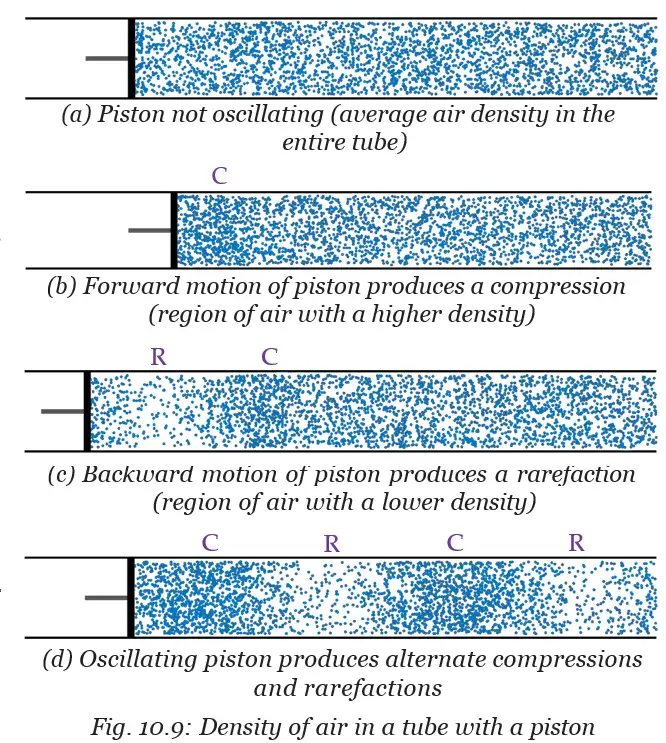
Sound wave — A sound wave is a disturbance of alternating compressions and rarefactions that propagates through a medium without carrying the medium’s particles along with it.
Direction of propagation — The direction in which a wave disturbance travels is called its direction of propagation.
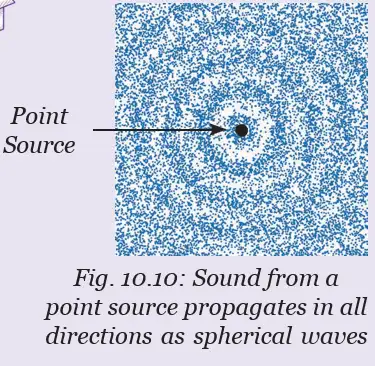
Sound Spreading and Loud Sound Pulses
Longitudinal and Transverse Waves
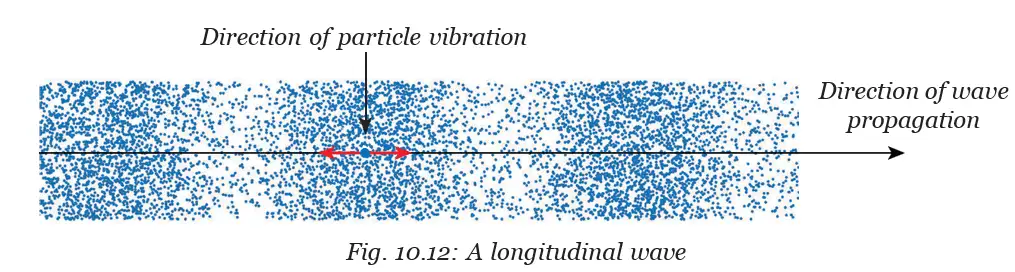
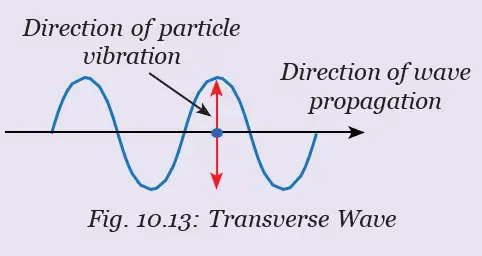
| Point | Longitudinal wave | Transverse wave |
|---|---|---|
| Particle vibration | Parallel to wave propagation | Perpendicular to wave propagation |
| Examples from the lecture | Sound; longitudinal seismic waves | Light; transverse seismic waves |
Mechanical and Non-mechanical Waves
- Mechanical waves: Require a material medium to propagate. Mechanical waves are of two types: longitudinal and transverse waves.
- Sound: A mechanical, longitudinal wave that needs a medium.
- Light: A transverse wave but not a mechanical wave; it can travel through a vacuum, allowing sunlight and starlight to reach Earth.
Do not say that medium particles move forward with sound. The particles oscillate about their mean positions; compressions and rarefactions travel through the medium.
Assertion: Compressions and rarefactions move through the medium. Reason: Individual medium particles continuously move forward with the wave. Choose the correct statement.
Quick recap
- Sound needs a material medium and propagates through particle interactions.
- Compressions are higher-density regions; rarefactions are lower-density regions.
- The wave disturbance travels, but medium particles only oscillate about their mean positions.
- Sound is longitudinal: particles vibrate parallel to wave propagation.
- Mechanical waves are of two types: longitudinal and transverse.
- Point sources can produce spherical sound waves; rapid gas expansion can produce loud pulses.
- Light is transverse but non-mechanical, so it can travel through a vacuum.
Energy of Sound Waves
Sound Transfers Energy
Sound energy — Sound is a form of energy that travels through a medium as sound waves.
How sound transfers energy
- Vibrating source: A sound source transfers energy to the surrounding medium by vibrating.
- Particle motion: Sound makes particles of the medium vibrate; their collisions pass energy to neighbouring particles.
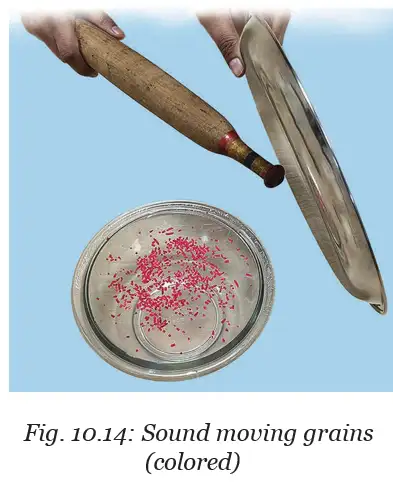
- Evidence: Sound can make a stretched sheet vibrate and cause grains resting on it to move, even without direct contact.
- Energy, not matter: Sound transfers energy through the medium; the medium’s particles do not travel along with the wave.
Particle Motion in a Sound Wave
Sound and the medium
- Usual motion: Medium particles are never completely at rest; thermal energy keeps them in random motion.
- During passage: A sound wave temporarily increases the particles’ vibrations.
- After passage: Particles return to their usual random motion; the wave has transferred energy, not carried the particles away.
Microphones and Speakers
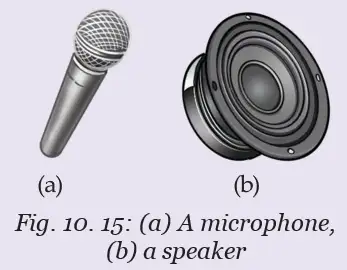
| Device | Conversion | How it works |
|---|---|---|
| Microphone | Sound energy → electrical energy | Sound waves vibrate a thin membrane called a diaphragm; the vibrations become an electrical signal. |
| Speaker | Electrical energy → sound energy | An electrical signal vibrates a cone or diaphragm, producing sound. |
When sound travels from a tuning fork to your ear, what reaches your ear?
Quick recap
- Sound is energy transferred through a medium by vibrating particles.
- Particle collisions pass energy from one part of the medium to another.
- Sound waves transfer energy, not the medium’s particles.
- Sound briefly increases particle vibrations; thermal motion continues before and after the wave.
- A microphone converts sound energy to electrical energy; a speaker converts it back to sound.
Graphical Representation of a Sound Wave
Density Variation in a Sound Wave
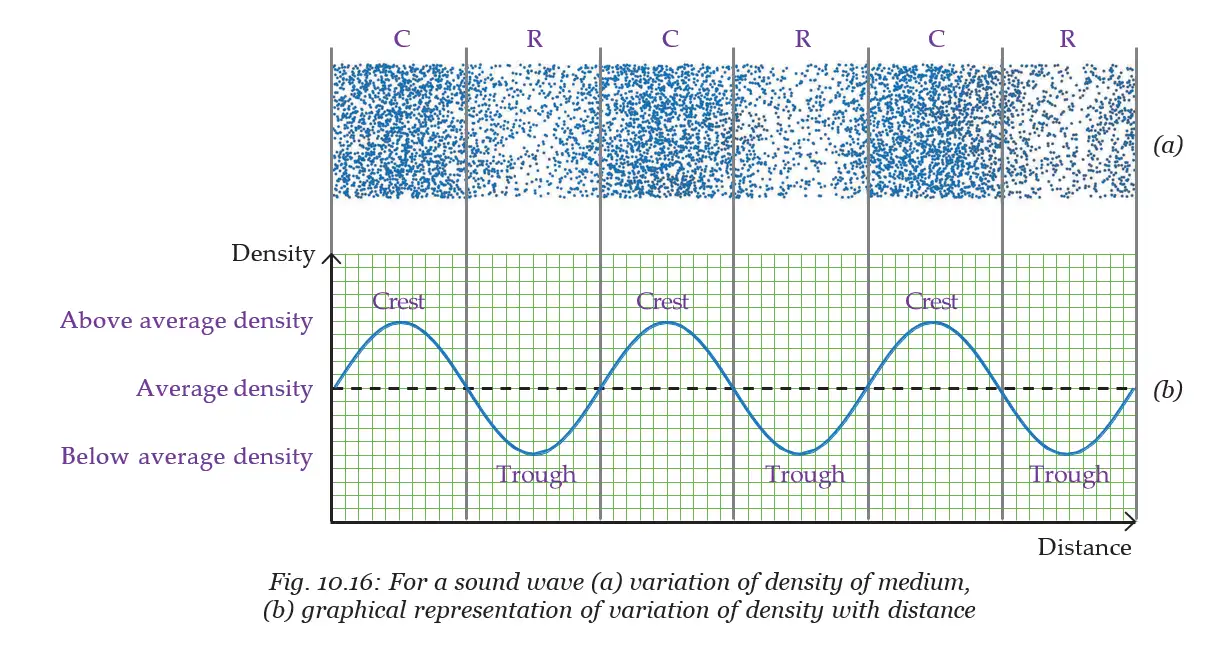
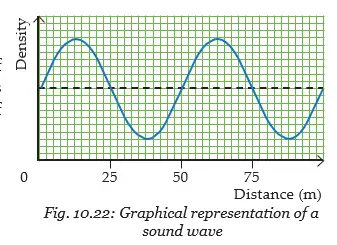
Density–distance graph — A graph showing how the medium’s density varies with distance from the source at one instant.
Reading the graph
- Axes: Distance is on the -axis; density is on the -axis. The horizontal dashed line marks the average density.
- Compression: Density is above average; its maximum value is the graph’s highest point, called the crest.
- Rarefaction: Density is below average; its minimum value is the graph’s lowest point, called the trough.
- Pattern: Density repeatedly rises above and falls below its average as the sound wave propagates.
Density–time graph — A graph showing how the medium’s density changes with time at one fixed location.
How do compression and rarefaction appear on a density–distance graph?
Quick recap
- A density–distance graph represents density at different distances at one instant.
- Distance is on the horizontal axis and density on the vertical axis.
- Compressions have above-average density; the maximum is a crest.
- Rarefactions have below-average density; the minimum is a trough.
- A density–time graph shows density changing over time at one fixed location.
Characteristics of a Sound Wave part 1
Wavelength, Frequency and Time Period
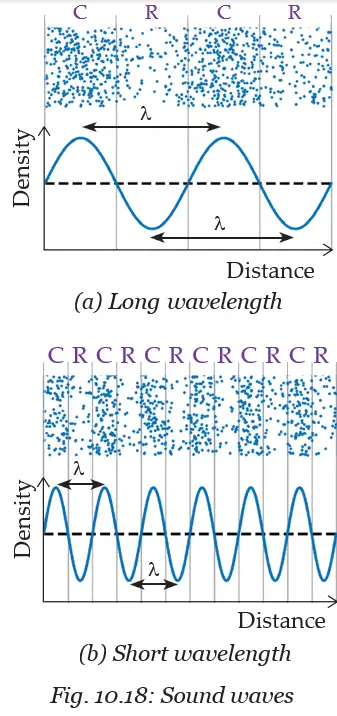
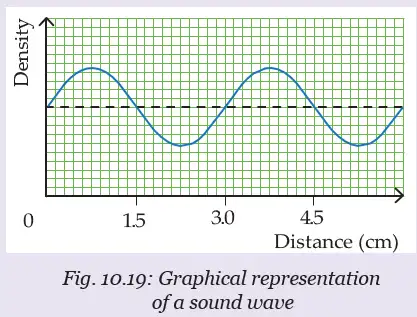
Wavelength — The wavelength is the distance between two consecutive crests or two consecutive troughs of a wave.
- Sound waves: Wavelength is the distance between consecutive compressions or consecutive rarefactions.
- Symbol and unit: Wavelength is represented by ; its SI unit is the metre ().
- Frequency: The number of complete density oscillations passing a fixed point per unit time is the frequency.
- Oscillation: One complete oscillation is a change from maximum density to minimum density and back to maximum density, or vice versa.
- Frequency symbol and unit: Frequency is represented by and measured in hertz (), equivalent to .
- Time period: The time taken for one complete density oscillation at a fixed point is the time period, represented by and measured in seconds ().
Frequency and time period are inversely related: a shorter time period means a higher frequency.
Frequencies in Sounds
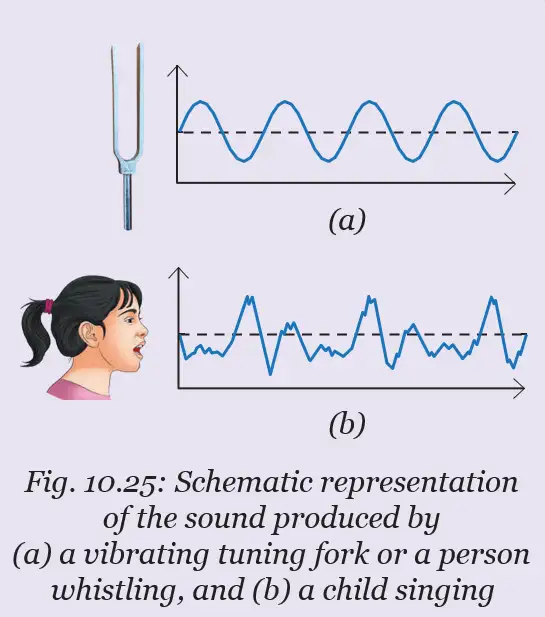
- Everyday sounds: Most contain a mixture of many frequencies.
- Nearly single-frequency sounds: These can be produced by striking a tuning fork or by whistling.
- Musical notes: Each note has a distinct frequency; in the ascending sequence Sa, Re, Ga, Ma, Pa, Dha, Ni, Sa, the frequency increases from the lowest note, Sa.
A sound wave makes 10 density oscillations in 2 seconds. Find its frequency and time period.
Amplitude and Intensity of Sound Waves
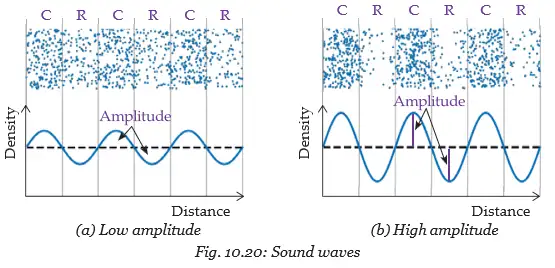
Amplitude — The amplitude of a sound wave is the maximum change in the medium’s density in a compression or rarefaction, compared with its average density.
- Density change: A larger change from the average density means a larger amplitude.
- Energy: A wave with greater amplitude carries more energy than a wave with smaller amplitude.
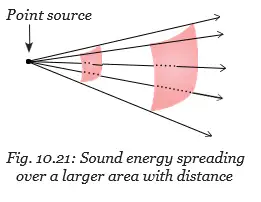
- Sound intensity: The sound energy passing per unit time through a unit area perpendicular to the direction of propagation.
- Spreading with distance: Sound spreads over a larger area as it travels from its source; with energy conserved, intensity decreases with distance.
- Initial amplitude: Sound produced with a larger amplitude carries more energy and can travel farther before its intensity falls to zero.
How are amplitude, energy and intensity related as sound travels away from its source?
Quick recap
- Wavelength is the distance between consecutive crests or troughs; for sound, it is between consecutive compressions or rarefactions.
- Frequency counts complete density oscillations per second and is measured in hertz.
- Time period is the duration of one oscillation; frequency and time period are related by .
- Each musical note has a distinct frequency; higher notes in the given sequence have higher frequencies.
- Amplitude measures the maximum density change from the average density; greater amplitude means more energy.
- Sound spreads as it travels, so its intensity decreases with distance from the source.
Characteristics of a Sound Wave part 2
Speed of Sound
Speed of sound — The speed of sound is the distance a sound-wave disturbance travels per unit time through a medium.
Wave speed and its factors
- Wave motion: Compressions and rarefactions travel through the medium; a crest or trough moves one wavelength in one time period.
- Medium: Sound travels fastest in solids, more slowly in liquids and slowest in gases.
- Relative speeds: Sound travels about 4–5 times faster in water and typically 15–20 times faster in solids than in air.
- Air conditions: Sound speed increases with temperature and humidity. It is about at and at .
- Frequency change: In most media, speed depends on the medium, not the source or frequency. If frequency changes, wavelength changes while speed remains constant.
One wavelength is covered in one time period. Use the relation to calculate speed, frequency or wavelength.
| State | Medium | Approximate speed |
|---|---|---|
| Solid | Steel | |
| Liquid | Water | |
| Gas | Air |
Using wave speed in calculations
- Wavelength: Rearrange the wave-speed relation as .
- Hearing-range example: In air at , a sound has wavelength ; a sound has wavelength .
- Thunder distance: If thunder is heard after lightning is seen, the strike is about , or , away. Light arrives almost instantly.
- Steel-wave example: A wave with wavelength in steel, where speed is , has frequency and period .
Compare the speed of sound in water with that in air, and in steel with that in water.
Sound travels along a steel fence over . How much earlier does it arrive through steel than air, and can the sounds be heard separately?
Human Perception of Sound
Physical properties and perception
- Measurable properties: Time period, wavelength, frequency, amplitude and speed are physical quantities that can be measured.
- Perception: Pitch and loudness describe how people experience sound; their relationship to physical properties is not always simple.
Pitch — Pitch is the human perception of the frequency of a sound.
Pitch and hearing range
- Frequency and pitch: Higher-frequency sounds generally have higher pitch; lower-frequency sounds generally have lower pitch.
- Examples: A whistle or siren sounds high-pitched; thunder or an aircraft rumble sounds low-pitched.
- Voice differences: Voices vary in frequency and in how the throat, mouth and nasal cavities shape sound. During adolescence, boys’ vocal cords lengthen and thicken, vibrate more slowly and deepen the voice.
- Audible range: Human hearing is roughly to ; the range varies between people and tends to decrease with age.
| Type | Frequency range | Human hearing | Examples of animals that detect it |
|---|---|---|---|
| Infrasound | Below | Not audible to humans | Elephants |
| Audible sound | About to | Audible to humans (range varies) | Humans |
| Ultrasound | Above | Not audible to humans | Dogs, cats, bats and dolphins |
Loudness and Sound Safety
Loudness — Loudness is the human perception of a sound wave’s amplitude.
Loudness, intensity and noise
- Amplitude: Greater amplitude is heard as louder sound; smaller amplitude as softer sound. Loudness decreases as distance from the source increases.
- Loudness vs intensity: Loudness depends on the listener’s hearing, while intensity is measurable. Everyday speech often uses the terms interchangeably.
- Decibels: Loudness is commonly measured in decibels (). Conversation is about ; firecrackers can exceed .
- Decibel scale: Even a small increase in the decibel level corresponds to a large increase in sound intensity.
- Noise: Unwanted or harmful sound is called noise; noise pollution is a serious problem.
- Health effects: Prolonged exposure to loud sound can affect health, sleep and hearing, and may cause hearing loss.
- Hearing care: Audiograms test hearing. Hearing aids use a microphone, amplifier and speaker to help people with hearing loss hear and communicate.
How We Hear
Hearing pathway and sound direction
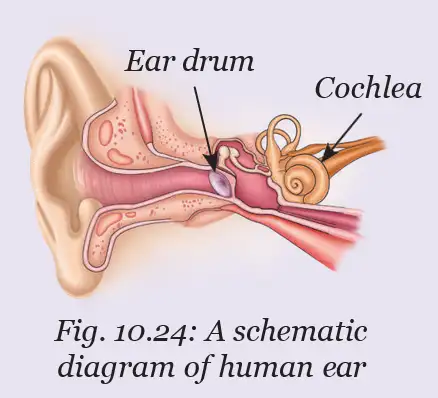
- Hearing pathway: Sound vibrates the eardrum; tiny bones amplify the vibrations, and the cochlea converts them into electrical signals sent to the brain.
- Direction of sound: The brain compares when each ear receives sound; the tiny arrival-time difference helps locate its direction.
- Other animals: Snakes and fish sense vibrations through their bodies; some insects have ear-like organs on body parts.
Tone, Musical Note, Timbre and Octave
Tone — A tone is a sound of a single frequency, such as one produced by a tuning fork or oral whistling.
Musical sound and quality
- Musical note: A musical note contains a lowest frequency called the fundamental and higher frequencies called overtones; together they create a rich sound.
- Timbre: Timbre makes sounds from different sources distinct, even when they play the same note at the same loudness.
- What shapes timbre: The source’s shape, material and construction affect the pattern and intensity of its overtones.
- Octave: An octave is the interval between notes whose fundamental frequencies have a ratio, such as and .
- Instruments: Extra strings on instruments such as the sarangi, sitar and veena enrich the combination of frequencies.
Indian instruments and acoustics
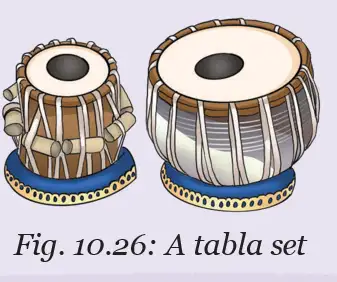
- C. V. Raman: He studied Indian percussion instruments, including the tabla and mridangam, to understand how they produce rich, nuanced sounds.
- Syaahi: The central black patch on a tabla or mridangam membrane alters its vibrations, enabling varied sounds and tonal control.
A thunderclap is heard after lightning is seen. Estimate the distance to the strike using a sound speed of .
Quick recap
- Wave speed: ; in an ordinary medium, changing frequency changes wavelength, not speed.
- Medium and conditions: Sound travels fastest in solids and slowest in gases; higher air temperature and humidity increase its speed.
- Pitch and range: Pitch is perceived frequency; human hearing is roughly to .
- Frequency types: Below is infrasound; above is ultrasound.
- Loudness and safety: Amplitude affects perceived loudness; even a small rise in dB represents a large rise in intensity, and prolonged loud sound can damage hearing.
- Sound quality: A tone has one frequency; a musical note includes a fundamental and overtones, whose pattern contributes to timbre.
Reflection of Sound
Reflection of Sound
Reflection of sound — The bouncing back of sound waves from an obstacle, such as a solid or liquid surface.
Laws of reflection
- Equal angles: The incident and reflected sound directions make equal angles with the normal to the surface.
- Same plane: The incident direction, reflected direction and normal all lie in the same plane.
Echo
Echo — A distinct repetition of a sound heard after it reflects from a distant surface.
When an echo is heard
- Time gap: The reflected sound is heard separately when it reaches the ear at least after the original sound.
- Shorter gap: If the gap is less than , the sounds are not clearly distinguished.
- Minimum distance: At , sound travels in ; this is the round trip, so the reflecting surface must be at least away.
Sound travels to the reflector and back, so divide the total distance by two.
| Surface | Effect on sound |
|---|---|
| Hard and smooth | Reflect sound well; echoes are stronger and clearer. |
| Soft, such as curtains | Absorb sound; echoes are weaker. |
| Rough | Scatter sound in different directions; echoes are less clear. |
A clap is heard as an echo after . How far away is the wall if sound travels at ?
For an echo to arrive at least after a sound, what is the minimum reflector distance if sound travels at ?
Reverberation
Reverberation — The persistence of sound after its source stops, due to multiple reflections from surfaces.
Control of reverberation
- Cause: In large halls or auditoriums, multiple reflections overlap; reverberation occurs when reflections arrive with time differences less than .
- Useful amount: Auditorium design aims for sound that is clear throughout the space, without distortion.
- Reducing excess: Sound-absorbing panels, upholstered chairs, curtains and other soft, porous materials reduce unwanted reverberation and prevent garbled sound.
Quick recap
- Sound reflects from obstacles and follows the same two laws as light.
- An echo is heard distinctly when the reflected sound arrives at least later.
- For an echo, reflector distance is half the sound’s round-trip distance: .
- Hard, smooth surfaces reflect sound; soft surfaces absorb it and rough ones scatter it.
- Multiple reflections can cause reverberation, which is reduced with soft, porous materials.
Ultrasonic and Infrasonic Waves, and their Applications
Sound Beyond Human Hearing
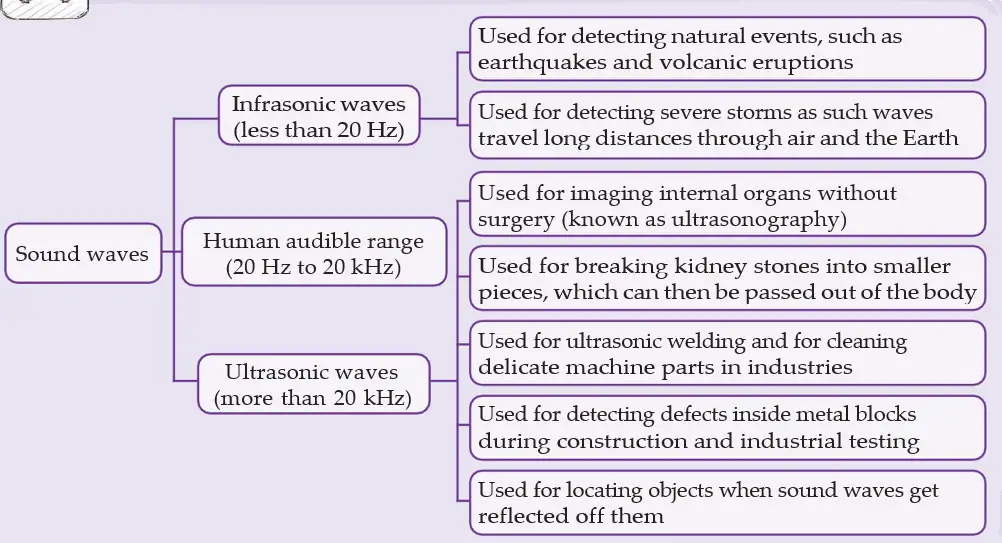
- Audible range: Humans generally hear frequencies from about to .
- Infrasonic waves: Sound waves with frequencies below .
- Ultrasonic waves: Sound waves with frequencies above ; they are used in echolocation and sonar.
Echolocation
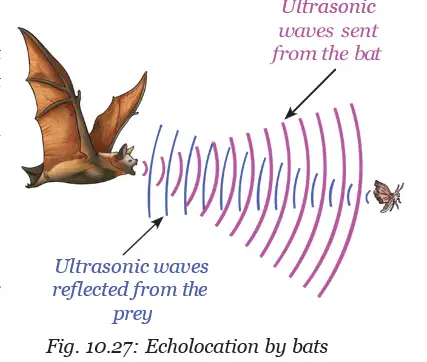
Echolocation — Locating objects by emitting sound waves and sensing the echoes reflected back from them.
How Echolocation Works
- Bats: Many bats emit short bursts of ultrasonic waves. Reflected echoes help them locate obstacles and prey in darkness.
- Other animals: Dolphins, whales and some birds also use echolocation for navigation and hunting.
Sonar
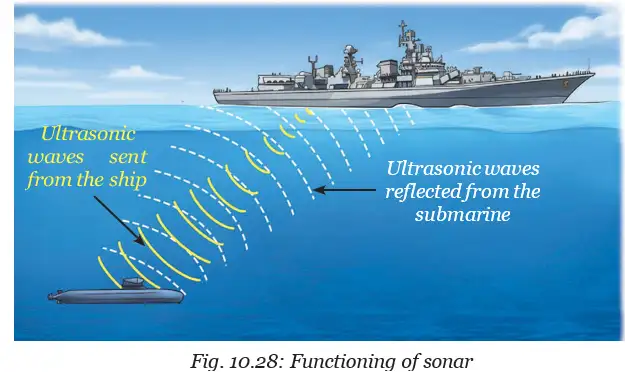
Sonar — Sound Navigation and Ranging uses ultrasonic waves and their echoes to detect underwater objects.
Sonar: Principle and Uses
- Principle: A signal is sent through water; the time taken for its echo to return is measured.
- Uses: The echo helps determine the distance, direction and speed of underwater objects, such as submarines and shipwrecks.
- Distance calculation: The measured time is for the signal's outward and return journey, so the one-way distance uses half the total time.
Use this when the recorded time is for the wave's complete journey to the object and back.
A naval sonar signal returns after . If sound travels in seawater at , how far away is the object?
A sonar signal takes to return from the ocean floor. If sound travels through seawater at , what is the ocean depth?
Audio Surveillance
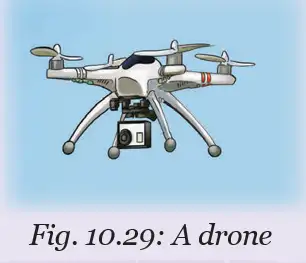
Audio surveillance — Monitoring for sounds from aircraft or drones to help observe airspace for safety and security.
Detecting Aircraft and Drones
- Sound source: Drones and aircraft produce characteristic sounds from their motors and engines.
- Detection: Sensitive sound sensors can pick up their low-frequency humming, even when the source is difficult to see.
- Application: The sounds can be used to monitor airspace for safety and security.
Other Uses of Sound
Sound as a Tool for Exploration
- Space: Space probes have recorded sounds from Mars.
- Earth science: Timing distant earthquake sounds can help scientists detect tiny ocean-temperature changes and study climate change.
- Biology and soil science: Mosquito buzzes can help identify disease-carrying mosquitoes; tiny crackles from soil microbes can provide clues about soil health and biodiversity.
Quick recap
- Infrasonic waves have frequencies below ; ultrasonic waves have frequencies above .
- Echolocation uses reflected sound to locate objects; bats, dolphins, whales and some birds use it.
- Sonar uses ultrasonic echoes to find underwater objects and measure their distance, direction and speed.
- For a returning echo, distance is because the signal travels to the object and back.
- Sensitive sensors can use the characteristic low-frequency sounds of aircraft and drones for audio surveillance.
- Sound recordings and signals can support research in space, climate, biology and soil science.
At a Glance
Sound and Its Propagation
Nature and travel of sound
- Production: Sound is produced by vibrating objects.
- Wave type: Sound is a longitudinal mechanical wave; it needs a medium to travel.
- Medium: Sound can propagate through solids, liquids and gases.
- What travels: The density disturbance moves through the medium; its particles only vibrate about their mean positions.
Characteristics of a Sound Wave
Wavelength — The distance between two consecutive crests or two consecutive troughs of a wave.
Oscillation — One complete change in density at a fixed point, from maximum to minimum and back to maximum, or vice versa.
Frequency — The number of density oscillations at a fixed point per unit time.
Time period — The time taken for one complete density oscillation at a fixed point.
Amplitude — The maximum change in air density in a compression or rarefaction, compared with the average density.
Intensity of sound — The sound energy passing per unit time through a unit area perpendicular to the direction of propagation.
Speed of sound — The distance travelled per unit time by a point on the wave, such as a crest or trough.
Reflection and Frequency Groups
Reflection of sound
- Echoes and reverberations occur because sound reflects from surfaces.
| Type | Frequency | Definition |
|---|---|---|
| Infrasonic | Below 20 Hz | Sound waves with frequency less than 20 Hz. |
| Ultrasonic | Above 20 kHz | Sound waves with frequency greater than 20 kHz. |
What travels through a medium when sound propagates?
Define frequency and time period of a sound wave.
Quick recap
- Sound is produced by vibrations and is a longitudinal mechanical wave.
- Sound travels through solids, liquids and gases; the density disturbance moves while particles vibrate in place.
- Wavelength is the distance between consecutive crests or troughs.
- Frequency counts density oscillations per unit time; time period is the duration of one oscillation.
- Amplitude is the maximum density change from average; intensity is energy passing through unit area per unit time.
- Echoes and reverberations result from reflected sound; infrasonic waves are below 20 Hz and ultrasonic waves are above 20 kHz.
Science — ALL CHAPTERS
1
Exploration: Entering the World of Secondary Science
2
Cell: The Building Block of Life
3
Tissues in Action
4
Describing Motion Around Us
5
Exploring Mixtures and their Separation
6
How Forces Affect Motion
7
Work, Energy, and Simple Machines
8
Journey Inside the Atom
9
Atomic Foundations of Matter
10
Sound Waves: Characteristics and Applications
11
Reproduction: How Life Continues
12
Patterns in Life: Diversity and Classification
13
Earth as a System: Energy, Matter, and Life