Class 9 . Science . Exploration . Journey Inside the Atom
Chapter 8: Journey Inside the Atom
Ch 8
Science
Class 9
Rediscovering the Roots of Atomic Theory
Matter and Its Building Blocks
Atom — A tiny building unit of matter; atoms are too small to be seen with the naked eye.
Matter and Smaller Building Units
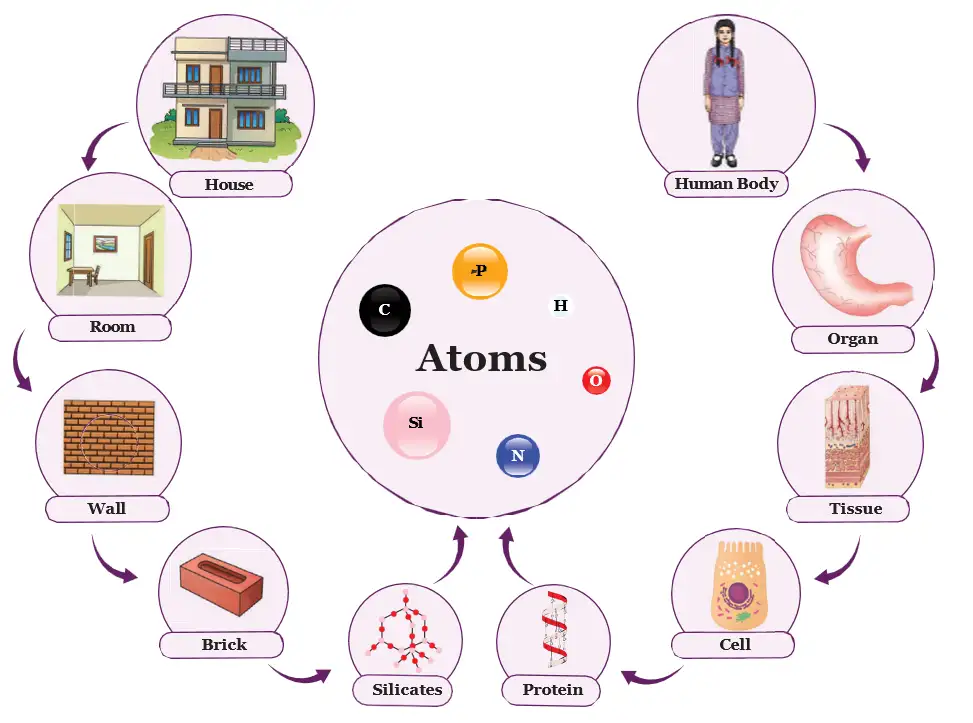
- Matter includes everything we see, observe or feel; it is made of tiny particles called atoms.
- Building levels: Bricks form walls and rooms; cells form tissues and organs. Atoms are basic building units of substances such as silicates and proteins.
Ancient Ideas About Atoms
| Thinker(s) | Idea | Important details |
|---|---|---|
| Acharya Kanada (ancient India) | Repeated division of matter eventually reaches indivisible particles called parmanus. | Parmanus are infinitely small and cannot be perceived by the senses. Kanada's ideas are recorded in the Sanskrit text Vaisesika Sutras. |
| Acharya Kanada | Parmanus combine to form larger groupings. | Groups of two are dyads; groups of three are triads. These combinations form the material universe, including living bodies. The proportions in which they combine into different substances were not specified. |
| Leucippus and Democritus (ancient Greece) | Matter is made of indivisible particles called atomos. | Atomos means “indivisible” in Greek. |
Nature of the Ancient Ideas
- Origin: The ancient concept of atoms was an imagined idea, not a conclusion based on experimental observations.
- Kanada's account described combinations of parmanus but did not state their proportions in different substances.
Dalton's Atomic Theory
Dalton's atomic theory — In 1808, John Dalton proposed that all matter is made of indivisible atoms, its fundamental building blocks.
Why Dalton's Theory Was a Turning Point
- Evidence: Unlike ancient proposals, Dalton's theory was based on scientific experiments of his time.
- Importance: It was the first scientific description of how matter is made and became the starting point for the modern understanding of atomic structure.
Questions Driving Atomic Models
What Scientists Wanted to Find Out
- Composition: What are atoms made of?
- Structure: What might atoms look like?
- Differences: What makes atoms of one element different from those of another?
How did the ancient idea of atoms differ from Dalton's theory?
Quick recap
- Matter is made of tiny atoms that cannot be seen with the naked eye.
- Acharya Kanada called indivisible particles parmanus; his ideas are recorded in the Vaisesika Sutras.
- Kanada described dyads, triads and larger combinations of parmanus as building the material universe.
- Leucippus and Democritus called indivisible particles atomos, meaning “indivisible.”
- Ancient atomic ideas were imagined proposals, while Dalton's 1808 theory was based on experiments.
- Scientists then investigated atoms' composition, structure and differences between elements.
A Short Historical Journey Through Atomic Models part 1
Radioactivity and the Structure of the Atom
Why the idea of indivisible atoms changed
- Earlier view: Until the late 19th century, atoms were considered the smallest, indivisible units of matter.
- Radioactivity: Some elements emit invisible energy and particles; this phenomenon showed that atoms contain smaller components.
- Scientific models: Atomic models changed as new experiments provided evidence that challenged earlier ideas.
J. J. Thomson and the Electron
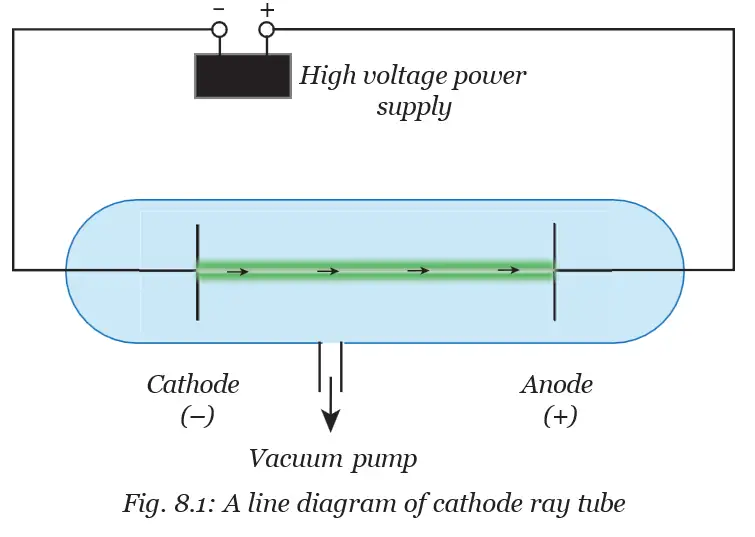
Cathode rays — Streams of negatively charged particles that travel from the cathode (negative electrode) towards the anode (positive electrode) in a low-pressure gas tube.
Thomson’s findings
- Year: In 1897, J. J. Thomson studied electric current through gases at very low pressure using a tube with two electrodes and a high voltage.
- Evidence: Electric and magnetic fields showed that cathode rays consist of negatively charged particles much less massive than atoms.
- Electron: These particles, later called electrons, come from atoms; the atom is therefore divisible.
- Universal presence: Cathode-ray properties did not depend on the cathode material or the gas, showing that electrons are present in atoms of every element.
- Electron charge: The charge is ; it is conventionally represented as .
Thomson’s Model of the Atom
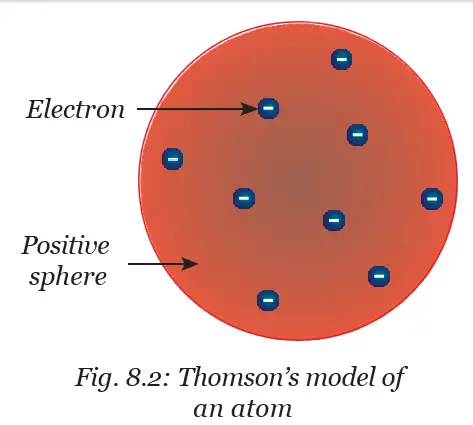
Thomson’s atomic model — An atom is a sphere of positive charge with negatively charged electrons distributed throughout it, making the atom neutral overall.
Visualising the model
- Plum pudding model: Electrons are like plums embedded in a positively charged pudding.
- Watermelon analogy: The red pulp represents positive charge, while the seeds represent electrons spread through it.
- Main idea: Positive and negative charges are distributed through the atom and balance each other.
Testing Thomson’s Model: The Gold Foil Experiment
Alpha particle — A tiny, positively charged particle emitted by certain radioactive elements; it is later identified as a helium nucleus containing two protons and two neutrons.
Experiment and observations
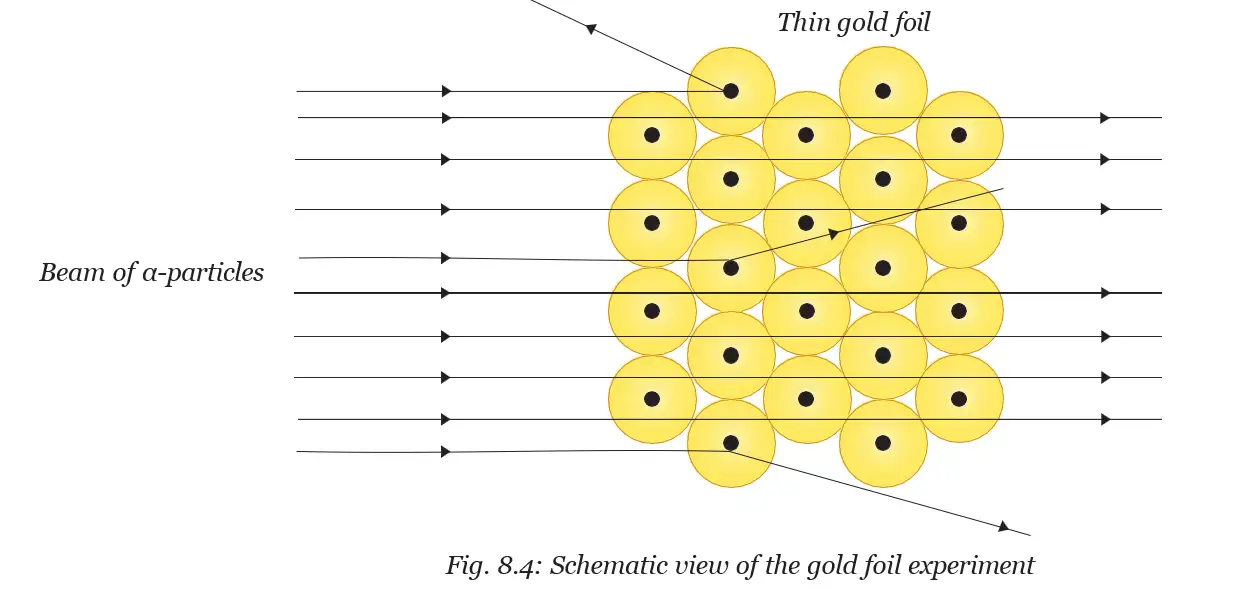
- Who and when: In 1911, Geiger and Marsden, working under Ernest Rutherford, directed a narrow beam of alpha particles at an extremely thin gold foil.
- Expected result: If positive charge were spread evenly through each atom, alpha particles should pass straight through or be deflected only slightly.
- Observed result: Most particles passed through undeflected; some were sharply deflected, and a few bounced back.
- Scattering: The deflection of a particle from its straight path is called scattering; the experiment is also called the alpha-ray scattering experiment.
Why Thomson’s model failed
- Failure: The model could not explain why some alpha particles were deflected through large angles or bounced back.
- Also unexplained: It did not account for why most alpha particles passed through the foil undeflected.
What evidence showed that electrons are present in every element?
State the observations of the gold foil experiment and one conclusion about Thomson’s model.
Quick recap
- Radioactivity showed that atoms are not indivisible.
- Thomson identified the electron in 1897 as a negatively charged particle present in all atoms.
- Thomson modelled the atom as electrons distributed within a sphere of positive charge.
- In 1911, Geiger and Marsden tested the model by directing alpha particles at thin gold foil.
- Most alpha particles passed through, but some were strongly deflected and a few bounced back.
- These observations could not be explained by Thomson’s model.
A Short Historical Journey Through Atomic Models part 2
Rutherford’s Atomic Model
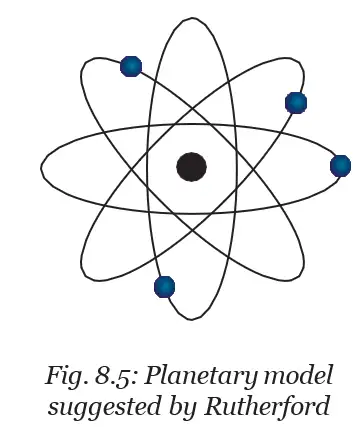
Relative sizes
- Atom’s diameter: approximately ; nucleus diameter: approximately .
- Scale: the nucleus is about times smaller in diameter than the atom.
Approximate number of atoms across a thickness equals sheet thickness divided by one atom’s diameter. For a sheet and atom diameter of , atoms.
Limitations of Rutherford’s Model
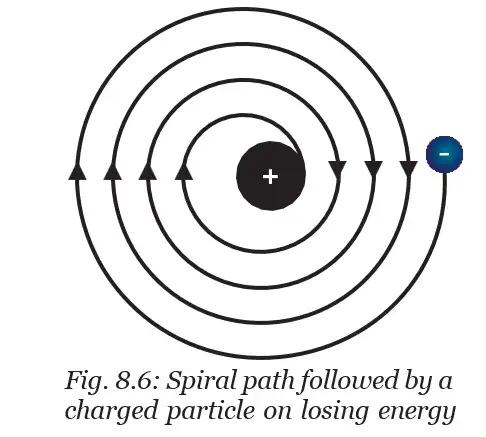
Discovery of the Proton
For a neutral atom, proton and electron numbers are equal.
Bohr’s Model of the Atom
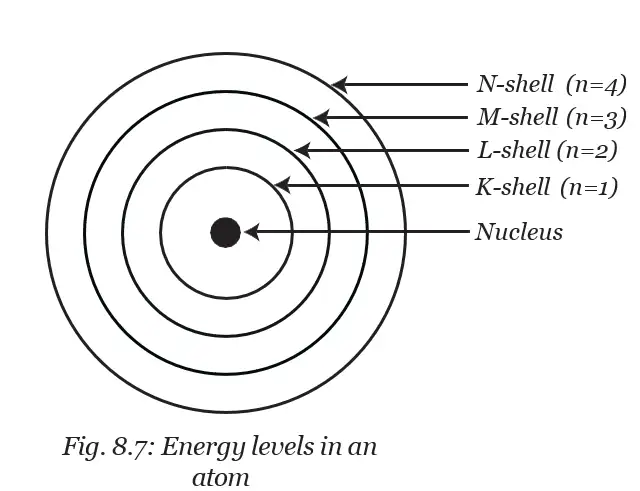
Bohr’s model and atomic stability
- Key postulate: electrons in stationary states do not lose energy while moving around the nucleus.
- Importance: the model explained atomic stability and many experimental observations.
- Later development: Bohr’s model also had limitations; the quantum mechanical model was proposed afterwards.
Quick recap
- Rutherford’s gold-foil results showed that atoms are mostly empty space, with positive charge and most mass concentrated in a tiny nucleus.
- The atom’s diameter is about and the nucleus is about across.
- Rutherford’s model could not explain stability because orbiting electrons were predicted to lose energy and fall into the nucleus.
- Protons are positively charged nuclear particles; a neutral atom has equal numbers of protons and electrons.
- Bohr proposed in 1913 that electrons occupy fixed shells and do not lose energy while in a shell.
- Electrons change shells by absorbing or releasing energy equal to the difference between the levels.
What Components Contribute to the Mass of an Atom
Where an Atom’s Mass Is Concentrated
Atomic mass — Most of an atom’s mass is concentrated in its nucleus; the mass of its electrons is negligible.
- The puzzle: Hydrogen has one proton, while helium has two; yet helium is about four times as massive as hydrogen, not twice as massive.
- Explanation needed: The nucleus must contain a particle that adds mass without adding electrical charge.
Discovery of the Neutron
- Neutron: James Chadwick discovered this electrically neutral subatomic particle in 1932; it is represented by and has a mass nearly equal to a proton.
- Location: Neutrons are found in the nuclei of all atoms except hydrogen.
- Mass contribution: Protons and neutrons packed in the nucleus account for most of an atom’s mass; this explains why atomic mass exceeds the mass of its protons alone.
- Recognition: Chadwick received the Nobel Prize in Physics in 1935.
| Particle | Symbol | Relative charge | Relative mass |
|---|---|---|---|
| Electron | Very small; negligible in atomic mass | ||
| Proton | About the same as a neutron | ||
| Neutron | Nearly equal to a proton |
Neutrons and Nuclear Stability
- Proton repulsion: Since protons have positive charge, they repel one another inside the nucleus.
- Neutron role: Neutrons help reduce this repulsion by increasing the separation between protons, and strengthen the nuclear force that binds the particles together.
- Neutron numbers: Lighter atoms often have roughly equal numbers of protons and neutrons; heavier atoms generally have more neutrons than protons.
- Examples: Carbon has 6 protons and 6 neutrons; oxygen has 8 of each. Iron has 26 protons and 30 neutrons, while uranium has 92 protons and 146 neutrons.
How do neutrons contribute to the mass and stability of an atom’s nucleus?
Quick recap
- Most atomic mass comes from protons and neutrons in the nucleus.
- Electrons have very little mass compared with protons and neutrons.
- James Chadwick discovered the neutron in 1932; it has no charge and nearly the mass of a proton.
- Neutrons occur in the nuclei of all atoms except hydrogen.
- Neutrons help reduce proton repulsion and strengthen the nuclear force.
- Heavier nuclei generally contain more neutrons than protons.
Symbols of Elements
How chemical symbols developed
Chemical symbol — A short, internationally recognised notation used to represent an element.
- 1803 — John Dalton: Introduced pictorial symbols for known elements as a standard way to represent elements and compounds.
- 1813 — Berzelius: Suggested alphabetic symbols, often derived from the Latin names of elements.
- Today — IUPAC: The International Union of Pure and Applied Chemistry approves element names and symbols.
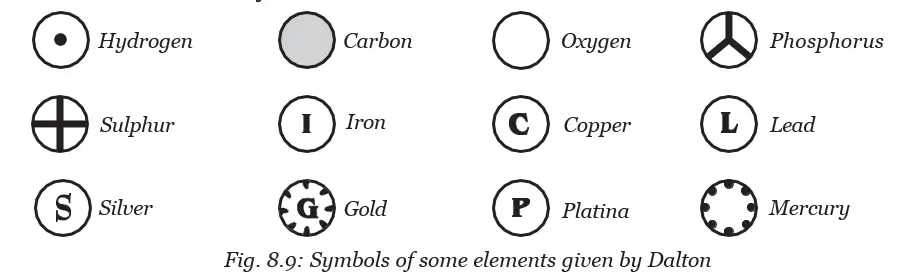
Rules for writing element symbols
- Length: A symbol is often the first letter or the first two letters of an element’s name.
- Capitalisation: The first letter is uppercase; if present, the second letter is lowercase. Examples: hydrogen, H; aluminium, Al; cobalt, Co.
- Letter choice: Some symbols use the first letter and another letter from the name, not necessarily the second; examples include chlorine, Cl, and zinc, Zn.
- Case matters: Write Al, not AL, and Co, not CO. Correct capitalisation distinguishes symbols from other letter combinations.
- Other-language names: Some symbols come from Latin, Greek or German names rather than English.
Symbols from other languages
- Iron: Fe comes from the Latin *ferrum*.
- Mercury: Hg comes from the Greek *hydrargyros*.
- Tungsten: W comes from the German *wolfram*.
| Element | Symbol | Element | Symbol | Element | Symbol |
|---|---|---|---|---|---|
| Aluminum | Al | Copper (Cuprum) | Cu | Nitrogen | N |
| Argon | Ar | Fluorine | F | Oxygen | O |
| Barium | Ba | Gold (Aurum) | Au | Potassium (Kalium) | K |
| Boron | B | Hydrogen | H | Silicon | Si |
| Bromine | Br | Iodine | I | Silver (Argentum) | Ag |
| Calcium | Ca | Iron (Ferrum) | Fe | Sodium (Natrium) | Na |
| Carbon | C | Lead (Plumbum) | Pb | Sulfur | S |
| Chlorine | Cl | Magnesium | Mg | Uranium | U |
| Cobalt | Co | Neon | Ne | Zinc | Zn |
More symbols based on older names
- Copper: Cu comes from *cuprum*; gold: Au from *aurum*; silver: Ag from *argentum*.
- Potassium: K comes from *kalium*; sodium: Na from *natrium*; lead: Pb from *plumbum*.
Why standard symbols are important
- International use: Scientists worldwide recognise the same symbols, regardless of language.
- Clear communication: Standard symbols prevent confusion that could arise if scientists used different symbols for the same element.
State the main rules for writing chemical symbols.
What problems could arise if scientists used different symbols for the same element?
Quick recap
- Dalton introduced pictorial element symbols in 1803; Berzelius proposed alphabetic symbols in 1813.
- IUPAC approves element names and symbols.
- A symbol’s first letter is uppercase and its second letter, if present, is lowercase.
- Some symbols come from Latin, Greek or German names, such as Fe, Hg and W.
- Standard symbols are recognised internationally and enable clear communication across languages.
Atomic Number and Mass Number
Atomic Number
Atomic number — The atomic number, , is the number of protons in an atom’s nucleus.
- Identity: Each element has a unique atomic number, which determines its identity and chemical behaviour.
- Neutral atom: Electrons equal protons, so the number of electrons is .
- Examples: Hydrogen has (1 proton and 1 electron); helium has (2 protons and 2 electrons).
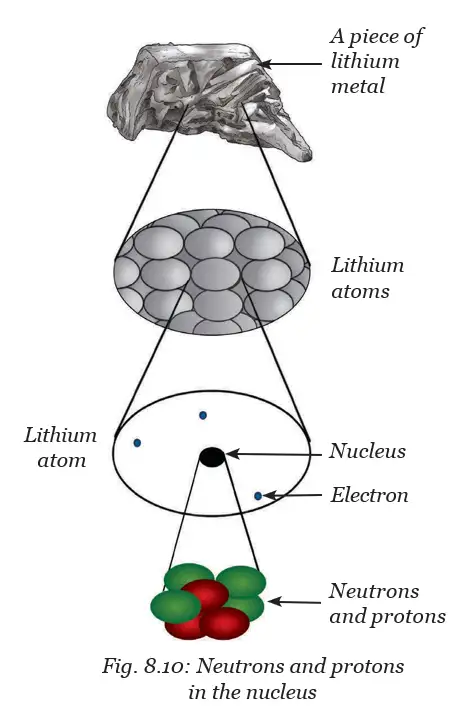
- Lithium: It has 3 protons, so its atomic number is 3.
Mass Number
Mass number — The mass number, , is the total number of protons and neutrons in an atom’s nucleus.
- Nucleons: Protons and neutrons in the nucleus are called nucleons.
- Mass contribution: A neutron has roughly the same mass as a proton; an electron’s mass is negligible in these calculations.
is the number of neutrons; therefore, .
| Element | Protons | Neutrons | Mass number |
|---|---|---|---|
| Hydrogen | 1 | 0 | 1 |
| Helium | 2 | 2 | 4 |
| Lithium | 3 | 4 | 7 |
Atomic notation
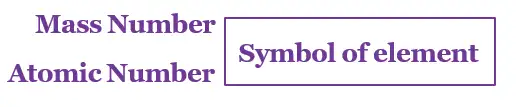
- Format: Write mass number as the upper-left number and atomic number as the lower-left number beside the element symbol.
- Carbon example: Carbon has atomic number 6 and mass number 12; its notation is .
An atom has atomic number 26 and 56 nucleons. Find its numbers of protons, electrons and neutrons.
A nucleus contains 20 protons and has mass number 41. How many neutrons does it contain?
An atom has 18 neutrons and atomic number 17. Find its mass number.
Quick recap
- Atomic number equals the number of protons and uniquely identifies an element.
- In a neutral atom, electrons = protons = .
- Mass number is the total number of protons and neutrons in the nucleus.
- Neutrons can be found using .
- Protons and neutrons are nucleons; an electron’s mass is negligible in these calculations.
- In atomic notation, mass number is written above the element symbol and atomic number below it; carbon is .
How Are Electrons Distributed in Different Energy Levels
Rules for Filling Electron Shells
Electronic configuration — The distribution of an atom’s electrons among its energy shells is called its electronic configuration.
- Shell capacity: The maximum number of electrons in shell number is given by .
- Outermost shell: It can hold a maximum of 8 electrons; the first shell can hold a maximum of 2.
- Filling order: Electrons occupy shells stepwise, starting closest to the nucleus: K, L, M, N, and so on.
- Completion first: A shell closer to the nucleus is filled before electrons enter the next shell.
Use this rule to find a shell’s maximum capacity; is the shell number.
| Shell | Shell number | Maximum capacity |
|---|---|---|
| K | 1 | 2 electrons |
| L | 2 | 8 electrons |
| M | 3 | 18 electrons |
Building Up Electron Configurations
- Building-up principle: When atomic number increases by 1, add one electron to the appropriate shell.
- Hydrogen: Its one electron occupies the K-shell.
- Neutral atoms: The number of electrons equals the atomic number.
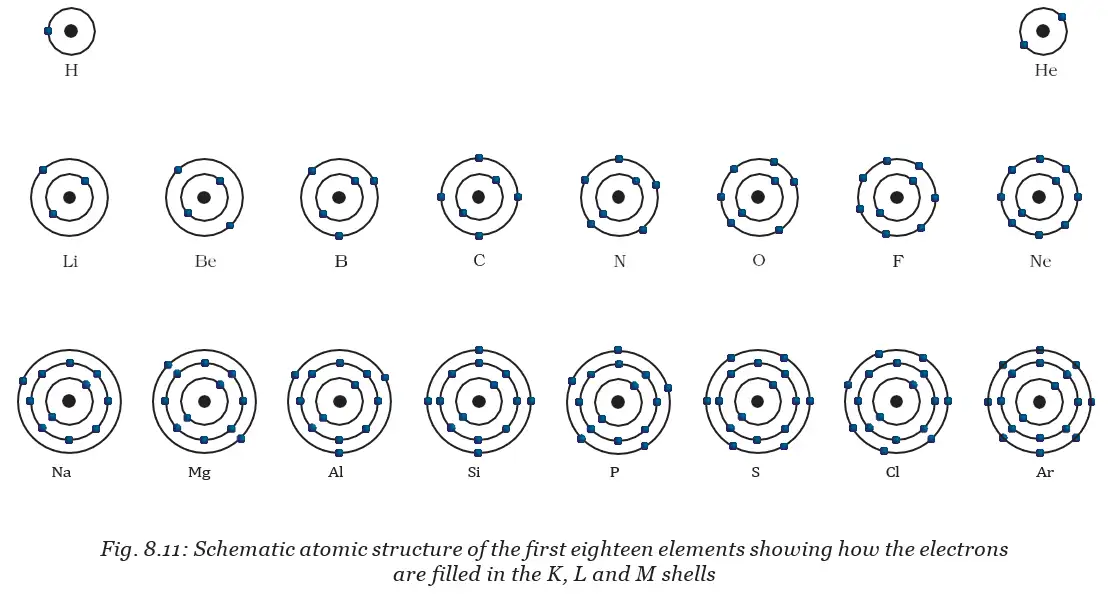
- First 18 elements: Their electrons occupy the K, L and M shells in the configurations shown.
| Atomic number | Element | Symbol | K | L | M |
|---|---|---|---|---|---|
| 1 | Hydrogen | H | 1 | — | — |
| 2 | Helium | He | 2 | — | — |
| 3 | Lithium | Li | 2 | 1 | — |
| 4 | Beryllium | Be | 2 | 2 | — |
| 5 | Boron | B | 2 | 3 | — |
| 6 | Carbon | C | 2 | 4 | — |
| 7 | Nitrogen | N | 2 | 5 | — |
| 8 | Oxygen | O | 2 | 6 | — |
| 9 | Fluorine | F | 2 | 7 | — |
| 10 | Neon | Ne | 2 | 8 | — |
| 11 | Sodium | Na | 2 | 8 | 1 |
| 12 | Magnesium | Mg | 2 | 8 | 2 |
| 13 | Aluminum | Al | 2 | 8 | 3 |
| 14 | Silicon | Si | 2 | 8 | 4 |
| 15 | Phosphorus | P | 2 | 8 | 5 |
| 16 | Sulfur | S | 2 | 8 | 6 |
| 17 | Chlorine | Cl | 2 | 8 | 7 |
| 18 | Argon | Ar | 2 | 8 | 8 |
How many electrons are in the outermost shell of carbon, fluorine and silicon?
Write the electronic configurations of the elements with atomic numbers 12, 16 and 18.
An atom has mass number 23 and 11 protons. Identify it and find its number of neutrons.
Quick recap
- Shell capacity: The maximum number of electrons in shell is .
- Outermost shell: It holds at most 8 electrons; the first shell holds at most 2.
- Filling order: Electrons fill K, then L, then M, and continue outward.
- Building up: Add one electron to the appropriate shell as atomic number increases by 1.
- Electronic configuration: This is the distribution of electrons among an atom’s shells.
- Neutral atoms: The number of electrons equals the atomic number.
Combining Capacity of an Atom: Valency
Combining Capacity
- Combining capacity: The number of atoms of hydrogen or chlorine that one atom of an element can combine with.
- Reference elements: Hydrogen and chlorine each have a combining capacity of one.
Valence Shell, Stability and Valency
- Valence shell: The outermost electron shell of an atom; its electrons are called valence electrons.
- Stability: Atoms with a complete outer shell—an octet, or two electrons in helium—are generally stable and unreactive.
- Valency: An atom’s combining capacity, related to how it achieves a stable outer shell.
Finding Valency from Valence Electrons
| Element | Electronic configuration | Valence electrons | How the shell is completed | Valency |
|---|---|---|---|---|
| Sodium (Na) | Loses electron | |||
| Oxygen (O) | Gains electrons | |||
| Carbon (C) | Shares electrons |
| Element | Electronic configuration | Valence electrons | Common valency |
|---|---|---|---|
| Hydrogen (H) | |||
| Helium (He) | |||
| Lithium (Li) | |||
| Beryllium (Be) | |||
| Boron (B) | |||
| Carbon (C) | |||
| Nitrogen (N) | |||
| Oxygen (O) | |||
| Fluorine (F) | |||
| Neon (Ne) | |||
| Sodium (Na) | |||
| Magnesium (Mg) | |||
| Aluminium (Al) | |||
| Silicon (Si) | |||
| Phosphorus (P) | |||
| Sulfur (S) | |||
| Chlorine (Cl) | |||
| Argon (Ar) |
Do not equate valency with the number of valence electrons in every case: nitrogen has valence electrons but commonly has valency , as it needs more electrons to complete its octet. Some compounds appear to violate the usual valency rule; these are studied in higher grades.
How does valency depend on the number of valence electrons?
Why are sodium, oxygen and carbon’s valencies , and respectively?
Neutrons in Atoms of the Same Element
- Isotopes: Atoms of the same element can have different numbers of neutrons while retaining the same number of protons.
- Atomic number: Isotopes have the same atomic number but different mass numbers.
- Properties: Isotopes have similar chemical properties because they have the same number of electrons and electronic configuration, but their physical properties can differ.
- Example: Hydrogen has three isotopes: protium, deuterium and tritium.
Quick recap
- Combining capacity is expressed by how many hydrogen or chlorine atoms an atom combines with.
- The valence shell is the outermost occupied shell; its electrons are valence electrons.
- A complete outer shell is generally stable and largely unreactive: an octet for most atoms, or a duet for helium.
- Valency is the number of electrons gained, lost or shared to complete the outer shell.
- Atoms with fewer than four valence electrons generally lose them; those with more than four generally gain electrons; those with four often share.
- Sodium, oxygen and carbon have valencies , and respectively; compounds can appear to depart from the usual valency rule.
- Atoms of the same element can differ in neutron number, even though they have the same atomic number.
A Deeper Look into Atomic Structure
Isotopes
Isotopes — Atoms of the same element with the same atomic number but different mass numbers are isotopes.
How isotopes differ
- Same element: Isotopes have the same proton number, , but different neutron numbers.
- Mass number: ; changing the neutron number changes the isotope’s mass number.
- Neutral atoms: Isotopes of an element have the same number of electrons and the same electronic configuration.
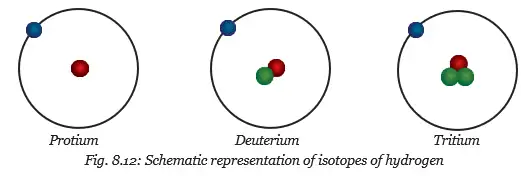
| Isotope | Protons | Neutrons | Natural abundance |
|---|---|---|---|
| Protium, | 1 | 0 | About 99.98% |
| Deuterium, | 1 | 1 | About 0.015% |
| Tritium, | 1 | 2 | Present in traces |
Properties and another example
- Chemical properties: Isotopes generally have similar chemical properties because their electron configurations, especially valence electrons, are the same.
- Physical properties: They can differ in physical properties, including melting and boiling points, because their masses differ.
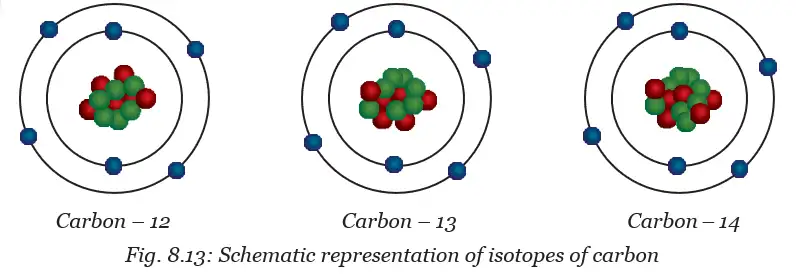
- Carbon: , and each have 6 protons and 6 electrons, but have 6, 7 and 8 neutrons respectively; carbon-12 is most abundant.
Unified atomic mass unit — The unified atomic mass unit, symbol , is a convenient unit for expressing the extremely small masses of atoms; it was formerly abbreviated as amu.
Uses of Isotopes
| Isotope | Use |
|---|---|
| Uranium-235, | Nuclear reactor fuel for generating electricity |
| Cobalt-60, | Radiation treatment for cancer |
| Iodine-131, | Treatment of goitre and thyroid cancer |
| Carbon-14, | Dating ancient fossils and artefacts in archaeology and geology |
Average Atomic Mass
Weighted average atomic mass — The average atomic mass of a natural element is the sum of each isotope’s mass multiplied by its relative abundance.
Use fractional abundances; if abundances are percentages, divide each by .
Chlorine example
- Isotopes and abundance: Chlorine-35 has mass and abundance ; chlorine-37 has mass and abundance .
- Simple mean: Treating them as equally common gives , which does not reflect their actual abundances.
- Weighted mean: .
- Meaning: is the average for a natural collection of chlorine atoms, not the mass of each individual atom.
Bromine has isotopes (49.7%) and (50.3%). Find its average atomic mass.
Two atoms each have 11 protons; one has 12 neutrons and the other has 13. Compare their atomic and mass numbers.
Isobars
Isobars — Atoms of different elements with the same mass number but different atomic numbers are called isobars.
| Atom | Atomic number | Mass number |
|---|---|---|
| 20 | 40 | |
| 19 | 40 | |
| 18 | 40 |
| Point | Isotopes | Isobars |
|---|---|---|
| Element | Same element | Different elements |
| Atomic number | Same | Different |
| Mass number | Different | Same |
Modern Picture of the Atom
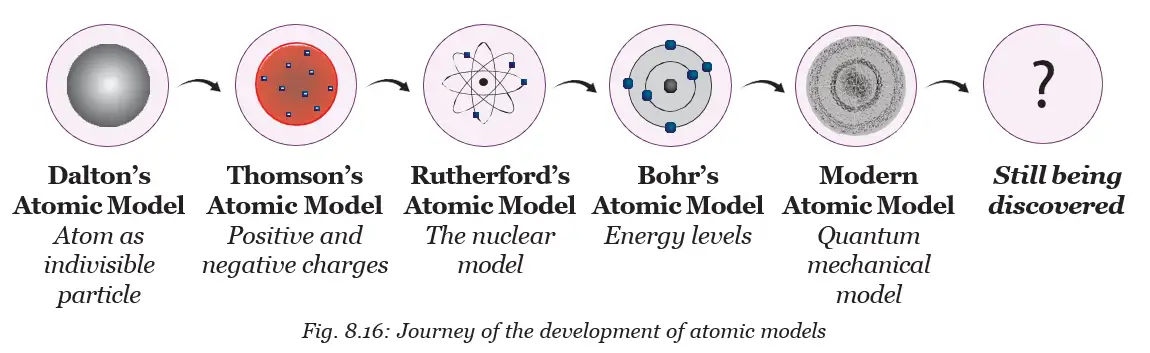
- Beyond fixed orbits: Electrons do not travel in well-defined paths like the fixed orbits in Bohr’s model.
- Electron cloud: Electrons occupy regions around the nucleus where they are most likely to be found; their exact positions cannot be specified.
Quick recap
- Isotopes have the same atomic number but different mass numbers; their neutron counts differ.
- Isotopes have similar chemical properties but may differ in physical properties.
- Use to express atomic masses; isotope applications include medicine, power generation and dating.
- Average atomic mass is a weighted average based on natural isotope abundances.
- Isobars have the same mass number but different atomic numbers.
- Electrons are described as clouds of probability around the nucleus, not fixed Bohr paths.
At a Glance
Atom — Atoms are the building blocks of matter.
Models of the atom
| Model / scientist | Main idea |
|---|---|
| J. J. Thomson | Electrons are embedded in a positively charged sphere. |
| Rutherford | The atom is mostly empty space, with a dense, positively charged nucleus at its centre and electrons orbiting it. |
| Niels Bohr | Electrons move around the nucleus in fixed energy levels, called shells. |
| James Chadwick | Discovered the presence of neutrons in the atom. |
Electron shells
- Shell names: The energy levels are named , , , , and so on.
Subatomic particles and stability
| Particle | Location / role |
|---|---|
| Electron | Moves around the nucleus in shells. |
| Proton | A positively charged particle in the nucleus. |
| Neutron | A particle in the nucleus with no charge. |
Stable configurations and valency
- Stable outer shell: An atom is stable and largely unreactive when its outermost shell has an octet, or two electrons in helium.
- Valency: The combining capacity of an atom; it equals the number of electrons gained, lost, or shared to achieve a stable configuration.
Atomic number and mass number
Atomic number — The number of protons in an atom’s nucleus; represented by .
Mass number — The total number of nucleons (protons and neutrons) in an atom’s nucleus; represented by .
is the number of neutrons.
Isotopes, average atomic mass, and isobars
Isotopes — Atoms of the same element with the same atomic number but different mass numbers.
Average atomic mass
- Meaning: An element’s average atomic mass takes account of the relative natural abundance of its isotopes.
- Calculation: Multiply each isotope’s mass by its fractional abundance, then add the products.
is an isotope’s mass and is its fractional abundance.
Isobars — Atoms of different elements with the same mass number but different atomic numbers.
| Point | Isotopes | Isobars |
|---|---|---|
| Element | Same element | Different elements |
| Atomic number | Same | Different |
| Mass number | Different | Same |
How do isotopes differ from isobars?
Quick recap
- Atoms contain electrons, protons, and neutrons.
- Thomson, Rutherford, and Bohr proposed different models of atomic structure.
- Bohr’s shells are named , , , , and so on.
- A filled outer shell—an octet, or two electrons for helium—indicates stability; valency is the combining capacity.
- Atomic number is the number of protons; mass number is the total number of protons and neutrons.
- Isotopes share an atomic number; isobars share a mass number.
Science — ALL CHAPTERS
1
Exploration: Entering the World of Secondary Science
2
Cell: The Building Block of Life
3
Tissues in Action
4
Describing Motion Around Us
5
Exploring Mixtures and their Separation
6
How Forces Affect Motion
7
Work, Energy, and Simple Machines
8
Journey Inside the Atom
9
Atomic Foundations of Matter
10
Sound Waves: Characteristics and Applications
11
Reproduction: How Life Continues
12
Patterns in Life: Diversity and Classification
13
Earth as a System: Energy, Matter, and Life