Class 9 . Science . Exploration . Earth As a System Energy Matter and Life
Chapter 13: Earth as a System: Energy, Matter, and Life
Ch 13
Science
Class 9
Uneven Heating of the Earth part 1
Earth as an Interacting System
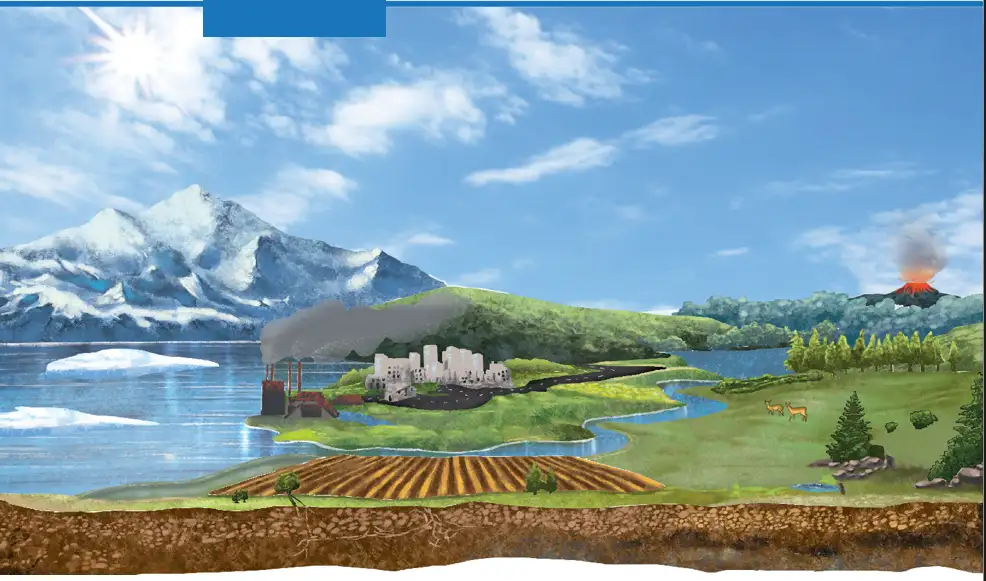
How Changes Spread Between Spheres
Warming and Its Effects Across Spheres
- Warmer Arabian Sea → more evaporation → fluctuations in southwest monsoon rainfall.
- Rainfall variability → floods in some regions and drought in others → disruption of the hydrosphere.
- Higher atmospheric temperature → faster melting of glaciers and polar ice → possible flooding of low-lying areas and rising sea levels.
- Sea-level rise → threat to coastal cities → habitat loss that can disturb biosphere ecosystems.
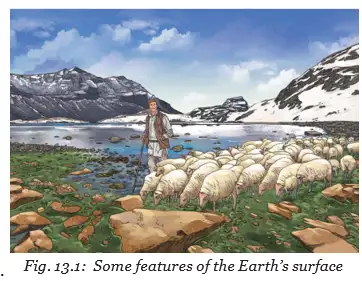
Solar Radiation and Uneven Heating
How can reduced winter snowfall affect a lake and nearby grass?
How can warming of the Arabian Sea affect India?
Quick recap
- Earth’s spheres are the geosphere, hydrosphere, cryosphere, atmosphere and biosphere.
- Energy and matter move between spheres; a change in one can affect others.
- The Sun is Earth’s main energy source, with additional contributions from its interior and chemical reactions.
- Less snowfall can reduce lake water and the grass supported by it.
- Solar radiation varies across Earth and drives winds, ocean currents and the water cycle.
- Warming can affect rainfall, ice, sea levels and habitats.
Uneven Heating of the Earth part 2
Solar Radiation and the Electromagnetic Spectrum
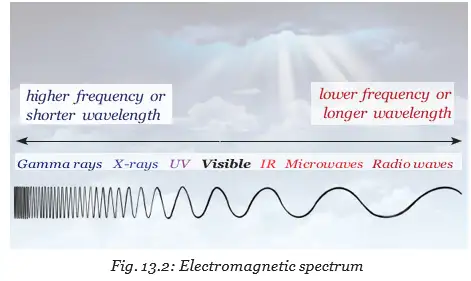
Solar radiation — Energy from the Sun reaches Earth mainly as electromagnetic (EM) waves, which can travel through the vacuum of space.
- Speed of light: EM waves travel through a vacuum at ; sound waves are mechanical and need a medium.
- Wavelength and energy: Higher-frequency, shorter-wavelength EM waves carry more energy than lower-frequency, longer-wavelength waves.
- Energy reaching Earth: About of the Sun’s energy reaching Earth is in the ultraviolet (UV), visible and infrared (IR) regions.
- Other regions: Gamma rays and X-rays have high energy and can harm life, but are mostly filtered by the upper atmosphere. Microwaves and radio waves contribute little energy to warming Earth.
| Radiation | Main interaction or effect |
|---|---|
| UV | Mostly absorbed by the ozone layer; this protects life and contributes to atmospheric heating. |
| Visible light | Reaches the surface, supports photosynthesis and partly warms land and water. |
| Infrared (IR) | Warms Earth’s surface; the surface then emits heat back toward the atmosphere. |
How Radiation Helps Keep Earth Warm
- Greenhouse effect: Greenhouse gases, including carbon dioxide (), methane () and water vapour, trap some outgoing heat.
- Result: This trapped heat helps keep Earth warm enough to support life.
Ultraviolet Radiation
- Wavelength range: UV rays have wavelengths from to ; .
- Risks: Prolonged UV exposure can damage skin and eyes and increase cancer risk; protective glasses and sunscreen help reduce exposure.
- Uses: UV rays can kill germs in water purifiers and help power fluorescent lights.
Insolation and the Solar Constant
Insolation — The amount of the Sun’s radiation that reaches Earth’s surface; it warms the surface and atmosphere.
Solar constant — The average solar energy received per unit time per unit area perpendicular to the Sun’s rays at the top of Earth’s atmosphere.
- Solar constant value: Approximately , or .
- Before atmospheric effects: It represents solar energy available before absorption, scattering or reflection in the atmosphere.
- At the surface: Gases, clouds and dust absorb or scatter some sunlight; maximum surface insolation is about under clear skies.
- Importance: The solar constant helps scientists study Earth’s energy balance, climate and weather patterns.
| Point | Solar constant | Insolation |
|---|---|---|
| Where measured | At the top of the atmosphere | Radiation reaching Earth’s surface |
| Atmospheric effects | Before absorption, scattering or reflection | Reduced by atmospheric absorption and scattering |
| Typical value given | About | Up to about under clear skies |
Insolation in India
- Sunlight: India’s tropical and sub-tropical location provides abundant sunlight through the year.
- Climate and agriculture: Solar insolation drives the southwest monsoon, influencing India’s climate and agriculture.
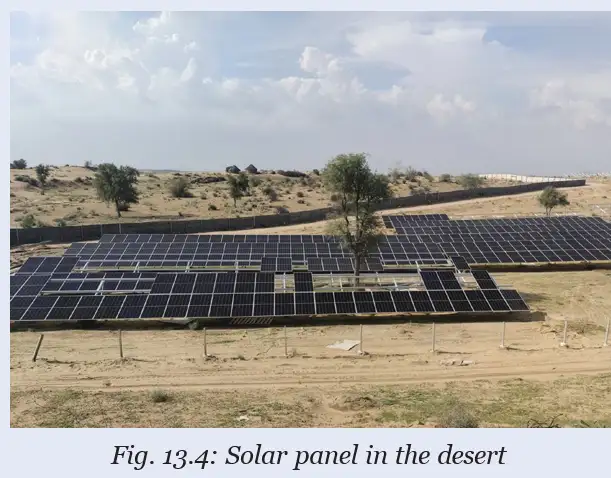
- Solar energy: Abundant sunlight gives India strong potential to harness solar power as a renewable, sustainable energy source.
- Solar measurements: Atmospheric scientist Anna Mani mapped insolation across India in the 1950s and published *Solar Radiation Over India* in 1981, the country’s first insolation atlas.
Calculating Solar Energy Received
Use when radiation intensity, area and exposure time are known; is intensity, is area and is time.
Example: Energy on a Area in One Hour
- Given: , and .
- Calculation: .
- Equivalent energy: This is about one household unit of electricity, or enough to melt about of ice and heat the resulting water to .
What is the solar constant, and how does it differ from surface insolation?
How do visible light and infrared radiation affect Earth?
Quick recap
- Solar radiation reaches Earth as EM waves; higher-frequency, shorter-wavelength waves carry more energy.
- UV is mostly absorbed by ozone, visible light supports photosynthesis, and IR warms Earth’s surface.
- Greenhouse gases trap some outgoing heat and help keep Earth warm.
- Insolation is solar radiation reaching Earth’s surface; the solar constant at the top of the atmosphere is about .
- Clear-sky surface insolation can reach about ; energy received is calculated using .
- India’s abundant sunlight supports climate processes and provides strong potential for solar power.
Uneven Heating of the Earth part 3
How Earth’s Surface Absorbs and Reflects Solar Radiation
Heating and Re-radiation
- Examples: Dark roads and dark clothes heat up more quickly than light-coloured surfaces and clothes.
- Polar regions: Snow and ice have high albedo, reflecting much incoming radiation and helping keep polar regions cold.
- Heat release: Surfaces radiate heat after absorbing it. Concrete can release stored heat at night, while thick mud and wooden walls tend to keep traditional houses cooler.
Urban Heat Island Effect
- Urban heat island: Cities are often warmer than surrounding rural areas, especially in summer and at night.
- Cause: Buildings and roads absorb and retain solar heat, then re-radiate it; less vegetation means less shade and cooling from transpiration.
- Impact: The extra heat increases demand for air conditioning and puts added stress on urban ecosystems.
Latitude, Earth’s Shape and Uneven Heating
- Earth’s shape: The spherical Earth causes sunlight to strike different latitudes at different angles.
- Uneven heating: Solar energy is concentrated over a smaller area near the equator and spread over a larger area near the poles, making equatorial regions warmer.
- Global effects: Earth’s tilt and revolution also affect the distribution of sunlight and the seasons; temperature differences help drive winds and ocean currents.
The Atmosphere and Its Layers
- Atmosphere: A layer of gases surrounding Earth, held in place by gravity; it consists mainly of nitrogen and oxygen.
- Layers: The atmosphere includes the troposphere, stratosphere, mesosphere, thermosphere and exosphere.
- Weather: Nearly all weather phenomena occur in the troposphere, the lowest atmospheric layer.
How the Atmosphere Regulates Energy
- Incoming radiation: The atmosphere absorbs some solar energy, while clouds and gases also scatter or reflect part of it.
- Outgoing heat: Earth’s surface re-radiates absorbed energy as infrared radiation; greenhouse gases absorb some of this heat and help keep Earth warm.
- Greenhouse effect: Excess carbon dioxide from human activities strengthens heat trapping and contributes to global warming.
Ozone Layer and Ozone Depletion
How does latitude affect the amount of solar heating?
State the atmosphere’s two main roles in Earth’s energy balance.
What causes the urban heat island effect?
Quick recap
- Albedo measures the fraction of sunlight reflected; high-albedo surfaces stay cooler.
- Dark, low-albedo surfaces absorb more solar energy; concrete can re-radiate stored heat at night.
- Uneven sunlight by latitude makes the equator warmer than the poles and helps drive winds and ocean currents.
- Most weather occurs in the troposphere; ozone absorbs UV in the stratosphere.
- The atmosphere absorbs some incoming radiation and greenhouse gases trap some outgoing infrared heat.
- CFCs caused severe Antarctic ozone loss; the Montreal Protocol helped reduce their use.
Uneven Heating Causes Wind and Ocean Currents part 1
Uneven heating and wind
- Wind: Air moves from regions of high pressure to regions of low pressure.
- Cause: Uneven solar heating creates temperature and pressure differences that set air in motion.
- Scale: These pressure differences produce winds ranging from local movements to large-scale planetary circulation.
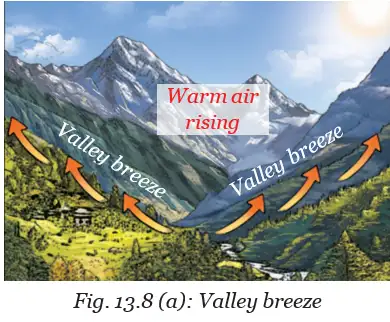
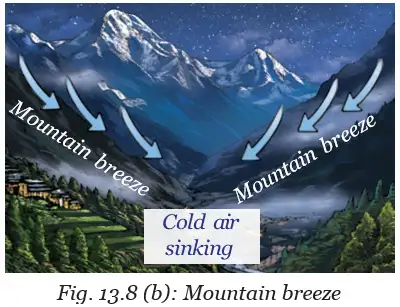
Local winds
| Time | Heating and air movement | Wind |
|---|---|---|
| Day | Sun-facing slopes heat faster; warm air rises, so cooler air from the valley flows upslope. | Valley breeze |
| After sunset | Slopes cool faster; cool, dense air flows downslope into the relatively warmer valley. | Mountain breeze |
Effects of local winds
- Where experienced: Daily reversals between valley and mountain breezes are common in hilly regions, including Himalayan valleys.
- Importance: These winds affect local weather, temperature and moisture conditions, supporting soil and crop health.
Planetary winds
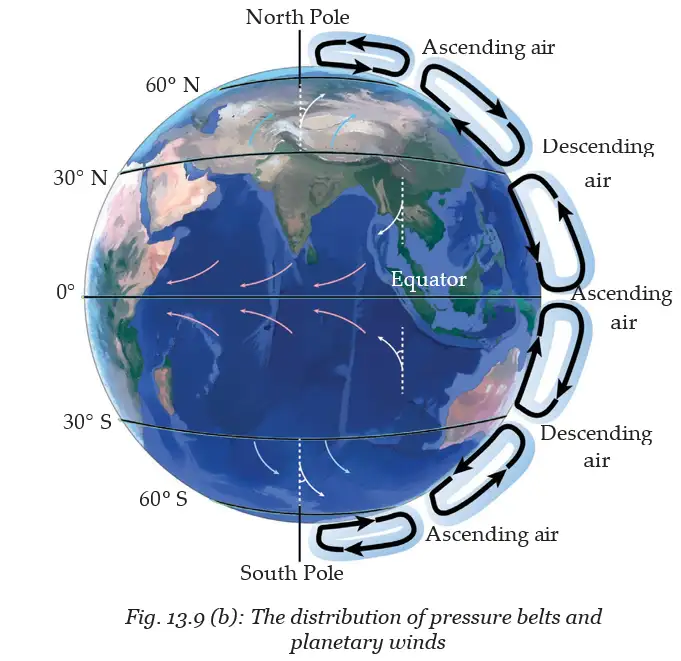
Planetary winds — Winds that flow over long distances because uneven heating between the equator and the poles creates global pressure belts.
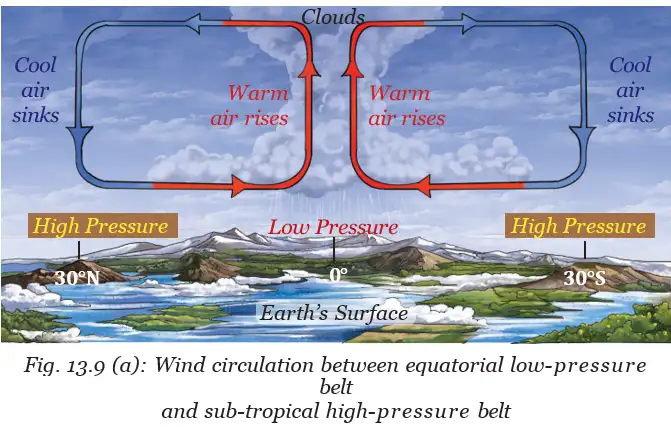
Global pressure belts and circulation
- Intense equatorial heating makes warm air rise, forming an equatorial low-pressure belt.
- Air moves poleward at higher altitudes, cools and sinks near north and south, forming subtropical high-pressure belts.
- Some surface air flows back towards the equator, completing a circulation cycle; some moves poleward and rises near north and south, forming sub-polar low-pressure belts.
- Very cold, dense air sinks near north and south, forming polar high-pressure belts; surface air flows from the poles towards the sub-polar belts.
Effect of Earth’s rotation
- Deflection: Earth’s rotation bends planetary winds away from a straight path between high- and low-pressure regions.
- Direction: Winds deflect towards the right in the Northern Hemisphere and towards the left in the Southern Hemisphere.
Ocean currents
Ocean currents — The continuous movement of large masses of ocean water.
What moves ocean water?
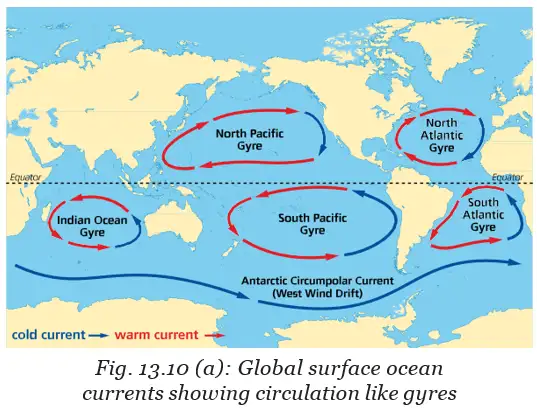
- Planetary winds: Friction between strong winds and ocean surfaces drags water and drives surface currents.
- Temperature: Warm equatorial surface water flows towards the poles; colder, denser water returns slowly towards the equator at deeper levels.
- Salinity: Lower-salinity water is less dense and tends to stay near the surface; saltier, denser water sinks and moves at depth.
- Other influences: Earth’s rotation deflects currents, while continents block and redirect their paths.
Gyres — Large circular patterns formed by ocean currents as moving water is deflected by Earth’s rotation and redirected by land.
Ocean currents and climate
- Heat transfer: Currents carry heat from the equator towards the poles, reducing temperature differences across Earth.
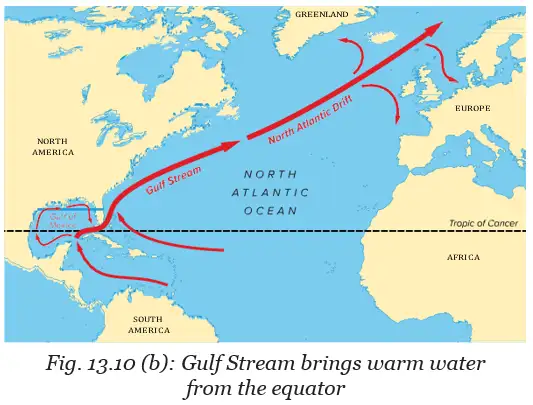
- North Atlantic Drift: This warm current, an extension of the Gulf Stream, flows towards northwestern Europe and helps keep many ports ice-free in winter.
- Benefits: Currents moderate regional climates, support trade and commerce, and transport nutrients that sustain marine ecosystems.
Indian scientific contribution
Monsoon modelling at IITM
- Institution: Scientists at the Indian Institute of Tropical Meteorology (IITM), Pune, use advanced computer models to simulate the Indian monsoon.
- Model inputs: The models couple energy flows among the atmosphere, oceans, land and ice, using data from satellites, Indian Ocean buoys and Antarctic stations.
- Purpose: These models improve seasonal forecasts and help study how global warming may change monsoon rainfall across India.
Quick recap
- Uneven solar heating creates pressure differences that drive winds.
- Daytime upslope flow is a valley breeze; nighttime downslope flow is a mountain breeze.
- Global heating differences create equatorial, subtropical, sub-polar and polar pressure belts.
- Earth’s rotation deflects winds right in the Northern Hemisphere and left in the Southern Hemisphere.
- Wind, temperature, salinity, rotation and continents influence ocean currents and gyres.
- Ocean currents redistribute heat, moderate climate and transport nutrients; IITM models help forecast monsoons.
Biogeochemical Cycles
Biogeochemical cycle — The cyclic movement of matter and energy between Earth’s living (biotic) and non-living (abiotic) components.
Why cycles matter
- Recycling: Cycles keep essential elements such as carbon, nitrogen and oxygen available to support life.
- Interconnection: Living organisms exchange matter and energy with air, water, soil and rocks across Earth’s spheres.
- Balance: Connected ecosystems can recover from disturbances and help maintain environmental balance.
Water Cycle
Movement and importance of water
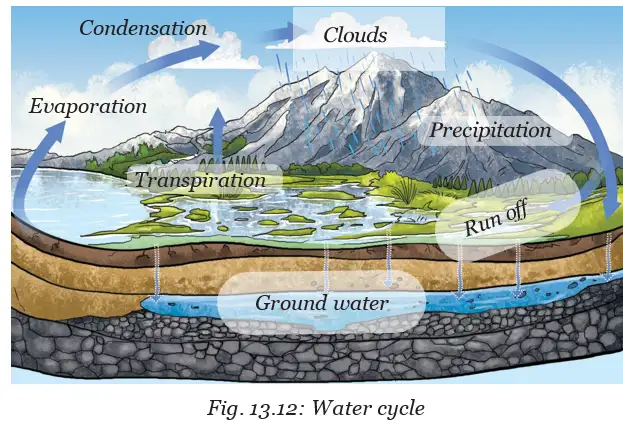
- Sequence: Water evaporates from rivers, lakes and oceans; vapour condenses into clouds; precipitation returns water as rain, hail or snow.
- Return to oceans: Surface runoff flows back towards the oceans; some water infiltrates soil and rocks and becomes groundwater.
- Transport: Water dissolves minerals from rocks and soil, carries nutrients towards oceans and supports both terrestrial and marine life.
- Key processes: Evaporation, transpiration, condensation, precipitation, infiltration, runoff and groundwater movement.
Climate change and the water cycle
- Warmer air holds more moisture → heavier rainfall in some places, including more intense monsoons, and drought in others.
- Glacier melting → increased river water and, over time, rising sea levels that threaten coastal cities such as Mumbai and Chennai.
- Intense rainfall bursts → greater runoff and soil erosion, but less infiltration → reduced groundwater recharge.
- Lower groundwater recharge and changing rainfall → greater difficulty sustaining agriculture, especially in dry months.
- These effects link the hydrosphere, atmosphere, geosphere and biosphere.
Carbon Cycle
Carbon cycle — The continuous movement of carbon among the atmosphere, biosphere, geosphere and hydrosphere.
Carbon reservoirs and fast cycle
- Importance: Carbon is present in proteins, carbohydrates, fats and DNA; it forms about 49% of the dry weight of living organisms.
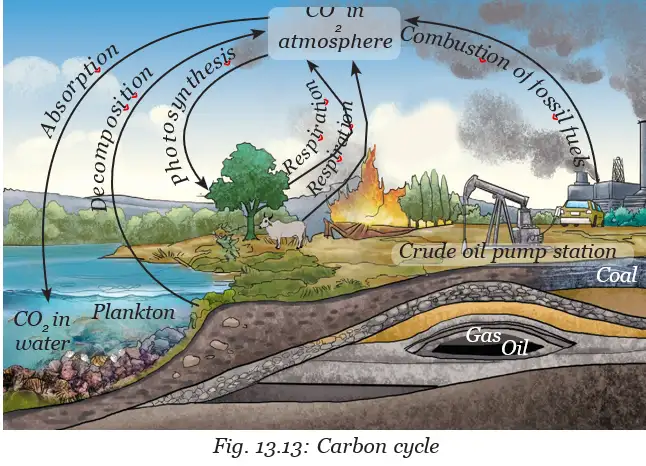
- Reservoirs: Carbon occurs as atmospheric , in organisms, in dissolved ocean carbon and marine shells, and in carbonate rocks and fossil fuels.
- Fast cycle: Over days to years, plants use sunlight to convert atmospheric into glucose by photosynthesis.
- Return to air: Respiration releases ; animals obtain carbon by eating plants or other animals, and decomposition returns carbon from dead organisms to the air.
Slow cycle and ocean exchange
- Slow cycle: Over millions of years, buried remains of plants and animals can become fossil fuels such as coal, oil and gas.
- Combustion: Burning fossil fuels for heating, cooking, transport and industry releases stored carbon quickly as atmospheric .
- Ocean exchange: Oceans absorb atmospheric , which forms carbonate and bicarbonate ions; phytoplankton use these in photosynthesis.
- Long-term storage: Some marine organisms use carbon to build shells. When organisms die and sink, their organic matter can remain stored on the ocean floor for a long time.
- Reservoir sizes: Oceans contain about 71% of global carbon and regulate atmospheric ; the atmosphere holds only about 1%.
Human impact on the carbon cycle
- Fossil-fuel burning and deforestation → atmospheric rises from about 315 ppm in 1960 to 420 ppm, an increase of about 35%.
- Some helps keep Earth warm enough for life, but excess intensifies the greenhouse effect → global warming.
- Global warming → melting glaciers and Arctic sea ice, rising sea levels and more extreme weather.
- In India, warmer air can hold more moisture → more intense monsoons and changing rainfall patterns that threaten agriculture.
- Increasing renewable energy can help reduce carbon released into the atmosphere.
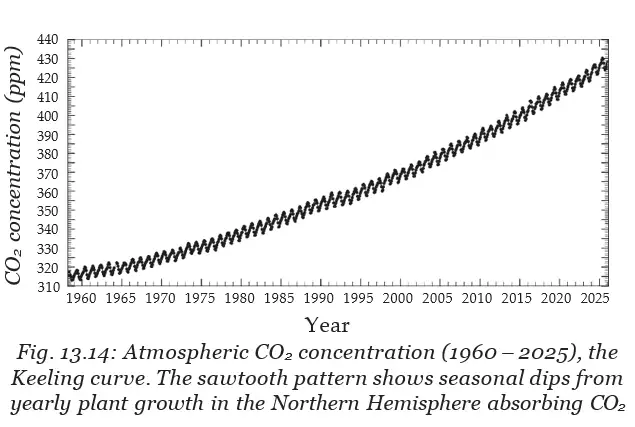
Ocean warming and marine life
- Likely effects: Warming disturbs the balance of dissolved ocean carbon. This can disrupt marine organisms that depend on dissolved carbon compounds for photosynthesis or shell formation, affecting marine ecosystems.
Nitrogen Cycle
Nitrogen cycle — The movement of nitrogen between air, soil, water and organisms through processes that make nitrogen usable and return it to the atmosphere.
Why nitrogen must be converted
- Importance: Nitrogen is needed to make proteins and nucleic acids.
- Main reservoir: The atmosphere contains the largest reservoir, mostly as nitrogen gas, .
- Availability: Atmospheric is relatively non-reactive and cannot be used directly by plants and animals; it must first become soluble compounds.
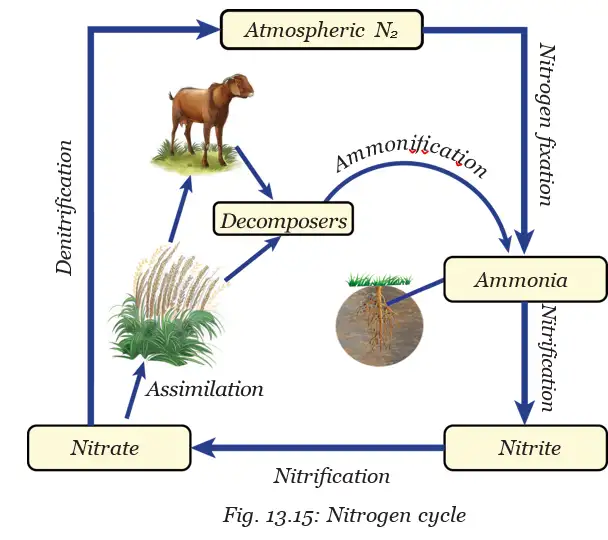
| Step | What happens | Examples / agents |
|---|---|---|
| Nitrogen fixation | Atmospheric is converted into ammonia or other usable nitrogen compounds. | Rhizobium in legume root nodules; Azotobacter in soil; lightning forms nitrogen oxides. |
| Assimilation | Plants absorb nitrogen compounds from soil; animals obtain nitrogen by eating plants or other animals. | Plants → animals through feeding. |
| Ammonification | Decomposers convert nitrogen in dead organisms and waste into ammonia compounds in soil. | Bacteria and fungi. |
| Nitrification | Ammonia is converted to nitrite, then nitrate. | Nitrosomonas: ammonia to nitrite; Nitrobacter: nitrite to nitrate. |
| Denitrification | Some nitrates are converted back into atmospheric nitrogen gas. | Pseudomonas and other denitrifying bacteria. |
Nitrogen movement at a glance
- Atmospheric → fixation → ammonia / usable nitrogen compounds
- Soil nitrogen compounds → plant assimilation → animals obtain nitrogen by feeding
- Dead organisms and waste → ammonification → ammonia compounds in soil
- Ammonia → nitrification → nitrite → nitrate
- Nitrate → denitrification → atmospheric
Artificial nitrogen fixation
- Haber–Bosch process: Developed in the early 1900s; it makes ammonia from atmospheric nitrogen and supplies most modern fertilisers.
- Impact: This energy-intensive process uses about 1–2% of global energy. More than half the nitrogen atoms in the human body come from it.
- Trade-off: Fertilisers support food production, including India’s Green Revolution, but their overuse degrades soil and water.
Oxygen Cycle
Oxygen cycle — The circulation of oxygen among the atmosphere, land, oceans and living organisms through oxygen-consuming and oxygen-producing processes.
Oxygen stores and movement
- Atmosphere: About 21% of the atmosphere is free oxygen gas, .
- Other forms: Oxygen is part of carbohydrates, proteins, nucleic acids and fats; it also occurs in crustal metal oxides and minerals, and in atmospheric carbon dioxide.
- Consumption: Plants and animals use oxygen in respiration, releasing carbon dioxide; fuel combustion also consumes oxygen and releases carbon dioxide.
- Replenishment: Plants use sunlight, water and carbon dioxide in photosynthesis, forming glucose and releasing oxygen.
- Balance: Photosynthesis replenishes oxygen used by respiration and combustion, helping sustain life across Earth’s spheres.
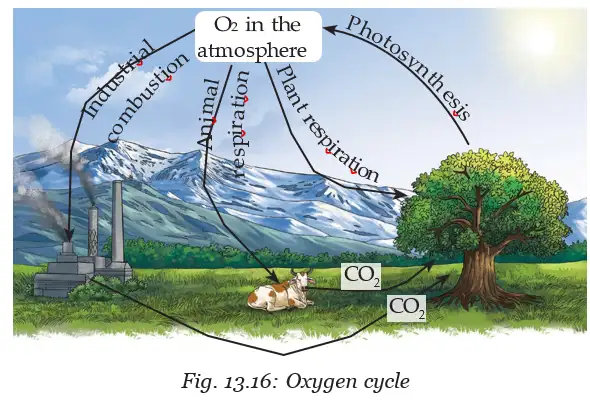
What may happen if biogeochemical cycles are disrupted?
How do nitrogen-fixing, nitrifying and denitrifying bacteria differ?
Quick recap
- Biogeochemical cycles move matter between living organisms and the non-living Earth, recycling essential nutrients.
- Water cycle: Evaporation and transpiration, condensation and precipitation, followed by runoff and infiltration, move water through Earth’s spheres.
- Carbon cycle: Photosynthesis, respiration, decomposition, fossil-fuel formation and combustion move carbon on fast and slow timescales.
- Nitrogen cycle: Fixation, assimilation, ammonification, nitrification and denitrification make nitrogen available and return it to the atmosphere.
- Oxygen cycle: Photosynthesis releases oxygen; respiration and combustion consume it.
- Human impacts: Climate change alters water and carbon cycling, while excessive fertiliser use can degrade soil and water.
Human Impact on Earth’s Processes
Human Disruption of the Carbon Cycle
Fossil Fuels, CO₂ and Oceans
- Fossil fuels: Burning them releases CO₂, intensifying greenhouse warming and contributing to extreme weather and biodiversity loss.
- Carbon sinks: Forests and oceans absorb and store carbon, but fossil-fuel use and deforestation overload these natural sinks.
- Ocean absorption: The ocean absorbs some excess atmospheric CO₂; this makes seawater more acidic and can threaten plankton and coral reefs.
- Warmer oceans: Warmer water absorbs less CO₂, weakening the ocean’s role as a carbon sink.
- Long-term change: Earth’s natural systems have changed significantly over the past 50 years.
- India: Fossil fuels still generate a significant share of electricity, while solar energy is growing rapidly.
Carbon sink — A natural system, such as a forest or ocean, that absorbs and stores carbon from the atmosphere.
If photosynthesis stopped
- Plants would stop taking in CO₂ and producing oxygen through photosynthesis.
- Primary food production would fall → food chains and ecosystems would be disrupted.
- Over time, reduced oxygen production and food availability would threaten life.
Fertilisers and Eutrophication
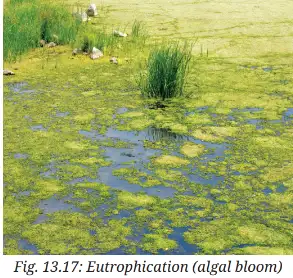
Eutrophication — Excess nutrients in a water body cause rapid algal growth, which depletes oxygen and harms aquatic life.
Fertiliser Use and Water Pollution
- Excess fertiliser use → nitrates enter rivers and lakes.
- Extra nutrients → rapid algal growth, called an algal bloom.
- Algal blooms deplete oxygen → fish may die and aquatic ecosystems are damaged.
- Damage to water bodies can threaten coastal fisheries.
Deforestation and Its Effects
Effects of Clearing Forests
- Fewer trees → less photosynthesis and transpiration → local rainfall may decline.
- Forest clearance changes the land surface’s albedo (reflectivity).
- Loss of tree roots → weaker soil binding → increased soil erosion.
- Habitat destruction → species lose natural homes → biodiversity declines.
Air Pollution and Ozone
Vehicle Emissions and Ground-Level Pollution
- Vehicle emissions react with sunlight → ground-level smog forms.
- These reactions also produce ground-level ozone, which is harmful to health.
- These pollutants make city air unhealthy.
| Point | Ground-level ozone | Stratospheric ozone |
|---|---|---|
| Location | Near Earth’s surface. | In the stratosphere. |
| Effect | Harmful to health and contributes to air pollution. | Blocks ultraviolet (UV) radiation and protects life. |
Restoring Environmental Balance
| Agreement | Purpose or progress |
|---|---|
| Montreal Protocol | Global cooperation has started the process of ozone-layer recovery. |
| Kyoto Protocol and Paris Agreement | Countries were expected to reduce CO₂ emissions; progress has been less successful. |
Actions That Help Restore Balance
- Conserve: Use energy, water, food and other resources carefully; reduce waste.
- Switch: Use renewable energy sources such as solar and wind.
- Restore: Plant trees and protect forests.
- Farm sustainably: Choose practices that reduce harm to soil and water.
- Use the 3Rs: Reduce, reuse and recycle materials.
- India’s efforts: India has planted billions of trees, expanded solar and other renewable energy, and promoted sustainable farming.
Mission LiFE
Mission LiFE — An India-led global initiative introduced at the United Nations Climate Change Conference in 2021 to encourage mindful, eco-friendly lifestyles.
Core Idea
- Interconnection: Energy flows and matter cycles across Earth’s spheres, linking them as a system.
- Imbalance: Unsustainable consumption disrupts these natural connections.
- Everyday choices: Saving energy and conserving resources help individuals and communities contribute to a sustainable future.
How does excess fertiliser cause eutrophication?
Give two effects of deforestation on the environment.
Name individual actions that can help reduce greenhouse-gas emissions.
Quick recap
- Fossil-fuel use and deforestation increase atmospheric CO₂ and weaken natural carbon sinks.
- Ocean acidification and warming threaten marine ecosystems and reduce ocean CO₂ absorption.
- Fertiliser nitrates can cause algal blooms, oxygen depletion and fish deaths.
- Deforestation can reduce local rainfall, increase soil erosion and destroy habitats.
- Vehicle emissions can form harmful ground-level smog and ozone; stratospheric ozone protects life from UV radiation.
- Renewable energy, conservation, tree planting, sustainable farming and international cooperation help restore environmental balance.
- Mission LiFE encourages mindful, eco-friendly lifestyles and resource conservation.
At A Glance
Solar Energy and Weather
Energy from the Sun
- Primary energy source: Electromagnetic radiation from the Sun supplies most of Earth’s energy.
- Weather: Evaporation, condensation and precipitation occur mainly in the troposphere.
Insolation — The incoming solar radiation received by Earth.
Uneven Heating
- Main factors: Earth’s shape, latitude and the tilt of its axis cause variations in insolation.
- Result: Different parts of Earth’s surface heat unevenly.
- Effects: Uneven heating generates winds and ocean currents.
Matter and Biogeochemical Cycles
Biogeochemical cycle — The continuous movement of matter and nutrients between living organisms and the non-living environment.
Cycling of Matter and Oxygen
- Continuous exchange: Matter and energy move between biotic (living) and abiotic (non-living) systems.
- Major cycles: Water, carbon, nitrogen and oxygen cycle among the atmosphere, oceans, land and living organisms.
- Oxygen use: Atmospheric oxygen is used in combustion, respiration and oxide formation.
- Oxygen restoration: Photosynthesis is the main process that restores atmospheric oxygen.
Why These Cycles Matter
- Nutrients: Cycles make essential nutrients available to living organisms.
- Earth systems: They sustain life, regulate climate and help maintain ecosystem balance.
Quick recap
- The Sun’s electromagnetic radiation is Earth’s primary energy source.
- Most evaporation, condensation and precipitation occur in the troposphere.
- Earth’s shape, latitude and axial tilt create variations in insolation and uneven heating.
- Uneven surface heating generates winds and ocean currents.
- Matter and energy cycle between biotic and abiotic systems.
- Water, carbon, nitrogen and oxygen cycle through Earth’s major systems.
- Biogeochemical cycles supply nutrients, sustain life, regulate climate and balance ecosystems.
Science — ALL CHAPTERS
1
Exploration: Entering the World of Secondary Science
2
Cell: The Building Block of Life
3
Tissues in Action
4
Describing Motion Around Us
5
Exploring Mixtures and their Separation
6
How Forces Affect Motion
7
Work, Energy, and Simple Machines
8
Journey Inside the Atom
9
Atomic Foundations of Matter
10
Sound Waves: Characteristics and Applications
11
Reproduction: How Life Continues
12
Patterns in Life: Diversity and Classification
13
Earth as a System: Energy, Matter, and Life