Class 9 . Science . Exploration . How Forces Affect Motion
Chapter 6: How Forces Affect Motion
Ch 6
Science
Class 9
The Concept of Force
Force — A force is a physical quantity that can change an object's motion or shape.
Effects of force
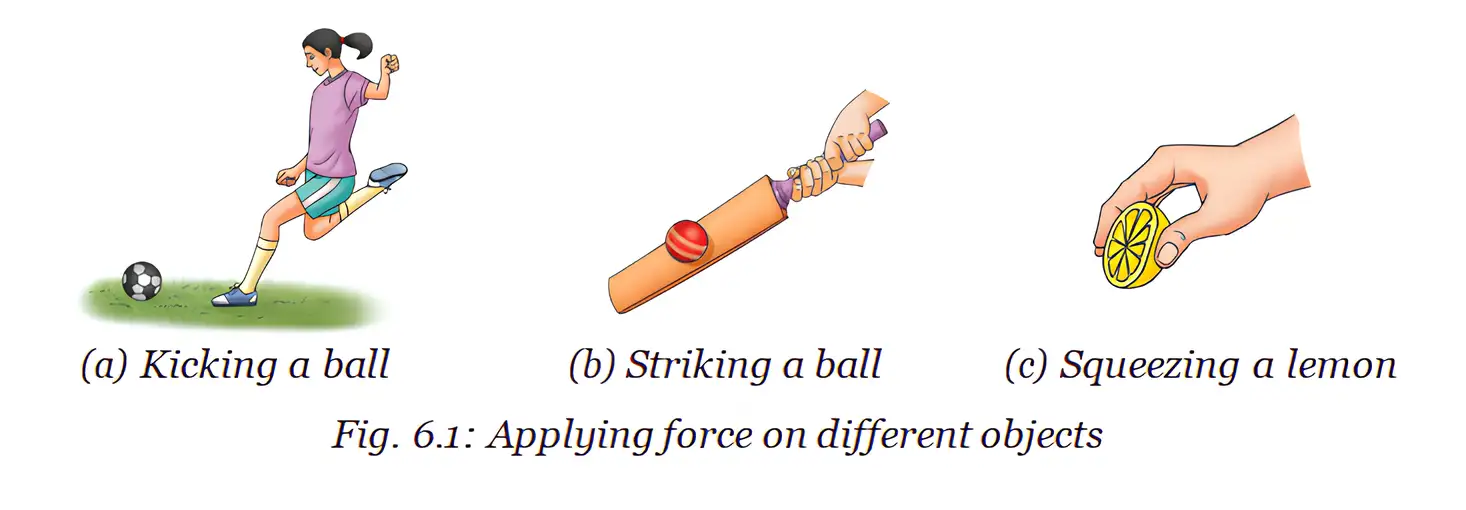
- Start motion: A force can set an object at rest in motion.
- Change motion: It can change a moving object's speed or direction.
- Change shape: Squeezing a lemon can deform it.
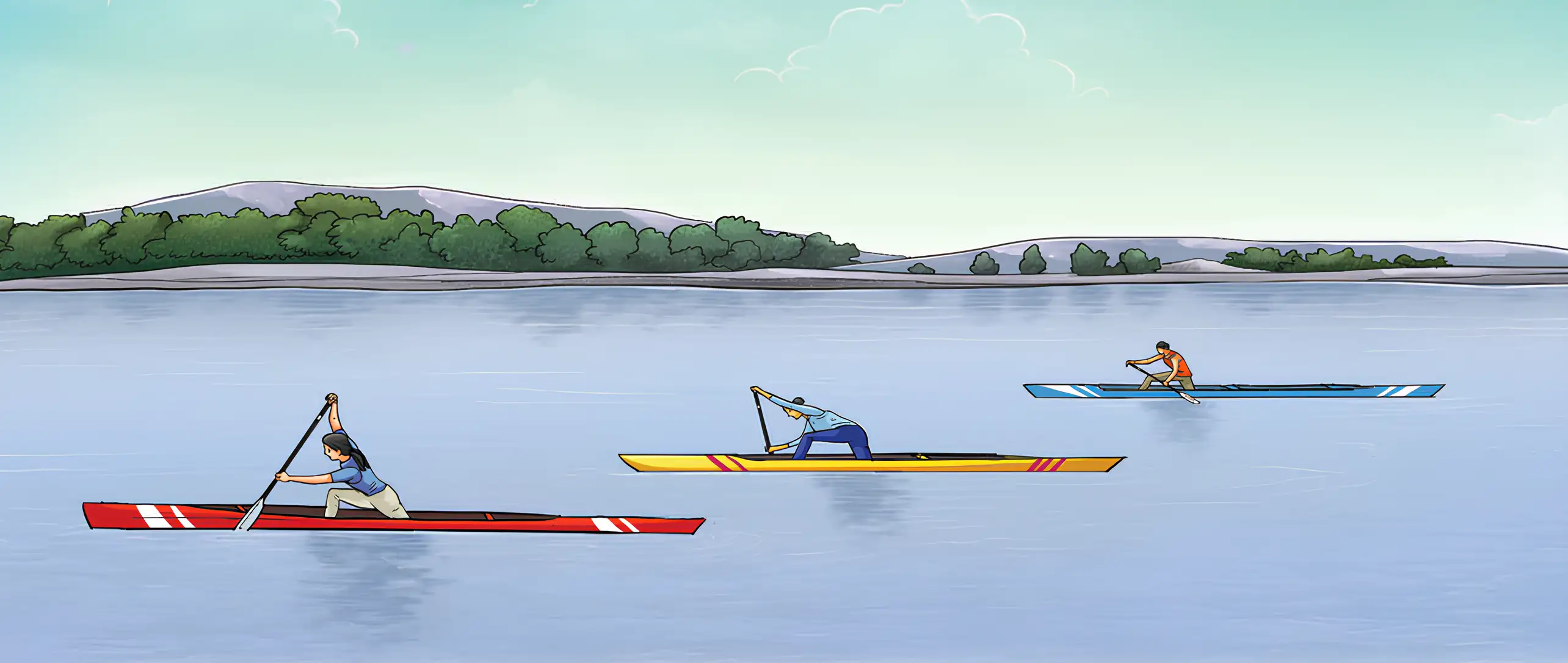
- Examples: A bat changes a cricket ball's direction; a harder paddle push can move a canoe faster.
Magnitude and direction of force
- Magnitude describes the strength of a force; its direction must also be specified.
- Unit: The SI unit of force is the newton, symbol N.
- Effect: Changing a force's magnitude, direction, or both can change its effect.
- Examples: Friction acts opposite motion; gravity pulls objects toward Earth; buoyant force acts upward.
Measuring force
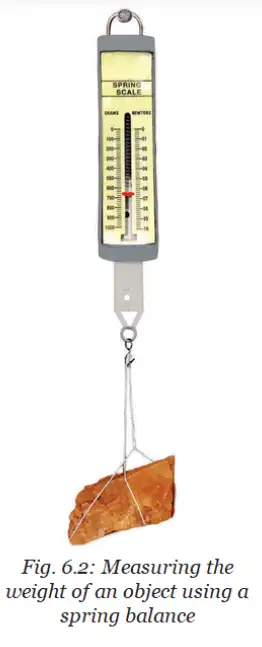
- Spring balance: Measures the magnitude of a force, including the pull exerted on its spring.
- Weight: An object's weight is the gravitational force with which Earth pulls it; a spring balance can measure it.
Why must a force be described by both magnitude and direction?
What does a spring balance measure?
Quick recap
- A force can start motion, alter speed or direction, or change shape.
- Force has both magnitude and direction; its SI unit is the newton (N).
- Changing a force's magnitude or direction can change its effect.
- A spring balance measures force magnitude, including weight.
Balanced and Unbalanced Forces
Several Forces Acting on an Object
Examples of Multiple Forces
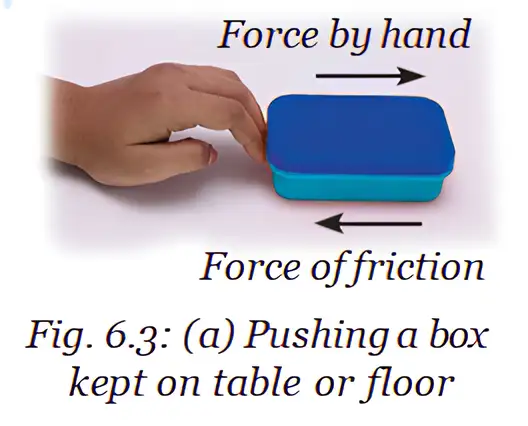
- Pushed box: The push acts forward while friction acts opposite to the motion.
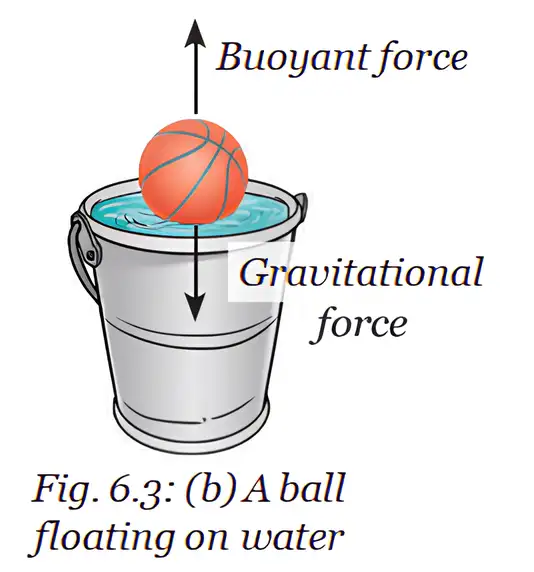
- Floating ball: Gravity acts downward and the liquid’s buoyant force acts upward.
Balanced and Unbalanced Forces
Balanced forces — Forces are balanced when their resultant (net force) is zero.
Unbalanced forces — Forces are unbalanced when they produce a non-zero net force.
Effects of Balanced and Unbalanced Forces
- Balanced forces: Equal forces in opposite directions keep the tug-of-war rope from moving.
- Unbalanced forces: A non-zero net force acts when forces are unbalanced.
- Tug of war: Equal opposing pulls keep the rope from moving; the stronger pull moves it in that force’s direction.
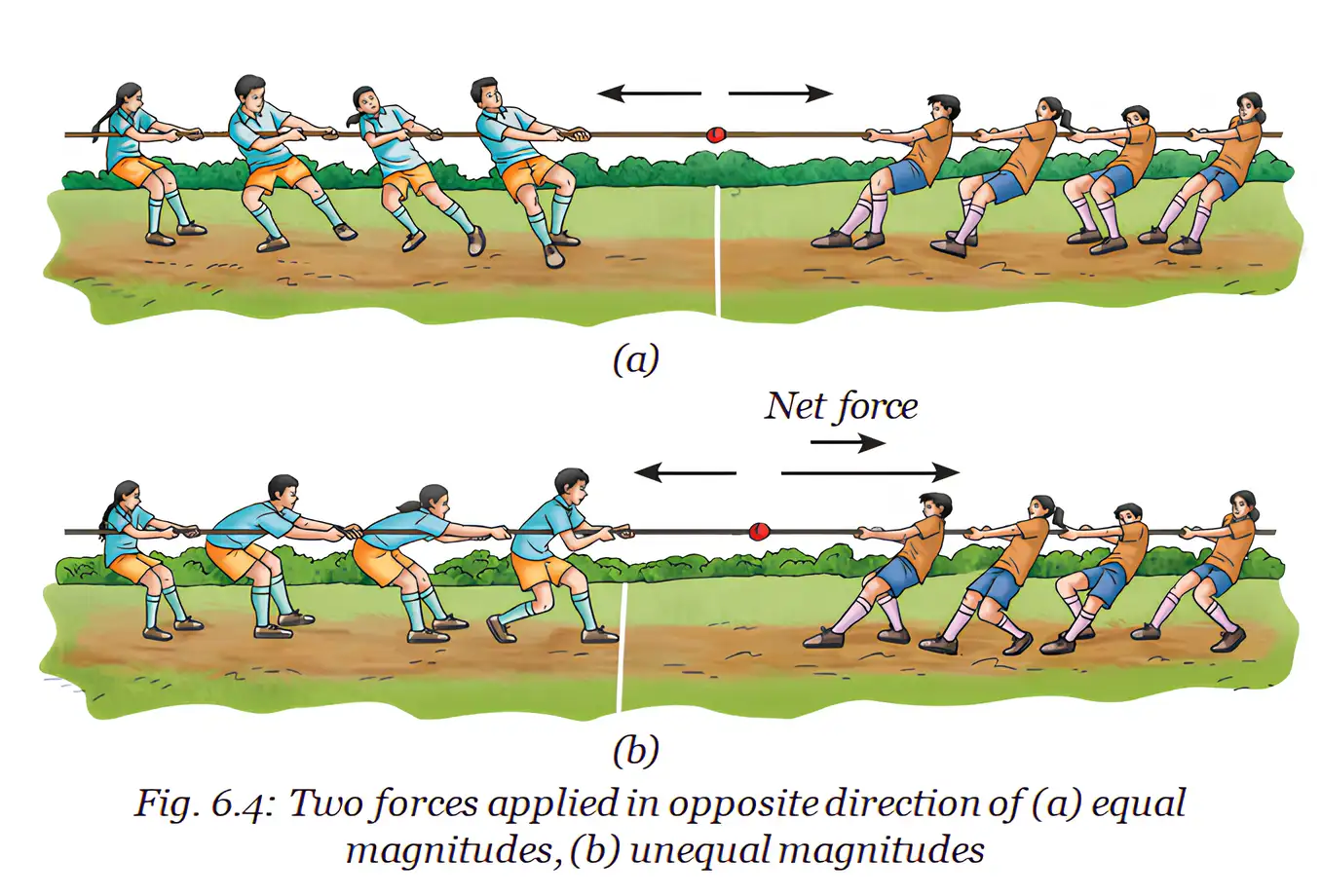
The net force points in the direction of the larger force.
Forces in the Same Direction
- Same-direction forces: Their magnitudes add, and the net force acts in their common direction.
- Example: Two people pushing a stalled car in the same direction combine their forces.
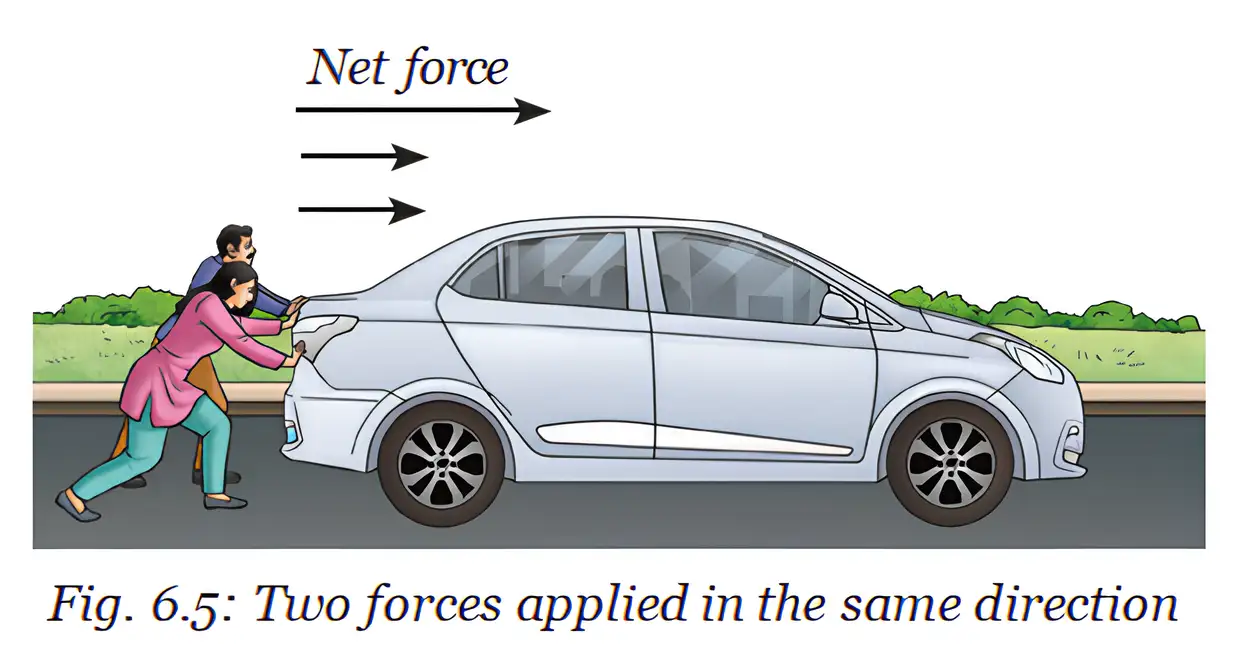
The net force acts in the direction of both forces.
Finding the Net Force
| Arrangement | Net force |
|---|---|
| Both forces act to the right | to the right |
| right; left | to the right |
| left; right | to the left |

Forces at Angles and Rotational Effect
- Forces at an angle: Their net force requires a method beyond adding or subtracting forces along one line.
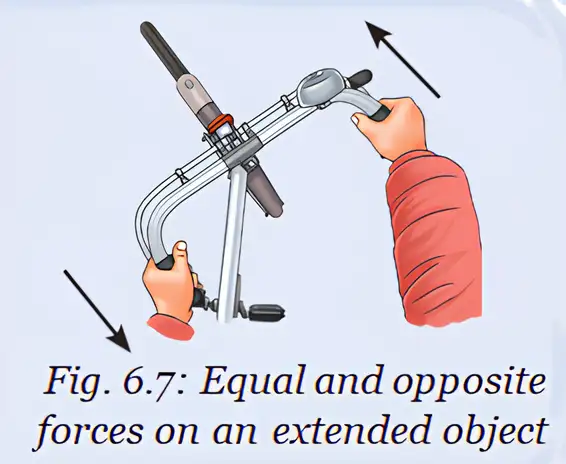
- Rotation: Equal and opposite forces applied at different points on an extended object can make it rotate.
- Examples: Equal opposing forces can turn a tap or handlebar.
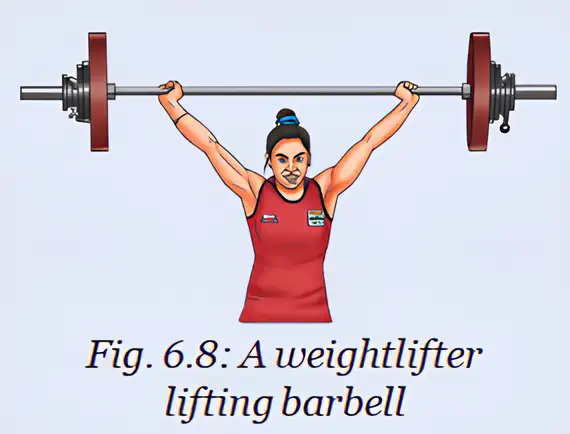
A weightlifter holds a barbell steady. Name two forces acting on it and state whether they are balanced.
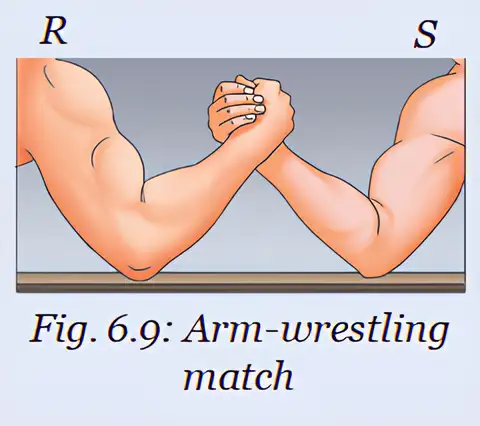
In an arm-wrestling match, the arms tilt toward the front. Are the forces balanced?
Quick recap
- Balanced forces produce zero net force; equal opposing pulls keep the tug-of-war rope from moving.
- Equal and opposite forces applied at different points can cause rotation.
- Unbalanced forces produce a non-zero net force.
- Same-direction forces add; opposite-direction forces subtract and point toward the stronger force.
- A steady barbell has upward support balanced by downward gravity.
The Force of Friction: Often Overlooked but Always Present
Friction and the Motion of Objects
- Friction: It acts opposite to an object’s motion and can slow it down or bring it to rest.
- Motion: An applied force must overcome friction for an object to start moving; while it moves, friction opposes its motion.
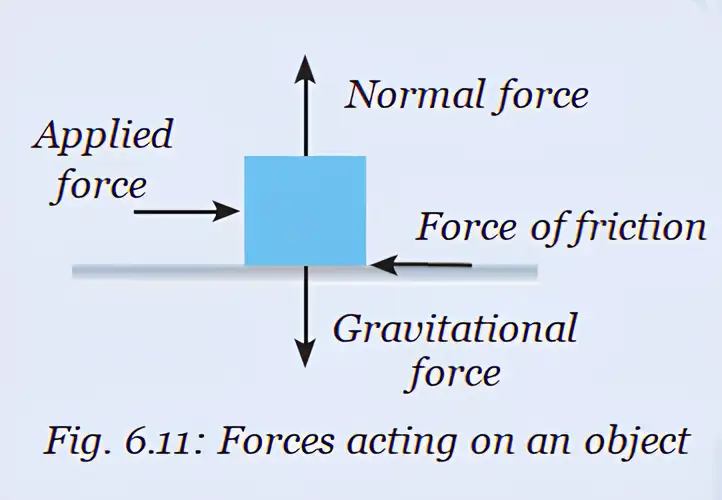
Other Forces on an Object
| Force | Direction | Role |
|---|---|---|
| Weight (gravitational force) | Downward | Pulls the object toward Earth. |
| Normal force | Upward, perpendicular to the surface | The surface's force on the object; balances its weight on a level surface. |
| Applied force | Direction of the push or pull | Can move the object if it exceeds opposing friction. |
| Friction | Opposite attempted or actual motion | Resists starting or continuing motion. |
Air friction
- Air resistance: Air also exerts friction on an object moving through it.
- Approximation: Its effect is often small enough to neglect.
Friction Slows Moving Objects
- After a push stops: A moving object slows and eventually stops because friction continues acting opposite its motion.
- Examples: A bicycle coasts to rest after pedalling stops; a pushed ball rolls to rest.
- Maintaining motion: In everyday conditions, a continuing force is needed to balance friction and keep an object moving at constant velocity.
Surface Type and Friction
Comparing surfaces
- Surface dependence: The force of friction changes with the nature of the surfaces in contact.
- Distance clue: With the same initial push, an object travels farther on a surface with less friction and slows down more gradually.
- Comparison: A larger stopping distance indicates less friction; a shorter distance indicates more friction.
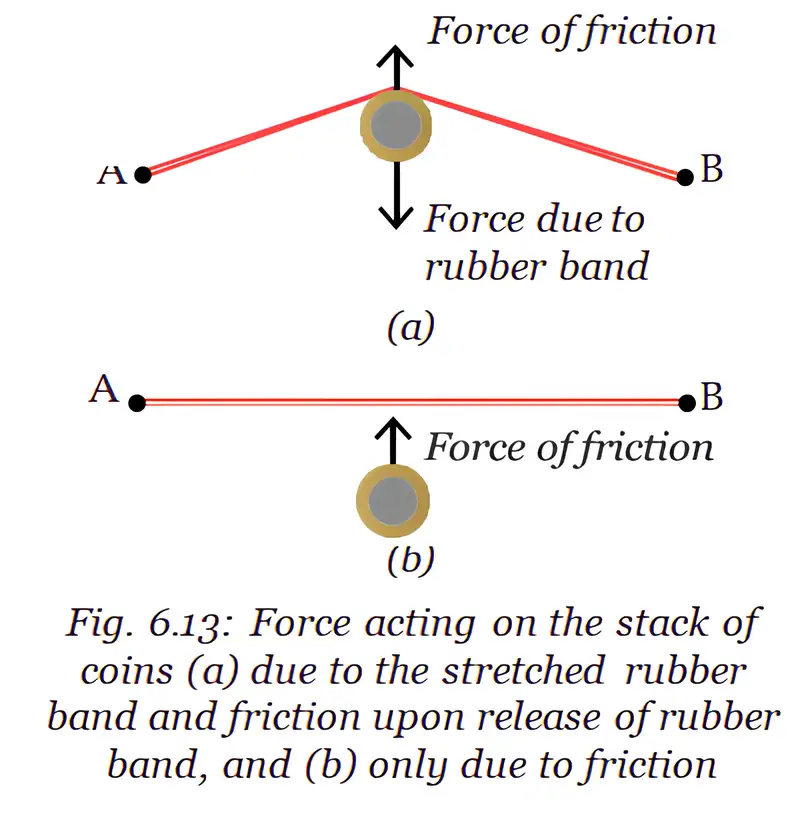
Forces on Released Coins
How the coins speed up and stop
- Before release: The coins are stationary, so the forces acting on them are balanced.
- While in contact: The stretched rubber band exerts a forward force greater than friction; the resulting net force accelerates the coins and changes their velocity from zero.
- After contact ends: The rubber band's force stops acting, but friction continues opposite the motion.
- Result: Friction gradually decreases the coins' velocity and eventually brings them to rest.
Estimating the Force of Friction
Spring balance reading
- Measurement idea: Pull a block horizontally and note the spring balance reading when the block just starts moving.
- Meaning: This reading approximately measures the friction opposing the pull at the start of motion.
- Comparing readings: A smaller reading indicates less friction; a larger reading indicates more friction.
- Link to distance: The surface with the lower reading generally lets the object travel farther before stopping.
If Friction Disappeared
- Thought experiment: If friction were zero and no other opposing force acted, an object set moving would not slow down due to friction.
- Result: It would continue moving indefinitely at constant velocity unless an unbalanced force changed its motion.
Galileo, Newton and Inertia
Development of the idea of motion
- 17th centuryGalileo Galilei argued through thought experiments that, without impediments, a body moving horizontally would continue indefinitely.
- 1687Isaac Newton presented his three laws of motion and used the idea of inertia to frame his first law.
Inertia — The tendency of an object to resist a change in its state of rest or uniform motion.
Force unit
- Unit: The SI unit of force is the newton, named after Isaac Newton.
- Writing: Its full name begins with a lowercase letter; its symbol is capitalized: .
Why does a moving object eventually stop when no one continues to push it?
How can a spring balance help compare friction on different surfaces?
What would happen to a moving object if friction and all other opposing forces were absent?
Quick recap
- Friction opposes attempted or actual motion between surfaces in contact.
- An object starts moving when its applied force exceeds friction; motion depends on net force.
- The net forward force from the rubber band accelerates the released coins; friction then slows them.
- Weight and normal force balance vertically on a level surface; air friction is often negligible.
- Less friction means slower decrease in velocity, a longer stopping distance and a lower spring balance reading.
- Without opposing forces, motion continues indefinitely; inertia is resistance to change in motion.
- Galileo argued for continued motion without impediments; Newton used inertia to frame his first law and presented three laws in 1687.
Newton’s First Law of Motion
Newton’s First Law
Newton’s first law of motion — An object stays at rest or continues moving with constant velocity unless a net force acts on it.
What the law means
- Net force is zero: The object’s velocity does not change, so its acceleration is zero.
- At rest: The object has zero velocity and remains at rest if the net force stays zero.
- In motion: The object continues in a straight line at the same speed if its velocity is non-zero and the net force stays zero.
- Constant velocity: Both the magnitude and direction of velocity remain unchanged.
Balanced Forces and Motion
Balanced forces on a moving box
- Example: A forward push on a moving box balances the backward friction force when the two forces are equal and opposite.
- Result: The net force is zero, so the box continues moving at constant velocity; it does not come to rest merely because friction is present.
- Important: Zero net force does not mean that no forces act; forces can balance one another.
When a force is needed
- To start motion: If friction is absent, an object at rest needs a net force to begin moving.
- To keep steady motion: Once moving, an object needs no further net force to maintain constant velocity.
- To change motion: A net force is needed to change speed, change direction, or stop a moving object.
Graphs When Net Force Is Zero
| Situation | Position–time graph | Velocity–time graph |
|---|---|---|
| Object at rest | Horizontal line: position stays unchanged. | Horizontal line at zero velocity. |
| Object moving at constant velocity | Straight line: position changes uniformly with time. | Horizontal line at the constant velocity. |
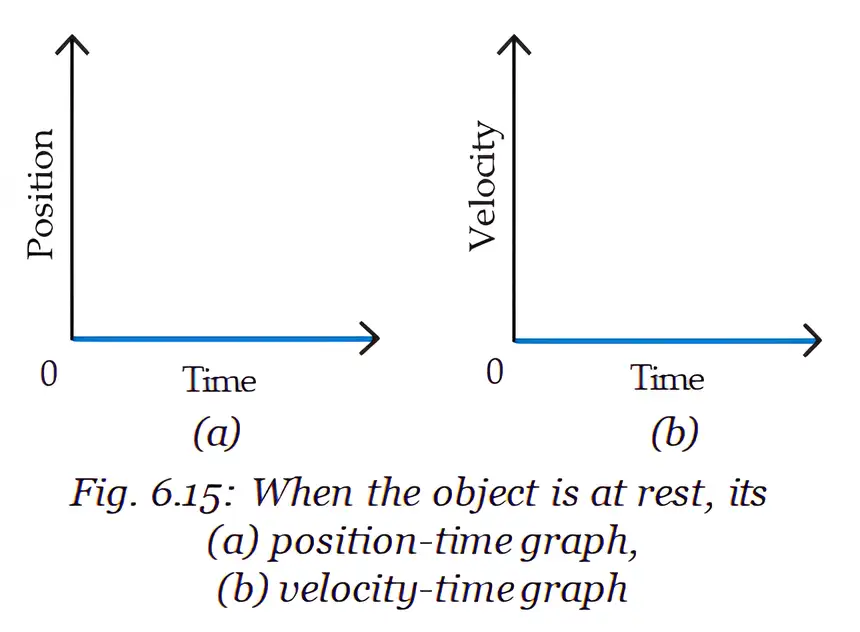
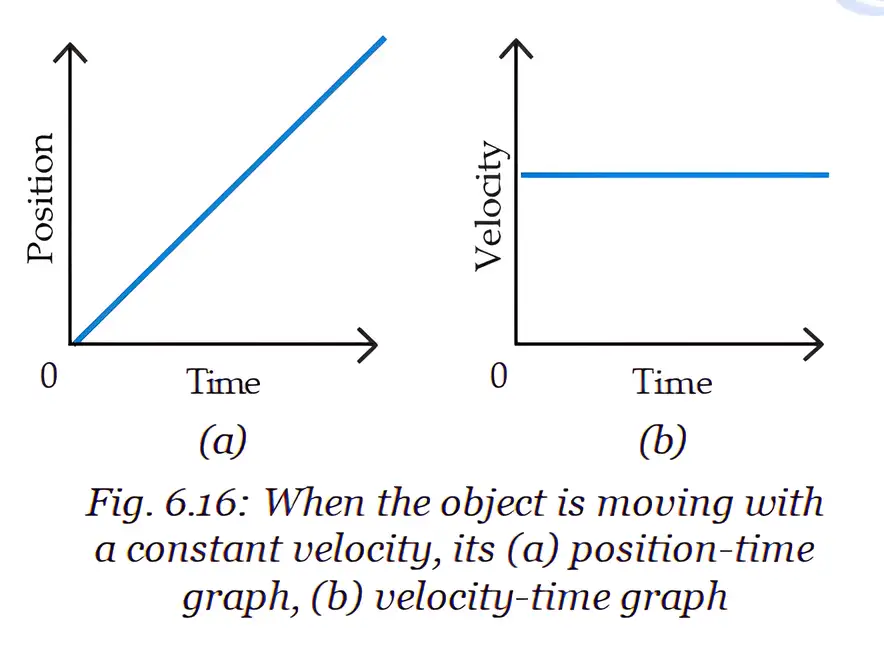
A moving object does not need a net force to keep moving at constant velocity. A net force is needed to change its velocity.
Does an object moving with constant velocity have a net force acting on it?
Can an object have constant acceleration if no net force acts on it?
Give an example of zero net force even though forces act on an object.
Link to the next law
- Next question: The first law describes motion when the net force is zero; Newton’s second law explains motion when a net force acts.
Quick recap
- Newton’s first law: without a net force, rest or constant velocity continues.
- Constant velocity has unchanged speed and direction; non-zero constant velocity is straight-line motion.
- Zero net force means zero acceleration, not necessarily that no forces act.
- Equal and opposite forces on a moving box can balance, allowing constant-velocity motion.
- A net force is needed to start motion from rest or to change or stop motion.
- With zero net force, a position–time graph is horizontal at rest or straight during constant motion; the velocity–time graph is horizontal.
Newton’s Second Law of Motion Part 1
Force and Acceleration
How force changes motion
- Force can set an object in motion, bring it to rest, or change its velocity.
- Acceleration occurs when velocity changes; a net force produces acceleration.
- Same object: a larger net force produces a larger acceleration.
Evidence for force–acceleration relationship
- Comparison: for the same cart and surface, increasing the pulling force increases the cart’s acceleration.
- From rest: for equal travel distance , the cart’s acceleration can be related to travel time by .
- Two force cases: and , so .
Effect of Mass
Mass and acceleration
- Same force: a lighter object accelerates more than a heavier object.
- Fixed force: increasing an object’s mass decreases its acceleration; acceleration is inversely proportional to mass.
- Evidence: with the pulling force kept constant, doubling the cart’s mass reduces its acceleration.
Newton’s Second Law of Motion
Newton’s second law of motion — The acceleration of an object is in the direction of the net force, is proportional to that force’s magnitude, and is inversely proportional to the object’s mass.
Use the net force acting on the object.
is net force, is mass, and is acceleration.
Direction
- Acceleration direction: the same as the direction of the net force.
SI Unit of Force
One newton — One newton is the force that gives a object an acceleration of .
The SI unit of force is the newton ().
Weight and Gravitational Acceleration
Gravitational force near Earth
- Acceleration due to gravity: denoted by , it is the acceleration of an object due to Earth’s gravitational force.
- Value: near Earth’s surface, and is nearly constant; for quick estimates, use .
- Mass independence: does not depend on the mass of the falling object.
- Weight: the gravitational force on an object of mass is .
- Everyday estimate: the weight of a mass is about .
Do not confuse mass with weight: mass is measured in kilograms, while weight is a gravitational force measured in newtons.
Why measurements may differ
- Experimental differences: measured acceleration may not exactly double when force doubles, or halve when mass doubles.
- Causes: measurement errors and friction between the cart’s wheels and the surface can affect the results.
Newton’s Second Law in Terms of Momentum
Momentum — Momentum is the product of an object’s mass and velocity; its direction is the same as the velocity’s direction.
denotes momentum, mass, and velocity.
Momentum form of the law
- Statement: the rate of change of momentum is proportional to the net force and occurs in the net force’s direction.
- Use: this form applies even when an object’s mass is not constant.
The net force is proportional to the rate of change of momentum.
Quick recap
- A net force produces acceleration in the direction of that force.
- For a fixed mass, acceleration increases with net force; for a fixed force, it decreases as mass increases.
- Newton’s second law is expressed as .
- One newton gives a mass an acceleration of .
- Weight is the gravitational force , with near Earth.
- Momentum is ; the momentum form of the law applies even when mass changes.
Newton’s Second Law of Motion Part 2
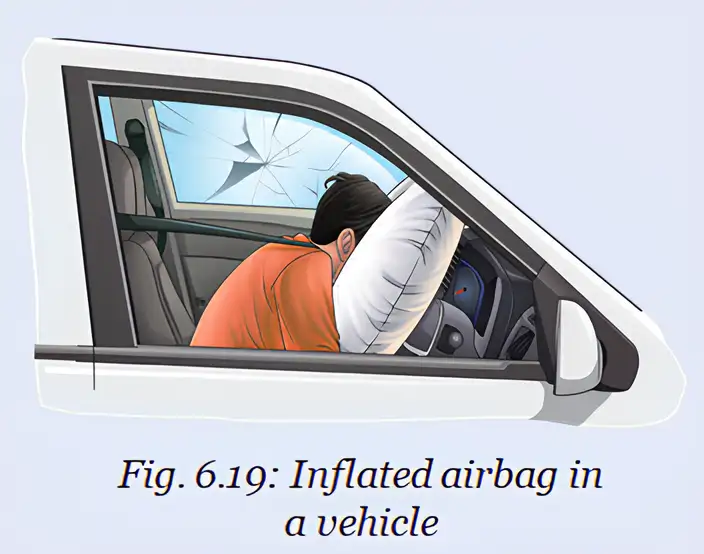
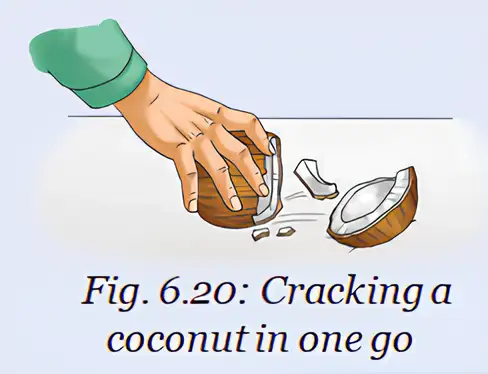
How stopping time affects force
Balanced forces and steady objects
Use this to calculate the gravitational force on an object.
Weightlifter example
- Calculation: For a barbell, downward.
- Answer: The weightlifter applies upward to keep it steady.
Net force, acceleration and displacement
Find acceleration from the net force and mass.
For motion with constant acceleration, starting with initial velocity .
Pushing a block against friction
- Applied force : It balances the friction force, so the block remains at rest and displacement in is zero.
- Applied force : Net force is ; for a block, .
- Displacement: Starting from rest, forward.
Force from a velocity–time graph
| Time interval | Motion | Acceleration | Net force |
|---|---|---|---|
| – | Velocity increases from to . | east | east |
| – | Constant velocity | ||
| – | Velocity decreases from to . | ; west |
A constant velocity does not mean the object is at rest; it means its acceleration and net force are zero.
A toy car of mass moves at a constant velocity of . What is its net force?
Two children of different masses sit on identical swings. Which child needs a larger force to get the same initial acceleration?
How do bubble wrap or hay protect glass items during transport?
Quick recap
- A longer stopping time means smaller acceleration and a smaller force.
- A shorter stopping time means larger force, as when a coconut hits a hard surface.
- Balanced forces give zero net force; a stationary object then remains at rest.
- Use to relate net force, mass and acceleration.
- Use for displacement under constant acceleration.
- The slope of a velocity–time graph gives acceleration; a negative sign indicates the opposite direction.
Newton’s Third Law of Motion
Action and Reaction Forces
How interacting objects affect each other
- Interaction: Forces arise through interactions between objects; each object exerts a force on the other.
- Direction and magnitude: The two forces act in opposite directions and have equal magnitudes. For example, a kicked ball exerts a force back on the foot.
- Example: When a person pushes a table from a wheeled chair, the table pushes the person and chair in the opposite direction.
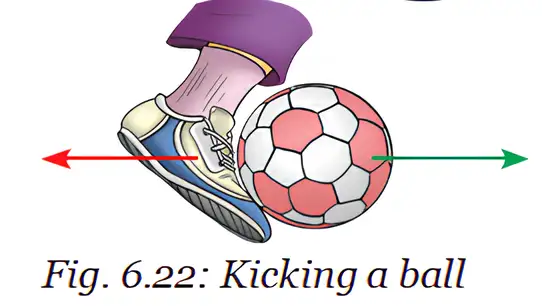
Newton’s third law of motion — Whenever one object exerts a force on a second object, the second object simultaneously exerts an equal and opposite force on the first.
The forces are equal in magnitude and opposite in direction; the subscripts identify the interacting objects.
- Different objects: The forces in a third-law pair act on different objects, so they do not cancel each other.
- Same object: Equal and opposite forces acting on the same object can balance and give zero net force.
Third Law in Everyday Motion
| Situation | Action | Reaction and result |
|---|---|---|
| Walking or running | Foot pushes the ground backward. | Ground’s forward friction on the foot helps move the person forward. |
| Climbing a tree | Climber’s legs push down against the trunk. | Friction from the trunk acts upward on the climber; smooth trunks provide less friction and are harder to climb. |
| Rowing a canoe | Paddle pushes water backward. | Water pushes the paddle forward, moving the canoe. A stronger push can increase its velocity. |
| Pushing a table from a wheeled chair | Person pushes the table. | The table pushes the person and chair in the opposite direction. |
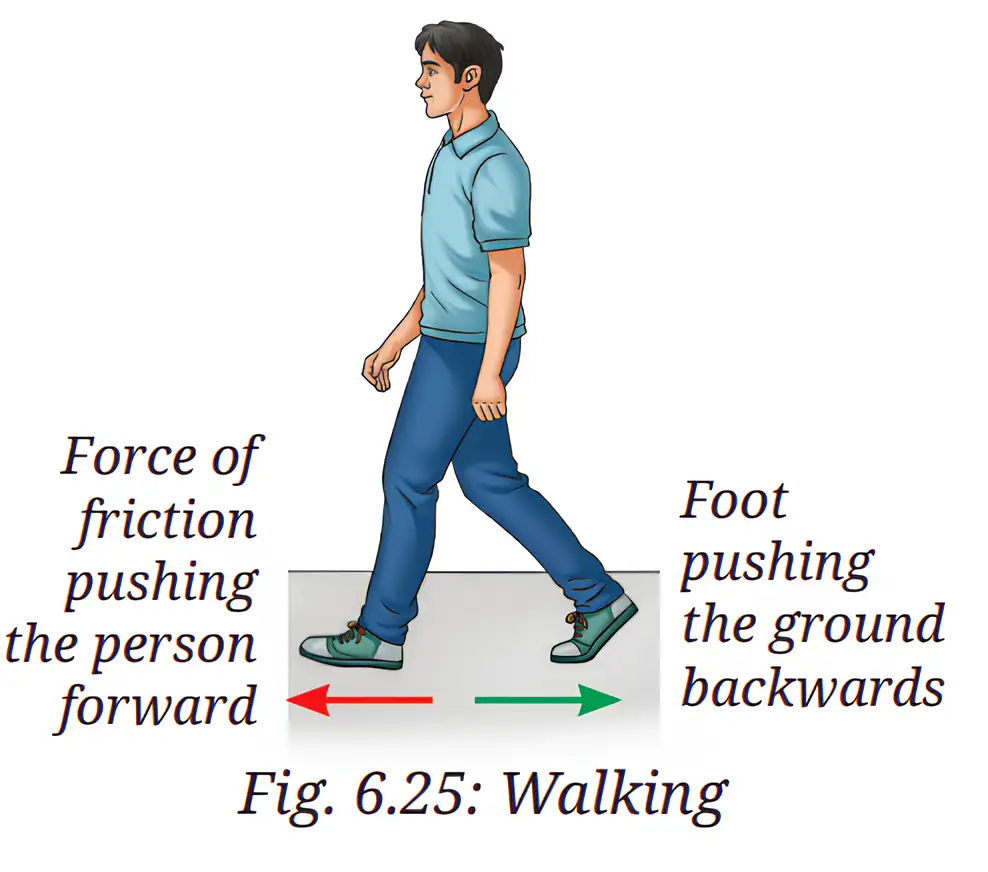
Friction helps movement
- Walking: The foot pushes the ground backward and tends to slide; forward friction from the ground helps propel the person.
- Footwear and tyres: Grooves in soles and treads on tyres increase friction with the ground or road.
- Low friction: Wet polished floors, ice, and roads covered with water or snow make walking or driving risky.
Comparing the Forces
Spring-balance evidence
- Observation: Two connected spring balances show the same reading when pulled, even when the pull’s magnitude changes.
- Conclusion: The forces exerted by the balances on each other are opposite in direction and equal in magnitude.
Balloon and Rocket Propulsion
Balloon motion
- The shrinking balloon pushes air out.
- The escaping air exerts an equal and opposite force on the balloon.
- The balloon moves opposite to the direction in which the air escapes.
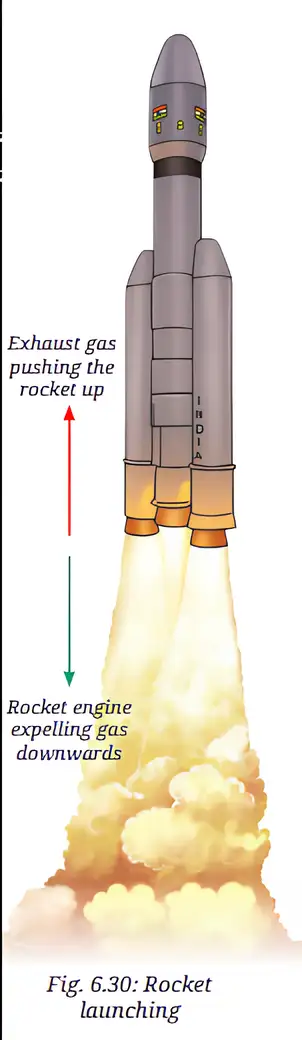
Rocket motion and braking
- The engine expels gas downward.
- The gas exerts an equal and opposite upward force on the rocket.
- The rocket lifts off when the upward force exceeds its weight, producing a net upward force.
- Firing exhaust opposite the rocket’s motion slows it. Chandrayaan-3’s Vikram lander used this to reduce speed for a soft lunar landing.
Third Law Applies to All Forces
| Force type | Interacting objects | Third-law pair |
|---|---|---|
| Contact | Foot and ground | Foot pushes ground backward; ground’s friction pushes the foot forward. |
| Magnetic (non-contact) | Two bar magnets | Each magnet exerts an equal and opposite magnetic force on the other. |
| Electrostatic (non-contact) | Two similarly charged balloons | Each balloon repels the other with an equal and opposite force. |
| Gravitational (non-contact) | Earth and a falling fruit | Earth and fruit pull on each other with equal and opposite forces. |
The same force produces different accelerations when the objects have different masses.
Why accelerations can differ
- Earth and fruit: Their gravitational forces on each other are equal and opposite, but Earth’s much larger mass gives it an extremely small, unnoticeable acceleration.
- Key point: Equal force magnitudes do not generally produce equal accelerations because the interacting objects may have different masses.
Why can a fireperson struggle to hold a hose issuing water?
How can a spacecraft change its velocity when gravity is negligible?
A bullet is fired from a gun with a force of . Find the initial acceleration magnitudes of the bullet and the gun.
Do not say action and reaction cancel: they act on different objects. Equal forces also do not necessarily produce equal accelerations, because the objects may have different masses.
Quick recap
- Newton’s third law: interacting objects exert simultaneous, equal and opposite forces on each other.
- Each force in an action–reaction pair acts on a different object, so the pair does not cancel.
- Friction from the ground helps a person walk forward; grooves and tyre treads improve grip.
- Walking, climbing, rowing, balloon motion, rocket propulsion, and hose recoil show action–reaction forces.
- Third-law pairs occur for contact, magnetic, electrostatic, and gravitational forces.
- Equal forces can produce different accelerations because acceleration depends on mass: .
Forces Acting on a System of Objects
Treating Connected Objects as a System
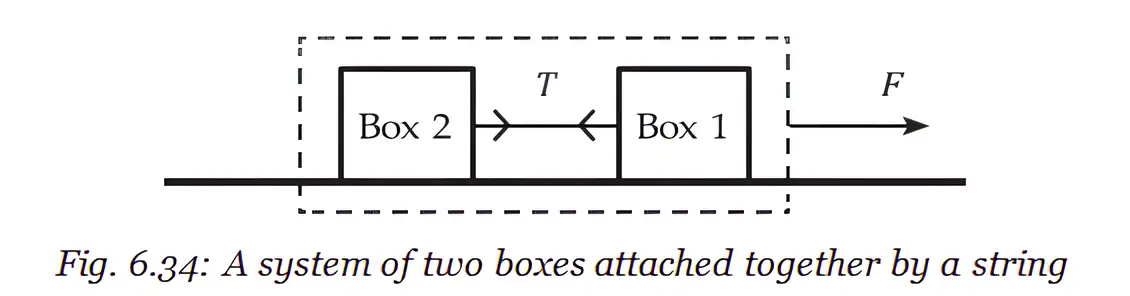
Two Connected Boxes
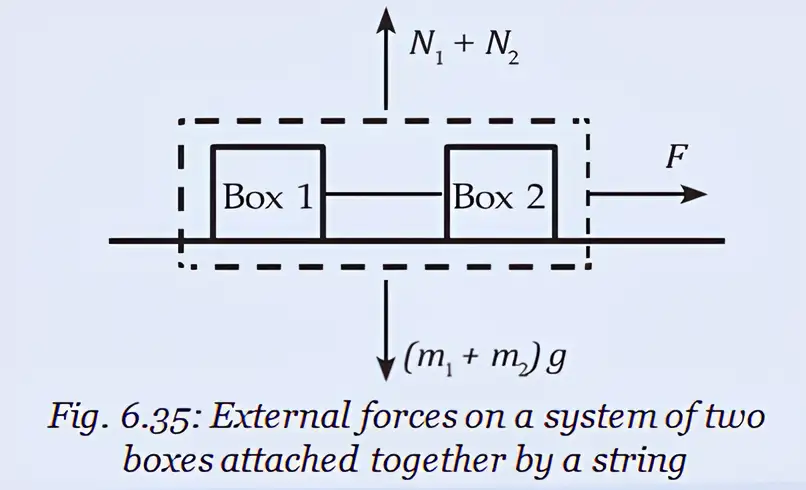
- Setup: Boxes of masses and are joined by a string on a frictionless horizontal surface.
- Applied force: A horizontal force pulls Box 1; the string’s tension pulls Box 1 backward and Box 2 forward.
- Newton’s third law: The boxes exert equal and opposite forces on each other through the string.
- System view: Tension is internal; the applied force is external. Only the net external force determines the system’s acceleration.
The two boxes accelerate like one object of total mass under the applied force.
Vertical External Forces
- Gravity: The system’s total weight is , acting downward.
- Normal force: The ground exerts a total normal force upward.
- Balance: These vertical forces balance, so they do not change the system’s horizontal acceleration.
For the system on the horizontal surface, the upward normal force balances its weight.
When calculating a system’s acceleration, include external forces only; internal forces such as tension do not affect the system’s net force.
Quick recap
- A system approach treats connected objects as one object with their combined mass.
- Internal forces, such as string tension, cancel in the whole-system analysis.
- External forces determine the acceleration of the system.
- For two boxes pulled horizontally, .
- The system’s weight and the ground’s normal force balance vertically.
At a Glance
Friction
Force of friction — A force that acts opposite to an object's direction of motion.
Newton’s Laws of Motion
Newton’s first law — An object at rest remains at rest, and an object in motion continues with constant velocity unless a net force acts on it.
Newton’s second law — A net force makes an object accelerate in the direction of that force; acceleration is proportional to net force and inversely proportional to mass.
Newton’s third law — When one object exerts a force on a second object, the second object simultaneously exerts an equal and opposite force on the first.
Quick recap
- Friction acts opposite to an object's direction of motion.
- The first law says an object's state of rest or constant velocity continues unless a net force acts.
- The second law links acceleration to net force and mass: acceleration increases with force and decreases with mass.
- The third law says interacting objects exert equal and opposite forces on each other simultaneously.
Science — ALL CHAPTERS
1
Exploration: Entering the World of Secondary Science
2
Cell: The Building Block of Life
3
Tissues in Action
4
Describing Motion Around Us
5
Exploring Mixtures and their Separation
6
How Forces Affect Motion
7
Work, Energy, and Simple Machines
8
Journey Inside the Atom
9
Atomic Foundations of Matter
10
Sound Waves: Characteristics and Applications
11
Reproduction: How Life Continues
12
Patterns in Life: Diversity and Classification
13
Earth as a System: Energy, Matter, and Life