SOLUTIONS
2022 BOARD EXAM
CBSE Class 12 Humanities Political Science Board Paper 2022 — Set 1 Solutions
2022
Political Science
Class 12 Humanities
CBSE EXAMINATION PAPER-2022
POLITICAL SCIENCE
(Solved)
General Instructions :
Read the following instructions carefully and follow them :
- This question paper contains 33 questions. All questions are compulsory.
- This question paper is divided into 5 sections.
- Section A – questions number 1 to 9 are case based questions
- Section B – questions number 10 to 18 are very short answer
- Section C – questions number 19 to 27 are short answer
- Section D – questions number 28 to 29 are long answer type i
- Section E – questions number 30 to 33 are long answer type ii
- There is no overall choice given in the question paper. However, an internal choice has been provided in few questions.
- Use of calculator is NOT allowed.
Section A
Question 1.
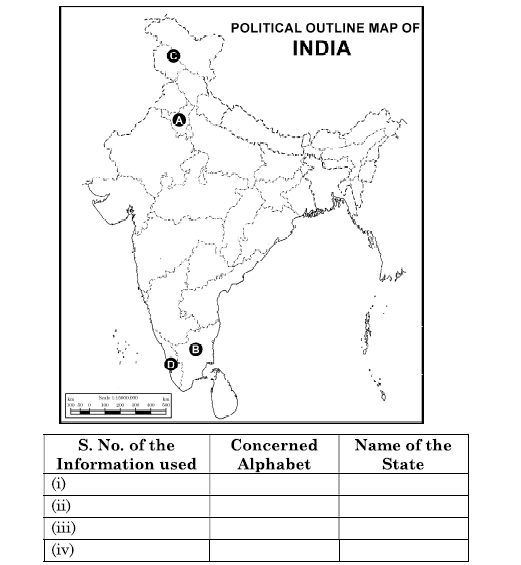
In the given political outline map of India, four states have been marked as (A), (B) , (C) and (D). Identify these states on the basis of the information given below and write their correct names in your Answer Book along with the respective serial number of the information used and the concerned alphabet as per format that follows
Question 2.
cf
Question 3.
In the given political outline map of India, four states have been marked as (A),(B) , (C) and (D). Identify these states on the basis of the information given below and write their correct names in your Answer
Book along with the respective serial number of the information used and the concerned alphabet as per format that follows :
Question 4.
In the given political outline map of India, four states have been marked as (A),(B) , (C) and (D). Identify these states on the basis of the information given below and write their correct names in your Answer
Book along with the respective serial number of the information used and the concerned alphabet as per format that follows
Question 5.
In the given political outline map of India, four states have been marked as(A), (B) , (C) and (D). Identify these states on the basis of the information given below and write their correct names in your Answer
Book along with the respective serial number of the information used and the concerned alphabet as per format that follows :
Question 6.
vfvbb
Question 7.
aa
Question 8.
In the given political outline map of India, four states have been marked
as @), , (© and (D). Identify these states on the basis of the
information given below and write their correct names in your Answer
Book along with the respective serial number of the information used and
the concerned alphabet as per format that follows
Question 9.
In the given political outline map of India, four states have been marked as (A),(B) ,(C) and (D). Identify these states on the basis of the information given below and write their correct names in your Answer
Book along with the respective serial number of the information used and the concerned alphabet as per format that follows :
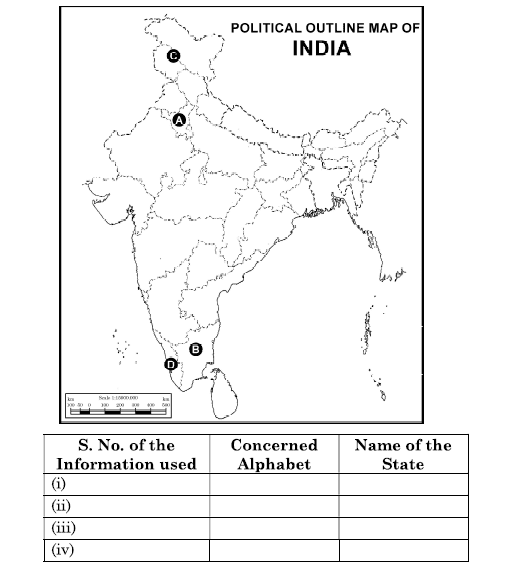
(1) The State which was not under the rule of the Congress Party in 1952.
[1 Mark]
Answer: Answer: State (C) is Kerala which was not under the rule of the Congress Party in 1952 as per the map showing Assembly Election Results 1967. Kerala is the red colored state representing rule by Democratic Left Front, not Congress. This information matches the context given about Kerala's political situation in the period.
Key Points: State (C) is Kerala - Kerala was not ruled by Congress in 1952 - Kerala colored red representing non-Congress rule
(2) The State where the Congress Party could not win majority in 1957.
Answer: According to the provided case, Kerala is the state where the Congress Party could not win majority in 1957. It was ruled by the Democratic Left Front from 1957 to 1959, which shows Congress lost the majority here. This is clearly indicated by the red color on the political map mentioned in the case.
Key Points: Kerala state - Congress did not win majority in 1957 - Democratic Left Front ruled Kerala from 1957-1959
(3) The State from where the phrase ‘Aaya Ram, Gaya Ram’ originated.
Answer: The phrase 'Aaya Ram, Gaya Ram' originated from the state of Haryana. Hence, the state marked as (A), (B), (C) or (D) corresponding to Haryana is the correct answer. This is supported by political history commonly known by students and mentioned in the case context regarding the identification of states on the map.
Key Points: Phrase 'Aaya Ram, Gaya Ram' originated from Haryana - Identification relates to state abbreviation on map - Haryana is known in Indian political history for this phrase
(4) The State from where K. Kamraj, a Veteran leader of the Congress Party, lost election in 1967.
Answer: Answer: The state from where K. Kamraj lost election in 1967 is Tamil Nadu (marked as C on the map). According to the case passage, in the political map showing Assembly Election Results 1967, Tamil Nadu was one of the states where Congress faced defeat. This highlights the political challenge to Congress in that year.
Key Points: K. Kamraj was a veteran Congress leader - He lost election in 1967 - The state is Tamil Nadu marked C on the map
Section B
Question 10.
Explain any two steps taken by the US that aided the integration of the European States after the Second World War.
[1 Mark]
Answer: After the Second World War, the US implemented the Marshall Plan, which provided substantial financial aid to rebuild war-torn European economies, fostering cooperation among European states. Additionally, the establishment of NATO created a collective security framework that united Western European nations and promoted political and military collaboration, further facilitating European integration and stability during the Cold War period.
Key Points: Marshall Plan-financial aid for economic recovery-NATO-collective security framework-political and military collaboration
Question 11.
Explain the ‘Vision 2020’ of the regional organization ‘ASEAN’.
[1 Mark]
Answer: ASEAN's 'Vision 2020' aims to establish a responsible and outward-looking region that plays a proactive role in the international community. It emphasizes the importance of resolving regional conflicts through negotiation, contributing to peace and stability. The vision builds on ASEAN's commitment to promote economic growth alongside social progress and cultural development, ensuring that member states respect sovereignty and national differences, while maintaining non-interference in domestic affairs.
Key Points: Outward-looking role; Resolving conflicts through negotiation; Economic growth; Social progress; Cultural development; Regional peace and stability; Non-interference; Respect for sovereignty
Question 12.
Show with the help of any two examples the interference of military in the administration of Pakistan.
[1 Mark]
Answer: The military has frequently interfered in Pakistan's politics, notably during General Zia-ul-Haq's rule from 1978 to 1988, where he imposed martial law and dismissed elected governments. Another significant example is the 1999 coup led by General Pervez Musharraf, who overthrew the elected government of Nawaz Sharif. This military intervention significantly undermined democratic institutions in Pakistan and led to a prolonged period of military dominance over civilian affairs.
Key Points: Military coups in 1978 and 1999 - General Zia-ul-Haq and General Pervez Musharraf - Dismissal of elected governments - Martial law implications - Impact on democracy in Pakistan
Question 13.
Highlight any two reasons for the ethnic conflict in Sri Lanka.
[1 Mark]
Answer: Two significant reasons for the ethnic conflict in Sri Lanka include the dominance of the Sinhala community in political representation, which marginalized the Tamil population, leading to feelings of disenfranchisement. Additionally, the growing militant nationalism among Tamils, fueled by the demand for a separate Tamil Eelam, arose in response to the perceived hostility and neglect of Tamil rights by the Sinhala-led government, further intensifying the conflict.
Key Points: Sinhala dominance in politics, Marginalization of Tamils, Tamils' demand for separate state, Emergence of LTTE
Question 14.
Name any four countries that are included in ‘South Asia’.
[1 Mark]
Answer: South Asia includes seven countries, of which four are: India, Pakistan, Bangladesh, and Sri Lanka. These nations share diverse cultures, languages, and histories, yet they collectively form a significant geopolitical space in the region. The diversity among these countries contributes to a rich tapestry of traditions and interactions, making South Asia a unique area on the global map.
Key Points: India-Pakistan-Bangladesh-Sri Lanka
Question 15.
Analyse any two causes of ‘Globalisation’.
[1 Mark]
Answer: Two primary causes of globalisation are advances in technology and liberalization of trade policies. Technological advancements, especially in communication and transportation, have allowed for rapid exchange of information and goods across borders. Meanwhile, trade liberalization, characterized by reduced tariffs and trade barriers, has encouraged countries to engage in international commerce. These factors foster interconnected economies and cultures, significantly shaping the global landscape.
Key Points: Advances in technology-Improved communication and transportation-Liberalization of trade policies-Reduced tariffs and trade barriers
Question 16.
Analyse any two reasons for the split of the Congress Party in 1969.
[1 Mark]
Answer: The split of the Congress Party in 1969 occurred primarily due to ideological differences and the electoral setbacks experienced in the late 1960s. The faction led by Indira Gandhi, known as the Congress (Requisitionists), advocated for socialist policies, emphasizing a welfare agenda. In contrast, the 'syndicate' faction, referred to as Congress (Organisation), focused on traditional methods of leadership and governance. This ideological rift culminated in the party's division, highlighting the changing political landscape of India.
Key Points: Ideological differences between Indira Gandhi and the syndicate; Electoral setbacks of Congress in late 1960s; Emergence of new political narratives in Indian politics
Question 17.
Analyse the concept of ‘Total Revolution’ as visualized by Jai Prakash Narayan in 1975.
[1 Mark]
Answer: Jai Prakash Narayan's concept of 'Total Revolution' in 1975 called for a comprehensive transformation of society. He identified seven key revolutions needed for true change, starting with the struggle against social and economic inequalities. Narayan emphasized civil liberties and non-violence, inspired by Gandhi's principles. The movement sought to unite diverse segments of society against corruption and injustice, ultimately advocating for a grassroots political renewal. His approach was not just political but aimed at moral and societal reformation.
Key Points: Total Revolution aimed for social and economic change - Seven key revolutions: equality, civil liberties, non-violence - Inspired by Gandhi - Focused on grassroots involvement - Response to corruption and injustice
Question 18.
Why did the first coalition government at the Centre in India not prove to be stable? Analyse the major reason.
[1 Mark]
Answer: The first coalition government in India faced instability primarily due to fragmented political alliances and a lack of a clear majority. Formed in 1989, the National Front government was dependent on the support of various parties, including the Left and the BJP, which had divergent interests. The absence of a unified agenda led to conflicts and eventually loss of majority support. This situation was reflective of the larger trend of transient coalitions in Indian politics.
Key Points: Fragmented political alliances-loss of majority support-lack of a unified agenda
Section C
Question 19.
Explain any two steps taken by the US that aided the integration of the European States after the Second World War.
[2 Marks]
Answer: After World War II, the United States played a significant role in the integration of European states through the Marshall Plan and the establishment of NATO. The Marshall Plan, launched in 1948, provided substantial financial aid to rebuild European economies, helping to restore stability and prevent the spread of communism. In addition, the formation of NATO in 1949 created a collective security framework that fostered political and military collaboration among Western European countries, strengthening their ties and facilitating cooperation for mutual defense and economic growth.
Key Points: Marshall Plan provided financial aid; Revitalized European economies; NATO established collective security; Fostered political and military collaboration
Question 20.
Explain the ‘Vision 2020’ of the regional organization ‘ASEAN’.
[2 Marks]
Answer: ASEAN's 'Vision 2020' outlines its ambition to strengthen its role as a regional organization while promoting economic growth, social progress, and cultural development among member nations. Established in 1967, ASEAN has evolved to include ten countries and emphasizes peaceful conflict resolution and cooperation based on mutual respect for sovereignty. The vision encourages active engagement in international issues and strategic partnerships beyond economic cooperation, thereby enhancing regional stability and fostering a more integrated Southeast Asia. By promoting dialogue and preventing conflicts, ASEAN aims to create a harmonious and prosperous community by 2020.
Key Points: ASEAN's establishment in 1967; Vision 2020 focuses on economic growth and cultural development; Member nations respect sovereignty; Peaceful conflict resolution; Role in regional stability; Enhancing international engagement.
Question 21.
Show with the help of any two examples the interference of military in the administration of Pakistan.
[2 Marks]
Answer: In Pakistan, military interference in politics has been significant throughout its history. One notable example is the overthrow of Prime Minister Nawaz Sharif's government in 1999 by General Pervez Musharraf, who seized power during a critical period of conflict with India. This coup illustrated the military's justification of its role in governance as necessary for national security. Another instance is the imposition of martial law in 1977 by General Zia-ul-Haq, which led to the suspension of the constitution and political parties, further entrenching military authority in the state. Both examples highlight how the military has positioned itself as a stabilizing force, often at the expense of democratic processes.
Key Points: Example of Nawaz Sharif's overthrow in 1999 by General Musharraf; Military's claim of ensuring national security; Imposition of martial law by General Zia-ul-Haq in 1977; Suspension of constitution and political parties; Military's entrenchment of authority.
Question 22.
Highlight any two reasons for the ethnic conflict in Sri Lanka.
[2 Marks]
Answer: Two significant reasons for the ethnic conflict in Sri Lanka are the dominance of the Sinhala majority in political representation and the historical grievances of the Tamil minority. Following independence in 1948, political power was predominantly held by Sinhala politicians who disregarded Tamil concerns and demands. This neglect fueled feelings of alienation among Tamils, leading to the rise of militant groups like the LTTE, which sought independence for Tamils. Additionally, Sinhala nationalists believed that Sri Lanka should not provide concessions to Tamils, further exacerbating tensions and conflict.
Key Points: Dominance of Sinhala majority in politics; Neglect of Tamil concerns; Rise of militant Tamil groups like LTTE; Sinhala nationalists' opposition to concessions for Tamils.
Question 23.
Name any four countries that are included in ‘South Asia’.
[2 Marks]
Answer: South Asia is a region that encompasses seven countries, reflecting a rich tapestry of cultures, languages, and traditions. Among these countries, four prominent nations are India, Bangladesh, Pakistan, and Nepal. India, the largest country in the region, is known for its vast diversity, ranging from languages to cultures. Bangladesh, gaining independence in 1971, has a unique cultural heritage influenced by Bengali traditions. Pakistan, created alongside India in 1947, has a distinct identity rooted in Islamic history. Lastly, Nepal, a landlocked nation renowned for its mountainous terrain, offers a unique blend of Hindu and Buddhist influences. Together, these countries significantly contribute to the geopolitical landscape of South Asia.
Key Points: Includes India, Bangladesh, Pakistan, Nepal; Represents diversity; India is largest; Bangladesh's heritage; Pakistan's Islamic roots; Nepal's culture; Geopolitical significance
Question 24.
Analyse any two causes of ‘Globalisation’.
[2 Marks]
Answer: Globalisation is driven by various factors, among which two key causes stand out: technological advancement and economic liberalisation. Firstly, technological advancement, particularly in communication and transportation, has significantly reduced barriers to global interaction. Innovations like the internet and affordable air travel have made it easier for people, goods, and ideas to cross borders, fostering interconnectedness. Secondly, economic liberalisation refers to the policies adopted by governments to open their economies to international trade and investment. This includes reducing tariffs and restrictions, allowing businesses to operate globally. Together, these causes not only facilitate the flow of capital and goods but also lead to cultural exchanges, making globalisation an intricate and multifaceted phenomenon.
Key Points: Technological advancement - Communication and transportation improvements; Economic liberalisation - Opening economies to trade; Interconnectedness - Global interactions facilitated.
Question 25.
Analyse any two reasons for the split of the Congress Party in 1969.
[2 Marks]
Answer: The split of the Congress Party in 1969 was primarily influenced by ideological differences and the need for political strategy. Firstly, Indira Gandhi's faction aimed to adopt a more socialist approach, distancing itself from the conservative policies of the 'syndicate' faction. This ideological divide manifested in disagreements over economic policies. Secondly, the growing discontent among various Congress factions and the emergence of regional parties during the late 1960s diminished the Congress's hegemony. As sections of the party began to leave for alternative political platforms, the pressure for a unified leadership became critical, leading to the eventual split.
Key Points: Ideological differences between Indira Gandhi and the syndicate; Indira's socialist policies vs. conservative approach; Growing discontent among party factions; Emergence of regional parties; Diminished Congress dominance; Challenges in unifying leadership.
Question 26.
Analyse the concept of ‘Total Revolution’ as visualized by Jai Prakash Narayan in 1975.
[2 Marks]
Answer: In 1975, Jai Prakash Narayan championed the idea of ‘Total Revolution’ to address the pressing socio-economic and political injustices in India. He emphasized that true revolution must encompass not just political reform but also social, economic, and moral transformations. JP called for the ‘Seven Revolutions’ to combat inequalities in wealth, race, education, governance, and health, alongside advocating for civil liberties and non-violence. His vision inspired a wide demographic to join the movement, emphasizing a united struggle against corruption and oppression. This inclusive approach not only revitalized the political landscape in Bihar but also aimed for a revolution that transcended state boundaries, fostering a collective sense of purpose among citizens seeking justice and change. Through this ideal of ‘Sampoorna Kranti’, or Total Revolution, JP sought to instill a sense of ownership and urgency among individuals to engage actively in transforming their society.
Key Points: Total Revolution; socio-economic reforms; Seven Revolutions; call for civil liberties; non-violence; broad-based movement; addressing corruption; future empowerment of citizens
Question 27.
Why did the first coalition government at the Centre in India not prove to be stable? Analyse the major reason.
[2 Marks]
Answer: The first coalition government at the Centre in India, formed in 1989, was marked by inherent instability primarily due to the lack of a cohesive ideological foundation among the coalition partners. The National Front government was supported by both the Left and the BJP, united only by their common interest in excluding the Congress party from power. However, this fragile alliance lacked a shared agenda, leading to frequent disagreements on policy matters. Moreover, as coalition partners were primarily focused on preserving their own political interests rather than collective governance, the government struggled to maintain a majority. This scenario paved the way for a rapid loss of support, resulting in its inability to carry out long-term initiatives and ultimately leading to its fall. Thus, factional strife and the absence of a unifying vision were significant contributors to the instability of the first coalition government.
Key Points: Lack of cohesive ideological foundation - Focus on excluding Congress - Fragile alliance with frequent disagreements - Absence of shared agenda - Prioritization of individual political interests - Difficulty in maintaining majority - Struggles to implement long-term initiatives
Section D
Question 28.
Explain any two economic consequences of Globalisation.
[4 Marks]
Answer: Globalisation has significantly transformed economies around the world, leading to both positive and negative consequences. Firstly, one major economic consequence is the increase in trade and investment. Countries are more interconnected than ever, allowing for the free flow of goods, services, and capital across borders. This has led to the expansion of markets and economic growth for many nations, especially emerging economies that benefit from foreign direct investment and access to global markets. Secondly, globalisation has resulted in job displacement in certain sectors. As companies strive for efficiency, they may outsource jobs to nations where labor is cheaper. This can lead to unemployment or underemployment in more developed countries, as industries move overseas for lower production costs. While globalisation creates opportunities for growth and access to various products and services, it also challenges local economies and labor forces, indicating the complexity of global interconnectedness in today’s economic landscape.
Key Points: 1. Increase in trade and investment leading to market expansion and economic growth. 2. Job displacement due to outsourcing and competitive pressures resulting in unemployment in developed countries.
Question 29.
Describe any four excesses made by the Union Government during the period of emergency imposed in 1975.
[4 Marks]
Answer: During the Emergency imposed in 1975, the Union Government committed several excesses that significantly undermined democratic values and individual freedoms. Firstly, political dissent was brutally suppressed; opposition leaders, including those from the Congress Party, were arrested without due process, leading to widespread fear. Secondly, censorship of the press was imposed, restricting any critical coverage of the government and violating the freedom of speech, essential for a healthy democracy. Thirdly, there was significant abuse of power by the government as laws were enacted that curtailed civil liberties, allowing for arbitrary detention under the Maintenance of Internal Security Act (MISA). Lastly, the government initiated forced sterilization programs aimed at population control, which were executed without consent and often met with public resistance. These excesses not only showcased an authoritarian approach but also left a profound impact on Indian politics and the public's trust in the democratic framework.
Key Points: Suppression of political dissent; Censorship of the press; Abuse of power with MISA; Forced sterilization programs
Section E
Question 30.
Explain any four steps taken by China to develop its economy.
[6 Marks]
Answer: China's economic development involved several critical steps that transformed it into a global economic powerhouse. Firstly, the privatization of agriculture in 1982 marked a significant shift, allowing farmers greater control over their production, leading to remarkable increases in yields and rural incomes. Secondly, the introduction of the 'Open Door' policy in 1978 welcomed foreign investment, fostering international trade and capital influx. Thirdly, Special Economic Zones (SEZs) were established, where trade barriers were eliminated, encouraging foreign enterprises to set up and driving regional economic growth. Lastly, the focus on education and health improved the workforce's quality, ensuring that citizens were not only productive but also healthier, which further supported economic expansion. These steps collectively shifted China from a planned economy towards a market-oriented system, encouraging technological advancements and higher productivity.
Key Points: Privatization of agriculture in 1982, 'Open Door' policy in 1978, establishment of Special Economic Zones (SEZs), focus on education and health.
Question 31.
Explain any four factors that make the European Union a strong organization.
[6 Marks]
Answer: The European Union (EU) has evolved into a formidable organization due to several key factors. Firstly, its economic strength is noteworthy; with a projected GDP of approximately $19.35 trillion in 2024, it is a major player in the global economy. The euro, as a common currency, enhances trade within the member states and poses a challenge to the dollar's dominance. Secondly, the EU has a robust political framework, providing a unified approach to governance and law-making among its members. Thirdly, the EU's foreign policy carries weight, as it navigates diplomatic relations effectively, exemplified by France's permanent position on the UN Security Council, which bolsters its influence. Lastly, the EU's commitment to collective security and military coordination among member states strengthens its global stance, allowing it to act collectively in international matters. This multifaceted power structure enables the EU to assert itself on the world stage, balancing economic interests with political and security needs.
Key Points: Economic strength with a large GDP-common currency (euro) enhances trade-political framework and unified governance-strong foreign policy with diplomatic influence-collective security and military coordination.
Question 32.
Highlight any three areas where consensus has emerged among most of the political parties in India after 1989.
[6 Marks]
Answer: After 1989, several areas of consensus have emerged among major political parties in India, reflecting a shift in political dynamics. Firstly, there is a broad agreement on new economic policies aimed at liberalization and globalization. Even traditionally left-leaning parties have acknowledged the necessity for economic reforms to enhance growth. Secondly, there is a consensus on the need for social justice, promoting affirmative actions for marginalized communities. Most parties now endorse policies that seek to empower Scheduled Castes, Scheduled Tribes, and women. Thirdly, a mutual agreement has developed around federalism and the need to uphold the rights of states in a centralized political framework, recognizing the importance of a balanced distribution of power. This emerging consensus reflects the evolving political culture and aspirations of Indian society in the modern context.
Key Points: Agreement on new economic policies; Consensus on social justice and affirmative action; Mutual recognition of federalism and state rights
Question 33.
Highlight any two major changes that took place in Indian politics after 2014 and also name any two welfare programmes that made women the real beneficiaries.
[6 Marks]
Answer: After 2014, Indian politics witnessed significant transformations, notably the rise of the Bharatiya Janata Party (BJP) as a dominant force, achieving a historic majority in both the 2014 and 2019 Lok Sabha elections. This established a shift towards a more competitive political landscape, characterized by an implicit focus on development and welfare policies. Furthermore, the Modi government's emphasis on social welfare initiatives led to programs that particularly benefitted women, such as 'Beti Bachao Beti Padhao' aimed at improving female literacy and saving the girl child, and 'Pradhan Mantri Awas Yojana' which included provisions for women in housing schemes, ensuring financial empowerment and security. These changes not only stabilized the party structure but also reinforced the economic position of women in society.
Key Points: BJP's rise to dominance; 2014 and 2019 Lok Sabha victories; shift towards competitive politics; emphasis on social welfare policies; 'Beti Bachao Beti Padhao' program; 'Pradhan Mantri Awas Yojana' benefits for women.
Paper Details
CBSE Board Exam 2022
Class
Class 12 Humanities
Subject
Political Science
Year
2022
Set
Set 1
Other Years — Political Science