QUESTION PAPER
2023 BOARD EXAM
CBSE Class 12 Humanities Political Science Board Paper 2023 — Set 3
2023
Political Science
Class 12 Humanities
CBSE EXAMINATION PAPER-2023
POLITICAL SCIENCE
(Solved)
General Instructions :
Read the following instructions carefully and follow them :
- This question paper contains 39 questions. All questions are compulsory.
- This question paper is divided into 6 sections.
- Section A – questions number 1 to 3 are case based questions
- Section B – questions number 4 to 8 are very short answer
- Section C – questions number 9 to 20 are multiple choice questions
- Section D – questions number 21 to 26 are short answer
- Section E – questions number 27 to 31 are long answer type i
- Section F – questions number 32 to 39 are long answer type ii
- There is no overall choice given in the question paper. However, an internal choice has been provided in few questions.
- Use of calculator is NOT allowed.
Section A
Read the following passage carefully and answer the questions that follow:
The first Prime Minister of India played a crucial role in setting the national agenda. He was foreign minister also and exercised profound influence in the formulation and implementation of India's foreign policy. The three major objectives of his foreign policy were to preserve the hard-earned sovereignty, protect territorial integrity and promote rapid economic development. He wished to achieve these objectives through the strategy of non-alignment. There were parties and groups in the country that believed that India should be more friendly with the bloc led by the US because that bloc claimed to be pro-democracy.
(1) Who was the main architect of India's foreign policy? (a) B.R. Ambedkar (b) Mahatma Gandhi (c) Jawaharlal Nehru (d) Sardar Patel
(2) Which one of the following is an objective of India's foreign policy? (a) To pursue its national interest (b) To preserve democracy (c) To strengthen its Armed forces (d) To become a superpower
(3) Non-alignment means__________. (a) to remain neutral (b) non-interference (c) to remain isolated (d) not joining any power bloc
(4) Who believed that India should be more friendly with the bloc led by the US? (a) Bharatiya Jana Sangh (c) B.R. Ambedkar (b) Swatantra Party (d) All of the above
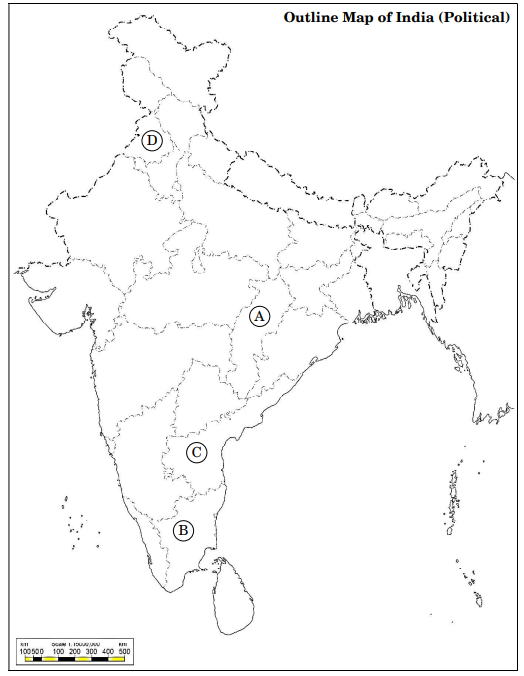
(1) The State which was partitioned in 1947.
[1 Mark](2) The State formed on the basis of imbalanced development.
[1 Mark](3) The State which was called 'Madras' at the time of Independence.
(4) The first State created in 1952.
[1 Mark](5) What is the present name of former 'Madras' State?
(6) Which two States were created by dividing Bombay ?
(7) Name the State which was carved out of Madhya Pradesh.
(8) Uttarakhand was carved out of which State ?
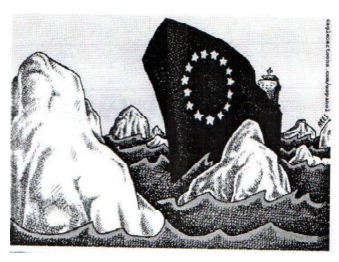
(1) The above cartoon is about which one of the following? (a) Global warming (b) Failure to make a trade agreement (c) Failure to draft a common constitution (d) Failure to protect the environment
(2) The above cartoon is related to which organisation? (a) ASEAN (b) European Union (c) SAARC (d) BRICS
(3) What does the circle of stars shown in the cartoon represent? (a) Member-states of the organisation (b) Unity of the organisation (c) Success of the organisation (d) Composition of the organisation
(4) In which year was the organisation related to the cartoon established? (a) 1967 (b) 1985 (c) 1992 (d) 2006
(5) Which two countries have resisted to adopt Maastricht Treaty ? (a) Bulgaria, Romania (b) Britain, France (c) Denmark, Sweden (d) Poland, Finland
(6) China adopted the 'open door' policy to improve its economy in which year? (a) 1975 (b) 1977 (c) 1978 (d) 1979
(7) Which set of five countries were the founders of ASEAN? (a) Indonesia, Malaysia, Philippines, Singapore and Thailand (b) Indonesia, Malaysia, Philippines, Thailand and Brunei (c) Indonesia, Philippines, Singapore, Thailand and Brunei (d) Indonesia, Malaysia, Philippines, Vietnam and Thailand
(8) Which organisation was established under the Marshall Plan ? (a) Council of Europe (b) Organisation for European Economic Cooperation (c) European Community (d) European Economic Community
Section B
Section C
In which pair of states did the Congress Party manage to win the General Election of 1977 after Emergency?
Arrange the following in chronological order:
(i) Establishment of SAARC
(ii) Establishment of European Union
(iii) Establishment of ASEAN
(iv) Privatization of agriculture in China. Choose the correct option:
Assertion (A) : South Asia stands for diversity in every sense, even then the various countries in South Asia have the same kind of political system.
Reason (R) : Despite many problems and limitations, all South Asian countries share the aspiration for democracy.
Assertion (A) : India pleaded with the superpowers for comprehensive nuclear disarmament, yet India opposed the indefinite extension of the NPT and also refused to sign the CTBT.
Reason (R) : These treaties were selectively applicable to the non-nuclear powers and legitimised the monopoly of the five nuclear weapon powers.
Identify the country which shares its borders with most of the South Asian countries.
Which among the following political parties was not a part of the Jayaprakash Narayan (JP) led peoples' march to Parliament in 1975?
In July 1985, "Punjab Accord" was signed between_________ to bring normalcy in punjab.
Choose the incorrect statements about India's relationship with China.
(i) Indian and Chinese leaders visited each other's countries and were greeted by large and friendly crowds.
(ii) A boundary dispute had surfaced between India and China in 1949.
(iii) China claimed two areas within the Indian territory.
(iv) After a very long correspondence and discussion among top leaders, these differences were resolved.
Which of the following are the common features for both, the Planning Commission and NITI Aayog ?
(i) Both are non-constitutional bodies.
(ii) Both have significant roles of states.
(iii) Both have the Prime Minister as chairperson.
(iv) Both have the power to allocate funds.
Section D
Why was the period of India's first nuclear test a difficult period in its domestic politics? Explain.
Section E
Section F
How is 'one party dominance' in india different from the 'one party dominance system' of other countries ? Analyse with the help of examples.
Paper Details
CBSE Board Exam 2023
Class
Class 12 Humanities
Subject
Political Science
Year
2023
Set
Set 3
Other Years — Political Science