QUESTION PAPER
2023 BOARD EXAM
CBSE Class 12 Humanities Political Science Board Paper 2023 — Set 4
2023
Political Science
Class 12 Humanities
CBSE EXAMINATION PAPER-2023
POLITICAL SCIENCE
(Solved)
General Instructions :
Read the following instructions carefully and follow them :
- This question paper contains 41 questions. All questions are compulsory.
- This question paper is divided into 6 sections.
- Section A – questions number 1 to 3 are case based questions
- Section B – questions number 4 to 15 are multiple choice questions
- Section C – questions number 16 to 22 are very short answer
- Section D – questions number 23 to 28 are short answer
- Section E – questions number 29 to 33 are long answer type i
- Section F – questions number 34 to 41 are long answer type ii
- There is no overall choice given in the question paper. However, an internal choice has been provided in few questions.
- Use of calculator is NOT allowed.
Section A
Read the passage given below and answer the questions that follow:
The leaders of the Indian national struggle did not believe in the two-nation theory. And yet, the partition on religious basis had taken place. The Muslim League was formed to protect the interests of the Muslims in colonial India. It was in the forefront of the demand for a separate Muslim nation.
(1) At the time of partition, which one of the following States was divided on the basis of religious majority? (a) Uttar Pradesh (b) Gujarat (c) Bengal (d) Jammu and Kashmir
(2) Which one of the following Princely States was the first to announce to remain independent and not to join the Union of India? (a) Hyderabad (b) Manipur (c) Junagarh (d) Travancore
(3) What was the stand of the Interim Indian Government on partition? (a) It was against partition. (b) It wanted peace, harmony and equality of religion. (c) It wanted India to become a Hindu nation. (d) It was in favour of treating people on religious basis.
(4) Why was the Muslim League formed? (a) To propose 'two-nation theory' (b) To form a new nation named Pakistan (c). To prepare the constitution of Pakistan (d) To protect the interests of the Muslims in colonial India
In the given political outline map of India (on page 17), four States have been marked as A, B, C and D. Identify these States on the basis of information given below and write their correct names in your answer-book along with the respective serial number of the information used and the concerned alphabets given in the map as per the following format:
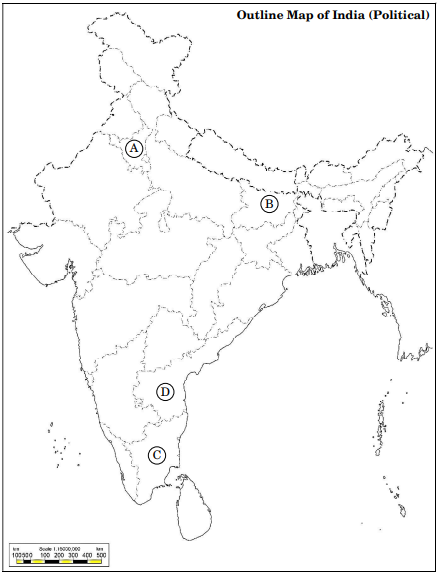
(1) The State related to V.V. Giri, the former President of India.
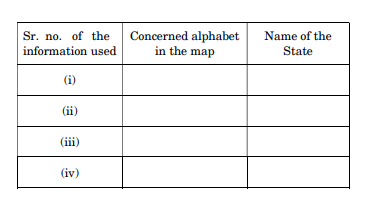 [1 Mark]
(2) The State related to the Congress leader, K. Kamaraj.
(3) The State from where the phrase, "Aya Ram, Gaya Ram" originated.
(4) The State which faced the most acute food crisis in 1965 1967.
(5) Name the State related to the former President of India, V.V. Giri.
(6) Which State faced the most acute food crisis in 1965 - 67 ?
(7) Name the State to which the Congress leader K. Kamaraj belonged.
(8) Name the State from where the famous phrase, "Aya Ram, Gaya Ram" originated.
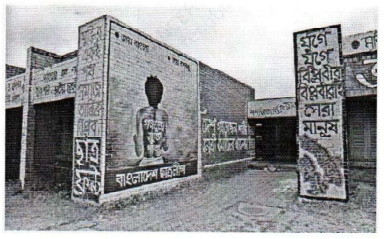
(1) The memorial shown in the picture is located at which one of the following places? (a) Shantiniketan (b) Calcutta University (c) Burma University (d) Dhaka University
(2) The given picture belongs to which one of the following countries? (a) Myanmar (b) Nepal (c) Bangladesh (d) Sri Lanka
(3) When did the incident related to the picture happen? (a) 1950 (b) 1975 (c) 1982 (d) 1987
(4) Which military ruler was the cause for this memorial? (a) General Musharraf (b) Lt.GeneralH.M. Ershad (c) Ziaur Rahman (d) Zia-ul-Haq
(5) Which country is Bhutan's biggest source of developmental aid? (a) USA (b) Russia (c) India (d) China
(6) A landlocked country of South Asia is : (a) Maldives (b) Bangladesh (c) Nepal (d) Pakistan
(7) The Seven Party Alliance is related to which country ? (a) Bhutan (b) Nepal (c) India (d) Pakistan
(8) In East Pakistan, the popular struggle against the domination of West Pakistan was led by which one of the following leaders ? (a) Sheikh Mujibur Rahman (b) Sheikh Mujib Mohammed (c) General Yahya khan (d) Lt. General H.M. Ershad
Section B
Which of the following statements about the 'Arab Spring are not correct?
(i) It began in 2008.
(ii) The struggle was against terrorism and pollution.
(iii) It raised its voice against corruption and unemployment.
(iv) It was basically a demand for democracy.
Which of these statements about the political decisions taken after independence related to development are correct?
(i) Almost everyone agreed that the development of India should mean both economic growth and social-economic justice.
(ii) It was also agreed that this matter cannot be left to businessmen, industrialists and farmers.
(iii) Only the government should play a key role to ensure growth with justice.
(iv) It was necessary to consult all political parties and get public approval.
Assertion (A): On 19th March, 2003 the US launched its invasion on Iraq under the name, 'Operation Iraqi Freedom'.
Reason (R): Iraq was developing Weapons of Mass Destruction (WMD).
Assertion (A) : There was a large-scale migration of refugees into India during the 1971 war with Pakistan.
Reason (R) : Pakistan had planned the migration to disturb the Indian economy.
Arrange the following in chronological order:
(i) Split in Congress Party
(ii) Imposition of Emergency by Indira Gandhi
(iii) Fifth General Elections
(iv) Appointment of Lal Bahadur Shastri as Prime Minister
Section C
What is the main feature of a federal government?
Define the term "sovereignty."
Who wrote the book The Prince?
What is meant by 'judicial review'?
Name any one organ of the government.
What is the meaning of the term "democracy"?
Which amendment gave constitutional status to Panchayati Raj in India?
Section D
Section E
"Globalisation has shifted power from nation-states to global consumers." Support the statement with two arguments.
"All regional movements need not lead to separatist demands." Justify the statement.
What is meant by 'Veto Power'? Name any four countries that enjoy veto power.
"India's impressive technological growth in recent years has made the country an attractive partner of US." Support the statement giving any
four examples.
Explain any four reasons for the grand victory of the Janata Party in the 1977 general elections.
Section F
Paper Details
CBSE Board Exam 2023
Class
Class 12 Humanities
Subject
Political Science
Year
2023
Set
Set 4
Other Years — Political Science