SOLUTIONS

2025 BOARD EXAM

CBSE Class 12 Humanities Political Science Board Paper 2025 — Set 2 Solutions

2025

Political Science

Class 12 Humanities

CBSE EXAMINATION PAPER-2025

POLITICAL SCIENCE

(Solved)

Time allowed : 3 hours

Maximum Marks : 98

General Instructions :

Read the following instructions carefully and follow them :

  1. This question paper contains 36 questions. All questions are compulsory.
  2. This question paper is divided into 5 sections.
  3. Section A – questions number 1 to 3 are case based questions
  4. Section B – questions number 4 to 15 are multiple choice questions
  5. Section C – questions number 16 to 21 are short answer
  6. Section D – questions number 22 to 28 are long answer type i
  7. Section E – questions number 29 to 36 are long answer type ii
  8. There is no overall choice given in the question paper. However, an internal choice has been provided in few questions.
  9. Use of calculator is NOT allowed.

Section A
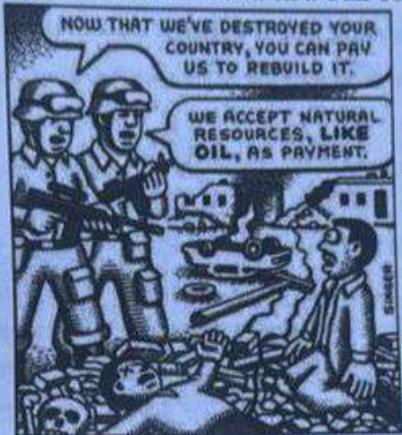
Question 1. Study the given cartoon about USA's invasion on a Gulf country.
Diagram 1 – CBSE Class 12 Humanities Political Science 2025 Set 2 Solutions

(1)

Which one of the following is the most important resource in global strategy?

A-Water

B-Oil

C-Land

D-Automobile

[1 Mark]
Answer: The most important resource in global strategy is Oil.
Key Points: Oil is a crucial resource for the global economy-Oil has been a major factor in strategic thinking and conflicts-Oil supplies influence government and business decisions-Oil was and continues to be key in geopolitical power and trade

(2)

What was the objective of the United States of America to attack the Gulf country?

A-To get control on the oil resources

B-to get the territory of a country

C-To establish its army headquarters

D-To stop USSR from entering this region

[1 Mark]
Answer: The objective of the United States to attack the Gulf country was to get control over the oil resources (Option A).
Key Points: Western strategic thinking focused on securing access to oil supplies-The Gulf region has vital oil resources-The US aimed to protect and control these oil supplies to maintain economic and strategic advantages-The cartoon symbolizes the connection between military action and economic interests in the Gulf

(3)

Which Gulf country was invaded by US America?

A-Iraq

B-Saudi Arabia

C-Kuwait

D-Iran

[1 Mark]
Answer: The Gulf country invaded by the United States of America was Iraq.
Key Points: The question asks about the Gulf country invaded by the USA-The cartoon shows references to the Iraq War-A large amount of money spent on the Iraq War is highlighted ($300 Billion Iraq War)-This indicates the invasion was related to Iraq-Therefore, the correct answer is Iraq.

(4)

Which of the following regions accounts for about 30% of global oil production?

A-Europe

B-China

C-Gulf Region

D-Japan

[1 Mark]
Answer: The Gulf Region accounts for about 30% of global oil production.
Key Points: Gulf region in West Asia accounts for about 30% of global oil production-Saudi Arabia and Iraq hold large oil reserves-Europe accounts for about 17% which is less than the Gulf region-China and Japan have very small shares compared to the Gulf region
Question 2.

Read the passage given below carefully and answer the question that follow:
The Central Asian republics did not ask for independence and wanted to remain with the soviet Federation. In December 1991, under the leadership of Yeltsin, Russia, Ukraine and Belarus declared that soviet Union was banned. Capitalism and democracy were adopted as the bases for the post soviet republics. The declaration on the USSR and the formation of the commonwealth of Independent states (CIS) and the formation of the came as a surprise to the other republics, especially to the Central Asian ones.

(1)

Which ideology was adopted by the post - soviet countries?

A-Socialist

B-Capitalist and Democratic

C-Communist

D-Democratic

[1 Mark]
Answer: The post-Soviet countries adopted Capitalism and Democracy as their ideology.
Key Points: The Soviet Union was disbanded in December 1991 - Post-Soviet countries adopted capitalism and democracy - The Communist Party and socialist system were abandoned - Capitalism meant private ownership and democratic governance

(2)

Which republic among the following became the successor of the soviet union?

A-Belarus

B-Ukraine

C-Commonwealth of Independent States
D-Russia

[1 Mark]
Answer: Russia became the successor of the Soviet Union after its disintegration in 1991.
Key Points: Russia was recognized as the successor state of the Soviet Union-Russia inherited the Soviet Union's seat in the United Nations Security Council-Russia accepted all international treaties and commitments of the Soviet Union

(3)

Which one of the following is a Central Asian Country?

A-Chechnya

B-Dagestan

C-Tajikistan

4-Czechoslovakia

[1 Mark]
Answer: The correct answer is C-Tajikistan as it is one of the Central Asian republics that joined the Commonwealth of Independent States (CIS) after the dissolution of the Soviet Union.
Key Points: Tajikistan is a Central Asian country-Tajikistan was part of the USSR and became independent after 1991-Tajikistan joined the CIS after the dissolution of the Soviet Union-Central Asian republics include Kazakhstan, Kyrgyzstan, Tajikistan, Turkmenistan, and Uzbekistan-Chechnya and Dagestan are parts of Russia and not separate Central Asian countries-Czechoslovakia is a European country

(4)

Which part of soviet Union had vast hydrocarbon resources?

A-Eastern Europe

B-Central Asian Republics

C-Yugoslavia

D-Czechoslovakia
[1 Mark]
Answer: The Central Asian Republics had vast hydrocarbon resources.
Key Points: Central Asian republics possessed significant hydrocarbon resources - Hydrocarbon resources refer to oil and natural gas - This made them economically important - The question options include Central Asian Republics as correct choice
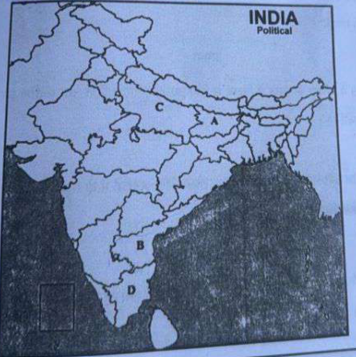
Question 3. In the given political outline map of India, four states have been marked as (A), (B), (C), and (D). Identify these states based on the information below and write their correct names in your answer book along with the serial number for the alphabet.
Diagram 2 – CBSE Class 12 Humanities Political Science 2025 Set 2 Solutions

(1) The state where the assassination of Rajiv Gandhi took place.

[1 Mark]
Answer: Tamil Nadu is the state where the assassination of Rajiv Gandhi took place.
Key Points: "Rajiv Gandhi assassination, State identification"

(2) The state where UPA won the majority of seats in Lok Sabha elections in 2004.

[1 Mark]
Answer:

Andhra Pradesh is the state where UPA won the majority of seats in the 2004 Lok Sabha election.

Key Points: "UPA, 2004 elections, Majority state"

(3) The state where Karpoori Thakur was a Chief Minister.

[1 Mark]
Answer: Bihar is the state where Karpoori Thakur served as Chief Minister.
Key Points: "Karpoori Thakur, Chief Minister, State identification"

(4) The state where Bahujan Samaj Party (BSP) achieved a breakthrough in the 1989 and 1991 elections.

[1 Mark]
Answer: Uttar Pradesh is the state where BSP achieved significant electoral success in 1989 and 1991.
Key Points: "BSP breakthrough, 1989 & 1991 elections, State identification"

Section B

Question 4. Given below are two statements: Statement-I: There were sections of Soviet society which felt that Gorbachev should have moved much faster and were disappointed and impatient with his methods. Statement-II: Communist Party and those who were served by the system felt that their power and privileges were eroding and Gorbachev was moving too quickly.
[1 Mark]
  • (A) Both Statement-I and Statement-II are true.
  • (B) Both Statement-I and Statement-II are false.
  • (C) Statement-I is true, but Statement-II is false.
  • (D) Statement-I is false, but Statement-II is true.
Explanation: Both Statement-I and Statement-II are true. Some parts of Soviet society wanted faster reforms and were unhappy with Gorbachev's slow pace, while the Communist Party members and those benefiting from the old system felt their privileges were threatened and thought reforms were too fast. Thus, Gorbachev's actions caused division with people on both sides feeling dissatisfied.
Question 5. Which leader played an important role in the disintegration and coup against the Soviet Union?
[1 Mark]
  • (A) Nikita Khrushchev
  • (B) Boris Yeltsin
  • (C) Joseph Stalin
  • (D) John F. Kennedy
Explanation: The correct answer is Boris Yeltsin. According to the context, Boris Yeltsin emerged as a national hero in opposing the abortive coup staged by Communist Party hardliners against Gorbachev in August 1991. He became the President of Russia and played a key role in the disintegration of the Soviet Union by shaking off centralized control.
Question 6.

On which one of the following basis was emergency declared in 1975

[1 Mark]
  • (A) External Aggression
  • (B) Internal disturbances
  • (C) External threat
  • (D) Armed rebellion
Explanation: The Emergency declared in 1975 was based on the threat of internal disturbances. The government invoked Article 352 of the Constitution citing internal disturbances as the reason to declare Emergency, rather than external threat or aggression. Although normally Emergency is associated with war or external aggression, in 1975 it was imposed due to perceived internal disturbances within the country.
Question 7. Choose the correct statement about India's nuclear policy from the statements given below:
[1 Mark]
  • (A) India was in support of the NPT.
  • (B) India's nuclear programme was started in 1952 under the guidance of Homi J. Bhabha.
  • (C) Now India has made it clear that the policy of 'no first use' can be reviewed.
  • (D) India was not against nuclear weapons.
Explanation: The correct statement is 'India's nuclear programme was started in 1952 under the guidance of Homi J. Bhabha.' This is true as Homi J. Bhabha is known as the father of the Indian nuclear programme, which began around that time. Other options are incorrect based on the context: India was against nuclear weapons and opposed discriminatory treaties like the NPT (Nuclear Non-Proliferation Treaty), which it refused to sign. Also, India has maintained a 'no first use' nuclear policy, and there is no clear indication that it has been reviewed.
Question 8.

Which Political party won 16 Lok Sabha seats and was at second place in the first general elections of India?

[1 Mark]
  • (A) Swatantra Party
  • (B) Socialist Party
  • (C) Communist Party of India
  • (D) Bharatiya Janata Party
Explanation: The Communist Party of India (CPI) won 16 Lok Sabha seats and was the party that came next in terms of seats after the Indian National Congress in the first general elections of India. The context states that while the Socialist Party had a significant share of votes, it secured less than 3% of the seats, and the CPI came next with 16 seats, making it the second largest party in terms of seats.
Question 9.

Choose the correct option to fill in the blank: Indira Gandhi and Z.A. Bhutto signed the _____ agreement in the year _____?

[1 Mark]
  • (A) War, 1971
  • (B) Peace, 1971
  • (C) Shimla, 1972
  • (D) Shimla, 1971
Explanation:

The correct option is 'Shimla, 1972'. According to the provided context, Indira Gandhi and Zulfikar Ali Bhutto signed the Shimla Agreement on 3 July 1972, which formalized the return of peace after the 1971 Indo-Pak war and the creation of Bangladesh.

Question 10.

Match the terms given in Column-A correctly with Column-B and choose the correct codes:
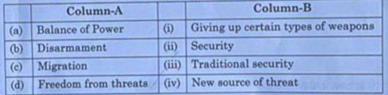
[1 Mark] Diagram 3 – CBSE Class 12 Humanities Political Science 2025 Set 2 Solutions
  • (A) a(iv) b(iii) c(ii) d(i)
  • (B) a(ii) b(iv) c(iii) d(i)
  • (C) a(iii) b(i) c(iv) d(ii)
  • (D) a(iv) b(i) c(iii) d(ii)
Explanation:

The correct matching is a(iii), b(i), c(iv), d(ii). This is because the terms in Column-A correspond appropriately to the categories or descriptions in Column-B as per the provided context. Each item in Column-A fits best with the matching item in Column-B based on their definitions and functions, ensuring conceptual accuracy.

Question 11.

In the following question a statement of Assertion is followed by a statement of Reason. choose the appropriate option as correct answer:

Assertion : The government suspended the freedom of press implemented press censorship during emergency in 1975

Reason : Newspapers protested against censorship by showing the cartoon only.

[1 Mark]
  • (A) Both the A and the R are correct , but the R is not the correct explanation of the A
  • (B) The A is correct, but the R is incorrect
  • (C) The A is incorrect, but the R is correct
  • (D) Both the A and R are correct, and the R is the correct explanation of the A
Explanation:

The Assertion is correct because during the Emergency in 1975, the government suspended press freedom and introduced press censorship, requiring newspapers to get prior approval for publication. The Reason is incorrect because newspapers protested against censorship not merely by showing cartoons, but more notably by leaving blank spaces where news items were censored. Therefore, the correct option is 'The A is correct, but the R is incorrect.'

Question 12.

Arrange the following in chronological order of their happening . (i) India-China War (ii) India's first test of a nuclear device (iii)Terrorists attack on world Trade Centre in America (iv) The Anti - Ballistic Missile Treaty

  • (A) (ii), (iv), (iii), (i)
  • (B) (iv), (i), (iii), (ii)
  • (C) (i), (iv), (ii), (iii)
  • (D) (i), (ii), (iii), (iv)
Explanation:

The correct chronological order is (i), (iv), (ii), (iii). The India-China War happened in 1962. India first tested a nuclear device in 1974. The Anti-Ballistic Missile Treaty (ABM Treaty) was signed between the US and the USSR in 1972. The terrorist attack on the World Trade Centre in America happened in 2001. Therefore, the correct order is India-China War (1962), India's first nuclear test (1974), The Anti-Ballistic Missile Treaty (1972) actually happened before the nuclear test, so the exact order is: (i) India-China War (1962), (iv) The Anti-Ballistic Missile Treaty (1972), (ii) India's first test of a nuclear device (1974), (iii) Terrorist attack on World Trade Centre (2001).

Question 13.

Which one among the following agreements was to cut the green house gas emission?

[1 Mark]
  • (A) Antarctic Treaty
  • (B) Kyoto Protocol
  • (C) Montreal Protocol
  • (D) Antarcti Environmental Protocol
Explanation:

The correct answer is Kyoto Protocol. The Kyoto Protocol is an international agreement that sets targets for industrialized countries to reduce their greenhouse gas emissions such as Carbon dioxide and Methane, which are responsible for global warming. Other agreements like the Antarctic Treaty, Antarctic Environmental Protocol, and Montreal Protocol address different environmental issues but not specifically greenhouse gas emissions.

Question 14. Agenda-21 contains a list of _____________.
  • (A) development practices
  • (B) global commons
  • (C) developed countries
  • (D) polluting Practices
Explanation: Agenda 21, produced at the Rio Summit, is a list of development practices aimed at sustainable development. It focuses on recommending methods and strategies for development that consider ecological conservation and sustainability, rather than just economic growth. Therefore, the correct option is 'development practices.'
Question 15.

Choose the correct full form of the E.V.M.

[1 Mark]
  • (A) Easy Voting Machine
  • (B) Electronic Voting Machine
  • (C) Electric Voting Machine
  • (D) Election Voting Machine
Explanation:

The correct full form of E.V.M. is Electronic Voting Machine. As per the given context, an EVM is an electronic device used during elections to cast and count votes digitally without the use of paper ballots. It records each vote securely and accurately when a voter presses a button corresponding to their preferred candidate or party.

Section C

Question 16. State any two major policy decisions taken by the Chinese leadership in the 1970s.
[2 Marks]
Answer: In the 1970s, the Chinese leadership took significant policy decisions to transform the country politically, economically, and diplomatically. Firstly, in 1972, China ended its political and economic isolation by establishing diplomatic relations with the United States. This was a major step towards engaging with the global community. Secondly, Premier Zhou Enlai proposed the 'Four Modernisations' in 1973, focusing on the development of agriculture, industry, science and technology, and the military. These reforms aimed to modernize China and boost economic growth. Later, in 1978, under the leadership of Deng Xiaoping, China adopted the 'open door' policy to encourage foreign investment and technology transfer, marking the beginning of gradual economic reforms. These decisions helped China shift from a closed, ideological economy to a more pragmatic and open development strategy.
Key Points: Establishment of relations with the United States in 1972-Four Modernisations proposed by Premier Zhou Enlai in 1973-Initiation of 'open door' policy and economic reforms by Deng Xiaoping in 1978-Shift from political and economic isolation to engagement-Emphasis on modernization in agriculture, industry, science and technology, and military
Question 17.

Analyse the Congress Party as an ideological coalition.

[2 Marks]
Answer: The Congress Party in India can be described as an ideological coalition because it brought together a wide range of political beliefs and groups under one umbrella. It included revolutionaries and pacifists, conservatives and radicals, extremists and moderates, representing the right, left, and center of the political spectrum. This diversity allowed the party to be inclusive and accommodate different ideas and interests. As a coalition, the Congress avoided extreme positions by balancing diverse viewpoints through compromise, which strengthened its position in the national movement. However, since 1969, the Congress started to shed this coalition character and identified itself more closely with a socialist and pro-poor ideology, marking a shift from its earlier inclusive nature.
Key Points: Congress included diverse ideological groups-Congress acted as a platform for many political beliefs and parties-It balanced different views through compromise-Congress avoided extreme positions to maintain unity-Since 1969, shifted towards socialist, pro-poor ideology-Shedding of umbrella coalition nature-Inclusiveness and compromise were main traits of Congress coalition
Question 18. Explain any two reasons for the split in the Janata Party in 1979.
[2 Marks]
Answer: The Janata Party that came to power in 1977 after the Emergency was a coalition of diverse groups united mainly by their opposition to Indira Gandhi's Emergency rule. However, this unity was temporary and the party soon faced internal conflicts. One major reason for the split was the lack of a common programme and clear leadership. The party consisted of leaders from different backgrounds with different agendas, which caused disagreements on policy directions. Another significant reason was the ideological differences within the party, especially between the former Jana Sangh members and other factions. The Jana Sangh members wanted to follow a cultural nationalist approach, while others supported Gandhian socialism. These differences led to mistrust and infighting. Eventually, these issues caused the Janata Party to break apart in 1979, and the former Jana Sangh members formed the Bharatiya Janata Party (BJP) in 1980.
Key Points: Lack of common programme and clear leadership-Ideological differences, especially between Jana Sangh members and others-Temporary unity based mainly on opposition to Emergency-Policy disagreements and infighting-Formation of BJP by former Jana Sangh members after the split
Question 19.

Suggest any two ways to reduce economic disparity between the poor and the rich countries at the global level.

[2 Marks]
Answer: Economic disparity between rich and poor countries can be reduced by promoting fair trade practices and increasing developmental aid. Fair trade ensures that developing countries get a better price for their exports, helping their economies grow and improving income for their population. Increasing developmental aid from rich countries can provide resources for education, healthcare, infrastructure, and technology in poorer nations, which can boost their economic development. Both measures help in reducing the income gap by enabling poor countries to improve living standards and participate more effectively in the global economy.
Key Points: Promote fair trade practices-Increase developmental aid from rich to poor countries-Help poor countries improve infrastructure, education, and healthcare-Enable better participation in global economy-Reduce income gap between rich and poor countries
Question 20. Explain any two differences between the First Five Year Plan and Second Five Year Plan of India.
[2 Marks]
Answer: The First Five Year Plan of India, launched in 1951, primarily focused on agriculture, irrigation, and power generation to improve food production and infrastructure. It aimed at stabilizing the economy affected by Partition and addressing urgent agrarian needs. In contrast, the Second Five Year Plan, launched in 1956, shifted focus towards rapid industrialization, especially heavy industries, to build a strong industrial base for the country. While the First Plan concentrated on the agricultural sector, the Second Plan emphasized the development of industries and aimed to promote balanced economic growth. Thus, the main difference lies in their focus areas, with the First Plan centered on agriculture and the Second Plan on industry.
Key Points: First Five Year Plan focused on agriculture and irrigation - targeted improving food production and infrastructure - addressed immediate post-Partition agrarian crisis- Second Five Year Plan shifted focus to heavy industries and industrialization - aimed at building a strong industrial base - focused on balanced economic growth and rapid industrial development
Question 21.

State any two methods of Traditional Security

[2 Marks]
Answer: Traditional security primarily focuses on protecting the state from external and internal threats through the use or threat of military force. Two common methods of traditional security include military defense and strategic alliances. Military defense involves building a strong armed force to deter attacks and defend the country’s sovereignty and territorial integrity. Strategic alliances are agreements between countries to support each other in case of aggression, enhancing collective security. Both methods prioritize the state as the referent object of security and emphasize maintaining peace and order within borders to face external threats effectively.
Key Points: Traditional security focuses on the state-Military defense as a method-Strategic alliances as a method-Use or threat of military force to ensure security-Emphasis on internal peace and order to face external threats

Section D

Question 22.

Explain any two reasons for the beginning of a long phase of coalition politics in India since 1989.

[4 Marks]
Answer:

Since 1989, India has witnessed a long phase of coalition politics due to multiple reasons. Firstly, the decline of the Congress party's dominance was a major factor. Earlier, the Congress was the single largest party with widespread support across the country, but after 1989, its power started to diminish as regional and smaller parties gained strength. This led to the need for alliance formation to secure a majority in the Lok Sabha.

Secondly, the rise of regional parties played a crucial role. India’s diverse population and regional aspirations gave rise to various regional parties representing specific states and communities. These parties became important players in national politics, as their support became essential to form a government. Consequently, coalition governments emerged as national parties required the support of regional parties to achieve majority.

These changes led to multiple coalition governments at the Centre, requiring parties to work together to form and sustain governments. Examples include the National Front in 1989, the United Front in the mid-1990s, and the BJP-led coalitions after the late 1990s. Thus, a combination of the weakening of a single dominant party and the rise of regional political forces caused the beginning and continuation of coalition politics in India since 1989.

Key Points: Decline of Congress dominance-Rise of regional parties and their growing influence-Emergence of coalition governments due to fragmented mandates-Need for alliances to form majority governments
Question 23.

Explain the role of 'Other Backward Classes' in the Indian politics.

[4 Marks]
Answer:

The Other Backward Classes (OBCs) have played a significant role in shaping Indian politics, especially since the period after the Emergency. OBCs refer to communities that are socially and educationally backward but are different from Scheduled Castes (SC) and Scheduled Tribes (ST). Their political rise began with growing awareness about their social identity and demands for reservation in education and employment. The appointment of the Mandal Commission by the Janata Party government was a landmark event that highlighted OBC issues. The report recommended reservations for OBCs, leading to intense debates nationwide. This increased political awareness among OBCs helped political parties see them as an important vote bank, and many parties started mobilizing support from these communities. Due to the decline in Congress's support among backward castes, non-Congress parties gained strength by representing OBC interests. Thus, OBCs have become a crucial social group influencing policies, elections, and the distribution of power in Indian politics, making the politics of backward castes an important dimension in the country’s democratic process.

Key Points: Definition of OBC – socially and educationally backward communities- Appointment of Mandal Commission to study backward classes - Recommendations for reservations for OBCs - National debates on reservation increasing OBC political awareness - Decline of Congress support among backward castes - Rise of non-Congress parties drawing OBC support - OBCs becoming a major political force influencing elections and policies.
Question 24.

Analyse any four reasons for the split in the Congress Party in 1969.

[4 Marks]
Answer:

The split in the Congress Party in 1969 was a significant event in Indian political history. Four main reasons contributed to this split. Firstly, there was a growing ideological difference between Indira Gandhi and the old Congress leaders, known as the 'Syndicate.' The Syndicate represented conservative, pro-rich interests, while Indira Gandhi wanted to project a pro-poor, socialist agenda. Secondly, power struggle within the party intensified as Indira Gandhi wanted more control and independence in decision-making, which the Syndicate opposed.

Thirdly, the conflict over the Presidential election of 1969 was a major trigger. The Syndicate supported a candidate opposed by Indira Gandhi who instead backed V.V. Giri as an independent candidate. The official Congress candidate's defeat weakened the Syndicate. Fourthly, the ideological division was projected by Indira Gandhi as a fight between socialists and conservatives, which attracted common people and weakened the old leadership.

Consequently, the party split into Congress (O) led by the Syndicate and Congress (R) led by Indira Gandhi. This division changed the power dynamics within Indian politics and marked a shift towards a more populist and socialist direction under Indira Gandhi's leadership.

Key Points: Ideological differences between Indira Gandhi and Syndicate; Power struggle and control over party; Presidential election conflict in 1969; Projection of ideological divide as pro-poor versus pro-rich
Question 25.

Analyse the basis of projecting China to overtake the US America to become the world's largest economy.

[4 Marks]
Answer:

China's projected overtaking of the United States as the world's largest economy by 2040 is based on several key factors. Since the economic reforms that began in 1978, China has experienced rapid and sustained economic growth, becoming the fastest growing economy globally. This growth is supported by its large population, abundant resources, vast landmass, and strategic regional location in East Asia. China's deep economic integration into the East Asian region makes it the central driver of regional growth, enhancing its influence in political and economic affairs.

Moreover, China's rise is not only economic but also political, as the strength of its economy adds to its global power. Its capacity to influence regional and international markets positions it as a major alternative center of power alongside the US and the European Union. The combination of these factors—economic growth rate, population size, resources, geopolitical influence, and regional integration—forms the basis of projections that China will become the world's largest economy by 2040.

Key Points: Rapid economic growth since 1978 - Largest population and landmass - Abundant natural resources - Strategic regional location in East Asia - Economic integration driving East Asian growth - Increasing political and economic influence globally - Projected to overtake US economy by 2040
Question 26.

"While the Chinese economy has improved, not everyone in China received the benefits of the reforms. "Analyse any two reasons for this.

[4 Marks]
Answer:

The economic reforms in China have indeed led to significant growth and development. However, the benefits of these reforms have not been equally distributed among all sections of the population. Firstly, unemployment has risen sharply, with nearly 100 million people searching for jobs. Although economic growth was strong, population growth of 2-3% annually outpaced job creation, leading to insufficient employment opportunities for the growing population. Secondly, economic inequality widened significantly. There was a marked disparity between rural and urban areas, as well as coastal and inland provinces. Urban and coastal regions experienced faster growth and development compared to rural and inland areas, causing social and economic divides. Additionally, conditions for female employment were poor, and social welfare was not adequately extended to all, which further limited the reach of reform benefits. Environmental degradation and corruption also increased, affecting the quality of life for many. In conclusion, while the Chinese economy flourished overall, the benefits of reforms were unevenly distributed due to rising unemployment, unequal regional development, and socio-economic disparities.

Key Points: Rising unemployment with 100 million job seekers-Inadequate job creation versus population growth-Increased economic inequality between rural-urban and coastal-inland areas-Poor conditions and employment for females-Environmental degradation and corruption leading to uneven benefit distribution
Question 27.

Describe the impact of globalisation on the Indian culture.

[4 Marks]
Answer:

Globalisation refers to the increasing interconnectedness of the world, especially in terms of economics, politics, and culture. In India, globalisation has had a significant impact on its culture, bringing both positive and negative changes. On the positive side, globalisation has helped India to integrate with the global economy, leading to the spread of new ideas, technology, and lifestyles. Indian culture has become more diverse as people are exposed to different cultural practices from around the world, enriching their own traditions. However, globalisation also poses a threat to Indian culture as it promotes cultural homogenisation – a trend where local traditions and customs are replaced by a uniform global culture. This can lead to the erosion of India’s diverse cultural heritage. For example, the dominance of Western fast food, fashion, and entertainment sometimes overshadows traditional Indian practices. Moreover, younger generations may start preferring global cultural icons over local ones, affecting cultural identity. Despite these challenges, India continues to influence globalisation by promoting its own culture internationally, such as through Bollywood films, yoga, and cuisine. In conclusion, while globalisation influences Indian culture by introducing new ideas and practices, it also threatens to diminish traditional cultural diversity. It is important to preserve Indian culture amidst global changes by balancing modernity with tradition.

Key Points: Definition of globalisation - Positive impacts on Indian culture (technology, ideas, diversity) - Threat of cultural homogenisation - Erosion of traditional customs - Influence of Western culture (food, fashion, entertainment) - India's contribution to global culture (Bollywood, yoga, cuisine) - Importance of preserving cultural identity
Question 28.

Highlight any four Directive Principles of state Policy that have been included in the Constitution of India for International peace and security.

[4 Marks]
Answer:

The Constitution of India, under Article 51, outlines several Directive Principles of State Policy aimed at promoting international peace and security. These principles guide the Indian government to maintain friendly relations with other nations and contribute to global peace. Four important Directive Principles in this context include:

1. Promotion of international peace and security: India is committed to fostering peace globally and discouraging war and conflict.

2. Maintenance of just and honorable relations between nations: The principles emphasize respect for the sovereignty and equality of all nations.

3. Respect for international law and treaty obligations: India pledges to abide by international treaties and laws, reflecting its lawful conduct in global affairs.

4. Settlement of international disputes by peaceful means: The Constitution encourages resolving conflicts through dialogue, negotiation, arbitration, or judicial settlement rather than force.

These Directive Principles reflect India's aspiration to conduct foreign relations in a way that supports global stability, peace, and security. They embody the lessons learned from past global conflicts and underline the importance of cooperation among nations for mutual prosperity.

Key Points: Article 51 of the Indian Constitution- Promotion of international peace and security- Maintenance of just and honorable relations between nations- Respect for international law and treaty obligations- Settlement of international disputes by peaceful means

Section E

Question 29. Describe any three circumstances under which the States Reorganisation Commission was constituted.
[6 Marks]
Answer: After India gained independence, the demand for the creation of states based on linguistic lines gained momentum. Various communities started agitating for states where their language and culture could be preserved, leading to several struggles and protests. These demands created unrest and posed a challenge to the unity and integrity of the country. To address these issues, the Central Government appointed the States Reorganisation Commission in 1953. The purpose of the Commission was to examine the existing state boundaries and recommend changes that would reflect the linguistic and cultural identities of the people. The commission's recommendations, made in its report, accepted that the states' boundaries should be reorganized primarily on linguistic lines. Following the Commission's suggestion, the States Reorganisation Act was passed in 1956, which reorganized states and created new states and union territories accordingly. This major step paved the way for further reorganisation processes in India, including the creation of states like Gujarat, Maharashtra, Punjab, Haryana, and several northeastern states. Thus, the Commission was constituted mainly due to the demands for linguistic states, the need to maintain unity while respecting cultural identities, and the unrest caused by existing state boundaries that did not represent linguistic communities effectively.
Key Points: Demand for linguistic states due to cultural and language identity struggles-Central Government wanted to maintain unity and peace among diverse linguistic groups-Demands and protests created unrest requiring a formal inquiry-Commission established in 1953 to examine state boundaries and recommend reorganisation-Report recommended states be reorganized on linguistic lines-Stories Reorganisation Act passed in 1956 based on the Commission's suggestions
Question 30.

Describe the circumstances led to Manipur's accession to India in 1949.

[6 Marks]
Answer: Before India gained independence in 1947, Manipur was a princely state ruled by Maharaja Bodhachandra Singh. A few days before India's independence, under uncertainties and political changes, the Maharaja signed the Instrument of Accession with the Indian government. This agreement was made with the assurance that Manipur would retain its internal autonomy. In response to public pressure, the Maharaja held elections in June 1948, making Manipur the first area in India to conduct elections based on universal adult franchise. The state's Legislative Assembly had debates about the merger with India, but the strategic location of Manipur, sharing borders with China, Myanmar, and Bangladesh, made its accession important for India. Over time, Manipur was fully integrated into the Indian Union and became a separate state in 1972 alongside other northeastern regions that were reorganised post-independence. The accession helped secure India’s northeastern frontier and facilitated political reorganisation of the region.
Key Points: Manipur was a princely state ruled by Maharaja Bodhachandra Singh - Maharaja signed the Instrument of Accession before independence with assurance of internal autonomy - Public pressure led to elections in June 1948 based on universal adult franchise - Legislative Assembly had sharp differences on merger with India - Manipur's strategic location bordering China, Myanmar and Bangladesh - Full integration and political reorganisation after accession - Became a separate state in 1972
Question 31.

Explain any two commonalities and two differences between Bangladesh and Pakistan in their democratic experiences.

[6 Marks]
Answer:

Bangladesh and Pakistan share some commonalities in their democratic journeys, but also exhibit significant differences. Firstly, both countries have experienced alternations between civilian and military rule. Their political history includes military coups and periods under military dictatorships, which have interrupted the democratic process. Secondly, despite these interruptions, both nations recognize democracy as the suitable form of governance for their countries, reflecting a shared preference for democracy over dictatorship among their people.

Regarding differences, Bangladesh has maintained a continuous democratic framework in the post-Cold War period, whereas Pakistan has historically had weaker support for democracy and more frequent military interventions. Additionally, Bangladesh’s constitution explicitly declares faith in secularism, democracy, and socialism and went through a constitutional amendment in 1975 shifting from a parliamentary to a presidential system under Sheikh Mujib. Pakistan, in contrast, has struggled more with balancing democratic governance amid military dominance and has shown less popular support for democratic ideals compared to Bangladesh.

Overall, while both countries have struggled with military influence, Bangladesh’s democratic experience has been relatively more stable and rooted in secular democratic principles, whereas Pakistan faces greater challenges in consolidating democracy.

Key Points: Both countries experienced civilian and military rule - Both have a popular belief in democracy as a suitable system - Bangladesh maintained democracy post-Cold War, Pakistan had weaker democracy support - Bangladesh's constitution embraces secularism, democracy, socialism; Pakistan struggles with military dominance and lesser democratic support
Question 32.

Explain any two issues of co-operation and two issues of confrontation between India and Bangladesh.

[6 Marks]
Answer:

India and Bangladesh share a long history and geographical proximity, leading to both cooperation and confrontation between the two nations.

Two key areas of cooperation include economic relations and border management. Over the past two decades, economic ties between India and Bangladesh have considerably improved, with both countries engaging in trade and infrastructure projects that benefit their populations. Additionally, they have worked together to address border issues and maintain peace along their international boundary.

However, there are notable issues of confrontation as well. One major issue is the sharing of river waters, particularly the Ganga and Brahmaputra rivers. Bangladesh has often felt that India acts like a regional bully by unfairly managing water resources, which affects agriculture and livelihoods in Bangladesh. Another significant point of contention is illegal immigration from Bangladesh to India. India perceives this as a threat to its demographic balance and security, while Bangladesh denies large-scale illegal migration. Furthermore, Bangladesh's refusal to allow Indian troops to pass through its territory to northeastern India and the dispute over the export and transit of natural gas have also caused tensions.

In conclusion, while India and Bangladesh cooperate on many fronts, such as economic development and border peace, challenges such as river water sharing and immigration continue to cause friction between the two neighbors.

Key Points: Cooperation - Improved economic relations in last 20 years - Effective border management enhancing peace; Confrontation - Sharing of Ganga and Brahmaputra river waters causing disputes - Bangladesh's perceived support for anti-Indian groups and denial of illegal immigration to India
Question 33.

Analyse any three reasons for the disturbance and unrest in Kashmir.

[6 Marks]
Answer:

The disturbance and unrest in Kashmir can be attributed to several key reasons rooted in political, social, and external factors. Firstly, the political crisis began when processes were undermined by the state under the influence of the Central government, which created disillusionment and tension among the local population. This political instability worsened with the rise of a militant movement by 1989, demanding a separate Kashmiri nation, reflecting deep dissatisfaction with the status quo.

Secondly, external involvement played a major role. Pakistan provided moral, material, and military support to insurgents in Kashmir, escalating the conflict and making it difficult to restore peace. This foreign interference intensified the insurgency and posed challenges to India's law and order maintenance efforts.

Thirdly, the internal dispute about Kashmir's special status within India contributed significantly to unrest. Articles 370 and 371 provided special provisions, but these triggered opposing reactions inside and outside Jammu and Kashmir, causing further divisions and conflict. Moreover, longstanding demands such as the call for a free and impartial plebiscite remained unfulfilled, adding to the people's frustration.

Additionally, the unrest has resulted in immense human suffering, including loss of lives, displacement of the Kashmiri Pandit community, and social disturbances affecting Jammu, Kashmir, and Ladakh regions differently. These complex internal and external factors together form the roots of the ongoing unrest in Kashmir.

Key Points: Political crisis due to undermining of state processes by Central government - Rise of militant movement demanding a separate Kashmiri nation by 1989 - Pakistan's moral, material, and military support to insurgents - Dispute over Kashmir's special status under Articles 370 and 371 provoking opposing reactions - Failure to conduct a free and impartial plebiscite - Human cost including loss of lives and displacement of Kashmiri Pandits
Question 34.

Suggest any three measure to maintain peace in Jammu and Kashmir.

[6 Marks]
Answer:

Maintaining peace in Jammu and Kashmir is essential for the stability and development of the region. Firstly, reducing the deployment of armed forces progressively can help restore normalcy and lessen the feeling of military occupation among the people, thereby promoting trust and confidence. Secondly, promoting political dialogue by conducting free and impartial elections can institutionalize democracy in the state, allowing the voice of the people to be heard and represented effectively. This will help address political instability and give a platform to resolve grievances peacefully. Thirdly, fostering communal harmony and mutual respect among the diverse communities in Jammu, Kashmir, and Ladakh is crucial. Encouraging inter-community interactions, protecting minority rights, and promoting cultural understanding can reduce tensions and violence. Alongside, ensuring that cross-border terrorism and external support to insurgents are curbed through diplomatic and security measures is vital for lasting peace. These combined efforts focusing on democratic governance, security adjustments, and social harmony will significantly contribute to peace in Jammu and Kashmir.

Key Points: Progressive reduction of armed forces-Promotion of free and impartial elections to institutionalize democracy-Fostering communal harmony and mutual respect-Curbing cross-border terrorism and external support to insurgents
Question 35.

Explain the importance of International organisations like the United Nations in the contemporary world.

[6 Marks]
Answer:

The United Nations (UN) plays a crucial role in today’s interconnected and interdependent world. Established in 1945 after the Second World War, the UN was created to promote international peace and cooperation and to prevent future conflicts. It acts like a referee in global affairs, ensuring countries respect international laws, play fair, and protect human rights and freedoms.

In a world where over seven billion people live together with increasing technological connections, the importance of the UN continues to grow. It helps resolve disputes peacefully by bringing member countries together for dialogue and negotiation rather than war. The UN also works to promote social progress, better living standards, and human rights worldwide.

Though it is not a super-state with authority over countries, the UN functions because states agree to cooperate through it. It reflects the realities of world politics and adapts to new challenges like climate change, poverty, and international security. Overall, the UN helps maintain global order, foster cooperation among nations, and address issues that no single country can solve alone.

Key Points: Established after WWII to maintain peace and prevent conflicts- Acts as an international referee ensuring countries respect fairness and human rights- Addresses global challenges like war, poverty, and human rights abuses- Enhances cooperation among over seven billion people through diplomacy and dialogue- Not a super-state but a platform created by member states for peaceful problem-solving- Increasing importance due to growing global interdependence and technological connections
Question 36.

Explain any four changes that have occurred after the cold war and have affected the realities of the world politics.

[6 Marks]
Answer: After the Cold War, there were several significant changes that reshaped the realities of world politics. Firstly, the Soviet Union collapsed, ending the communist bloc and the bipolar world order. This disintegration led to the emergence of the United States as the sole superpower, dominating global political affairs. Secondly, the Cold War confrontations came to an end, which changed the context of international relations entirely, reducing the threat of large-scale military conflict between major powers. Thirdly, the collapse of socialist systems in Eastern Europe paved the way for democratic governments and market economies, transforming the political landscape of the region. Lastly, with the end of Cold War divisions, geopolitical alliances and foreign policies evolved, as countries redefined their positions in the global arena, focusing on cooperation over confrontation. These changes collectively brought a new era in world politics characterized by unipolarity, new security challenges, and shifting alliances.
Key Points: Collapse of the Soviet Union-The United States becomes the strongest power-End of Cold War confrontations-Democratic and economic transformations in Eastern Europe-Shift in geopolitical alliances and foreign policies

Paper Details

CBSE Board Exam 2025

Class

Class 12 Humanities

Subject

Political Science

Year

2025

Set

Set 2

Other Years — Political Science

2022 Set-1

2022 Set-2

2022 Set-3

2022 Set-4

2022 Set-5

2023 Set-1

2023 Set-2

2023 Set-3

2023 Set-4

2023 Set-5

2024 Set-1

2024 Set-2

2024 Set-3

2024 Set-4

2024 Set-5

2025 Set-1

2025 Set-2

2025 Set-2

2026 Set-2

2026 Set-4

2026 Set-5

CBSE Class 12 Political Science 2025 Set 2 Solutions | Prepzy