QUESTION PAPER
2023 BOARD EXAM
CBSE Class 12 Humanities Political Science Board Paper 2023 — Set 1
2023
Political Science
Class 12 Humanities
CBSE EXAMINATION PAPER-2023
POLITICAL SCIENCE
(Solved)
General Instructions :
Read the following instructions carefully and follow them :
- This question paper contains 41 questions. All questions are compulsory.
- This question paper is divided into 6 sections.
- Section A – questions number 1 to 3 are case based questions
- Section B – questions number 4 to 15 are multiple choice questions
- Section C – questions number 16 to 22 are very short answer
- Section D – questions number 23 to 28 are short answer
- Section E – questions number 29 to 33 are long answer type i
- Section F – questions number 34 to 41 are long answer type ii
- There is no overall choice given in the question paper. However, an internal choice has been provided in few questions.
- Use of calculator is NOT allowed.
Section A
Read the following passage carefully and answer the questions that follow:
"The war with China alerted the Indian leadership to the volatile situation in the North-East region. Apart from being isolated and extremely under-developed, this region also presented India with the challenge of national integration and political unity."
(1) Which one of the following States was affected the most due to the Sino-Indian conflict? (a) Assam (b) Nagaland (c) Arunachal Pradesh (d) Sikkim
(2) Which one of the following States was created in the North-East just after the end of the Indo-China War? (a) Nagaland (b) Assam (c) Sikkim (d) Arunachal Pradesh
(3) Which political party got split just after the Indo-China War due to internal differences? (a) Swatantra Party (b) Congress Party (c) Communist Party of India (d) Jana Sangh
(4) Which one of the following States is not a North-Eastern State? (a) Arunachal Pradesh (b) Uttarakhand (c) Meghalaya (d) Tripura
In the given political outline map of India (on page 15), four States/Union Territories have been marked as A, B, C and D. Identify these States/Union Territories on the basis of the information given below and write their correct names in your answer-book along with the respective serial number of the information used and the concerned alphabets given in the map as per the following format :
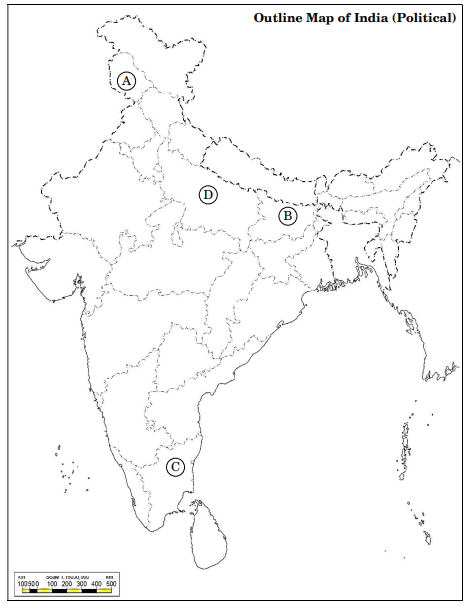
(1) The State to which the Chairman of the Mandal Commission, B.P. Mandal, belonged.
[1 Mark](2) The Union Territory which was constituted in 2019.
[1 Mark](3) The State from which the political party Dravida Munnetra Kazhagam originated.
[1 Mark](4) The State where the Bahujan Samaj Party formed its first government.
[1 Mark](5) Name the founder leader of the Bahujan Samaj Party.
(6) Who was the first Non-Congress Prime Minister of India ?
(7) B.P. Mandal, the chairman of Mandal Commission belonged to which State of India ?
(8) Which Union Territory was constituted in 2019 ?
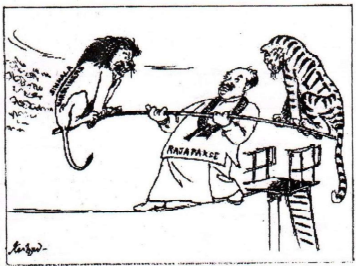
(1) Which one of the following statements about the Sri Lankan crisis is true? (a) India did not interfere in the crisis and kept away from the problem. (b) India asked the United Nations to resolve the problem. (c) India signed an Accord with Sri Lanka and got involved in the solution to the problem. (d) India snapped its diplomatic relations with Sri Lanka during the crisis.
(2) What message does the cartoon convey? (a) Sri Lankan government managed to balance the two rival groups. (b) Both the groups were against the government. (c) The government treated both the communities equally. (d) It was very difficult to maintain balance between the two rival groups.
(3) The conflict in Sri Lanka from 1983 onwards was based on which of the following? (a) Discrimination by the government between political parties (b) Discrimination by the government between two communities (c) Discrimination by the government between two regions (d) Discrimination by the government between two religions
(4) The tiger sitting on the right-hand side represents which organisation? (a) Liberation Tigers of Tamil Eelam (b) Liberal Tigers of Tamil Estate (c) Liberation Tigers of Tamil East (d) Liberal Tigers of Tamil Eelam
(5) In 1989, India sent troops to Sri Lanka, named as : (a) Indian Peace Groups (b) Indian Peace Keeping Force (c) Indian Peace Workers (d) Indian Troops for Tamils
(6) In Sri Lanka, there was a conflict between __________. (a) two communities (b) two regions (c) two religions (d) two ideologies
(7) Name the group of Tamils who fought against the army of Sri Lanka. (a) Indian Tamils (b) LTTE (c) Tamils for Democracy (d) Tamil United Front
(8) In spite of conflict, Sri Lanka has registered __________. (a) rise in its economy and development (b) fall in its economy (c) rise in the population (d) fall in its trade
Section B
Which of the following statements about the environment are correct?
(i) Environmental concerns are part of the global politics.
(ii) A conference on environment was held in Rio-de-Janeiro in 1992.
(iii) The UN has assigned the environmental programmes to UN Human Rights Commission.
(iv) The Earth Summit was organised by the United Nations.
Arrange the following in chronological order:
(i) Pakistan sent tribal infiltrators to Kashmir.
(ii) Sheikh Abdullah became Prime Minister of Jammu and Kashmir.
(iii) The Punjab Accord was signed by Longowal and Rajiv Gandhi.
(iv) Jammu and Kashmir was a Princely State.
Assertion (A) : In May 1977, the Janata Party government appointed a Commission of Inquiry headed by Justice J.C. Shah.
Reason (R) : The Commission was appointed to inquire into the reasons for declaring Emergency, by the Indira Gandhi Government.
Section C
Who was Mikhail Gorbachev in the context of the USSR?
What was the Arab Spring?
Which organisation works to prevent international conflicts?
Which of the following is not a threat to global security: global warming, international terrorism, epidemics, or rising prices?
Who gave the call for a nationwide railway strike in 1974?
Which Indian Prime Minister first started economic reforms in the country?
In which year was the first coalition government formed in India?
Section D
Highlight any two important features of the 'ASEAN way'.
Show with the help of any two examples, the strength of the United Nations.
Explain the term 'Security'.
Name any four regional parties which have ever formed their government in any State.
Highlight any two recommendations of the Mandal Commission.
In which year was the first coalition government formed in India and why ?
Section E
Write the full form of 'UNICEF and state any two functions of it.
Section F
"Despite various problems, the people in all the South Asian countries share the aspiration and support for democracy." Justify the statement with any three suitable examples.
Paper Details
CBSE Board Exam 2023
Class
Class 12 Humanities
Subject
Political Science
Year
2023
Set
Set 1
Other Years — Political Science