Section B
[1 Mark]
Answer: Coalition governments enhance democracy by promoting inclusivity and broad representation of diverse interests. With multiple parties involved, they reflect varied social and ideological perspectives, fostering dialogue and compromise. This collaborative approach encourages decision-making that accounts for a wider array of public concerns, as parties must consult and negotiate with one another. Additionally, the rise of coalition politics has reduced the concentration of power in the hands of a single party, empowering smaller parties and minority groups.
Key Points: Inclusivity of diverse interests-Promotion of dialogue and compromise-Reduction of power concentration
[1 Mark]
Answer: The NITI Aayog, established on January 1, 2015, serves crucial roles in India's governance. Firstly, it functions as a policy think tank, formulating and recommending strategic policies for economic development and poverty eradication. Secondly, it plays a vital role in fostering cooperative federalism by enhancing the participation of states in decision-making processes and enabling them to implement effective policies tailored to local needs. These roles promote sustainable development in India.
Key Points: Policy formulation and recommendations; fostering cooperative federalism through state participation
[1 Mark]
Answer: The period around the Emergency of 1975 is termed a constitutional crisis due to the significant conflict between Parliament and the judiciary regarding their powers. This tension culminated in the imposition of Emergency, which was justified by the government citing internal disturbances as a threat to national stability. This deviation from normal constitutional governance indicated a severe breakdown in democratic principles, showing how power can be abused during times of crisis.
Key Points: Conflict between Parliament and judiciary-Internal disturbances cited-Change in governance and democratic principles
[1 Mark]
Answer: Four republics of the erstwhile USSR are Russia, Ukraine, Belarus, and Georgia. These republics were part of the Soviet Union before its dissolution in 1991. The disbandment of the USSR allowed these republics to assert their independence and follow their own political and economic paths post-Soviet era.
Key Points: Russia-Ukraine-Belarus-Georgia
[1 Mark]
Answer: Deen Dayal Upadhyaya's Integral Humanism emphasizes the interconnectedness of individual and society. First, it advocates for the intrinsic value of each individual, ensuring equal opportunities for all to achieve their potential, regardless of caste or gender. Second, it promotes the idea of harmony between personal freedom and social responsibility, where individual rights align with the collective welfare of society. These principles challenge inequalities and aim for a holistic development approach.
Key Points: Intrinsic value of each individual-Equal opportunities for potential-Social responsibility aligns with personal freedom
Section C
[1 Mark]
-
(A) Orissa and Assam
-
(B) Karnataka and Tamil Nadu
-
(C) Gujarat and Karnataka
-
(D) Uttar Pradesh and Jammu and Kashmir
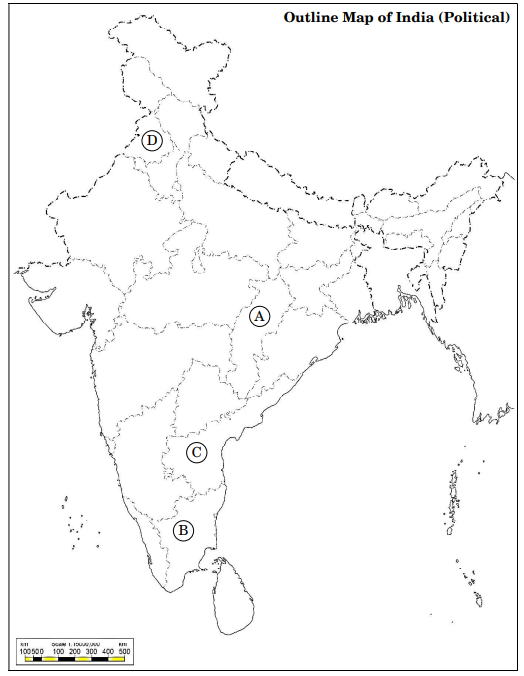
Explanation: According to the context, in the 1977 General Election after the Emergency, the Congress Party did not lose elections all over the country. It retained many seats in Maharashtra, Gujarat, and Orissa and virtually swept through the southern States. Since Karnataka is a southern state, and Gujarat is explicitly mentioned as a state where Congress retained seats, the pair Gujarat and Karnataka is the correct answer.
[1 Mark]
-
(A) To distribute equal economic benefits among its member-states
-
(B) Non-interference in the internal policies of member-states
-
(C) To promote peace and security
-
(D) To establish a more equitable and fair world
Explanation: The correct answer is 'To distribute equal economic benefits among its member-states.' This statement is not an objective of BRICS because the organization focuses on fostering cooperation and development among its members rather than guaranteeing equal distribution of economic benefits. The other options—non-interference in internal policies, promoting peace and security, and establishing a more equitable and fair world—align with the objectives of BRICS, which emphasize mutual respect, international peace, and collaboration.
[1 Mark]
-
(A) Manmohan Singh
-
(B) V.P. Singh
-
(C) H.D. Deve Gowda
-
(D) Rajeev Gandhi
Explanation: The correct answer is Manmohan Singh. Although Rajiv Gandhi initiated economic changes, it was under Manmohan Singh, who was the Finance Minister in 1991 and later became Prime Minister, that the new economic reforms were formally implemented and became widely recognized. These reforms included liberalization of the economy and structural adjustments that had significant long-term effects.
[1 Mark]
-
(A) (ii), (iv), (iii), (i)
-
(B) (iii), (iv), (i), (ii)
-
(C) (ii), (iv), (i), (iii)
-
(D) (ii), (i), (iv), (iii)
Explanation: ASEAN was established in 1967. China began privatization of agriculture in the late 1970s. SAARC was formed in 1985, and the European Union was established in 1993. Therefore, the correct chronological order is (iii), (iv), (i), (ii).
[1 Mark]
-
(A) Both Assertion (A) and Reason (R) are true and Reason (R) is the correct explanation of the Assertion (A).
-
(B) Both Assertion (A) and Reason (R) are true, but Reason (R) is not the correct explanation of the Assertion (A).
-
(C) Assertion (A) is false, but Reason (R) is true.
-
(D) Assertion (A) is true, but Reason (R) is false.
Explanation: South Asian countries do not have the same political system; they differ in structure and practice (e.g., parliamentary democracy, constitutional monarchy in the past, military influence, etc.). However, despite differences and challenges, all South Asian countries share an aspiration for democracy. Hence, (A) is false but (R) is true.
[1 Mark]
-
(A) Both Assertion (A) and Reason (R) are true and Reason (R) is the correct explanation of the Assertion (A).
-
(B) Both Assertion (A) and Reason (R) are true, but Reason (R) is not the correct explanation of the Assertion (A).
-
(C) Assertion (A) is true, but Reason (R) is false.
-
(D) Assertion (A) is false, but Reason (R) is true.
Explanation: Both Assertion (A) and Reason (R) are true, and Reason (R) is the correct explanation of the Assertion (A) because India opposed the NPT and CTBT for being discriminatory towards non-nuclear powers, which aligns with its stance on seeking equitable global disarmament.
[1 Mark]
-
(A) Nepal
-
(B) India
-
(C) Bangladesh
-
(D) Afghanistan
Explanation: The correct answer is India, as the context indicates that India is centrally located in South Asia and borders all the other countries in the region, making it the only country that shares borders with most of them.
[1 Mark]
-
(A) Socialist Party
-
(B) Communist Party of India (M)
-
(C) Bharatiya Lok Dal
-
(D) Bharatiya Jana Sangh
Explanation: The Bharatiya Jana Sangh was indeed a part of the JP led march, as indicated by the context stating it was supported by non-Congress opposition parties, including the Bharatiya Jana Sangh, Bharatiya Lok Dal, and Socialist Party. However, the Communist Party of India (M) is not mentioned as part of this coalition, making it the correct answer.
[1 Mark]
-
(A) Rajiv Gandhi and Harchand Singh Longowal
-
(B) Rajiv Gandhi and Tara Singh Longowal
-
(C) Rajiv Gandhi and Sant Singh Longowal
-
(D) Rajiv Gandhi and Surjit Singh Longowal
Explanation: The correct answer is 'Rajiv Gandhi and Harchand Singh Longowal' because Sant Harchand Singh Longowal was the president of the Akali Dal at the time and played a crucial role in negotiating the accord with then Prime Minister Rajiv Gandhi to address the demands of the Akalis and restore peace in Punjab.
[1 Mark]
-
(A) (i) and (iii) only
-
(B) (iii) and (iv) only
-
(C) (ii) and (iv) only
-
(D) (i) and (ii) only
Explanation: (ii) is incorrect because a boundary dispute surfaced later, primarily after China's annexation of Tibet in 1950. (iv) is also incorrect, as the differences regarding the boundary have not been resolved despite ongoing talks.
[1 Mark]
-
(A) (ii) and (iv) only
-
(B) (i) and (iii) only
-
(C) (i) and (iv) only
-
(D) (ii) and (iii) only
Explanation: The correct options are (ii) and (iii) only. Both the Planning Commission and NITI Aayog are non-constitutional bodies and the Prime Minister serves as their chairperson. While both bodies incorporate significant roles of states, the Planning Commission primarily had the power to allocate funds, but NITI Aayog, having an advisory role, does not wield this power in the same manner, focusing instead on coordinating efforts and formulating policies. Thus, not all proposed commonalities are accurate.
[1 Mark]
-
(A) Mysore
-
(B) Hyderabad
-
(C) Baroda
-
(D) Gwalior
Explanation: The correct answer is Baroda. The context mentions only Hyderabad, Junagadh, Kashmir, and Manipur as Princely States that acceded to the Indian Union. Baroda was not listed among those that faced the accession process at that time, indicating it did not initially become part of the Indian Union.
Section D
[2 Marks]
Answer: Coalition governments enhance democracy by enabling diverse representation and promoting power-sharing among multiple political parties. Unlike single-party rule, coalitions necessitate dialogue and negotiations, which lead to consensus-based decision making. This arrangement reduces ideological rigidity, focusing instead on pragmatic governance and collaboration. Furthermore, the necessity for coalitions promotes the involvement of smaller parties and regional interests, thus reflecting a broader spectrum of public opinion. Such inclusivity may result in policies that better address varied societal needs, ultimately fostering a more participative and representative democratic framework.
Key Points: Diverse representation; Power-sharing; Consensus-based decision making; Inclusion of smaller parties; Reflecting public opinion; Addressing varied societal needs
[2 Marks]
Answer: NITI Aayog, established on 1 January 2015, serves as a critical institution for India's development strategies. One of its primary functions is to formulate and implement policies aimed at sustainable economic growth and poverty alleviation. This involves careful planning and attention to the needs of various sectors. Secondly, NITI Aayog plays a vital role in coordinating between different governmental ministries to ensure effective implementation of these policies. This coordination helps streamline efforts across sectors, ensuring comprehensive development for the nation.
Key Points: Formulates policies for economic growth - Focuses on poverty alleviation - Coordinates between government ministries for effective policy implementation
[2 Marks]
Answer: The period around the Emergency of 1975 is often referred to as a period of constitutional crisis due to the serious conflict between the Parliament's jurisdiction and the judiciary's authority. The imposition of the Emergency was not in response to external threats but rather due to perceived internal disturbances, marking a significant political crisis. This situation raised questions about the government’s use of extraordinary powers, which were intended to be regulated by the rule of law but were ultimately abused, leading to widespread violations of civil liberties.
Key Points: Conflict between Parliament and judiciary; Imposition of Emergency due to perceived internal threats; Abuse of extraordinary powers; Violation of civil liberties.
[2 Marks]
Answer: Four prominent republics of the erstwhile USSR include Russia, Ukraine, Belarus, and Georgia. Following the disintegration of the Soviet Union in 1991, these republics asserted their sovereignty and moved towards establishing independent states. Russia, as the largest republic, played a leading role in the dissolution process, while Ukraine and Belarus were also significant in the declaration that led to the formation of the Commonwealth of Independent States (CIS). Additionally, Georgia, with its growing nationalism, sought independence, marking a pivotal moment in the post-Soviet landscape.
Key Points: Russia-Ukraine-Belarus-Georgia
[2 Marks]
Answer: Integral Humanism, as advocated by Deen Dayal Upadhyaya, emphasizes the need for a holistic approach to human society that integrates individual and collective aspects. One key principle is 'Antyodaya' or upliftment of the last person in society, which ensures that economic development benefits every individual, especially the marginalized. Another important principle is the unity of the self and society, promoting the idea that individual freedom must align with social responsibilities. This harmonious coexistence fosters a just and equitable society.
Key Points: Antyodaya; upliftment of marginalized; unity of self and society; individual freedom; social responsibility; holistic approach
[2 Marks]
Answer: The period surrounding India's first nuclear test in May 1974 was fraught with challenges in domestic politics. After the Arab-Israel War of 1973, India faced significant economic difficulties due to the global Oil Shock, which resulted in rising oil prices and economic turmoil. During this time, the Indian government was under pressure to respond to national security concerns, particularly given its regional conflicts with nuclear-armed neighbors like Pakistan and China. The nuclear test was framed as a peaceful explosion, to assert India's commitment to peaceful nuclear use, while simultaneously addressing the demands for reinforcing military capabilities. This dichotomy in policy led to political tensions domestically, as differing opinions emerged regarding the implications of nuclear development versus non-proliferation commitments.
Key Points: Impact of the 1973 Oil Shock on the economy -Pressure on national security due to regional conflicts -Debate on nuclear policy balancing peaceful use and military needs -Political tensions arising from nuclear test implications
Section E
[4 Marks]
Answer: Traditional notions of security primarily focus on military threats and the use of military force as the key means to achieve security. This perspective is state-centric, emphasizing the protection of national borders and internal order from external aggression and internal unrest. However, non-traditional notions of security broaden this view to encompass a wide array of threats affecting human existence, such as economic instability, environmental dangers, and social issues. These perspectives advocate for 'human security', prioritizing individual and community welfare over state security. Consequently, non-traditional security emphasizes cooperative, global approaches that address issues like poverty, health, and human rights, highlighting that true security cannot be achieved without ensuring the well-being of all individuals. This represents a significant shift from the traditional focus on military might to a more holistic understanding of what security truly entails.
Key Points: 1. Traditional security centers on military threats and national borders. 2. Non-traditional security includes economic, environmental, and social threats. 3. Traditional view is state-centric; non-traditional focuses on individuals and communities. 4. Non-traditional security is often termed 'human security' or 'global security'. 5. Emphasizes cooperation and addressing broader issues for true security.
[4 Marks]
Answer: The separatist movement in Mizoram emerged due to several deep-rooted issues, but two primary reasons were the perceived historical context and the government's failure during the 1959 famine. Many Mizos believed they had never been part of British India and hence were not duly represented in the Indian Union. This belief fueled their desire for autonomy. Moreover, the Assam government's inadequate response to the severe famine in 1959 ignited widespread anger among the Mizos, culminating in the formation of the Mizo National Front (MNF) in 1966. The MNF sought independence, believing that their grievances and aspirations were being ignored in the larger Indian political framework, leading to increased support for separation from India.
Key Points: Historical context of Mizo identity; Inadequate government response to the 1959 famine; Formation of the Mizo National Front (MNF); Desire for autonomy and representation; Mobilization of popular support for independence.
[4 Marks]
Answer: The mutual relations between the smaller countries of South Asia and India are complex and multifaceted. While conflicts have historically characterized these relationships, the importance of cooperation is increasingly recognized. The South Asian Association for Regional Cooperation (SAARC) symbolizes the commitment of these nations to work together, despite ingrained suspicions and fears. Smaller South Asian countries often distrust India, perceiving it as a potential regional hegemon, fostering instability within their own borders. Conversely, India views these smaller nations through a lens of concern, fearing external influences that exploit their political weaknesses. Despite these challenges, shared cultural ties and trade potential highlight the benefits of collaboration. Countries such as Bangladesh, Nepal, and Sri Lanka have shown willingness to engage with India to enhance economic growth and regional stability. The evolution towards cooperative relations depends largely on mutual respect and understanding among the states, as well as the role of their respective governments and the aspirations of their populations. Building confidence through dialogue and addressing issues like trade barriers, transit rights, and security concerns can pave the way for a more integrated and prosperous South Asian region. Ultimately, the future of South Asia hinges on whether these nations can prioritize cooperative development over divisive conflicts.
Key Points: Historical conflicts; Importance of cooperation; SAARC's role; Mutual distrust; Economic growth opportunities; Shared cultural ties; Need for dialogue; Future cooperation potential
[4 Marks]
Answer: After the 2014 elections, Indian politics witnessed several significant changes. First, the emergence of the BJP as a dominant force, winning 303 seats in the Lok Sabha, marked a shift towards a stronger right-wing politics. This was coupled with a focus on decisive governance, evidenced by the NDA government's swift decisions in social sectors and foreign policy. Second, the concept of coalition politics, although overshadowed by the BJP's majority, remained relevant, reflecting a more competitive political landscape. Third, there was a noticeable increase in nationalistic rhetoric, influencing public discourse and party agendas. Finally, a growing emphasis on economic reforms and digital governance characterized the Modi administration's approach, aiming at transforming India’s economic framework. These changes have reshaped the political environment, leading to new dynamics and expectations among voters.
Key Points: BJP dominance post-2014 elections; decisive governance by NDA; relevance of coalition politics; increase in nationalistic rhetoric; focus on economic reforms and digital governance.
[4 Marks]
Answer: Globalization has significantly impacted Indian culture in various ways. Firstly, it has led to cultural homogenization, where Western values and lifestyles are increasingly adopted over traditional Indian practices, creating concerns over the erosion of indigenous culture. Secondly, globalization facilitates the exchange of ideas, resulting in a blend of cultural elements, such as fusion cuisines and music genres, enriching the overall cultural landscape. Thirdly, the access to global media has influenced fashion and entertainment, with Bollywood incorporating Western styles and themes. Lastly, globalization has spurred social movements in India that resist these changes, aiming to preserve traditional values and practices, showcasing the dynamic interplay between global influences and local identity.
Key Points: Cultural homogenization; Exchange of ideas leading to cultural blends; Influence of global media on fashion and entertainment; Rise of social movements resisting Western influences.
Section F
[6 Marks]
Answer: Several factors contribute to the conflicts and threats faced by former Soviet Republics. Firstly, the legacy of ethnic diversity and historical grievances has resulted in tensions among different national groups. Many of these republics contain significant ethnic minorities, which can lead to separatist movements as seen in places like Chechnya. Secondly, the geopolitical dynamics in the region are intense, with external powers often intervening or influencing local conflicts, further complicating relations between neighboring countries. For example, outside states may support separatist factions to undermine their rivals. Lastly, the economic instability and lack of effective governance in many post-Soviet states have exacerbated internal strife; corruption and weak political institutions contribute to social dissatisfaction and conflict, as people feel marginalized and oppressed. This combination of ethnic rivalries, external interference, and internal governance issues makes these regions particularly vulnerable to conflicts.
Key Points: Legacy of ethnic diversity and historical grievances; geopolitical dynamics with external influences; economic instability and lack of effective governance
[6 Marks]
Answer: Mikhail Gorbachev initiated reforms in the Soviet Union primarily due to economic stagnation, the need for political liberalization, and international pressures. Firstly, the Soviet economy was facing severe stagnation with low productivity and a lack of innovation. The existing centralized economic model was incapable of keeping pace with advancements in the West, necessitating reform to revive growth and improve living standards. Secondly, there was a growing demand for political liberalization among the populace, who sought more democratic governance and personal freedoms. Gorbachev recognized that strict authoritarianism could no longer sustain loyalty or rule, urging him to implement democratization. Finally, international pressures, including the Cold War dynamics and competition with Western nations, highlighted the inefficiencies of the Soviet system. Gorbachev understood that normalizing relations with the West and adopting some capitalist elements were essential to modernizing the Soviet Union. These factors compelled Gorbachev to take significant steps towards reforming the economy and political landscape of the USSR, ultimately shaping the future of the nation.
Key Points: Economic stagnation in the USSR-Need for political liberalization and democratization-International pressures and competition with the West
[6 Marks]
Answer: Environmental concerns have become pivotal in global politics due to their far-reaching implications on humanity and the planet. First, climate change is a critical issue, resulting in extreme weather events, rising sea levels, and biodiversity loss, prompting global agreements like the Paris Accord. Second, deforestation significantly impacts carbon sequestration and natural habitats, affecting ecosystems worldwide. Third, pollution, particularly plastic and air contamination, has raised health concerns, leading to international efforts for sustainable practices. Lastly, water scarcity poses threats to food security and livelihood, with countries now addressing resource management cooperatively. These interconnected issues necessitate global collaboration and commitment to ensuring a sustainable future.
Key Points: Climate Change-Deforestation-Pollution-Water Scarcity
[6 Marks]
Answer: Globalisation has significant economic consequences, both positive and negative. Firstly, it promotes economic growth by facilitating trade and investment among countries, leading to increased production and job opportunities. However, it can also result in job losses in industries unable to compete with global players, particularly in developing economies. Secondly, globalisation can exacerbate income inequality, where the rich benefit disproportionately compared to the poor, creating a divide within and between nations. Thirdly, it can lead to economic dependence on global market forces, making vulnerable economies susceptible to global economic fluctuations. Lastly, globalisation can result in the exploitation of labor in weaker countries, where workers may face poor working conditions and minimal wages, leading to widespread economic insecurity.
Key Points: 1. Promotes economic growth through trade and investment. 2. Causes job losses in uncompetitive industries. 3. Exacerbates income inequality between rich and poor. 4. Leads to economic dependence on global market forces.
[6 Marks]
Answer: The 1969 Presidential election marked a pivotal moment in Indian politics, leading to a formal split in the Congress Party. Following the death of President Zakir Hussain, the ruling Congress, divided between the 'Syndicate' faction and Indira Gandhi's faction, nominated N. Sanjeeva Reddy as their candidate. Despite Reddy's backing, he lost to the independent candidate, Varahagiri Venkata Giri. This defeat highlighted the growing rift, as Indira Gandhi claimed her group represented true Congress ideals while the Syndicate, which was more aligned with traditional party hierarchies, attempted to retain control. Indira Gandhi's expulsion from the party solidified the divide, leading to the formation of two factions: the Congress (Organisation) led by the Syndicate and the Congress (Requisitionists) led by Gandhi. This split was more than a power struggle; it represented a fundamental ideological clash between socialist principles and established political norms. Despite the Congress's weakened position, Indira Gandhi successfully regrouped and adopted new policies, focusing on social justice and economic reforms, which eventually restored her influence within Indian politics. This period not only transformed the Congress but also gave rise to regional parties and altered the political landscape in India, marking a significant shift in the dynamics of power, dominance, and ideology in the country.
Key Points: Death of Zakir Hussain; Nomination of N. Sanjeeva Reddy; Defeat of official Congress candidate; Indira Gandhi's expulsion; Formation of Congress (Organisation) and Congress (Requisitionists); Ideological divide; Rise of regional parties; Indira Gandhi's new policies and reforms
[6 Marks]
Answer: The UN Security Council has faced criticism for its composition, leading to discussions on criteria for new members. Four significant proposed criteria include: 1) Major economic power: This criterion emphasizes that a state should possess considerable economic influence to contribute effectively to global decision-making. 2) Major military power: Military strength is seen as essential, allowing a nation to support international peacekeeping efforts. 3) Substantial contributor to the UN budget: Financial commitment reflects a country’s dedication to the UN's mission and gives it leverage in global matters. 4) Respect for democracy and human rights: This criterion aims to ensure that potential members adhere to fundamental democratic values, promoting a more just and equitable international system. Each of these criteria has its advantages and limitations, reflecting the multifaceted nature of global politics today.
Key Points: Major economic power; Major military power; Substantial contributor to UN budget; Respect for democracy and human rights.
[6 Marks]
Answer: In 2005, the heads of member states proposed several key steps to enhance the relevance of the United Nations in a rapidly changing world. Firstly, they acknowledged the need for reforming the Security Council to ensure that it reflects contemporary political realities and includes equitable representation of diverse nations, beyond just Western powers. Secondly, there was a consensus on expanding the membership of the Security Council, allowing for the inclusion of emerging powers and major contributors to the UN budget. Thirdly, they emphasized the necessity for the UN to address global challenges such as terrorism, climate change, and development, thus broadening the scope of its operations. Lastly, the leaders recommended strengthening the UN's capacity for conflict resolution and peacekeeping, ensuring that its interventions are more effective and in line with modern geopolitical landscapes. These reforms aimed to maintain the UN’s relevance in promoting peace, security, and cooperation among nations amid evolving global dynamics.
Key Points: Reform the Security Council representation; Expand Security Council membership; Address global challenges; Strengthen conflict resolution and peacekeeping capacity
[6 Marks]
Answer: One party dominance in India presents a distinct scenario compared to other countries where such dominance is often characterized by authoritarianism. In nations like China and Cuba, the ruling party maintains control through undemocratic means, often suppressing opposition and limiting electoral freedoms. Contrastingly, India's experience with the Congress party's dominance occurred under a framework of democratic elections, where multiple parties contested freely. For instance, during the Congress's reign, despite its control, various regional parties emerged and active electoral competition prevailed. The transition to a multi-party coalition system post-1989 further emphasizes India's unique context. This enabled smaller parties to participate in governance, unlike in countries experiencing totalitarian control. Thus, India's one-party dominance relates to a functioning democracy, allowing for political pluralism that other one-party regimes do not share.
Key Points: 1. India’s one party dominance occurred under democratic conditions, unlike authoritarian regimes in countries like China and Cuba. 2. The Congress party maintained control through free elections, showcasing electoral competition. 3. The emergence of a multi-party coalition system in India post-1989 illustrates the dynamism in the political landscape, allowing smaller parties to succeed.