QUESTION PAPER
2024 BOARD EXAM
CBSE Class 12 Humanities Political Science Board Paper 2024 — Set 4
2024
Political Science
Class 12 Humanities
CBSE EXAMINATION PAPER-2024
POLITICAL SCIENCE
(Solved)
General Instructions :
Read the following instructions carefully and follow them :
- This question paper contains 43 questions. All questions are compulsory.
- This question paper is divided into 6 sections.
- Section A – questions number 1 to 3 are case based questions
- Section B – questions number 4 to 15 are multiple choice questions
- Section C – questions number 16 to 22 are very short answer
- Section D – questions number 23 to 28 are short answer
- Section E – questions number 29 to 35 are long answer type i
- Section F – questions number 36 to 43 are long answer type ii
- There is no overall choice given in the question paper. However, an internal choice has been provided in few questions.
- Use of calculator is NOT allowed.
Section A
Read the passage given below carefully and answer the questions that follow:
The growing focus on environmental issues within the arena of global politics was firmly consolidated at United Nations Conference on Environment and Development held in Rio de Janeiro of Brazil. This was also called the Earth Summit.
(1) Which one of the following countries was exempted from the requirements of the Kyoto Protocol? (A) USA (B) United Kingdom (C) France (D) China
(2) In which year was the Earth Summit held? (A) 1990 (B) 1991 (C) 1992 (D) 1993
(3) The Ozone hole was discovered in the mid 80’s over the? (A) Atlantic Ocean (B) Pacific Ocean (C) Antarctic (D) Arctic Ocean
(4) Which one of the following was not an outcome of the Rio Summit? (A) Agenda-21 (B) Sustainable Development (C) Common but differentiated responsibilities (D) Kyoto Protocol
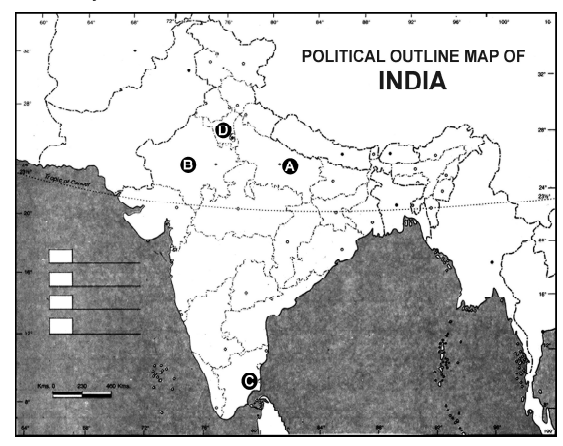
(1) The State to which the former Congress President K. Kamraj belonged.
[1 Mark](2) The State from where the phrase ‘Aya Ram, Gaya Ram’ originated.
[1 Mark](3) The State where the Congress Party did not get majority in 1967 assembly elections.
[1 Mark](4) The State to which former Prime Minister Lal Bahadur Shastri belonged.
[1 Mark](5) Name the State where the Congress Party did not get majority in the 1967 assembly elections.
(6) The phrase ‘Aya Ram, Gaya Ram’ originated from which State ?
(7) The former Congress President K. Kamraj belonged to which State ?
(8) Name the State to which the former Prime Minister Lal Bahadur Shastri belonged.
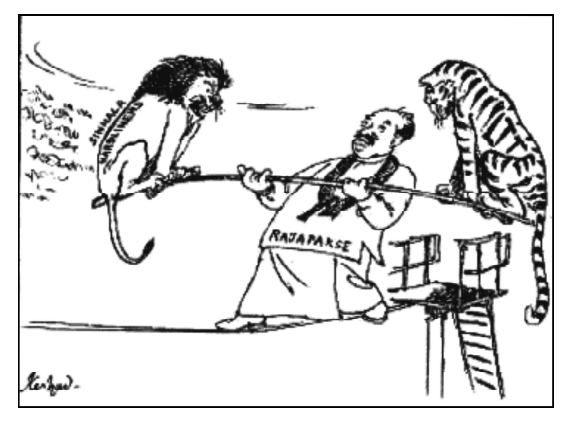
(1) Which community does the tiger shown in the cartoon represent?
[1 Mark](2) Which community does the Lion shown in the cartoon represent?
[1 Mark](3) What did the balancing act by Rajapaksa aim at? Explain.
[2 Marks](4) Name the two main communities of Sri Lanka.
(5) Write the correct expansion of LTTE.
(6) In which year did Sri Lanka get independence ?
(7) Name the country which mediated in the Ethnic conflict of Sri Lanka.
Section B
Arrange the following events in chronological order and choose the correct option as answer:
(i) The Russian Revolution
(ii) The Soviet invasion of Afghanistan
(iii) The disintegration of Soviet Union
(iv) The end of the World War II
People who seek better economic opportunities abroad are called:
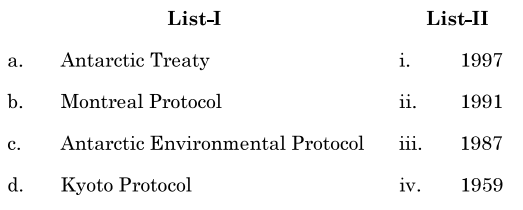
Match List-I correctly with List-II:
Assertion (A) : India, China and other developing countries were exempted from the requirements of Kyoto Protocol.
Reason (R) : Their contribution to the emission of green house gases during the industrialisation period was not significant.
Assertion (A) : The Mizo National Front (MNF) started an armed campaign for independence.
Reason (R) : After independence the Mizo Hill area was made an autonomous district within Assam.
Section C
Which region of India is referred to as the 'Seven Sisters'?
Who led the 'People’s March' to the Parliament in 1975?
Which two states witnessed student agitations against rising food prices in 1974?
Which two states witnessed student agitations against rising food prices in 1974?
Which political party secured the second most Lok Sabha seats in India's first general elections?
When were the first general elections in India finally held?
Which regional organization is associated with Southeast Asian nations?
Section D
Why did the people of East Pakistan resent the domination of West Pakistan? Explain the reason.
“Terrorism is a new threat to security.” Support the statement.
Why was India’s experiment with universal adult franchise described as 'bold and risky'? Explain.
Section E
Section F
Analyse any four factors that make the European Union an influential regional organisation of the world.
Analyse any four objectives of establishing the regional organisations.
Describe the composition of the United Nations Security Council and the suggested reforms to make it more relevant.
Describe any four changes that occurred in world politics after the end of Cold War.
Describe any four consequences of the partition of British India in 1947.
Describe any three problems that were faced during the process of partition of British India.
Explain any three important issues on which a consensus has émerged among most political parties of India.
Explain any three benefits of the coalition governments formed in India since 1989.
Paper Details
CBSE Board Exam 2024
Class
Class 12 Humanities
Subject
Political Science
Year
2024
Set
Set 4
Other Years — Political Science