QUESTION PAPER
2023 BOARD EXAM
CBSE Class 12 Humanities Political Science Board Paper 2023 — Set 2
2023
Political Science
Class 12 Humanities
CBSE EXAMINATION PAPER-2023
POLITICAL SCIENCE
(Solved)
General Instructions :
Read the following instructions carefully and follow them :
- This question paper contains 41 questions. All questions are compulsory.
- This question paper is divided into 6 sections.
- Section A – questions number 1 to 3 are case based questions
- Section B – questions number 4 to 15 are multiple choice questions
- Section C – questions number 16 to 22 are very short answer
- Section D – questions number 23 to 28 are short answer
- Section E – questions number 29 to 33 are long answer type i
- Section F – questions number 34 to 41 are long answer type ii
- There is no overall choice given in the question paper. However, an internal choice has been provided in few questions.
- Use of calculator is NOT allowed.
Section A
Read the following passage carefully and answer the questions that follow:
India conducted a series of nuclear tests demonstrating its capacity to use nuclear energy for military purposes. After this, Pakistan also conducted tests. International Community imposed sanctions on both India and Pakistan which were subsequently waived. India opposed the international treaties aimed at non-proliferation.
(1) Identify the treaty that India refused to sign. (a) Comprehensive Test Ban Treaty (b) Shimla Agreement (c) Panchsheel Agreement (d) Indus waters Treaty
(2) In which year did India conduct a series of nuclear tests? (a) 1971 (b) 1985 (c) 1992 (d) 1998
(3) Under whose guidance did India initiate its nuclear programme? (a) C.V. Raman (b) Homi J. Bhabha (c) A.P.J.Abdul Kalam (d) K. Kasturirangan
(4) In the beginning, India wanted to generate nuclear energy for (a) peaceful purpose. (b) making atomic bombs. (c) competing with the super powers. (d) ensuring its security.
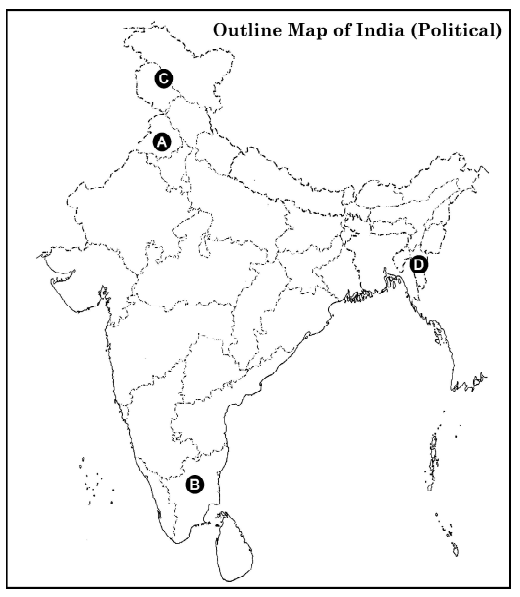
(1) The state which has been bifurcated into two Union Territories recently.
[1 Mark](2) The state where Rajiv Gandhi — Longowal Accord was signed.
[1 Mark](3) The state from where the Dravidian Movement started.
[1 Mark](4) The state to which Laldenga belonged.
[1 Mark](5) Article 370 has been abolished from which State ?
(6) Which State was created on language basis in 1966 ?
(7) In which State was the former Prime Minister Rajiv Gandhi assassinated ?
(8) In which state did Laldenga lead a separatist movement ?
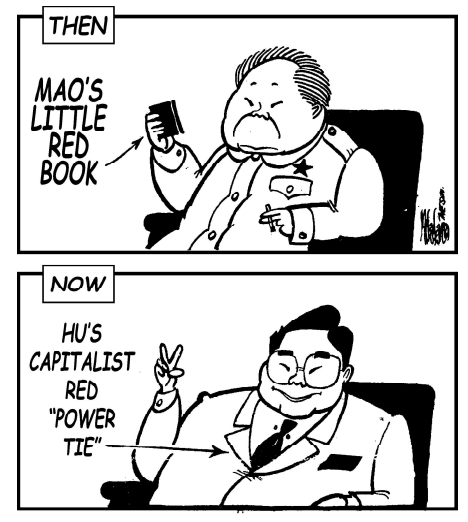
(1) To which country are these two cartoons related? (a) Japan (b) Vietnam (c) South Korea (d) China
(2) Red Book is related to which ideology? (a) Capitalism (b) Communism (c) Humanism (d) Terrorism
(3) What does the ‘Red Power Tie’ depict? (a) Negation of communism (b) Acceptance of Capitalism (c) Coordination of communism with Capitalism (d) Negation of Capitalism
(4) What is the difference between ‘then’ and ‘now’ as per the cartoon? (a) ‘Rigidity’ has increased now in the ideology of ‘then’ (b) Rigidity has decreased ‘now’ in the ideology of ‘then’. (c) The leader under ‘then’ and the leader under ‘now’ belong to different political parties. (d) The Leader under ‘then’ and the leader under ‘now’ belong to different organisations.
(5) In 1982, which one of the following changes was made in China ? (a) Privatisation of industries was done. (b) China ended its political and economic isolation. (c) Special economic zones were established. (d) Privatisation of agriculture was done.
(6) Which one of the following ideologies is followed by India ? (a) Liberalism (b) Socialism (c) Capitalism (d) Communism
(7) Which one of the following symbols is NOT related to China ? (a) The Great Wall (b) Dragon (c) Bicycle (d) Rising Sun
(8) Which one of the following statements is true about China ? (a) It is a republic (b) It is a monarchy (c) It has multiparty system (d) It has a coalition government
Section B
Assertion (A) : In 1969 the Congress Party faced a split.
Reason (R) : Factional rivalry existed between the Congress Syndicate and Indira Gandhi.
Arrange the following in chronological order:
(i) Implementation of recommendations of Mandal Commission.
(ii) Appointment of Manmohan Singh as Prime Minister for the first time.
(iii) Signing of the Punjab Accord with Longowal.
(iv) Appointment of Rajiv Gandhi as Prime Minister. Choose the correct option.
Section C
Which country was not a part of the Soviet Union?
What was the code name of the 2003 US invasion of Iraq?
What is the main objective of the United Nations?
Which of the following is not a global common: Antarctica, Ocean floor, Outer space, or Forests?
Who advanced the Two Nation Theory?
Name any one programme launched after 2014 for women's progress.
Who among the following remained Prime Minister of India for less than a year?
Section D
Section E
Section F
Analyse any three happenings during Gorbachev’s period that led to the disintegration of the Soviet Union.
Analyse any three consequences of the disintegration of USSR.
Highlight any three features of the First Five Year Plan.
Highlight any three problems faced by Government of India immediately after independence related to the displaced population.
Assess any three effects of Emergency imposed in 1975 in strengthening the democracy in India.
Assess the impact of three democratic upsurges in post independent India.
Evaluate any three steps taken by the Chinese leadership for the growth of Chinese economy.
Analyse any three major happenings in Bangladesh that show peoples’ support to democracy.
Paper Details
CBSE Board Exam 2023
Class
Class 12 Humanities
Subject
Political Science
Year
2023
Set
Set 2
Other Years — Political Science