Section B
[1 Mark]
-
(A) the founder of the Communist Party of Russia
-
(B) General Secretary of the Communist Party of USSR
-
(C) a leader against reforms in the USSR
-
(D) a leader of Western European countries
Explanation: The correct option is 'General Secretary of the Communist Party of USSR' because Mikhail Gorbachev held this position starting in 1985 and was the last leader of the Soviet Union. He initiated significant reforms in the political and economic systems, known as perestroika and glasnost.
[1 Mark]
-
(A) Social movement
-
(B) Cultural movement
-
(C) Political movement
-
(D) Environmental movement
Explanation: The Arab Spring was a political movement characterized by mass protests and uprisings in various Arab countries, calling for democratic reforms and an end to authoritarian regimes. This aligns with the context mentioning social movements as a platform for new political actions, demonstrating the Arab Spring's role in promoting political change.
[1 Mark]
-
(A) United Nations Human Rights Commission
-
(B) United Nations Security Council
-
(C) ASEAN
-
(D) Amnesty International
Explanation: The correct option is 'United Nations Security Council' because it is primarily responsible for maintaining international peace and security, preventing conflicts through diplomatic efforts, and can take action against threats to peace. While ASEAN also promotes peace within its region, the UN Security Council has a broader mandate and authority in addressing international conflicts.
[1 Mark]
-
(A) Global warming
-
(B) International terrorism
-
(C) Epidemics
-
(D) Rising prices
Explanation: Rising prices are primarily an economic issue and do not directly threaten global security like global warming, international terrorism, and epidemics do, as these directly impact human safety, health, and the environment.
[1 Mark]
-
(A) (ii), (iii), (iv)
-
(B) (i), (ii), (iii)
-
(C) (i), (iii), (iv)
-
(D) (i), (ii), (iv)
Explanation: Environmental concerns are an important part of global politics. The Earth Summit was held in Rio de Janeiro in 1992 and was organised by the United Nations. However, environmental programmes are handled by UNEP (United Nations Environment Programme), not the UN Human Rights Commission. Hence, (i), (ii), and (iv) are correct.
[1 Mark]
-
(A) The formation of United Nations
-
(B) The development of new technology
-
(C) The establishment of the World Bank
-
(D) The rise of economy in India and China
Explanation: The development of new technology is the main cause of globalization as it has revolutionized communication and facilitated interactions across the globe, as highlighted in the context provided. Innovations such as the telegraph, telephone, and microchip have drastically changed how countries connect with one another.
[1 Mark]
-
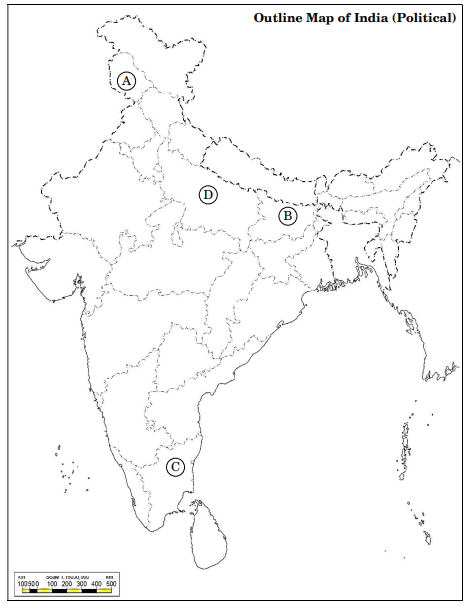
(A) Manipur, Tripura, Nagaland
-
(B) Assam, Manipur, Chhattisgarh
-
(C) Jharkhand, Nagaland, Uttarakhand
-
(D) Manipur, Maharashtra, Mizoram
Explanation: The correct option is 'Manipur, Tripura, Nagaland.' These states are part of the North-East region of India, as mentioned in the context. The context clearly lists Arunachal Pradesh, Assam, Nagaland, Manipur, Tripura, Mizoram, and Meghalaya as the states that constitute the North-East India, while the other options include states like Chhattisgarh, Jharkhand, Uttarakhand, and Maharashtra, which do not belong to this region.
[1 Mark]
-
(A) mixed economy
-
(B) planned development
-
(C) socialism
-
(D) industrialisation
Explanation: The correct option is 'planned development'. The context states that India initiated development planning as an instrument for rapid economic progress after independence. The Planning Commission was established to coordinate and supervise the management of resources for planned development, reflecting the focus on structured economic strategies.
[1 Mark]
-
(A) George Fernandes
-
(B) Jayaprakash Narayan
-
(C) Ram Manohar Lohia
-
(D) Morarji Desai
Explanation: The correct answer is George Fernandes, as he led the National Coordination Committee for Railwaymen’s Struggle which called for the nationwide strike due to demands related to bonus and service conditions.
[1 Mark]
-
(A) (i), (ii), (iii), (iv)
-
(B) (ii), (i), (iv), (iii)
-
(C) (iv), (ii), (i), (iii)
-
(D) (iv), (i), (ii), (iii)
Explanation: The correct chronological order is (iv), (i), (ii), (iii). Jammu and Kashmir was a Princely State (iv), before October 1947 when Pakistan sent tribal infiltrators to Kashmir (i). Following that, Sheikh Abdullah became the Prime Minister of Jammu and Kashmir in 1948 (ii). The Punjab Accord signed by Longowal and Rajiv Gandhi occurred later in 1985 (iii).
[1 Mark]
-
(A) Indira Gandhi
-
(B) Manmohan Singh
-
(C) Rajiv Gandhi
-
(D) Inder Kumar Gujral
Explanation: The correct answer is Rajiv Gandhi. He is credited with initiating changes that led to economic reforms in India, which became prominently visible in 1991. His efforts in promoting a more open economy and pressing for advancements in technology laid the groundwork for the structural adjustment programme.
[1 Mark]
-
(A) Assertion (A) is true, but Reason (R) is false.
-
(B) Both Assertion (A) and Reason (R) are true, but Reason (R) is not the correct explanation of the Assertion (A).
-
(C) Both Assertion (A) and Reason (R) are true and Reason (R) is the correct explanation of the Assertion (A).
-
(D) Assertion (A) is false, but Reason (R) is true.
Explanation: In May 1977, the Janata Party government set up the Shah Commission under Justice J.C. Shah. It was specifically appointed to investigate the circumstances and misuse of authority related to the declaration of the Emergency by Indira Gandhi’s government in 1975. Therefore, both statements are true and (R) correctly explains (A).
Section C
[1 Mark]
Answer: Mikhail Gorbachev, born in 1931, was the last leader of the Soviet Union from 1985 to 1991. He introduced significant reforms like perestroika (restructuring) and glasnost (openness) aimed at modernizing the Soviet economy and political structure. Gorbachev also worked to normalize relations with the West, withdrew troops from Afghanistan, and played a crucial role in the dissolution of the Soviet Union amidst internal crises and democratization efforts.
Key Points: Last leader from 1985-1991 - Introduced perestroika and glasnost - Aimed to modernize the USSR - Normalized relations with the West - Withdrew troops from Afghanistan - Played a role in the USSR's dissolution
[1 Mark]
Answer: The Arab Spring was a series of anti-government protests and uprisings that began in late 2010 in various Arab countries, including Tunisia, Egypt, and Libya. These movements aimed to challenge authoritarian regimes and demanded political freedom, social justice, and economic reforms. Triggered by economic issues, rising unemployment, and oppression, the Arab Spring led to significant political changes but also resulted in violence and instability in some regions. Citizens sought to express their aspirations for democracy and better governance.
Key Points: series of protests in Arab countries-economic issues leading to rebellion-demand for democracy and social justice-political changes and instability as a result
[1 Mark]
Answer: The United Nations (UN) is a key organization that works to prevent international conflicts. It facilitates discussions among countries to address contentious issues peacefully, promoting cooperation and stability. Through various peacekeeping missions and diplomatic negotiations, the UN aims to resolve conflicts without resorting to war. The organization also engages in initiatives to support human rights and economic development, further contributing to global peace and security.
Key Points: United Nations (UN)-peacekeeping-diplomatic negotiations
[1 Mark]
Answer: Rising prices are not considered a direct threat to global security compared to global warming, international terrorism, and epidemics. While rising prices can create economic challenges and contribute to instability, they do not pose an immediate existential threat to nations or groups. Conversely, global warming can lead to significant environmental changes, international terrorism threatens lives and stability, and epidemics can result in widespread health crises, all of which can fundamentally threaten human existence and dignity.
Key Points: global warming poses existential threats; international terrorism endangers lives; epidemics cause widespread health crises; rising prices, while impactful, are not immediate threats; definition of global security includes threats to existence and dignity
[1 Mark]
Answer: The call for a nationwide railway strike in 1974 was given by the National Coordination Committee for Railwaymen’s Struggle, which was led by George Fernandes. This strike aimed to address the demands of railway employees concerning bonuses and their service conditions, amidst opposition from the government. The strike had a significant impact, paralyzing rail operations and highlighting labor rights issues.
Key Points: National Coordination Committee for Railwaymen’s Struggle - George Fernandes - Nationwide strike - 1974 - Demands related to bonuses and service conditions - Government opposition
[1 Mark]
Answer: The Indian Prime Minister who first initiated economic reforms in the country was Rajiv Gandhi. Although these reforms began to take shape in the mid-1980s, they became prominent in 1991, during India's economic crisis. Rajiv Gandhi's approach aimed to deregulate sectors, enhance trade, and attract foreign investment, fundamentally altering India's economic landscape, which had been characterized by sluggish growth since independence.
Key Points: Rajiv Gandhi started reforms-1991 as a response to economic crisis-de-regulated trade and investment-fundamentally changed economy
[1 Mark]
Answer: The first coalition government in India was formed in 1977. This government was created when various non-Congress parties came together after the 1977 general elections, following a period of Congress dominance. The coalition was established in response to the political dynamics of the time, marking a significant shift in Indian politics towards multi-party coalitions.
Key Points: First coalition government formed in 1977 - Response to non-Congress parties uniting - Marked a shift in Indian political dynamics
Section D
[2 Marks]
Answer: The 'ASEAN Way' emphasizes non-confrontation and cooperation among member states. This approach promotes an informal and respectful dialogue, allowing nations to to address conflicts through negotiation rather than confrontation. Another significant feature is the strong commitment to national sovereignty. ASEAN operates with a principle of non-interference in the internal affairs of member countries, which fosters an environment where national interests are prioritized and respected. This unique blend of cooperation and respect for sovereignty underpins the stability and growth of the region.
Key Points: Non-confrontation and cooperation; respect for national sovereignty.
[2 Marks]
Answer: The United Nations showcases its strength through various initiatives that foster international cooperation. One major example is its role in peacekeeping missions, such as those in the Democratic Republic of the Congo, where UN forces work to stabilize conflict-affected areas and protect civilians. Another example is the UN's involvement in climate action, particularly through the Paris Agreement, where it facilitates dialogue among countries to address climate change collectively. These efforts demonstrate the UN’s capacity to unite nations for global stability and cooperation.
Key Points: Peacekeeping missions, Global climate action, International cooperation
[2 Marks]
Answer: Security refers to the condition that ensures freedom from threats or harm to individuals and nations. In a broader context, it encompasses various dimensions, including traditional security that focuses on the state and its institutions, and non-traditional security which considers individual welfare and rights. It raises critical questions about who is being secured and from what kinds of threats. The discussion surrounding security often highlights its complexity, urging democratic participation in understanding and addressing these concerns.
Key Points: Definition of security as freedom from threats - Traditional vs. non-traditional security concept - Importance of context in determining security - Who is being secured and from what - Role of democratic participation in security discourse
[2 Marks]
Answer: Four regional parties that have formed their government in different states are the Dravida Munnetra Kazhagam (DMK) in Tamil Nadu, the Shiv Sena (SS) in Maharashtra, the Janata Dal (United) [JD(U)] in Bihar, and the Biju Janata Dal (BJD) in Odisha. The DMK came to power after a significant anti-Hindi agitation, reflecting regional pride. Similarly, the Shiv Sena has been influential in Maharashtra politics, advocating for Marathi identity. The JD(U) has played a pivotal role in Bihar, and the BJD has dominated Odisha's political landscape by focusing on regional issues.
Key Points: Dravida Munnetra Kazhagam (DMK) - Tamil Nadu; Shiv Sena (SS) - Maharashtra; Janata Dal (United) [JD(U)] - Bihar; Biju Janata Dal (BJD) - Odisha.
[2 Marks]
Answer: The Mandal Commission, officially the Second Backward Classes Commission, made several important recommendations. Firstly, it recommended the reservation of 27% of seats in educational institutions and government jobs for the Other Backward Classes (OBCs). This aimed to address the social and educational disparities faced by these groups. Secondly, the commission advocated for land reforms to improve the socio-economic conditions of the OBCs. These recommendations were significant in shaping policies towards backward communities in India.
Key Points: Reservation of 27% seats for OBCs in education and government jobs; Advocacy for land reforms to improve living conditions of OBCs; Addressing social and educational disparities.
[2 Marks]
Answer: The first coalition government in India was formed in 1989, marking the beginning of a new phase of coalition politics in the country. This development occurred because no single party managed to secure a majority in the Lok Sabha elections, prompting various non-Congress parties to come together and form a government. The rise of coalition governments reflected shifting political dynamics, highlighting the fragmented nature of party politics in India, making cooperation among parties essential to govern effectively.
Key Points: First coalition government in 1989 - Formed due to no single party achieving majority - Involved non-Congress parties coming together - Signified a shift in political dynamics in India - Highlighted fragmented party politics
Section E
[4 Marks]
Answer: UNICEF stands for the United Nations Children’s Fund. Established in 1946, its primary goal is to promote and protect the rights and well-being of children around the world. One key function of UNICEF is to provide emergency relief in cases of natural disasters and conflicts, ensuring that vulnerable children receive essential services like food, water, and healthcare. Another important function is to promote health and education initiatives globally, focusing on improving access to quality healthcare and education for children, particularly in disadvantaged communities. These efforts aim to create a better future for children and ensure their rights are upheld.
Key Points: Full form: United Nations Children’s Fund; Function 1: Provide emergency relief for children in crises; Function 2: Promote health and education initiatives globally.
[4 Marks]
Answer: Globalization has profoundly influenced my daily life in multiple ways. Firstly, it has diversified my food choices. With global trade networks, I can enjoy cuisines from around the world, such as sushi from Japan, pasta from Italy, and tacos from Mexico. This culinary variety enriches my eating habits and exposes me to different cultures. Secondly, globalization has impacted my fashion choices, allowing me to access international brands and styles. I can easily buy clothes from global retailers through online shopping, which allows me to express my individuality while participating in a global fashion trend. However, this also raises concerns about cultural homogenization, where local traditions may be overshadowed by dominant global cultures. Overall, globalization shapes both my consumption patterns and cultural identity.
Key Points: Diverse food choices; Exposure to different cultures through cuisines; Access to international fashion and brands; Impact of online shopping; Cultural homogenization concerns
[4 Marks]
Answer: To conserve natural resources, one effective measure is to promote afforestation while protecting existing forests. Planting new trees helps increase green cover, which stabilizes the climate, balances water supplies, and enhances biodiversity. Another significant measure is the adoption of renewable energy sources, such as solar, wind, and biodiesel. By using cleaner energy options, we can reduce dependence on fossil fuels, decrease pollution, and mitigate the effects of climate change. These actions are crucial for sustainable development and maintaining ecological balance.
Key Points: Afforestation and reforestation - Increase green cover, stabilize climate; Adoption of renewable energy - Reduce fossil fuel dependence, decrease pollution.
[4 Marks]
Answer: India-Israel relations are characterized by various significant features that enhance their bilateral ties. Firstly, strong defense cooperation is a cornerstone, with Israel supplying advanced military technology and weapons systems to India, which has bolstered India's defense capabilities. Secondly, both nations share common interests in counter-terrorism, collaborating on intelligence sharing and joint military exercises. Thirdly, their relationship includes extensive trade relations, notably in sectors like agriculture, water management, and technology, which benefit both economies. Lastly, cultural exchanges and people-to-people contact have flourished, fostering mutual understanding and strengthening diplomatic ties. Overall, India-Israel relations are comprehensive, covering various domains and contributing to regional stability.
Key Points: Defense cooperation; counter-terrorism collaboration; extensive trade relations; cultural exchanges
[4 Marks]
Answer: Indira Gandhi, during her tenure as Prime Minister, implemented several significant measures to combat poverty in India. First, she launched the 'Garibi Hatao' campaign, which aimed to mobilize support among the economically disadvantaged, including landless laborers, Dalits, and the unemployed youth. Second, she focused on the growth of the public sector to provide more job opportunities and services. Third, she imposed ceilings on rural land holdings and urban properties to curtail wealth concentration and promote equitable distribution of land. Lastly, she actively worked on the implementation of land reform laws and introduced further legislation, ensuring that these laws were effectively executed to benefit the marginalized segments of society. These initiatives underscored her commitment to social justice and poverty alleviation.
Key Points: Launch of 'Garibi Hatao' campaign; Growth of the public sector; Imposition of land holding ceilings; Implementation of land reform laws
Section F
[6 Marks]
Answer: The disintegration of the Soviet Union can be attributed to several critical factors. Firstly, the rise of nationalism played a crucial role, particularly in the Baltic republics and Ukraine, where people sought independence and sovereignty from Russian dominance. Secondly, the excessive centralization of power led to discontent among various ethnic groups who felt marginalized and oppressed within the Soviet framework. Lastly, the economic inefficiencies and reforms initiated by Mikhail Gorbachev, such as glasnost and perestroika, aimed to revitalize the economy but ultimately exposed the flaws within the system and weakened the grip of the Communist Party. These elements combined to erode the unity of the Soviet Union, leading to its eventual collapse.
Key Points: Nationalism and desire for sovereignty; Excessive centralization of power; Economic inefficiencies and Gorbachev's reforms
[6 Marks]
Answer: The Arab Spring, which began in 2010, was largely fueled by widespread dissatisfaction with oppressive regimes and economic hardship. Firstly, the lack of democratic governance and the suppression of political dissent prompted citizens to demand greater freedoms. For instance, long-standing authoritarian leaders faced protests as people sought to influence political processes. Secondly, high unemployment rates and rising costs of living, exacerbated by global economic conditions, led to public unrest. The outcomes of the Arab Spring were significant. Many authoritarian governments were toppled, leading to greater political freedom in regions like Tunisia, which transitioned towards democracy. However, the movement also resulted in instability in several countries, such as Syria and Libya, where civil wars erupted, highlighting the complexity of achieving lasting democratic change. Ultimately, the Arab Spring illustrated the critical role of socioeconomic factors and popular participation in shaping political landscapes.
Key Points: Political oppression and lack of democracy; Economic challenges like unemployment and inflation; Successful regime changes in Tunisia; Emergence of civil wars in Libya and Syria; Increased political awareness and activism.
[6 Marks]
Answer: After gaining independence in 1947, India confronted several significant challenges as it sought to establish itself as a cohesive nation. Firstly, the challenge of national integration was paramount; with immense diversity in languages, cultures, and religions, fostering a unified national identity proved difficult. The second challenge revolved around economic stability, especially in the aftermath of the war with China and amidst food shortages caused by failed monsoons. This situation exacerbated poverty and threatened food security. Lastly, India faced the challenge of territorial integrity, notably during the conflict with Pakistan in 1965. These challenges required astute political leadership and social cooperation to navigate effectively, shaping the trajectory of modern India.
Key Points: National integration; economic stability; territorial integrity
[6 Marks]
Answer: Sardar Vallabhbhai Patel, as the Deputy Prime Minister and first Home Minister of independent India, played a pivotal role in the integration of the Princely States into the Indian Union. His approach was characterized by both firmness and diplomacy, crucial for navigating the complexities of this political task. For instance, during negotiations, Patel issued letters to princely rulers urging them to consider the overwhelming public support for joining India. In Hyderabad, Patel undertook a strategic approach leading to the successful police action known as 'Operation Polo', integrating the state without extensive bloodshed. Additionally, in the case of Junagadh, Patel's determination led to the invocation of democratic principles, resulting in a referendum that favored India. These examples illustrate Patel’s adeptness at combining negotiation with assertive action, ultimately ensuring a unified nation.
Key Points: Role as Deputy Prime Minister and Home Minister-Use of firm but diplomatic negotiations-Letter to princely rulers urging integration-Operation Polo in Hyderabad-Junahadh's referendum in favor of India
[6 Marks]
Answer: The European Union (EU) stands out as a robust regional organization due to its significant economic, political, and security capabilities. First, the EU has considerable economic power, serving as a major bloc within international organizations like the World Trade Organization (WTO). This enhances its influence in global trade negotiations and economic policies. Second, politically, the EU plays a crucial role in advocating common foreign and security policies, fostering unity among its member states. For example, France's permanent seat in the UN Security Council amplifies this influence, validating the EU's commitment to global stability. Lastly, the EU's expansion efforts include integrating former Soviet bloc states, reflecting its ability to forge alliances and promote cooperation, thereby increasing its geopolitical strength. In summary, through economic prowess, political influence, and successful expansion strategies, the EU asserts itself as an effective regional organization.
Key Points: Economic power in global trade-Political unity and influence-Focus on expansion and cooperation
[6 Marks]
Answer: The aspiration for democracy in South Asia is evident despite the challenges faced by its nations. Firstly, in India, democracy has thrived since independence, showcasing citizens' deep-rooted desire for a participative political system through regular elections and a vibrant civil society. Secondly, Sri Lanka, despite ethnic tensions, demonstrates public support for democratic governance, emphasizing the population's commitment to democratic values, evidenced by their participation in elections. Lastly, Nepal's transition from monarchy to federal democratic republic highlights the people's yearning for political representation, with mass movements advocating for democracy. These examples illustrate that, across South Asia, people are united in their support for democratic principles, underscoring a collective aspiration for empowered governance.
Key Points: India's long-standing democracy and civil engagement; Sri Lanka's continual support for democratic values despite challenges; Nepal's transition from monarchy to democracy as a reflection of popular desire for political representation.
[6 Marks]
Answer: The dominance of the Congress Party in Indian politics during the first two decades post-independence can be attributed to several significant factors. Firstly, the Congress was the leading force during the national movement for independence, which granted it substantial legitimacy and support among the populace. Its all-inclusive nature appealed to varied social groups, ensuring widespread representation and loyalty. Secondly, the party's ability to adapt to changing political landscapes under the leadership of Indira Gandhi helped it address internal divides and external challenges, maintaining its electoral success. Lastly, Congress's implementation of progressive policies aimed at ensuring social justice and economic development resonated with the masses, reinforcing its status as a dominant political force. Together, these factors established a robust foundation for the Congress party's long-standing influence in Indian politics.
Key Points: Congress as a national movement; all-inclusive nature of Congress; leadership of Indira Gandhi; response to opposition challenges; progressive policies promoting social justice; democratic victory in free elections
[6 Marks]
Answer: The declaration of Emergency in India on June 25, 1975, can be attributed to several interrelated factors. First, there was a perceived threat of internal disturbances, primarily due to rising political unrest and opposition movements against the government of Prime Minister Indira Gandhi. This unrest culminated in widespread protests, which created a sense of chaos and disorder that the government believed endangered national stability. Second, the relationship between the government and judiciary was increasingly strained, particularly following a Supreme Court ruling that upheld the right to free and fair elections. This ruling threatened Indira Gandhi's political power and prompted her to take drastic measures. Lastly, significant economic challenges, including high inflation and unemployment, exacerbated public discontent, prompting the government to declare a state of emergency to retain control. These reasons contributed to the imposition of extraordinary powers which allowed the government to suppress dissent and postpone elections, fundamentally altering the democratic landscape of India.
Key Points: Perceived threat of internal disturbances; Tensions between government and judiciary; Economic challenges leading to public discontent