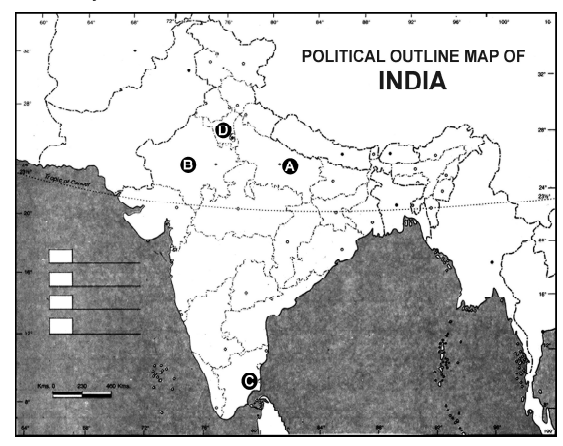
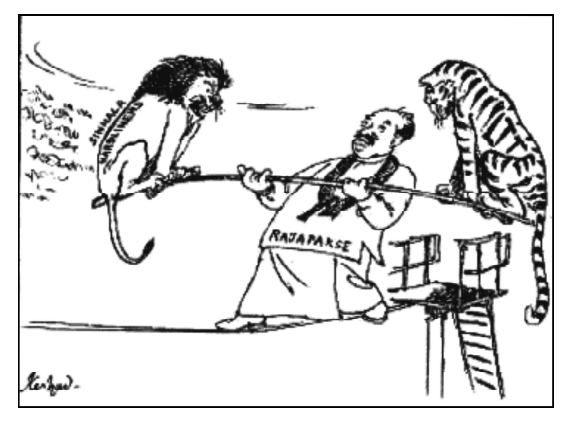
Section B
[1 Mark]
-
(A) (i), (iv), (ii), (iii)
-
(B) (i), (ii), (iv), (iii)
-
(C) (i), (ii), (iii), (iv)
-
(D) (i), (iii), (iv), (ii)
Explanation: The Russian Revolution took place in 1917. World War II ended in 1945. The Soviet invasion of Afghanistan occurred in 1979, and finally, the disintegration of the Soviet Union happened in 1991. Hence, the correct chronological order is (i), (iv), (ii), (iii).
[1 Mark]
-
(A) Tajikistan
-
(B) Kazakhstan
-
(C) Uzbekistan
-
(D) Azerbaijan
Explanation: The correct answer is Tajikistan, as stated in the provided context, which specifically mentions that Tajikistan experienced a civil war that lasted for ten years until 2001.
[1 Mark]
-
(A) Alliance Building
-
(B) Confidence Building
-
(C) Arms control
-
(D) Balance of Power
Explanation: The correct answer is 'Confidence Building' because the context explicitly defines confidence building as a process where countries share ideas and information with their rivals, informing each other about military intentions and plans to avoid misunderstandings that could lead to conflict.
[1 Mark]
-
(A) Immigrants
-
(B) Non-Residents
-
(C) Migrants
-
(D) Refugees
Explanation: The correct answer is 'Migrants'. According to the context provided, migrants are defined as individuals who voluntarily leave their home countries in search of better economic opportunities, differentiating them from refugees who flee due to war, natural disasters, or political persecution.
[1 Mark]
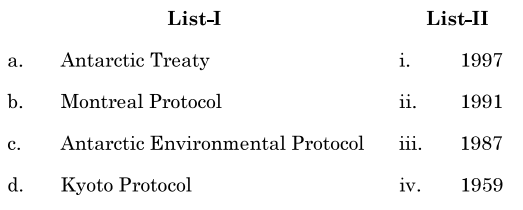
-
(A) a-iii, b-i, c-iv, d-ii
-
(B) a-ii, b-iv, c-i, d-iii
-
(C) a-iv, b-iii, c-ii, d-i
-
(D) a-i, b-ii, c-iii, d-iv
Explanation: The Antarctic Treaty was signed in 1959 (iv). The Montreal Protocol was adopted in 1987 (iii). The Antarctic Environmental Protocol (Madrid Protocol) was signed in 1991 (ii). The Kyoto Protocol was adopted in 1997 (i). Hence, the correct matching is a-iv, b-iii, c-ii, d-i.
[1 Mark]
-
(A) (A) is correct and (R) is incorrect.
-
(B) Both (A) and (R) are correct and (R) is not the correct explanation of (A).
-
(C) Both (A) and (R) are correct and (R) is the correct explanation of (A).
-
(D) (A) is incorrect and (R) is correct.
Explanation: Both (A) and (R) are correct and (R) is the correct explanation of (A). India, China, and other developing countries were indeed exempted from the Kyoto Protocol's requirements due to their historically low contributions to greenhouse gas emissions during the industrialization period. This aligns with the context stating that their per capita emissions are significantly lower compared to developed countries, thus justifying their exemption.
[1 Mark]
-
(A) W. Bengal
-
(B) Tripura
-
(C) Manipur
-
(D) Kerala
Explanation: The correct answer is Kerala. According to the context, the Communist Party won a significant number of seats in the 1957 assembly elections in Kerala, securing 60 out of 126 seats and forming a government for the first time through democratic elections. This event marked a historical moment as it was the first instance in the world where a communist party came to power through such a method.
[1 Mark]
-
(A) S.L. Shakdhar
-
(B) Sukumar Sen
-
(C) R.K. Trivedi
-
(D) K.V.K. Sundaram
Explanation: The correct answer is Sukumar Sen, as stated in the provided context that he became the first Chief Election Commissioner when the Election Commission of India was established in January 1950.
[1 Mark]
-
(A) 1950
-
(B) 1960
-
(C) 1962
-
(D) 1954
Explanation: The correct answer is 1950, as the context explicitly states that China annexed Tibet in 1950, which removed a historical buffer between India and China.
[1 Mark]
-
(A) Both (A) and (R) are correct and (R) is not the correct explanation of (A).
-
(B) Both (A) and (R) are correct and (R) is the correct explanation of (A).
-
(C) (A) is incorrect and (R) is correct.
-
(D) (A) is correct and (R) is incorrect.
Explanation: The Mizo National Front (MNF) did start an armed movement for independence in 1966. It is also true that after independence, the Mizo Hills were made an autonomous district within Assam. However, this administrative arrangement was not the direct reason for the armed campaign. Therefore, both statements are correct, but (R) does not correctly explain (A).
[1 Mark]
-
(A) British
-
(B) French
-
(C) Dutch
-
(D) Portuguese
Explanation: The correct answer is 'Dutch' because India, under Nehru's leadership, actively supported Indonesia's struggle for freedom from Dutch colonial rule. This is specifically mentioned in the context where it states that India convened an international conference in 1949 to help Indonesia achieve its independence.
[1 Mark]
-
(A) Manipur
-
(B) Assam
-
(C) Nagaland
-
(D) Arunachal Pradesh
Explanation: The correct answer is Assam. The provided context explains that the Karbis community, along with the Dimasas, has been granted autonomy under District Councils while remaining in Assam, indicating that they are primarily located in this state.
Section C
[1 Mark]
Answer: The region of India referred to as the 'Seven Sisters' consists of Arunachal Pradesh, Assam, Nagaland, Manipur, Tripura, Mizoram, and Meghalaya. This designation highlights the unique cultural and geographical diversity of these northeastern states. Additionally, Sikkim is considered the 'Brother' to these states, completing the region's representation. This combination of states has significant cultural and social distinctiveness, enhancing India’s diversity.
Key Points: Seven sisters are Arunachal Pradesh, Assam, Nagaland, Manipur, Tripura, Mizoram, Meghalaya-Sikkim is the 'Brother'-Northeast's cultural diversity.
[1 Mark]
Answer: The 'People’s March' to the Parliament in 1975 was led by Jayaprakash Narayan, commonly known as JP. He mobilized a significant number of citizens and various non-Congress opposition parties, uniting them against the issues of rising prices, food scarcity, unemployment, and corruption. This march marked one of the largest political rallies in the history of the capital, showcasing widespread public dissatisfaction with the government's policies.
Key Points: Jayaprakash Narayan (JP)-1975 'People’s March'-largest political rally-non-Congress opposition-unemployment-corruption
[1 Mark]
Answer: The two states that witnessed student agitations against rising food prices in 1974 were Gujarat and Bihar. In Gujarat, the agitation began in January 1974, focusing on the rising prices of food grains and corruption. Similarly, in Bihar, students protested in March 1974 against the economic hardships, including food scarcity and unemployment. These movements marked significant student unrest during that period, showcasing widespread dissatisfaction with the prevailing political and economic conditions.
Key Points: Gujarat- Bihar- Student agitations- Rising food prices- Corruption- January 1974- March 1974- Economic hardships
[1 Mark]
Answer: In 1974, student agitations against rising food prices were prominent in Gujarat and Bihar. In Gujarat, students initiated protests in January to address the escalating prices of food grains and corruption. Following this, in March, students in Bihar joined the movement to contest widespread food scarcity, unemployment, and corruption. Both movements reflected the broader dissatisfaction with economic conditions across India during that time.
Key Points: Gujarat-student agitation began in January 1974-rising food prices-corruption; Bihar-student protests in March 1974-food scarcity-unemployment-corruption; general dissatisfaction with economic situation in India
[1 Mark]
Answer: The party that secured the second most Lok Sabha seats in India's first general elections in 1952 was the Indian National Congress. Although many opposition parties garnered a significant percentage of votes across the country, the first-past-the-post electoral system meant that they could not convert those votes into a proportional number of seats. Thus, the Congress maintained its dominance by winning a vast majority of seats despite other parties having substantial voter support.
Key Points: Indian National Congress-second most Lok Sabha seats-1952 elections-first-past-the-post system-impact on seat distribution
[1 Mark]
Answer: The first general elections in India were held in 1952. The Election Commission of India was established in January 1950, and preparations began for these historic elections. They represented a significant milestone in India's democratic journey, as 17 crore eligible voters participated. Observers noted this unprecedented scale of electoral activity, marking India's elections as the largest democratic exercise in the world.
Key Points: First general elections in 1952-Election Commission established in January 1950-17 crore eligible voters participated
[1 Mark]
Answer: The regional organization associated with Southeast Asian nations is the Association of Southeast Asian Nations (ASEAN). Established to promote economic growth, political stability, and cultural cooperation among member countries, ASEAN emphasizes principles of non-interference and respect for national sovereignty. It facilitates dialogue both among its ten member states and with external partners to enhance regional peace and security. The organization plays a vital role in addressing collective regional challenges.
Key Points: ASEAN is a regional organization; promotes economic growth; emphasizes non-interference; respects national sovereignty; facilitates dialogue among member states; addresses regional challenges.
Section D
[2 Marks]
Answer: The people of East Pakistan resented the domination of West Pakistan due to several reasons. Firstly, there was unfair treatment towards the Bengali culture and language, with the imposition of Urdu leading to significant protests. The Bengalis demanded fair representation in administration and political power, which was continually denied by the West Pakistani rulers. Sheikh Mujib-ur Rahman emerged as a leader advocating for autonomy and a federation. The situation escalated when the Pakistani army arrested him and initiated terror against the East Pakistani populace, prompting a struggle for independence, which ultimately led to the creation of Bangladesh in 1971.
Key Points: Unfair treatment of Bengali culture and language - Demand for fair representation in administration - Sheikh Mujib-ur Rahman's leadership - Imposition of Urdu - Arrest of Mujib and rise of terror - Struggle for independence forming Bangladesh
[2 Marks]
Answer: Terrorism has evolved into a significant and contemporary threat to global security, especially since the attacks on September 11, 2001. These attacks heightened awareness and concern about potential threats, leading to a reevaluation of security protocols across the globe. Unlike traditional forms of violence, terrorist acts often target civilians in crowded places, creating widespread fear and instability. Additionally, modern terrorists utilize advanced communication technologies, forming international networks that can orchestrate attacks from various geographical locations. This complexity and the unpredictability of terror acts challenge traditional security measures, making terrorism a distinct and alarming phenomenon in today's world.
Key Points: Impact of 9/11 attacks-Heightened global awareness-New communication technologies-International terrorist networks-Targeting civilians-Need for modern security measures
[2 Marks]
Answer: On the eve of India's independence, two prominent models of development were prominently considered: the liberal-capitalist model and the socialist model. The liberal-capitalist model, prevalent in Europe and the United States, emphasized economic growth, individual entrepreneurship, and material progress, encouraging competition and trade. In contrast, the socialist model, primarily associated with the USSR, advocated for state intervention in the economy, aiming for equitable distribution of resources and welfare for all citizens. These models represented distinct ideological paths for post-independence India.
Key Points: liberal-capitalist model; socialist model; economic growth; individual entrepreneurship; state intervention; equitable distribution of resources
[2 Marks]
Answer: India's experiment with universal adult franchise was termed 'bold and risky' due to the prevailing social and economic conditions. At the time of independence, India hosted a large population of illiterate individuals, which led many critics to doubt the feasibility of such a democratic measure. A British civil servant even predicted that such an attempt would be seen as absurd in the future. Furthermore, many countries were still grappling with gender and class-based voting rights, making India’s approach revolutionary. Despite skepticism, India's electoral process has largely succeeded, proving critics wrong and showcasing the political maturity of its populace. The establishment of an independent Election Commission has underscored the seriousness with which India approached this bold initiative.
Key Points: High illiteracy rates at independence-Global context of limited voting rights-Concerns raised by critics-Impact of universal franchise on democracy-Success of electoral process-Establishment of Election Commission
[2 Marks]
Answer: The balance of power is a vital component of traditional security, focusing on preventing military threats among nations. It operates on the premise that countries constantly assess their relative strength against others, particularly nearby states. A nation that perceives a potential threat from a stronger neighbor may strengthen its military capabilities to maintain this balance. Additionally, forming alliances plays a critical role in managing power dynamics. Through formal coalitions, countries coordinate strategies to repel threats and bolster mutual security. By maintaining a favorable balance of power, nations aim to deter aggression and ensure stability, making military capability a core element of their security policies.
Key Points: Definition of balance of power-Role in preventing threats-Military buildup to maintain strength-Importance of alliances in security-Deterrence through maintained balance
[2 Marks]
Answer: The Mandal Commission, established in 1978, is known for its significant recommendations aimed at improving the socio-economic conditions of Other Backward Classes (OBCs) in India. One of its primary recommendations was to reserve 27% of seats in educational institutions and government jobs for these backward classes, thus providing them with better access to opportunities. Additionally, the Commission also suggested implementing land reforms to help improve living conditions for the OBC population, aiming to empower and uplift these communities economically and socially.
Key Points: Reservation of 27% seats in educational institutions and government jobs; Land reforms to improve conditions for OBCs.
Section E
[4 Marks]
Answer: At the time of India's independence in 1947, the world was in turmoil. Following World War II, nations were focused on reconstruction, grappling with the legacies of colonialism and the emergence of new nations. India faced extraordinary challenges as it became independent. The partition led to mass violence and a humanitarian crisis, resulting in millions of displaced individuals. Moreover, the new nation had to address the vast diversity of cultures, languages, and religions within its borders while aiming for unity. Additionally, the British colonial legacy left unresolved international disputes and significant issues like poverty and social inequality. This complex backdrop made India's journey toward nation-building exceptionally challenging.
Key Points: Post-World War II reconstruction challenges- Emergence of nations from colonialism- Partition causing violence and displacement- Diversity in languages, cultures, and religions in India- Need for unity and accommodation- Legacy of unresolved international disputes- Task of poverty alleviation and addressing social inequalities
[4 Marks]
Answer: India has maintained strong relations with Russia post-Cold War through various significant examples. First, the Indo-Russian Strategic Agreement of 2001 established over 80 bilateral agreements, strengthening cooperation in defense, trade, and technology. Second, Russia has been a reliable ally for India on the Kashmir issue, consistently supporting India's stance in international forums. Third, Russia plays a crucial role in India's energy security, providing essential nuclear and hydrocarbon resources. Lastly, the military relationship remains robust, with India being one of Russia's largest arms importers, ensuring technological and defense collaboration that reinforces both nations' interests. These examples highlight the enduring partnership between India and Russia, characterized by mutual benefits and shared geopolitical goals.
Key Points: Indo-Russian Strategic Agreement of 2001; Support on Kashmir issue; Energy security cooperation; Strong military ties and arms trade
[4 Marks]
Answer: The imposition of Emergency in India from 1975 to 1977 offers significant lessons for democracy. Firstly, it highlighted the resilience of democratic practices. Despite the suspension of constitutional rights and democratic processes, the restoration to normal political functioning post-Emergency demonstrated that the core principles of democracy were deeply ingrained in the Indian populace. Secondly, it underscored the need for checks and balances within the government. The blatant misuse of power by the ruling party during the Emergency illustrated the importance of judicial independence and a vigilant media in safeguarding democracy. These lessons have shaped the understanding of democratic governance in India.
Key Points: Resilience of democracy, Restoration of democratic processes post-Emergency, Need for checks and balances, Misuse of power by the ruling party, Importance of judicial independence, Role of media in safeguarding democracy
[4 Marks]
Answer: The imposition of Emergency in India in 1975 had significant consequences that shaped the political landscape of the country. Firstly, it curtailed civil liberties, leading to the suppression of dissent and political opposition, with many leaders and activists imprisoned. Secondly, it resulted in the centralization of power under Prime Minister Indira Gandhi, as her government bypassed democratic norms. Thirdly, it created a backlash against the Congress Party, culminating in its defeat in the 1977 elections, reflecting the people's desire for a return to democratic governance. Lastly, the Emergency highlighted ambiguities in the Constitution regarding the declaration of emergency, prompting reforms that ensure such measures can only be invoked under clearly defined circumstances. Overall, the Emergency significantly impacted Indian democracy, emphasizing the need for vigilance in protecting democratic rights.
Key Points: Curtailment of civil liberties; Centralization of power; Backlash leading to Congress defeat in 1977; Highlighted constitutional ambiguities; Prompted reforms for future emergencies
[4 Marks]
Answer: Cultural homogenisation and cultural heterogenisation are two concepts that describe the effects of globalization on cultures. Cultural homogenisation refers to the process where cultures become more uniform, primarily under the influence of dominant cultures, often Western in nature. This results in a decline of local traditions and an increase in shared global practices. For instance, Western clothing styles have become prevalent globally, sometimes overshadowing indigenous attire. In contrast, cultural heterogenisation is the phenomenon where globalization leads to cultures becoming distinct and diverse as they interact and influence one another. This could be seen in the adaptation of cultural elements, like the fusion of Western and indigenous practices, creating hybrid cultures. While homogenisation threatens the uniqueness of cultures, heterogenisation emphasizes cultural exchange and the emergence of new identities. Understanding both processes highlights the complex interplay of cultural dynamics in the age of globalization.
Key Points: Cultural homogenisation leads to uniform cultures; it often promotes Western culture; an example is global clothing trends. Cultural heterogenisation emphasizes increased cultural diversity and distinctiveness; it creates hybrid cultures through interaction; it reflects cultural exchange rather than dominance.
[4 Marks]
Answer: Globalisation has significant economic consequences that can be both beneficial and detrimental. Firstly, it facilitates increased trade and market access for countries, allowing them to sell their goods and services on a global stage. This can boost a nation’s economy, create jobs, and increase overall wealth. However, a negative consequence is the potential job loss in certain sectors, particularly in industries that cannot compete with cheaper foreign imports. As companies move production to countries with lower labor costs, workers in developed nations may face unemployment or wage stagnation. Secondly, globalisation can lead to economic inequality. While some nations and sectors thrive, others may fall behind, widening the gap between the rich and the poor. This disparity can create social tensions and hinder overall development, leading many to argue that the negative aspects of globalisation may outweigh the positive, particularly for disadvantaged communities. Thus, while globalisation enhances global connectivity and economic opportunities, it also poses risks to job security and income equality.
Key Points: Increased trade and market access; Job loss in non-competitive sectors; Economic inequality between nations and communities; Social tension due to wealth disparity; Balancing positive and negative impacts of globalisation.
[4 Marks]
Answer: India has addressed the regional aspirations of its people through a democratic and flexible constitutional framework that encourages political expression without labeling it as anti-national. One prominent example is the Dravidian movement in Tamil Nadu, which sought to voice regional identities and political autonomy through peaceful means like public debates and elections. This movement successfully gained political power, influencing both state and national politics. Another example is the Punjab conflict, where the government intervened to address the aspirations of the Sikh community by granting more autonomy and creating a separate state. Despite facing challenges, the Indian state has maintained a balance between respecting regional aspirations and preserving national unity, demonstrating the strength of its democratic ethos.
Key Points: Democratic approach to diversity; Dravidian movement's use of democratic means; Example of Punjab and Sikh aspirations; flexible constitutional framework; maintaining balance between regionalism and national unity
Section F
[6 Marks]
Answer: The European Union (EU) is an influential regional organisation due to several key factors. First, its substantial economic power is exemplified by a projected GDP of approximately $19.35 trillion in 2024, positioning it as a significant player in global trade. Second, the EU's common currency, the euro, enhances its economic stability and competitiveness, challenging the dominance of the US dollar. Third, the EU's political and diplomatic influence is evident through its active participation in international organisations like the WTO and in global diplomatic relations. Lastly, the EU's shared foreign and security policies fortify its collective stance, enabling it to project military influence and maintain regional stability. This combination of economic, political, and military strengths contributes to the EU’s role as a major alternative power in a multipolar world.
Key Points: Economic power and GDP, Common currency (euro), Political and diplomatic influence in organizations, Shared foreign and security policies
[6 Marks]
Answer: Regional organisations play a vital role in enhancing cooperation and development among member countries. Firstly, one key objective is to foster economic integration, allowing member states to create a seamless trading environment that boosts regional economies and enhances global competitiveness. Secondly, these organisations aim to ensure regional stability and security by promoting dialogue and peaceful conflict resolution among nations. Thirdly, they facilitate cultural exchange, promoting mutual understanding and cooperation on social issues, which is critical in today’s globalized world. Lastly, regional organisations often act as a collective voice for member states in international forums, ensuring that their interests are represented and their concerns addressed on a global scale. This multifaceted approach not only supports the development of member countries but also contributes to a more stable and cooperative international environment.
Key Points: 1. Foster economic integration among member countries 2. Promote regional stability and security through dialogue 3. Facilitate cultural exchange and mutual understanding 4. Act as a collective voice in international forums
[6 Marks]
Answer: The United Nations Security Council (UNSC) currently consists of fifteen members: five permanent members (the United States, Russia, China, France, and the United Kingdom) and ten non-permanent members elected for two-year terms. This structure heavily favors the interests of these five permanent members, failing to adequately represent modern geopolitical realities and neglecting the voices of emerging powers and developing nations. Suggested reforms include expanding the number of permanent members to include countries such as India, Brazil, and Germany, reflecting their significant economic and political influence. Furthermore, reforms advocate for enhanced representation from Africa and Latin America, thereby ensuring a more equitable balance of power. These changes aim to align the UNSC's structure with the contemporary global political landscape, ensuring that its decisions reflect a broader array of values and interests. The challenge lies in reaching consensus among member states on the criteria and number of new members.
Key Points: Composition: 5 permanent members, 10 non-permanent members; Dominance of Western powers; Lacks equitable representation; Suggested reforms include expanding permanent membership; Consideration for emerging powers like India and Brazil; Ensure representation from Africa and Latin America; Align UNSC with contemporary political realities.
[6 Marks]
Answer: The end of the Cold War brought significant transformations in world politics. Firstly, the collapse of the Soviet Union in 1991 led to the dissolution of the Second World and the withdrawal of socialist regimes in Eastern Europe, fundamentally altering the global power dynamics. Secondly, the United States emerged as the unipolar superpower, establishing a dominance that reshaped international relations and led to concerns about unchecked American power. Thirdly, the role of the United Nations evolved, with increased expectations for it to manage global peace and security in a new context dominated by the US. Lastly, there was a growing emphasis on promoting democracy and capitalism worldwide, as nations began transitioning from authoritarian regimes to more democratic governance structures, influenced by Western ideals. These changes set the stage for a new era of global politics marked by both opportunities and challenges.
Key Points: Collapse of the Soviet Union; Emergence of the US as a superpower; Evolution of the UN's role; Promotion of democracy and capitalism worldwide
[6 Marks]
Answer: The partition of British India in 1947 led to several significant consequences. Firstly, it caused massive displacement, with millions of people forced to migrate across the newly drawn borders, leading to one of the largest human migrations in history. Secondly, the violence that erupted resulted in extensive communal riots, leaving hundreds of thousands dead and many more injured, creating a legacy of mistrust between communities. Thirdly, the partition necessitated the urgent integration of numerous princely states into the Indian Union, a complex process that required careful negotiation and intervention. Finally, the partition profoundly impacted the notion of secularism in India, as the violent religious nature of partition raised concerns about communal harmony and the protection of minority rights in the new nation-states.
Key Points: Massive displacement and migration; widespread communal violence and casualties; integration of princely states into Indian Union; challenges to secularism and minority rights
[6 Marks]
Answer: The partition of British India in 1947 was fraught with numerous challenges. Firstly, the division was based on religious majorities, leading to significant violence and communal riots. As communities were forced to relocate, millions faced persecution and loss of life. Secondly, the bifurcation of provinces like Punjab and Bengal was highly contentious due to overlapping populations, resulting in many individuals discovering they were now minorities in their own homes. Lastly, the integration of princely states posed a complex issue, as many princely rulers were reluctant to join either India or Pakistan, creating further instability. These problems not only caused immediate suffering but also had lasting effects on both nations.
Key Points: Communal violence due to religious majority principle; Bifurcation of Punjab and Bengal and the dilemmas of displaced populations; Challenges in integrating princely states into India.
[6 Marks]
Answer: In recent years, several key issues have garnered broad consensus among the political parties in India, highlighting a collective approach to pressing national concerns. Firstly, the need for economic reform has gained traction among major parties. This includes an agreement on liberalizing the economy to boost growth and compete globally. Secondly, there is an emerging consensus on the importance of national unity and integrity, particularly in addressing regional demands and autonomy movements, especially in Northeast India. Lastly, most parties concur on the significance of social justice, especially in addressing the needs and aspirations of marginalized communities. Such political agreements not only reflect a commitment to democratic processes but also ensure the stability and progress of the nation amidst diversities.
Key Points: Economic reforms, National unity and integrity, Social justice
[6 Marks]
Answer: Coalition governments in India since 1989 have brought several benefits to the political landscape. Firstly, they promote inclusivity by allowing diverse regional parties to participate in governance, which ensures representation of varied interests and perspectives in decision-making processes. Secondly, coalition governments foster stability through consensus-building, as they require cooperation and negotiation among different parties, helping to smoothen contentious issues. Finally, they enhance accountability, as these governments must cater to the needs of multiple stakeholders, leading to more diligent governance. This multi-party approach can mitigate the dominance of a single party and encourage collaborative politics, leading to policies that better reflect the multifaceted needs of India's diverse population.
Key Points: Inclusive representation of diverse regional interests; fosters consensus and political stability; enhances accountability and collaborative governance.