QUESTION PAPER

2024 BOARD EXAM

CBSE Class 12 Humanities Political Science Board Paper 2024 — Set 2

2024

Political Science

Class 12 Humanities

CBSE EXAMINATION PAPER-2024

POLITICAL SCIENCE

(Solved)

Time allowed : 3 hours

Maximum Marks : 106

General Instructions :

Read the following instructions carefully and follow them :

  1. This question paper contains 42 questions. All questions are compulsory.
  2. This question paper is divided into 6 sections.
  3. Section A – questions number 1 to 3 are case based questions
  4. Section B – questions number 4 to 9 are very short answer
  5. Section C – questions number 10 to 21 are multiple choice questions
  6. Section D – questions number 22 to 27 are short answer
  7. Section E – questions number 28 to 34 are long answer type i
  8. Section F – questions number 35 to 42 are long answer type ii
  9. There is no overall choice given in the question paper. However, an internal choice has been provided in few questions.
  10. Use of calculator is NOT allowed.

Section A

Question 1.

Read the following passage carefully and answer the questions that follow:

India is of the view that the major responsibility of curbing emission of greenhouse gases rests with the developed countries, which have accumulated emissions over a long period of time. India pointed out that the per capita emission rates of the developing countries are a tiny fraction of those in the developed world.

(1)

Why were some developing countries exempted from the requirements of the Kyoto Protocol?

(A) They were pioneers in developing eco-friendly technology.

(B) They were assisting some other countries to adopt clean technologies.

(C) They had already launched renewable energy programmes.

(D) Their contribution to emission of greenhouse gases was insignificant.

[1 Mark]

(2)

Which one of the following is an example of 'Global Commons'?

(A) The Great Barrier Reef

(B) The Grand Canyon

(C) The Outer Space

(D) The Sahara Desert

[1 Mark]

(3)

India signed and ratified the Kyoto Protocol in:

(A) August 2000

(B) August 2001

(C) August 2002

(D) August 2003

[1 Mark]

(4)

Where was the Earth Summit held?

(A) Paris

(B) Rio de Janeiro

(C) Kyoto

(D) Montreal

[1 Mark]
Question 2.

In the given political outline map of India (on page 17), four States have been marked as A, B, C and D. Identify these States on the basis of the information given below and write their correct names in your answer-book along with the respective serial number of the information used and the concerned alphabets given in the map as per the following format:
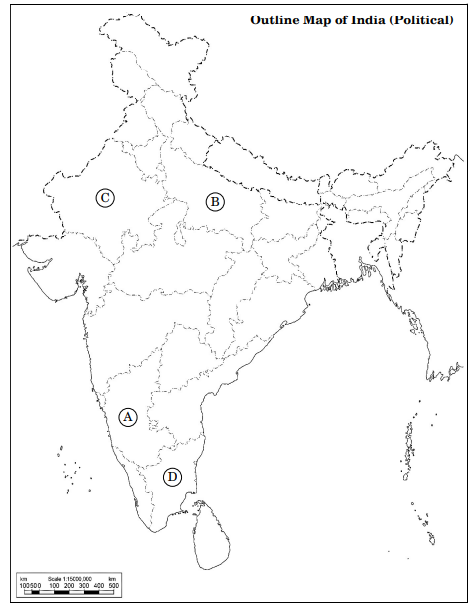
Diagram 1 – CBSE Class 12 Humanities Political Science 2024 Set 2

(1)

The State to which the former Prime Minister Lal Bahadur Shastri belonged.

[1 Mark]

(2)

The State to which former Chief Minister S. Nijalingappa belonged.

[1 Mark]

(3)

The State where DMK (Dravida Munnetra Kazhagam) came to power in 1967.

[1 Mark]

(4)

The State where the Congress Party did not get majority in 1967 Assembly elections.

[1 Mark]

(5)

Name the state to which the former Chief Minister Karpoori Thakur belonged.

[1 Mark]

(6)

Name the state to which the political party DMK (Dravida Munnetra Kazhagam) belongs.

[1 Mark]

(7)

Name the state to which the former Prime Minister Lal Bahadur Shastri belonged.

[1 Mark]

(8)

Name the state to which the former President of India V.V. Giri belonged.
[1 Mark]
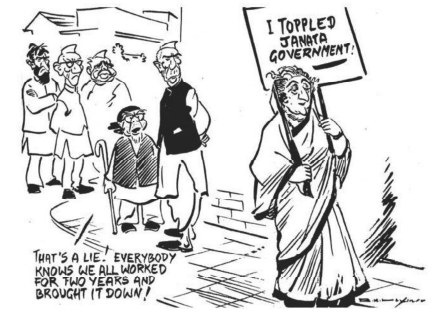
Question 3. Study the cartoon given below and answer the questions that follow:
Diagram 2 – CBSE Class 12 Humanities Political Science 2024 Set 2

(1) Identify and name the leader who toppled the Janata Government.

[1 Mark]

(2) Identify and name the Prime Minister of the Janata Party Government shown in the cartoon.

[1 Mark]

(3) Highlight any two reasons for the defeat of the Janata Party in 1980.

[2 Marks]

(4)

Highlight any two reasons for the defeat of the Congress Party in the general elections of 1977.

[2 Marks]

(5)

Name the political party that won the general elections in 1977.

[1 Mark]

(6)

Name the Prime Minister of India before the Congress Party won the elections in 1980.

[1 Mark]

Section B

Question 4. Which political party won all the seats in the 1970 elections in East Pakistan and under whose leadership?
[1 Mark]
Question 5. Explain the meaning of Global Security.
[1 Mark]
Question 6. Highlight any two features of the First Five Year Plan.
[1 Mark]
Question 7. Why did the elections of 1952 become a landmark in the history of democracy all over the world? Explain.
[1 Mark]
Question 8. How has the strengthening of international norms and international institutions helped India protect its security interests? Explain.
[1 Mark]
Question 9. Assess any two advantages of coalition governments at the Centre.
[1 Mark]

Section C

Question 10.

Arrange the following events in the chronological order:

(i) Soviet invasion of Afghanistan

(ii) Russian Revolution

(iii) End of Civil War in Tajikistan

(iv) Fall of the Berlin Wall

[1 Mark]
  • (A) (iv), (iii), (ii), (i)
  • (B) (i), (ii), (iii), (iv)
  • (C) (iii), (iv), (i), (ii)
  • (D) (ii), (i), (iv), (iii)
Question 11. Which two republics of Russia have had violent secessionist movements?
[1 Mark]
  • (A) Croatia and Uzbekistan
  • (B) Chechnya and Azerbaijan
  • (C) Chechnya and Dagestan
  • (D) Dagestan and Croatia
Question 12. Balance of power requires countries to __________.
[1 Mark]
  • (A) give up certain kinds of weapons
  • (B) regulate acquisition and development of weapons
  • (C) maintain a favourable balance with other countries
  • (D) coordinate their actions to defend against military attack
Question 13. People who flee their homes but remain within national borders are called __________.
[1 Mark]
  • (A) migrants
  • (B) fugitives
  • (C) internally displaced people
  • (D) indigenous people
Question 14.

Match List I with List II and choose the correct option:
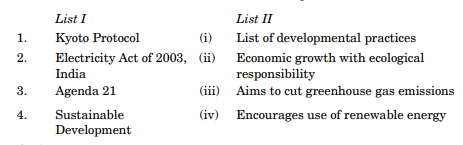
[1 Mark] Diagram 3 – CBSE Class 12 Humanities Political Science 2024 Set 2
  • (A) 1-(iii), 2-(iv), 3-(i), 4-(ii)
  • (B) 1-(ii), 2-(iii), 3-(iv), 4-(i)
  • (C) 1-(iv), 2-(i), 3-(iii), 4-(ii)
  • (D) 1-(i), 2-(ii), 3-(iii), 4-(iv)
Question 15.

Assertion (A): Oil continues to be the most important resource in global strategy.

Reason (R): The immense wealth associated with oil generates political struggles.

[1 Mark]
  • (A) Assertion (A) is true, but Reason (R) is false.
  • (B) Both Assertion (A) and Reason (R) are true and Reason (R) is the correct explanation of the Assertion (A).
  • (C) Assertion (A) is false, but Reason (R) is true.
  • (D) Both Assertion (A) and Reason (R) are true, but Reason (R) is not the correct explanation of the Assertion (A).
Question 16. Which political party came to power in Jammu and Kashmir in 1952?
[1 Mark]
  • (A) Indian National Congress
  • (B) Kashmir National Congress
  • (C) National Conference
  • (D) Communist Party of India
Question 17. In which year was the Election Commission of India set up?
[1 Mark]
  • (A) 1949
  • (B) 1950
  • (C) 1951
  • (D) 1952
Question 18. In which of the following countries did Dalai Lama obtain political asylum?
[1 Mark]
  • (A) Nepal
  • (B) Bhutan
  • (C) India
  • (D) Myanmar
Question 19.

Assertion (A): In 1979, the All Assam Students' Union (AASU) led an anti-foreigner movement.

Reason (R) : The movement was against illegal migrations and against faulty voters' lists.

[1 Mark]
  • (A) Assertion (A) is true, but Reason (R) is false.
  • (B) Both Assertion (A) and Reason (R) are true, but Reason (R) is not the correct explanation of the Assertion (A).
  • (C) Assertion (A) is false, but Reason (R) is true.
  • (D) Both Assertion (A) and Reason (R) are true and Reason (R) is the correct explanation of the Assertion (A).
Question 20. The first summit of NAM was held in:
[1 Mark]
  • (A) Cairo
  • (B) Belgrade
  • (C) India
  • (D) Indonesia
Question 21. In which state of India are the Khasi Hills located?
[1 Mark]
  • (A) Meghalaya
  • (B) Manipur
  • (C) Mizoram
  • (D) Tripura

Section D

Question 22. Which political party won all the seats in the 1970 elections in East Pakistan and under whose leadership?
[2 Marks]
Question 23. Explain the meaning of Global Security.
[2 Marks]
Question 24. Highlight any two features of the First Five Year Plan.
[2 Marks]
Question 25.

Why did India's general elections of 1952 become a landmark in the history of democracy all over the world? Explain.

[2 Marks]
Question 26. How has the strengthening of international norms and international institutions helped India protect its security interests? Explain.
[2 Marks]
Question 27. Assess any two advantages of coalition governments at the Centre.
[2 Marks]

Section E

Question 28. Describe the circumstances that led to the Bangladesh War in 1971.
[4 Marks]
Question 29. Explain any two reasons for the disintegration of the Soviet Union.
[4 Marks]
Question 30.

Suggest any two measures to improve Indo-Pakistan relations.

[4 Marks]
Question 31. Suggest any two measures to improve Indo-China relations.
[4 Marks]
Question 32. Highlight any two causes of globalization.
[4 Marks]
Question 33. Highlight any two positive effects of globalization.
[4 Marks]
Question 34. The best way to respond to regional aspirations is through democratic negotiations rather than through suppression. Justify the statement with examples.
[4 Marks]

Section F

Question 35. Analyze any four factors that make the European Union an influential regional organization.
[6 Marks]
Question 36. ASEAN is rapidly growing into a very important regional organization. Justify the statement.
[6 Marks]
Question 37. Explain the grounds on the basis of which India seeks to become a permanent member of the UN Security Council.
[6 Marks]
Question 38. Explain the three main complaints reflected in the resolution adopted by the UN General Assembly in 1992 to reform the UN Security Council.
[6 Marks]
Question 39. Describe the difficulties faced by India to get the merger of all the Princely States into the Union of India.
[6 Marks]
Question 40. Describe the events that led to the accession of Hyderabad into the Union of India.
[6 Marks]
Question 41. Describe any four major developments in Indian politics since 1989.
[6 Marks]
Question 42. Describe any three issues on which a general consensus has emerged among most of the political parties of India.
[6 Marks]

Paper Details

CBSE Board Exam 2024

Class

Class 12 Humanities

Subject

Political Science

Year

2024

Set

Set 2

Other Years — Political Science

2022 Set-1

2022 Set-2

2022 Set-3

2022 Set-4

2022 Set-5

2023 Set-1

2023 Set-2

2023 Set-3

2023 Set-4

2023 Set-5

2024 Set-1

2024 Set-2

2024 Set-3

2024 Set-4

2024 Set-5

2025 Set-1

2025 Set-2

2025 Set-2

2026 Set-2

2026 Set-4

2026 Set-5