QUESTION PAPER
2023 BOARD EXAM
CBSE Class 12 PCB Biology Board Paper 2023 — Set 1
2023
Biology
Class 12 PCB
CBSE EXAMINATION PAPER-2023
BIOLOGY
(Solved)
General Instructions :
Read the following instructions carefully and follow them :
- This question paper contains 39 questions. All questions are compulsory.
- This question paper is divided into 5 sections.
- Section A – questions number 1 to 3 are case based questions
- Section B – questions number 4 to 19 are multiple choice questions
- Section C – questions number 20 to 25 are very short answer
- Section D – questions number 26 to 33 are short answer
- Section E – questions number 34 to 39 are long answer
- There is no overall choice given in the question paper. However, an internal choice has been provided in few questions.
- Use of calculator is NOT allowed.
Section A
Gene expresses itself in a cell system as a protein/enzyme. How does an expression of gene occur in a cell system and when does it need to occur, and how the gene expression is regulated in a prokaryote cell system was studied by the combined efforts of Jaeque Monod, the biochemist and Francois Jacob, the geneticist. For their work on lactose metabolism in E. coli and introducing the concept of "lac operon" they were awarded the Nobel Prize in 1965.
(1) Why is lac operon said to be a transcriptionally regulated system ?
(2) It is said that "the lac operon has to be operational at a very low level in the bacterial cell all the time." Justify.
(3) Draw a schematic diagram of lac operon in absence of inducer in the culture medium of the bacteria.
(4) Why is the regulator gene in lac operon marked as i gene?
Study the diagrammatic representation given below of the Earth with regions marked 'A' and 'B' respectively. Answer the questions that follow.
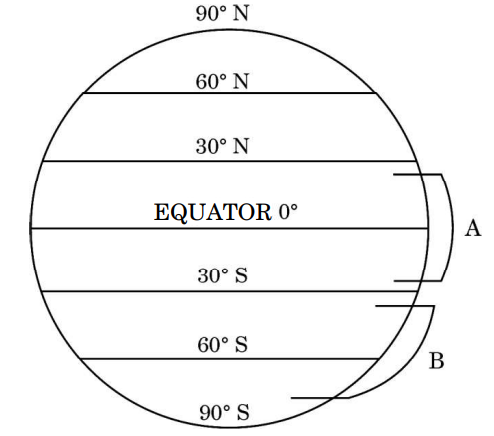
(1) Name the region in the world that records the greatest biodiversity and mention why.
(2) Write the observations made regarding the species diversity when moving from region 'A' to region 'B'. Give two reasons also
(3) Stating the reason, mention the approximate number of bird species recorded in India.
Section B
Which one of the following processes results in the production of recombinants in future generations?
(i) Crossing over of bivalents
(ii) Independent assortment during meiosis I
(iii) Mutation
(iv) Independent assortment during meiosis II
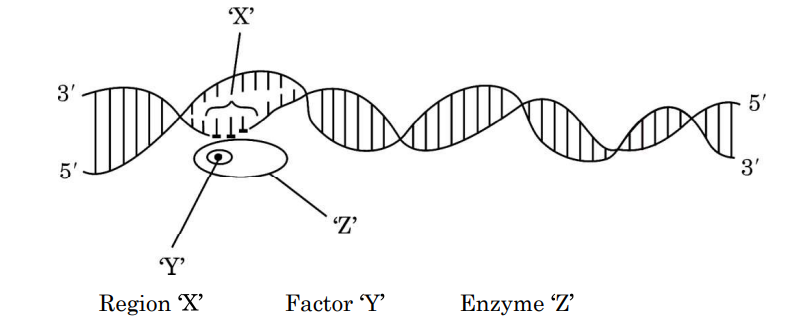
Identify the region of transcription in prokaryote as shown in the schematic representation given below.
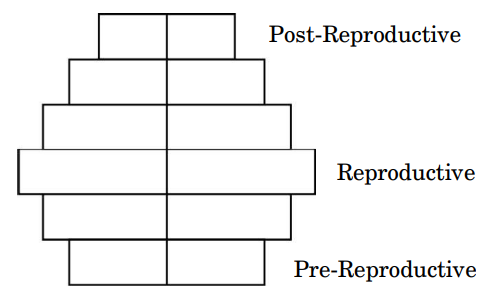
The status of the human population reflected in the human age pyramid given below is:
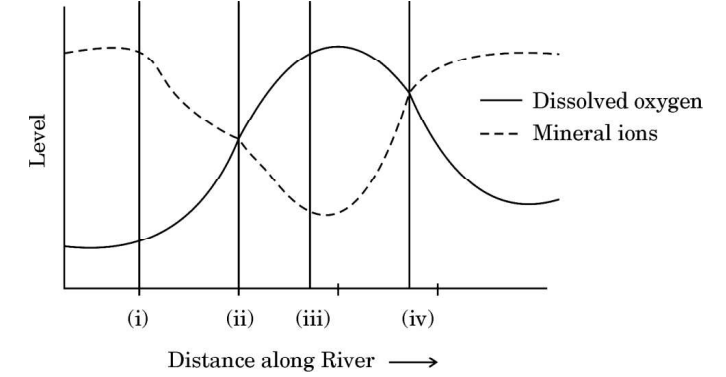
The graph plotted below is based on the data collected by biology students with respect to the levels of oxygen at the specific points in the river flowing outside their city. Which point in the graph indicates the entry of untreated sewage in the river?
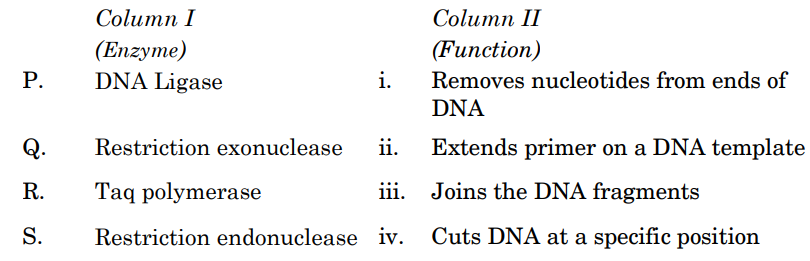
Given below are two columns. In Column I is the list of four enzymes and in Column II is the list of functions of the given enzymes. Which one of the following options shows the enzymes matched with their respective functions correctly?
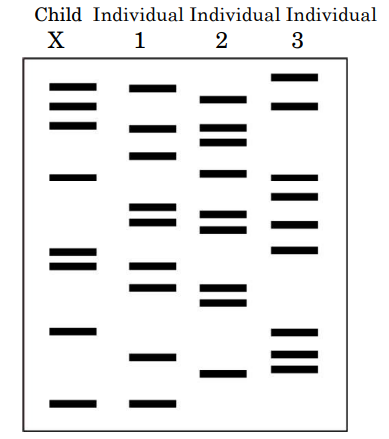
Study the DNA profiles obtained as a result of DNA fingerprinting of a child 'X' and three individuals 1, 2 and 3. Which one of the following options shows the possible parents of the child 'X' ?
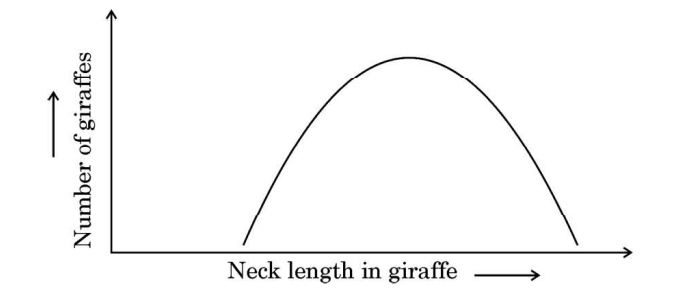
Select the option that gives the correct description of the process of Natural Selection with respect to the length of the neck of giraffe.
Choose the option that gives the correct number of pollen grains that will be formed after 325 microspore mother cells undergo microsporogenesis.
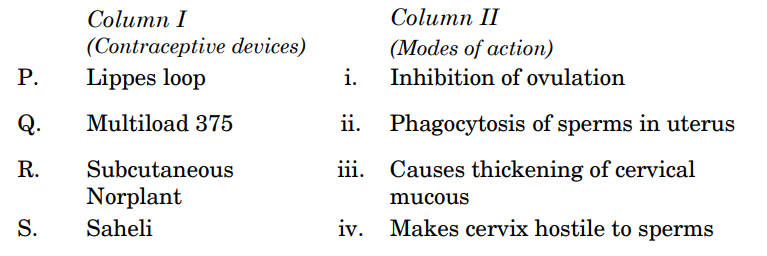
Given below are two columns. In Column I the names of four contraceptive devices are given and in Column II the modes of action of the contraceptives are given. Select the option where the contraceptive devices are correctly matched with their respective modes of action.
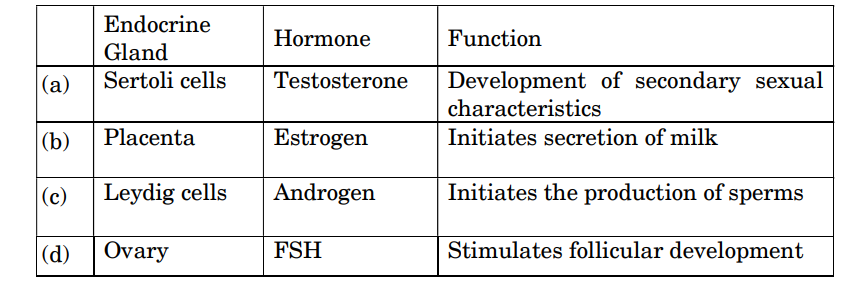
In which one of the following options does the endocrine gland correctly match with its hormonal secretion and its function?
The organism used in construction of the first artificial recombinant DNA by Cohen and Boyer in 1972 was:
Who among the following challenged the patent right granted to the University of Mississippi Medical Centre for 'use of turmeric in wound healing'?
Assertion (A): A patient of ADA deficiency undergoing treatment for gene therapy requires periodic infusion of genetically engineered lymphocytes.
Reason (R): Lymphocytes are immortal.
Assertion (A): A cattle egret and grazing cattle in close association is a classic example of commensalism. Reason (R): As grazing cattle move through the field, they stir up and flush out insects from the vegetation that otherwise might be difficult for egrets to find and catch.
Assertion (A): Endosperm is completely consumed during the development of embryo in ex-albuminous seeds.
Reason (R): Castor, pea and beans are all examples of ex-albuminous seeds.
Assertion (A): Birds like pigeon have heterogametic females whereas the males are homogametic.
Reason (R): In pigeons, females have Z and W sex chromosomes whereas males have ZZ sex chromosomes.
Section C
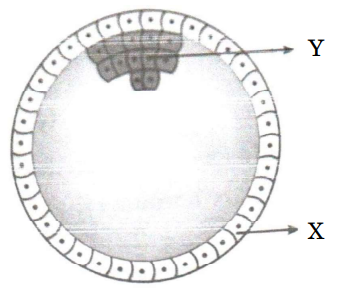
The diagram given below shows a developmental stage of human embryo. Answer the following questions with reference to it :
(a) Identify and name the human embryonic stage shown.
(b) Mention its exact location in the normal pregnancy of a woman.
(c) Write one function of each of the two parts labelled 'X' and 'Y'.
(a) From which end of the ovule, and how does the pollen tube gain its entry into the embryo sac of a Hibiscus flower ?
(b) State the fate of the male nuclei present in the pollen tube.
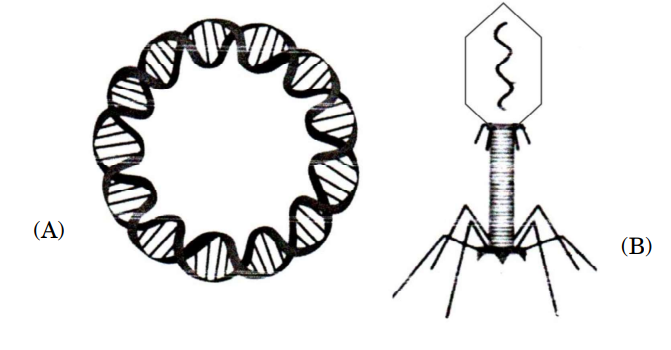
(i) Identify and name the structures 'A' and 'B' marked in the image given below:
(ii) State their importance in various biotechnology experiments.
Explain the process by which a bacterial cell can be made 'competent' to take up foreign DNA from its surroundings, using divalent cations and temperature treatment.
Ecological pyramids give important information about the ecological system, but do have some limitations. List any two limitations of ecological pyramids.
India is the seventh largest country in the world in terms of total land area including land and water. Write the value of the land area of our country (in terms of percentage) of the world. Mention then, what makes India one of the 12 mega diversity countries of the world.
Section D
With the help of a schematic diagram only, show in three steps, the formation of recombinant DNA by the action of restriction endonuclease EcoRI and DNA ligase.
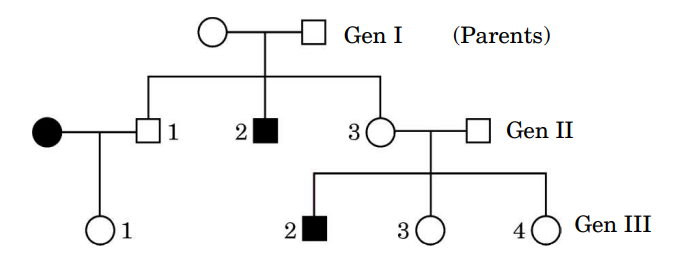
Study the given pedigree chart and answer the questions that follow.
(a) Is the trait given in the chart dominant or recessive ? Give reason in support of your answer.
(b) Is this trait autosomal or sex-linked ? Give reason in support of your answer.
(c) Write the possible genotypes of the children numbers '1' and '3' of the second generation.
(a) (a) Write the characteristics of 'stem cells'.
(b) From where can one obtain 'stem cells' in humans?
(c) State any two applications of 'stem cells' in curing human diseases.
(a) Differentiate between malignant and benign tumours.
(b) Name and explain the most feared property of a malignant tumour.
Treatment of wastewater is done in a sewage treatment plant to make it less polluting. Explain the following with reference to this treatment process :
(a) Primary sludge
(b) Activated sludge
(c) Anaerobic sludge digesters
(a) Name the two primate ancestors of the present day humans, who existed approximately about 15 million years ago.
(b) According to geological records, when and where did Australopithecines live ?
(c) Give two differences between Homo habilis and Homo erectus.
(i) Expand the abbreviations given below, used for different modes of assisted reproductive technologies :
(1) ZIFT
(2) ICSI
(3) IUT
(4) GIFT
(ii) Which one of them cannot be considered as a procedure of IVF ? Give reasons in support of your answer.
Differentiate between the following :
(i) Perisperm and Pericarp
(ii) Syncarpous pistil and Apocarpous pistil
(iii) Plumule and Radicle
Section E
Meselson and Stahl carried out an experiment to prove the nature of DNA replication. Recall the experiment and answer the following questions.
(i) Which two types of nitrogen were used by them in their experiment and why ?
(ii) Why did they take samples of E. coli at definite time intervals for their observation ?
(iii) State the role of caesium chloride density gradient in their experiment. (iv) Write the conclusions they arrived at.
(i) A true breeding tall pea plant with round seeds is crossed with a recessive dwarf pea plant having wrinkled seeds. Work out the cross up to F2 generation giving the phenotypic ratios of F1 and F2 generation respectively.
(ii) State the Mendelian principle that can be derived only with the help of such a cross.
(i) What is the chemical name of 'smack'? Why is the consumption of smack considered as an abuse?
(ii) Name the source plant and one effect of the following drugs on the human body:
(1)Marijuana
(2) Cocaine
(3) Morphine
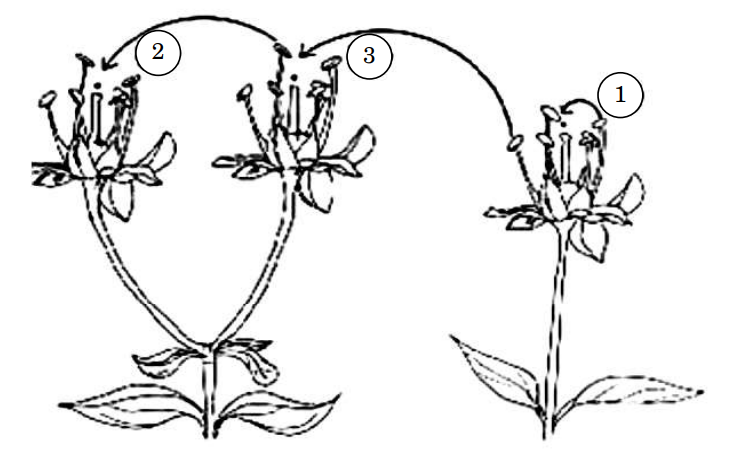
Study the diagram given below showing the modes of pollination. Answer the questions that follow.
(i) The given diagram shows three methods of pollen transfer in plants. What are the technical terms used for pollen transfer methods '1', '2' and '3'?
(ii) How do the following plants achieve pollination successfully ?
(1) Water lily
(2) Vallisneria
(iii) Flowering plants have developed many devices to avoid inbreeding depression. Explain one hereditary and one physiological device which helps plants to achieve this target.
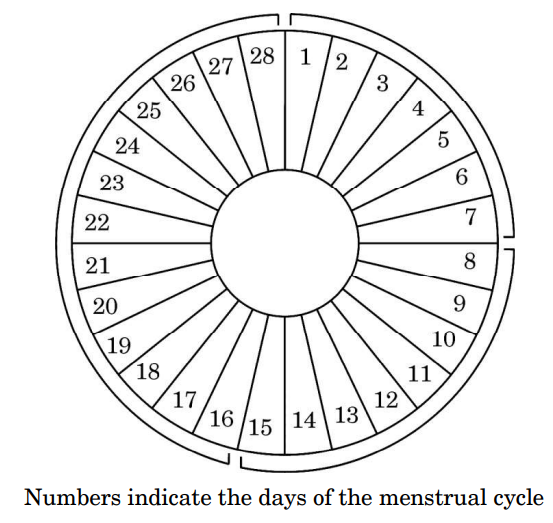
Observe the diagram given below showing the menstrual cycle of a normal human female and answer the questions that follow :
(i) What are the suitable technical terms used for the following ?
(1) Days 1-7
(2) Days 8-12
(3) Days 16-28
(4) Days 13-15
(ii) Explain the role of ovarian and pituitary hormones during the following time periods :
(1) Days 8-12
(2) Days 13-15
(3) Days 16-28
A time-bound vaccination programme is followed for the children in our country from their birth up to ten years of age. A graph plotted below shows the effect of the vaccination followed by infection by the same pathogen, and the antibody concentration in the blood of the child.
(i) Explain why the administration of a vaccine causes an increase in the antibody concentration.
(ii) If the child is infected with the same pathogen almost four months later, the antibody concentration in his/her blood increases very fast. Explain why.
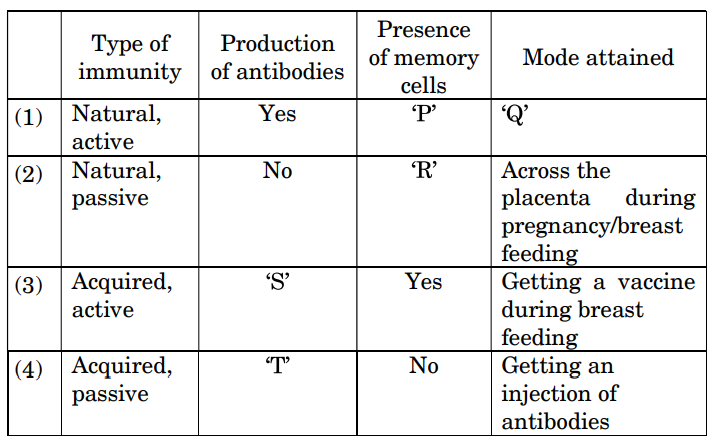
(iii) A table given below gives information about different types of immunity and how they are attained. Identify P , Q , R , S and T in the table.

Paper Details
CBSE Board Exam 2023
Class
Class 12 PCB
Subject
Biology
Year
2023
Set
Set 1
Other Years — Biology