Section B
[1 Mark]
-
(A) Homo habilis
-
(B) Neanderthal man
-
(C) Java man
-
(D) Homo erectus
Explanation: The correct answer is Neanderthal man, as they are known to have used animal hides for clothing and practiced burial rituals for their dead, indicating a level of social and cultural development.
[1 Mark]
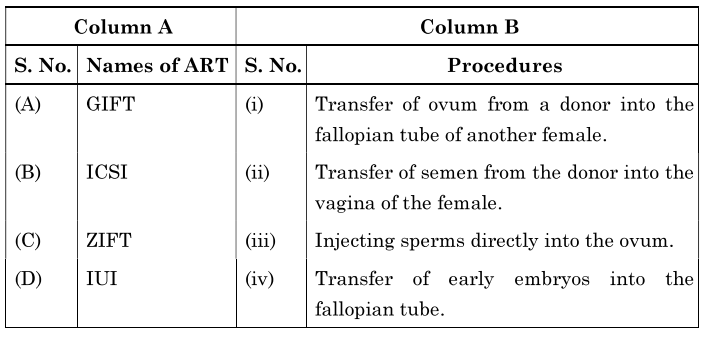
-
(A) (A)-(i), (B)-(ii), (C)-(iii), (D)-(iv)
-
(B) (A)-(iv), (B)-(i), (C)-(ii), (D)-(iii)
-
(C) (A)-(iv), (B)-(iii), (C)-(i), (D)-(ii)
-
(D) (A)-(i). (B)-(iii), (C)-(iv), (D)-(ii)
Explanation: Assisted Reproductive Technology (ART) involves several specialized methods to aid in conception. Gamete Intra-Fallopian Transfer (GIFT) involves transferring a donor's ovum into the fallopian tube of another female, which corresponds to procedure (i). Intra-Cytoplasmic Sperm Injection (ICSI) is a laboratory technique where sperm is directly injected into the ovum, corresponding to procedure (iii). Zygote Intra-Fallopian Transfer (ZIFT) involves transferring an early embryo into the fallopian tube for further development, which corresponds to procedure (iv). Finally, Intra-Uterine Insemination (IUI) involves the artificial introduction of semen into the female reproductive tract to facilitate fertilization, corresponding to procedure (ii). Therefore, the correct matching of ART with procedures is (A)-(i), (B)-(iii), (C)-(iv), (D)-(ii).
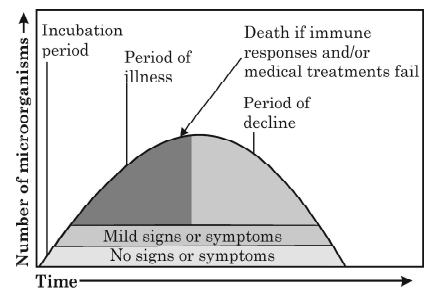
[1 Mark]
-
(A) Decrease in antigens
-
(B) Decrease in antibodies
-
(C) Increase in antibodies
-
(D) Increase in antigens
Explanation: The correct answer is 'Decrease in antibodies.' T-lymphocytes, or T-cells, play a crucial role in the immune response by helping to produce antibodies that fight off infections. If the count of T-lymphocytes decreases, the body's ability to produce antibodies is compromised, leading to a decrease in their levels.
[1 Mark]
-
(A) Serine, Valine
-
(B) Alanine, Proline
-
(C) Cysteine, Glycine
-
(D) Phenylalanine, Methionine
Explanation: To determine the amino acids at codon positions 3 and 5, we first need to convert the mRNA sequence to codons. The given sequence is interpreted from the 5' to 3' direction: 5' UACGUUUGUCA 3'. The third codon (UUG) corresponds to Leucine, and the fifth codon (UGU) corresponds to Cysteine. The correct combination is therefore Cysteine, Glycine.
[1 Mark]
-
(A) Commensalism
-
(B) Parasitism
-
(C) Mutualism
-
(D) Amensalism
Explanation: The correct answer is Mutualism. In this relationship, both the fig trees and the wasps benefit from each other. The fig trees provide a habitat and food for the wasps, while the wasps help in the pollination of the fig trees, which is crucial for their reproduction.
[1 Mark]
-
(A) Wuchererids bancrofti: Chronic inflammation of lymphatic vessels of lower limb.
-
(B) Haemophilus influenzae : Blockage of the intestinal passage.
-
(C) Epidermophyton: Dry scaly lesions on nail.
-
(D) Entamoeba histolytica: Constipation, abdominal pain.
Explanation: Haemophilus influenzae is a bacterial pathogen known to cause respiratory tract infections, meningitis, and ear infections, but it is not associated with blockage of the intestinal passage. Blocking of the intestinal passage is not a known symptom caused by Haemophilus influenzae. Other options correctly match the pathogens with their disease symptoms: Entamoeba histolytica causes amoebiasis with constipation and abdominal pain, Epidermophyton causes dry scaly lesions on nails (a fungal infection), and Wuchereria bancrofti causes chronic inflammation of lymphatic vessels leading to elephantiasis.
[1 Mark]
-
(A) g m ^ - 2 y * r ^ - 1
-
(B) g m ^ - 2 yr
-
(C) Kcal m ^ - 2 y * r ^ - 1
-
(D) Kcal * m ^ - 2
Explanation: Primary productivity is the rate at which biomass or organic matter is produced per unit area over a certain time period by plants during photosynthesis. Because it is a rate, the unit must include three dimensions: energy or mass, area, and time.
[1 Mark]
-
(A) 5' C - T - G - C - A 3' G G3 A - C - G - T - C 5'
-
(B) 5' C - T 3' G - A - G - C G - C - A - G 3' T - C 0.5'
-
(C) 5' C - T - G 3' G - A - C - G - T C - A - G * 3' C5'
-
(D) 5' C - T - G - C 3' G - A - C - G A - G 3' T - C 5'
Explanation: Restriction endonucleases like Pst-I recognize specific DNA sequences and cut within or near these sequences in a predictable manner. Pst-I recognizes the sequence 5'-CTGCAG-3' and cuts between the A and G, producing sticky ends. The correct fragments after Pst-I digestion would reflect cuts at this specific site resulting in fragments like 5' C - T - G - C 3' and complementary 3' G - A - C - G A - G 5' T - C 5'. This matches the first option, showing correct cleavage consistent with the action of Pst-I as per the context about restriction enzymes cutting at specific sites to generate sticky ends.
[1 Mark]
-
(A) 359 invertebrates
-
(B) 330 invertebrates
-
(C) 338 invertebrates
-
(D) 362 invertebrates
Explanation: According to the provided context, the IUCN Red List (2004) documents the extinction of 784 species over the last 500 years, which includes 338 vertebrates, 359 invertebrates, and 87 plants. Therefore, the correct number of extinct invertebrate species is 359.
[1 Mark]
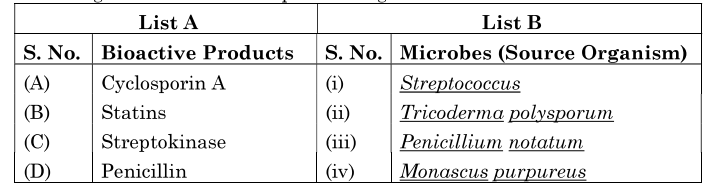
-
(A) (A)-(i), (B)-(ii), (C)-(iii), (D)-(iv)
-
(B) (A)-(iii), (B)-(iv), (C)-(ii), (D)-(i)
-
(C) (A)-(iv), (B)-(iii), (C)-(ii), (D)-(i)
-
(D) (A)-(ii), (B)-(iv), (C)-(i), (D)-(iii)
Explanation: The correct matches refer to correctly identifying the commercially important products alongside their source organisms. Options should be evaluated accordingly based on accurate knowledge of common products and their origins.
[1 Mark]
-
(A) (i) only
-
(B) (ii) only
-
(C) (ii) and (iii)
-
(D) (i) and (iv)
Explanation: The correct option is (i) and (iv). Birth rate and death rate (i) are demographic measures that apply to populations, not individuals, while sex-ratio (iv) is also a population attribute that reflects the proportion of males to females in a population. Male and female (ii) and birth and death (iii) are characteristics of individuals.
[1 Mark]
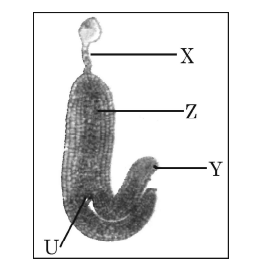
-
(A) X- Suspensor (2n), Y Cotyledon (2n), Z - Radicle (2n), U- Plumule (2n).
-
(B) X-Plumule (2n), Y - Suspensor (n), Z - Cotyledon (2n), U - Radicle (2n).
-
(C) X - Plumule (2n), Y - Suspensor (2n), Z - Radicle (2n), U- Cotyledon (2n).
-
(D) X-Cotyledon (2n), Y - Radicle (n), Z-Plumule (n), U-Suspensor (n).
Explanation: In a developing dicot embryo, the suspensor (X) connects the embryo to the parent tissue, helping push the embryo into the nutrient-rich endosperm. The cotyledons (Y) are the seed leaves that nourish the seedling, the radicle (Z) develops into the root, and the plumule (U) develops into the shoot. All these parts are diploid (2n). This matches the first option.
[1 Mark]
-
(A) (A) is false, but (R) is true.
-
(B) (A) is true, but (R) is false.
-
(C) Both (A) and (R) are true, but (R) is not the correct explanation of (A).
-
(D) Both (A) and (R) are true and (R) is the correct explanation of (A).
Explanation: Determining the sex of an unborn child followed by Medical Termination of Pregnancy (MTP) if the fetus is female is an illegal practice to prevent female foeticides. This is stated as illegal and dangerous in the context. Amniocentesis is indeed used to test for the presence of genetic disorders such as Down syndrome, haemophilia, sickle-cell anaemia, etc., which makes (R) true. However, (R) does not explain why determining sex and subsequent MTP is illegal. Therefore, both (A) and (R) are true but (R) is not the correct explanation of (A).
[1 Mark]
-
(A) Both (A) and (R) are true and (R) is the correct explanation of (A).
-
(B) (A) is true, but (R) is false.
-
(C) (A) is false, but (R) is true.
-
(D) Both (A) and (R) are true, but (R) is not the correct explanation of (A).
Explanation: Both (A) and (R) are true and (R) is the correct explanation of (A). Synthetic oligonucleotide polymers, which are the primers, are essential during the annealing step of PCR as they bind to the complementary regions of the double-stranded DNA, helping to initiate the replication process.
[1 Mark]
-
(A) Both (A) and (R) are true, but (R) is not the correct explanation of (A).
-
(B) (A) is false, but (R) is true.
-
(C) (A) is true, but (R) is false.
-
(D) Both (A) and (R) are true and (R) is the correct explanation of (A).
Explanation: The assertion (A) is true because detritus rich in lignin and cutin decomposes slower due to their complex chemical nature resistant to microbial attack. The reason (R) is also true as decomposition is largely an aerobic process requiring oxygen. However, the slower decomposition caused by lignin and cutin richness is due to their chemical composition and not because of oxygen availability. Thus, (R) does not correctly explain (A).
[1 Mark]
-
(A) (A) is false, but (R) is true.
-
(B) Both (A) and (R) are true, but (R) is not the correct explanation of (A).
-
(C) (A) is true, but (R) is false.
-
(D) Both (A) and (R) are true and (R) is the correct explanation of (A).
Explanation: (A) is false because Thalassemia refers to an abnormal production of hemoglobin chains rather than myoglobin. (R) is true as it correctly states that a-Thalassemia is controlled by genes HBA1 and HBA2 on chromosome 16.
Section C
[2 Marks]
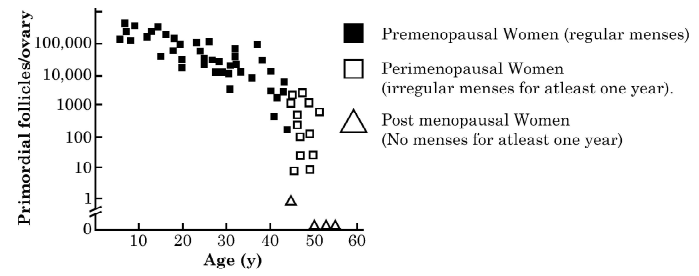
Answer: The average age of women at the onset of menopause is approximately 51 years. This is the age when hormonal changes lead to the cessation of menstruation. According to the graph, the maximum number of primordial follicles per ovary is typically present around the age of 20 years. At this age, women's ovaries contain the highest reserve of these follicles, which gradually decline as they age.
Key Points: onset of menopause around 51 years-maximum follicles present at 20 years-decline of follicles with age
[2 Marks]
Answer: Cattle and goats generally avoid browsing Calotropis plants due to their high toxicity. The plant contains toxic compounds called cardenolides, which can be harmful to these animals if ingested. Additionally, the bitter taste of Calotropis makes it unappealing to livestock. This is an evolutionary adaptation since consuming such toxic plants can cause significant health problems or even death in these animals.
Key Points: toxicity of Calotropis - presence of cardenolides - unappealing bitter taste
[2 Marks]
Answer: To perform a test cross for pod color in garden peas, we assume an unknown genotype, which could be homozygous dominant (GG) or heterozygous (Gg). Using a Punnett square with a known homozygous recessive genotype (gg), we have: For GG x gg: all offspring will be green (100% Gg). For Gg x gg: offspring will be 50% green (Gg) and 50% yellow (gg). This illustrates potential outcomes.
Key Points: Use Punnett square-Genotypes: GG, Gg, gg-Phenotypes: green, yellow-Test cross with recessive (gg)-Possible outcomes
[2 Marks]
Answer: One example of a genus of virus used as a narrow spectrum insecticidal biocontrol agent is the 'Baculovirus'. Baculoviruses specifically target certain insect hosts, making them effective in controlling pest populations without harming non-target organisms. Their use in pest management supports integrated pest management (IPM) by reducing reliance on chemical pesticides, thus minimizing environmental impact and preserving beneficial insect populations. Moreover, they can be incorporated into a wider pest control strategy along with biological and cultural practices.
Key Points: Baculovirus-example, narrow spectrum, target insect hosts, integrated pest management, reduces chemical pesticides, minimizes environmental impact
[2 Marks]
Answer: A malignant tumour is considered more damaging than a benign tumour because it can invade and destroy surrounding tissues, leading to serious health complications. Unlike benign tumours, which grow slowly and do not spread, malignant tumours can metastasize to other parts of the body, forming secondary tumours. This aggressive nature of malignant tumours poses significant risks to overall health and can adversely affect vital organs, making treatment more complex and necessary.
Key Points: Malignant tumours invade surrounding tissues-benign tumours grow slowly and do not spread-malignant tumours can metastasize to other body parts-affect vital organs-treatment is more complex
[2 Marks]
Answer: The scientific name of the source organism of the thermostable DNA polymerase used in PCR is Thermus aquaticus. The advantage of using thermostable DNA polymerase is that it remains active at high temperatures, which is essential for the denaturation step in PCR. This stability allows for repeated cycles of heating and cooling without degrading the enzyme, ensuring efficient DNA amplification.
Key Points: Thermus aquaticus- thermostable DNA polymerase- remains active at high temperatures- essential for denaturation in PCR- allows for repeated heating and cooling cycles- ensures efficient DNA amplification
Section D
[3 Marks]
Answer: One effective surgical contraceptive method for males is a vasectomy. This procedure involves cutting and sealing the vas deferens, the tubes that carry sperm from the testicles to the urethra. During a vasectomy, local anesthesia is usually employed, and the operation can be performed in a clinic. After the procedure, sperm can't mix with semen during ejaculation, which effectively prevents pregnancy. Vasectomy is considered a permanent method of contraception, although reversals are sometimes possible. Men are advised to consider this option seriously, as it can lead to lifelong infertility if not reversed. Post-operative care includes avoiding heavy lifting and sexual activity for a short period to allow proper healing. Overall, a vasectomy is a safe, effective, and relatively simple procedure for permanent contraception.
Key Points: Definition of vasectomy-Procedure details-Effectiveness and permanence-Post-operative care
[3 Marks]
Answer: The Human Genome Project (HGP) aimed to achieve several important goals. Firstly, it sought to identify and map all the genes in the human genome. Secondly, it aimed to determine the sequences of the three billion chemical base pairs that make up human DNA. Thirdly, it endeavored to create databases for storing and analyzing genomic information. Lastly, it aimed to address ethical, legal, and social issues related to genetic research. A common non-human model organism that has been sequenced is the fruit fly (Drosophila melanogaster).
Key Points: Identify all human genes-Determine sequences of human DNA-Create genomic databases-Address ethical issues
[3 Marks]
Answer: Industrial melanism refers to the phenomenon where darker-colored individuals of a species become more common due to environmental changes and selective pressures. In England, during the Industrial Revolution, soot and pollution from factories darkened tree bark in urban areas. The peppered moth, which was typically light-colored, became more visible to predators on these darkened backgrounds. Consequently, darker variants of the moths, known as melanistic forms, had a survival advantage as they were less likely to be eaten by birds. This shift in survival rates led to an increase in the population of the dark moths, demonstrating natural selection in action. The reverse occurred after pollution control measures were implemented, leading to a rise in light-colored moths as they became better camouflaged, showing how environmental changes can drive evolutionary adaptations.
Key Points: Definition of industrial melanism; Impact of pollution on tree bark color; Role of natural selection in survival rates; Examples of peppered moths; Increase in dark moth population; Changes with pollution control.
[3 Marks]
Answer: Artificial hybridization in plants involves several steps to ensure that only the desired pollen grains fertilize the stigma. Firstly, the plant breeder selects the parent plants with desirable traits. Next, the bisexual flower from the female parent is emasculated, which involves removing the anthers to prevent self-pollination. The next step is the collection of pollen grains from the male parent. Once collected, the desired pollen is carefully introduced to the stigma of the emasculated flower using a fine brush or tool. Finally, the flower is often covered or bagged to prevent contamination from unwanted pollen, ensuring that only the intended cross-pollination occurs. These steps emphasize precision in controlled pollination to achieve the desired genetic traits in crop improvement.
Key Points: Selection of parent plants-Emasculation of flowers-Collection of desired pollen-Introduction of pollen to stigma-Covering for preventing contamination
[3 Marks]
Answer: Plasmodium is a genus of protozoan parasites that cause malaria in humans. It has a complex life cycle that requires two hosts: the female Anopheles mosquito and humans. In the mosquito, Plasmodium undergoes sexual reproduction, producing sporozoites that are transferred to humans during a blood meal. Once inside the human host, the sporozoites travel to the liver, where they reproduce asexually, leading to the release of merozoites into the bloodstream. These merozoites infect red blood cells, further multiplying and causing the symptoms of malaria. The cycle continues when a mosquito bites an infected human, ingesting the parasites, thus allowing for the transmission and continuation of the Plasmodium life cycle. This dependence on both hosts ensures the persistence of the malaria pathogen in the environment.
Key Points: Plasmodium requires two hosts: mosquito and human; sexual reproduction in mosquito; asexual reproduction in humans; symptoms caused by merozoites; mosquito transmission crucial for life cycle.
[3 Marks]
Answer: Maintaining good health is essential for leading a fulfilling life. Here are six effective ways to achieve good health: First, a balanced diet rich in fruits, vegetables, whole grains, and proteins provides essential nutrients and energy. Second, regular physical activity, such as at least 30 minutes of exercise most days, helps maintain a healthy weight and strengthens the heart. Third, staying hydrated by drinking adequate water is vital for bodily functions. Fourth, ensuring enough sleep enhances overall health and cognitive function. Fifth, managing stress through techniques like meditation or yoga promotes mental well-being. Finally, avoiding harmful habits like smoking and excessive alcohol consumption significantly reduces health risks. By incorporating these practices into daily life, individuals can work towards achieving and maintaining good health.
Key Points: Balanced diet-regular exercise-hydration-sufficient sleep-stress management-avoiding harmful habits
[3 Marks]
Answer: Bacillus thuringiensis (Bt) produces a crystal protein toxin, known as Bt toxin, which is lethal to certain insects. When these bacteria are sprayed on infected cotton crops, the toxin is ingested by the target pests, such as caterpillars. In the insects' digestive systems, the toxin is activated and binds to specific receptors in their gut cells, leading to their death. However, Bt has evolved specific receptors in its own cells that do not bind to the toxin, thus rendering it immune. This specificity allows Bt to effectively control pest populations without harming itself or beneficial organisms, making it an eco-friendly option for pest management.
Key Points: Bacillus thuringiensis produces a specific toxin; toxin affects insects by binding to gut receptors; bacteria itself is immune due to lack of binding receptors; effective pest control method; eco-friendly biopesticide.
[3 Marks]
Answer: Biodiversity contributes significantly to ecosystem services, providing numerous utilitarian benefits. Firstly, it supports food security; diverse species improve crop yields and resilience to pests and diseases, ensuring sustainable food production. Secondly, biodiversity promotes ecological balance and stability; a variety of organisms contributes to nutrient cycling, soil fertility, and pest control, which are vital for ecosystem health. Additionally, conserving biodiversity is morally justified; all species have intrinsic value and the right to exist, which supports ethical stewardship of our planet's resources.
Key Points: Food security, ecological balance, intrinsic value, moral obligation, sustainable ecosystems
Section E
[5 Marks]
Answer: The monosporic development of the embryo sac in angiosperms typically involves the formation of a single megaspore from the megasporangium (nucellus) following meiosis. This haploid megaspore undergoes three mitotic divisions to produce an eight-nucleate stage, leading to the formation of the mature embryo sac. The eight nuclei then organize into structures: one egg cell, two synergids, three antipodal cells, and one central cell with two polar nuclei, which is crucial for double fertilization. This complex structure ensures proper fertilization and subsequent seed development. Additionally, the embryo sac is housed within the ovule, which plays an essential role in the reproductive cycle of angiosperms. The diagram of the mature embryo sac would depict these components clearly, illustrating the specific cellular arrangements and their functions during fertilization and seed formation.
Key Points: 1. Development begins with a single megaspore. 2. Megaspore undergoes three mitotic divisions. 3. Formation of an eight-nucleate embryo sac. 4. Organization into egg cell, synergids, antipodals, and central cell. 5. Importance of embryo sac in fertilization and seed development.
[5 Marks]
Answer: The formation of the placenta begins post-implantation when the fertilized egg, now called a blastocyst, embeds itself into the uterine lining (endometrium). The outer layer of the blastocyst, known as the trophoblast, develops into the chorion, which extends finger-like projections called chorionic villi into the maternal tissue. These villi invade the endometrium and establish a connection with the mother's blood vessels, facilitating the exchange of nutrients, gases, and wastes. The placenta forms from the chorion and the decidua (the modified endometrium). As pregnancy progresses, the placenta grows, becoming a vital organ that supports the fetus, produces hormones, and mediates maternal-fetal exchanges. It also serves as a barrier to certain substances while allowing vital nutrients to pass. Concurrently, the amniotic sac develops around the embryo, safeguarding it in fluid, providing cushioning and maintaining a stable temperature. The placenta eventually becomes fully functional, typically around the end of the first trimester, playing a crucial role throughout the gestation period until birth. It is expelled after childbirth along with the umbilical cord. In addition to nutrient transfer, the placenta is instrumental in immunological protection, as it helps mediate the mother and fetus’s immune responses, preventing rejection of the semi-allogeneic fetal tissue.
Key Points: Implantation of blastocyst-trophoblast formation-chorionic villi development-nutrient and gas exchange-hormone production-amniotic sac protection
[5 Marks]
Answer: The technique widely used in forensics for paternity testing is DNA profiling or DNA fingerprinting. The process involves several key steps: Firstly, biological samples are collected from the child, mother, and alleged father, such as blood, saliva, or hair. Once samples are acquired, DNA is extracted from these cells. The next step involves amplification of specific regions of the DNA using Polymerase Chain Reaction (PCR), which ensures there is enough DNA for analysis. After amplification, the DNA fragments are separated through a process called gel electrophoresis, which allows visualization of the unique patterns of DNA from each individual. The final step is interpretation of the results, where genetic markers are compared between the child and the alleged father. If the patterns match at a significant number of loci, it indicates a likely biological relationship. This technique is both highly accurate and reliable, making it the gold standard for paternity testing in forensic investigations. Potential errors can arise from contamination or poor sample quality, so stringent protocols are essential throughout the process.
Key Points: Step 1: Sample Collection - Obtain DNA from child, mother, and alleged father. Step 2: DNA Extraction - Isolate DNA from collected samples. Step 3: PCR Amplification - Amplify specific DNA regions for analysis. Step 4: Gel Electrophoresis - Separate and visualize DNA fragments. Step 5: Result Interpretation - Compare genetic markers to determine biological relationship.
[5 Marks]
Answer: This phenomenon is known as incomplete dominance, where the F₁ generation exhibits a phenotype that is a blend of the parents' traits. A classic example is the cross between red-flowered (RR) and white-flowered (rr) snapdragons. In the F₁ generation, all the offspring (Rr) produce pink flowers, demonstrating an intermediate phenotype. When the F₁ plants are self-pollinated to produce the F₂ generation, the genotypic ratio is 1 RR: 2 Rr: 1 rr, leading to phenotypes of 1 red, 2 pink, and 1 white, resulting in a 1:2:1 phenotypic ratio. This illustrates how intermediate traits can arise from blending inheritance, highlighting the complexity of inheritance patterns beyond the simple Mendelian dominance.
Key Points: Incomplete dominance - Example: red and white snapdragons - F₁ generation (pink flowers) - Self-pollination to F₂ - Genotypic ratio of 1 RR: 2 Rr: 1 rr - Phenotypic ratio of 1 red: 2 pink: 1 white - Blending inheritance and complex patterns.
[5 Marks]
Answer: To achieve the optimisation of the bioreactor system, several operational guidelines must be followed due to their significance in ensuring the efficiency of the biotechnological process. Firstly, maintaining optimal temperature and pH levels is crucial as they affect cellular metabolism and growth rates. Secondly, ensuring adequate oxygen transfer rates is vital for aerobic organisms. Thirdly, regular monitoring and control of nutrient levels within the bioreactor can enhance the growth and productivity of the cells. Finally, minimizing contamination risks through sterilization procedures ensures the integrity of the production process. Regarding the phase of growth referenced in the statement, it pertains to the logarithmic or exponential phase, where cells are actively dividing and exhibiting high metabolic activity. As for the biological product formed in the bioreactor, it is typically not suitable for immediate use. This is because most biotechnological products require downstream processing, including purification and characterization, to remove impurities and ensure safety for intended applications, thereby making the product suitable for use.
Key Points: Operational guidelines include maintaining optimal temperature and pH, ensuring adequate oxygen transfer, monitoring nutrient levels, and minimizing contamination. The phase of growth referred to is the exponential phase. Biological products are usually not immediately suitable for use and require downstream processing.
[5 Marks]
Answer: EcoRI is a restriction endonuclease derived from the bacterium Escherichia coli. The naming convention for EcoRI reflects its source and the order of its discovery; 'Eco' derives from the genus (Escherichia), 'R' indicates the species (coli), and 'I' denotes it as the first restriction enzyme isolated from this species. EcoRI recognizes the palindromic DNA sequence GAATTC and cleaves between the G and the A on both strands, producing sticky ends. The resulting sticky ends exhibit four protruding adenine nucleotides which facilitate annealing with complementary sequences during the formation of recombinant DNA (r-DNA). The sticking ends help in the ligation process by ensuring that the desired DNA fragments align properly, allowing the incorporation of foreign DNA into vectors, which is crucial in genetic engineering and molecular cloning. This capability makes EcoRI a critical tool in r-DNA technology for producing genetically modified organisms and for research purposes.
Key Points: EcoRI's naming originates from Escherichia coli; recognizes and cuts GAATTC sequence; generates sticky ends; sticky ends vital for r-DNA formation; essential for ligation and genetic engineering.