QUESTION PAPER
2024 BOARD EXAM
CBSE Class 12 PCB Biology Board Paper 2024 — Set 3
2024
Biology
Class 12 PCB
CBSE EXAMINATION PAPER-2024
BIOLOGY
(Solved)
General Instructions :
Read the following instructions carefully and follow them :
- This question paper contains 39 questions. All questions are compulsory.
- This question paper is divided into 5 sections.
- Section A – questions number 1 to 3 are case based questions
- Section B – questions number 4 to 19 are multiple choice questions
- Section C – questions number 20 to 25 are very short answer
- Section D – questions number 26 to 33 are short answer
- Section E – questions number 34 to 39 are long answer
- There is no overall choice given in the question paper. However, an internal choice has been provided in few questions.
- Use of calculator is NOT allowed.
Section A
Read the passage given below and answer the questions that follow:
In recombinant DNA technology, restriction enzymes are used as they recognize and cut DNA within a specific recognition sequence. BamH I is one such restriction enzyme which binds at the recognition sequence 5 G-G-A-T-C-C 3 and cleaves this sequence between G and G on each strand, whereas Alu I binds at the recognition sequence 5 A-G-C-T 3 and cleaves these sequences between G and C on each strand.
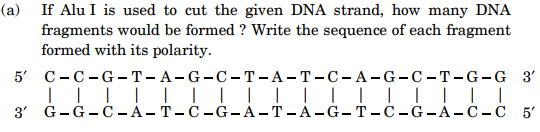
(1) If Alu I is used to cut the given DNA strand, how many DNA fragments would be formed ? Write the sequence of each fragment formed with its polarity.
(2) Which one of the two restriction enzymes BamH I or Alu I willpreferably be used on the same given DNA strand to make are combinant DNA molecule and why ?
(3) After binding to the two strands of the double helix DNA, where specifically does the restriction enzyme act to cut the two strands of DNA ? Write the specific term used for the specific nucleotidesequences of DNA recognised by a restriction endonuclease.
(4) Write the specific sequence of DNA segment recognised by the restriction endonuclease EcoRI.
Study the figures given below that depict the comparative age distribution of human populations in Sweden and Rwanda. (International Data Base 2003) and answer the questions that follow :
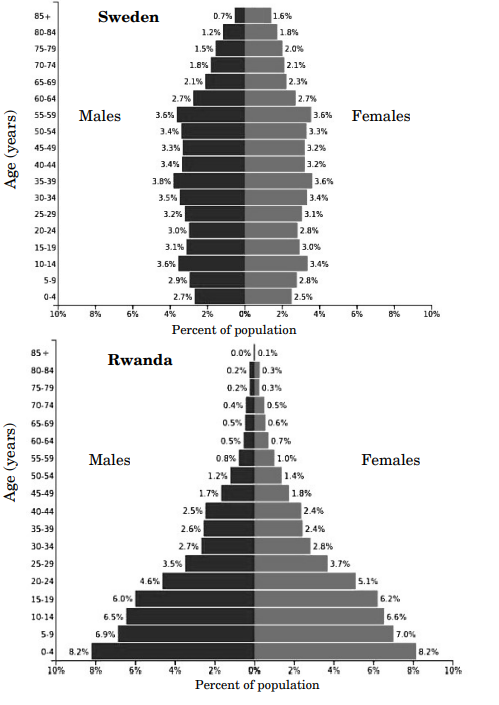
(1) (i) What can be inferred from the very broad base of Rawanda's age pyramid ? Support your answer with the data provided in the figure.
(2) Sweden has an age distribution that is approximately of the same width near its base as at the apex. What does this indicate ?
(3) Name the type of age pyramid shown above for Rwanda.
(4) Name the type of age pyramid shown above for Sweden.
Section B
The part of the ovule that develops into protective coats of a seed after fertilization in a typical flowering plant is:
A DNA fragment has 2000 nucleotides, out of which 140 are Adenine. How many bases does this DNA segment possess that have triple hydrogen bonds between them?
During the 1850s in the pre-industrialisation era in England, the expected effect of natural selection on the number of dark-winged moths as compared to white-winged moths was:
In which one of the following floral plants are many embryos formed in the seeds without fertilisation of the egg cell?
A Snapdragon plant bearing pink colour flowers is crossed with a Snapdragon plant bearing white colour flowers. The expected phenotypic percentage of the offspring is:
In which of the given chromosomal disorders does the individual have tall stature with feminised character?
S.L. Miller in 1953, to support the theory of chemical evolution, created conditions in the closed flask that included:
In an experiment, E. coli is grown in a medium containing 14NH₄Cl. (14N is the light isotope of Nitrogen) followed by growing it for six generations in a medium having heavy isotope of nitrogen (15N). After six generations, their DNA was extracted and subjected to CsCl density gradient centrifugation. Identify the correct density (Light/Hybrid/Heavy) and ratio of the bands of DNA in CsCl density gradient centrifugation.
Which disease is the patient suffering from who is showing symptoms such as sustained high fever (39C to 40C), stomach pain, constipation, headache, loss of appetite and weakness?
Which native plasmid did Stanley Cohen and Herbert Boyer use for the construction of the first recombinant DNA?
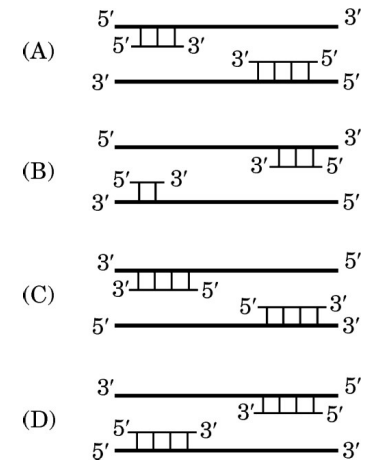
Which one of the following represents the correct annealing of primers to the DNA to be amplified in the PCR?
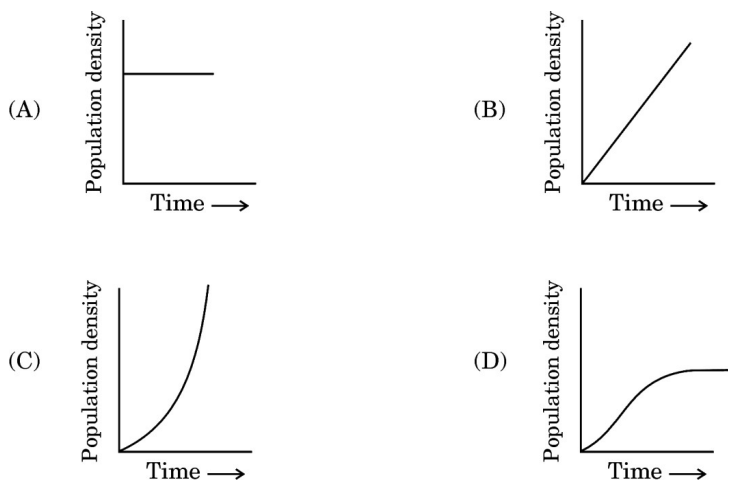
The population growth curve applicable for a population growing in a geometric fashion, when the resources are not limiting in the habitat will be:
Assertion (A) : Primary transcripts in eukaryotes are subjected to splicing to remove the introns. Reason (R) : Primary transcripts contain both exons and introns and the introns are non-functional in eukaryotes.
Assertion (A) : The chronic use of alcohol by a person leads to cirrhosis. Reason (R) : Alcohol addiction at times becomes the cause of mental and financial distress to the entire family of the addicted person.
Assertion (A) : The zygote gives rise to heart-shaped embryo and subsequently proembryo in most angiosperms. Reason (R) : The zygote is present at the micropylar end of the embryo sac and develops into an embryo.
Assertion (A) : The stirrer facilitates the even mixing of oxygen availability in a bioreactor. Reason (R) : Stirred-tank bioreactors generally have a flat base.
Section C
Consider the given data of a hypothetical small portion of mRNA that codes for a functional polypeptide chain and answer the questions that follow :
mRNA 5 UCAUUACCACGAUUCUUUAAAAGA 3
(a) How many amino acids will be formed from the given codons, if substitution of U by C takes place at the 5th codon ? Explain your answer.
(b) Write the number of amino acids that would be in the polypeptide synthesised by a similar mRNA as above, where in the fourth ustify your answer.
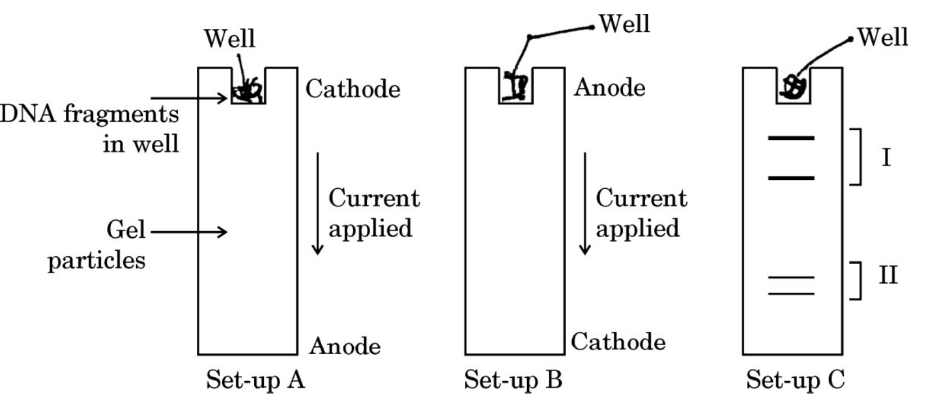
With reference to the set-ups (A, B and C) given below, of the electrophoretic separation of a mixture of DNA fragments of varied lengths, answer the questions that follow :
(a) In which one of the two Set-ups, A or B, would you see the DNA fragments separated and why ? Justify your answer.
(b) In Set-up C, which one of the two, I / II, are the bands of longer fragments of DNA ? Justify your answer.
(i) Graphically represent the relationship between species richness and area on a log-log scale for bats and fishes. Write the equation for the relationship as on a logarithmic scale.
(ii) Write the equation for the relationship as on a logarithmic scale.
Section D
Draw a longitudinal section of pistil of a flower showing growth of the pollen tube. Label the part :
(a) through which the pollen tube moves down.
(b) the cell wherein the pollen tube releases its contents.
Explain the IUI and IUT methods of assisted reproductive technologies.
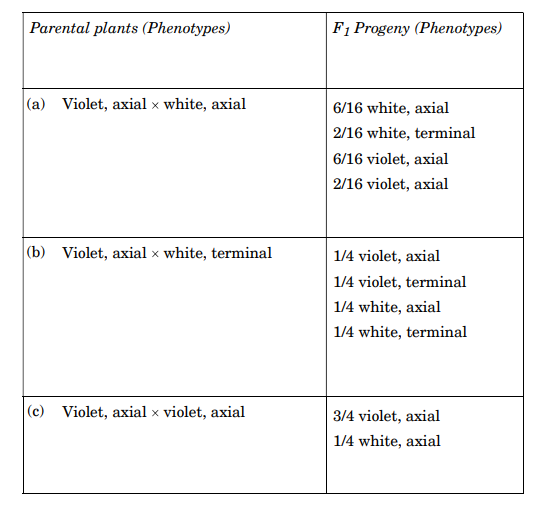
Three crosses were carried out in pea plants with respect to flower colour violet/white (V/v) and flower position axial/terminal (A/a). Study in the table the crosses 'a', 'b' and 'c' where parental phenotypes and their F₁ progeny phenotypes are given.
Find the genotypes of each of the parental pairs of crosses 'a', 'b' and 'c'.
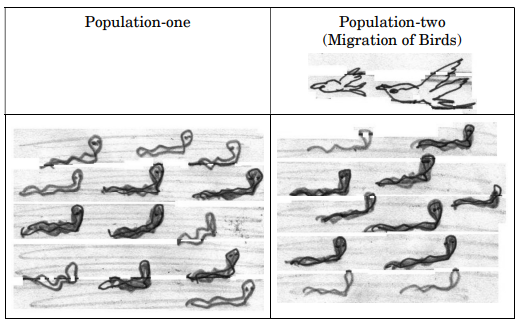
A population of snakes lived in a desert with brown sand. Study the drawings given below showing the change in the population from to over time and answer the question that follows. Brown snakes and Grey snakes are represented by alleles A/a (Dominant/recessive).
(a) If the frequency of the recessive trait is 9% in population-one, work out the frequency of homozygous dominant and heterozygous dominant snakes.
(b) Name the mechanism of evolution that must have operated so that population-two evolved from population-one.
(i) List two major reasons for using cow-dung in a biogas plant instead of using domestic sewage.
(ii) Mention one use of the unspent slurry of the biogas plant.
Name the bioactive molecule and its microbial source generally used by physicians to treat the patients for :
(i) Myocardial infarction
(ii) High blood cholesterol level
(iii) Organ transplantation
(i) Give the scientific name of the bacteria widely used in biotechnology to create a GM cotton crop resistant to bollworm attacks.
(ii) Explain how GM cotton crop is able to resist insect attacks.
Describe how fig tree and wasp relationship is a spectacular example of mutualism.
Section E
(i) Explain any four devices that flowering plants have developed to encourage cross-pollination.
(ii) Why do plants discourage self-pollination ? State any one reason.
Explain the ovarian and uterine events taking place along with the role of pituitary and ovarian hormones, during menstrual cycle in a normal human female under the following phases :
Follicular phase/proliferative phase
Luteal phase/secretory phase
Menstrual phase
The influence of both the alleles in a heterozygous state is clearly expressed in codominance." Explain with the help of inheritance of ABO blood group in humans.
A group of genes are regulated and expressed together as a unit in lac operon.
(i) "Explain the mechanism of switching 'on' of the structural genes of lar operon.
(ii) "Regulation of lac operon' is referred to be negatively regulated. Justify giving a reason.
(i) Describe the life cycle of Plasmodium from the time it enters the human body till a female Anopheles mosquito bites an infected person.
(ii) Mention the two events of Plasmodium life cycle that occur within the female Anopheles body.
(i) Write two differences between malignant tumor and benign tumor.
(ii) Explain any three diagnostic techniques for the detection of cancer.
Paper Details
CBSE Board Exam 2024
Class
Class 12 PCB
Subject
Biology
Year
2024
Set
Set 3
Other Years — Biology