QUESTION PAPER
2023 BOARD EXAM
CBSE Class 12 PCB Biology Board Paper 2023 — Set 5
2023
Biology
Class 12 PCB
CBSE EXAMINATION PAPER-2023
BIOLOGY
(Solved)
General Instructions :
Read the following instructions carefully and follow them :
- This question paper contains 39 questions. All questions are compulsory.
- This question paper is divided into 5 sections.
- Section A – questions number 1 to 3 are case based questions
- Section B – questions number 4 to 19 are multiple choice questions
- Section C – questions number 20 to 25 are very short answer
- Section D – questions number 26 to 33 are short answer
- Section E – questions number 34 to 39 are long answer
- There is no overall choice given in the question paper. However, an internal choice has been provided in few questions.
- Use of calculator is NOT allowed.
Section A
When a microorganism invades a host, a definite sequence of events usually occur leading to infection and disease, causing suffering to the host. This process is called pathogenesis. Once a microorganism overcomes the defense system of the host, development of the disease follows a certain sequence of events as shown in the graph. Study the graph given below for the sequence of events leading to appearance of a disease and answer the questions that follow:
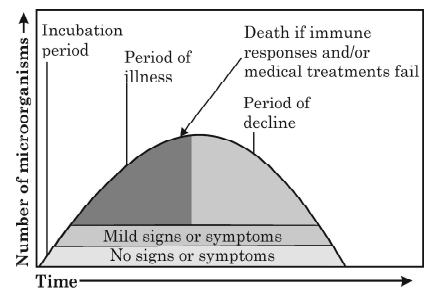
(1) In which period, the number of immune cells forming antibodies will be the highest in a person suffering from pneumonia? Name the immune cells that produce antibodies
(2) In which period, according to the graph there are maximum chances of a person transmitting a disease/infection and why
(3) Study the graph and write what is an incubation period. Name a sexually transmitted disease that can be easily transmitted during this period. Name the specific type of lymphocytes that are attacked by the pathogen of this disease.
(4) Draw a schematic labelled diagram of an antibody.
The chromosome number is fixed for all normal organisms leading to species specification whereas any abnormality in the chromosome number of an organism results into abnormal individuals. For example, in humans 46 is the fixed number of chromosomes both in male and female. In male it is 44+ XY and in female it is '44 + XX. Thus the human male is heterogametic, in other words produces two different types of gametes one with 22 + X chromosomes and the other with 22 + Y chromosomes respectively. Human female, on the other hand is homogametic i.e. produces only one type of gamete with '22+ X' chromosomes only.
Sometimes an error may occur during meiosis of cell cycle, where the sister chromatids fail to segregate called nondisjunction, leading to the production of abnormal gametes with altered chromosome number. On fertilisation such gametes develop into abnormal individuals.
(1) Name best known and most common autosomal aneuploid 21 abnormality in human and write any two symptoms.
(2) State what is aneuploidy.
(3) If during spermatogenesis, the chromatids of sex chromosomes fail to segregate during meiosis, write only the different types of gametes with altered chromosome number that could possibly be produced.
(4) A normal human sperm (22+Y) fertilises an ovum with karyotype 22+ XX'. Name the disorder the offspring thus produced would suffer from and write any two symptoms of the disorder.
Section B
At which stage during evolution did human use hides to protect their bodies and buried their dead?
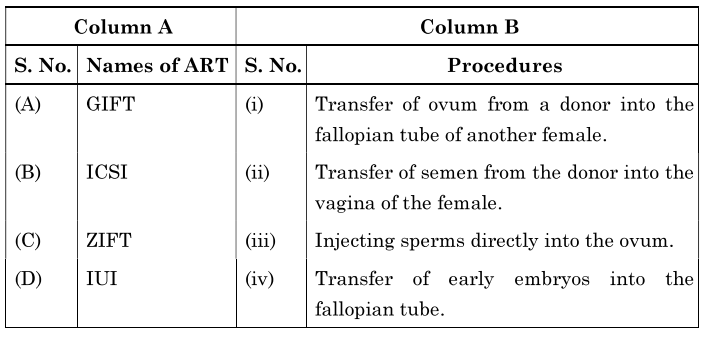
Given below are Column A with a list of certain Assisted Reproductive Technologies (ART) and in Column B the procedures followed during ART:
Choose the option where ART correctly matches with the procedure.
The decrease in the T-lymphocytes count in human blood will result in:
Given below is a sequence of bases in mRNA of a bacterial cell. Identify the amino acid that would be incorporated at codon position 3 and codon position 5 during the process of its translation.
3' AUCAGGUUUGUGAUGGUACGA 5'
A Tight one-to-one relationship between many species of fig tree and certain wasps is an example of -
Select the pathogen mismatched with the symptoms of disease caused by it from the list given below:
The primary productivity in an ecosystem is expressed as:
Given below is the restriction site of a restriction endonuclease Pst-I and the cleavage sites on a DNA molecule.
5' C - T - G - C - A plus/minus G 3' 3' G - A - C - G - T - C 5'
Choose the option that gives the correct resultant fragments by the action of the enzyme Pst-I.
The IUCN Red Data List (2004) in the last 500 years documents the extinction of nearly 784 species including:
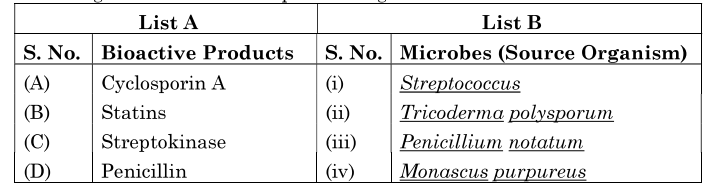
Given below are the list of the commercially important products and their source organisms. Select the option that gives the correct matches.
Important attributes belonging to a population but not to an individual are:
(i) Birth rate and death rate
(ii)Male and female
(iii)Birth and death
(iv)Sex-ratio
Select the correct option from the given options:
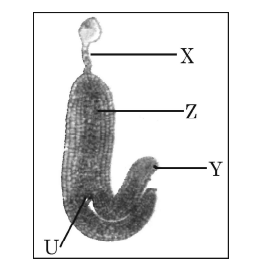
Select the option that shows the correctly identified 'U', 'X, Y and Z' in a developing dicot embryo.
Assertion (A): Determining the sex of an unborn child followed by MTP is an illegal practice.
Reason (R): Amniocentesis is a practice to test the presence of genetic disorders also.
Assertion (A): Synthetic oligonucleotide polymers are used during Annealing in a PCR.
Reason (R): The primers bind to the double stranded DNA at their complementary regions.
Assertion (A): Decomposition process is slower if detritus is rich in lignin and cutin.
Reason (R): Decomposition is largely an oxygen requiring process.
Assertion (A): In Thalassemia an abnormal myoglobin chain is synthesized due to a gene defect.
Reason (R): a-Thalassemia is controlled by genes HBA1 and HBA2 on chromosome 16.
Section C
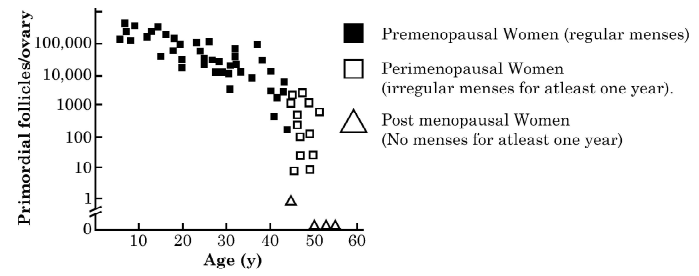
The graph given below shows the number of primordial follicles per ovary in women at different ages. Study the graph and answer the questions that follow.
(a) What is the average age of the women at the onset of menopause?
(b) At what age are maximum primordial follicles present in the ovary, according to the given graph?
"Cattle and goats do not browse the Calotropis plant." Justify the statement giving reasons.
By using Punnert square depict the genotypes and phenotypes of test crosses (where green pod colour (G) is dominant over yellow pod colour (g)) in Garden pea with unknown genotype.
(i) Give an example of a genus of virus used as narrow spectrum insecticidal biocontrol agent.
(ii) How does its use serve as an aid in overall integrated pest management programme?
Why a malignant tumour considered to be more damaging than a benign tumour? Explain.
(a) Write the scientific name of the source organism of the themostable DNA polymerase used in PCR.
(b) State the advantage of using Thermostable DNA polymerase.
Section D
Name and explain a surgical contraceptive method that can be adopted by the male partner of a couple.
Human Genome Project (HGP) was a mega project launched in the year 1990 with some important goals.
(a) Enlist any four prime goals of HGP.
(b) Name any one common non-human animal model organism which has also been sequenced thereafter.
Industrial melanism in England after 1850 is an excellent example of Natural selection. Explain how?
One of the major approaches of crop improvement programme is Artificial Hybridisation. Explain the steps involved in making sure that only the desired pollen grain pollinate the stigma of a bisexual flower by a plant
"Plasmodium protozoan needs both a mosquito and a human host for its continuity." Explain.
We all must work towards maintaining good health because 'health is wealth'. Enlist any six ways of achieving good health.
On spraying Bacillus thuringiensis on an infected cotton crop field the pests are killed by the toxin, however the toxin although produced by the bacteria does not affect it. Explain giving reason.
"Biodiversity plays a major role in many ecosystem services that nature provides."
(a) Describe any two broadly utilatarian arguments to justify the given statement.
(b) State one ethical reason of conserving biodiversity.
Section E
(i)Explain the monosporic development of embryo sac in the ovule of an angiosperm.
(ii) Draw a diagram of the mature embryo sac of an angiospermic ovule and label any four parts in it.
(i) Explain the formation of placenta after the implantation in a human female.
(ii) Draw a diagram showing human foetus within the uterus and label any four parts in it.
Name and describe the steps involved in the technique widely used in forensics that serves as the basis of paternity testing in case of disputes.
It is sometimes observed that the F₁ progeny has a phenotype that does not resemble either of the two parents and has intermediate phenotype. Explain by taking a suitable example and working out the cross upto F₂ progeny.
Bioreactors are the containment vehicles of any biotechnology-based production process. For large scale production and for economic reasons the final success of biotechnological process depends on the efficiency of the bioreactor.
Answer the following questions w.r.t. the given paragraph:
(i) List the operational guidelines that must be adhered to so as to achieve optimisation of the bioreactor system. Enlist any four.
(ii) Mention the phase of the growth we refer to in the statement "Optimisation of growth and metabolic activity of the cells".
(iii) Is the biological product formed in the bioreactor suitable for the intended use immediate? Give reason in support of your answer.
(i) EcoRI' has played very significant role in r-DNA technology.
(I) Explain the convention for naming EcoRI.
(II) Write the recognition site and the cleavage sites of this restriction endonuclease.
(ii) What are the protruding and hanging stretches of DNA produced by these restriction enzymes called? Describe their role in formation of r-DNA.
Paper Details
CBSE Board Exam 2023
Class
Class 12 PCB
Subject
Biology
Year
2023
Set
Set 5
Other Years — Biology