Class 6 . Social Science . Exploring Society India And Beyond . Economic Activities Around Us
Chapter 14: ECONOMIC ACTIVITIES AROUND US
Ch 14
Social Science
Class 6
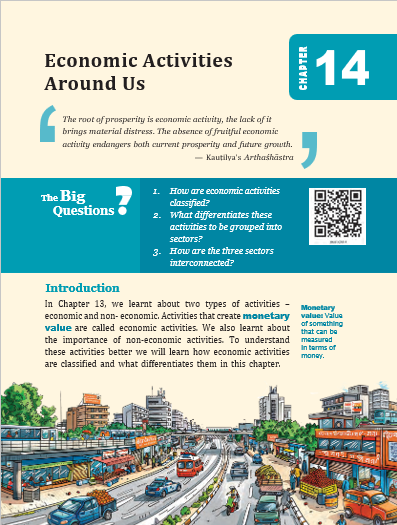
Introduction & the Classification of Economic Activities Into Economic Sectors
Economic Activities Around Us
- Changing livelihoods Earlier, many people earned a living through agriculture, livestock rearing, tool-making, pottery and weaving.
- Growing variety As societies progressed, the number and range of livelihoods increased.
- Today’s examples Activities include making computers, mobile phones and drones; banking, teaching, hotel work and transport.
- Other examples People also make furniture, tailor clothes using machines, create software and repair refrigerators and washing machines.
- Why classify? Grouping activities helps us understand how they function and how they are connected.
Economic Sectors
Economic sectors — Broad groups of activities that contribute to the economic prosperity of a nation.
How Activities Are Classified
- Grouping basis Activities with similar characteristics are grouped into broader economic sectors.
- Three main sectors The primary, secondary and tertiary sectors.
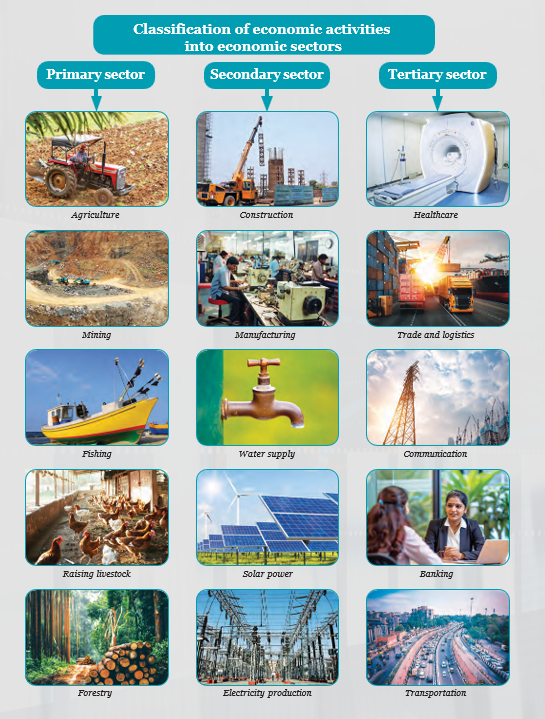
Primary Sector
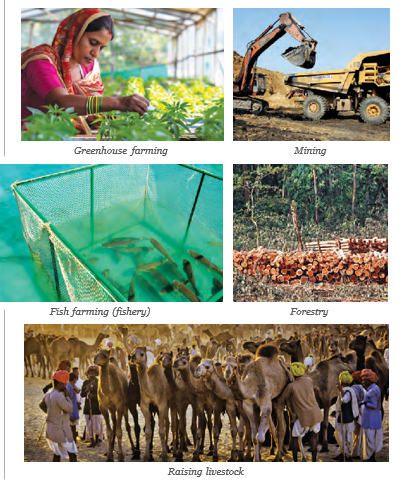
Primary activities — Economic activities in which people depend directly on nature to produce goods.
Primary-Sector Examples
- Common types Agriculture, mining, fishing, livestock rearing and forestry.
- Farm products Growing grains and vegetables, and raising poultry for eggs.
- Other examples Collecting wood from forests, extracting coal from mines and obtaining fish from fisheries.
- Key feature These activities rely directly on nature and natural resources.
- Economic activity
- Work through which people produce goods or earn a livelihood.
- Economic sector
- A broad group of activities with similar characteristics.
- Primary activity
- An activity that depends directly on nature to produce goods.
Quick recap
- Economic activities have increased in number and variety as societies have progressed.
- Classifying activities helps explain how they function and connect.
- Economic sectors are broad groups of activities that contribute to a nation's prosperity.
- The three main economic sectors are primary, secondary and tertiary.
- Primary activities depend directly on nature and include agriculture, mining, fishing, livestock rearing and forestry.
Secondary Activities and Tertiary Activities
Processing Raw Materials into Goods
Secondary sector — The group of activities that processes raw materials from the primary sector into goods for sale or consumption.
What this sector includes
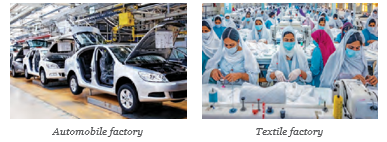
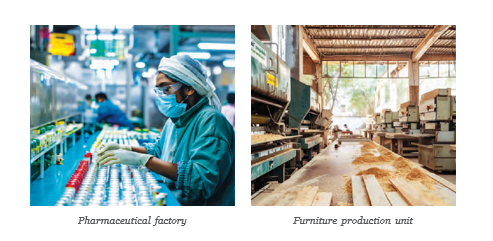
- Manufacturing: Factories and production units transform primary-sector raw materials into other products.
- Construction: Building houses, roads and other structures is part of this sector.
- Utilities: Providing necessities such as water, electricity and gas is also included.
- Purpose: Goods made through processing can be sold or consumed.
Examples of processing raw materials
- Grains → flour
- Groundnuts → oil; tea leaves → tea
- Forest wood → furniture or paper
- Cotton → clothes; iron ore → steel → automobiles
| Type of automobile | Units produced |
|---|---|
| Passenger vehicles such as cars | 45 lakhs |
| Commercial vehicles such as trucks | 10.3 lakhs |
| Three-wheelers | 8.6 lakhs |
| Two-wheelers | 2 crores |
Services That Support Production and Daily Life
Tertiary sector (service sector) — The group of activities that provides services supporting people and the primary and secondary sectors.
How services help
- Transport and trade: Truck drivers carry grains and vegetables from farms to factories or markets; vendors sell farm produce to households.
- Professional services: Doctors, nurses, teachers, lawyers and pilots serve people’s needs.
- Repair and maintenance: Technicians repair electronic items; mechanics repair cars and tractors; electricians help ensure a regular electricity supply.
- Communication and technology: Mobile and internet services, along with software development, are tertiary activities.
- Other services: Hotels, restaurants, banks, schools, hospitals, airports, shops and warehouses provide services.
Warehouse — A large building used to store products before they are sold, used or rented out to shops.


- Secondary sector
- Activities that turn primary-sector raw materials into goods.
- Tertiary sector
- Service activities that support people and the primary and secondary sectors.
- Warehouse
- A large building where products are stored before sale, use or rental to shops.
How do the secondary and tertiary sectors differ?
Give two examples each of secondary and tertiary activities.
Quick recap
- The secondary sector transforms raw materials from the primary sector into goods.
- Manufacturing, construction and providing utilities are included in the secondary sector.
- Grains can become flour, cotton can become clothes, and iron ore can be processed into steel and automobiles.
- The tertiary sector provides services that support people and primary- and secondary-sector activities.
- Transport, trade, healthcare, education, repairs, communication and banking are tertiary services.
- The tertiary sector is also called the service sector.
Interdependence Among Sectors
How the Three Sectors Are Interconnected
- Primary sector: Farmers obtain milk from cows and buffaloes.
- Secondary sector: Factories process milk into products such as butter, milk powder, ghee and cheese.
- Tertiary sector: Transport, trade and retail services deliver milk products to consumers.
- Mutual dependence: Each sector relies on the others to turn natural resources into goods and bring them to consumers.
- Another example: Trees provide pulp for paper, which is processed and printed into textbooks and then transported for sale.
Social Science — ALL CHAPTERS
1
LOCATING PLACES ON THE EARTH
2
Oceans and Continents
3
LANDFORMS AND LIFE
4
TIMELINE AND SOURCES OF HISTORY
5
INDIA, THAT IS BHARAT
6
THE BEGINNINGS OF INDIAN CIVILISATION
7
INDIA’S CULTURAL ROOTS
8
UNITY IN DIVERSITY, OR MANY IN THE ONE
9
FAMILY AND COMMUNITY
10
GRASSROOTS DEMOCRACY – PART 1 GOVERNANCE
11
GRASSROOTS DEMOCRACY – PART 2 LOCAL GOVERNMENT IN RURAL AREAS
12
GRASSROOTS DEMOCRACY – PART 3 LOCAL GOVERNMENT IN URBAN AREAS
13
THE VALUE OF WORK
14
ECONOMIC ACTIVITIES AROUND US