Class 6 . Social Science . Exploring Society India And Beyond . Timeline and Sources of History
Chapter 4: TIMELINE AND SOURCES OF HISTORY
Ch 4
Social Science
Class 6
Introduction
Learning About the Past
History — The study of the human past.
Why Study the Past?
- Purpose: Studying the past helps us understand how the present world and human societies developed.
- Earth’s history: Earth has an extremely long history; human history occupies only a tiny, recent part of it.
- Evidence: Objects and remains from earlier times provide evidence about the past.
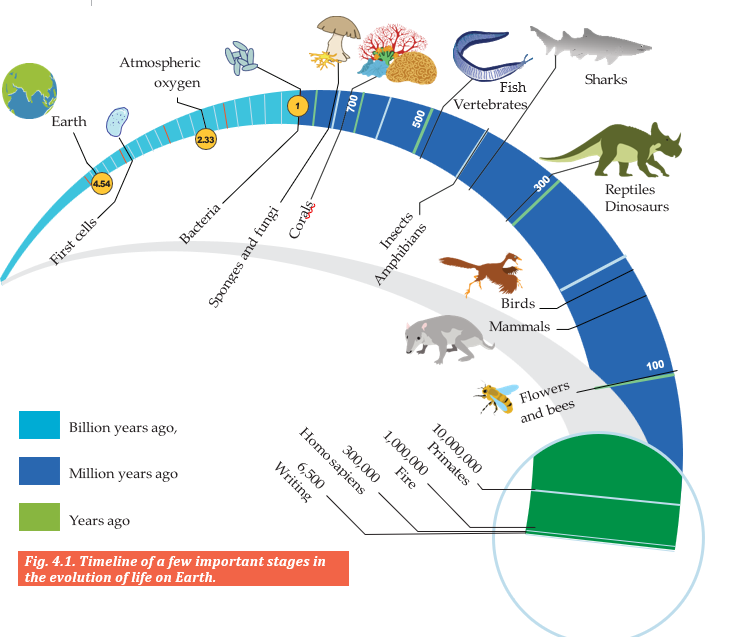
Fossils — Impressions of footprints, or parts of plants or animals, preserved within layers of soil or rocks.
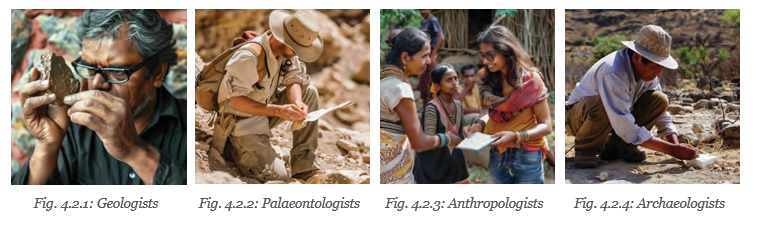
| Field | What it studies |
|---|---|
| Geologists | Physical features of Earth, such as soil, stones, hills, mountains, rivers, seas and oceans. |
| Palaeontologists | Fossil remains of plants, animals and humans from millions of years ago. |
| Anthropologists | Human societies and cultures from the oldest times to the present. |
| Archaeologists | The past through digging up remains left by people, plants and animals, such as tools, pots, beads, bones, burnt grains and parts of houses. |
- Fossils
- Preserved impressions or remains of ancient plants and animals found in soil or rocks.
- Archaeologists
- Researchers who study the past by excavating remains left behind.
- Anthropologists
- Researchers who study human societies and cultures.
Quick recap
- History is the study of the human past.
- Studying the past helps us understand the present world.
- Earth’s history is extremely long; humans occupy only a tiny, recent part of it.
- Fossils are impressions or remains preserved within layers of soil or rocks.
- Geologists study Earth’s physical features; palaeontologists study ancient fossils.
- Anthropologists study human societies and cultures; archaeologists excavate past remains.
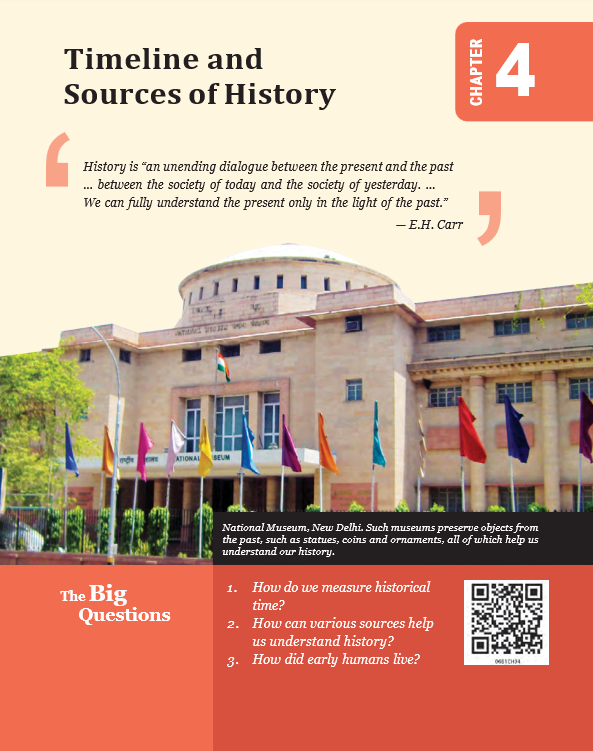
- Museums preserve objects that help us learn about the past.
How Is Time Measured in History?
Calendars and Eras
Gregorian Calendar: Leap Years
- Ordinary leap years: A leap year occurs every four years.
- Century years: A year ending in 00 is a leap year only if it is divisible by 400.
- Example: Of 1800, 1900 and 2000, only 2000 is a leap year.
Counting Years: CE, BCE and the Missing Year Zero
There is no year zero: 1 BCE is followed immediately by 1 CE. Do not count a year zero when working out the gap.
Add the two year numbers, then subtract 1 because there is no year zero.
Calculating a BCE–CE Time Gap
- Example: From 2 BCE to 2 CE, years pass.
- Buddha example: If the present year is 2024 CE, then years since the approximate birth year of Gautama Buddha.
Timelines
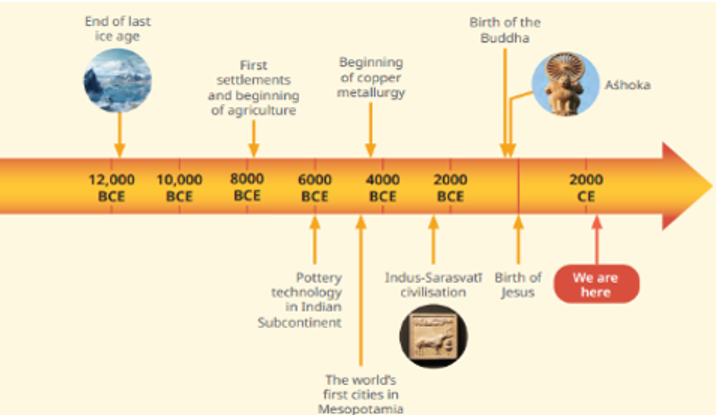
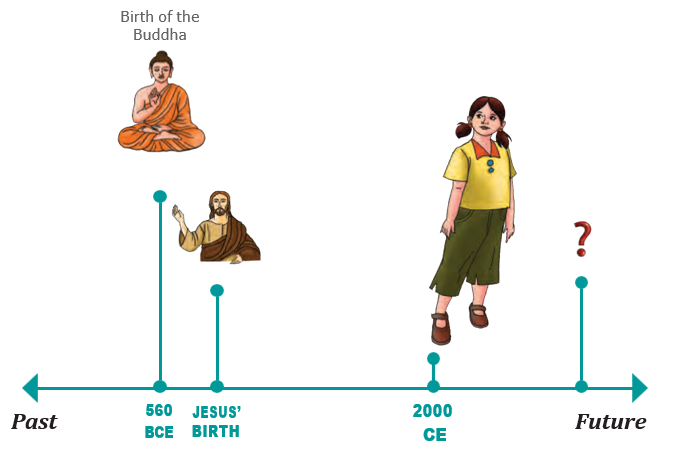
Decades, Centuries and Millenniums
How Periods Are Numbered
- CE periods: The 1st century and 1st millennium begin at 1 CE; the 21st century and 3rd millennium began in 2001 CE.
- BCE periods: Counting starts at 1 BCE and extends backward in time. The 8th millennium BCE covers 8000–7001 BCE.
Key Calendar Periods
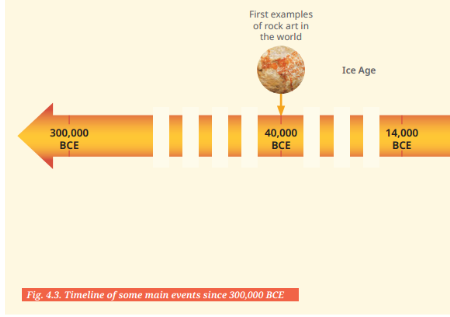
- 300,000–14,000 BCETimeline range shown for major events, including early Ice Age rock art.
- 560 BCEApproximate birth year of Gautama Buddha.
- 1 BCE to 1 CEThe calendar moves directly between these years; there is no year zero.
- 2001–2100 CEThe 21st century CE.
- 2001–3000 CEThe 3rd millennium CE.
Traditional Indian Calendars
Why must 1 be subtracted when calculating the years between a BCE and a CE date?
What is a pañchānga, and what information can it provide?
Quick recap
- Calendars vary across societies; the Gregorian calendar is widely used and has a leap year every four years, with a special rule for century years.
- AD/CE label years after the conventional starting point; BC/BCE label years before it.
- There is no year zero, so a BCE-to-CE gap is found by adding the year numbers and subtracting 1.
- A timeline places dates and events in sequence and may use dotted sections to skip time.
- A decade is 10 years, a century is 100 years and a millennium is 1,000 years.
- Many Indian calendars use the Sun and Moon; pañchāngas provide calendar and astronomical information.
What Are the Sources of History?
Sources of History
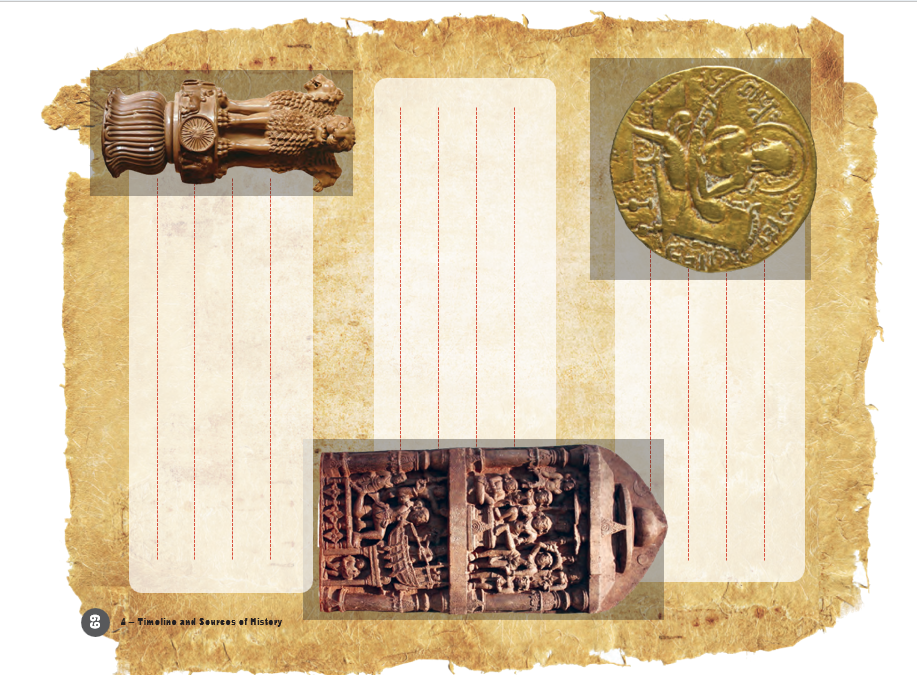
Sources of history — Evidence used to learn about and reconstruct the past.
Using Historical Sources
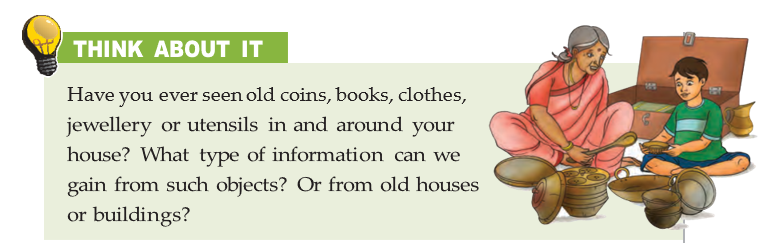
- Examples: Objects, structures, photographs, diaries, identity cards and memories from relatives can reveal information about the past.
- Puzzle pieces: Each source gives only part of the picture; some pieces of the past may remain missing.
- Cross-checking: Historians consult as many sources as possible. Sources may support or contradict one another, so they assess which sources are more trustworthy.
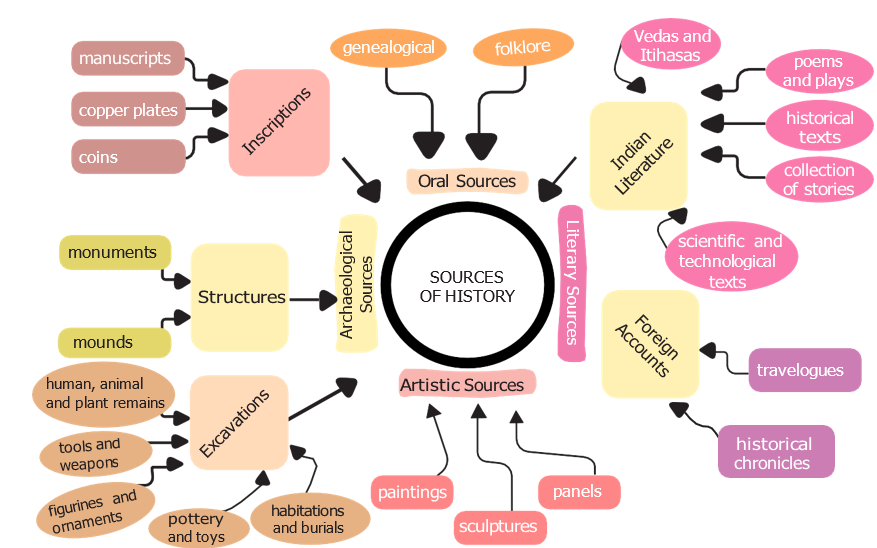
| Source type | What it includes |
|---|---|
| Archaeological | Objects and structures from the past |
| Oral | Memories and accounts passed on by people |
| Literary | Written works and texts |
| Foreign accounts | Accounts about a place or people written by visitors from elsewhere |
| Artistic | Artworks such as paintings and sculptures |
People and Methods That Help Reconstruct the Past
Contributors and New Evidence
- Specialists: Historians, archaeologists, epigraphists (who study ancient inscriptions), anthropologists (who study human societies and cultures), and literature and language experts contribute to historical research.
- Scientific studies: Research on ancient climates, chemical analysis of excavated materials and genetics of ancient people provide fresh evidence to supplement other sources.
- Recent sources: Newspapers help historians study recent history; television and the internet are useful for the last few decades.
Historian — A person who studies and writes about the past.
Genetics — The branch of biology that studies how features and characteristics pass from one generation to the next.
Time Spans and Sources
- Last two or three centuriesNewspapers can serve as sources for studying recent history.
- Last 50 years or soScientific studies have contributed increasingly to reconstructing the past.
- Last few decadesElectronic media, including television and the internet, can be consulted.
The Beginnings of Human History
Early Humans
- Modern humans: Homo sapiens have lived on Earth for about 300,000 years—a tiny fraction of Earth’s history.
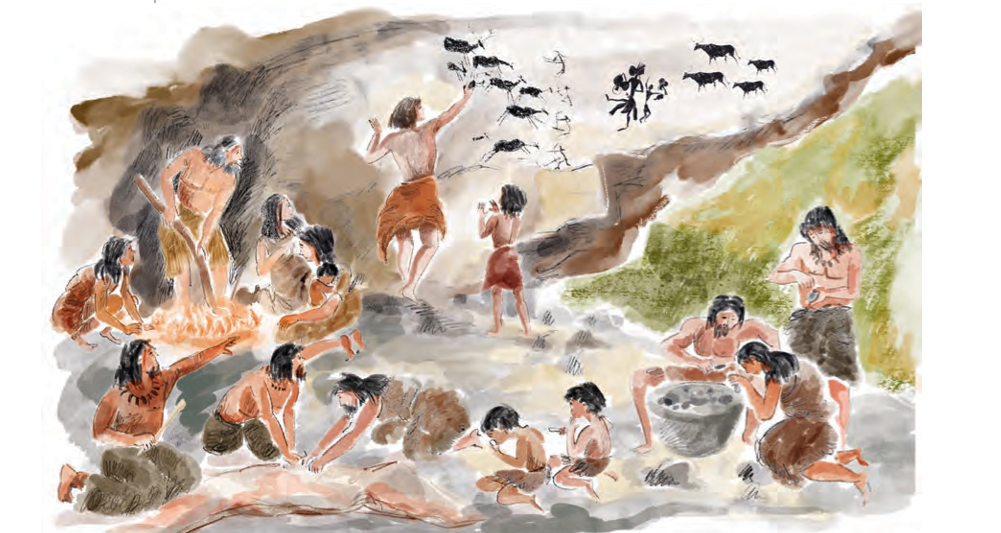
- Group life: Early humans faced challenges from nature and lived in bands, helping one another find food and shelter.
- Hunter-gatherers: They survived by hunting animals and collecting edible plants and fruits.
- Homes and communication: They used temporary camps, rock shelters or caves, and spoke languages that are now lost.
- Tools and fire: They used fire and made tools such as improved stone axes, blades and arrowheads to make life easier.
- Beliefs and art: They may have believed in natural elements and an afterlife. Rock paintings found in caves around the world show figures, symbols, animals and human scenes.
- Ornaments and exchange: They made stone or shell beads and pendants from animal teeth; sometimes they exchanged them with other groups.
Afterlife — A life believed to begin after death.
How do historians use sources to reconstruct the past?
Name three ways scientific studies contribute to knowledge of the past.
Quick recap
- Historical sources are evidence used to learn about and reconstruct the past.
- Sources include archaeological, oral, literary, foreign-account and artistic evidence.
- Historians compare sources and assess their reliability when accounts conflict.
- Scientific research has contributed increasingly to reconstructing the past over the last 50 years or so.
- Homo sapiens have lived on Earth for about 300,000 years.
- Early humans lived in groups, hunted and gathered, made tools, created rock paintings and fashioned ornaments.
The First Crops
Climate Change and the Last Ice Age
The Last Ice Age
- Over 100,000 years agoThe last Ice Age began.
- Around 12,000 years agoThe last Ice Age ended.
The Beginning of Farming and Settled Life
Why Communities Settled and Farmed
- Climate became warmer and living conditions improved.
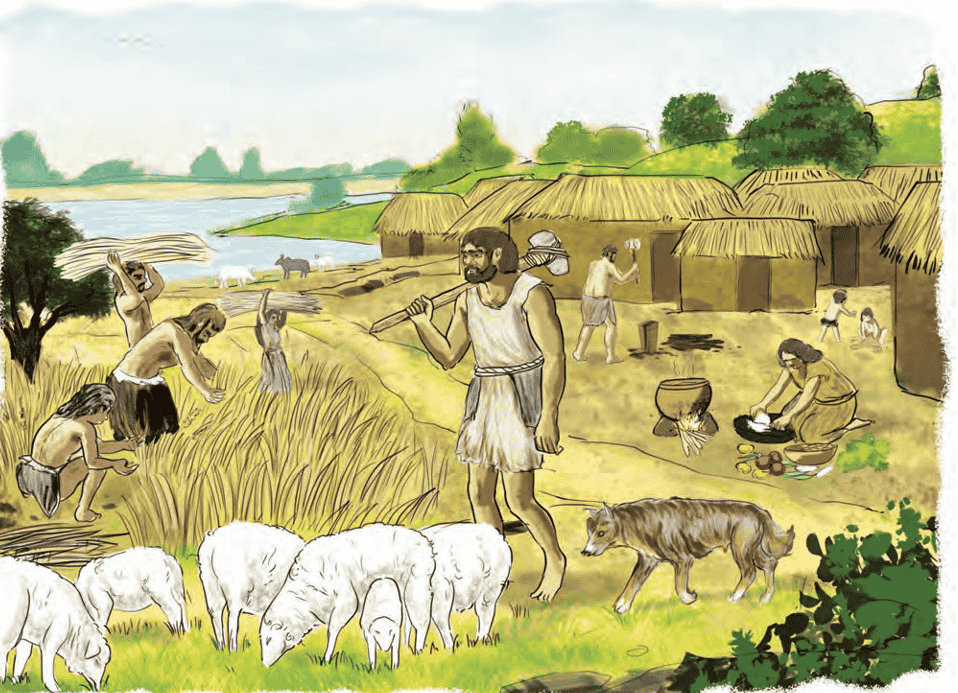
- In many regions, people settled down, cultivated cereals and grains, and domesticated animals such as cattle and goats.
- A greater food supply helped communities grow in size and number.
- Many communities settled near rivers for water and fertile soil, which made crop-growing easier.
Social Roles and Community Life
Roles and Shared Work
- Roles: Pictures may show men and women doing particular tasks, but these roles are not necessarily fixed or universal.
- Possibilities: Women may have prepared colours or painted rock shelters; men may have cooked or cared for children.
- Leadership: Chieftains or leaders were responsible for the community’s welfare, and people worked together for it.
- Land: There was no sense of individual ownership; land was collectively sown and harvested.
From Hamlets to Villages and Towns
Growth of Settlements and Exchange
- Small hamlets grew into sizeable villages.
- Villages exchanged goods, mainly food, clothing and tools.
- Communication and exchange networks developed among villages.
- Some villages eventually grew into small towns.
| Technology | Use or importance |
|---|---|
| Pottery | Made pots and other objects from clay. |
| Copper, then iron | Helped make durable tools, everyday objects and ornaments. |
Early Progress, Challenges and Civilisation
- Growing communities developed more complex social life, exchange and technologies.
- These developments prepared the way for the emergence of civilisation.
- Early human progress also faced serious challenges; at critical times, humanity may have come close to disappearing, as some earlier species did.
- The courage and persistence of early humans helped make our existence today possible.
- Welfare
- Health, prosperity and well-being.
- Hamlet
- A small settlement or small village.
- Chieftain
- A community leader responsible for people’s well-being.
- Domestication
- The process of bringing animals under human care and control.
- Timelines show the sequence of historical events.
- Time units include years, decades, centuries and millenniums.
- Sources of history help us reconstruct and interpret the past.
Why did many early farming communities settle near rivers?
How did settlements develop into small towns?
Quick recap
- The last Ice Age lasted from over 100,000 years ago to around 12,000 years ago.
- Warmer conditions supported settled life, crop cultivation and animal domestication.
- Rivers offered water and fertile soil, encouraging farming settlements.
- Communities grew, shared work and developed villages, exchange networks and towns.
- Pottery and the use of copper, followed later by iron, brought useful objects and durable tools.
- Early social and technological developments helped prepare the way for civilisation, despite serious challenges faced by early humans.
Social Science — ALL CHAPTERS
1
LOCATING PLACES ON THE EARTH
2
Oceans and Continents
3
LANDFORMS AND LIFE
4
TIMELINE AND SOURCES OF HISTORY
5
INDIA, THAT IS BHARAT
6
THE BEGINNINGS OF INDIAN CIVILISATION
7
INDIA’S CULTURAL ROOTS
8
UNITY IN DIVERSITY, OR MANY IN THE ONE
9
FAMILY AND COMMUNITY
10
GRASSROOTS DEMOCRACY – PART 1 GOVERNANCE
11
GRASSROOTS DEMOCRACY – PART 2 LOCAL GOVERNMENT IN RURAL AREAS
12
GRASSROOTS DEMOCRACY – PART 3 LOCAL GOVERNMENT IN URBAN AREAS
13
THE VALUE OF WORK
14
ECONOMIC ACTIVITIES AROUND US