Class 6 . Social Science . Exploring Society India And Beyond . India S Cultural Roots
Chapter 7: INDIA’S CULTURAL ROOTS
Ch 7
Social Science
Class 6
Introduction to the Vedas and Vedic Culture
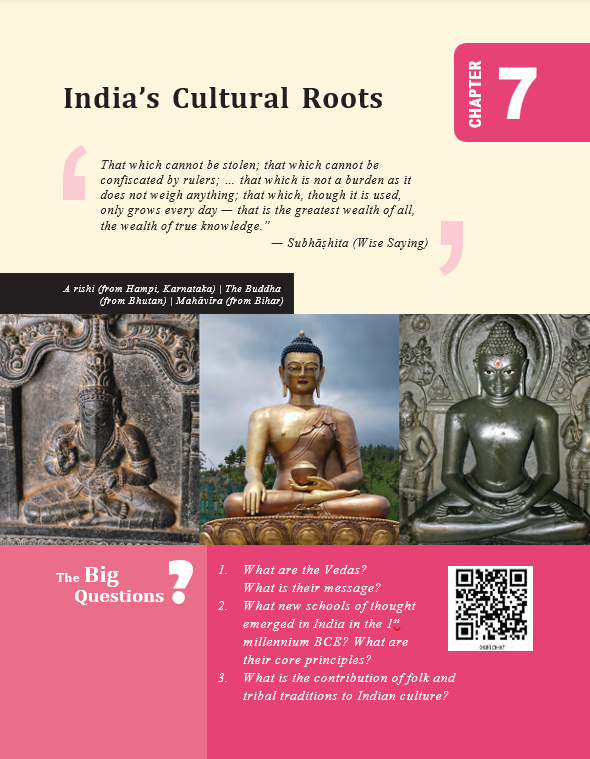
India’s shared cultural roots
Culture, its branches and roots
- Age and diversity: Indian culture is several millennia old, with branches such as art, literature, science, medicine, religion, governance and martial arts.
- Common foundation: Diverse traditions can be seen as branches growing from shared roots and a common cultural trunk.
- Schools of thought: Groups of thinkers or spiritual seekers who share ideas about human life and the world.
- Early roots: Some archaeologists and scholars trace cultural roots to the Indus, Harappan or Sindhu-Sarasvatī civilisation; many schools of thought emerged later.
- Spiritual
- Concerned with the spirit or soul; spirituality seeks a deeper dimension beyond one’s present personality.
- Seeker
- A person searching for truth, such as a sage, saint, yogi or philosopher.
- Rishi and rishika
- Male and female seers or sages associated with composing Vedic hymns.
- Ritam
- Truth and order in human life and the cosmos.
- Worldview
- A way of understanding the world, its origin or how it works.
- UNESCO
- United Nations Educational, Scientific and Cultural Organization; it promotes dialogue through education, science and culture.
The Vedas and Vedic Culture
Veda — An ancient Indian text; the word comes from Sanskrit vid, meaning “knowledge” (as in vidyā).
| No. | Veda |
|---|---|
| 1 | Ṛig Veda |
| 2 | Yajur Veda |
| 3 | Sāma Veda |
| 4 | Atharva Veda |
Vedic hymns and their transmission
- Importance: The Vedas are the most ancient texts of India and among the most ancient texts in the world.
- Hymns: They contain thousands of hymns—prayers composed as poems and songs.
- Oral tradition: The hymns were recited orally, not written, and memorised through rigorous training with very few alterations.
- Duration: Oral transmission continued for roughly 100–200 generations.
- Place of composition: The hymns were composed in the Sapta Sindhava region.
Dating and recognition
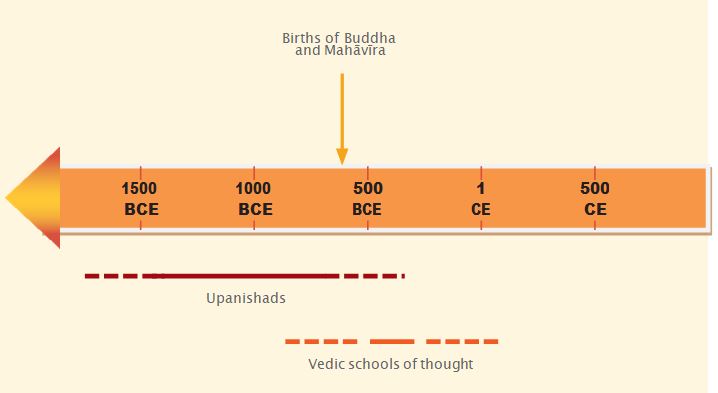
- 5th–2nd millennium BCEExperts have proposed dates within this broad range for composing the Ṛig Veda, the oldest of the four Vedas.
- 2008UNESCO recognised Vedic chanting as a masterpiece of the oral and intangible heritage of humanity.
Vedic culture and worldview
- Composers: Rishis (male seers or sages) and rishikas (female seers) composed hymns in an early form of Sanskrit.
- Deities: Hymns addressed deities including Indra, Agni, Varuṇa, Mitra, Sarasvatī and Uṣhas.
- Ritam: Seers and deities were understood to sustain ṛitam—the truth and order of human life and the cosmos.
- Cosmos: The world or universe understood as an ordered and harmonious system.
- One reality: Early rishis and rishikas viewed the gods and goddesses as one reality, not as separate beings.
Truth and unity
- Truth: Truth was a central value and was often another name for God.
- One reality, many names: A Vedic hymn says that reality is one, though sages give it many names.
- Unity among people: The Ṛig Veda’s final mantras call people to unite their speech, minds, thoughts, purpose and hearts.
What are the Vedas, and how were they preserved?
What ideas about reality and society appear in Vedic hymns?
Quick recap
- Indian culture has many branches connected by shared roots; some roots are linked to the Indus or Harappan civilisation.
- The four Vedas are the Ṛig, Yajur, Sāma and Atharva Vedas.
- The Vedas are India’s most ancient texts and among the world’s most ancient texts.
- Vedic hymns were composed in the Sapta Sindhava region and recited orally, not written; they were memorised across roughly 100–200 generations.
- Rishis and rishikas composed hymns to deities and upheld ṛitam, or truth and order.
- Vedic ideas include one reality with many names and a call for unity; UNESCO recognised Vedic chanting in 2008.
The Vedas and Vedic Culture ( Continuation )
Vedic Society
Jana — A jana was a clan or large group of people associated with a particular region.
Society and Occupations
- Clans: The Ṛig Veda names more than 30 janas, including the Bharatas, Purus, Kurus, Yadus and Turvaśhas.
- Regions: Each jana was linked to a region in the northwestern part of the Subcontinent.
- Governance clues: Vedic texts mention a rājā (ruler), and the collective gatherings called sabhā and samiti; little is known about how janas were governed.
- Professions: Texts refer to agriculturists, weavers, potters, builders, carpenters, healers, dancers, barbers and priests.
- Healer: A person who uses traditional practices to relieve or cure diseases.
Vedic Schools of Thought
Rituals and Upanishadic Ideas
- Yajña: Vedic rituals were performed for deities for individual or collective benefit and wellbeing.
- Daily worship: Prayers and offerings were commonly made to Agni, the deity associated with fire; rituals became more complex over time.
- Upanishads: These texts developed Vedic ideas and introduced concepts including rebirth (being born again) and karma (actions or their results).
- Vedanta: One school of thought holds that human life, nature and the universe are one divine essence, called brahman or tat (“That”). Brahman is not the god Brahmā.
- Mantras: “Aham brahmāsmi” means “I am brahman”; “tat tvam asi” means “You are That.”
Atman, Interconnection and Compassion
- Ātman: The divine essence or Self present in every being; ultimately, it is one with brahman.
- Interdependence: Since all beings share this ultimate essence, everything in the world is connected.
- Prayer: “Sarve bhavantu sukhinah” means “May all creatures be happy”; the prayer also wishes them freedom from disease and sorrow.
Growth of Vedic Schools
- Early 1st millennium BCESeveral schools of thought grew out of the Vedas, including Yoga.
Yoga and the Foundations of Hinduism
- Yoga: A school that developed methods to realise brahman within one’s consciousness (awareness).
- Legacy: Together, the Vedic schools of thought became the foundations of what is now called Hinduism.
- Sabhā
- A collective gathering or assembly mentioned in the Vedas.
- Samiti
- A collective gathering or assembly mentioned in the Vedas.
- Yajña
- A ritual performed for the benefit and wellbeing of individuals or groups.
- Karma
- Actions or their results.
- Brahman
- The divine essence understood by Vedanta as one reality underlying life, nature and the universe.
- Ātman
- The divine Self within every being, ultimately one with brahman.
What do the Vedas reveal about early Vedic society?
Explain the relationship between ātman and brahman in the Upanishadic ideas described here.
Quick recap
- The Ṛig Veda names over 30 janas, or clans, associated with northwestern regions.
- Vedic texts mention a rājā, sabhā and samiti, but provide few details about governance.
- Vedic rituals included yajñas and daily prayers and offerings to Agni.
- The Upanishads discuss rebirth and karma; Vedanta teaches the oneness of all existence as brahman.
- Ātman is the divine Self in every being and is ultimately one with brahman.
- Yoga and other Vedic schools became foundations of Hinduism.
Buddhism & Jainism
New Schools of Thought
Schools that questioned Vedic authority
- Buddhism and Jainism: These schools developed their own teachings and did not accept the authority of the Vedas.
- Intellectual diversity: People explored different philosophical and spiritual ideas.
- Shared setting: Buddhism and Jainism became widespread around the same broad period.
Questioning in the Upanishads
Ideas shown through Upanishadic stories
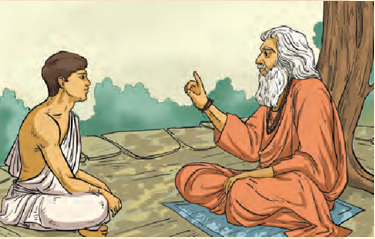
- Śvetaketu and Uddālaka: Uddālaka explained that the invisible essence, brahman, is present in everything, using the seed of a banyan fruit and pots made from clay as examples.
- Main teaching: Everything arises from the same subtle essence; Uddālaka tells Śvetaketu, “You are That.”
- Nachiketa and Yama: Nachiketa asks what happens after death. Yama teaches that the ātman, or self within all creatures, is immortal—it is neither born nor dies.
- Gārgī and Yājñavalkya: At King Janaka’s philosophical debate, Gārgī questions the rishi about the world and brahman. Yājñavalkya explains that brahman makes the world and its processes possible.
- Significance: These stories show the value of persistent questioning and that women, children and men could take part in philosophical inquiry.
The Buddha’s Search and Teachings
Siddhārtha Gautama’s path to enlightenment
- Birth: Siddhārtha Gautama was a prince born in Lumbini, now in Nepal; about 560 BCE is used as an approximate birth year.
- Four encounters: At age 29, he saw an old man, a sick man, a dead body and a peaceful ascetic. These encounters made him confront suffering and the possibility of a different way of life.
- Renunciation: He left palace life, including his wife and son, and travelled as an ascetic to seek the root cause of human suffering.
- Enlightenment: After meditating for many days beneath a pipal tree at Bodh Gaya, he realised that ignorance and attachment cause suffering.
- Name: Siddhārtha became known as the Buddha, meaning “the enlightened” or “awakened” one.
The Buddha’s explanation of suffering
- Ignorance and attachment
- A person misunderstands life and becomes attached
- Attachment and ignorance give rise to suffering
- Removing these causes through insight and inner discipline offers a way beyond suffering
Buddhist teachings and the Sangha
- Ahimsa: Often translated as nonviolence; its original sense is “non-hurting” or “non-injuring.”
- Inner discipline: The Buddha emphasised sincere self-discipline, truth and dharma rather than outward acts alone.
- Self-conquest: Conquering oneself is greater than defeating others in battle; purity comes from truth and dharma within, not merely bathing in sacred rivers.
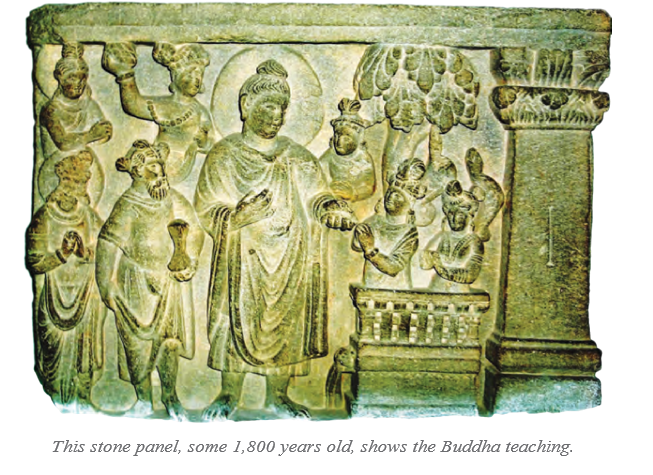
- Sangha: The Buddha founded a community of bhikṣhus (monks), and later bhikṣhuṇīs (nuns), devoted to practising and spreading his teachings.
- Influence: Buddhist teachings had a major influence in India and across Asia, and remain influential today.
Jainism and Mahāvīra
Vardhamāna’s path
- Birth and renunciation: Prince Vardhamāna was born near Vaiśālī in present-day Bihar in the early sixth century BCE. At age 30, he left home to seek spiritual knowledge.
- Ascetic practice: After 12 years of rigorous discipline, he attained supreme wisdom, described as “infinite knowledge.”
- Mahāvīra: Vardhamāna became known as Mahāvīra, meaning “great hero,” and began teaching what he had realised.
- Jina: “Jain” comes from jina, meaning “conqueror”—one who conquers ignorance and attachment, not territory or enemies.
| Teaching | Meaning |
|---|---|
| Ahimsa | Do not harm or injure living beings; this includes avoiding violence in thought as well as action. |
| Anekāntavāda | Truth has many aspects and cannot be fully expressed through a single perspective or statement. |
| Aparigraha | Non-possession: detach from material possessions and limit oneself to what is truly necessary. |
Interdependence of living beings
- Jain view: All creatures, from humans to invisible organisms, are interconnected and depend on one another.
- Ethical result: Respect for life and restraint from harm follow from recognising this interdependence.
| Point | Buddhism | Jainism |
|---|---|---|
| Key teacher | Siddhārtha Gautama, the Buddha | Vardhamāna, known as Mahāvīra |
| Path described in this lecture | Recognise ignorance and attachment as causes of suffering; practise inner discipline. | Practise ascetic discipline and seek supreme knowledge; follow ahimsa, anekāntavāda and aparigraha. |
| Shared emphasis | Ahimsa and the search to overcome suffering and ignorance. | Ahimsa and the search to overcome suffering and ignorance. |
Stories and Ethical Lessons
The Jātaka tale of the monkey king
- Jātaka tales: Stories of the Buddha’s former births that communicate Buddhist values in an accessible way.
- The sacrifice: A monkey king used his body as a bridge so his troop could escape soldiers, suffering severe injuries and dying.
- Lesson: His selfless protection moved the human king to reflect on a ruler’s responsibility towards subjects.
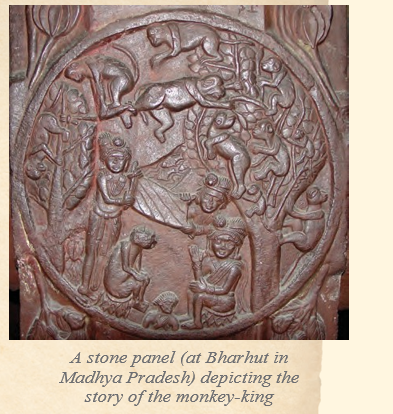
The Jain story of Rohineya
- Change of direction: Rohineya, a skilled burglar, remembered part of Mahāvīra’s sermon and used it to recognise a minister’s plan.
- Reform: Remorseful, he confessed his crimes, returned stolen goods, asked forgiveness and became a monk.
- Lesson: The story stresses right action and right thinking, and the possibility of a second chance.
Spread, Diversity and Shared Ideas
Monastic communities and places of practice
- Travelling teachers: Buddhist and Jain monks, and sometimes nuns, travelled to spread their teachings.
- Monasteries and caves: Some established monasteries in distant places; others lived ascetic lives in rock-cut caves.
- Archaeological evidence: Remains of monasteries, stone beds and inscriptions—including monks’ names—help reveal these communities.
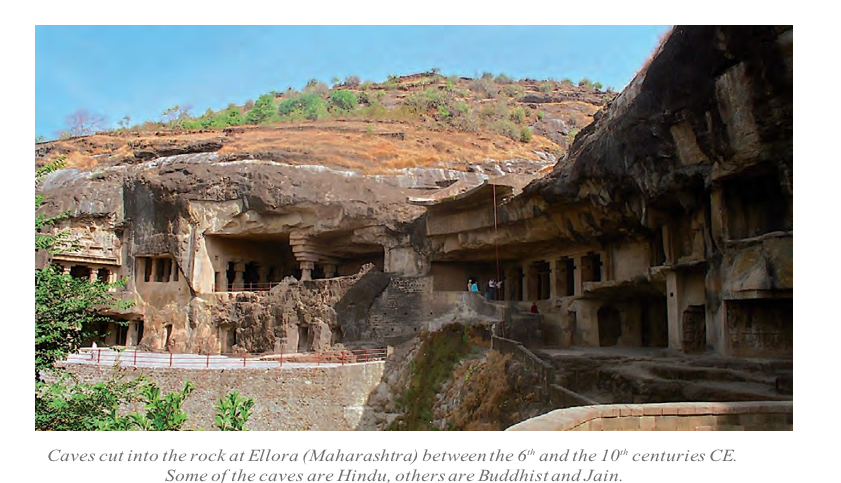
Different belief systems and common ground
- Many dimensions: Indian traditions include philosophical, spiritual, religious, ethical and social aspects; some scholars consider the label “religion” too limiting for them.
- Chārvāka (Lokāyata): This school held that only the material world exists and therefore there is no life after death. It later disappeared and did not become widely popular.
- Shared concepts: Vedic, Buddhist and Jain traditions differed, but shared ideas such as dharma, karma, rebirth, ending suffering and ignorance, and important ethical values.
- Cultural image: These related ideas form a shared foundation within India’s diverse traditions.
Dates and periods in this lecture
- Early sixth century BCEVardhamāna was born near Vaiśālī.
- About 560 BCEApproximate birth year used for Siddhārtha Gautama.
- Sixth to tenth centuries CEEllora’s rock-cut caves were built; the complex includes Hindu, Buddhist and Jain sites.
- Avidyā
- Ignorance; identified with attachment as a source of human suffering.
- Attachment
- A bond with a person or thing, often formed through sentiment or habit.
- Ahimsa
- Non-hurting or non-injuring; it includes avoiding harm in thought and action.
- Sangha
- The Buddhist community of monks and, later, nuns who practised and spread the teachings.
- Ascetic
- Someone who practises rigorous discipline to attain a higher consciousness.
- Monk and nun
- A monk or nun gives up ordinary worldly life for religious or spiritual pursuits and typically follows strict vows or rules.
What causes suffering according to the Buddha, and how can it be addressed?
Name and explain three central Jain teachings.
What ideas did Vedic, Buddhist and Jain traditions share?
Quick recap
- Buddhism and Jainism were schools of thought that developed outside Vedic authority.
- Upanishadic stories highlight questioning and ideas such as brahman and the immortal ātman.
- The Buddha linked suffering to ignorance and attachment and taught ahimsa and inner discipline.
- Mahāvīra taught ahimsa, anekāntavāda and aparigraha, alongside the interdependence of living beings.
- Ascetics practise rigorous discipline; monks and nuns give up ordinary worldly life for spiritual pursuits.
- Buddhist and Jain monks and nuns spread their teachings through travel, monasteries and cave communities.
- These traditions differed but shared ideas such as dharma, karma, rebirth and the search to overcome suffering.
Folk and Tribal Roots
Oral, Folk and Tribal Traditions
Oral traditions — Teachings and practices passed on through everyday life and practice, rather than through written texts; the Vedas are an example of an oral tradition transmitted without written texts.
- Folk traditions
- Traditions transmitted by common people.
- Tribal traditions
- Traditions transmitted within tribal communities.
- Jana
- A community or group; ancient India had no separate word for ‘tribe’, and tribes were regarded as different janas living in particular environments.
- Janjāti
- The Hindi term used for tribes or tribal communities.
- Supreme being
- A higher or ultimate divinity recognised by many tribal groups alongside their worship of multiple deities.
Understanding Tribes
Tribe — A close-knit community of families or clans sharing common descent, culture and language, traditionally living under a chief and holding no private property.
Terms, Population and Changing Views
- Ancient usage: Ancient India had no word for ‘tribe’; tribes were different janas living in environments such as forests or mountains.
- Official terms: The Constitution uses “tribes” and “tribal communities” in English, and *janjāti* in Hindi.
- Population: In 2011, India had 705 tribes with about 104 million people—more than the populations of Australia and the United Kingdom combined.
- Changing views: In the 19th century, some anthropologists called tribes “primitive” or “inferior”; deeper study of their complex cultures led these biased judgments to be mostly abandoned.
Tribal Communities in Historical Accounts
- 19th centurySome anthropologists described tribes as primitive or inferior; these biased views were later mostly rejected.
- 2011Official figures recorded 705 tribes in India, with a combined population of about 104 million.
Long Interaction Between Traditions
Mutual Influence
- Exchange: Folk, tribal and Hindu traditions have shared deities, concepts, legends and rituals in both directions for a very long time.
- Tribal influence: According to tradition, Jagannath, worshipped at Puri in Odisha, was originally a tribal deity; several forms of mother-goddess worship also have tribal roots.
- Hindu influence: Some tribes adopted Hindu deities and developed their own versions of the *Mahābhārata* and *Rāmāyaṇa*, documented from northeastern India to Tamil Nadu.
- Art and beliefs: Tribal belief systems and art have interacted with Hinduism for millennia; this two-way exchange has enriched India’s cultures.
Why Traditions Could Interact
- Folk, tribal and Hindu belief systems share some concepts
- Nature and its features are often regarded as sacred and conscious
- Communities worship deities associated with natural elements
- Beliefs, deities, legends, rituals and art are exchanged in both directions
- Long-term interaction leads to mutual cultural enrichment

Nature and Divinity in Tribal Beliefs
- Sacred nature: Mountains, rivers, trees, plants, animals and some stones may be sacred because they are believed to have consciousness.
- Many deities: Tribal groups often worship multiple deities associated with natural elements.
- Toda example: For the Toda people of the Nilgiris in Tamil Nadu, more than thirty peaks are homes of gods or goddesses; the peaks are so sacred that Todas avoid pointing at them.
- Higher divinity: Alongside many deities, numerous tribal groups also recognise a supreme being.
| Deity | Community or region | Significance |
|---|---|---|
| Donyipolo | Several tribes of Arunachal Pradesh | A combined form of the Sun and Moon that later rose to the status of a supreme god. |
| Khandoba | Parts of central India | An example of a higher divinity. |
| Singbonga | Munda and Santhal communities, among others, in eastern India | Supreme deity believed to have created the world. |
A Sociologist’s View
- André Béteille: The Indian sociologist noted that castes and tribes have influenced one another’s religious beliefs and practices since early times.
- Two-way influence: Tribal religions have been influenced by Hinduism, and Hinduism has also been influenced by tribal religions throughout its development.
Connection to Other Indian Traditions
| Tradition | Key point |
|---|---|
| Vedic traditions | The Vedas, India’s earliest texts, gave rise to schools of thought including Vedanta and Yoga. |
| Buddhism and Jainism | They departed from the authority of the Vedas and emphasised specific values and practices. |
| Shared concern | Despite differing principles and methods, these schools sought the cause of suffering and ways to remove ignorance. |
How have folk, tribal and Hindu traditions influenced one another?
Give examples of nature worship and a supreme divinity in tribal traditions.
Quick recap
- Oral traditions pass on teachings and practices without written texts; the Vedas are an example.
- Folk traditions are transmitted by common people, while tribal traditions are transmitted within tribal communities.
- A tribe is a close-knit community sharing descent, culture and language; India had 705 tribes and about 104 million tribal people in 2011.
- Folk, tribal and Hindu traditions—including tribal belief systems and art—have exchanged ideas and practices for millennia.
- Tribal beliefs often treat natural features as sacred and may recognise many nature-linked deities as well as a supreme being.
- Vedic schools, Buddhism and Jainism differed in principles but shared a search for the cause of suffering and ways to overcome ignorance.
Social Science — ALL CHAPTERS
1
LOCATING PLACES ON THE EARTH
2
Oceans and Continents
3
LANDFORMS AND LIFE
4
TIMELINE AND SOURCES OF HISTORY
5
INDIA, THAT IS BHARAT
6
THE BEGINNINGS OF INDIAN CIVILISATION
7
INDIA’S CULTURAL ROOTS
8
UNITY IN DIVERSITY, OR MANY IN THE ONE
9
FAMILY AND COMMUNITY
10
GRASSROOTS DEMOCRACY – PART 1 GOVERNANCE
11
GRASSROOTS DEMOCRACY – PART 2 LOCAL GOVERNMENT IN RURAL AREAS
12
GRASSROOTS DEMOCRACY – PART 3 LOCAL GOVERNMENT IN URBAN AREAS
13
THE VALUE OF WORK
14
ECONOMIC ACTIVITIES AROUND US