Class 6 . Social Science . Exploring Society India And Beyond . Oceans and Continents
Chapter 2: Oceans and Continents
Ch 2
Social Science
Class 6
Introduction & the Distribution of Water and Land on the Earth
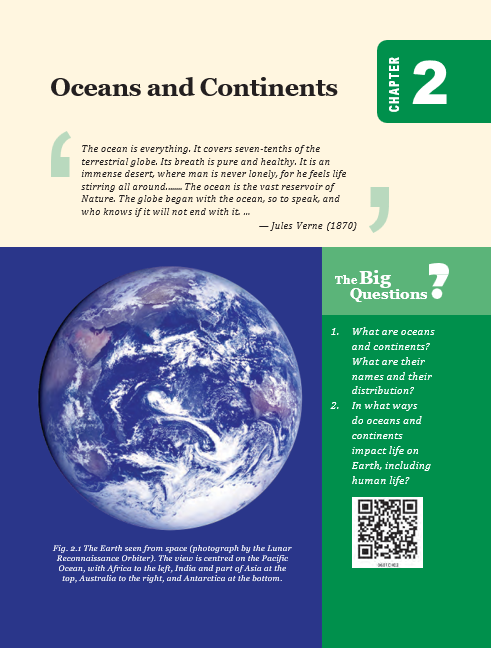
Earth: The Blue Planet
Water and land on Earth
- Water covers almost three-fourths of Earth’s surface, making the planet appear mostly blue from space.
- Blue planet is a name for Earth because of its extensive water cover.
- Land covers a little more than one-fourth of Earth’s surface.
- Oceans are the largest water bodies on Earth.
- Oceans and continents shape climate and affect plants, animals and human life.
- Landmass
- A large body of land.
- Continent
- A large, continuous expanse of land.
- Hemisphere
- One half of Earth, such as the Northern or Southern Hemisphere.
Distribution of Water and Land
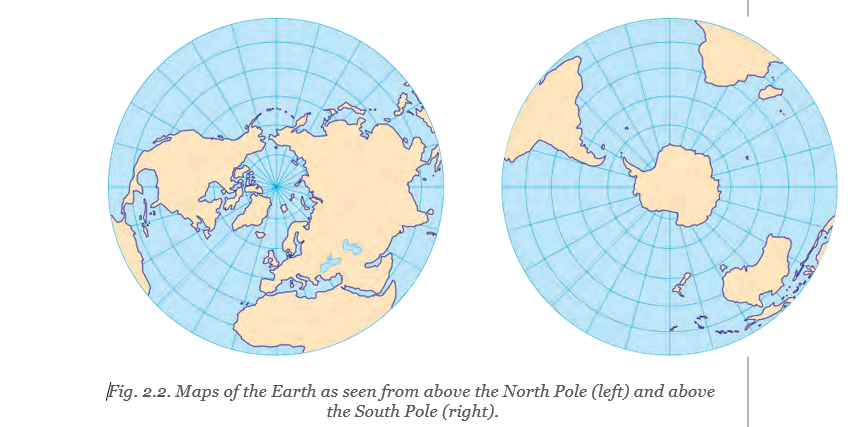
Comparing the hemispheres
- Unequal distribution: Water and land are not spread equally across the Northern and Southern Hemispheres.
- Southern Hemisphere: It contains a greater share of water than the Northern Hemisphere.
- Map lines: Circular lines are lines of latitude; lines radiating from the poles are lines of longitude.
- Connected oceans: The oceans form a connected body of water, though different regions have separate names.
- Smaller water bodies: Seas, bays and gulfs are named extensions of the oceans.
Ocean Water and Freshwater
| Point | Seawater | Freshwater |
|---|---|---|
| Amount | Oceans hold most of the planet’s water. | Makes up only a very small proportion of Earth’s water. |
| Use | Salty and unfit for consumption by most land animals, including humans. | Found in glaciers, rivers, lakes, the atmosphere and underground. |
| Underground source | — | Water found underground is called groundwater. |
Why water scarcity can occur
- Oceans contain most of Earth’s water
- Ocean water is salty and unsuitable for direct consumption by most land animals
- Only a small proportion of Earth’s water is freshwater
- Therefore, the supply of usable freshwater is limited
Why is there water scarcity even though Earth has abundant water?
What is the difference between a landmass and a continent?
Quick recap
- Almost three-fourths of Earth’s surface is water; a little more than one-fourth is land.
- Earth is called the blue planet, and oceans are its largest water bodies.
- A continent is a large, continuous expanse of land; a landmass is a large body of land.
- Water and land are distributed unequally between the hemispheres; the Southern Hemisphere has more water.
- Oceans are connected and include named extensions such as seas, bays and gulfs.
- Most planetary water is salty seawater, while freshwater is a very small share and occurs in several sources.
Oceans
The Five Oceans
Names, Size and Hemispheres
- Five oceans: Pacific, Atlantic, Indian, Southern (or Antarctic), and Arctic.
- Size order: Pacific is largest, followed by Atlantic, Indian, Southern, and Arctic.
| Ocean | Hemisphere(s) |
|---|---|
| Pacific Ocean | Northern and Southern |
| Atlantic Ocean | Northern and Southern |
| Indian Ocean | Northern and Southern |
| Southern Ocean | Southern |
| Arctic Ocean | Northern |
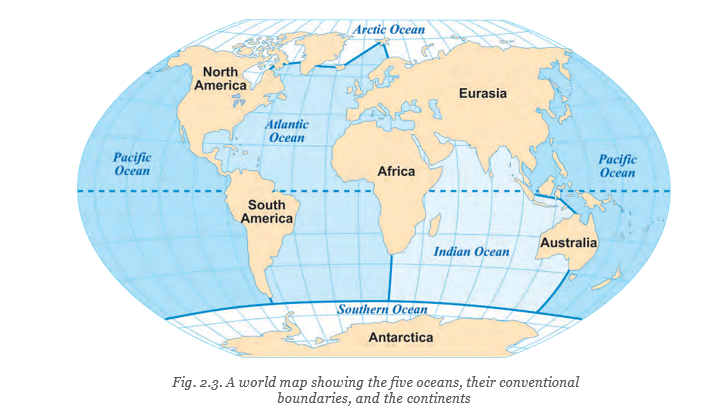
Connected Oceans and Marine Life
- Ocean boundaries: Lines dividing oceans on maps are conventions; oceans are connected, and seawater flows between them.
- Shared life: Many marine species occur across multiple oceans, supported by the movement of seawater.
Marine flora — Plant life in the sea, including tiny algae and different kinds of seaweeds.
Marine fauna — Animal life in the sea, including colourful fish, dolphins, whales, and deep-sea creatures.
- Ocean habitats: Different life forms live throughout the ocean, from the sunlit surface to the dark depths.
The Indian Ocean and India
- Indian Ocean limits: Asia lies to its north, Africa to its west, Australia to its east, and the Southern Ocean to its south.
- On either side of India: The Arabian Sea is to the west; the Bay of Bengal is to the east.
- Indian island groups: Lakshadweep lies in the Arabian Sea; the Andaman and Nicobar Islands lie in the Bay of Bengal.
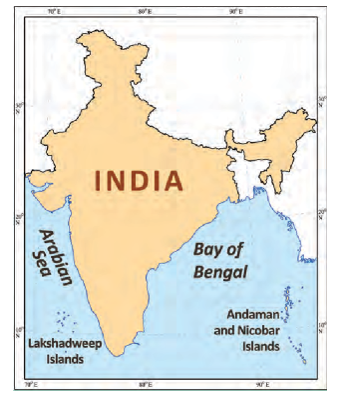
Quick recap
- The five oceans are the Pacific, Atlantic, Indian, Southern, and Arctic.
- The Pacific is largest and the Arctic is smallest; the others rank Atlantic, Indian, then Southern.
- Ocean boundaries on maps are conventional, and seawater flows between oceans.
- Marine flora includes algae and seaweeds; marine fauna includes fish, dolphins, whales, and deep-sea creatures.
- Asia, Africa, Australia, and the Southern Ocean border the Indian Ocean to the north, west, east, and south respectively.
- The Arabian Sea is west of India, while the Bay of Bengal is east; their island groups include Lakshadweep and Andaman and Nicobar.
Oceans and Disasters
Oceans and Disasters
How oceans affect life and coasts
- Rainfall: Clouds over oceans bring rain to continents. Indian monsoon rains originate in the ocean and support agriculture and life.
- Storms: Oceans can give rise to storms with extreme rainfall or very strong winds.
- Cyclones: These violent storms can cause widespread damage to coastal regions.
Tsunami — A tsunami is a huge, powerful ocean wave generally caused by a strong undersea earthquake or volcanic eruption.
How a tsunami causes damage
- Strong earthquake or volcanic eruption on the ocean floor
- A powerful tsunami wave forms
- The wave can travel thousands of kilometres
- Coastal areas may be submerged, causing widespread damage and loss of life
The 2004 Indian Ocean tsunami
- 26 December 2004An earthquake in Indonesia caused a powerful tsunami that struck India and 13 other countries around the Indian Ocean.
- 26 December 2004More than two lakh people died. In India, the Andaman and Nicobar Islands and the coasts of Tamil Nadu and Kerala suffered severe damage and loss of life.
Tsunami preparedness and disaster management
- Early warning: Tsunamis are rare but highly destructive; they can often be detected before reaching a coast.
- Cooperation: Countries collaborate through early warning systems. The Indian Ocean Tsunami Warning System includes India and many other countries.
- Purpose: Warnings help authorities take measures to protect lives and property.
- Disaster management: The handling of events that cause loss of life and property is called disaster management.
- India: The National Disaster Management Authority (NDMA) deals with all kinds of disasters.
- Early warning system
- A system that detects an approaching hazard in time to help protect people and property.
- Disaster management
- The handling of events that cause loss of life and property.
- National Disaster Management Authority
- India's authority for dealing with disasters.
Continents
Continent — A continent is a large landmass; how many continents are counted depends on how landmasses are grouped.
Why continent counts differ
- North and South America: Usually counted separately, but together they can be treated as one landmass called America.
- Europe and Asia: Usually treated as separate continents for historical and cultural reasons, though they form one landmass.
- Eurasia: Geologists often treat Europe and Asia as one continent called Eurasia.
- Africa and Eurasia: Usually regarded as separate, but can sometimes be combined.
| Count | Continents |
|---|---|
| Four | Africa-Eurasia, America, Antarctica, Australia |
| Five | Africa, America, Antarctica, Australia, Eurasia |
| Six | Africa, Antarctica, Australia, Eurasia, North America, South America |
| Seven | Africa, Antarctica, Asia, Australia, Europe, North America, South America |
The commonly used list
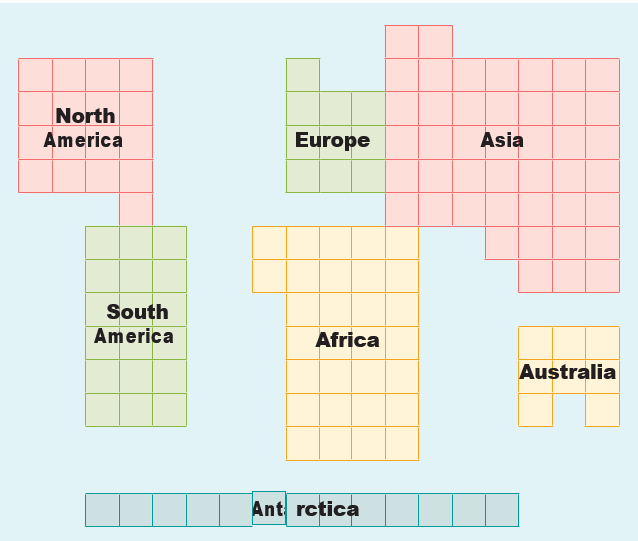
- Seven continents: This is the most widely adopted list: Africa, Antarctica, Asia, Australia, Europe, North America and South America.
- Relative size: A schematic diagram can compare the continents' relative sizes without showing their actual shapes.
Quick recap
- Oceans supply rain-bearing clouds, including those that bring India's monsoon rains.
- Ocean storms such as cyclones can severely damage coastal regions.
- Tsunamis are powerful waves usually caused by undersea earthquakes or volcanic eruptions.
- The 2004 Indian Ocean tsunami caused immense loss of life and damaged parts of India's coast.
- Early warning systems and disaster-management authorities help protect lives and property.
- Continents may be counted in different ways, from four to seven; the seven-continent model is most widely used.
Islands
Island — A smaller piece of land surrounded by water on all sides.
Islands
- Islands and continents: Both are surrounded by water, but continents are so large that they are not considered islands.
- Variety: There are lakhs of islands on Earth, and they vary greatly in size.
- Largest island: Greenland is the world’s largest island; its area is roughly equal to the combined areas of India’s 10 largest states.
| Feature | Details |
|---|---|
| Indian islands | India has more than 1,300 small islands. |
| Andaman and Nicobar Islands | A major island group in the Bay of Bengal. |
| Lakshadweep Islands | A major island group in the Arabian Sea. |
India’s Antarctic Research
- Programme: The Indian Antarctica Programme explores Antarctica, a continent with an extremely cold climate and harsh environment.
- First base: India’s first scientific base station there was Dakshin Gangotri; two more bases were established later.
- Research: About 40 teams of Indian scientists have researched the evolution of climate and the environment in this remote region.
- Settlement: The scientists’ settlement includes facilities such as a library and a post office.
Key Dates
- 1981The Indian Antarctica Programme began exploring Antarctica.
- 1983India established its first Antarctic scientific base, Dakshin Gangotri.
- June 8The United Nations-designated World Oceans Day, recognising the ocean’s importance in everyday life.
Oceans and Life
How Oceans Support Earth
- Rainfall: Oceans supply water that contributes to rainfall on continents; without oceans, Earth would be a desert.
- Oxygen: Ocean flora produces more than half of the world’s oxygen, earning oceans the name “the planet’s lungs.”
- Climate and life: Oceans help regulate the climate and sustain life on Earth.
- Marine resources: Oceans support many kinds of marine life and are major sources of food and medicine.
How Oceans Have Shaped Human Life
- Movement and trade: Since early times, people have used oceans and seas for migration, trade and military campaigns.
- Food: Fishing has long provided people with food.
- Coastal cultures: Oceans have shaped coastal communities’ cultures. Their stories often include the sea, sea gods and goddesses, monsters and treasures, reflecting both its dangers and blessings.
Threats to Oceans and Their Effects
- Human activity adds several million tonnes of plastic waste to the oceans every year, along with other pollutants.
- Plastic waste can choke marine life, while other forms of pollution also damage the marine environment.
- Overfishing means excessive fishing and contributes to the decline of marine life.
- Pollution and overfishing threaten oceans, making their protection a collective responsibility for the planet’s and humanity’s future.
- Earth has vast water bodies called oceans and large landmasses called continents; the oceans are interconnected.
- Continents may be counted in different ways, but the most common count is seven.
- The Northern Hemisphere has more land than the Southern Hemisphere.
Why are oceans called “the planet’s lungs”?
Name India’s two major island groups and the waters where they are located.
When did India establish its first scientific base in Antarctica, and what was it called?
Quick recap
- An island is a smaller landmass surrounded by water on all sides; continents are too large to be classed as islands.
- Greenland is the world’s largest island; India has more than 1,300 small islands, including Andaman and Nicobar and Lakshadweep.
- The Indian Antarctica Programme began in 1981, and India established Dakshin Gangotri in 1983.
- Oceans contribute to rainfall, produce more than half of the world’s oxygen, regulate climate, sustain life and provide food and medicine.
- Oceans have supported migration, trade, military campaigns, fishing and coastal cultures.
- World Oceans Day is June 8; several million tonnes of plastic enter the oceans every year, and pollution and overfishing threaten marine life.
- Oceans are interconnected, the most common count is seven continents, and the Northern Hemisphere has more land than the Southern Hemisphere.
Social Science — ALL CHAPTERS
1
LOCATING PLACES ON THE EARTH
2
Oceans and Continents
3
LANDFORMS AND LIFE
4
TIMELINE AND SOURCES OF HISTORY
5
INDIA, THAT IS BHARAT
6
THE BEGINNINGS OF INDIAN CIVILISATION
7
INDIA’S CULTURAL ROOTS
8
UNITY IN DIVERSITY, OR MANY IN THE ONE
9
FAMILY AND COMMUNITY
10
GRASSROOTS DEMOCRACY – PART 1 GOVERNANCE
11
GRASSROOTS DEMOCRACY – PART 2 LOCAL GOVERNMENT IN RURAL AREAS
12
GRASSROOTS DEMOCRACY – PART 3 LOCAL GOVERNMENT IN URBAN AREAS
13
THE VALUE OF WORK
14
ECONOMIC ACTIVITIES AROUND US