Class 6 . Social Science . Exploring Society India And Beyond . Family and Community
Chapter 9: FAMILY AND COMMUNITY
Ch 9
Social Science
Class 6
Family, Roles and Responsibilities
Types of Families and Family Relationships
Joint family — A family in which several generations and relatives, such as grandparents, uncles, aunts and cousins, live together or share family life.
Nuclear family — A family consisting of a couple and their children, or one parent and their children.
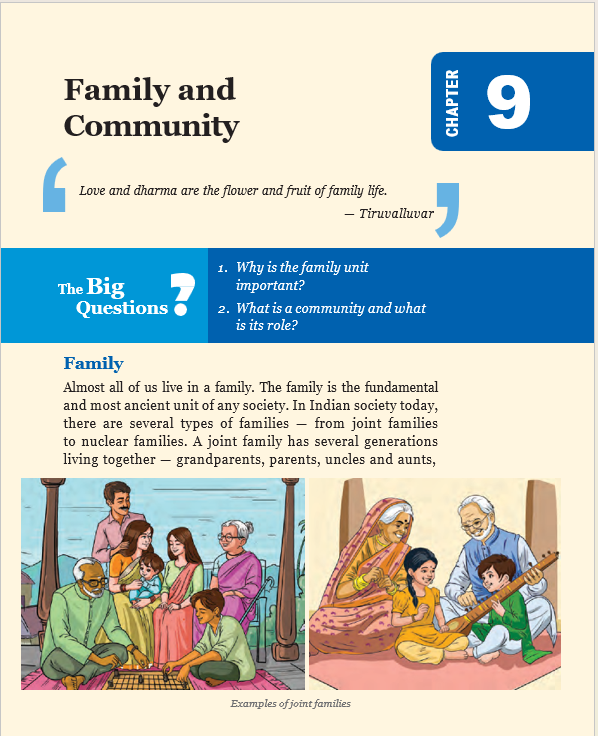
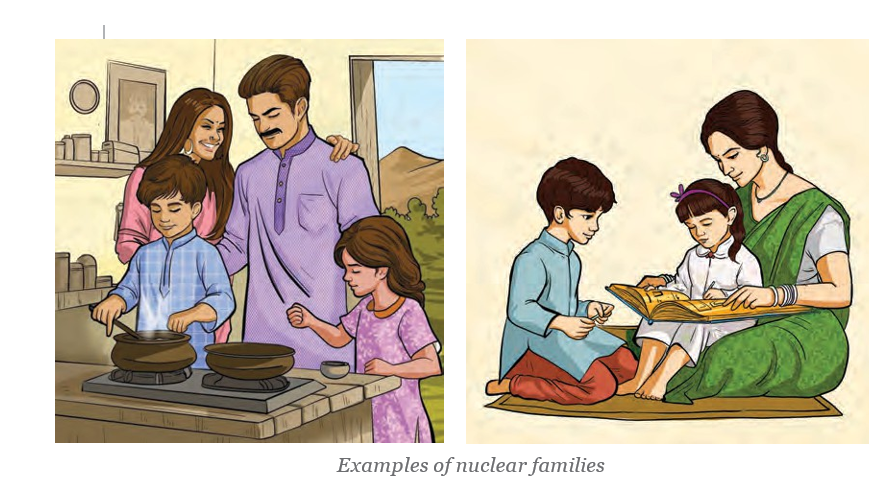
| Point | Joint family | Nuclear family |
|---|---|---|
| Members | May include several generations and relatives | Usually a couple and their children, or one parent and children |
| Possible advantage (discussion idea) | More relatives may be available to share care and support | Some families may value living with fewer household members |
| Possible challenge (discussion idea) | Members may need to balance different needs and preferences | Fewer household members may mean fewer people to share responsibilities |
Family Terms in Indian Languages
- Kinship words: Indian languages often have specific terms for relatives; Hindi examples include bua, tau, tai, chacha, mausi, nana and nani.
- Cousins: In many Indian languages, cousins are referred to as brothers or sisters, expressing close bonds among children in the family.
- Language differences: Some languages, such as Tamil, distinguish elder and younger brothers or sisters.
- Translation: One word in a regional language may need several English words to explain the exact relationship.
| Name | Hindi term | Relationship described |
|---|---|---|
| Rani | बहन (behen) | Mother’s brother’s daughter; she may be called a sister |
| Sameer | चाचा (chacha) | Father’s younger brother |
Roles, Responsibilities and Family Values
Cooperation — Working together to meet shared needs and complete responsibilities.
How Family Responsibilities Work
- Relationships: Family life is built on love, care, cooperation and interdependence.
- Roles: Every family member has responsibilities towards others; these may change as children grow.
- Parents: Parents care for their children and guide them to become happy individuals and responsible members of society.
- Children: Children learn to help at home and take part in household life through daily practice.
- Traditions: Families pass on customs and practices across generations.
- Dharma
- Following one’s duty; an important principle in Indian culture.
- Ahimsa
- Non-violence.
- Dāna
- Giving.
- Sevā
- Service.
- Tyāga
- Sacrifice, including giving up personal needs for the family.
The Family as a School of Values
- Values: Families help children learn ahimsa, dāna, sevā and tyāga.
- Duty: Family members may put aside some personal needs to care for the needs of the family.
- Practice: These values are learned through everyday cooperation and care.
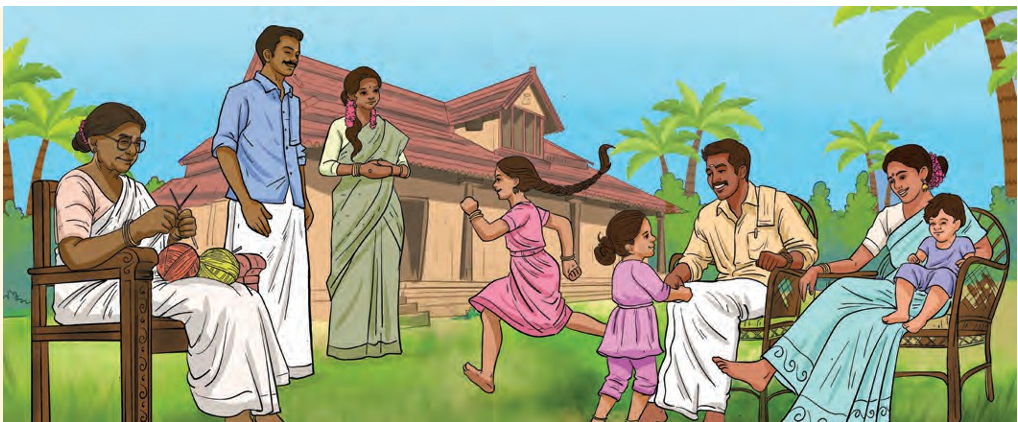
Family Support and Shared Responsibilities: Examples
Shalini’s Family in Kerala
- Family setting: Shalini lives with her parents, younger brother, grandmother Acchamma, uncle Chittappa, aunt Chitti and cousin Chinni.
- Support: When Chittappa’s family faced financial difficulty, Shalini’s parents bought festival clothes for them as well as for their own family.
- Sharing: Shalini accepted a simple cotton dress instead of the silk dress she wanted, and was glad that everyone could celebrate with new clothes.
- Lesson: Family members support one another and share what they have.
Tenzing’s Family in Meghalaya
- Shared work: When Tenzing’s mother became busy in a handicraft cooperative, his father helped with cleaning, gardening and cooking.
- Grandparents: His grandmother shares stories and wisdom; his grandfather helps with homework, takes him to the bus stop and serves the community.
- Shared decisions: Tenzing’s parents discuss special expenses together and try to save for unexpected needs.
- Community care: His grandfather organised neighbourhood help when a storm damaged a neighbour’s house.
- Lesson: Household work, decisions and care can be shared by family members; support can also extend to neighbours.
Choosing a Family Living Arrangement
| Point | Joint family | Nuclear family |
|---|---|---|
| Living arrangement | Several generations or relatives share family life | A couple or one parent lives with their children |
| Possible reasons for choosing this arrangement | Students might suggest that relatives living together can provide companionship or shared support | Students might suggest work, study or other circumstances as reasons for living apart from relatives |
| Possible benefits | Students might suggest shared care and household responsibilities | Students might suggest that a smaller household suits their family’s needs |
| Possible challenges | Students might suggest that family members need to consider different needs and preferences | Students might suggest that fewer relatives in the household may mean less immediate help with chores or care |
The benefits, challenges and reasons for choosing a family type are discussion ideas, not fixed facts; explain that they can vary between families.
Quick recap
- A joint family includes relatives across generations; a nuclear family consists of a couple or one parent and their children.
- Indian languages often have detailed kinship terms, and cousins may be called brothers or sisters.
- Family relationships rely on love, care, cooperation and interdependence.
- Parents guide children; children increasingly share household responsibilities as they grow.
- Families pass on traditions and teach values such as ahimsa, dāna, sevā and tyāga.
- Shalini’s and Tenzing’s families show sharing, shared decisions, care for elders and community support.
- Possible advantages, challenges and reasons for choosing a family type are discussion ideas that can differ between families.
Community
Meaning and role of a community
- Community: A group of connected people and families who share relationships, interests, activities or resources.
- Interdependence: Communities include people with different roles who rely on one another and work together.
Community action and mutual support
- Cooperation: Community members come together to meet shared needs and support one another.
- Shared responsibility: Each member contributes through duties that help the community function smoothly.
Urban communities and shared responsibilities
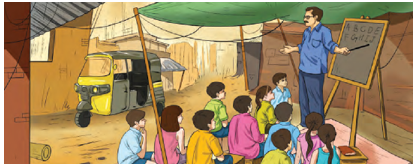
Communities are flexible and interdependent
Examples and emergence of communities
- Over the last 30–40 yearsNewer forms of community, such as urban Residents’ Welfare Associations, have emerged.
- More than 20 years agoKamal Parmar began evening tuition and free dinners for underprivileged children in Ahmedabad.
- 2015During the Chennai floods, private groups distributed food to people in need.
- 2019Shri Mahesh Sharma received the Padma Shri for work with Bhil communities.
How did the Bhil community respond to water scarcity around Jhabua?
What does Kamal Parmar’s initiative show about community support?
Why are communities interdependent?
Quick recap
- Community: Connected people may share a place, identity, work, interest or purpose.
- Cooperation: Members support one another and take part in shared work and community duties.
- Examples of service: Bhil water-conservation work, food distribution during the 2015 Chennai floods, and Kamal Parmar’s free classes and dinners show community support.
- Urban communities: RWAs make rules for shared needs such as cleanliness, waste and pet care.
- Interdependence: People and communities rely on one another for goods, services and support.
Social Science — ALL CHAPTERS
1
LOCATING PLACES ON THE EARTH
2
Oceans and Continents
3
LANDFORMS AND LIFE
4
TIMELINE AND SOURCES OF HISTORY
5
INDIA, THAT IS BHARAT
6
THE BEGINNINGS OF INDIAN CIVILISATION
7
INDIA’S CULTURAL ROOTS
8
UNITY IN DIVERSITY, OR MANY IN THE ONE
9
FAMILY AND COMMUNITY
10
GRASSROOTS DEMOCRACY – PART 1 GOVERNANCE
11
GRASSROOTS DEMOCRACY – PART 2 LOCAL GOVERNMENT IN RURAL AREAS
12
GRASSROOTS DEMOCRACY – PART 3 LOCAL GOVERNMENT IN URBAN AREAS
13
THE VALUE OF WORK
14
ECONOMIC ACTIVITIES AROUND US