Class 6 . Social Science . Exploring Society India And Beyond . India That Is Bharat
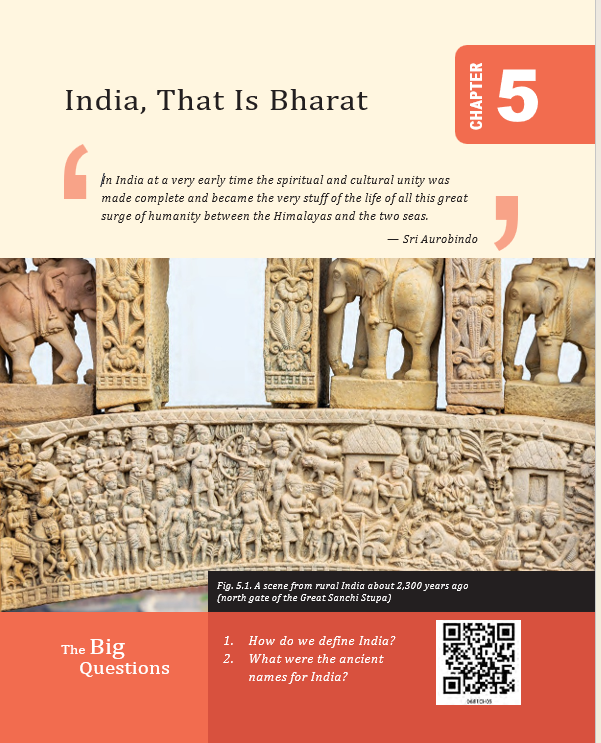
Chapter 5: INDIA, THAT IS BHARAT
Ch 5
Social Science
Class 6
Introduction & How Indians Named India
India as a Subcontinent
A changing region
- Modern India is a nation with defined borders, states and population; these have not always been the same through history.
- Indian Subcontinent is a region that has had different names and shifting boundaries over time.
- Sources for its past include ancient texts, accounts of travellers and pilgrims, and inscriptions.
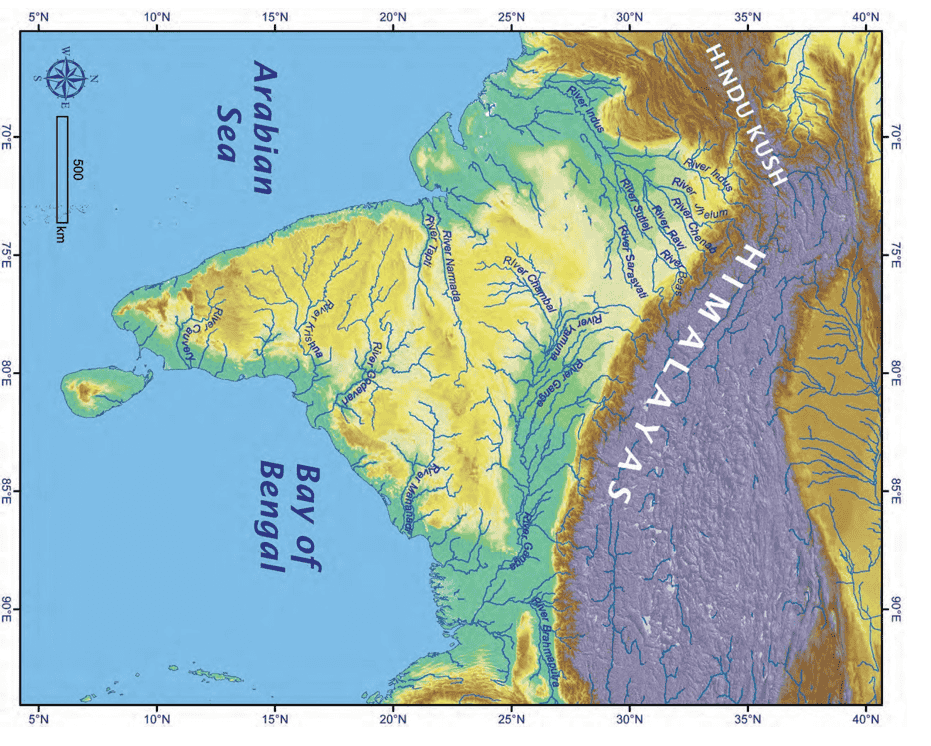
- Natural features visible on the physical map include the Himalayas to the north and the seas around the peninsula.
Names in Ancient Indian Texts
Inhabitants — People who live in a particular place.
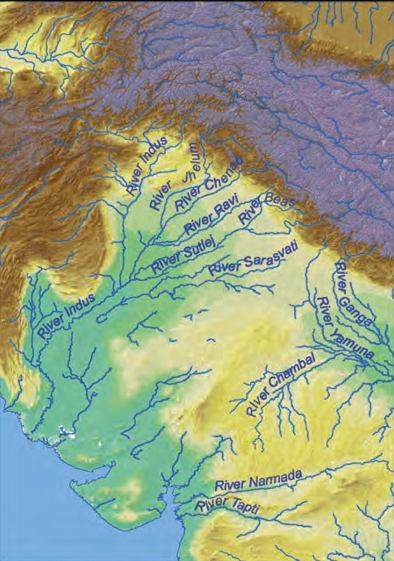
Sapta Sindhava — The Rig Veda’s name for the northwestern region of the Subcontinent, meaning “land of the seven rivers.”
The Rig Veda and the rivers
- Rig Veda is India’s most ancient text and is several thousand years old.
- Sindhava comes from Sindhu, a word for the Indus River and, at times, for a river in general.
- River systems shown for the Subcontinent include the Indus, Ganga and Brahmaputra systems, along with other rivers.
Regions named in the Mahabharata
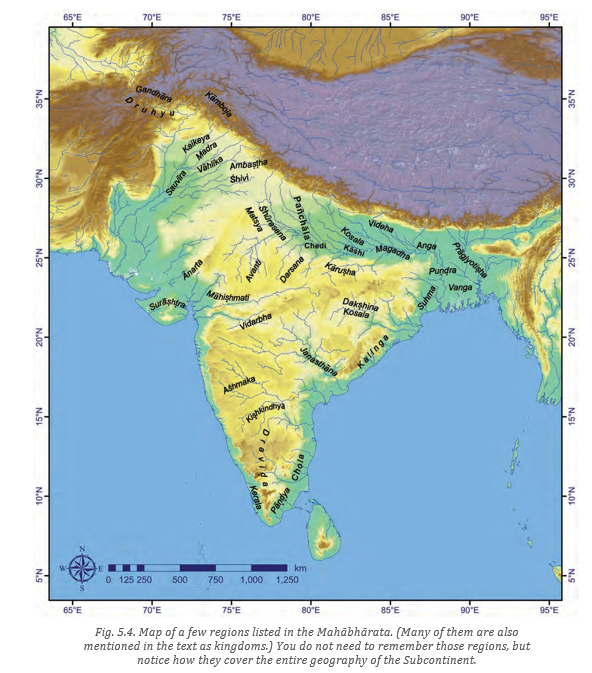
- Mahabharata names many regions of the Subcontinent, several of which resemble regions known today.
| Ancient name | Approximate present-day region |
|---|---|
| Kashmira | Kashmir |
| Kurukshetra | Parts of Haryana |
| Vanga | Parts of Bengal |
| Pragjyotisha | Assam |
| Kaccha | Kutch |
| Kerala | Kerala |
Names for the Whole Subcontinent
Bharatavarsha — A Mahabharata name for the whole Subcontinent, meaning “the country of the Bharatas.”
The name Bharata
- Bharata first appears in the Rig Veda as the name of one of the main Vedic groups of people.
- Later literature also mentions several kings named Bharata.
- Mahabharata uses both Bharatavarsha and Jambudvipa for the Subcontinent; scholars generally place the poem’s composition from a few centuries BCE onward.
Jambudvipa — A name meaning “island of the fruit of the jamun tree”; it came to mean the Indian Subcontinent.
Ashoka’s use of Jambudvipa
- Ashoka, dated here to about 250 BCE, used Jambudvipa in an inscription to describe the whole of India.
- Extent at that time included what is now Bangladesh and Pakistan, as well as parts of Afghanistan.
Bhārata: Geography and Continued Use
Bhārata — A name that became generally used for the Indian Subcontinent a few centuries after Ashoka’s time and remains in use today.
Geographic descriptions of Bhārata
- Vishnu Purana describes Bhārata as the land north of the ocean and south of the snowy mountains.
- The snowy mountains refer to the Himalayas; the description gives broad natural limits for the country.
- Tamil literature, in a poem from about 2,000 years ago, describes a king’s fame as extending from Cape Kumari in the south to the great northern mountain, and from the eastern to the western ocean.
- Name forms include Bharat in north India and Bharatam in south India.
India, That Is Bharat
The Constitution’s wording
- English Constitution begins with the phrase “India, that is Bharat.”
- Hindi Constitution gives the equivalent phrase “Bhārat arthāth India.”
Dates and periods mentioned
- Several thousand years agoThe Rig Veda, India’s most ancient text, names the northwest Sapta Sindhava.
- From a few centuries BCE onwardScholars generally place the composition of the Mahabharata within this broad period.
- About 250 BCEAshoka uses Jambudvipa in an inscription for the whole of India.
- About 2,000 years agoA Tamil poem describes a northern mountain and the oceans east and west as geographic limits.
- Indian Subcontinent
- A geographic region whose names and boundaries have changed over time.
- Sapta Sindhava
- “Land of the seven rivers”; the Rig Veda’s name for the northwest.
- Bharatavarsha
- “Country of the Bharatas”; a Mahabharata name for the Subcontinent.
- Jambudvipa
- “Island of the fruit of the jamun tree”; a name for the Subcontinent.
- Bhārata
- A name for the Subcontinent that remains in use today.
What do Bharatavarsha and Jambudvipa mean?
How did Ashoka use the name Jambudvipa?
Quick recap
- The Indian Subcontinent has had changing names and shifting boundaries through history.
- The Rig Veda calls the northwestern region Sapta Sindhava, the land of the seven rivers.
- The Mahabharata uses Bharatavarsha and Jambudvipa for the Subcontinent.
- Ashoka used Jambudvipa for the whole of India in an inscription around 250 BCE.
- Bhārata is associated with the land south of the Himalayas and north of the ocean, and remains in use today.
- The Constitution begins with “India, that is Bharat.”
How Foreigners Named India
Persian Names for India
How the Persian Names Originated
- First foreign references: The Persians, ancient inhabitants of Iran, were the first foreigners recorded as mentioning India.
- Background: In the 6th century BCE, a Persian emperor gained control of the Indus River region through a military campaign.
- Names: Persian records and inscriptions used Hind, Hidu or Hindu, adapted from Sindhu, the earlier name of the Indus River.
- Meaning: In ancient Persian, “Hindu” was a geographical term for the region, not a reference to the Hindu religion.
Greek and Chinese Names
Names Derived from Sindhu
- Greeks: They called India Indoi or Indike, adapting the Persian form and dropping its initial “h” because Greek did not have that letter.
- Chinese: Chinese texts used Yintu or Yindu; these names also ultimately came from Sindhu.
How the Names Developed
- Greek forms: Sindhu → Hindhu → Indoi / Indike.
- Chinese forms: Sindhu → Hindhu → Indu / Yindu.
India in the Constitution
Constitution — A document that sets out a nation’s basic principles and laws.
The Union and Its Territory
- Article 1: “India, that is Bharat, shall be a Union of States.”
- Territory of India: It comprises the territories of the States, the territories specified in Part D of the First Schedule, and any other territories acquired.
- Article 2: Parliament may admit new States into the Union or establish new States, on terms and conditions it decides.
- Article 3—scope: Parliament may form a new State by separating territory from a State; uniting two or more States, or parts of States; or uniting a territory with part of a State. It may also increase or diminish a State’s area, alter its boundaries, or change its name.
- Article 3—procedure: A Bill requires the President’s recommendation. If it affects a State’s area, boundaries or name, the President must refer it to that State’s Legislature for its views.
- Time for views: The State Legislature must be given the period specified in the reference, or any further period allowed by the President. That period must expire before the Bill is introduced in either House of Parliament.
Chinese Visitors and Tianzhu
Xuanzang and the Name Tianzhu
- Xuanzang: This Chinese traveller visited India in the 7th century CE, met scholars and collected Buddhist texts.
- Return to China: After 17 years, he returned with manuscripts and translated them from Sanskrit into Chinese.
- Tianzhu: Another Chinese name derived from Sindhu; it could also mean “heavenly master” and reflected respect for India as the land of the Buddha.
Hindustan and Other Names
Names Used for India
- Hindustan: First used in a Persian inscription about 1,800 years ago; later, many invaders used it for the Indian Subcontinent.
- Names used within India: Jambudvīpa and Bhārata were ancient names; Bhārata spread widely and is used in most Indian languages.
- Overall pattern: Many foreign names for India developed from Sindhu or Indus, leading to forms such as Hindu, Indoi and eventually India.
| Language | Name |
|---|---|
| Persian | Hind, Hidu, Hindu |
| Greek | Indoi, Indike |
| Latin | India |
| Chinese | Yintu, Yindu, Tianzhu |
| Arabic and Persian | Hindustan |
| English | India |
| French | Inde |
Key Dates and Periods
- 6th century BCEPersians gained control of the Indus region and recorded names adapted from Sindhu.
- About 1,800 years agoThe name Hindustan appeared in a Persian inscription.
- 7th century CEXuanzang travelled to India; he returned to China after 17 years.
- 1950The Constitution of India came into force.
- Sindhu
- An ancient name for the Indus River and the source of many foreign names for India.
- Hindustan
- A name first found in a Persian inscription about 1,800 years ago.
- Bhārata
- An ancient Indian name that spread widely and is used in most Indian languages.
- Xuanzang
- A Chinese traveller who visited India in the 7th century CE and translated manuscripts after returning home.
How did the names Indoi and Indike develop?
What did “Hindu” mean in ancient Persian?
Quick recap
- Persians were the first recorded foreigners to name India, adapting names from Sindhu.
- Greek names included Indoi and Indike; Chinese names included Yintu, Yindu and Tianzhu.
- Xuanzang visited India in the 7th century CE and returned to China after 17 years with manuscripts.
- Hindustan appeared in a Persian inscription about 1,800 years ago and was later used for the Indian Subcontinent.
- Jambudvīpa and Bhārata were names used within India; Bhārata became widespread.
- Article 1 says India, that is Bharat, is a Union of States; its territory includes State territories, Part D of the First Schedule and acquired territories.
- Article 3 covers forming States and changing State areas, boundaries or names; the required State Legislature view period must expire before the Bill is introduced.
Social Science — ALL CHAPTERS
1
LOCATING PLACES ON THE EARTH
2
Oceans and Continents
3
LANDFORMS AND LIFE
4
TIMELINE AND SOURCES OF HISTORY
5
INDIA, THAT IS BHARAT
6
THE BEGINNINGS OF INDIAN CIVILISATION
7
INDIA’S CULTURAL ROOTS
8
UNITY IN DIVERSITY, OR MANY IN THE ONE
9
FAMILY AND COMMUNITY
10
GRASSROOTS DEMOCRACY – PART 1 GOVERNANCE
11
GRASSROOTS DEMOCRACY – PART 2 LOCAL GOVERNMENT IN RURAL AREAS
12
GRASSROOTS DEMOCRACY – PART 3 LOCAL GOVERNMENT IN URBAN AREAS
13
THE VALUE OF WORK
14
ECONOMIC ACTIVITIES AROUND US