Class 7 . Mathematics . Ganita Prakash Part I . A Peek Beyond the Point
Chapter 3: A Peek Beyond the Point
Ch 3
Mathematics
Class 7
The Need for Smaller Units
Measuring Lengths in Tenths of a Centimetre
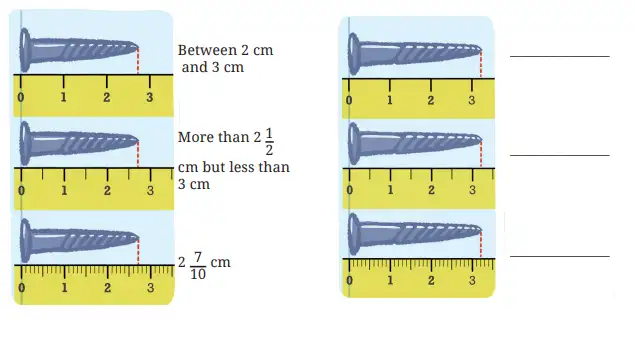
Here, is the number of whole centimetres and is the number of tenths.
Measure an object to the nearest tenth of a centimetre
- Place one end of the object at the ruler’s zero mark.
- Find the mark at the other end and count the complete centimetres.
- Count the extra equal parts; each part is one-tenth of a centimetre.
- Write the measurement as whole centimetres plus tenths of a centimetre.
What is the screw’s length?
- A screw reaches the seventh small mark after the cm mark. Each small interval is one-tenth of a centimetre.
- Add the whole centimetres and the tenths.
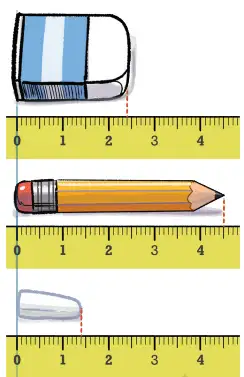
| Object | Length |
|---|---|
| Eraser | cm |
| Pencil | cm cm |
| Chalk | cm |
Do not count each small mark as a whole centimetre: when one centimetre is divided into equal parts, each small part is only cm.
An object reaches the sixth small mark after cm. What is its length?
Write cm using a simpler fractional part.
One screw is cm long and another is cm long. How much longer is the first screw?
Quick recap
- Smaller units help measure lengths more accurately.
- Dividing cm into equal parts makes each part cm.
- Measure by counting whole centimetres and then the extra tenths.
- cm means cm plus tenths of a centimetre.
- cm is equivalent to cm.
A Tenth Part
Tenths and mixed measurements
Use this to express the whole measurement in one-tenths.
Write a length in two forms
- Keep the whole units and tenths separate.
- To write the length as tenths, convert each whole unit into ten tenths and add the remaining tenths.
Write units in tenths.
- Write three units and four one-tenths as tenths.
Comparing and ordering tenths
Convert each value to tenths, then compare the numerators.
Order measurements
- Convert all measurements to tenths, or compare whole units and tenths.
- Arrange their values from smallest to largest.
Arrange , , and in increasing order.
- Convert each measurement to tenths.
- Order the values; the two middle forms are equal.
Do not confuse with : they equal and , respectively.
Adding measurements
Regroup the tenths if their sum reaches a whole unit.
Add mixed measurements
- Add the whole units and the tenths separately.
- Regroup ten tenths as one unit, if needed.
- Write the final mixed measurement.
Find the total of units and units.
- Add the whole units and tenths separately.
- Regroup ten tenths as one unit.
When converting to tenths, , not . Thus .
Subtracting measurements
Regroup a whole unit as ten tenths if the first measurement has fewer tenths.
Subtract mixed measurements
- Subtract tenths first; if needed, regroup one whole unit as ten tenths.
- Subtract tenths and whole units.
Shylaja’s hand is units long and her palm is units long. Find the length of her middle finger.
- Regroup one unit from the first measurement as ten tenths.
- Subtract the tenths and whole units.
Patterns that change by tenths
| Starting terms | Change each time | Extended sequence |
|---|---|---|
| Add | ||
| Add | ||
| Add | ||
| Subtract | ||
| Subtract | ||
| Subtract |
Add the same change to extend an increasing sequence; subtract it for a decreasing sequence.
Extend a sequence
- Find the change between the first two terms.
- Repeat that change to obtain each next term.
Continue the sequence by four terms.
- Find the change between the first two terms.
- Keep adding three-tenths, regrouping ten-tenths as one unit.
Arrange , , , and in increasing order.
Find .
Continue by two terms.
Quick recap
- Ten one-tenths make one unit; .
- Compare measurements in tenths or compare whole units first, then tenths.
- When adding tenths, regroup every as one whole unit.
- When subtracting, regroup one whole unit as if needed.
- Extend a sequence by repeating its constant addition or subtraction rule.
A Hundredth Part -1
Measuring in Hundredths
One-hundredth — One-hundredth is one of 100 equal parts of a unit.
Key points
- Divide a tenth: Split each tenth into 10 equal smaller parts; each part is one-hundredth of a unit.
- Count the parts: A unit has 10 tenths, and each tenth has 10 hundredths, so a unit has 100 hundredths.
- Convert: 10 hundredths make 1 tenth.
- Folded paper: Half of a length of 8 9/10 units is 4 4/10 5/100 units.
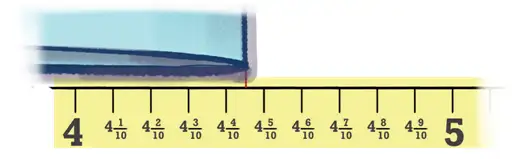
Use these equivalent fractions to convert tenths into hundredths.
Write a length in hundredths
- Identify the whole units, tenths, and any extra hundredths.
- Convert each tenth into 10 hundredths.
- Combine the hundredths and keep any whole units.
A ruler shows a length of 4 units, 4 tenths, and 5 hundredths. Write it as units and hundredths.
- Write the measured length as whole units, tenths, and hundredths.
- Change the tenths to hundredths and combine.
Reading, Writing, and Comparing Measurements
Decimal measurement — A decimal measurement writes a length using a whole-number part and a fractional part.
Equivalent forms and number lines
- Equivalent forms: The length 1.14 can be written as 1 + 14/100 or 1 + 1/10 + 4/100.
- Read a decimal: 1.14 is read as “one and fourteen hundredths.”
- Number line: Each tenth interval can be split into 10 equal parts to mark hundredths.
- Compare lengths: Compare place values, or express fractional parts with the same denominator before deciding which is longer.
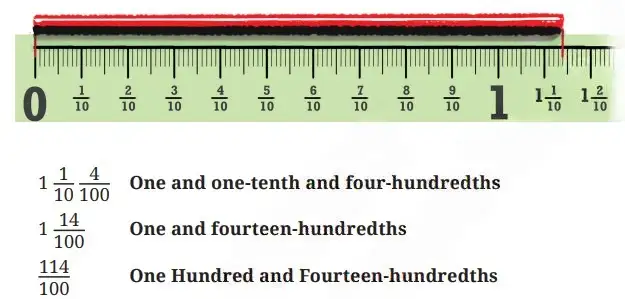
The first two digits after the decimal point represent tenths and hundredths.
Compare lengths
- Compare whole-number parts first, if present.
- If the whole-number parts match, compare tenths and then hundredths.
- For fractions, convert to a common denominator when needed.
Do not compare lengths by looking only at the digits; compare their place values or rewrite them with a common denominator.
Write 1.14 as a sum of whole units, tenths, and hundredths.
Which is longer: 54/100 units or 4/10 units?
Quick recap
- A unit contains 10 tenths and 100 hundredths.
- Each tenth contains 10 hundredths, so 10/100 = 1/10.
- Lengths can be expressed using units, tenths, and hundredths, or in decimal form.
- A number line can show hundredths by splitting each tenth into 10 parts.
- Compare lengths using place value or equivalent fractions.
A Hundredth Part -2
Adding Decimals by Regrouping
Regrouping does not change a number's value: hundredths equal tenth, and tenths equal whole.
Use these equivalences to regroup or convert to hundredths before adding.
Add by place value
- Write each number as whole units, tenths and hundredths.
- Add hundredths; regroup each group of hundredths as a tenth.
- Add tenths, including any carried tenth; regroup each group of tenths as a whole.
- Add the whole units. Alternatively, convert both numbers to hundredths first.
Find .
- Add the hundredths; regroup hundredths as tenth and hundredths.
- Add the tenths, including the carried tenth; regroup tenths as whole.
- Add the whole units, including the carried whole.
- The sum is wholes and hundredths.
Do not add digits from different places without regrouping. For example, hundredths equals tenth and hundredths, not tenths.
Subtracting Decimals by Regrouping
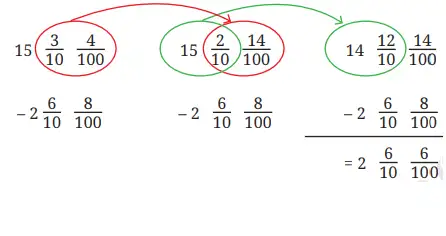
Regrouping preserves value: tenth is hundredths, and whole is tenths.
Use these equalities to borrow across decimal places.
Subtract by place value
- Write both numbers with matching decimal places.
- Subtract hundredths; regroup tenth as hundredths if needed.
- Subtract tenths; regroup whole as tenths if needed.
- Subtract the whole units. Check by adding the difference to the number subtracted.
Find .
- Write the minuend to the hundredths place, then regroup tenth as hundredths.
- Subtract the hundredths, tenths and whole units.
- Combine the place-value results.
Do not subtract each place independently when the top digit is smaller. Regroup from the next place first, keeping the number's value unchanged.
Find .
Find .
Find , , and .
Quick recap
- Add or subtract like place values: wholes, tenths and hundredths.
- In addition, regroup hundredths as tenth and tenths as whole.
- In subtraction, borrow from the next larger place when needed.
- Convert to hundredths when it makes a calculation easier.
- Check subtraction by adding the difference to the number subtracted.
- For example, after regrouping as .
Decimal Place Value
Extending Place Value
Decimal system — A place-value system based on , extended to show quantities smaller than one.
Place-value pattern
- Whole-number places: Ones, tens, hundreds, thousands, and further places continue to the left.
- Fractional places: Tenths, hundredths, thousandths, and further places continue to the right of ones.
- Adjacent places: Moving one place left multiplies the value by ; moving one place right divides it by .
- Breaking up a unit: Divide into equal parts for tenths; divide each tenth into parts for hundredths, then continue.
- Other partitions: A unit may also be divided into , , , or other equal parts; dividing each quarter into gives sixteenths.
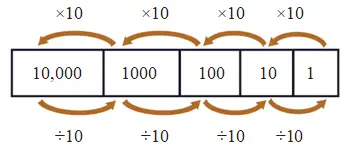
| Place | Value |
|---|---|
| Thousands | |
| Hundreds | |
| Tens | |
| Ones | |
| Tenths | |
| Hundredths | |
| Thousandths |
Each place is times the place immediately to its right. Thus, ones make ten, tens make hundred, and tenths make one.
Use this pattern to continue the place-value sequence in either direction.
Find a Digit's Place Value
- Locate the digit's place in the number.
- Write the value of that place.
- Multiply the digit by its place value; the digit's contribution is , where is the digit and is its place value.
What is the value of each digit in ?
- Find the place values of the digits in .
- Evaluate each digit's contribution.
How many thousandths make one unit?
How many thousandths make one tenth, and how many make one hundredth?
How many tenths and hundredths make one ten?
Do not confuse the number of parts with the size of each part: one hundredth is smaller than one tenth, and each move right in the place-value chart divides the value by .
Quick recap
- The decimal system is based on powers of and extends place value to parts smaller than one.
- Each place to the left is times greater; each place to the right is one-tenth as great.
- Dividing a unit successively by gives tenths, hundredths, thousandths, and smaller parts.
- There are thousandths in one unit, in one tenth, and in one hundredth.
- One ten contains tenths or hundredths.
- A unit can also be partitioned into other equal parts, such as quarters or sixteenths.
Notation, Writing and Reading of Numbers
Decimal Notation and Place Value
Decimal point — The decimal point separates the whole-number part from the fractional part of a number.
Each place to the left is times the value of the place to its right. To the right of the decimal point, the places are tenths, hundredths, thousandths, and so on.
Place-value rules
- Left of the point: Ones, tens, hundreds, and larger places.
- Right of the point: Tenths, hundredths, thousandths, and smaller places.
- Purpose: The point distinguishes quantities that may use the same digits, such as , , and .
| Quantity | Place-value expansion | Decimal form |
|---|---|---|
| Seven hundreds and five ones | ||
| Seven tens and five tenths | ||
| Seven ones and five hundredths |
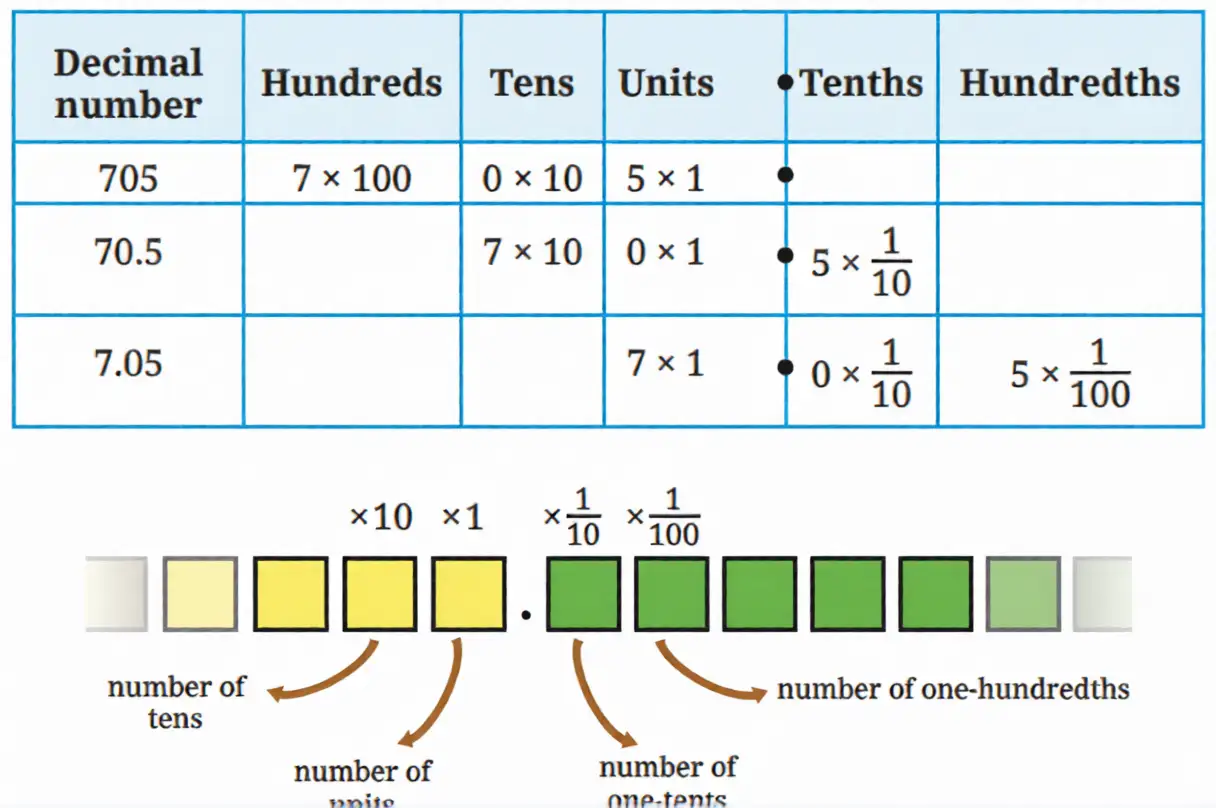
Expand a decimal by multiplying each digit by the value of its place.
Writing a quantity as a decimal
- Place each digit in its named place-value column.
- Put the decimal point after the ones place.
- Use zeroes to show any empty places.
Write seven tens and five tenths in decimal notation.
- Write seven tens and five tenths in decimal notation.
- Write the tens to the left of the point and the tenths to its right.
Do not omit the decimal point: and have different place values and represent different quantities.
Writing and Reading Decimal Numbers
Decimal number — A decimal number uses digits on both sides of the decimal point to show whole-number and fractional place values.
Read the whole-number part first, say “point,” then name each digit after the point separately from left to right.
Reading rules
- Read the whole part: Say the whole-number part first, then say “point.”
- Read the decimal digits: Say each digit after the point separately, from left to right.
- Read by place value: A decimal can also be described using tenths, hundredths, or thousandths.
- Use zeroes: In , the zero holds the tenths place and the is in the hundredths place.
| Quantity | Decimal form | Reading |
|---|---|---|
| Two ones, three tenths, five hundredths | Two point three five; or two and thirty-five hundredths | |
| One ten and five tenths | Ten point five; or ten and five tenths | |
| Four ones and six hundredths | Four point zero six; or four and six hundredths | |
| One hundred, one one, one hundredth | One hundred one point zero one; or one hundred one and one hundredth | |
| Nine tenths and eight hundredths | Zero point nine eight; or ninety-eight hundredths | |
| Five hundredths | Zero point zero five; or five hundredths | |
| One tenth | Zero point one; or one tenth | |
| Two ones and one hundredth | Two point zero one | |
| Four ones and one tenth | Four point one | |
| Seven ones and seven thousandths | Seven point zero zero seven | |
| Total of the three quantities above | Thirteen point one one seven |
The digits after the point represent tenths, hundredths, thousandths, and so on.
Reading a decimal
- Read the whole-number part, including zero if there is no whole part.
- Say “point,” then read every digit after it separately.
How is read, and what does it represent?
- Read the digits in after the point one by one.
- The number is read as “zero point two seven four.” Its digits represent two tenths, seven hundredths, and four thousandths.
Do not read as “zero point two hundred and seventy-four.” Read the digits after the decimal point separately.
Writing Tenths and Hundredths as Decimals
Tenths and hundredths — A quantity of tenths or hundredths can be regrouped into whole units and written in decimal form.
Every tenths make whole, and every hundredths make whole.
Conversion facts
- Tenths: The first place after the point is the tenths place.
- Hundredths: The second place after the point is the hundredths place.
- Thousandths: The third place after the point is the thousandths place.
Write tenths over and hundredths over , then convert to decimal form.
| Quantity | Conversion | Decimal form |
|---|---|---|
| Two hundred thirty-four tenths | ||
| Two hundred thirty-four hundredths | ||
| One hundred five tenths |
Converting a number of tenths or hundredths
- Write the quantity as a fraction with denominator for tenths or for hundredths.
- Regroup the fraction into whole units and any remaining fractional part.
- Write the remaining fraction in its correct decimal place.
Write tenths in decimal form.
- Write two hundred thirty-four tenths as a fraction.
- Separate the whole units from the remaining tenths.
- Write the tenths in the first place after the decimal point.
Write four ones and six hundredths as a decimal, then read it.
Write tenths in decimal form.
Write five hundredths as a decimal and read it.
Quick recap
- The decimal point separates whole-number places from fractional places.
- The first three places after the point are tenths, hundredths, and thousandths.
- A zero marks an empty place, as in .
- Read digits after the point one at a time: is “zero point two seven four.”
- tenths is , while hundredths is .
- The three quantities , , and are , , and ; their total is .
Units of Measurement
Length Conversion
| Length | Equivalent length |
|---|---|
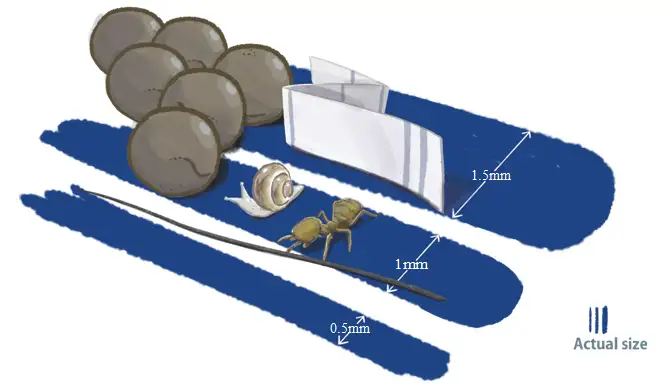
Examples of very small lengths
- Pen strokes: The three shown widths represent fine, medium, and bold strokes.
- Human hair: About thick.
- Newspaper: Thickness ranges from about to .
- Mustard seeds: About to thick.
- Carabera bruni: A tiny ant, about to long; found in Sri Lanka and China.
- Acmella nana: A tiny land snail whose shell is about in diameter; found in Malaysia.
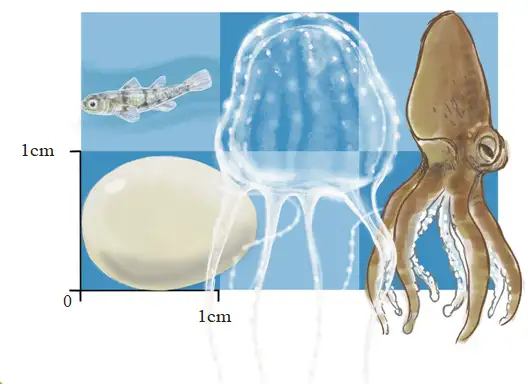
Small organisms and their lengths
- Hummingbird egg: Typically about long and wide.
- Philippine goby: About long; found in the Philippines and other Southeast Asian countries.
- Irukandji jellyfish: Bell size about to ; tentacles can reach . Found in Australia; its venom can be fatal to humans.
- Wolfi octopus: Also called the star-sucker pygmy octopus; typically to long and weighs less than . Found in the Pacific Ocean.
Use these relationships to convert between millimetres, centimetres, and metres.
How many millimetres are there in ?
- Convert to millimetres using .
- Therefore, equals .
Convert to metres.
Convert to metres.
Do not multiply when converting to a larger unit: divide by the conversion factor (for example, millimetres to centimetres).
Quick recap
- ; divide millimetres by to get centimetres.
- ; divide centimetres by to get metres.
- ; therefore, .
- Multiply when converting from a larger unit to a smaller unit; divide when converting to a larger unit.
Weight Conversion
Converting Metric Mass Units
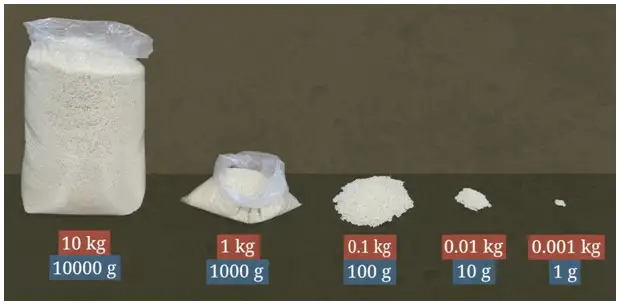
Rice masses in the comparison
- Tenfold sequence: .
- Combined mass: The five quantities together weigh .
Convert to kilograms.
- Write the conversion using .
- Divide by by moving the decimal point three places left.
When converting grams to kilograms, divide by ; do not multiply. Keep the zeroes needed to show place value, as in .
Converting Rupees and Paise
Convert paise to rupees.
- Use the fact that paise make rupee.
- Write the quotient as a decimal.
Do not reverse the conversion: paise to rupees means divide by , while rupees to paise means multiply by .
Convert to kilograms.
Convert to grams.
Convert paise to rupees.
Quick recap
- Convert grams to kilograms by dividing by ; convert kilograms to grams by multiplying by .
- Convert milligrams to grams by dividing by .
- and .
- A tenfold sequence of rice masses from to totals .
- rupee paise; divide or multiply by to convert.
- Paise coins of denominations paise and below were removed from use in .
Locating and Computing Decimals
Locating Decimals on a Number Line
- Locate: To place a decimal such as 1.4, divide the interval from 1 to 2 into 10 equal parts and mark the fourth part after 1.
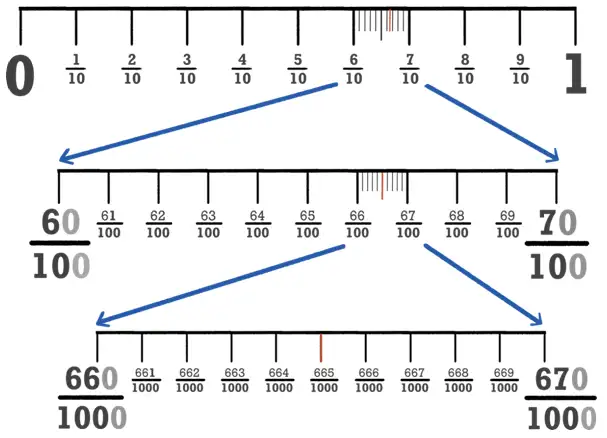
- Subdivide: Each interval between consecutive tenths can be divided into 10 equal parts to locate hundredths.
- Compare: A decimal farther to the right on the number line is greater; one farther to the left is smaller.
There is Zero Dilemma!
Equivalent Decimals and Place Value
Appending one or more zeros to the right of the final decimal digit preserves the number’s value; shifting a non-zero digit to another place changes its value.
Check whether decimals are equal
- Line up the decimal points and compare the digits in each place.
- Ignore any extra zeros at the end of the decimal part.
- Do not treat zeros inside a number as extra trailing zeros.
Which numbers are equal: , , , , , , and ?
- Group the decimals that have the same digits in the same place values, ignoring final zeros.
- The second pair has an extra trailing zero only.
- The remaining decimal has a different place value for its digits.
Locating Decimals on a Number Line
When an interval is divided into ten equal parts, each small step is one tenth of the interval’s length.
Locate a decimal by zooming in
- Find the two consecutive whole numbers that contain the decimal.
- Use tenths to narrow the interval.
- Use hundredths, then thousandths, to pinpoint the number.
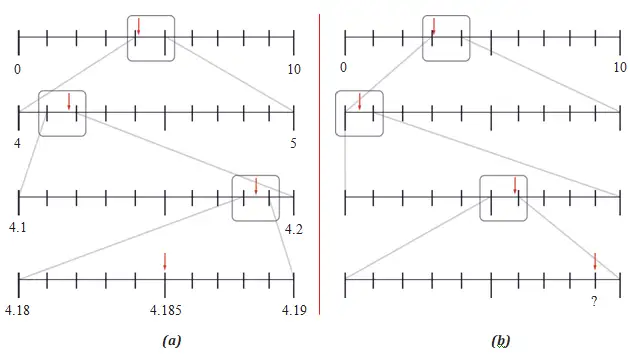
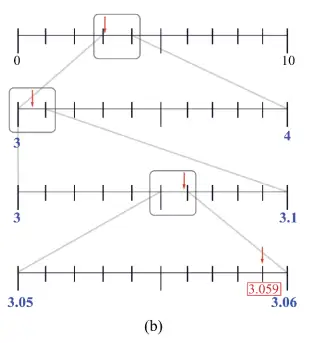
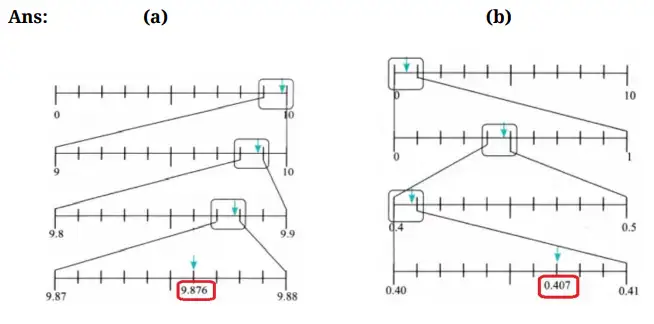
Locate on a number line using successive magnification.
- The decimal lies between the whole numbers and .
- Narrow the location to the interval between and .
- Narrow it again to the hundredths interval containing it.
- The thousandths position identifies the point.
Comparing Decimal Numbers
For decimals with equal digits up to a place, the number with the greater digit at the first differing place is greater.
After aligning decimal points, the first unequal pair of digits determines the greater number.
Compare two decimals
- Align the decimal points and pad the shorter decimal with trailing zeros.
- Compare the whole-number parts and then each decimal place in order.
- Use the first differing place to determine the greater number.
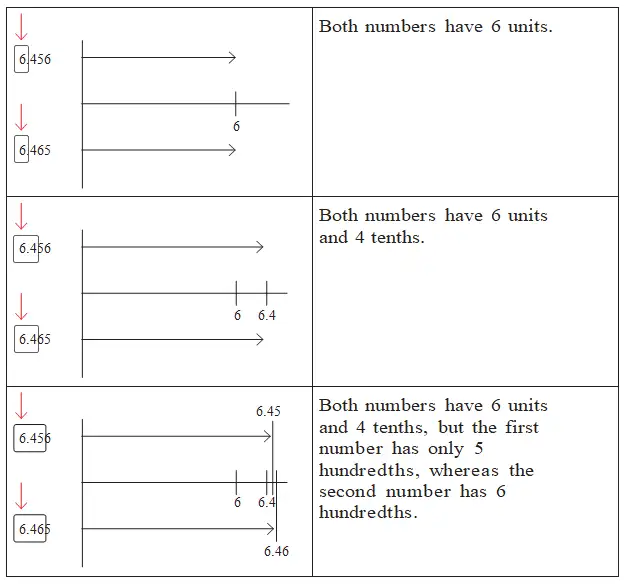
Which is greater: or ?
- The whole-number parts are equal.
- The tenths digits are also equal.
- The hundredths digits differ; is greater than .
Which is the smallest and which is the largest: , , , , and ?
Compare: (a) and ; (b) and ; (c) and .
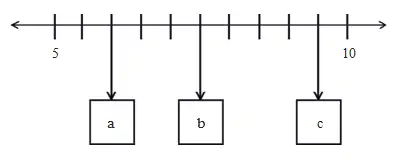
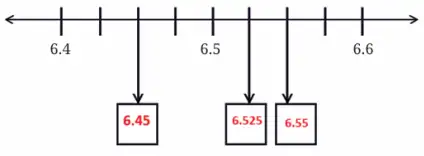
A number line from to is divided into equal parts. What values are marked at , , and if the points shown are , , and ?
Quick recap
- Appending zeros after the final decimal digit does not change a number’s value.
- A non-zero digit’s place determines whether it represents tenths, hundredths, thousandths, and so on.
- To locate a decimal, repeatedly divide the containing interval into ten equal parts.
- Read the number-line scale to calculate the value of each division.
- To compare decimals, align decimal points and compare digits from left to right.
- The first differing digit decides which decimal is greater.
Closest Decimals
Finding the Closest Decimal
Closest decimal — The closest decimal to a target number is the one with the smallest distance from that target.
Compare how far each number is from the target; the number with the least distance is closest. Numbers on either side of the target must both be considered.
Use the absolute difference to compare a number with the target.
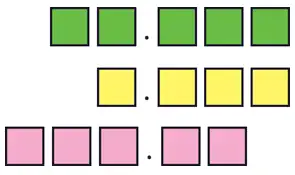
How to find the closest decimal
- Identify the target number and the decimals being compared.
- Find each decimal’s distance from the target using the absolute difference.
- Compare the distances; the smallest distance gives the closest decimal.
Which is closest to 1: 0.9, 1.1, 1.01, or 1.11?
- Find the distance of each number from the target 1.
- Compare the distances; 0.01 is the smallest.
Quick comparisons
- Target 1.09: From 0.9, 1.1, 1.01, and 1.11, the closest is 1.1; its distance is 0.01.
- Target 4: Of 3.56, 3.65, and 3.099, the closest is 3.65; its distance is 0.35.
- Target 1: Of 0.8, 0.69, and 1.08, the closest is 1.08; its distance is 0.08.
Making a Decimal Close to 25
Using given digits
- Rule: Use each of the digits 4, 1, 8, 2, and 5 exactly once, placing the decimal point to make a value as close as possible to 25.
- Best arrangement: 25.148 is 0.148 above 25.
- Check the nearest value below: 24.851 is 0.149 below 25, so 25.148 is closer by 0.001.
Do not decide by which number looks closer or has more matching digits. Calculate the distance from the target and compare the distances.
Which is closest to 2: 1.89, 2.04, or 2.12?
Arrange the digits 1, 2, 3, 4, and 5 once each, with a decimal point, to make a number as close as possible to 12.
Quick recap
- The closest decimal has the smallest distance from the target.
- Find distance with the absolute difference between the number and the target.
- Check numbers on both sides of the target.
- For target 1, 1.01 is closer than 0.9 because 0.01 is less than 0.10.
- When arranging digits, compare the distances of the best candidates on either side.
Addition and Subtraction of Decimals
Adding and Subtracting Decimals
The usual whole-number addition and subtraction methods work for decimals when equal place values are aligned.
Align place values before calculating.
Column method
- Write the numbers one below the other with decimal points aligned.
- Add zeros to make the decimal parts the same length, if helpful.
- Add with carrying or subtract with regrouping, as with whole numbers.
- Place the decimal point in the answer directly below the others.
Cloth quantities
- Total cloth: Priya needs m and Shylaja needs m, so m.
- Difference: Shylaja needs m more cloth than Priya.
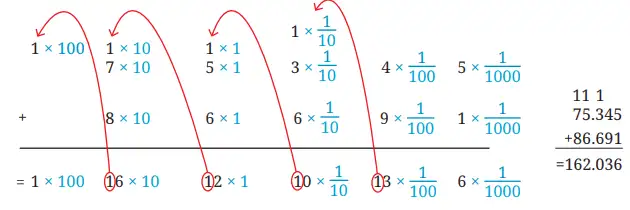
Find and .
- Align the decimal points, then add by place value.
- For subtraction, regroup across decimal places as needed.
Do not line up the last digits instead of the decimal points. Align the points first, then calculate by place value.
Calculate and .
Decimal Sequences
If the same change is repeated, add to the current term to get the next term; a negative means subtraction.
Use the repeated change to continue the sequence.
Continue a sequence
- Subtract consecutive terms to find the change.
- Check that the same change works for each pair shown.
- Repeat the change to find the next terms.
| Given terms | Change each step | Next three terms |
|---|---|---|
| Add | ||
| Add | ||
| Add | ||
| Add | ||
| Add | ||
| Subtract | ||
| Subtract | ||
| Subtract |
Continue for three terms.
- Find the repeated change between the given terms.
- Keep adding to extend the sequence.
Continue for three terms.
Estimating Sums and Differences
For positive decimals and with whole-number parts and , their sum and (when ) difference satisfy the bounds below.
Use and for the whole-number parts of the two positive decimals; for the difference, take .
Estimate using whole-number parts
- Identify the whole-number part of each decimal.
- For a sum, add those parts; the sum is less than more than that total.
- For a difference, subtract the parts in the same order as the decimals.
- Use the range to check whether an exact answer is reasonable.
Check Sonu’s claim for and .
- The whole-number parts of and are and ; their total is .
- The sum is above and below ; calculating confirms Sonu’s estimate for these numbers.
- The claim also holds for the longer decimal, whose exact sum is still between the same bounds.
The whole-number parts of and are and . Give a range for their sum and for .
Quick recap
- Align decimal points before adding or subtracting; carry or regroup by place value.
- For the cloth example, m and m.
- A sequence’s repeated change is found by subtracting consecutive terms.
- Continue a constant-step sequence by adding its repeated change to each term.
- For decimals with whole-number parts and , .
- When , the difference lies between and .
More on the Decimal System
Decimal Points and Unit-Conversion Errors
Decimal or unit-conversion error — A mistake in reading a decimal point or converting units can drastically change a quantity.
Convert a quantity using the correct relationship between its units, and check that the resulting size is reasonable.
Why precision matters
- Amsterdam, 2013: A programming error processed euro cents as euros; the city sent €188 million in housing benefits instead of the intended €1.8 million.
- Air Canada, 1983: Ground staff loaded 22,300 pounds of fuel instead of the required 22,300 kilograms—about half the fuel needed. The Boeing 767 ran out of fuel mid-air and made an emergency landing at an abandoned airfield; everyone survived.
- Medication: Reading mg as mg means giving ten times the prescribed amount.
- Check carefully: Confirm both the decimal point and the unit before calculating or using a measurement.
| Conversion | Equivalent |
|---|---|
| Euro cents to euros | cents euro |
| Pounds to kilograms | pound kg |
Use this relationship to change a mass from pounds to kilograms.
Check a unit conversion
- Identify the given unit and the unit required.
- Apply the correct conversion factor.
- Check that the converted amount and decimal point make sense.
Approximately how many kilograms are equal to 22,300 pounds?
- Write the conversion factor.
- Multiply the number of pounds by the conversion factor.
- Attach the required unit.
Decimal Parts of Units
Decimal part of a unit — A decimal part represents a fraction of the whole unit; convert it using the number of smaller units in one whole unit.
If one whole unit contains smaller units, then a decimal part of that unit equals smaller units.
Convert the part of a unit
- Hours: Since hour is minutes, hour is minutes.
- Feet and inches: Since foot is inches, foot is inches.
- Doorway error: A width of ft in is not ft; ft is ft in.
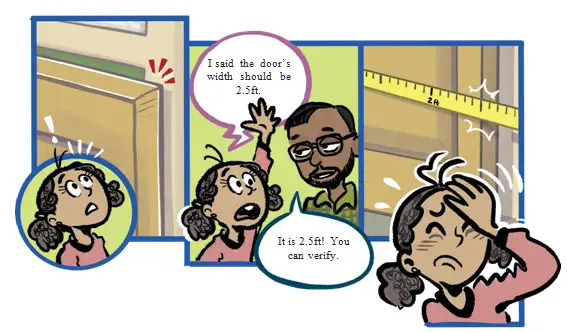
Here, is the number of smaller units, is the decimal part, and is the number of smaller units in one whole unit.
Convert decimal hours to clock time
- Separate the whole-number hours from the decimal part.
- Multiply the decimal part by to get minutes.
- Add the whole hours and converted minutes to the starting time.
When is 4.5 hours after noon?
- Separate the whole hours from the fractional hour.
- Convert the fractional hour to minutes.
- Add four hours and thirty minutes to noon.
Do not read the digits after a decimal point as minutes or inches. Convert the decimal fraction using the number of smaller units in one whole unit.
Cricket Overs: Decimal-Looking Notation
Cricket over notation — In cricket, the digit after the point counts balls bowled in the current over; it is not a decimal fraction of an over.
One over contains balls. In notation , is the number of complete overs and is the number of additional balls.
Reading cricket overs
- One over: balls.
- Example: overs means complete overs and balls—not ordinary overs.
- As a fraction of overs: overs and balls is overs.
For notation , multiply the complete overs by and add the extra balls.
Interpret cricket over notation
- Read the whole-number part as complete overs.
- Read the digit after the point as the additional balls.
- If needed, find the total number of balls.
How many balls are represented by 5.5 overs in cricket notation?
- Read the notation as complete overs and extra balls.
- Convert the complete overs to balls and add the remaining balls.
A journey lasts hours. How many hours and minutes is this?
In cricket notation, how many balls are represented by overs?
Quick recap
- Check both the decimal point and the unit before using a measurement.
- Convert units with the correct factor; pound is approximately kg.
- A decimal part of a unit is converted by multiplying it by the number of smaller units in one whole unit.
- hour is minutes, while foot is inches.
- In cricket notation, means overs and balls, not five and a half ordinary overs.
- A cricket over contains balls.
A Pinch of History–Decimal Notation Over Time
How Decimal Notation Developed
- Development: Ways of writing decimal quantities changed over time as mathematicians sought clear notation.
- Adoption: Different symbols were used to separate whole-number and fractional parts; the point became the most widely used convention.
Decimal Fractions and Place Value
A denominator that is a power of gives a decimal fraction.
Convert Between Fractions and Decimals
- For denominators , or , place the decimal point according to the denominator's place value.
- For a decimal, express each digit as tenths, hundredths or thousandths, then add the fractions.
Write as a decimal and as a sum of place-value fractions.
- Write the fraction as a decimal.
- Expand the decimal by place value.
Comparing and Calculating with Decimals
If whole-number parts are equal, the number with the greater digit at the first differing decimal place is greater.
Compare, Order or Calculate Decimals
- Write the numbers with decimal points aligned; append zeros if needed to match place values.
- For comparison, check digits from left to right; for addition or subtraction, calculate column by column.
- Keep the decimal point in the same column in the result and include the given unit.
A person's weight changes from kg in January to kg in February. Find the change.
- Compare the two weights.
- Subtract the February weight from the January weight.
Do not decide which decimal is greater by counting decimal digits. Compare place values: .
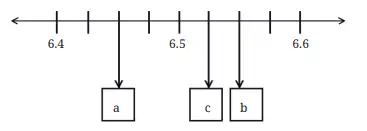
Write as a decimal.
Arrange , , , and in descending order.
Insurance costs paise per passenger. Find the total fee for lakh passengers.
Quick recap
- Decimal fractions have denominators that are powers of .
- Digits after the decimal point represent tenths, hundredths, thousandths, and so on.
- Fractions with denominators , or convert directly to decimals.
- Compare decimals from the highest place value; trailing zeros do not change a number's value.
- Align decimal points when adding or subtracting decimals.
- Decimal notation developed through several forms; the decimal point is widely used in the Indian place-value system, while some countries use a comma.
Summary
Decimal Place Value
Each place is one-tenth of the value of the place immediately to its left. Thus, tenths make unit, hundredths make tenth, and thousandths make hundredth.
Read a decimal by place value
- Identify the whole-number part and the digits after the decimal point.
- Name each fractional digit by its place.3.47=3+\frac{4}{10}+ rac{7}{100}
Write in expanded form using place values.
- Write in expanded form using place values.3.47=3+\frac{4}{10}+ rac{7}{100}
- Rename the tenths as hundredths if needed.
Comparing, Locating and Calculating with Decimals
Compare and calculate with decimals
- Write the decimals with the same number of decimal places when helpful.
- Compare matching places from left to right.
- For addition or subtraction, align decimal points and calculate.
Compare and , locate between consecutive tenths, and find their sum and difference.
- Write with two decimal places and compare.
- Locate between consecutive tenths.
- Add after aligning decimal points.
- Subtract after aligning decimal points.
Do not assume a decimal with more digits is larger. Compare matching place values; for example, .
Which is greater: or ?
Calculate and .
Quick recap
- Splitting a unit into smaller parts allows more exact measurements.
- The decimal point separates whole-number and fractional parts.
- Ten tenths make a unit; ten hundredths make a tenth; ten thousandths make a hundredth.
- Compare decimals by checking matching place values from left to right.
- Decimals increase from left to right on a number line.
- Align decimal points when adding or subtracting decimals.
Formula sheet
Mathematics — ALL CHAPTERS
1
Large Numbers Around Us
2
Arithmetic Expressions
3
A Peek Beyond the Point
4
Expressions using Letter-Numbers
5
Parallel and Intersecting Lines
6
Number Play
7
A Tale of Three Intersecting Lines
8
Working with Fractions
1
Geometric Twins
2
Operations with Integers
3
Finding Common Ground
4
Another Peek Beyond the Point
5
Connecting the Dots
6
Constructions and Tilings
7
Finding the Unknown