Class 7 . Mathematics . Ganita Prakash Part II . Finding Common Ground
Chapter 3: Finding Common Ground
Ch 3
Mathematics
Class 7
The Greatest of All
Highest Common Factor
Highest Common Factor (HCF) — The HCF of two or more numbers is their greatest common factor; it is also called the Greatest Common Divisor (GCD).
A common factor divides every given number exactly. The HCF is the greatest such factor. Choosing the HCF gives the largest equal tile or bag size and therefore the fewest tiles or bags. The longest jump from zero that lands on two target numbers is their HCF.
Use this to express the greatest common factor of two numbers.
Finding the HCF by Listing Factors
Finding the HCF by listing factors
- List all factors of each number.
- Identify the factors that occur in every list.
- Choose the greatest common factor.
What is the largest square tile with whole-number side length that exactly covers a room measuring ft by ft, and how many tiles are needed?
- The tile side must be a common factor of the room's breadth and length.
- Choose the greatest common factor for the largest square tile.
- Find how many tiles fit across each dimension.
- Multiply the number of rows by the number in each row.
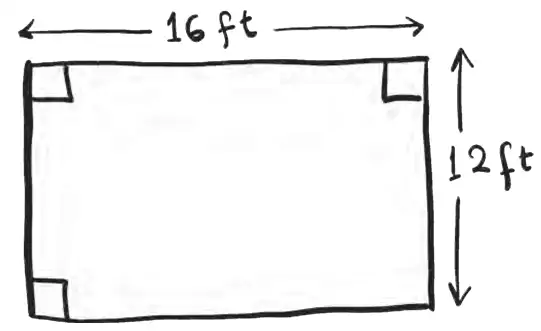
Using the HCF in Equal-Size Groups
Rice from two farms weighs kg and kg. What is the greatest whole-number bag weight that works for both, and how many bags are needed?
HCF and the Longest Jump
Find the longest jump size for each pair: (a) and , (b) and , (c) and , (d) and . Is each longest jump the pair's HCF?
Would allowing a fractional tile side change the largest square tile that exactly covers a ft by ft room?
Why Prime Factorisation Is Useful
A more reliable way to find the HCF
- Listing factors can become cumbersome for numbers with many factors and it is easy to miss one.
- Prime factorisation provides a more systematic way to find the HCF.
Quick recap
- The HCF is the greatest factor common to all the given numbers; it is also called the GCD.
- A square tile side must be a common factor of both room dimensions.
- The greatest common factor gives the largest equal tile or bag size and therefore the fewest are needed.
- The longest jump from zero that lands on both target numbers equals their HCF.
- Listing factors can be cumbersome; prime factorisation is a systematic method to study next.
Primes
Prime Numbers and Prime Factorisation
Prime number — A whole number greater than whose only factors are and itself.
Key ideas
- Composite number: A whole number greater than with more than two factors; is neither prime nor composite.
- Prime factorisation: Writing a number as a product of prime numbers. A prime number’s prime factorisation is itself.
- Sieve of Eratosthenes: A method for listing primes by eliminating composite numbers.
Every whole number greater than has a prime factorisation that is unique apart from the order of the factors.
Write the number as a product of primes.
Show that factoring in this way gives its prime factorisation.
- Factor the composite parts of one possible factorisation.
- Rearranging the factors gives the same prime product.
Prime Factorisation by the Division Method
Division method — A method that repeatedly divides a number by prime factors until the quotient is .
Using the division method
- Divide by a prime that divides the number exactly.
- Continue dividing each quotient by prime factors.
- Stop only when the quotient reaches ; multiply all the prime divisors used.
Division-method examples
- Factor diagram: Collect the prime factors along the side and at the bottom; their product is the original number.
- Examples: and .
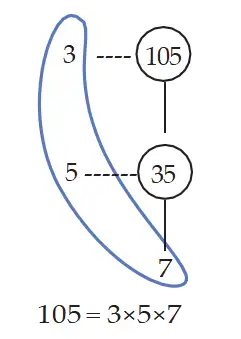
Find the prime factorisation of using division.
- Divide successively by prime factors.
- Continue until the quotient is , then collect all prime divisors.
- Write repeated prime factors using powers.
Finding Factors from Prime Factorisation
Using the prime factors of 840
- Factor test: A proposed factor can use each prime no more times than it appears in the number’s factorisation.
- Example: , so is a factor and its partner is .
- Other checks: and are factors of ; is not, because contains only one factor of .
- HCF application: Prime factorisation helps simplify finding the HCF of two numbers by identifying their common prime factors.
For , each factor is formed by choosing an exponent from to for each prime.
Listing all factors
- Find the prime factorisation of the number.
- Form every product using no more copies of each prime than are available.
- Include , which uses none of the prime factors, and check that no combinations are missing.
Find all factors of using its prime factorisation.
- Prime-factorise the number.
- Choose powers of and from exponent to .
- List every product, including .
Prime Factorisation Length
Does a larger number have a longer prime factorisation?
- No: The size of a number does not determine how many prime factors appear in its factorisation.
- Counterexample: has six prime factors, while the larger number has only two.
Find the prime factorisation of .
List all factors of .
Is a factor of ? If so, what must it be multiplied by to make ?
Quick recap
- A prime is greater than and has exactly two factors: and itself.
- Every whole number greater than has a unique prime factorisation, apart from order.
- In the division method, keep dividing by primes until the quotient is .
- A factor uses no more copies of each prime than the number’s prime factorisation contains.
- List factors by forming all valid prime-power combinations, including .
- Prime factorisation can help find the HCF of two numbers.
- A larger number does not necessarily have a longer prime factorisation.
Finding the HCF of Number Using Prime Factorisation
HCF by Prime Factorisation
Use the minimum exponent of each prime shared by all the numbers.
Finding the HCF
- Write each number as a product of prime factors.
- For each prime appearing in every factorisation, take its smallest exponent.
- Multiply the selected prime powers to get the HCF.
- To list all common factors, list the factors of the HCF.
Find the common factors and HCF of and .
- Prime-factorise both numbers.
- Use the shared primes with their minimum exponents.
- The common factors are all the factors of the HCF.
Do not compare arbitrary composite factors as though they were primes. Prime-factorise first; for example, and do not show that the numbers have no common factor.
Find the common factors and HCF of and .
Find the HCF of , and .
If and , can we conclude that and have no common factor other than ?
Quick recap
- Prime-factorise every number before comparing its factors.
- Minimum exponents of shared primes give the HCF.
- Common factors of the numbers are exactly the factors of their HCF.
- No shared prime factors means the HCF is .
- Several numbers: use the minimum exponent shared across all their prime factorisations.
Least But Not Last
Meaning of the LCM
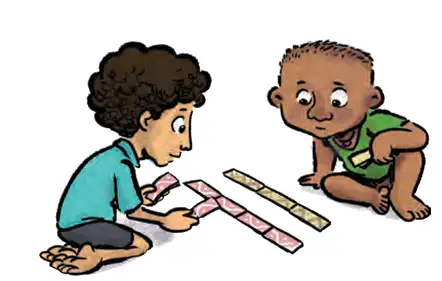
The LCM is the smallest positive common multiple of the numbers.
Find an LCM by listing multiples
- Write the multiples of each number in order.
- Find the first multiple that appears in every list.
- That first shared value is the LCM.
Anshu uses strips of length cm and Guna uses strips of length cm. What is the shortest toran length they can both make?
- The toran lengths must be multiples of both strip lengths.
- The first shared length is the shortest possible toran.
LCM in repeating schedules and the Idli-Vada game
- Repeating events: The first time two repeating schedules coincide is after a number of days equal to the LCM of their intervals.
- Sweet-shop example: Kabamai visits every days; free gajak is given every days. Their next shared day is after days.
- Idli-Vada rule: The first number that is a multiple of both chosen numbers is their LCM.
| Numbers | First common multiple (LCM) |
|---|---|
| 4 and 6 | 12 |
| 7 and 11 | 77 |
| 14 and 30 | 210 |
| 15 and 55 | 165 |
Finding LCM through Prime Factorisation
For each prime appearing in the numbers, use the greatest number of times it occurs in any one prime factorisation. Multiply these selected prime factors to get the LCM.
Why the greatest occurrence count is used
- Every common multiple must contain each prime factorisation as a part.
- Fewest required factors: Taking the greatest occurrence count for each prime contains all the original numbers as factors.
- Least result: Using more occurrences still gives a common multiple, but makes it larger than necessary.
For each prime , is its greatest exponent among the factorizations.
Find an LCM by prime factorisation
- Write each number as a product of primes.
- For every prime present, select its greatest exponent among the factorizations.
- Multiply the selected prime powers.
Find the LCM of and using prime factorisation.
- Prime-factorise both numbers.
- Choose the greatest exponent for each prime: five s, two s, and one .
- Multiply the selected prime powers.
Do not use each prime just once or add its exponents. Use the greatest exponent in either factorisation; for example, and , so their LCM is .
Find the LCM of and .
Find the LCM of , , and .
Find the LCM of and .
Quick recap
- The LCM is the smallest positive common multiple; there is no largest common multiple.
- The first time repeating intervals coincide is their LCM.
- For the listing method, the first shared multiple is the answer.
- For prime factorisation, take the greatest exponent of every prime appearing.
- The LCM of and is ; Kabamai’s next shared free-gajak day is after days.
Patterns, Properties and a Pretty Procedure?
HCF patterns and general statements
Generalisation — A generalisation describes a pattern or property that holds in all cases, not just one example.
- Factor and multiple: If one number is a factor of the other, the smaller number is the HCF. For example, divides , so their HCF is .
- Algebraic form: If the numbers are and , where is a positive integer, then their HCF is and their LCM is .
- Other number pairs: If one number is , the other can be ; if one number is , the other can be any positive-integer multiple of .
| Pair of numbers | HCF |
|---|---|
| Two consecutive even numbers | |
| Two consecutive odd numbers | |
| Two even numbers | An even number; the exact HCF depends on the pair |
| Two consecutive numbers | |
| Two co-prime numbers |
A common factor of two numbers must divide their difference. Consecutive numbers differ by , while consecutive even or consecutive odd numbers differ by .
LCM patterns
When the LCM is one of the numbers
- Condition: The LCM of two numbers is one of them exactly when the smaller number divides the larger.
- Algebraic form: For and , the LCM is .
- Co-prime numbers: Their LCM is their product.
- Consecutive numbers: Their LCM is their product because their HCF is .
| Pair of numbers | LCM |
|---|---|
| Co-prime numbers | |
| Consecutive numbers | |
| Consecutive even numbers | |
| Multiples of : |
Changing numbers and common factors
If both numbers are doubled, their HCF doubles: . Each number gains a factor of , which also becomes part of their common factors.
| Numbers | Prime factors | HCF |
|---|---|---|
| ; | ||
| ; |
For a common multiplier , . This HCF equals exactly when and are co-prime.
Examples with a common multiplier
- Example: and have HCF .
- HCFs: The pairs , , and have HCFs , , and , respectively.
- When HCF equals the multiplier: This holds for the second and third listed pairs, since and . It does not hold for the first or fourth pair.
Efficient procedures for HCF and LCM
Common-factor ladder method — Repeatedly divide both numbers by a common factor until the remaining quotients are co-prime.
| Quantity | Calculation |
|---|---|
| HCF | Product of all common divisors used |
| LCM | Product of the common divisors and both final quotients |
Why the ladder works
- Shared factors: The recorded common divisors contribute to the HCF.
- Remaining factors: The final quotients supply the additional factors needed to form the LCM.
- Flexible divisors: You may divide by any common factor, not only a prime factor; for example, divide and by , then divide and by .
Additional ladder result
- For and : Divide by common factors , and to leave and . Thus, the HCF is , and the LCM is .
Using the ladder
- Write the two numbers side by side.
- Divide both by a common factor and record the factor.
- Repeat until the resulting numbers are co-prime.
- Multiply the recorded common factors for the HCF; include both final quotients as well to get the LCM.
Use the common-factor ladder to find the HCF and LCM of and of .
- For and , divide successively by the common factors , , and ; the final quotients are and .
- Multiply the common factors for the HCF, and include the final quotients for the LCM.
- For and , divide by , then , then ; the final quotients are and .
- Multiply the common factors for the HCF, and include both final quotients for the LCM.
Do not stop dividing after removing just one common factor. Continue until the final quotients are co-prime; otherwise, the HCF or LCM may be incomplete.
Use common factors to find the HCF and LCM of and .
Use common factors to find the HCF and LCM of and .
Quick recap
- If one number divides the other, the smaller is the HCF and the larger is the LCM.
- Consecutive numbers are co-prime; consecutive even numbers have HCF , and consecutive odd numbers have HCF .
- Co-prime numbers have LCM equal to their product; multiples of do not have one fixed LCM rule beyond .
- Doubling both numbers doubles their HCF.
- For and , the HCF is .
- In the common-factor ladder, multiply shared divisors for the HCF; include both final quotients as well for the LCM.
Property Involving Both the HCF and the LCM
Comparing the LCM with the Product
- Common multiples: A common multiple is divisible by both numbers; their product is one such multiple.
- Comparison: The section explores how the LCM relates to the product of two numbers.
The HCF–LCM Relationship
For any two positive integers, their HCF multiplied by their LCM equals their product.
Why the property works
- Prime factors: For each prime, let its powers in the two numbers be and .
- HCF and LCM: The HCF uses the smaller exponent, ; the LCM uses the larger, .
- Product comparison: Since , the prime factors in HCF × LCM match those in the product.
Use the lower prime powers for the HCF and the higher prime powers for the LCM.
Finding the HCF and LCM by prime factorisation
- Write each number as a product of prime powers.
- For the HCF, multiply the common primes using their smaller exponents.
- For the LCM, multiply all primes using their larger exponents.
- Check the result using the product relationship.
Find the HCF and LCM of and , and verify their relationship.
- Prime-factorise the two numbers.
- Take common prime factors with the lower powers for the HCF.
- Take each prime factor with the higher power for the LCM.
- Verify that the product equals HCF times LCM.
Do not apply to three numbers in general. For example, for , the HCF is , the LCM is , but their product is .
Useful consequences
- Coprime numbers: If the HCF is , then the LCM equals the product.
- Different primes: For distinct primes and , the LCM is : it is greater than both primes and equal to their product.
- Common cube size: A cube fits a rectangular box exactly when its side length divides all three dimensions.
For and , find the HCF and LCM. What must the LCM be multiplied by to obtain the product?
A herd has fewer than cows. The cows divide equally through groups of , , and . How many cows could there be?
A box measures cm by cm by cm. Which cube side lengths from cm fit exactly without gaps?
Quick recap
- The product of two numbers is a common multiple, so their LCM is no greater than their product.
- For two positive integers, .
- In prime factorisation, the HCF uses the lower exponents and the LCM the higher exponents.
- If two numbers are coprime, their LCM equals their product.
- The HCF–LCM product rule does not generally extend to three numbers.
Summary
Prime Factorisation and Factors
- Prime factorisation: Write a number as a product of primes; this factorisation is unique apart from the order of the factors.
- Factors: Factors can be formed from subparts of the prime factorisation, including 1 and the number itself.
Highest Common Factor (HCF)
A common factor can use only primes that occur in each number’s prime factorisation. For the HCF, use the minimum number of occurrences of each shared prime.
Lowest Common Multiple (LCM)
A common multiple must contain the prime factors of each number. For the LCM, use the greatest number of occurrences of each prime across the factorisations.
Find HCF and LCM from prime factorisations
- Write each number as a product of primes.
- For the HCF, multiply the shared primes using their minimum occurrence counts.
- For the LCM, multiply all primes present using their maximum occurrence counts.
Find the HCF and LCM of 12 and 18.
- Write the numbers as products of primes.
- Use the minimum occurrence count for each prime shared by both numbers.
- Use the maximum occurrence count for each prime present.
Patterns and Related Procedures
- Patterns: HCF and LCM follow useful patterns for multiples, consecutive numbers, even numbers, and co-prime pairs.
- Efficient procedure: Repeatedly divide both numbers by common factors; the common factors give the HCF, and the process can also help find the LCM.
Mathematical Terms
Find the HCF of 24 and 36 using prime factorisation.
Find the LCM of 8, 12 and 20 using prime factorisation.
Quick recap
- Prime factorisation expresses a number as a product of primes.
- Finding all factors from a prime factorisation can require checking many combinations.
- The HCF uses the minimum occurrence count of each prime common to all the numbers.
- The LCM uses the maximum occurrence count of every prime present in the numbers.
- Patterns involving consecutive, even and co-prime numbers were explored.
- A procedure for finding HCF and LCM together, and a quicker version, were covered.
- Conjecture and generalisation are mathematical terms introduced in the chapter.
Formula sheet
Mathematics — ALL CHAPTERS
1
Large Numbers Around Us
2
Arithmetic Expressions
3
A Peek Beyond the Point
4
Expressions using Letter-Numbers
5
Parallel and Intersecting Lines
6
Number Play
7
A Tale of Three Intersecting Lines
8
Working with Fractions
1
Geometric Twins
2
Operations with Integers
3
Finding Common Ground
4
Another Peek Beyond the Point
5
Connecting the Dots
6
Constructions and Tilings
7
Finding the Unknown