Class 7 . Mathematics . Ganita Prakash Part I . A Tale of Three Intersecting Lines
Chapter 7: A Tale of Three Intersecting Lines
Ch 7
Mathematics
Class 7
Equilateral Triangles
Triangles and Their Parts
- Triangle: A closed shape with three vertices and three line segments joining them.
- Angles: The sides meeting at each vertex form the triangle’s three angles.
- Naming: A triangle is named by its vertices, which may be listed in any order.
Equilateral Triangles
Use this condition to check that all three sides are equal.
Construct an Equilateral Triangle
- Draw the base segment of the required length.
- With centre , draw an arc of radius equal to the base length.
- With centre , draw an arc of the same radius; mark an intersection as .
- Join to and to to complete the triangle.
Construct an equilateral triangle with side length cm.
- Construct an equilateral triangle with side length cm by drawing its base.
- Draw arcs from and , each with radius cm; call an intersection .
- Join the intersection to both endpoints of the base.
Constructing a Triangle from Three Side Lengths
For arcs centred at and , the intersection has distances equal to the two radii.
Construct a Triangle with Three Given Sides
- Draw one given side as the base.
- Draw an arc from using the length of the side from to the third vertex.
- Draw an arc from using the length of the other side to the third vertex.
- Mark an intersection of the arcs as , then join and .
Construct a triangle with side lengths cm, cm and cm.
- Use the cm side as the base.
- Draw an arc centred at with radius cm.
- Draw an arc centred at with radius cm; label an intersection .
- Join to and to to finish the construction.
Isosceles Triangles and Circle Patterns
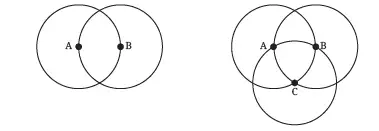
Construct a triangle with side lengths cm, cm and cm. What type of triangle is it?
Construct a triangle with side lengths cm, cm and cm.
Construct an equilateral triangle with side length cm.
Quick recap
- A triangle has three vertices, three sides and three angles; collinear vertices do not form a triangle.
- An equilateral triangle has three equal sides: .
- An isosceles triangle has two equal sides.
- For a construction, arcs centred at the endpoints of a base locate the third vertex.
- The radius of each arc gives the distance from its centre to the intersection point.
- Equal-sized intersecting circles can help reveal isosceles and equilateral triangles; and are equilateral in the given pattern.
Are Triangles Possible for any Lengths? Part-1
The direct path and the roundabout path
Why compare path lengths?
- Shortest route: A straight path between two points is shorter than a route that goes through a third point.
- Triangle connection: Between any two triangle vertices, one side is the direct path; the other two sides make the roundabout path.
- Test idea: Therefore, each side must be shorter than the sum of the other two.
Triangle inequality
Triangle inequality — Three lengths satisfy the triangle inequality when each length is less than the sum of the other two.
If three lengths are the sides of a triangle, every side is shorter than the sum of the other two. If any side is at least the sum of the other two, they cannot form a triangle.
Arrange the lengths as . The two smaller-side comparisons are then automatically true; check whether the two smaller lengths add to more than the largest.
What the test tells us
- Fails the test: If the largest length is greater than or equal to the sum of the other two, no triangle is possible.
- Passes the test: The lengths satisfy the triangle inequality. In this lecture, that alone is not treated as a construction confirmation; the question of whether construction arcs intersect is left open.
- Examples: ; ; ; ; ; ; and fail the test.
- Examples that pass: and satisfy the triangle inequality.
- Borderline case: If the two shorter lengths add up exactly to the largest, the paths form a straight line, not a triangle.
Check three proposed side lengths
- Arrange the lengths from smallest to largest.
- Add the two smaller lengths.
- Compare the sum with the largest length: if it is not greater, a triangle is impossible; if it is greater, the triangle inequality is satisfied, but this lecture leaves construction confirmation to the arc-intersection check.
Can cm, cm, and cm be the side lengths of a triangle?
- Test whether lengths cm, cm, and cm satisfy the triangle inequality.
- Add the two shorter lengths and compare with the longest.
- The longest length is greater than the sum of the other two, so these lengths cannot form a triangle.
Do not conclude that a triangle is confirmed just because the lengths pass the inequality test in this lecture. Passing shows the condition is satisfied; the construction question is whether the arcs for the third vertex intersect.
Can cm, cm, and cm form a triangle?
Do cm, cm, and cm satisfy the triangle inequality, and what does this lecture conclude?
Do lengths , , and satisfy the triangle inequality?
Quick recap
- A straight path between two points is shorter than a route through a third point.
- For triangle side lengths, each length must be less than the sum of the other two.
- Arrange the lengths in order and check whether the two smaller lengths add to more than the largest.
- If the two smaller lengths add to less than or equal to the largest, a triangle is impossible.
- Passing the inequality test satisfies the condition; in this lecture, construction confirmation still depends on whether the arcs intersect.
Are Triangles Possible for any Lengths? Part-2
Testing Side Lengths by Constructing Circles
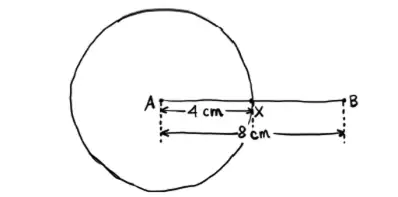
Example: Side Lengths cm, cm and cm
- Centre distance: With cm and cm on the base, cm.
- Circle radii: The circles have radii cm and cm; they intersect at two points.
- Conclusion: Either intersection gives a triangle with side lengths cm, cm and cm.
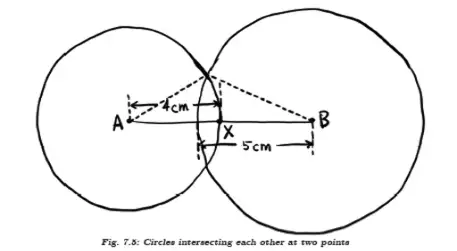
Three positive lengths form a triangle exactly when each length is less than the sum of the other two. With the longest length , it is enough to check .
What the Circles Show
- Two intersections: The circles cross at two points, so a triangle can be formed.
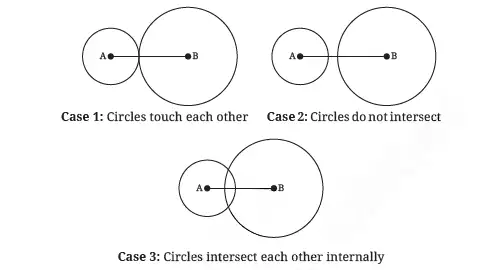
- One touching point: If the longest length equals the sum of the other two, the circles touch at one point; this does not form a proper triangle.
- No intersection: If the longest length exceeds the sum of the other two, the circles do not meet and no triangle is possible.
- Reason: The circles intersect at two points exactly when the distance between their centres is less than the sum of their radii; with the longest side as the base, this is the triangle inequality.
| Lengths | Check | Triangle possible? |
|---|---|---|
| No | ||
| Yes | ||
| No | ||
| Yes | ||
| Yes | ||
| No | ||
| Yes |
For lengths arranged as , check whether the two shorter lengths add to more than the longest.
Deciding Whether Three Lengths Form a Triangle
- Arrange the lengths from smallest to largest: .
- Add the two smaller lengths.
- Compare their sum with the largest length: a strict greater-than result means a triangle is possible.
- If the sum equals or is less than the largest length, a proper triangle is not possible.
Can lengths cm, cm and cm form a triangle?
- Test whether lengths cm, cm and cm form a triangle.
- The longest length is cm; add the other two lengths.
- Since the sum is greater than the longest length, the lengths satisfy the triangle inequality.
Can lengths cm, cm and cm form a triangle?
Can lengths cm, cm and cm form a proper triangle?
Do not accept equality: if the two shorter lengths add exactly to the longest, the circles touch at one point, so no proper triangle is formed.
Quick recap
- Use the longest length as the base and the other two lengths as circle radii.
- Two circle intersections give the third vertex of a triangle.
- Three lengths form a triangle when each is less than the sum of the other two.
- With , the key test is .
- Equality gives a single touching point; a smaller sum gives no intersection.
Are Triangles Possible for any Lengths? Part-3
Circle Intersections and Triangle Inequality
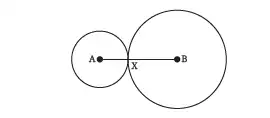
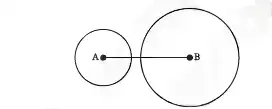
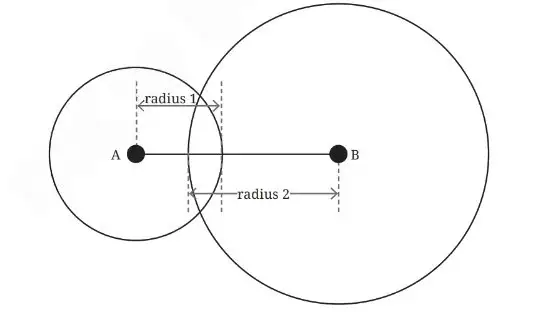
Three positive lengths form a triangle exactly when the sum of the two shorter lengths is strictly greater than the longest length.
What the Test Means
- If : The circles intersect, so the three lengths can make a triangle.
- If : The circles touch; the lengths lie in a straight line and do not make a triangle.
- If : The circles do not meet; a triangle is impossible.
- Here: is the longest length, while and are the other two.
Checking Whether a Triangle Exists
Triangle Existence Test
- Arrange the three positive lengths from smallest to largest.
- Add the two smaller lengths.
- Compare their sum with the longest length: a greater sum means a triangle; equality or a smaller sum means no triangle.
For two fixed positive sides and , the third side must lie strictly between their difference and their sum.
Do lengths 5, 10, and 12 form a triangle?
- Check whether lengths 5, 10, and 12 form a triangle. The longest length is 12.
- Add the two shorter lengths.
- Since the sum is greater than the longest length, the lengths form a triangle.
Do not accept equality: if the sum of the two shorter lengths equals the longest, the shape is a straight line, not a triangle.
Examples and Possible Side Lengths
Key Results
- Lengths : A triangle exists because .
- Lengths : No triangle exists because .
- Lengths : No triangle exists because .
- Equilateral triangles: Any positive side length works; for three equal sides , .
For each set, decide whether a triangle is possible: (a) 1, 100, 100; (b) 3, 6, 9; (c) 1, 1, 5.
Give five possible third-side lengths for each pair: (a) 1 and 100; (b) 5 and 5; (c) 3 and 7.
Can an equilateral triangle have side length 50? Can it have any positive side length?
Quick recap
- Order the lengths and compare the sum of the two shorter sides with the longest.
- A triangle exists exactly when the sum of the two shorter sides is strictly greater than the longest.
- Equality gives touching circles and a straight-line shape, not a triangle.
- If the shorter-side sum is less than the longest, no triangle is possible.
- For fixed sides and , a third side must satisfy .
- Every equilateral triangle with a positive side length satisfies the triangle inequality.
Construction of Triangles When Some Sides and Angles are Given Part-1
Two Sides and the Included Angle
Use this condition to check whether the given included angle can form a triangle.
Constructing a triangle from two sides and the included angle
- Draw one given side as the base.
- At the appropriate endpoint, construct the given included angle.
- On the angle's other arm, mark the second given side length.
- Join the two unjoined endpoints to complete the triangle.
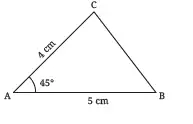
Construct with , and .
- Draw the base of the triangle.
- Construct the given angle at .
- Mark point on the new ray at the given distance from .
- Join to to complete the required triangle.
Do not treat an angle of or more as a valid included angle; the two arms cannot enclose a triangular region.
Two Angles and the Included Side
Check the two given angles before construction; the third angle follows from the triangle angle sum.
Constructing a triangle from two angles and the included side
- Draw the given included side as the base.
- At endpoint , construct the first given angle.
- At endpoint , construct the second given angle on the same side of the base.
- Mark the intersection of the new arms as ; it is the third vertex.
Construct with , and .
- Draw the included side.
- Construct a angle at .
- Construct an angle at on the same side of .
- The two new arms meet at ; the third angle is determined by the angle sum.
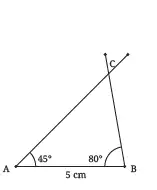
Construct a triangle with sides and and included angle .
Can a triangle be constructed from two sides and with included angle ? Give a reason.
Construct a triangle with angles and and the included side . Find the third angle.
- Two sides and included angle: Construct the angle between the given sides; the angle must be less than .
- Two angles and included side: Construct the angles at the two ends of the side; their sum must be less than .
Quick recap
- Two side lengths and their included angle determine a triangle when the angle is between and .
- For the two-side construction, draw a side, construct the included angle, mark the second side, and join the endpoints.
- An included angle of or more does not produce a triangle.
- With two angles and the included side, construct the angles at the base endpoints; their arms meet at the third vertex.
- The two given angles must add to less than .
- The third angle is minus the sum of the two given angles.
Construction of Triangles When Some Sides and Angles are Given Part-2
When Do Two Given Angles Form a Triangle?
Use this test for two given angles.
Test Whether Two Angles Can Form a Triangle
- Add the two given angles.
- If the sum is less than , a triangle is possible; otherwise, it is not.
Can and be two angles of a triangle?
- Check whether and can be angles of a triangle.
- The sum is less than , so a triangle is possible.
- The third angle is the difference from .
| Given angles | Possible? | Reason or third angle |
|---|---|---|
| No | Sum is | |
| Yes | Third angle is | |
| Yes | Third angle is | |
| No | Sum is |
Finding the Third Angle
For any triangle with angles , , and , .
Use when two angles of a triangle are known.
Find the Third Angle Using a Parallel Line
- Draw a line through the vertex of the unknown angle, parallel to the opposite side.
- Use alternate interior angles to copy the two known angles onto the new line.
- Use the straight angle on the new line and solve for the unknown angle.
Find when and .
- In , let and . Draw through parallel to .
- By alternate interior angles, the angles on the straight line equal the two given angles.
- The three adjacent angles on line add to ; solve for .
- Subtract the known angles.
| Known angles | Third angle |
|---|---|
Equal-Angle Cases
- Two angles equal to : The third angle is ; a triangle with all three angles is impossible.
- All angles equal: Each angle must be , since .
- Equal base angles: If and , then .
Can and be two angles of a triangle?
A triangle has angles and . Find its third angle.
In a triangle, and . Find and .
Quick recap
- Two positive angles form a triangle exactly when their sum is less than .
- An included side's length does not determine whether the triangle is possible.
- The interior angles of a triangle add to .
- The third angle is minus the sum of the other two.
- A parallel line and alternate interior angles provide a geometric way to find the third angle.
- An equiangular triangle has three angles of each.
Angle Sum Property
Angle Sum Property of a Triangle
For any triangle , the sum of its interior angles is .
Use this relation to find a missing interior angle.
Showing why the angles add to 180 degrees
- Through vertex , draw a line parallel to side .
- By alternate interior angles, the angles made with equal the angles at and .
- The three angles along the straight line through add to .
- Substitute the equal angles to obtain the triangle angle sum.
Find the third angle of a triangle if the other two angles are and .
- In a triangle, two angles are and . Find the third angle.
- Subtract the known angles from the triangle angle sum.
Exterior Angles
An exterior angle of a triangle equals the sum of its two remote interior angles.
For triangle with extended to , use either relation to find the exterior angle at .
Finding an exterior angle
- Add the two remote interior angles, or first find the adjacent interior angle using the triangle angle sum.
- Use the straight-angle relationship between the interior angle and exterior angle.
Find if and .
- Given and , first find the interior angle at .
- The exterior angle and the interior angle at form a straight angle.
- This also matches the sum of the two remote interior angles.
Two angles of a triangle are and . Find the third angle.
A triangle has remote interior angles of and . Find the exterior angle.
Quick recap
- The interior angles of every triangle sum to .
- A parallel line through a vertex helps show the angle sum using alternate interior angles.
- An interior angle and its adjacent exterior angle form a straight angle.
- An exterior angle equals the sum of the two remote interior angles.
- Use the triangle angle sum or the exterior angle property to find unknown angles.
Constructions Related to Altitudes of Triangles
Altitudes and height
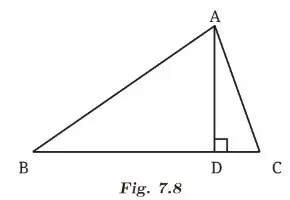
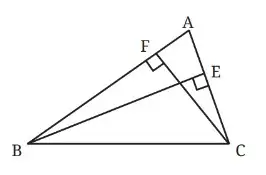
If an altitude does not meet the opposite side itself, extend that side and draw the perpendicular to its line; this can happen in an obtuse triangle.
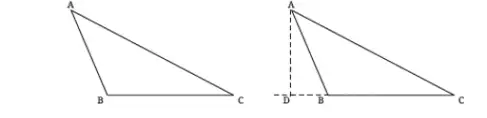
When is the base, is the altitude and its length is the height.
Altitude by paper folding
- Crease: A crease represents an altitude only when it is drawn from the vertex perpendicular to the base line.
- Reason: Perpendicularity is part of the definition of an altitude; an arbitrary fold does not necessarily make a perpendicular.
Constructing an altitude
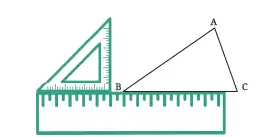
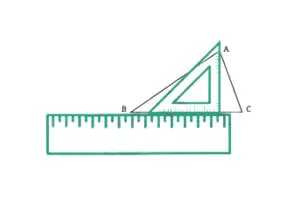
Draw the altitude from to
- Align a ruler with base .
- Place a set square against the ruler, with one edge of its right angle along the ruler.
- Slide the set square until its perpendicular edge passes through vertex .
- Draw from along that edge to or its extension, and mark the foot as .
Construct the altitude from to in .
- Construct the altitude from to base in .
- Align the ruler with and place the set square against it.
- Slide the set square until its perpendicular edge passes through , then draw to the base.
- Label the point where the perpendicular meets the base as .
Right triangles
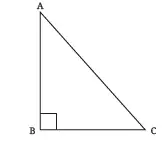
In , the perpendicular from to the line meets it at . What is the altitude from , and what is the height when is the base?
In right triangle , the right angle is at . Which side is an altitude to base ?
Quick recap
- An altitude runs from a vertex perpendicular to the line containing the opposite side.
- The altitude’s length is the height for the chosen base.
- An altitude may meet an extended side rather than the side segment itself.
- A ruler and set square can construct a perpendicular from a vertex to the base.
- A crease represents an altitude only if it is perpendicular to the base.
- In a right triangle, each side forming the right angle is an altitude to the other.
Types of Triangles
Classification by Side Lengths
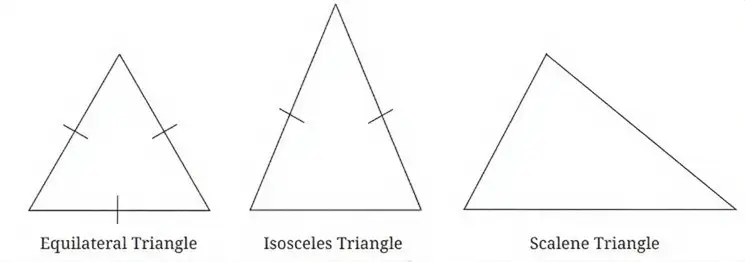
Classification by Angle Measures
- Acute-angled: All three angles are acute.
- Right-angled: One angle is a right angle.
- Obtuse-angled: One angle is obtuse.
Constructing Triangles and Altitudes
Construct a triangle from three side lengths and draw the requested perpendicular
- Draw the given base.
- With centres at the base endpoints, draw arcs using the other two side lengths as radii; their intersection locates the third vertex.
- Join the third vertex to both endpoints of the base, then construct the requested perpendicular from it to the base.
Construct with , and , then construct an altitude from T to RY.
- Draw the given base.
- At R, construct the given angle and mark T on its arm at the stated distance.
- Join T to Y to complete the triangle.
- From T, construct a perpendicular to the line containing RY.
Construct with , and ; construct a perpendicular from A to BC.
Quick recap
- By side lengths, triangles are equilateral, isosceles, or scalene.
- An equilateral triangle has three equal sides; an isosceles triangle has two equal sides.
- A scalene triangle has three different side lengths.
- By angles, triangles are acute-angled, right-angled, or obtuse-angled.
- An acute-angled triangle has all three angles acute.
- For a requested altitude, construct a perpendicular from the named vertex to the opposite side.
Summary
Triangle Inequality and Construction
Use this to check whether three lengths can form a triangle.
Constructing a Triangle from Three Side Lengths
- Check that the three lengths satisfy the triangle inequality.
- Draw one side as the base.
- With a compass, draw arcs from the base endpoints using the other two side lengths; their intersection is the third vertex.
Can lengths of 4 cm, 5 cm and 6 cm form a triangle?
- Check whether lengths of 4 cm, 5 cm and 6 cm can form a triangle.
- All three inequalities are true, so the triangle can be constructed.
A triangle can also be constructed when two sides and their included angle are given, or when two angles and their included side are given.
Angle Sum and Altitude
Use this relation to find a missing interior angle.
Finding a Missing Angle
- Add the known interior angles.
- Subtract their sum from the triangle angle sum.
Find the third angle of a triangle whose other angles are and .
- Two angles of a triangle are and .
- Subtract their sum from to find the third angle.
Classifying Triangles
Classify a triangle with side lengths 5 cm, 5 cm and 8 cm by its sides.
- A triangle has side lengths 5 cm, 5 cm and 8 cm.
- It has exactly two equal sides, so it is isosceles.
Can side lengths 2 cm, 3 cm and 6 cm form a triangle?
Find the third angle of a triangle with angles and .
Classify a triangle with angles , and by its angles.
Quick recap
- Three positive lengths form a triangle exactly when each is less than the sum of the other two.
- A compass helps construct triangles from given side lengths.
- Triangles can be constructed from two sides and their included angle, or two angles and their included side.
- The interior angles of a triangle add up to .
- An altitude runs from a vertex perpendicular to the opposite side.
- Triangles are classified by sides as equilateral, isosceles or scalene, and by angles as acute, right or obtuse.
Formula sheet
Mathematics — ALL CHAPTERS
1
Large Numbers Around Us
2
Arithmetic Expressions
3
A Peek Beyond the Point
4
Expressions using Letter-Numbers
5
Parallel and Intersecting Lines
6
Number Play
7
A Tale of Three Intersecting Lines
8
Working with Fractions
1
Geometric Twins
2
Operations with Integers
3
Finding Common Ground
4
Another Peek Beyond the Point
5
Connecting the Dots
6
Constructions and Tilings
7
Finding the Unknown