Class 7 . Mathematics . Ganita Prakash Part I . Number Play
Chapter 6: Number Play
Ch 6
Mathematics
Class 7
Numbers Tell us Things
Reading Call-Out Numbers
Here, is the height of the child in position .
For the child in position , the call-out number satisfies , because only people are in front.
Finding the Call-Out Sequence
- Start with the child at the front of the line.
- For each child, compare their height with every person already in front.
- Count the taller people and write that number in the child’s position.
Write the call-out sequence for the seven-child arrangement shown in the lecture.
- For the seven-child arrangement, count the taller children in front of each child from left to right.
- The call-out numbers for children 1 and 2 are both zero.
- Children 3 and 4 call out one and zero.
- Children 5, 6, and 7 call out three, zero, and three.
Building Height Arrangements
| Call-out sequence | Height ranks from left to right |
|---|---|
Reasoning About the Numbers
| Statement | Classification | Reason |
|---|---|---|
| A person who says is the tallest. | Only sometimes true | They may have no taller person in front even though someone taller is behind. |
| The tallest person says . | Always true | Nobody in the group is taller than them. |
| The first person says . | Always true | Nobody is standing in front of the first person. |
| A person between the first and last cannot say . | Only sometimes true | They say if everyone in front is shorter. |
| The person with the largest number is the shortest. | Only sometimes true | With ranks , the numbers are : the shortest is not the person with the largest number. With descending heights, the shortest can have the largest number. |
| Largest possible number in a group of . | The last person has seven people in front, and can say if all seven are taller. |
Height ranks are from left to right, where is shortest. Find the call-out sequence.
What is the greatest possible call-out number in a group of people?
Quick recap
- A child counts only the taller people standing in front.
- The first child always calls out .
- At position , the call-out number is between and .
- The tallest person always calls out ; a person saying is not always tallest.
- The given seven-child arrangement has sequence .
- In a group of people, the largest possible call-out number is .
Picking Parity
Parity and Number Operations
Parity — Parity is the property of a number being even or odd.
- Even number: Can be arranged in pairs with none left over.
- Odd number: Is one more than a collection of pairs.
- Addition: The sum of any number of even numbers is even.
- Odd-number sums: An even count of odd numbers adds to even; an odd count adds to odd.
- Subtraction: Subtracting numbers of the same parity gives an even result; different parities give an odd result.
Adding or subtracting two numbers of the same parity gives an even number; combining numbers of different parities gives an odd number.
An even integer and an odd integer can be represented in these forms.
Finding the parity of a sum
- Count how many odd numbers are being added.
- An even number of odd terms gives an even sum; an odd number gives an odd sum.
What is the parity of the sum of eight odd numbers?
- Eight odd numbers make an even number of odd terms.
- Pair the odd numbers; each pair has an even sum.
- The full sum is a sum of four even pair-sums, so it is even.
The Five-Card Puzzle
Parity argument
- Given: Five boxes must each contain one card, and every card shows an odd number.
- Odd count: Five odd numbers have an odd sum.
- Conclusion: They cannot add to , which is even.
Testing whether a target sum is possible
- Find the parity of the numbers being selected and count how many are selected.
- Use the odd-term count rule to determine the sum's parity.
- Compare it with the target; opposite parities mean the target is impossible.
Can five odd-number cards add to ?
- Five odd cards make an odd number of odd terms.
- Their sum must therefore be odd.
- The target is even, so it cannot be reached.
Parity of Consecutive Numbers
Consecutive numbers
- Alternation: Counting numbers alternate between even and odd.
- Consecutive pair: One number is even and the other is odd.
- Sum: An even number plus an odd number is odd.
The sum of any two consecutive counting numbers is odd, because one is even and the other is odd.
A pair of consecutive numbers has this form; its sum is always odd.
Checking a claimed sum of consecutive ages
- Represent the ages as two consecutive numbers.
- Use the fact that their sum is odd.
- Compare the claimed total's parity with odd.
Martin and Maria are one year apart in age. Can their ages add to ?
- Ages one year apart are consecutive.
- Their sum is always odd.
- Since is even, it cannot be their sum.
Find the parity of the sum of two odd numbers and three even numbers.
Lakpa has an odd number of Rs. 1 coins, an odd number of Rs. 5 coins, and an even number of Rs. 10 coins. Can their total be Rs. 205?
Find the parity of even minus odd and odd minus even.
Quick recap
- Parity tells whether a number is even or odd.
- An even number of odd terms sums to even; an odd number of odd terms sums to odd.
- Adding or subtracting numbers of the same parity gives an even result; different parities give an odd result.
- Five odd cards cannot sum to because their sum is odd and is even.
- Consecutive numbers have opposite parity, so their sum is always odd.
- The total value of Lakpa's coins must be even, so it cannot be Rs. 205.
Small Squares in Grids
Parity of the Number of Small Squares
Parity — Parity tells whether a whole number is even or odd.
A grid with rows and columns has an even number of small squares if either dimension is even; the count is odd only when both dimensions are odd.
Use this to find the total number of squares in a grid with rows and columns.
Grid parity rules
- Even product: If at least one of or is even, then is even.
- Odd product: If both and are odd, then is odd.
- Examples: A grid has squares (odd); a grid has squares (even).
- Quick checks: A grid has an odd count; and grids have even counts.
Find grid parity without multiplying
- Check whether either grid dimension is even.
- If neither is even, both are odd, so the square count is odd.
Without multiplying, find the parity of the number of squares in a grid.
- Identify the parity of each dimension in a grid.
- Since one dimension is even, the product is even.
Parity of Expressions
Parity of an expression — The parity of an expression is whether its value is even or odd for a chosen value of its variable.
For integer values, adding an even number preserves parity, while adding an odd number changes it. An even multiple of an integer is always even.
| Expression | Parity | Reason |
|---|---|---|
| Always even | It is a multiple of . | |
| Always odd | An even number plus is odd. | |
| Always even | It is a multiple of . | |
| Always even | Both terms are even. | |
| Always odd | An even number plus an odd number is odd. |
Parity can depend on the variable
- Expression: The parity of depends on whether is even or odd.
- If is odd: is odd; for example, gives .
- If is even: is even; for example, gives , and gives .
- When is odd: and are odd, while and are even.
- When is even: and are even.
For every integer , these forms are always even and always odd, respectively.
Determine an expression's parity
- Decide whether the variable is even or odd.
- Use multiplication and addition rules: an even plus an even is even; an odd plus an even is odd.
Find the parity of when .
- Evaluate when .
- Write as an even number plus to identify its parity.
The Nth Even and Odd Numbers
Nth number — The th number is the number at position in an ordered sequence, with positions beginning at .
The th positive even number is twice its position. The th positive odd number is one less than the even number at the same position.
For positions , these formulas generate all positive even and odd numbers in order.
Why the formulas work
- Even sequence: ; its th term is .
- Odd sequence: ; each term is one less than the even term at the same position.
- A sequence that skips numbers: For , gives and misses many even numbers.
- Listing all odd numbers: The expression gives .
Find the nth odd number
- Find the even number at the same position.
- Subtract to get the odd number at that position.
What is the 100th odd number?
- Find the 100th even number.
- Subtract to get the 100th odd number.
Find the parity of the number of small squares in a grid without multiplying.
Is always even or always odd for integer ?
Write formulas for the 25th even number and the 25th odd number, then find their values.
Quick recap
- A grid with rows and columns contains small squares.
- The grid count is even if either dimension is even; it is odd if both are odd.
- An even number plus an even number is even; an even number plus an odd number is odd.
- is always even, and is always odd for integer .
- The th positive even number is ; the th positive odd number is .
- The 100th odd number is .
Some Explorations in Grids
Grid Sums and Feasibility
Grid-sum puzzle — A grid-sum puzzle fills a grid with the numbers –, without repeats; clues give row and column totals.
A row or column has three distinct numbers, so its sum is between and . The three row sums total , as do the three column sums; all six clues together total .
Use these necessary checks before trying to fill a grid.
| Grid 1 | Row sum | Grid 2 | Row sum |
|---|---|---|---|
| Column sums | Column sums |
Check whether clues are possible
- Check every row and column clue against the smallest and largest possible line sums.
- Check that all row clues total and all column clues total .
Can a grid using – have row or column clues of and ?
- Test clues of and against the possible line-sum range.
- Both clues are outside the possible range.
Magic Squares
Magic square — A square grid is a magic square if every row, column and diagonal has the same sum, called the magic sum.
Its magic sum is , its centre is , and and must occupy middle edge cells, not corners. There are exactly ways to arrange – in a grid; only one magic square is unique when rotations and reflections are treated as the same.
Why the centre and edge positions are restricted
- Magic sum: The three equal row sums total , so each is .
- Centre: If the centre is , each pair of opposite outer cells sums to . The four pairs together use all outer numbers, whose total is ; hence , giving .
- Corners: If is in a corner, each of its three lines needs a pair summing to . Only two distinct pairs work: and . If is in a corner, pairs summing to also provide only two choices: and .
- Edges: Therefore, and cannot be corners and must be in middle edge cells.
The total of the nine entries is divided equally among the three rows.
Build a magic square systematically
- Find the required magic sum from the total of all entries.
- Place in the centre and and in middle edge cells.
- Fill the remaining cells so every row, column and diagonal totals .
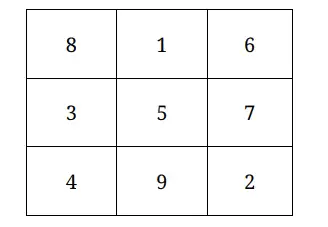
Verify that the displayed grid is a magic square.
- Check the first row, second row and first column.
- Check one diagonal; the other lines also total .
Transforming Magic Squares
Same-operation transformation — Applying the same linear change to every entry of a magic square preserves equal line sums.
In a magic square, adding to every entry adds to each line sum. Multiplying every entry by multiplies the magic sum by . Thus, adding, subtracting, multiplying or dividing every entry by the same constant preserves the magic-square property; division requires a non-zero constant.
Use this when every entry changes from to .
Create a square for consecutive numbers
- Start with a magic square using –, whose magic sum is .
- For consecutive numbers from to , add to every entry.
- Add three times the shift to the original magic sum.
What are the new magic sums after adding to every entry and after doubling every entry?
- Adding to every entry raises each line sum by .
- Doubling every entry doubles each line sum.
Can a row or column clue of occur in a grid filled with –?
What are the centre number and magic sum for a magic square using –?
Find the magic sum for consecutive numbers from to .
Quick recap
- For a grid using –, every row or column sum lies from to .
- The three row sums total , and the three column sums also total ; all six clues total .
- A magic square has equal sums in every row, column and diagonal.
- For –, the magic sum is , the centre is , and and occupy middle edge cells.
- There are possible fillings of a grid with –; there is one magic square up to rotations and reflections.
- Adding to each entry changes the magic sum from to ; multiplying by changes it to .
- For consecutive numbers from to , the magic sum is .
Generalising a 3 × 3 Magic Square
The Algebraic Structure of a 3-by-3 Magic Square
This form arranges the entries around centre number .
In any 3-by-3 magic square, if every row, column and diagonal has the same sum, that magic sum is , where is the centre number.
Changing every entry
- Add : The centre becomes and the magic sum increases by .
- Double: The centre becomes and the magic sum becomes .
- Non-consecutive numbers: A magic square can use non-consecutive numbers, provided every required row, column and diagonal has the same sum.
| Operation | Resulting square |
|---|---|
| Add to every entry | |
| Double every entry |
Build a square from its magic sum
- Divide the required magic sum by to find the centre number.
- Substitute the centre number into the generalised square.
- Check that every row, column and diagonal has the required sum.
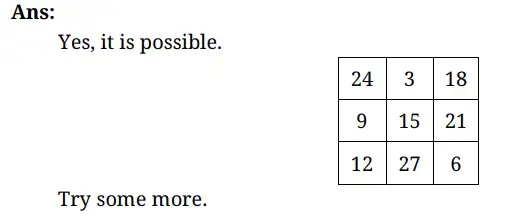
Create a magic square whose magic sum is .
- Find the generalised magic square with magic sum .
- Find the centre number by dividing the magic sum by .
- Substitute into the generalised form.
- The common sum is confirmed by multiplying the centre by .
Use the generalised form to find a magic square with centre number .
What happens to the magic sum if every entry in the generalised square is doubled?
Must a 3-by-3 magic square use consecutive numbers?
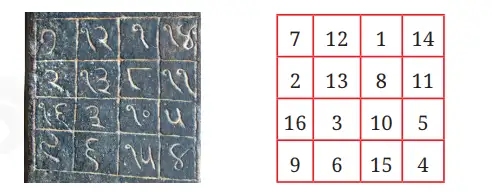
The First Recorded 4-by-4 Magic Square
- Chautīsā Yantra: The first recorded 4-by-4 magic square is found in a 10th-century inscription at the Pārśhvanath Jain temple in Khajuraho, India.
- Numbers and sum: It uses the numbers through ; every row, column and diagonal sums to .
- Name: “Chautīs” means , which explains the Yantra’s name.
Magic Squares in History and Culture
- Lo Shu Square: The earliest recorded magic square dates back over years to ancient China. It is a 3-by-3 arrangement of the numbers to .
- Legend: A story associates the square with a turtle that appeared during a catastrophic flood on the Lo River.
- Worldwide study: Magic squares have been studied in India, Japan, Central Asia and Europe.
- Indian methods: Indian mathematicians developed methods for constructing squares of sizes 3-by-3, 4-by-4, 5-by-5 and larger.
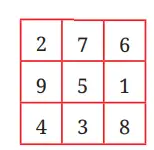
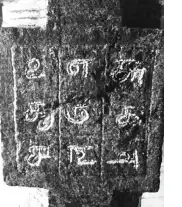
- Palani temple: A 3-by-3 magic square is carved on a pillar at a temple in Palani, Tamil Nadu; the temple dates to the 8th century CE.
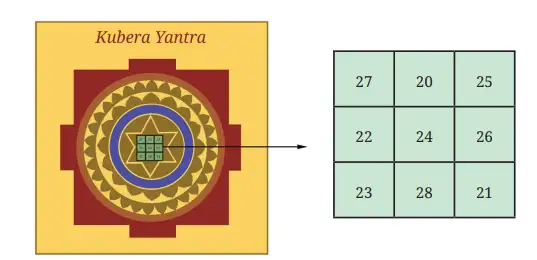
- Everyday use: 3-by-3 magic squares are also found in homes and shops in India, including the Navagraha Yantra.
| Graha | Centre number | Magic sum |
|---|---|---|
| Mercury | ||
| Venus | ||
| Moon | ||
| Jupiter | ||
| Sun | ||
| Mars | ||
| Ketu | ||
| Saturn | ||
| Rahu |
Quick recap
- For a 3-by-3 magic square, the magic sum is , where is the centre number.
- Adding to each entry raises the magic sum by ; doubling each entry doubles the sum.
- A magic square need not use consecutive numbers, but all required lines must have equal sums.
- The Chautīsā Yantra is a 4-by-4 square from Khajuraho using through with magic sum .
- The Lo Shu Square is an ancient Chinese 3-by-3 magic square using to .
- The Navagraha Yantra has squares with different centre numbers and magic sums.
Nature’s Favourite Sequence: The Virahāṅka– Fibonacci Numbers!
Counting Rhythms with 1s and 2s
Every rhythm of beats begins with either a -beat step or a -beat step. These cases leave or beats, so their counts add: .
Do not treat rearrangements as the same rhythm: and are different because the syllables occur in a different order.
The Sequence in Nature
Find the number of rhythms for beats.
Write the next three terms after .
Without calculating the exact terms, state the repeating parity pattern and identify the parity of the term after two consecutive odd terms.
Quick recap
- A short syllable represents beat; a long syllable represents beats.
- Ordered sums of s and s count distinct rhythms.
- The rhythm count starts and each new term is the sum of the previous two.
- There are rhythms for beats; after come .
- The parity pattern repeats odd, even, odd.
- Virahāṅka described the rule around CE; Fibonacci wrote about the numbers in CE.
Digits in Disguise
Cryptarithms (Alphametics)
Cryptarithm — A number puzzle in which each letter represents a digit from to .
Key rules and clues
- Same letter: A letter stands for the same digit wherever it appears; different letters are usually assigned different digits.
- Leading digit: The first digit of a multi-digit number cannot be .
- Place value: means ; solve addition column by column, starting with the units and tracking carries.
- Example clue: In , the units column gives ; the full solution is .
- Other puzzles: The lecture also gives , , , and .
Solving a cryptarithm
- Begin in the units column and find the result digit and any carry.
- Move left through the columns, including each carry in the next sum.
- Check that leading digits are non-zero and verify the complete addition.
Find and if .
- Translate the addition into place value.
- Subtract from each side.
- The two-digit sum has tens digit , so find .
- Check the result.
Parity: Odd and Even Numbers
Parity — The parity of an integer tells whether it is even or odd.
Any number of even numbers has an even sum. An even number of odd numbers has an even sum; an odd number of odd numbers has an odd sum.
| Terms being added | Parity of the sum |
|---|---|
| An odd number of even numbers | Even |
| An even number of odd numbers | Even |
| An odd number of odd numbers | Odd |
| An even number of even numbers | Even |
Parity in context
- Toggling: Each switch toggle changes the bulb from on to off or off to on. After an odd number of toggles the starting state reverses; after an even number it returns.
- 77 toggles: An initially ON bulb ends OFF because is odd.
- Loose pages: Each sheet has one even-numbered page and one odd-numbered page, so its page-number sum is odd. The sums from sheets have even parity; is therefore possible and consistent with parity.
Odd-and-even grid
- Rule: A row or column has an odd sum exactly when it contains an odd number of odd entries.
- Task: Fill the six cells with three odd and three even numbers so the row and column parities match their labels.
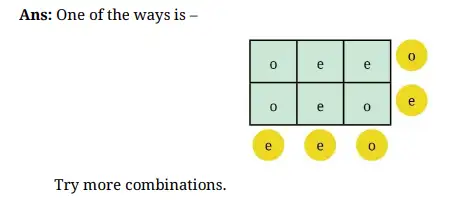
Pair the first and last numbers, then the second and next-to-last, to find the total.
What is the parity of the sum of the numbers from to ?
- Pair numbers from to ; there are pairs, each totalling .
- Calculate the total and identify its parity.
A Zero-Sum Magic Square
Magic square — A square arrangement in which each row, column and main diagonal has the same sum.
Zero-sum square
- Condition: Every row, column and main diagonal must sum to .
- Entries: The numbers need not all be ; negative numbers can be used.
Give a non-zero magic square with magic sum .
- Here is a non-zero square.
- Check a row, a column and a diagonal; each totals zero.
Virahāṅka Sequence and Staircase Paths
Virahāṅka sequence — A sequence in which each term after the first two is the sum of the two preceding terms.
Starting with , add the previous two terms to continue; subtract to work backwards.
Sequence values and parity
- Beginning: .
- Parity pattern: Odd, even, odd, then the pattern repeats every three terms.
- Twentieth term: Since , the th term has the parity of the second term in the pattern: even.
Staircase path — A way to climb the staircase by taking the allowed step sizes, here either or steps at a time.
A path to stair ends with either a -step from or a -step from .
| Number of two-step moves | Number of paths |
|---|---|
| 0 | 1 |
| 1 | 7 |
| 2 | 15 |
| 3 | 10 |
| 4 | 1 |
| Total | 34 |
How many ways can someone climb an -step staircase using - or -step moves?
- Build the path counts using the recurrence.
- Add the counts for stairs and to get the count for stair .
Algebraic Forms of Odd and Even Numbers
General forms — For an integer , even numbers have the form and odd numbers have the form (equivalently, ).
| Statement | Verdict | Reason |
|---|---|---|
| is always odd. | True | , an odd form. |
| All even numbers are . | False | For example, cannot equal for any integer . |
| Both and describe all odd numbers. | False for positive whole-number variables | misses when is positive; if variables may be any integers, both forms describe all odd integers. |
| gives both even and odd numbers. | False | For integer , is always odd. |
Testing a claimed number form
- Assume the variable is an integer, using the domain stated in the question.
- Rewrite the expression in the standard even or odd form.
- To disprove an “all numbers” claim, test whether a particular number can be produced.
Show that is odd for every integer .
- Rewrite the expression using the standard odd form.
- Since is an integer, the expression is odd for every integer .
Solve the cryptarithm .
The consecutive Virahāṅka terms are and . Find the next two and previous two terms.
Is a form for every even number, when is an integer?
Quick recap
- A cryptarithm assigns digits to letters; solve it by place-value columns, starting with the units.
- An odd number of odd terms sums to odd; an even number of odd terms or any number of even terms sums to even.
- A zero-sum magic square has every row, column and main diagonal summing to .
- Virahāṅka terms and staircase path counts each follow a recurrence that adds the previous two terms.
- The Virahāṅka parity pattern repeats odd, even, odd; its th term is even.
- For integer variables, even numbers have form and odd numbers have form or .
Summary
Representing order without exact numbers
Relative order — Relative order shows how values in a sequence are arranged or compared, even when their exact values are unknown.
Key idea
- Compare positions: Record which value comes first, is smaller, or is larger without knowing its exact measurement.
Record a sequence order
- Assign a letter or label to each unknown value.
- Use comparison signs to show their order.
How can the order of three unknown measurements be shown?
- Three unknown measurements are ordered from smallest to largest.
- This records their order without specifying the measurements.
Parity: even and odd numbers
Parity — Parity tells whether a whole number is even or odd.
Even and odd numbers
- Even: Can be arranged in pairs with none left over; divisible by .
- Odd: Leaves one unpaired; not divisible by .
Two numbers with the same parity have an even sum; an even and an odd number have an odd sum. A product with an even factor is even, while the product of two odd numbers is odd.
Here is an integer.
Check parity
- For a whole number, check its remainder when divided by .
- Remainder means even; remainder means odd.
Is even or odd?
- Divide the number by and find the remainder.
- The remainder is , so the number is odd.
Grid sums and magic squares
Grid-sum check — A grid-sum check compares the totals of the required row sums and column sums to test whether a filling is possible.
Key ideas
- Necessary check: The grand total of the row sums must equal the grand total of the column sums.
- Impossible grid: If the two grand totals differ, no filling can satisfy all the stated sums.
- Magic square: A number grid in which every row, every column, and both diagonals have the same sum.
A valid grid must satisfy this equality.
Test whether grid sums are possible
- Add all the required row sums.
- Add all the required column sums.
- If the totals differ, the grid is impossible; if they agree, the check alone does not guarantee a solution.
Can a grid have row sums and column sums ?
- Add the row sums.
- Add the column sums.
- Since the grand totals differ, the grid cannot be filled as required.
Virahāṅka numbers
Virahāṅka sequence — The Virahāṅka sequence is a number sequence in which each term after the first two is the sum of the two terms before it.
Key facts
- Sequence:
- Arts connection: The sequence was first discovered through the Arts.
The starting values are and .
Find a later Virahāṅka term
- Take the two most recent terms.
- Add them to get the next term.
Find the term after in the Virahāṅka sequence.
- Add the two terms immediately before the next term.
- Continue the sequence using this rule.
Cryptarithms
Cryptarithm — A cryptarithm is an arithmetic puzzle in which letters replace digits.
Key idea
- Goal: Find digit values for the letters that make the arithmetic statement correct.
- Check: Substitute the digits back and verify the calculation.
Solve a simple cryptarithm
- Choose possible digits for the letters.
- Substitute the digits and check the arithmetic.
Give one digit assignment that makes true.
- Assign digits to the letters.
- Substitute and verify the statement.
Is the sum of an odd number and an even number odd or even?
Find the next term:
- A valid grid's row and column grand totals must agree.
- A magic square has equal sums in every row, column, and both diagonals.
- Virahāṅka numbers follow the two-previous-terms addition rule.
Quick recap
- Relative order can be recorded without knowing exact values.
- Even numbers pair completely; odd numbers leave one unpaired.
- Same-parity numbers have an even sum; unlike parities have an odd sum.
- A grid is impossible if its row and column grand totals do not match.
- A magic square has equal sums in every row, column, and both diagonals.
- Virahāṅka numbers were first discovered through the Arts; each new term adds the previous two.
- Cryptarithms replace digits with letters that must satisfy an arithmetic statement.
Formula sheet
Mathematics — ALL CHAPTERS
1
Large Numbers Around Us
2
Arithmetic Expressions
3
A Peek Beyond the Point
4
Expressions using Letter-Numbers
5
Parallel and Intersecting Lines
6
Number Play
7
A Tale of Three Intersecting Lines
8
Working with Fractions
1
Geometric Twins
2
Operations with Integers
3
Finding Common Ground
4
Another Peek Beyond the Point
5
Connecting the Dots
6
Constructions and Tilings
7
Finding the Unknown