Class 7 . Mathematics . Ganita Prakash Part I . Parallel and Intersecting Lines
Chapter 5: Parallel and Intersecting Lines
Ch 5
Mathematics
Class 7
Across the Line
Intersecting Lines and Their Angles
- Intersection: Two straight lines on a plane meet at a single point when they intersect.
- Angles formed: The intersecting lines create four angles around their point of intersection.
Linear Pairs and Vertically Opposite Angles
When two lines intersect, vertically opposite angles are equal. For instance, since and , it follows that . This reasoning is a proof.
Use these relationships to find unknown angles.
Finding the four angles
- Identify a given angle and the angle adjacent to it.
- Subtract the given angle from 180° to find its adjacent angle.
- Use equality of vertically opposite angles to find the remaining two.
Two intersecting lines form angles , , , and in order. If , find , , and .
- Two lines intersect. If one angle is 120°, its adjacent angle forms a linear pair with it.
- Find the adjacent angle.
- The opposite angle equals the given angle.
- The remaining angle is opposite the 60° angle.
Do not expect measurements from a drawing to be perfectly exact: protractor errors and line thickness can affect them. Use geometric reasoning; an ideal straight angle is exactly .
Two lines intersect. One angle is . Find its adjacent angle and its vertically opposite angle.
Two adjacent angles formed by intersecting lines are and . Find and both angles.
Quick recap
- Intersecting lines meet at one point and form four angles.
- Adjacent angles forming a straight line are a linear pair and sum to .
- Vertically opposite angles are equal.
- Use a linear pair to find an adjacent angle, then equality to find its opposite.
- Reason from ideal geometric properties rather than relying only on measurements.
Perpendicular Lines
Perpendicular Lines
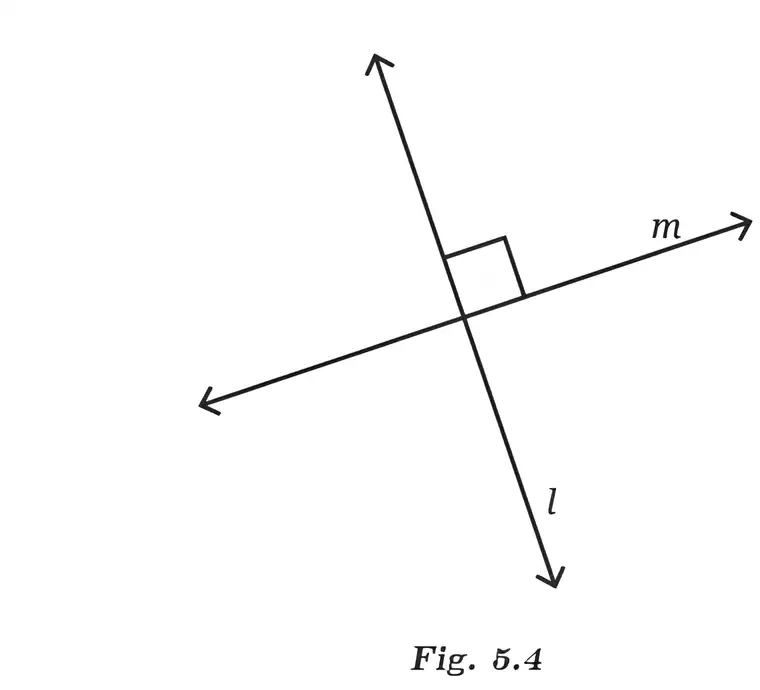
If two intersecting lines form four equal angles, each angle is a right angle because the four angles around a point total .
Use when four angles around an intersection are equal.
Check whether lines are perpendicular
- Locate the angle where the two lines meet.
- Check whether the angle measures a right angle.
- If it does, the lines are perpendicular.
Two intersecting lines form four equal angles. Find each angle and state whether the lines are perpendicular.
- Two intersecting lines form four equal angles. Find each angle and state whether the lines are perpendicular.
- The four angles around the intersection total a full turn.
- Divide by four to find each angle.
One angle formed by two intersecting lines is . Are the lines perpendicular?
Four equal angles are formed where two lines intersect. What is the measure of each angle, and are the lines perpendicular?
Quick recap
- Perpendicular lines are intersecting lines that meet at right angles.
- A right angle measures .
- Four equal angles around an intersection are each .
- If one angle formed by intersecting lines is , the lines are perpendicular.
Between Lines
When Line Segments Meet
- Meeting: Line segments can meet at a common point, such as at an endpoint.
- Crossing: Segments may also cross at a point between their endpoints.
- Describing the meeting: Identify the meeting point and, where relevant, state whether it is an endpoint or midpoint and give the angle measure.
Parallel Lines

Identifying Parallel Pairs
Which pairs of lines appear parallel in the dot-grid figure?
- In the dot-grid figure, identify the pairs stated to be parallel.
- Group the matching labels as shown in the figure.
Two coplanar lines do not meet even when extended. What is their relationship?
Segments and do not meet as drawn, but their supporting lines cross at point . What can you say?
Quick recap
- Line segments meet if they share a point, either at an endpoint or in their interiors.
- Intersecting lines have a common point.
- Parallel lines lie in the same plane and never meet, however far extended.
- A pair of segments may not meet as drawn, even when their extended lines intersect.
- On a dot grid, parallel pairs may run horizontally, vertically, or slantingly.
Parallel and Perpendicular Lines in Paper Folding
Line Relationships in Paper Folding and Folding Patterns.
Parallel lines — Lines in the same plane that stay the same distance apart and never meet.
Perpendicular lines — Lines that intersect to form a right angle of .
Relationships on a square sheet
- Opposite edges: Opposite edges of a square sheet are parallel.
- Adjacent edges: Adjacent edges meet at right angles, so they are perpendicular.
- Horizontal fold: The fold line is parallel to the horizontal edges and perpendicular to the vertical sides.
- Vertical fold: A vertical fold line is perpendicular to horizontal fold lines.
- Diagonal fold: A fold can create a line parallel to a diagonal.
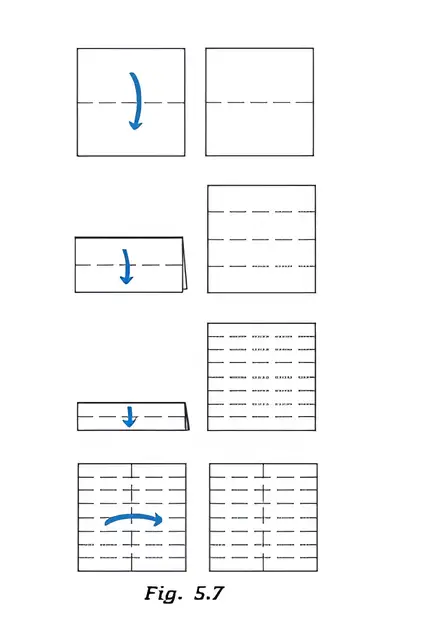
Each additional horizontal halving fold creates a pattern of parallel edges and crease lines. After folds, the total number of parallel lines is .
Use for successive folds that halve the sheet horizontally.
| Horizontal folds | Parallel lines |
|---|---|
Count lines after repeated halving folds
- Let be the number of successive folds.
- Substitute into the line-count rule.
- Evaluate to find the number of parallel lines.
How many parallel lines are formed after three successive horizontal folds?
- There are three successive horizontal folds, so use .
- Substitute into the rule.
- Evaluate the expression.
More Folded-Line Relationships
Creased lines and parallel pairs
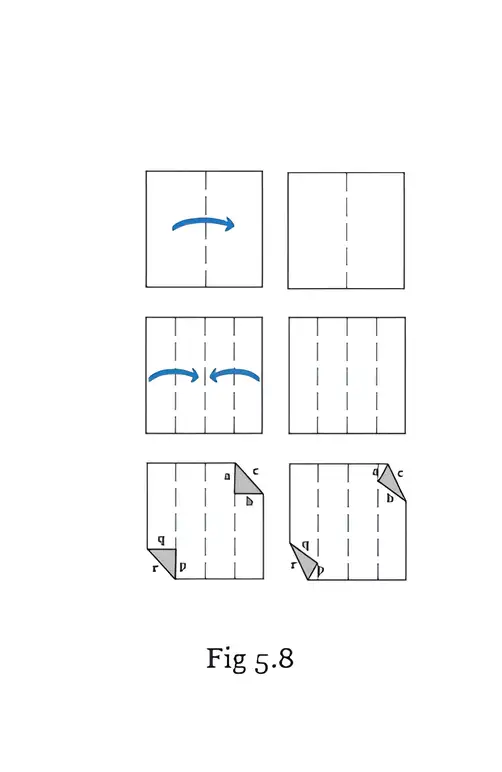
- Folded triangles: The lines , , and are respectively parallel to , , and .
- Reason for and : They lie along parallel lines.
- Reason for and : Both are perpendicular to the same parallel directions, so they are parallel to each other.
- Reason for and : The triangular folds create lines parallel to the same diagonal.
Notation and Identifying Line Relationships
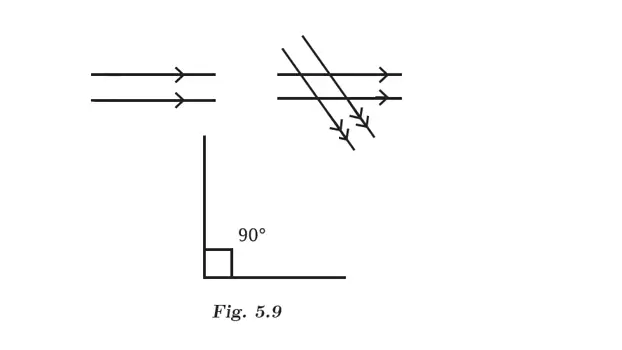
Matching arrow marks show sets of parallel lines; use different numbers of arrow marks for different sets. A small square at an intersection marks a right angle.
The notation states that line is parallel to line .
The notation states that line is perpendicular to line .
Recognise parallel and perpendicular lines
- For perpendicular lines, check whether they meet at a right angle.
- For parallel lines, check whether the distance between them stays constant.
- On a grid, horizontal and vertical lines meet at right angles; lines in the same direction are parallel.
Drawing parallel lines on dot paper
- Direction: Match the direction of the given segment.
- Spacing: Keep the new line the same distance from the original along its length.
- Endpoints: Choose dots as endpoints; the parallel segments may have different lengths.
Do not decide that lines are parallel just because they look parallel or point in the same direction; check that their separation remains constant.
A square sheet is folded horizontally twice, with each fold halving the sheet. How many parallel lines are in the pattern?
Two lines are both perpendicular to the same line. What is their relationship to each other?
How can you check whether two lines on a dot grid are parallel?
Transversals
Transversal — A transversal is a line that intersects two or more other lines; it can help determine whether those lines are parallel.
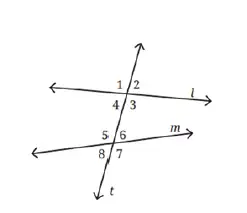
Quick recap
- Opposite edges of a square are parallel; adjacent edges are perpendicular.
- Horizontal folds are parallel to horizontal edges and perpendicular to vertical sides.
- After successive halving folds, the line pattern contains parallel lines.
- Matching arrow marks indicate parallel sets; a square mark indicates a right angle.
- Parallel lines remain equally spaced, while perpendicular lines meet at .
- A transversal intersects two or more lines and can be used to investigate whether they are parallel.
Transversals
A transversal and the angles it forms
- Transversal: A line that intersects two other lines is called a transversal.
- Angles formed: A transversal crossing two lines forms eight angles, four at each intersection.
- Distinct measures: There can be at most four distinct angle measures, since vertically opposite angles at each intersection are equal.
Quick recap
- A transversal intersects two different lines.
- Crossing two lines with a transversal forms eight angles.
- Vertically opposite angles are equal.
- The eight angles can have at most four distinct measures.
Corresponding Angles
Identifying Corresponding Angles
Corresponding angles — Angles in the same relative position at the two intersections made by a transversal are corresponding angles.
Pairs in the standard numbering
- At the two intersections, corresponding angles occupy matching positions.
- The pairs are and , and , and , and and .
Corresponding Angles and Parallel Lines
If a transversal cuts two parallel lines, each pair of corresponding angles is equal.
If a pair of corresponding angles formed by a transversal are equal, the two lines are parallel.
Use a corresponding-angle pair to test whether the lines are parallel.
Key implication
- Parallel lines give equal corresponding angles.
- Equal corresponding angles show that the lines are parallel.
- Non-parallel lines cannot form equal corresponding angles with the same transversal.
Using corresponding angles to test lines
- Identify the transversal and the two intersections.
- Select angles in the same relative position.
- Compare their measures: equal angles mean the lines are parallel.
A transversal forms corresponding angles measuring and . Are the lines parallel?
- A transversal forms corresponding angles measuring 68° and 68°. Decide whether the two lines are parallel.
- Compare the corresponding angles; their measures are equal.
- By the converse property, the two lines are parallel.
Do not conclude that lines are parallel just because some two angles are equal; they must be a corresponding pair.
Lines and are parallel. One corresponding angle is . Find the other angle in the pair.
A transversal forms corresponding angles of and . Are the lines parallel?
Quick recap
- Corresponding angles are in matching positions at the two intersections of a transversal.
- The standard pairs are with , with , with , and with .
- Parallel lines cut by a transversal have equal corresponding angles.
- Equal corresponding angles imply that the two lines are parallel.
- For the parallel-line test, make sure the equal angles are a corresponding pair.
Drawing Parallel Lines
Drawing Parallel Lines with a Ruler and Set Square
- Set up: Draw a line with a ruler and place one side of a set square along it.
- Draw perpendiculars: Use the set square to draw two lines perpendicular to the given line; each makes a right angle with it.
- Why they are parallel: The given line is a transversal, and the equal corresponding right angles show that the two new lines are parallel.
- Through a point: Hold a ruler against the set square and slide the set square along the ruler until its edge reaches the required point; draw the parallel line along that edge.
Quick recap
- A set square can be slid along a fixed ruler to draw lines in the same direction.
- Equal corresponding angles made by a transversal show that two lines are parallel.
- Two lines perpendicular to the same line are parallel.
- Paper folding can construct a line through a point parallel to a given line.
Alternate Angles Part-1
Alternate Angles
When a transversal intersects two parallel lines, alternate angles are equal. This follows because corresponding angles are equal and vertically opposite angles are equal.
Use this when a transversal cuts a pair of parallel lines.
Find an alternate angle
- Find the angle corresponding to the given angle.
- Use the equality of vertically opposite angles to find the alternate angle.
If , find its alternate angle .
- The corresponding angle equals the given angle.
- The alternate angle is vertically opposite to that corresponding angle.
- Therefore, the alternate angle is also .
Finding All Angles Made by a Transversal
For the numbered angles shown, one group of four angles is equal, and the other group is its supplement.
Find the remaining angles
- Use corresponding angles to transfer the given measure to the other intersection.
- Use vertically opposite angles to find the opposite angles.
- Subtract the given angle from to find an adjacent angle.
Parallel lines and are cut by a transversal. If , find the other seven angles.
- The corresponding angle to is equal to it.
- Use vertical opposite and corresponding angle relationships to find the other equal angles.
- Each angle adjacent to a angle is its supplement.
- The four remaining angles are each .
Using Angles to Test Whether Lines Are Parallel
Parallel lines have equal corresponding angles. Therefore, unequal corresponding angles show that the lines are not parallel.
Check whether two lines are parallel
- Use the linear-pair rule to find the angle corresponding to the other given angle.
- Compare the two corresponding angles.
- If they are unequal, the lines are not parallel.
If and , are lines and parallel?
- Since and form a linear pair, find .
- Compare with its corresponding angle .
- The corresponding angles are unequal, so the lines are not parallel.
Interior Angles on the Same Side of a Transversal
When a transversal cuts two parallel lines, the interior angles on the same side of the transversal are supplementary.
Use this relationship when the two lines are parallel.
Find a same-side interior angle
- Identify the two interior angles on the same side of the transversal.
- Subtract the known angle from .
Parallel lines and are cut by a transversal. If , find .
- Use the linear-pair rule to find .
- Since the lines are parallel, and are corresponding angles.
- The same-side interior angles are supplementary.
Two parallel lines are cut by a transversal. If one angle is , what is its alternate angle?
A pair of corresponding angles measures and . Can the lines be parallel?
Two parallel lines are cut by a transversal. If one same-side interior angle is , find the other.
Quick recap
- Alternate angles are equal when a transversal cuts parallel lines.
- Corresponding angles and vertically opposite angles are equal.
- Angles in a linear pair add to .
- Unequal corresponding angles show that two lines are not parallel.
- Same-side interior angles between parallel lines add to .
Alternate Angles Part-2
Angle relationships in parallel lines
If a transversal crosses parallel lines, alternate interior angles are equal, corresponding angles are equal, and same-side interior angles are supplementary.
Use these relationships for a transversal crossing parallel lines.
Chasing angles
- Identify the parallel lines and the transversal.
- Classify the given and unknown angles as alternate, corresponding, or same-side interior angles.
- Use equal angles or a supplementary sum of .
- If an angle is split into adjacent parts, add or subtract the parts.
Finding angles in a quadrilateral
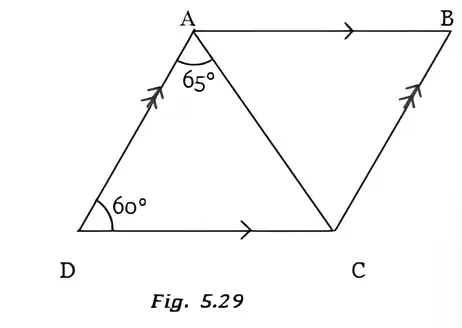
Find , and .
- Given , , and . Find , and .
- Since , the same-side interior angles along transversal add to .
- Find the whole angle at .
- Subtract the given part of the angle at .
- Using , the same-side interior angles along transversal add to .
- Using again, the same-side interior angles along transversal add to .
Applying the angle rules
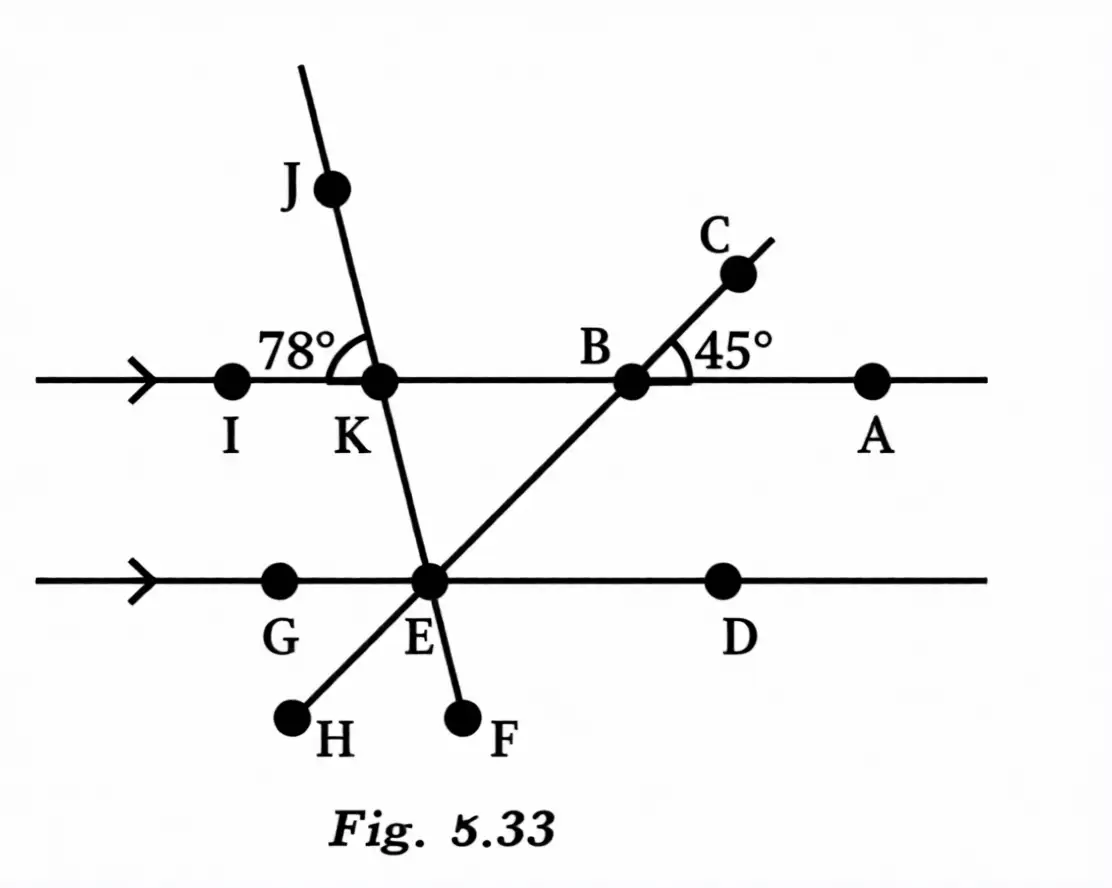
In Fig. 5.33, and . Find , and .
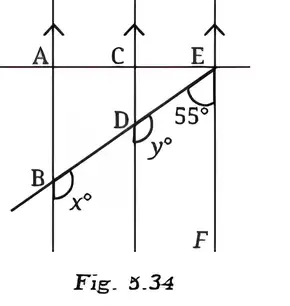
In Fig. 5.34, , , and . Find and .
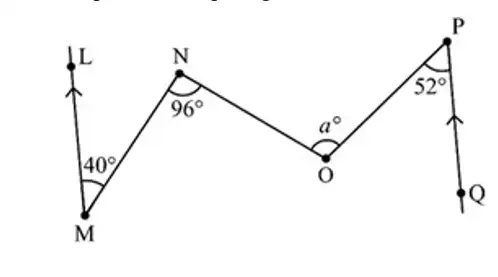
What is in Fig. 5.35?
Do not confuse the angle pairs: alternate interior angles equal alternate interior angles, and corresponding angles equal corresponding angles. Same-side interior angles add to ; these different angle types are not generally equal to one another.
Quick recap
- With parallel lines, alternate interior angles are equal.
- Corresponding angles are equal when the lines are parallel.
- Same-side interior angles add to .
- Adjacent parts of an angle add up to the whole angle.
- Combine angle relationships to find unknown angles in quadrilaterals and zigzag diagrams.
Parallel Illusions
When Parallel Lines Look as if They Meet
- Visual appearance: Surrounding patterns or perspective can make parallel lines appear to converge or look non-parallel.
- Definition: Parallel lines lie in the same plane and never meet, however far they are extended.
- How to check: Judge parallelism by the lines’ direction and equal separation, not by an illusion in the surrounding design.
Quick recap
- Parallel lines in one plane never intersect.
- Patterns can create the illusion that parallel lines converge.
- An apparent meeting in a picture does not by itself establish that lines intersect.
- Distinguish what the pattern seems to show from the geometric relationship between the lines.
Summary
Intersecting and Perpendicular Lines
Intersecting lines — Two lines that cross form four angles at their point of intersection.
Vertically opposite angles are equal. Each adjacent linear pair adds up to .
Perpendicular lines — Intersecting lines are perpendicular when they meet at right angles; all four angles are .
Parallel Lines and Transversals
Parallel lines — Lines in the same plane that never meet are parallel.
Transversal — A line that intersects two other lines is a transversal; it forms two sets of four angles.
Angle pairs made by a transversal
- Corresponding angles occupy matching positions at the two intersections.
- Alternate angles lie on opposite sides of the transversal.
- Interior angles on the same side lie between the two lines and on the same side of the transversal.
When a transversal crosses parallel lines, corresponding angles and alternate angles are equal; interior angles on the same side add up to . Conversely, equal corresponding angles show that the two lines are parallel.
For parallel lines, corresponding and alternate angle pairs are equal; same-side interior angles are supplementary. The paired angles are represented by the variables below.
Finding an unknown angle
- Identify the angle relationship from the positions of the angles.
- For vertically opposite, corresponding or alternate angles, use equality.
- For a linear pair or same-side interior angles, subtract the given angle from .
Two parallel lines are crossed by a transversal. One interior angle is ; find its alternate interior angle and its same-side interior angle.
- Alternate interior angles are equal.
- Same-side interior angles add up to .
Two intersecting lines form an angle of . Find its vertically opposite angle and either adjacent angle.
A transversal makes a pair of corresponding angles of . What can you conclude about the two lines?
- Vertically opposite angles are equal; a linear pair sums to .
- For parallel lines, corresponding and alternate angles are equal.
- Same-side interior angles sum to .
Quick recap
- Intersecting lines form four angles; vertically opposite angles are equal.
- Adjacent angles in a linear pair add to .
- Perpendicular lines meet at four right angles.
- Parallel lines in the same plane never meet; a transversal intersects two lines.
- For parallel lines, corresponding and alternate angles are equal.
- Same-side interior angles add up to ; equal corresponding angles imply parallel lines.
Formula sheet
Mathematics — ALL CHAPTERS
1
Large Numbers Around Us
2
Arithmetic Expressions
3
A Peek Beyond the Point
4
Expressions using Letter-Numbers
5
Parallel and Intersecting Lines
6
Number Play
7
A Tale of Three Intersecting Lines
8
Working with Fractions
1
Geometric Twins
2
Operations with Integers
3
Finding Common Ground
4
Another Peek Beyond the Point
5
Connecting the Dots
6
Constructions and Tilings
7
Finding the Unknown