Class 7 . Mathematics . Ganita Prakash Part I . Expressions Using Letter Numbers
Chapter 4: Expressions using Letter-Numbers
Ch 4
Mathematics
Class 7
The Notion of Letter-Numbers Part-1
Letter-Numbers and Algebraic Expressions
Formula — A formula is a concise way to express a general mathematical relation using letter-numbers and algebraic expressions.
Age Relations
Age relation — When Shabnam is years older than Aftab, her age is Aftab’s age plus .
Use these expressions to calculate either person’s age when the other age is known.
Find an age using a letter-expression
- Choose the letter that represents the known age.
- Substitute that value in the expression for the other age.
- Calculate the result and include the unit.
If Aftab is years old, how old is Shabnam?
- Use the relation for Shabnam’s age.
- Substitute Aftab’s age, .
- Add to find Shabnam’s age.
Matchstick Patterns
Matchstick expression — A matchstick expression gives the number of sticks needed for any number of repeated shapes.
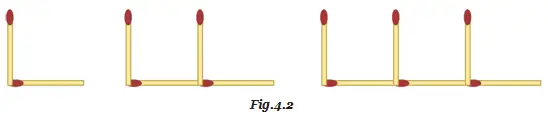
Use when each L-shape needs matchsticks.
Find the matchstick count
- Let be the number of L-shapes.
- Multiply by the matchsticks in each L.
- Substitute the given number of L-shapes.
How many matchsticks are needed to make L-shapes?
- Use the expression for the matchstick count.
- Substitute .
- Multiply to get the count.
Cost Expressions
Total-cost expression — A total-cost expression adds the cost of each item, found by multiplying its quantity by its price per unit.
Use when is the number of coconuts and is the kilograms of jaggery.
Calculate a total cost
- Identify the quantities of each item.
- Substitute them into the total-cost expression.
- Calculate both costs, then add them.
Find the total cost of coconuts and kg of jaggery.
- Use the total-cost expression.
- Substitute and .
- Calculate each cost and add.
Quick cost checks
- 10 coconuts and 5 kg jaggery: , so the total is Rs. .
- 8 coconuts and 9 kg jaggery: , so the total is Rs. .
Perimeter of a Square
Perimeter — The perimeter is the total length around the boundary of a shape.
Use when is the length of one side of the square.
Find a square’s perimeter
- Represent the side length by .
- Substitute the given side length into the formula.
- Multiply and state the perimeter in the correct unit.
Find the perimeter of a square with side length cm.
- Use the square perimeter formula.
- Substitute the side length cm.
- Multiply and keep the length unit.
If Shabnam is years old, find Aftab’s age using the letter-expression.
How many matchsticks are needed for L-shapes?
Find the perimeter of a square with side length cm.
Quick recap
- A letter-number represents a number, and an expression containing letters is an algebraic expression.
- Replace a letter with its known value to evaluate an expression.
- A formula concisely expresses a general mathematical relation using letter-numbers and algebraic expressions.
- Shabnam’s age is ; Aftab’s age is .
- For L-shapes using two matchsticks each, the total is .
- Coconut and jaggery costs combine as .
- A square with side length has perimeter .
The Notion of Letter-Numbers Part-2
Perimeters of Equal-Sided Shapes
For a polygon with equal sides, each of length , the perimeter is times .
| Shape | Formula |
|---|---|
| Equal-sided triangle | |
| Regular pentagon | |
| Regular hexagon |
Find the Perimeter
- Count the equal sides.
- Multiply the number of sides by the length of one side.
Write a formula for the perimeter of a regular hexagon with side length .
- A regular hexagon has six equal sides of length .
Expressions for Combined Quantities
Letter-number expression — An expression uses letters, numbers and operation signs to represent a quantity, including an unknown or changing amount.
Add separate amounts to find a combined total; multiply a quantity by its per-item value.
Use for the length of the added pipe; use , and for the counts of Rs. 100, Rs. 20 and Rs. 5 notes.
Write a Combined-Amount Expression
- Identify each quantity and its value per item, if applicable.
- Multiply each count by its value, then add the amounts.
What is the total value of three Rs. 100 notes, five Rs. 20 notes and six Rs. 5 notes?
- Find the value of three Rs. 100 notes, five Rs. 20 notes and six Rs. 5 notes.
- Multiply each count by its note value and add.
| Rs. 100 notes | Rs. 20 notes | Rs. 5 notes | Expression and total (Rs.) |
|---|---|---|---|
Fixed Time and Per-Unit Time
Fixed-plus-rate expression — It adds a one-time fixed amount to an amount that depends on the number of units.
For a fixed starting time and a rate of seconds per kg, grinding kg takes seconds.
Model Fixed and Changing Time
- Write the fixed time once.
- Multiply the time per unit by the number of units.
- Add the fixed and changing times.
Write an expression for the total time to grind kg.
- The mill takes seconds to start and seconds per kg to grind kg.
Do not multiply the starting time by the quantity: the mill starts only once, so use , not .
Translating Words into Expressions
Algebraic expression — An algebraic expression represents a quantity using numbers, operation signs and letters.
Subtract the stated amount from the quantity named after “than”; the order of subtraction matters.
| Phrase | Expression (let the number be ) |
|---|---|
| more than a number | |
| less than a number | |
| less than times a number | |
| less than times a number |
Translate a Verbal Phrase
- Choose a letter for the unknown number.
- Translate the multiplication phrase first.
- Subtract the stated amount from that quantity.
Write an expression for less than times a number.
- “ less than times a number” means subtract from .
“ less than a number” is , not : subtract from the number.
Describing Situations with Expressions
Situation model — A situation model explains what each term in an algebraic expression represents in a real context.
A product can represent a repeated quantity or a per-item cost; addition combines totals and subtraction represents a deduction.
| Expression | Situation |
|---|---|
| A pen costs Rs. and a notebook costs Rs. . Abha buys pens and notebooks; this is the total cost. | |
| A factory makes chairs daily for days. If chairs break daily for days, this represents the remaining good chairs. |
Multiply each item's price by its quantity, then add the costs.
Describe an Expression as a Situation
- Assign a quantity or value to each letter.
- Interpret each product as a repeated amount or total cost.
- Use addition or subtraction to describe how the amounts combine.
Describe a situation represented by .
- In , is the number of chairs made and is the number that break.
Date Patterns in a Calendar Grid
Calendar pattern — A calendar grid arranges dates so each row moves by one day and each column moves by one week.
Moving one column right adds ; moving one row down adds .
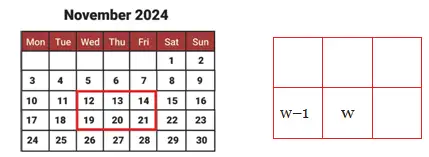
If the bottom-middle date is , the other dates follow from changes of across and between rows.
Fill a Calendar Grid
- Place the given date in the specified cell.
- Fill its row using changes of across.
- Subtract from each date to get the row above.
Write the dates in a two-row calendar grid when the bottom-middle date is .
- The bottom-middle date is . Fill the bottom row, then subtract for the row above.
A pipe of length m is joined to another pipe of length m. Write the combined length.
Write an expression for less than times a number .
In a two-row calendar grid, the bottom-middle date is . Find the top-right date.
Quick recap
- A regular polygon has equal side lengths and equal angle measures.
- For an equal-sided polygon, perimeter equals the number of sides multiplied by one side length.
- Use a letter for an unknown amount; multiply repeated quantities by their unit values and add the totals.
- A one-time starting time is added once; a per-unit time is multiplied by the number of units.
- Translate “less than” by subtracting from the quantity named after “than.”
- Calendar dates change by across a row and by down a column.
Revisiting Arithmetic Expressions
Evaluating Arithmetic Expressions
Use this order when evaluating an expression.
Evaluate using order of operations
- Perform operations inside brackets first.
- Calculate multiplication before adding or subtracting.
- Combine the remaining signed terms.
Evaluate .
- Evaluate multiplication first.
- Subtract.
Swapping and Grouping Addition Terms
For numbers , , and , and .
A subtraction can be rewritten as adding a negative term.
Simplify by regrouping
- Rewrite subtraction as addition of a negative term.
- Swap and group terms that make easy sums.
- Add the grouped results.
Evaluate .
- Rewrite subtraction as addition of a negative term.
- Regroup into convenient pairs.
- Add the pair totals.
A Negative Sign Outside Brackets
The negative sign applies to every term inside the bracket.
Evaluate an expression with a negative bracket
- Either calculate inside the bracket first, or change every sign inside the bracket.
- Combine the resulting signed terms with the number outside.
Evaluate .
- Evaluate the bracket and apply the negative sign.
- Combine the signed terms.
The Distributive Property
The multiplier applies to every term in the bracket.
Expand a product over a sum
- Multiply the outside number by each term inside the bracket.
- Add the resulting products.
Evaluate using the distributive property.
- Multiply the outside number by each term.
- Calculate and add.
Substituting Values into Algebraic Expressions
Replace the letter with its given value, then calculate.
Find an expression's value
- Replace each letter-number with its given number.
- Evaluate using the usual order of operations.
Find the value of when .
- Replace with .
- Add.
Do not swap or regroup terms in a way that changes their signs; first rewrite subtraction as addition of a negative term.
Evaluate .
Evaluate .
Evaluate .
Quick recap
- Evaluate brackets first, then multiplication, then addition and subtraction from left to right.
- Subtraction can be rewritten as addition of a negative term.
- Swap and group addition terms to make easier sums, keeping each sign attached.
- A negative sign outside brackets changes the sign of every term inside.
- The distributive property is .
- To evaluate an algebraic expression, substitute the given number for each letter-number.
Omission of the Multiplication Symbol in Algebraic Expressions
Writing Products Without the Multiplication Sign
Use this notation when a number is multiplied by a letter.
Evaluating an expression
- Replace each letter with its given value.
- Treat a number beside a letter as multiplication.
- Use brackets where needed, then calculate using the order of operations.
Find the value of when .
- Evaluate the expression when the letter has the given value.
- Substitute the value of the letter.
- Multiply, then add.
Do not treat a negative value as positive: if , then , not . Also, means multiply the entire bracket by .
| Given values and expression | Correct substitution | Correct value |
|---|---|---|
| : | ||
| : | ||
| : | ||
| : | ||
| : | — correct as stated | |
| : | ||
| : | ||
| : | ||
| : |
Write a rule for the th term of the sequence .
Find the value of when .
Find the value of when .
Quick recap
- A product such as is written as .
- The number is written before the letter in a product.
- The th term of the multiples-of- sequence is .
- To evaluate an expression, substitute the given values for its letters.
- Use brackets for negative substitutions and calculate the full expression carefully.
Simplification of Algebraic Expressions Part-1
Equivalent Expressions and Perimeter
Add the length and breadth twice, then combine like terms.
Simplify the perimeter expression for a rectangle with length and breadth .
- Write the perimeter as the sum of all four sides.
- Group the matching terms and add their coefficients.
Combining Like Terms
The distributive property allows the common letter-number part to be factored out: .
| Item | Day 1 | Day 2 | Day 3 | Total earned |
|---|---|---|---|---|
| Pencils at each | ||||
| Erasers at each |
Combine terms with the same letter-number part; unlike terms remain separate.
Simplify the pencil earnings . Find the total if .
- Factor out the common letter-number part.
- Add the coefficients.
- For , substitute to find the pencil earnings.
Area Models and Like Terms
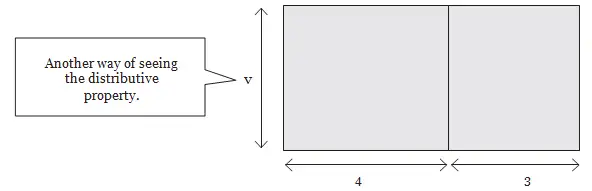
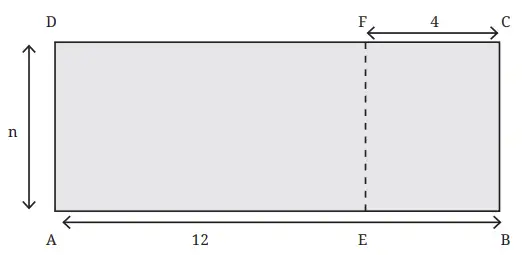
A rectangle of height is split into widths and . Write its total area as a simplified expression.
- Find the whole area using the total width.
- Add the areas of the two smaller rectangles.
Subtracting Algebraic Expressions
The minus sign applies to every term inside the bracket.
| Item | Amount paid per piece | Amount returned per piece |
|---|---|---|
| Chair | Rs. 40 | Rs. 6 |
| Table | Rs. 75 | Rs. 10 |
Find the net amount paid when renting chairs and tables, if the shop charges Rs. 40 per chair and Rs. 75 per table, then refunds Rs. 6 per chair and Rs. 10 per table.
- Write the amount paid at the start minus the amount refunded.
- Open the second bracket, changing both signs.
- Group like terms and subtract their coefficients.
Do not change only the first sign when removing a minus bracket: becomes , not .
Simplify .
Simplify the area expression .
Simplify .
Quick recap
- Equivalent expressions have the same value for every replacement of their letter-numbers.
- Combine like terms by adding or subtracting their coefficients.
- Unlike terms, such as and , cannot be combined.
- The distributive property explains why .
- A rectangle's total area can be found by adding or subtracting the areas of its parts.
- When subtracting a bracket, change the sign of every term inside it.
Simplification of Algebraic Expressions Part-2
Combining Like Terms
Like terms — Terms with the same variable part are like terms and can be combined by adding or subtracting their coefficients.
Key properties
- Combine like terms: Add or subtract coefficients, keeping the variable part unchanged; do not combine unlike terms such as and .
- Subtraction: Rewrite subtraction as addition of a negative term, then collect like terms.
- Subtracting brackets: A minus sign before a bracket changes the sign of every term inside it.
- Quiz scores: A correct answer contributes points and an incorrect answer incurs a penalty of points; no penalty means .
Combine coefficients of matching variable parts.
Simplify by collecting like terms
- Remove brackets, reversing signs if a minus sign comes before a bracket.
- Group terms with the same variable part.
- Combine coefficients and write the simplified expression.
Find Charu's individual and total scores when and , and simplify the difference from Krishita's total .
- Find Charu's score in each round for and .
- Add the three round expressions by collecting like terms.
- Evaluate Charu's total for the given values.
- Subtract Charu's total expression from Krishita's to find the difference.
- Evaluate the difference for and .
Applying the score expressions
- Possible round scores for Krishita: .
- Who scores more? The difference is ; for positive correct-answer points and a non-negative penalty, this is non-negative. For , , Krishita scores 10 more points.
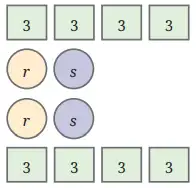
| Grouping | Expression | Simplified total |
|---|---|---|
| Add row-wise | ||
| Group like terms | ||
| Add the upper half and double |
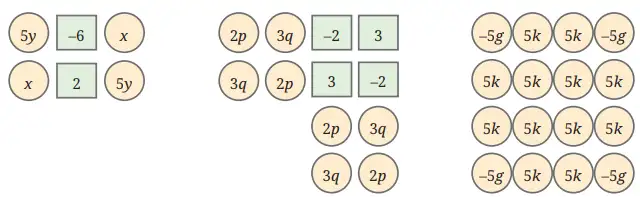
| Terms in the array | Simplified sum |
|---|---|
| Four terms, four terms, and constants | |
| Four terms and twelve terms |
Using the Distributive Property
Distributive property — Multiplication outside a bracket applies to every term inside it.
Key property
- Expand first: Multiply the outside factor by each term inside the bracket.
- Then collect: Combine any like terms formed after expansion.
Multiply the outside factor by every term in the bracket.
Expand and simplify
- Multiply the outside factor by each term inside the bracket.
- Keep each term's sign and collect like terms.
Simplify .
- Distribute across both terms in the bracket.
- Combine the like terms involving .
- Write the simplified expression.
Do not multiply only the first term: , not .
When Are Two Expressions Equal?
Equivalent expressions — Expressions are equivalent if they have the same value for every allowed value of their variable(s).
If two expressions give different values for even one input, they are not equivalent. Matching at one input alone does not prove equivalence.
Key comparisons
- Different operations: means five times , while means five more than .
- Bracket placement matters: means less than times ; means times the quantity .
- Expand to compare: , which is different from .
The expressions must agree for every input.
Check whether expressions are equivalent
- Substitute the same value into both expressions.
- If the results differ, the expressions are not equivalent.
- For a general comparison, simplify both expressions and check whether they match.
Are and equivalent? Are and equivalent?
- Test and at .
- Because the values differ, this pair is not equivalent.
- Expand and compare it with .
- The expressions differ by for every value of .
| Expression(s) | Simplified result(s) |
|---|---|
| ; ; | ; ; |
| ; | ; |
| ; | ; |
| ; | ; |
| ; | ; |
Simplify and .
Simplify and .
Find the sum of .
Quick recap
- Combine only terms with the same variable part; add or subtract their coefficients.
- A minus before a bracket reverses the signs of all terms inside it.
- Charu's round scores for , are , , and ; her total is .
- Krishita's lead expression is ; for , , it is .
- Distribute multiplication to every term in a bracket, then collect like terms.
- Equivalent expressions agree for every input; one differing input proves they are not equivalent.
- Different groupings of the same terms have the same sum, such as .
Mind the Mistake, Mend the Mistake
Checking and correcting simplifications
Simplify an expression
- Remove brackets, applying the correct signs or distributing any outside factor.
- Group terms with identical letter parts and group the constants.
- Add or subtract the coefficients and constants, then write the result without unnecessary brackets.
Simplify .
- Subtract the second bracket by reversing its signs.
- Combine the like terms.
| No. | Expression | Incorrect form | Correct simplest form | Likely error |
|---|---|---|---|---|
| 1 | Adding coefficients of unlike terms. | |||
| 2 | Correct: all terms are like terms. | |||
| 3 | Not multiplying the factor by the constant. | |||
| 4 | Not reversing both signs in the second bracket. | |||
| 5 | Not reversing the sign of . | |||
| 6 | Changing signs or combining unlike terms. | |||
| 7 | Combining coefficients with the wrong signs. | |||
| 8 | Leaving out when combining the -terms. | |||
| 9 | Distributing correctly but not combining like terms. | |||
| 10 | Factoring out a common factor is equivalent, but brackets have not been removed. | |||
| 11 | Using incorrect signs while distributing. |
Do not combine unlike terms or change signs without a minus before the brackets. For example, cannot be simplified to , and .
Terms and letter-numbers
How many terms and distinct letters are in after simplification?
- The simplified expression has one term containing a letter and one numerical constant.
- Count the two terms and the single distinct letter.
Simplify .
Simplify .
Simplify .
Quick recap
- Combine only like terms; unlike letter parts remain separate.
- A minus sign before brackets reverses the sign of every term inside.
- Multiply an outside factor by every term inside the brackets.
- Simplest form has brackets removed and like terms and constants combined.
- The number of terms need not equal the number of distinct letters.
- A numerical constant counts as a term; the source counts as one term.
Pick Patterns and Reveal Relationships
Number Machines and Algebraic Rules
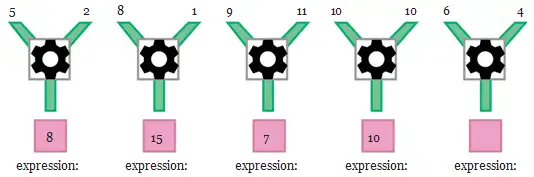
| Rule in words | Expression |
|---|---|
| Twice the first number minus the second | |
| Two subtracted from the sum of the numbers | |
| One added to the product of the numbers |
Use for the rule “two times the first number minus the second number.”
Use when two is subtracted from the sum of the inputs.
Use when one is added to the product of the inputs.
Finding a number-machine rule
- Compare several input-output examples to identify the operations that stay the same.
- State the rule in words, keeping the first and second inputs in the correct order.
- Replace the inputs by and to write the algebraic expression.
- Substitute a given pair of inputs to check that the rule produces the output.
What output does the machine give for inputs and ?
- For the rule “twice the first input minus the second,” use and .
- Substitute the inputs and calculate.
Do not confuse “two less than the sum” with “the sum minus one”: the correct expression is .
A machine adds one to the product of its inputs. Find its output for inputs and .
Describing Repeating Patterns
Every third position is Design C.
Design B is one position before the corresponding Design C.
Design A is two positions before the corresponding Design C.
When a position number is divided by , its remainder identifies the design: remainder means C, remainder means B, and remainder means A.
| Remainder after division by | Design |
|---|---|
| C | |
| A | |
| B |
Finding the design at a given position
- Divide the position number by .
- Find the remainder.
- Use the remainder rule: , , or .
Which designs appear at positions , , and ?
- Divide each position by and use its remainder.
- Match the remainders with their designs.
At what position does Design B appear for the th time?
Which design appears at position ?
Quick recap
- A number machine’s repeated operations can be written as an algebraic expression using its inputs.
- The rules “twice the first input minus the second,” “two less than the sum,” and “one more than the product” are , , and .
- The nth positions of Designs C, B, and A are , , and , respectively.
- Divide a position number by to identify its design from the remainder.
- Remainders , , and correspond to Designs C, A, and B, respectively.
Patterns in a Calendar
Diagonal Sums in a 2 × 2 Calendar Square
In every calendar square, the diagonal sums are equal because each sum simplifies to .
Use this for a calendar square whose top-left number is .
Check the diagonal sums
- Call the top-left date .
- Write the remaining dates as , , and .
- Add opposite corners and simplify both sums.
- Compare the simplified expressions.
Show that the diagonal sums are equal in the calendar square beginning with 12.
- Take a calendar square with top-left date .
- Add the numbers on each diagonal.
Sum of a Calendar Cross
The sum of the five numbers in a calendar cross is always five times its centre number.
Use this when the centre number of the cross is .
Find the total of a calendar cross
- Call the centre number .
- Write the numbers above, below, left, and right of it.
- Add the five numbers and cancel the opposite changes.
Find the total of the calendar cross centred on 15.
- For a cross with centre , the surrounding numbers are , , , and .
- Add the centre and its four neighbours.
A calendar square has top-left number . Find the four numbers and verify that its diagonal sums are equal.
A calendar cross has centre number . Find its five numbers and their total.
Do not treat the date below as more; calendar numbers increase by down a column. In a cross, pair opposite neighbours so their changes cancel.
Quick recap
- Calendar dates increase by across and down.
- A square with top-left contains , , , and .
- Both diagonal sums in that square equal .
- A calendar cross centred on contains , , , , and .
- The total of a calendar cross is always .
Matchstick Patterns Part-1
Matchstick Pattern and Its Rule
At Step , start with sticks and add sticks for each of the next steps. This is equivalent to .
Use either equivalent form to find the number of matchsticks at any step.
Find a Matchstick Count
- Substitute the step number for .
- Evaluate , or use .
How many matchsticks are needed at Step 33?
- Find the number of matchsticks at Step .
- Substitute into the rule.
| Placement | Count at Step | Pattern |
|---|---|---|
| Horizontal | ||
| Diagonal | ||
| Total | The two orientation counts add to the total. |
Do not add only times: the first step already has sticks. There are increases after Step 1.
Writing Expressions for Situations
| Situation | Expression | Reason |
|---|---|---|
| A plate of jowar roti costs Rs. 30 and a plate of pulao costs Rs. 20; quantities are and . | Cost per plate times number of plates, then add. | |
| customers buy only champak, only marigold, and buy both; one flag goes to each customer. | Each customer receives one flag; the customers are counted once. | |
| A snail climbs cm by day and slips cm at night for 10 days and nights. | Net movement per day-night cycle is . | |
| Radha cycles km daily in Week 1; daily distance rises by km each week. | km | Add seven days of cycling for each of the three weeks. |
If , the snail's net movement is negative; it slips down more than it climbs and will not reach the top by this repeated movement.
Each week's daily distance applies for seven days; the daily distances are , , and km.
Write an expression for the total cost of plates of jowar roti at Rs. 30 each and plates of pulao at Rs. 20 each.
- Let plates of jowar roti and plates of pulao be ordered.
- Multiply each price by its quantity and add the costs.
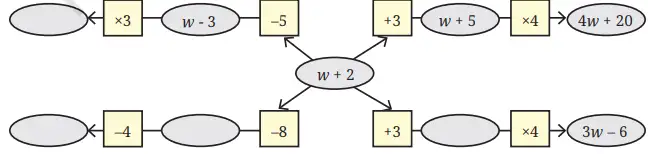
Find the matchstick counts at Steps 84 and 108.
There are customers who buy only champak, who buy only marigold, and who buy both. Each receives one flag. Write the number of flags given away.
A snail climbs cm each day and slips cm each night for 10 cycles. Write its net movement; what does imply?
Quick recap
- The matchstick counts follow ; each new step adds sticks.
- At Step , the total is .
- At Step , there are horizontal sticks and diagonal sticks.
- Build situation expressions by multiplying unit amounts by quantities and adding the results.
- For 10 snail cycles, net movement is ; if , the net movement is downward.
- Radha's total cycling distance after three weeks is km.
Matchstick Patterns Part-2
Writing Expressions for Repeated Journeys
Use when each of four equal journey sections takes minutes and there are three two-minute stops.
If the time between consecutive stations is minutes, how long is the journey?
- Substitute into the journey-time expression.
Simplifying, Adding and Subtracting Expressions
Only like terms can be combined. Use the distributive property to remove brackets, then combine coefficients and constants.
Simplify or combine expressions
- Expand brackets using the distributive property.
- If a minus sign is before brackets, change the sign of every term inside.
- Group like terms and add or subtract their coefficients.
To subtract an expression, add its opposite and reverse all its signs.
Simplify .
- Expand the brackets.
- Combine the like terms.
Do not combine unlike terms, such as and . When removing brackets preceded by a minus sign, reverse every sign inside.
Useful results
- Addition: .
- Subtraction: .
Interpreting Expressions in Situations
- Interpret: Read each expression as a combination of quantities and operations in a real-life situation.
- Model: Identify what the letters represent, then explain how the terms combine to describe the total or change.
Rope-Folding Pattern
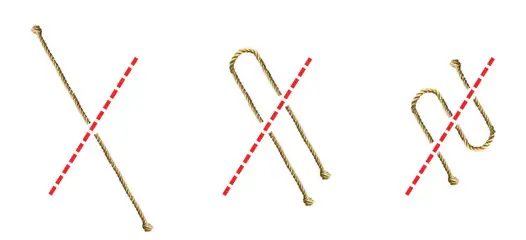
Rope-piece pattern — After folding a rope times and cutting it, the number of pieces is .
Each additional fold increases the number of pieces by one.
Example
- Ten folds: pieces.
Matchstick Squares

Matchstick pattern — A row of joined squares uses matchsticks for the first square and more for each additional square.
Use either equivalent form to find the total for joined squares.
How many matchsticks are needed to make joined squares?
- Start with sticks for the first square and add for each of the remaining squares.
Repeating Traffic-Signal Colours
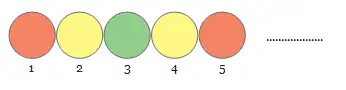
Repeating sequence — In a repeating sequence, each item returns after a fixed number of positions; this colour cycle has length .
Here is a positive integer. Red occurs first in each cycle, green third, and yellow in both even positions.
Find a colour at a given position
- Divide the position number by and find the remainder.
- Remainder means red; remainder or means yellow; remainder means green.
What colour is at position ?
- Divide by the cycle length.
- A remainder of corresponds to green.
Check the given positions
- Position : Even position, so the colour is yellow.
- Position : Even position, so the colour is yellow.
- Position : Remainder on division by , so the colour is green.
Growing Square Pattern

Square-count pattern — The pattern has squares at step and increases by squares at each new step.
Each square has vertices; the formula counts the vertices of every square, including shared vertices more than once.
Useful step values
- Step : squares.
- Step : squares.
- Step : squares.
Numbers in a Four-Column Grid
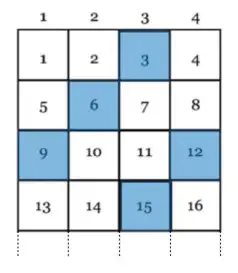
| Column | Number in row |
|---|---|
Here is the row number and is the column number, where .
Locate a number in the grid
- Divide the number by .
- If the remainder is , or , it gives the column; the row is the quotient plus .
- If the remainder is , the number is in column and its row is the quotient.
In which row and column does appear?
- Write as a multiple of plus a remainder.
- The remainder gives column ; the row is the quotient plus .
Grid patterns
- Multiples of : Every multiple of is in column .
- Even numbers: They appear in columns and ; odd numbers appear in columns and .
- Multiples of : Their columns repeat as .
Simplify .
Subtract from .
What are the row and column of in the four-column grid?
Quick recap
- Represent repeated equal amounts with multiplication, then add any fixed extra amounts.
- Simplify expressions by expanding brackets and combining like terms; reverse every sign when subtracting a bracketed expression.
- Fruit and pencil situations can be represented using expressions such as and .
- The rope-piece rule is ; joined squares use matchsticks.
- Traffic colours repeat every positions: red at , green at , and yellow at .
- The growing square pattern has squares and counted vertices at step .
- The number in row , column of the four-column grid is .
Summary
Algebraic Expressions
Translate between words and algebra
- Choose a letter-number for the quantity that can vary or is unknown.
- Translate the relationship words into operations, or read the operations in an expression as words.
Translate “three more than a number” into algebra, then describe the expression in words.
- Write “three more than a number” using for the number.
- Read the expression in ordinary language.
Quick recap
- Algebraic expressions use numbers and letter-numbers to represent quantities.
- They model patterns and relationships and can help make predictions.
- Arithmetic manipulation rules also apply when simplifying algebraic expressions.
- Expressions can be translated into ordinary language, and verbal descriptions into algebra.
- Algebra often expresses relationships more briefly than ordinary language.
Formula sheet
Mathematics — ALL CHAPTERS
1
Large Numbers Around Us
2
Arithmetic Expressions
3
A Peek Beyond the Point
4
Expressions using Letter-Numbers
5
Parallel and Intersecting Lines
6
Number Play
7
A Tale of Three Intersecting Lines
8
Working with Fractions
1
Geometric Twins
2
Operations with Integers
3
Finding Common Ground
4
Another Peek Beyond the Point
5
Connecting the Dots
6
Constructions and Tilings
7
Finding the Unknown