Class 7 . Mathematics . Ganita Prakash Part II . Another Peek Beyond the Point
Chapter 4: Another Peek Beyond the Point
Ch 4
Mathematics
Class 7
A Quick Recap of Decimals.
Decimal Place Value and Fractions
Do not omit zeros inside a decimal: , not .
Dividing by 10, 100, 1000, and More
Calculate .
- Write the dividend with a decimal point at the end.
- The divisor has three zeros, so move the decimal point three places left; add zeros as needed.
Write as a sum of place values and as a decimal.
Express in kilograms as a fraction and as a decimal.
Calculate .
Quick recap
- Decimals use place values that decrease by a factor of to the right of the decimal point.
- Fractions with denominators that are powers of can be written as decimals.
- A decimal can be expanded as a sum of tenths, hundredths, thousandths, and so on.
- Dividing by , , or shifts the decimal point left by one, two, or three places.
- Add zeros when necessary to move the decimal point the required number of places.
Decimal Multiplication
Multiplying Decimals
Here, and are the whole-number forms of the factors; and are their decimal-place counts.
Multiply two decimals
- Count the decimal places in each factor and add the counts.
- Multiply the factors as whole numbers, temporarily ignoring the decimal points.
- Place the decimal point in the product so it has decimal places.
Find .
- Multiply the numbers without their decimal points.
- Add the decimal places: has one and has two.
- Place three decimal places in the product.
Applications
- Cost: Five pens at Rs. each cost rupees.
- Distance: At km per litre, litres give km.
- Unit conversion: m is km. Walking to school and back for six days gives km.
- Area: A rectangle measuring cm by cm has area cm.
Multiplying a decimal by , , or shifts its decimal point right by , , or places respectively; add zeroes if needed.
Do not count decimal places in only one factor. Add the decimal-place counts of both factors before placing the decimal point.
Comparing the Product with Its Factors
For positive factors, use these comparisons to predict whether the product is larger or smaller.
Predict product size
- Identify whether each positive factor is less than, equal to, or greater than .
- If both factors exceed , the product exceeds both; if both are below , the product is below both.
- If one factor is below and the other above , the product lies between the two factors.
Compare with its factors.
- Both factors are greater than , so their product is greater than both.
- Multiply to confirm.
- Check the comparison.
Find .
A notebook costs Rs. wholesale and sells for Rs. . Find the profit on notebooks.
Which products are less than : , , , and ?
Quick recap
- Multiply decimal factors as whole numbers, then place the decimal point using the total decimal-place count.
- A decimal can be written as a fraction with denominator , , , and so on.
- Multiplication by , , or shifts the decimal point right by , , or places.
- Two factors greater than give a product greater than both; two positive factors below give a product below both.
- If one positive factor is below and the other above , their product lies between the factors.
- Trailing zeroes after the decimal point do not change a decimal's value.
Decimal Division
Dividing by 10, 100, 1000, and Other Powers of 10
Division by a power of 10 — Dividing a decimal by , , , and so on shifts its decimal point to the left.
- Rule: Move the decimal point left by as many places as there are zeroes in the divisor.
- Placeholders: Add zeroes when needed to show all the places shifted.
- Example: ; therefore each of equal pieces of a m ribbon is m.
- Unit conversion: .
When dividing by , shift the decimal point places to the left.
Use when the divisor is a power of .
Divide a decimal by a power of 10
- Count the zeroes in the divisor.
- Shift the decimal point left by that number of places.
- Add placeholder zeroes if the shift goes beyond the available digits.
A m ribbon is cut into equal pieces. What is the length of each piece?
- Write the decimal as a fraction, then divide by multiplying by the divisor's reciprocal.
- Multiply the fractions and write the result as a decimal.
- Each of the ten equal ribbon pieces is this long.
Converting a Fraction to a Decimal
Fraction-to-decimal conversion — Rewrite a fraction as an equivalent fraction with denominator , , , and so on, then write it as a decimal.
Multiplying the numerator and denominator by the same non-zero number keeps a fraction's value unchanged: .
Dividing a fraction by a non-zero number is the same as multiplying it by that number's reciprocal.
- Choose a denominator: Find a power of divisible by the fraction's denominator.
- Example: , so sharing m equally between two people gives m each.
- When no power of 10 works: Use place-value division to find the quotient.
Choose so that the new denominator is a power of .
Convert a fraction to a decimal
- Choose a power of 10 divisible by the denominator.
- Multiply the numerator and denominator by the same number to obtain that denominator.
- Write the fraction over 10, 100, 1000, and so on, as a decimal according to its denominator.
Share a m ribbon equally among four friends. How much does each get?
- Since , multiply both numerator and denominator by .
- Write the equivalent fraction as a decimal.
- Each of the four friends receives this length.
Division Using Place Value
Long division — Long division divides a number into equal groups by handling one place-value unit at a time.
Divide from the greatest place value to the least, regrouping any remainder into the next smaller place.
- Regrouping: Exchange one place-value unit for units of the next smaller place.
- Remainder: Regroup a remainder into the next smaller place before continuing.
- Example of the need for a general method: cannot be rewritten as an equivalent fraction with denominator , , or another power of .
The quotient is the dividend divided by the divisor.
Divide using place value
- Start with the greatest place-value unit and divide it among the groups.
- Regroup any remainder as ten units of the next smaller place.
- Continue through the place values until the division is complete.
Find using place value.
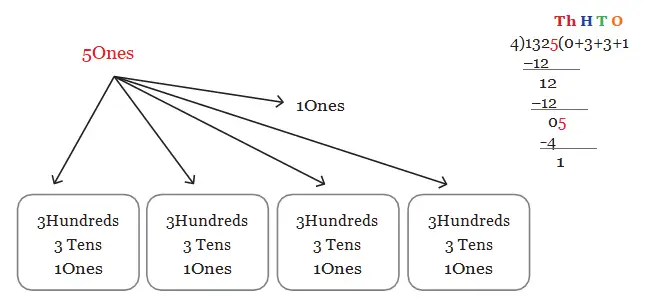
- Regroup the thousand as ten hundreds; with the original three hundreds, there are thirteen hundreds.
- Each group gets three hundreds, with one hundred left over.
- Regroup the remaining hundred as ten tens and add the two tens; each group gets three tens.
- Divide the four ones equally.
- Combine the place values to get the quotient.
Calculate .
Write as a decimal.
Find using place value.
Quick recap
- Dividing by shifts the decimal point places to the left.
- Dividing a fraction by a non-zero number means multiplying it by the number's reciprocal.
- Convert a fraction to a decimal by making its denominator a power of , when possible.
- Equivalent fractions are formed by multiplying the numerator and denominator by the same non-zero number.
- Long division uses regrouping to divide one place-value unit at a time.
Division With a Decimal Quotient
Dividing to Get a Decimal Quotient
Decimal quotient — A decimal quotient is a division result written with a decimal point when the quotient has parts smaller than one.
Place-value regrouping
- Regrouping: If a remainder remains in the ones place, exchange it for tenths; tenths can be exchanged for hundredths, then thousandths.
- Decimal point: Put the decimal point in the quotient when regrouping ones as tenths.
- Next digits: Each division after the decimal point gives the next place value: tenths, hundredths, thousandths, and so on.
- Check: Multiplying the quotient by the divisor should give the dividend.
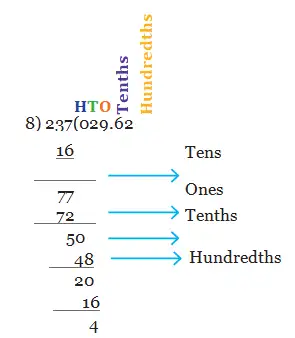
At each step, regroup the remainder into ten units of the next smaller place value: ones become tenths, tenths become hundredths, and so on.
For remainder and divisor , regroup the remainder by a factor of ; divide to get quotient digit and new remainder .
Long division with a decimal quotient
- Divide the whole-number places from left to right, bringing down each next digit.
- If a remainder remains after the ones place, put a decimal point in the quotient and regroup the remainder as tenths.
- Continue regrouping and dividing to find hundredths, thousandths, and further decimal places as needed.
- Stop when the remainder is zero, or when the required precision is reached; check by multiplication or an equivalent fraction.
Find .
- Divide the hundreds and tens; the quotient digits are 2 tens and 9 ones, with 5 ones left.
- Regroup the 5 ones as tenths and divide.
- Regroup the 2 tenths as hundredths and divide.
- Regroup the 4 hundredths as thousandths; the division ends with no remainder.
Equivalent-fraction check
- Equivalent fractions: Multiplying the numerator and denominator by the same number preserves the fraction's value.
- Decimal denominator: To write a fraction as a decimal, make its denominator , , , and so on, when possible.
Do not omit the decimal point when moving from ones to tenths. Place it in the quotient at the moment you first regroup a ones remainder as tenths.
Find and verify the result using an equivalent fraction.
Additional practice (not in the source lecture): Find .
Quick recap
- Regroup a ones remainder as tenths, then regroup each new remainder into the next smaller place value.
- Place the decimal point in the quotient when ones are regrouped as tenths.
- The remainder is multiplied by to find the next decimal digit.
- Continue through tenths, hundredths, and thousandths until the remainder is zero or the required precision is reached.
- Equivalent fractions can verify a decimal quotient by making the denominator a power of .
Division with a Decimal Dividend
Dividing a Decimal by a Whole Number
Decimal dividend — A decimal dividend is divided by a whole-number divisor using place-value division, keeping the quotient’s decimal point aligned with the dividend’s decimal point.
Divide each place in turn. Regroup any remainder into units of the next smaller place; continue by adding zeroes to the dividend if needed.
Key points
- Decimal point: Place it in the quotient directly above the decimal point in the dividend.
- Remainders: Regroup a remainder into ten units of the next smaller place before continuing.
- Zeroes: Append zeroes after the dividend’s decimal digits if more places are needed; its value does not change.
Use place-value division; check the quotient by multiplying it by the divisor.
Divide a decimal by a whole number
- Divide the whole-number part by the divisor.
- Place the quotient’s decimal point above the dividend’s decimal point.
- Continue with tenths, hundredths, and smaller places, regrouping remainders as needed.
- Append zeroes after the decimal digits if division must continue.
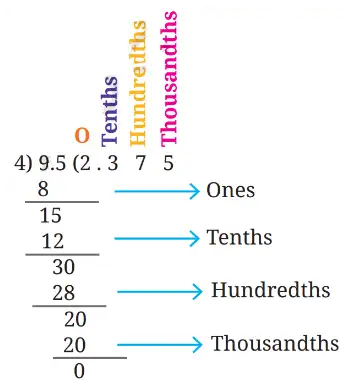
A shopkeeper divides 9.5 kg of sugar equally among 4 bags. Find the weight in each bag.
- Divide the whole-number part; the remainder becomes tenths when regrouped.
- Place the quotient’s decimal point, regroup the remainder as tenths, and divide.
- Regroup the remaining tenths as hundredths and divide.
- Regroup the remaining hundredths as thousandths and divide.
Regrouping through zero places
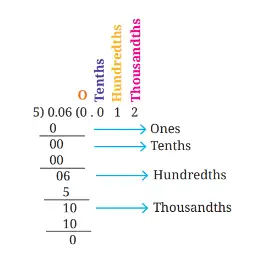
- Regrouping: In , divide the six hundredths by ; the remainder of one hundredth becomes ten thousandths.
- Result: .
Dividing by a Decimal
Decimal divisor — A decimal divisor can be made into a whole number by multiplying both the dividend and divisor by the same power of ten.
Multiplying the dividend and divisor by the same non-zero number does not change the quotient. Choose a power of ten that makes the divisor a whole number.
Choose so that is a whole number, then divide as usual.
Divide by a decimal
- Count the decimal places in the divisor.
- Multiply both numbers by the power of ten that makes the divisor whole.
- Divide the resulting numbers using ordinary long division.
Ravi travels 126 km in 2.5 hours. Find his average speed.
- Multiply both numbers by ten to make the divisor whole.
- Perform the division.
Effect of the divisor’s decimal places
- One decimal place: Multiply both numbers by ; .
- Two decimal places: Multiply both numbers by ; .
- Check: Multiply the dividend by the same amount as the divisor.
Do not shift only the divisor’s decimal point. Multiply both the dividend and divisor by the same power of ten so the quotient stays unchanged.
Find .
Find .
Find .
Quick recap
- For a decimal dividend divided by a whole number, align the quotient’s decimal point with the dividend’s.
- Regroup remainders into the next smaller place value and add trailing zeroes if needed.
- To divide by a decimal, multiply both numbers by the same power of ten.
- Once the divisor is whole, use ordinary division.
- Check division by multiplying the quotient by the divisor.
Does This Ever End?
Decimal Quotients That Do Not End
- Repeating quotients: Some divisions produce decimal digits that continue without ending, such as 10 ÷ 3 = 3.333…
- Remainders: In these divisions, regrouping leaves a remainder at every step, so the decimal expansion does not terminate.
The Cyclic Number 142857
- Repeating block: Dividing 1 by 7 gives 0.142857142857…, with the block 142857 repeating.
- Cyclic pattern: Multiplying 142857 by 1 through 6 gives the same digits in a cycled order; multiplying it by 7 gives 999999.
Dividend, Divisor, and Quotient
- Division terms: The dividend is the number being divided, the divisor is the number we divide by, and the quotient is the result.
- Effect of the divisor: A quotient can be smaller or larger than the dividend; for example, 128 ÷ 4 = 32, while 128 ÷ 0.4 = 320.
Fractions and Terminating Decimals
Calculate .
Three litres of juice are shared equally among friends. How many millilitres does each get?
Do not assume division always makes a number smaller: dividing a positive number by a divisor between and makes the quotient larger.
Quick recap
- A repeated non-zero remainder in long division causes the quotient digits to repeat.
- , and the remainder cycle is .
- The number has cyclic multiples from to and gives when multiplied by .
- For positive numbers, dividing by a divisor greater than decreases the dividend; dividing by a divisor between and increases it.
- Make a decimal divisor whole by multiplying both dividend and divisor by the same power of .
- A reduced fraction terminates as a decimal exactly when its denominator has only prime factors and .
Look Before You Leap?
Why Leap Years Are Needed
Compare the calendar total with the time Earth takes for four revolutions.
How do the calendar and orbital day counts compare over four years?
- Find the calendar days in four years when one extra day is added.
- Find the days Earth takes for four revolutions.
- The four-year calendar total is about day longer.
Refining the Leap-Year Adjustment
Exclude the century year from the years divisible by .
How many calendar days are there in years under the century-year exception?
- Subtract the century year from the years divisible by .
- The other years have days.
- Add the days in the leap years and common years.
The Gregorian Leap-Year Rule
Check whether a year is a leap year
- If the year is divisible by , it is a leap year.
- Otherwise, if it is divisible by , it is a common year.
- Otherwise, if it is divisible by , it is a leap year.
- If none of these tests apply, it is a common year.
For a span counted from year through year , count multiples of , remove century years, then add back years divisible by .
How many calendar days are there in years under the Gregorian rule?
- Count years divisible by in the first years.
- Remove the century years, then add back the years divisible by .
- There are leap years and common years.
- Calculate the calendar-day total.
- Compare with the orbital total.
Is a leap year?
Is a leap year?
How many leap years occur from year through year ?
Do not treat every year divisible by as a leap year: century years are excluded unless they are divisible by .
Quick recap
- Earth’s orbit takes about days, so a -day calendar needs adjustment.
- A leap year has days; a common year has days.
- Years divisible by are generally leap years.
- Century years are common years unless divisible by .
- In years, the Gregorian rule gives calendar days, about day short of the orbital total.
Making Yet Another Adjustment
Calendar adjustment
Comparing a calendar year with the solar year
- Solar-year value in the lecture: The supplied text states that Earth takes about days for one revolution around the Sun.
- Accumulated difference: A small mismatch between calendar days and the solar year adds up over many years.
- Comparison: For years, compare the calendar-day total under the stated leap-year rule with days.
- Adjustment: A leap-year scheme can be modified to reduce the accumulated difference; the exact calendar total requires the leap-year scheme being used.
Use the calendar total and the solar-year value stated in the lecture.
Unit price and profit
Unit price — Unit price is the cost of one unit of a product; compare it when packet sizes differ.
Profit — Profit is the total selling revenue minus the total cost.
Compare cost per unit; for profit, subtract the cost price from total revenue.
Compare packet prices
- Divide each packet price by its quantity, using the same unit for both.
- The smaller unit price is the cheaper option.
Which packet is cheaper per gram?
- Compare a g chikki packet costing Rs. with a g chips packet costing Rs. .
- Calculate the cost per gram of each packet.
- Choose the lower cost per gram.
Metric conversions and measurements
Metric conversion — Metric conversion changes a measurement from one unit to another using the relevant conversion factor.
| Measure | Conversion |
|---|---|
| Length | ; ; |
| Mass | ; |
| Volume |
Choosing the conversion operation
- To a smaller unit: Multiply by the conversion factor.
- To a larger unit: Divide by the conversion factor.
- Fit on a shelf: Divide shelf length by the thickness of one book; use the whole-number part for the number of books.
How many metres are in km?
- Convert km to metres.
- Multiply by to change kilometres to metres.
Shyamala buys kg of bananas at Rs. per kg. She sells all bananas for Rs. each. Find her profit.
Decimal positions and factor pairs
Locating decimals and making products
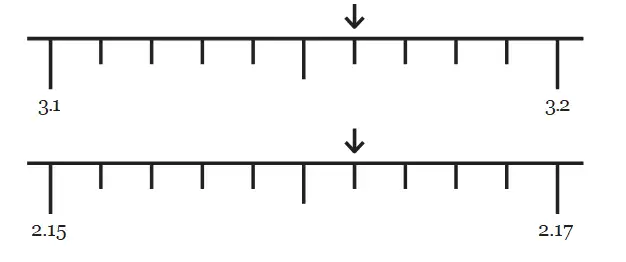
- Number line: Locate a decimal by identifying the interval between consecutive tenths or hundredths, then subdividing that interval.
- Factor pairs: A target product can be made by many pairs; check by multiplying the chosen factors.
- Digit arrangement: To maximize, minimize, or approach a target product, compare valid digit placements using place value and estimation.
Give two factor pairs with product , and two with product .
Decimal division and ordering
Multiplying the dividend and divisor by the same non-zero number does not change the quotient.
Divide decimals
- Multiply both numbers by a suitable power of so the divisor becomes a whole number.
- Divide the resulting numbers.
Calculate .
- Calculate by multiplying both numbers by .
- Use the known whole-number division.
Scaling quotients from a known division
- Given: .
- Scale equally: and .
- Scale one side differently: ; ; .
- Repeated item: The source lists twice; each occurrence equals .
| Row value | Column value | Cell value |
|---|---|---|
Convert and to decimals and find the quotients.
Ordering expressions by estimation
- Estimate first: Compare expressions by their approximate sizes before calculating exactly.
- Multiplication: Multiplying by a number between and reduces a positive number; multiplying by a number greater than increases it.
- Division: Dividing by a number greater than reduces a positive number; dividing by a number between and increases it.
Arrange in increasing order: , , , , , and .
When dividing decimals, do not move the decimal point in only one number; multiply both dividend and divisor by the same factor.
- Price comparison: Compare cost per unit, not packet prices alone.
- Conversions: Multiply to change to a smaller unit; divide to change to a larger unit.
- Decimal division: Scale both numbers equally so the divisor becomes a whole number.
Quick recap
- The supplied lecture uses days for one solar revolution and asks students to compare calendar days with that value.
- Compare packet prices using unit price; profit equals total revenue minus total cost.
- Use metric conversion factors, multiplying for smaller units and dividing for larger units.
- On number lines, locate decimals within the correct tenths or hundredths interval.
- To divide decimals, multiply dividend and divisor by the same power of .
- Estimate products and quotients to order decimal expressions efficiently.
Summary
Multiplying Decimals
Decimal multiplication — Multiply the factors as counting numbers, then place the decimal point using the total number of decimal places in both factors.
The product has as many decimal places as the total number of decimal places in the multiplier and multiplicand.
If the factors have and decimal places, their product has decimal places.
Multiply decimal factors
- Multiply the factors as counting numbers, ignoring their decimal points.
- Add the number of decimal places in the multiplier and multiplicand.
- Place that total number of decimal digits in the product, counting from the right.
How do you determine the number of decimal places in a product?
- Suppose the two factors have p and q decimal places. Multiply them as counting numbers first.
- The product must have the total number of decimal places from both factors.
If the multiplier has p decimal places and the multiplicand has q, how many decimal places will the product have?
Dividing Decimals
Decimal division — Divide decimals using place-value long division, as with counting numbers, regrouping into smaller place values when needed.
After the ones place, regroup into tenths, hundredths, thousandths, and so on. Place the decimal point in the quotient when ones are regrouped as tenths.
In some divisions, a remainder remains after each regrouping and division, so the decimal quotient never ends.
A whole can be regrouped as tenths, hundredths, or thousandths.
Divide using place value
- Divide the ones and record any remainder.
- If needed, regroup the remainder as tenths and continue dividing.
- Place the decimal point in the quotient when regrouping ones as tenths; continue with hundredths, thousandths, and further places as needed.
When is the decimal point placed in the quotient during place-value division?
What does it mean if a remainder remains after each regrouping and division?
Quick recap
- Multiply decimal factors as counting numbers first.
- The product's decimal places equal the total decimal places in both factors.
- Decimal division uses place-value long division.
- Regrouping proceeds from ones to tenths, hundredths, thousandths, and beyond.
- Place the decimal point in the quotient when ones are regrouped as tenths.
- A remainder that continues at every stage means the decimal quotient does not end.
Formula sheet
Mathematics — ALL CHAPTERS
1
Large Numbers Around Us
2
Arithmetic Expressions
3
A Peek Beyond the Point
4
Expressions using Letter-Numbers
5
Parallel and Intersecting Lines
6
Number Play
7
A Tale of Three Intersecting Lines
8
Working with Fractions
1
Geometric Twins
2
Operations with Integers
3
Finding Common Ground
4
Another Peek Beyond the Point
5
Connecting the Dots
6
Constructions and Tilings
7
Finding the Unknown