Class 7 . Mathematics . Ganita Prakash Part II . Operations with Integers
Chapter 2: Operations with Integers
Ch 2
Mathematics
Class 7
Quick Recap of Integers
Finding Two Integers from Their Sum and Difference
Use when the sum and the ordered difference (first minus second) are known.
Solve using sum and difference
- Take the given sum as and the first-minus-second difference as .
- Find the first integer using the sum plus the difference, divided by .
- Find the second integer using the sum minus the difference, divided by .
- Check that the answers give the stated sum and ordered difference.
Find two integers whose sum is and whose difference (first minus second) is .
- For sum and difference , identify and .
- Calculate the first integer.
- Calculate the second integer.
- Check both conditions.
Do not treat difference as an unordered distance: the question defines it as first integer minus second, so a negative difference means the first integer is smaller.
Integers as Directed Movements
The same rule works whether the movements are in the same or opposite directions.
Read movements on a number line
- Start at .
- Move right for a positive integer or left for a negative integer.
- Add each signed movement in order.
- The sum gives the final position.
A coin starts at . Its movements are units right and then units left. Where does it finish?
- The first strike moves units right; the second moves units left.
- Add the signed movements to find the final position.
A coin starts at and makes the movements . Find its final position.
A coin moves first by units and finishes at position . Find the second movement.
Subtraction and Additive Inverses
For integers and , subtracting is equivalent to adding its additive inverse. The additive inverse of is .
Change subtraction to addition and replace the subtracted integer with its additive inverse.
Evaluate an integer subtraction
- Keep the first integer.
- Replace subtraction with addition and change the sign of the second integer.
- Add the resulting integers, using their signs.
Evaluate .
- Change the subtraction to addition of the opposite.
- Add the integers.
Evaluate .
- Adding a negative movement means moving left; the signed sum gives the final position.
- Subtracting a negative integer becomes addition of its positive opposite.
Quick recap
- For ordered integers, difference means first minus second.
- From sum and difference , the integers are and .
- Positive movements go right and negative movements go left on a number line.
- The final position is the sum of all signed movements.
- An integer and its additive inverse add to .
- Subtracting an integer means adding its additive inverse.
Multiplication of Integers
Multiplication Using Integer Tokens
Integer multiplication — Multiplication can be modelled as repeatedly adding or removing equal groups of integer tokens.
Token Model
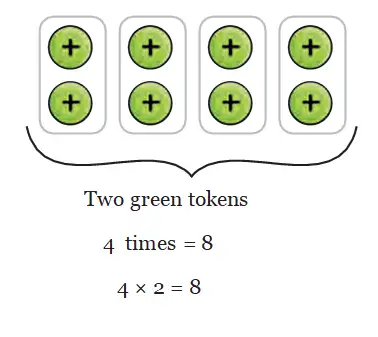
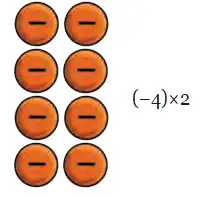
- Positive tokens: Four groups of two positive tokens represent .
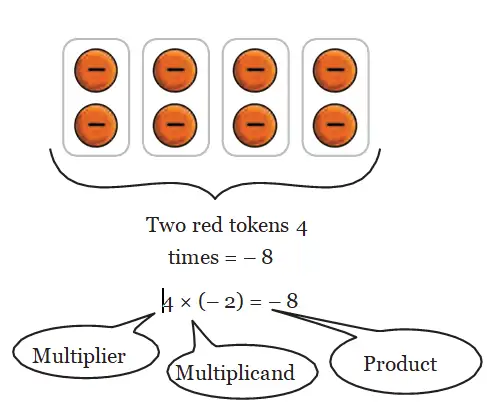
- Negative tokens: Four groups of two negative tokens represent .
- Zero pair: One positive token and one negative token together have value ; adding a zero pair does not change the bag’s value.
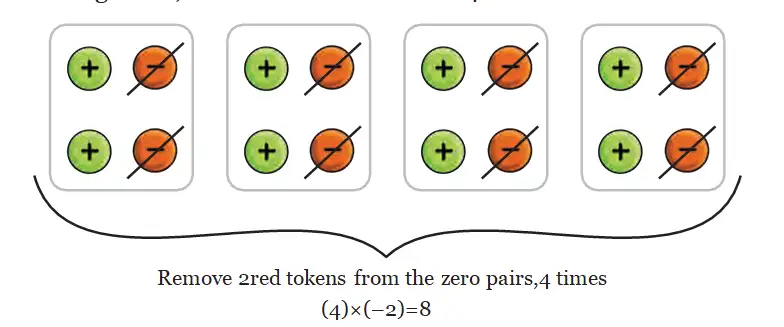
- Removal: A negative first factor is modelled by repeatedly removing the indicated tokens. Add zero pairs first when there are no tokens of the type to remove.
Removing Tokens
- Removing positives: To model , remove two positive tokens four times. Start with zero pairs so the positives are available; the remaining value is .
- Removing negatives: To model , add zero pairs and remove two negative tokens four times; eight positive tokens remain.
- Why remove positives? The second factor is , so each removal takes two positive tokens; the negative first factor indicates repeated removal.
Factors with the same sign have a positive product; factors with opposite signs have a negative product. Multiply their absolute values to find the product’s magnitude.
Use the signs of the factors for the product’s sign, and multiply their magnitudes.
Equivalent Token Representations
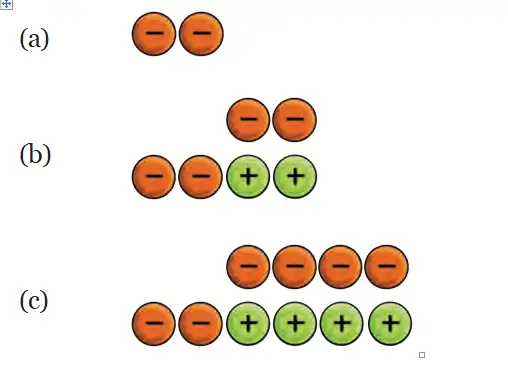
- Same value: Different token sets can represent the same integer when they differ only by zero pairs.
- Same product: Repeating any set representing four times gives , regardless of its extra zero pairs.
- Removal as addition: Removing a number is equivalent to adding its additive inverse; removing two positive tokens is equivalent to adding two negative tokens.
Multiply Two Integers
- Multiply the absolute values of the two integers.
- Give the product a positive sign for same-sign factors and a negative sign for opposite-sign factors.
Find .
- Multiply the absolute values.
- Both factors are negative, so the product is positive.
Find .
Given that , find without multiplying again.
Find using the integer multiplication rules.
Quick recap
- Repeated addition or removal of integer tokens models multiplication.
- A positive and a negative token form a zero pair, which does not change the represented value.
- Same-sign factors give a positive product; opposite-sign factors give a negative product.
- Multiply the absolute values to find the product’s magnitude.
- Different token sets can represent the same integer when extra tokens form zero pairs.
- Removing a number is equivalent to adding its additive inverse.
Patterns in Integer Multiplication
Patterns in Integer Multiplication
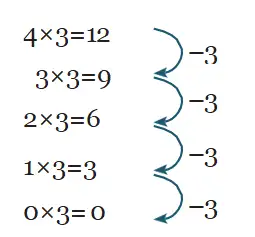
Integer multiplication pattern — When the multiplier decreases by , the product changes by the negative of the multiplicand.
For multiplicand , decreasing the multiplier by changes the product by . The pattern continues for negative multipliers.
How the product changes
- Positive multiplicand: Each unit decrease in the multiplier decreases the product by that multiplicand.
- Negative multiplicand: Each unit decrease in the multiplier increases the product by the magnitude of the multiplicand.
- Example pattern: Multiples of go down by at each step; multiples of go up by .
Extend a multiplication pattern
- Identify the multiplicand and the change in the multiplier.
- For each decrease of in the multiplier, change the product by the negative of the multiplicand.
- Continue the same change even when the multiplier reaches or passes .
Continue the multiplication patterns for multiplicands and as the multiplier decreases from to .
- With multiplicand , each multiplier decrease of lowers the product by .
- With multiplicand , each multiplier decrease of raises the product by .
Sign and Magnitude of a Product
Sign rule for integer multiplication — The product’s magnitude is the product of the factors’ magnitudes; its sign follows the signs of the factors.
Changing the signs of the factors does not change the magnitude of their product.
| Factors | Sign of product | Example |
|---|---|---|
| Both positive | Positive | |
| Both negative | Positive | |
| One positive and one negative | Negative |
Multiply integers
- Multiply the magnitudes of the factors.
- Give the product a positive sign if the factors have the same sign, and a negative sign if they have different signs.
Find .
- The factors have different signs, so the product is negative.
Brahmagupta’s Multiplication and Division Rules
- Brahmagupta: In the *Brāhmasphuṭasiddhānta* ( CE; –), he stated rules for multiplying and dividing positive and negative numbers.
- Fortune (dhana): A positive number; debt (ṛṇa) represents a negative number.
- Rule: Fortune with fortune, or debt with debt, gives fortune; fortune with debt gives debt, for both products and quotients.
Multiplicative Identity and Commutativity
Multiplicative identity — Multiplying any integer by leaves it unchanged.
These rules hold for every integer .
Swapping the multiplier and multiplicand does not change the product, whatever their signs.
Use identity and commutativity
- Multiplication by keeps the integer unchanged.
- Multiplication by gives its additive inverse.
- To reverse the order of factors, use commutativity.
Evaluate and compare with .
- Multiplying by gives the additive inverse.
- Swapping the factors keeps the product unchanged.
Using Integer Multiplication in Context
Integer Models
- Scores: Represent marks gained by positive integers and penalties by negative integers; add the signed scores.
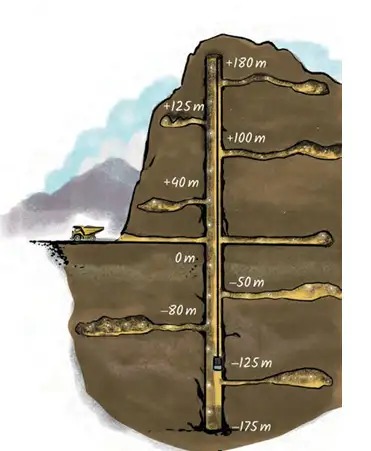
- Position: Use positive integers above ground and negative integers below ground.
- Movement: Represent direction with a signed rate; descending at metres per minute is metres per minute.
Solve integer-context problems
- Assign positive or negative signs according to gain/loss or direction.
- Multiply the signed amount or rate by the number of occurrences or time.
- Add the resulting change to the starting total or position.
An exam has questions, awarding marks per correct answer and deducting per wrong answer. Find Mala’s score for correct and wrong, and the maximum and minimum scores. Also find an elevator’s positions after descending for minutes from ground level and minutes from metres above ground, at metres per minute.
- Mala earns marks for each correct answer and loses for each wrong answer.
- If all answers are correct, the score is the maximum; if all are wrong, it is the minimum.
- From ground level, descending at metres per minute for minutes gives:
- From metres above ground, descending for minutes gives:
Find .
Find .
Find .
Quick recap
- When the multiplier decreases by , the product changes by the negative of the multiplicand.
- Same-sign factors give a positive product; different-sign factors give a negative product.
- The product’s magnitude is the product of the factors’ magnitudes.
- and for every integer .
- Integer multiplication is commutative: .
- Use signed integers for gains, penalties, and movement above or below ground.
A Magic Grid of Integers
The Magic Grid
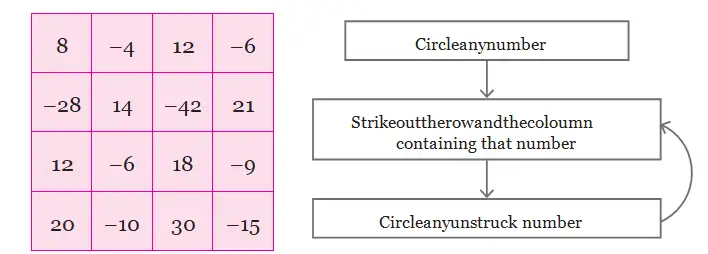
| Row | Column 1 | Column 2 | Column 3 | Column 4 |
|---|---|---|---|---|
| Row 1 | ||||
| Row 2 | ||||
| Row 3 | ||||
| Row 4 |
If every entry has the form , any selection of one entry from each row and column has the same product.
Use this factorisation to see why every valid selection gives the same product.
Playing the grid game
- Choose any unstruck number and circle it.
- Cross out its row and column so that no later choice uses either one.
- Repeat until every row and column has one circled number, then multiply the circled numbers.
Find the product when the diagonal entries , , , and are selected.
- Multiply the four selected entries.
- Group them into their row and column factors; these contain every factor once.
Division of Integers
Integer division — Division asks which number, when multiplied by the divisor, gives the dividend.
Divide the absolute values, then use the signs: like signs give a positive quotient; unlike signs give a negative quotient. Division by zero is undefined.
Here and are positive integers; the rules apply when the divisions are defined.
Dividing integers
- Divide the absolute values of the dividend and divisor.
- Give the quotient a positive sign if the signs match and a negative sign if they differ.
- Check by multiplying the quotient by the divisor to recover the dividend.
Evaluate .
- The dividend and divisor have the same sign, so the quotient is positive.
- Divide their absolute values.
- Check by multiplying the quotient by the divisor.
Evaluate: (a) ; (b) ; (c) ; (d) .
A room starts at and cools by per hour. What is its temperature after hours?
White cement earns Rs. profit per bag and grey cement incurs Rs. loss per bag. (a) Find the result for white and grey bags. (b) If grey bags are sold, how many white bags give neither profit nor loss?
Quick recap
- A valid magic-grid selection uses one entry from every row and every column.
- When entries are row-factor column-factor, every valid selection has the same product.
- For integer division, like signs give a positive quotient and unlike signs give a negative quotient.
- Divide absolute values to find the quotient’s magnitude; division by zero is undefined.
- Check division by multiplying the quotient by the divisor.
Expression Using Integers
Multiplying Three or More Integers
- Grouping: Integer multiplication is associative, so factors can be grouped in different ways.
- Order: Multiplication is commutative; changing the order of the factors does not change the product.
- Evaluation: Multiply three or more integers in any convenient order or grouping.
Signs in Products and Quotients
Count the negatives
An even count gives a positive product; an odd count gives a negative product.
Do not decide a product’s sign from just one negative factor: count all negative factors first.
Distributive Property
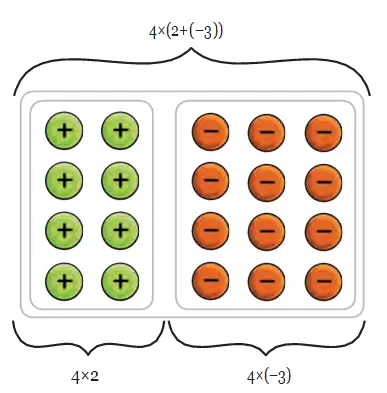
Do not multiply the outside number by only the first term: it must multiply every term inside the parentheses.
Number Machines and Expressions
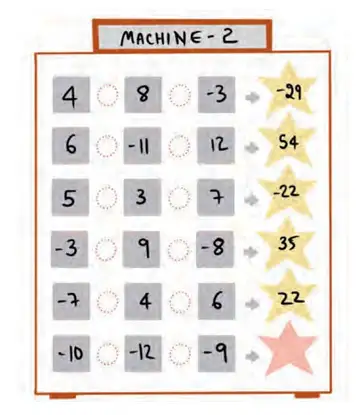
Evaluate .
A test gives marks for each correct answer and for each incorrect answer. A student answers all questions, gets correct, and scores . How many answers were incorrect, and how many questions were there?
Given that , find without calculating it from the beginning.
Quick recap
- Multiplication is associative and commutative, so factors can be grouped or rearranged.
- An even number of negative factors gives a positive product; an odd number gives a negative product.
- A quotient is positive for like signs and negative for unlike signs.
- Distribute multiplication to every term inside parentheses: .
- Machine 1 follows and gives output for inputs , , and .
Summary
Multiplication of Integers
Integer multiplication — Multiplying two integers gives a product whose sign depends on the signs of the factors.
Same signs give a positive product; different signs give a negative product.
For integers , , and , multiplication is commutative, associative, and distributive over addition.
Multiply signed integers
- Multiply the absolute values of the integers.
- Give the product a positive sign for matching signs and a negative sign for different signs.
Find .
- The factors have different signs, so the product is negative.
- Multiply their absolute values.
Division of Integers
Integer division — Dividing one integer by another gives a quotient whose sign depends on the signs of the dividend and divisor.
Same signs give a positive quotient; different signs give a negative quotient.
For non-zero integers and , the quotient sign follows the same-sign/different-sign rule.
Divide signed integers
- Divide the absolute value of the dividend by the absolute value of the divisor.
- Give the quotient a positive sign for matching signs and a negative sign for different signs.
Find .
- The dividend and divisor have the same sign, so the quotient is positive.
- Divide their absolute values.
Evaluate .
Evaluate .
Quick recap
- Multiplication: Same-sign factors give a positive product; different-sign factors give a negative product.
- Division: Same-sign integers give a positive quotient; different-sign integers give a negative quotient.
- Commutative law: .
- Associative law: .
- Distributive law: .
Formula sheet
Mathematics — ALL CHAPTERS
1
Large Numbers Around Us
2
Arithmetic Expressions
3
A Peek Beyond the Point
4
Expressions using Letter-Numbers
5
Parallel and Intersecting Lines
6
Number Play
7
A Tale of Three Intersecting Lines
8
Working with Fractions
1
Geometric Twins
2
Operations with Integers
3
Finding Common Ground
4
Another Peek Beyond the Point
5
Connecting the Dots
6
Constructions and Tilings
7
Finding the Unknown