Class 7 . Mathematics . Ganita Prakash Part I . Large Numbers Around Us
Chapter 1: Large Numbers Around Us
Ch 1
Mathematics
Class 7
A Lakh Varieties
Understanding One Lakh and Place Value
Rice varieties and seed access
- Earlier and now: Ramanna said the country once had about one lakh rice varieties, but only a handful remain today.
- Seed access: Farmers once preserved different seeds; now they have to buy seeds at the market.
- Seed bank: Lakshmamma described a nearby seed bank that had collected about indigenous rice varieties from different places, which people could buy.
Place-value facts
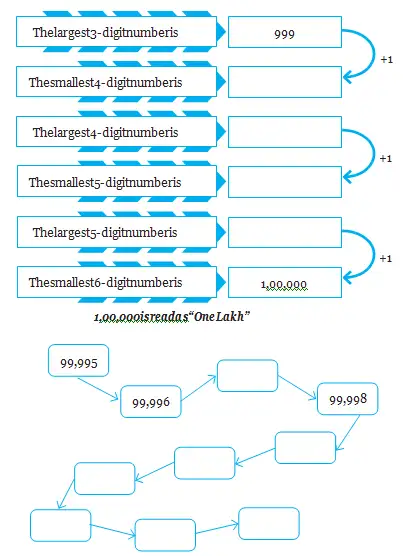
- Five-digit numbers: The largest is ; the next number is .
- Six-digit numbers: The smallest is , and the largest is .
| Number of digits | Smallest number | Largest number |
|---|---|---|
Counting Varieties Over a Lifetime
Ignoring leap years, years contain days. Eating varieties each day gives a total of varieties.
Compare with one lakh
- One variety daily for years: , fewer than one lakh.
- Two varieties daily for years: , still fewer than one lakh.
- Three varieties daily for years: , enough to taste one lakh varieties.
Use the absolute difference to show how far a number is from one lakh, whether it is above or below.
Check whether the total reaches one lakh
- Find the number of days in the chosen number of years.
- Multiply by the number of varieties eaten each day.
- Compare the total with one lakh; a total at least as large as one lakh is enough.
Would eating three varieties a day be enough to taste one lakh varieties in years?
- Find the days in years, ignoring leap years.
- Calculate varieties tasted at three varieties per day.
- Compare the total with one lakh.
Comparing Populations with One Lakh
Compare a population with one lakh or find its increase
- For the distance from one lakh, subtract the smaller number from the larger.
- For a population increase, subtract the earlier population from the later population.
| Question | Calculation | Result |
|---|---|---|
| How much less is than one lakh? | less | |
| How much more is than one lakh? | more | |
| Increase from 2011 to 2024 |
Chintamani’s population was about in 2011. How many fewer than one lakh is this?
If the estimated population in 2024 was , how many more than one lakh was it?
Find the increase from in 2011 to in 2024.
Quick recap
- One lakh is , the smallest six-digit number.
- The number after is .
- Rice varieties were once said to number about one lakh, but only a handful remain today; farmers now buy seeds at markets.
- Ignoring leap years, years contain days; eating varieties daily gives varieties.
- At three varieties a day for years, the total is .
- Population increase is the later population minus the earlier population.
Getting a Feel of Large Numbers
Estimating Size by Comparison
If one floor is about m high, divide the total height by to estimate the number of floors.
Estimate a height or floor count
- Choose a familiar reference, such as Somu’s height of about m.
- Estimate the size of one unit; here, one floor is about four times Somu’s height.
- Multiply by the number of floors to estimate building height, or divide a target height by one-floor height.
About how many floors high is the Kunchikal waterfall?
- Estimate how many floors would reach the waterfall’s height of about m.
- Use about m for each floor.
- Round to a whole number of floors.
A lakh in context — A lakh is ; whether it feels large depends on what is being counted or measured.
| Perspective | Example |
|---|---|
| Feels large | days is about years; a line of people shoulder to shoulder could stretch about km. |
| Feels small in context | Ahmedabad’s cricket stadium seats more than people; a human head may have about – hairs. |
| Feels small in nature | Some female fish lay nearly eggs at once; some lay tens of lakhs. |
| Feels plentiful | One lakh varieties of rice would be a very large variety. |
Reading and Writing Numbers in the Indian System
The final group has three digits; each group to its left has two digits.
Read the groups from left to right as lakhs, thousands, and ones; within each group, use its usual number name.
Read or write a number
- To read a number, put commas in Indian grouping and name each group from left to right.
- To write a number from words, write the lakh, thousand, and final groups in their place-value positions.
- Use zeroes to hold any empty places, then add commas in Indian grouping.
Write in words.
- Separate the number into lakh, thousand, and final groups.
- Show the value represented by each group.
- Read each group in order and combine the group names: twelve lakh seventy-eight thousand eight hundred thirty.
| Numeral | Number name |
|---|---|
| Fifteen lakh seventy-five thousand | |
| Three lakh six hundred | |
| Five lakh four thousand eighty-five | |
| Twenty-seven lakh thirty thousand | |
| Seventy lakh fifty-three thousand one hundred thirty-eight | |
| One lakh twenty-three thousand four hundred and fifty-six | |
| Four lakh seven thousand seven hundred and four | |
| Fifty lakhs five thousand and fifty | |
| Ten lakhs two hundred and thirty-five |
Write in words.
Write “nine lakh two thousand and seven” in the Indian place-value system.
Quick recap
- Compare an unfamiliar measurement with a familiar reference to estimate its size.
- At about m per floor, a m height is approximately floors.
- A lakh equals ; its apparent size depends on context.
- In Indian comma grouping, start with three digits at the right, then group in pairs.
- Read number groups from left to right as lakhs, thousands, and ones.
- Use zeroes as place holders when writing a numeral from its number name.
Land of Tens
Repeated-Addition Buttons and Place Values
Repeated-addition button — A button labelled adds to the displayed number each time it is pressed.
Use when each press adds the same amount.
Place-value button facts
- Thousands: The button needs presses to make one lakh: .
- Tens: The button needs presses to make one lakh: .
- Hundreds: The button needs presses for ten thousand and presses for one lakh.
- Exact multiples: A single button makes only whole-number multiples of its button value.
| Button | Target | Presses |
|---|---|---|
Find the number of presses
- Identify the value added by one press.
- Divide the target by the button value.
- Check that the result is a whole number.
How many times should the +1000 button be pressed to show 1,53,000?
- Divide the target by the value of the button.
Every number made with the button can also be made with the button, but not every number made with can be made with . So it is false that the hundreds button can make numbers that both the tens and thousands buttons cannot.
Creative Chitti: Many Ways to Make a Number
Creative Chitti — Creative Chitti has buttons , , , , , , and ; a target can be made in many ways.
Button decomposition — A button decomposition writes a number as the sum of button values multiplied by their press counts.
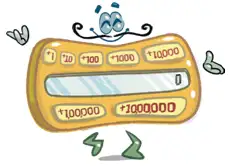
The same total can be made by regrouping button values; for example, ten presses of equal one press of .
Here, is a button value and is its number of presses.
Examples of different decompositions
- : ; alternatively, .
- : ; alternatively, .
- : ; alternatively, .
- : ; alternatively, .
- and : ; and .
- : ; alternatively, .
Make a number in different ways
- Choose button values whose weighted sum equals the target.
- Use each coefficient as the number of presses of that button.
- Add the parts to verify the target; add the coefficients to count clicks.
Give a different button expression for 5072 and find its number of clicks.
- Use the proposed button counts to check the value.
- Add the press counts to find the total clicks.
Exactly 30 Clicks
Using the available positive place-value buttons, the largest three-digit total possible in exactly clicks is ; the smallest is .
What are the largest and smallest three-digit numbers possible in exactly 30 clicks?
- For the largest three-digit total, use nine hundreds and fill the remaining clicks with tens and ones.
- For the smallest three-digit total, use eight tens and fill the remaining clicks with ones.
Changing the number of clicks
- One construction of : hundreds, tens, and ones use clicks.
- Another construction: uses clicks.
Systematic Sippy: Use the Fewest Clicks
Systematic Sippy — Systematic Sippy has buttons , , , , , and and aims to make each target with as few clicks as possible.
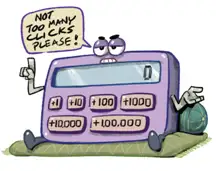
With buttons for powers of ten, the minimum number of clicks is the sum of the target's digits. Each digit gives the press count for its place-value button; zero digits need no presses.
Use the target's digits as the press counts for the matching buttons.
Find the minimum number of clicks
- Write the number in place-value form.
- Press each place-value button as many times as its digit.
- Add the digits to find the minimum click count.
Make 5072 with as few Sippy clicks as possible.
- Write using place values.
- Add the digit counts; the zero hundreds need no clicks.
| Target | Place-value expression | Minimum clicks |
|---|---|---|
Why the digit-sum rule works
- Place-value form: Each digit gives the number of presses of its matching button.
- Fewest clicks: If a button were pressed ten or more times, those ten presses could be replaced by one press of the next larger button.
From Lakhs to Crores
Crore — One crore equals lakhs and is written as in the Indian place-value system.
One crore is followed by seven zeroes.
What number is made by pressing +10,00,000 ten times?
- Ten presses of the button make the total.
How many presses of the +100 button make 97,600?
Give two different button expressions for 8300.
What is the minimum number of Sippy clicks needed to make 56354?
Quick recap
- Divide the target by the button value to find the presses needed for a single-button calculator.
- Creative Chitti has buttons from through and can make a number in many ways.
- The same target can have different button decompositions by regrouping place values.
- With exactly clicks, the smallest and largest three-digit totals are and .
- Systematic Sippy has buttons from through ; its minimum clicks equal the sum of the target's digits.
- One crore equals lakhs and is written as .
Of Crores and Crores!
Indian and American Number Systems
- Indian system: Commas group digits from right in a 3-2-2 pattern: 1,00,000 and 1,00,00,000.
- American system: Commas group digits in threes from the right, as in 1,000,000 and 1,000,000,000.
- Number names: One lakh is 100,000; one crore is 10,000,000, and one billion is 1,000,000,000.
- Equivalences: One million equals ten lakhs; one billion equals 100 crore, or one arab.
- Usage: The Indian system is used in countries including India, Nepal, Pakistan, Bangladesh and Sri Lanka.
Quick recap
- The Indian comma pattern is --… from the right; the American pattern is --…
- One lakh has zeros, one crore has , and one arab has .
- One lakh equals one hundred thousand; one crore equals one hundred lakhs.
- One arab equals one hundred crores; one billion equals one thousand million.
- Group digits before reading or comparing large numbers.
Exact and Approximate Values
Exact Values and Approximation
Exact value — The precise value of a quantity, with no rounding or estimation.
Approximate value — A close, simpler value used when the exact value is unnecessary; it is written using .
When to use each
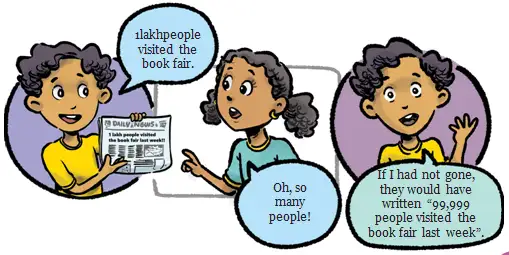
- Approximation is useful when a broad idea is enough; Chintamani's population of may be described as about .
- Round up when too few would cause a problem; for people, ordering sweets is safer than ordering .
- Round down when a higher estimate could mislead; an item costing Rs. may be described as around Rs. rather than Rs. .
- Either direction may be acceptable for a rough estimate, such as the distance between faraway places.
- Exact values matter for financial transactions, such as handling money in a bank.
An approximation can be greater than the exact value (rounding up) or less than it (rounding down); choose the direction that suits the purpose.
Estimate for a practical purpose
- Decide whether an exact value is needed or an estimate will do.
- Choose a convenient nearby value and decide whether rounding up or down is more suitable.
Give an approximate population if the exact population is .
- The census gives Chintamani's exact population.
- For a quick idea of its size, use the convenient estimate.
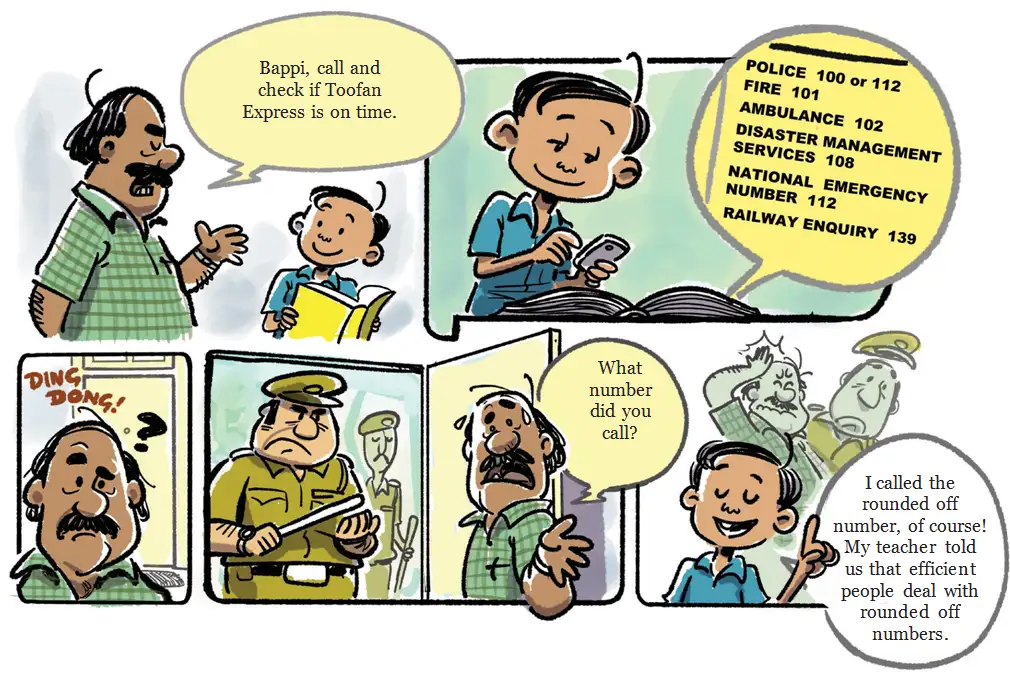
Nearest Neighbours
Nearest neighbour — The nearest neighbour at a given place is the closest multiple of that place value.
To round to a place, check the digit immediately to its right: digits – mean round down; digits – mean round up. Replace all digits to the right with zeros.
Here, is the place value and is an integer.
Round to a specified place
- Find the place to which the number must be rounded.
- Inspect the digit immediately to its right and decide to round down or up.
- Keep the digits to the left, adjust the rounding digit if needed, and change the following digits to zeros.
Find the nearest thousand, ten thousand, lakh, ten lakh and crore to .
- For the nearest thousand, inspect the hundreds digit, which is less than .
- Keep the thousands and higher digits; change the final three digits to zeros.
| Place | ||
|---|---|---|
| Nearest thousand | ||
| Nearest ten thousand | ||
| Nearest lakh | ||
| Nearest ten lakh | ||
| Nearest crore |
If all five nearest neighbours are , the number must round to at the nearest-thousand place. Using the usual half-up rule, the possible whole numbers run from through — numbers in total.
Estimating Calculations
Estimate of a calculation — A quick prediction of a calculation's value, used to judge its approximate size before finding the exact answer.
An estimate can be checked by comparing the exact answer with nearby benchmarks; the closest estimate is the one with the smaller difference from the exact answer.
Use the exact operation to check an estimate.
Estimate and verify
- Use nearby convenient values to predict the result's size.
- Find the exact sum or difference.
- Compare the exact answer with the estimates and any given benchmark.
Estimate and find ; compare the answer with and .
- Add the two numbers.
- The sum is above and below ; its distance from is smaller, so Estu's estimate is closer.
- Compare with the two suggested benchmarks.
| Check | Result |
|---|---|
| Exact difference | |
| Near or ? | Both descriptions are possible; it is closer to . |
| Compare with | |
| Compare with |
Find the five nearest neighbours of .
How many whole numbers have all five nearest neighbours equal to ?
Find and decide whether the difference is above or below and .
Quick recap
- Exact values are precise; approximate values give a useful nearby estimate.
- Round up when the estimate should exceed the actual value; round down when it should be less.
- For nearest-place rounding, inspect the digit to the right: – rounds down and – rounds up.
- Nearest neighbours are multiples of the place value, such as thousand, lakh or crore.
- Check an estimate by finding the exact calculation and comparing it with the benchmarks.
- The exact sum is and the exact difference is .
Populations of Cities
Comparing City Populations
| Rank | City | Population (2011) | Population (2001) |
|---|---|---|---|
| 1 | Mumbai | 1,24,42,373 | 1,10,78,450 |
| 2 | New Delhi | 1,10,07,835 | 98,79,172 |
| 3 | Bengaluru | 84,25,970 | 43,01,326 |
| 4 | Hyderabad | 68,09,970 | 36,37,483 |
| 5 | Ahmedabad | 55,70,585 | 35,20,085 |
| 6 | Chennai | 46,81,087 | 43,43,645 |
| 7 | Kolkata | 44,86,679 | 45,72,876 |
| 8 | Surat | 44,67,797 | 24,33,835 |
| 9 | Vadodara | 35,52,371 | 16,99,000 |
| 10 | Pune | 31,15,431 | 25,38,473 |
| 11 | Jaipur | 30,46,163 | 23,22,575 |
| 12 | Lucknow | 28,15,601 | 21,85,927 |
| 13 | Kanpur | 27,67,031 | 25,51,337 |
| 14 | Nagpur | 24,05,665 | 20,52,066 |
| 15 | Indore | 19,60,631 | 14,74,968 |
| 16 | Thane | 18,18,872 | 12,62,551 |
| 17 | Bhopal | 17,98,218 | 14,37,354 |
| 18 | Visakhapatnam | 17,28,128 | 13,45,938 |
| 19 | Pimpri-Chinchwad | 17,27,692 | 10,12,472 |
| 20 | Patna | 16,84,222 | 13,66,444 |
Estimating Changes and Comparing Populations
Use this to find how much a city’s population changed between the two years.
Divide the larger population by the smaller population to estimate how many times as large it is.
How to interpret a population table
- Read the table heading and identify the years and cities being compared.
- For a change, subtract the earlier population from the later population.
- Round the result to a convenient place value when an approximate answer is requested.
- For a comparison factor, divide one population by the other and round suitably.
By approximately how much did Pune’s population increase between 2001 and 2011?
- Find approximately how much Pune’s population increased from 2001 to 2011.
- Subtract the 2001 population from the 2011 population.
- Round the difference to the nearest lakh for an approximate answer.
Do not subtract the later population from the earlier one when finding an increase; use 2011 minus 2001. Keep exact figures separate from rounded estimates.
Which city had the greatest population increase from 2001 to 2011, and what was the increase?
About how many times Patna’s 2011 population is Mumbai’s 2011 population?
Name one city whose 2011 population was almost double its 2001 population.
Quick recap
- Most listed cities grew in population from 2001 to 2011; Kolkata was the exception.
- Population increase = 2011 population − 2001 population.
- Pune’s increase was 5,76,958, or approximately 6 lakh.
- Bengaluru had the greatest increase: 41,24,644.
- Bengaluru, Hyderabad, Surat and Vadodara had populations close to double their 2001 figures.
- Mumbai’s 2011 population was about 7.39 times Patna’s.
Patterns in Products
Multiplication Shortcuts
Use these equalities to create easy powers of .
Calculate by regrouping
- Rewrite a factor as a power of divided by a convenient number.
- Regroup the factors so the division is easy.
- Multiply by the power of to finish.
Find quickly.
- Rewrite as .
- Divide first, then multiply by .
Calculate quickly.
How Many Digits Can a Product Have?
For positive integers with and digits, the product has either or digits.
| First factor | Second factor | Product has |
|---|---|---|
| 1-digit | 1-digit | 1 or 2 digits |
| 2-digit | 1-digit | 2 or 3 digits |
| 2-digit | 2-digit | 3 or 4 digits |
| 3-digit | 3-digit | 5 or 6 digits |
| 5-digit | 5-digit | 9 or 10 digits |
| 8-digit | 3-digit | 10 or 11 digits |
| 12-digit | 13-digit | 24 or 25 digits |
Determine the possible number of product digits
- Let the factors have and digits.
- Find the two possible counts: and .
- Use the bounds to decide whether a specific digit count is possible.
Can a 4-digit number multiplied by a 2-digit number give a 5-digit product?
- A 4-digit number is at least , and a 2-digit number is at least .
- The product is at least a 5-digit number; its maximum possible digit count is .
Can the product of two 3-digit numbers have 4 digits?
Patterns in Products
| Multiplications | Products and pattern extension |
|---|---|
| , , | , , ; next: |
| , , | , , ; next: |
| , , | , , ; next: |
| , , | , , ; next: |
For numbers of the form , expand the square to calculate it and reveal the pattern.
Calculate and identify its product.
- Write as and use the square expansion.
- Expand and add the terms.
Extend the pattern by finding .
Do not claim every product of an -digit and an -digit number has exactly digits; it can have digits instead.
Quick recap
- Rewrite , , and using convenient powers of to calculate products quickly.
- Regroup factors so division happens before multiplication by a power of .
- Factors with and digits produce a product with either or digits.
- Use the smallest and largest possible factors to test whether a product digit count is possible.
- Calculate related products to spot patterns, then verify any extension.
Fascinating Facts about Large Numbers
Large numbers in different naming systems
Large-number naming systems — The Indian and American systems group and name large numbers differently.
| Number | Indian system | American system |
|---|---|---|
| 1 lakh | One hundred thousand | |
| 10 lakh | 1 million | |
| 1 crore | 10 million | |
| 100 crore | 1 billion |
Reading a calculated number
- Indian commas: After the first three digits from the right, place commas every two digits: .
- American commas: After the first three digits from the right, place commas every three digits: .
Products and quotients reveal facts
Product — A product is the result of multiplying numbers.
Quotient — A quotient is the result of dividing one number by another.
Use multiplication to find a product and division to find a quotient.
Calculate and interpret a large-number fact
- Calculate the product or quotient accurately.
- Write the result with commas in the Indian and American systems.
- Use the result with its unit and context to state the fact.
According to legends, how many kirtanas did Purandaradasa compose?
- Find the number of kirtanas represented by the product.
- Multiply the factors.
- Write the result in both naming systems.
Facts represented by large-number calculations
- Purandaradasa: The product gives the number of kirtanas attributed to him in legends. He was a 15th-century composer and singer whose works included social reform, bhakti and spirituality.
- Carnatic music: Purandaradasa systematized teaching methods that continue to be followed.
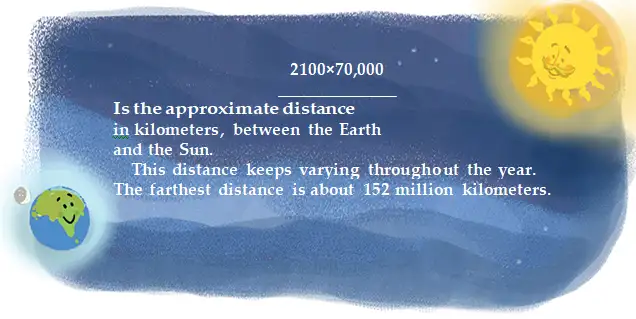
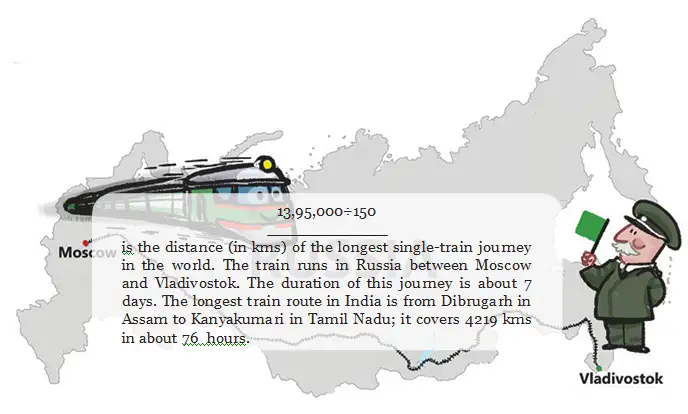
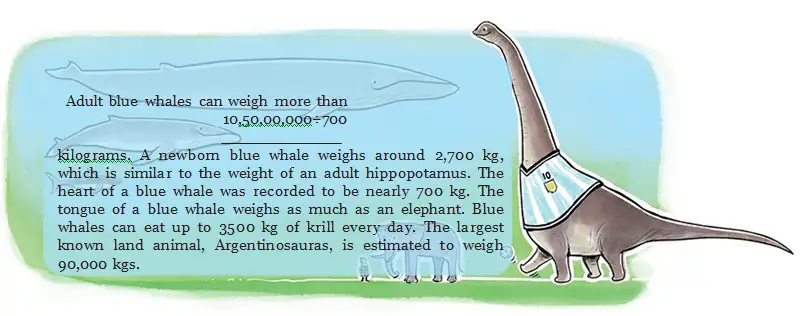
- Amazon River: litres per second, or crore litres per second, is its average discharge into the Atlantic Ocean. Drinkable freshwater can be found as far as km into the open sea.
Plastic waste calculation
- Global plastic waste: tonnes, or tonnes ( crore tonnes), in 2021.
Large numbers in soil
Soil organisms
- Bacteria: One gram of healthy soil can contain million to billion bacteria.
- Fungi: The same amount of soil can contain lakh to million fungi.
- Importance: These organisms can support plant growth and health.
Calculate and express the result in Indian and American naming systems.
Calculate and express the answer in both naming systems.
After calculating, check the commas and name of the number, then include the correct unit and context.
Quick recap
- A product is the result of multiplication; a quotient is the result of division.
- Indian and American systems group commas differently and use names such as lakh, crore, million and billion.
- kirtanas are attributed to Purandaradasa in legends.
- The Amazon's average discharge is litres per second.
- The 2021 global plastic-waste figure given is tonnes.
- One gram of healthy soil may contain million to billion bacteria and lakh to million fungi.
Did You Ever Wonder?
Estimating with Large Numbers
Large-number estimation — Use reasonable quantities and compare totals to decide whether a large-scale claim is possible.
If the total capacity is smaller than the number of people or objects, they cannot all fit. Compare both quantities in the same unit.
Use when each of a number of groups holds the same amount.
Estimate and compare
- Identify the amount per group and the number of groups.
- Multiply to find the total capacity or amount.
- Convert both quantities to the same unit and compare.
Could the entire population of Mumbai fit into one lakh buses, assuming 50 people per bus?
- Find how many people one lakh buses can carry if each bus holds 50 people.
- Compare this with Mumbai's population, which is more than 1 crore 24 lakh.
Useful large-number checks
- Ships: At about 2,500 passengers per ship, 5,000 ships hold 1,25,00,000 people. A population stated only as more than 1,24,00,000 is not precise enough to decide whether it fits.
- Paper: At 5 g per sheet, 1,00,000 sheets weigh 5,00,000 g, or 500 kg; one person cannot lift this weight.
- Births: At 250 births per minute, a day gives 250 × 60 × 24 = 3,60,000 births, less than one million (10 lakh).
- Coins: Counting one coin per second for a day gives 60 × 60 × 24 = 86,400 coins, not one million.
- Moon travel: At 100 km per day, 10 years of 365 days gives 3,65,000 km, less than the Earth–Moon distance of 3,84,400 km. The trip would take about 10.5 years.
- Sun travel: At 1,000 km per day, reaching the Sun would take about 403 years, so it is not reachable within a human lifetime.
Building and Comparing Numbers
Digit arrangement — A digit arrangement is a number formed by placing given digits in a chosen order; place value makes earlier digits more significant.
For numbers with the same number of digits, compare from the left; the number with the larger first differing digit is larger. A multiple of 5 ends in 0 or 5, and an even number ends in an even digit.
Compare digits from the greatest place value toward the ones place.
Arrange digits for an extreme value
- For the largest number, place the largest available digits first.
- For the smallest number, use the smallest possible non-zero first digit, then the remaining digits in increasing order.
- If there is an extra condition, reserve a suitable final digit before arranging the rest.
Using each digit from 0 to 9 exactly once, find the largest multiple of 5 and the smallest even number.
- To make the largest ten-digit multiple of 5 using every digit once, put the digits in descending order and end in 0.
- For the smallest even number, reserve 8 as the final digit; arranging the other digits as small as possible gives the result.
Other digit puzzles
- Maximum by deletion: To make the largest number after striking out a fixed number of digits, keep the greatest possible digit at each leftmost position. For 12345123451234512345, removing 10 digits gives 5534512345.
- Swap condition: For every exchange of two digits to make a number bigger, the digits must increase from left to right. Using digits 1–9, the only such nine-digit number is 123456789.
- Number names: A seven-digit number with a particularly long name is 77,77,777: “seventy-seven lakh seventy-seven thousand seven hundred seventy-seven” (60 letters, excluding spaces).
- Shared-letter puzzle: Compare the English spellings of consecutive number names letter by letter; the answer depends on the number-word naming convention used.
Counting Digits in a Number Sequence
Digit stream — A digit stream is the continuous sequence formed by writing positive integers one after another without spaces.
There are 9 one-digit numbers, 90 two-digit numbers, 900 three-digit numbers, and so on; multiply the count by the number of digits in each number.
For all positive integers with exactly k digits.
Locate the nth digit
- Count the digits in complete groups, starting with one-digit numbers.
- Subtract these complete-group totals from the required position.
- Divide the remainder by the digits per number to locate the number and the digit within it.
What is the 1000th digit in the sequence 123456789101112… and which number contains it?
- Digits in the numbers from 1 to 99 total 9 one-digit digits and 180 two-digit digits.
- The 1000th position is therefore 811 digits into the three-digit group.
- After 270 complete three-digit numbers, the next number is 370; the remaining position is its first digit.
Further digit-stream results
- Millionth digit: The millionth digit in the sequence occurs in the number 185,185.
- Counting the digit 5: The 5000th occurrence of the digit 5 is in 13,495. There are 4,000 occurrences from 1 to 9,999, then 1,000 more from 10,000 to 13,495.
Place Value, Units, and Rates
Unit rate — A unit rate describes how much of a quantity is covered, produced, or counted in one unit of time or distance.
For a constant rate, total quantity equals rate times duration. To compare heights, divide the height being compared by the reference height.
Use the first formula for constant rates and the second for “how many times as large” comparisons.
Calculate a rate or scale
- For a journey or count, divide the total by the duration to find the amount per unit time.
- For a target distance, divide the target by the amount covered per day to find the days needed.
- Convert units before comparing quantities, then divide by the reference amount.
A bar-tailed godwit flies 13,560 km in about 11 days. Estimate its distance per day and per hour.
- Divide the 13,560 km flight by 11 days to estimate distance per day.
- Divide the daily distance by 24 hours to estimate distance per hour.
Conversions and real-world comparisons
- Large units: 1 billion = 10,000 lakh.
- Coin stack: A 1 mm-thick coin stack matching the 180 m Statue of Unity requires 180 × 1,000 = 1,80,000 coins.
- Albatross trip: A 12,000 km journey at 900–1,000 km per day takes about 12–14 days.
- Building comparisons: Somu’s building is 40 m high. Bald eagles at 4,500–6,000 m fly about 112.5–150 times its height; Everest at 8,850 m is about 221 times its height.
- Aeroplane comparison: At 10,000–12,800 m, aeroplanes fly about 250–320 times the building height.
Button Clicks and Number Cards
Place-value decomposition — Place-value decomposition expresses a number as a sum of multiples of its place-value units.
With +10,000 and +100 buttons, write the target as a sum of these increments; the number of clicks is the sum of their coefficients.
Here, a and b are non-negative whole numbers of clicks.
Find the number of clicks
- Express the target as a sum of 10,000s and 100s.
- Add the number of each type of increment.
How many clicks are needed to reach 70,25,700 using only +10,000 and +100 buttons?
- Break 70,25,700 into 10,000 and 100 increments.
- Add the required clicks.
Number-card strategies
- Largest sum: Arrange the cards to make the greatest possible number in each addend, then add. One arrangement gives 99,88,776 + 65,544 = 1,00,54,320.
- Smallest difference: Make the two numbers as close as possible while respecting the digit-card rules. The example gives 11,22,334 − 99,887 = 10,22,447.
- Target-making cards: Combine the supplied numbers with operations, using each card no more than once for a target. For example, 4,000 × (20 + 5) + 13,000 = 1,13,000, which is 3,000 above 1,10,000.
- Check card use: Verify that every number used in an expression comes from a card or is formed from cards that have not already been used.
At 80 km per day, how far would a traveller go in 365 days? Would this reach the Moon, 3,84,400 km away?
Which number contains the 500th digit in 123456789101112…?
A stack of coins, each 2 mm thick, must match a height of 180 m. How many coins are needed?
Quick recap
- Estimate large quantities by multiplying group size by the number of groups, then compare in the same units.
- Use place value and end-digit rules to build the largest or smallest number satisfying a condition.
- For digit streams, count complete number-length groups before locating a particular digit.
- Find total distance or count with rate × time; find the rate by dividing by time.
- Convert units before comparing heights or quantities; “how many times” means divide by the reference amount.
- Write target numbers as sums of allowed increments to find button-click totals.
Summary
Large numbers and naming systems
- Lakh: 1 lakh = 1,00,000, or 1 followed by 5 zeroes.
- Crore: 1 crore = 1,00,00,000, or 1 followed by 7 zeroes.
- Million: 1 million = 1,000,000, which is 10 lakhs.
- Arab and billion: 1 arab = 1,000,000,000 = 100 crore = 1 billion.
- Reading large numbers: Indian commas group digits in a 3-2-2 pattern; American/International commas group them in threes.
Quick recap
- A lakh is and a crore is .
- A million is lakh; an arab is crore or billion.
- Indian and International systems group digits differently.
- Rounding gives a convenient nearby value when an exact number is unnecessary.
- Comparing a large quantity with familiar quantities helps show its scale.
- Factorising and regrouping can make multiplication easier.
Formula sheet
Mathematics — ALL CHAPTERS
1
Large Numbers Around Us
2
Arithmetic Expressions
3
A Peek Beyond the Point
4
Expressions using Letter-Numbers
5
Parallel and Intersecting Lines
6
Number Play
7
A Tale of Three Intersecting Lines
8
Working with Fractions
1
Geometric Twins
2
Operations with Integers
3
Finding Common Ground
4
Another Peek Beyond the Point
5
Connecting the Dots
6
Constructions and Tilings
7
Finding the Unknown