Class 7 . Mathematics . Ganita Prakash Part II . Finding the Unknown
Chapter 7: Finding the Unknown
Ch 7
Mathematics
Class 7
Find The Unknowns
Unknown Weights and Equations
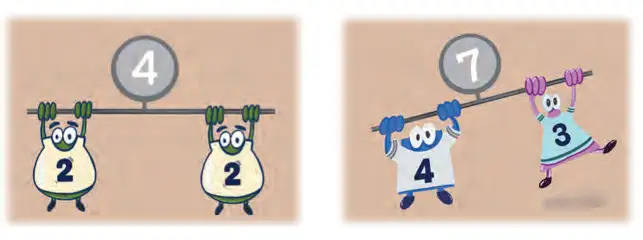
Adding or subtracting the same quantity from both sides of an equation keeps the equation balanced.
Writing Equations from Weighing Scales
- Two fried eggs: If one egg weighs units and each bread slice weighs units, then , so .
- Another scale: If each unknown object weighs units, the balance gives .
- Other equation forms: , , , and .
Solve a Simple Equation
- Simplify each side if needed.
- Undo operations around the unknown, doing the same operation to both sides.
- Check by substituting the result into the original equation.
Find the unknown in .
- Solve the equation.
- Subtract from both sides.
- Divide both sides by .
- Check the value in the original equation.
Do not change just one side of an equation: whatever operation is used to keep the equation balanced must be applied to both sides.
Matchstick Pattern

Matchsticks at Each Position
- Pattern: Positions have matchsticks respectively.
- Rule: Each position adds matchsticks, so position has matchsticks.
- Equation use: To find the position for a given number of sticks, set equal to that number and solve.
Use this rule to find the stick count or the position number.
At what position does the arrangement use exactly matchsticks?
- Set the pattern rule equal to sticks.
- Subtract from both sides.
- Divide both sides by .
Can an arrangement in this pattern use exactly matchsticks?
Solve .
Solve .
How many matchsticks are in position ?
Quick recap
- A balanced scale represents an equality between the total weights on its two plates.
- An equation uses to show that two expressions have the same value.
- Solve equations by applying the same operation to both sides, then check the result.
- For the matchstick pattern, position uses sticks.
- The pattern position must be a whole number; therefore, sticks cannot form an arrangement in this sequence.
Solving Equations Systematically Part-1
Trial and Error
Trial and error — A method of testing possible values of a variable until one makes the left-hand side equal the right-hand side.
Key Points
- How it works: Substitute a possible value for the variable and compare the two sides.
- Solution check: A value is a solution if substitution gives equal values on both sides.
- Limitation: Trial and error can be inefficient when many guesses are needed.
A value is a solution only if substitution makes both sides equal.
Test Values by Trial and Error
- Choose a possible value for the variable.
- Substitute it into the left-hand side and calculate.
- Compare the result with the right-hand side; keep testing until they match.
Solve by trial and error.
- Test the value in .
- The left-hand side equals the right-hand side.
Preserving Equality and Solving Equations
Equality-preserving operation — An operation performed identically on both sides of an equation keeps the equality true.
If two sides are equal, adding, subtracting, multiplying or dividing both sides by the same number preserves equality. Division is allowed only by a non-zero number.
Using Inverse Operations to Remove Terms or Factors
- Inverse operations: Addition and subtraction undo each other; multiplication and division undo each other.
- Remove a term: Use the opposite operation on both sides, such as subtracting to cancel .
- Remove a factor: Divide both sides by that factor, or multiply by its reciprocal.
| Given equality | Operation on both sides | Value of required expression |
|---|---|---|
| Subtract | ||
| Divide by | ||
| Add | ||
| Divide by |
To isolate the variable, undo operations in reverse order while keeping both sides balanced.
Solve an Equation Systematically
- Undo added or subtracted terms by using the inverse operation on both sides.
- Undo multiplication or division by applying the inverse operation to both sides.
- Check the answer by substituting it into the original equation.
Solve and check .
- Add to both sides to cancel .
- Divide both sides by to isolate .
- Check by substituting into the original equation.
Do not change only one side of an equation; apply every operation to both sides. When dividing, never divide by zero.
Solve .
Solve .
Solve and check your answer.
Quick recap
- Trial and error finds a solution by testing values, but can be inefficient.
- An equation stays balanced when the same operation is performed on both sides.
- Addition and subtraction, and multiplication and division, are inverse-operation pairs.
- Undo operations in reverse order to isolate the variable.
- Check a solution by substituting it into the original equation and confirming .
Solving Equations Systematically Part-3
Using Inverse Operations to Solve Equations
Systematic equation solving — A method of finding an unknown by using inverse operations on both sides while keeping the equation balanced.
Applying the same operation to both sides preserves equality. To isolate the unknown, undo operations in reverse order.
Key properties
- Added or subtracted term: Remove it using its additive inverse; the inverse appears on the other side.
- Factor: Remove a factor by dividing both sides by it.
- Divisor: Remove a divisor by multiplying both sides by it; for example, gives .
- Unknowns on both sides: Add or subtract an unknown term on both sides to collect the unknowns on one side.
- No solution: If simplifying leaves a false statement, such as , no value of the unknown can satisfy the equation.
The division rules require .
Solve an equation systematically
- Collect unknown terms on one side by adding or subtracting the same unknown term on both sides.
- Move constant terms away from the unknown using the inverse operation.
- Remove the coefficient by dividing, or remove a divisor by multiplying.
- Check the result by substituting it into the original equation.
Solve and check and .
- Solve the equation by removing the negative addend.
- Subtract from both sides, which is equivalent to adding .
- Divide both sides by .
- Check by substituting into the original equation.
- Now solve the equation with unknown terms on both sides; subtract from both sides.
- Subtract from both sides, then divide by .
- Check by substituting into the original equation.
Do not change only one side of an equation. Apply the same operation to both sides; when removing an added or subtracted term, use its additive inverse.
Solve and check: .
Solve and check: .
Write an equation with no solution using the idea “4 more than a number equals 5 more than the same number.”
Quick recap
- Keep an equation balanced by applying the same operation to both sides.
- Undo addition or subtraction using the additive inverse.
- Undo multiplication by dividing; undo division by multiplying.
- Collect unknown terms on one side before isolating the unknown.
- Check a solution by substituting it into the original equation.
- A false statement after simplification means the equation has no solution.
Solving Problems Part-1
Using an Equation to Find a Pattern Step
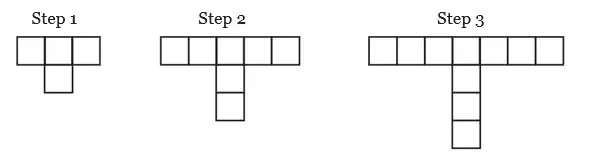
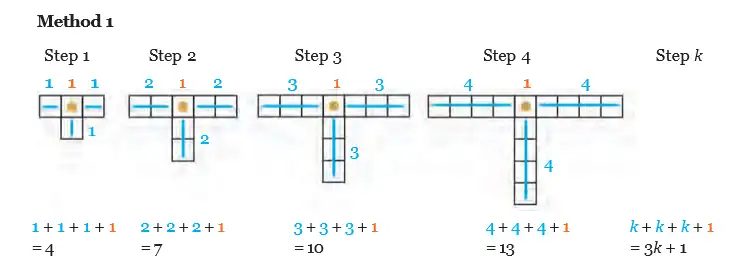
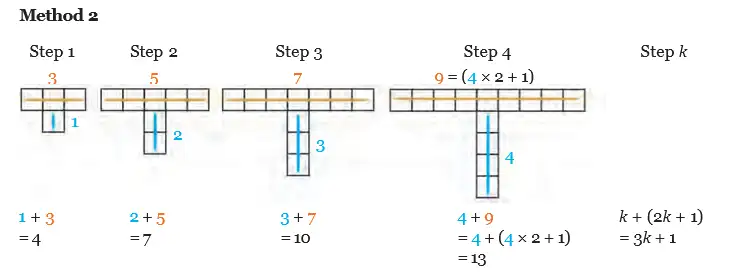
For Step , the number of tiles is .
Use this rule to find the step for a given tile total.
Testing Whether a Tile Total Is Possible
- Set the tile-count rule equal to the required total.
- Solve the equation using the same operation on both sides.
- Check that is a positive whole number; if it is, that step exists.
Can the pattern be extended to make an arrangement using tiles? If so, which step is it?
- For tiles, equate the tile-count rule to .
- Subtract from both sides.
- Divide both sides by .
- Since is a positive whole number, the arrangement is possible.
Forming Equations for Cost Problems
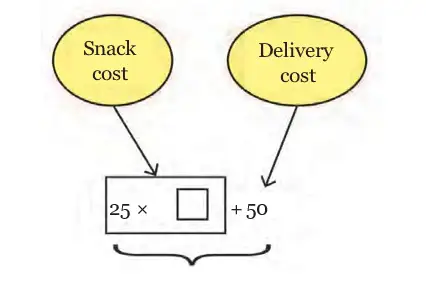
| Unknown | Equation | Meaning |
|---|---|---|
| Total people | The total cost includes delivery. | |
| Friends | The remaining snack budget covers the family and friends. |
Total cost equals the per-plate cost multiplied by the number of plates, plus the fixed delivery charge.
Subtract delivery before finding the number of plates; subtract family members to find friends.
Solving a Cost Word Problem
- Choose a variable for the unknown number of people or friends.
- Write the total-cost equation, including the fixed charge.
- Solve for the number of plates or people.
- Subtract the number of family members to find the number of friends.
With a Rs. budget, plates costing Rs. each, and a Rs. delivery charge, how many friends can be invited if the family has members?
- Let be the total number of people, including the family. Write the total-cost equation.
- Subtract the delivery charge from both sides.
- Divide by the cost of one plate.
- Subtract the family members to get the number of friends.
Do not count the Rs. delivery charge as a plate. Also, distinguish total people from friends: subtract the family members only after finding the total number of plates.
A tile pattern has tiles at Step . Is an arrangement with tiles possible? If so, find the step.
A delivery charge is Rs. . Each meal costs Rs. , and the total budget is Rs. . How many meals can be bought?
Quick recap
- Represent the step number in a tile pattern with a variable and build a rule for its tile count.
- For this pattern, Step uses tiles.
- Set a pattern rule equal to a required total and check whether the solution is a positive whole number.
- Model total cost as item cost multiplied by quantity plus any fixed charge.
- Subtract fixed costs before calculating how many items the remaining budget can buy.
- Subtract the number of family members from the total people to find the number of friends.
Solving Problems Part-2
Using Equations to Compare Savings
Savings after several months — An amount that grows by the same amount each month equals the initial amount plus the monthly saving multiplied by the number of months.
Use this expression for each person, then equate the savings to find when they are equal.
Find when two savings amounts are equal
- Let the unknown number of months be n.
- Write an expression for each person's savings using the initial amount and monthly saving.
- Set the two expressions equal and solve for n.
- Substitute n into either expression to check the shared amount.
Jahnavi starts with Rs. 4000 and saves Rs. 650 monthly. Sunita starts with Rs. 5050 and saves Rs. 500 monthly. After how many months will their savings be equal?
- Let m be the number of months. Write Jahnavi's and Sunita's savings.
- Equate the savings and collect the terms with m.
- Divide by 150 to find the number of months.
- Check: both savings are Rs. 8550 after 7 months.
Solving an Equation in Different Ways
An equation stays true when the same operation is performed on both sides.
Useful solving strategies
- Undo operations: Reverse addition, subtraction, multiplication or division to isolate the unknown.
- Simplify first: Expand brackets and combine like terms before isolating the unknown.
- Reduce first: If all terms are divisible by a common number, divide both sides by it to simplify.
Solve a linear equation
- Simplify each side, including expanding brackets if useful.
- Use the same operation on both sides to move terms and isolate the unknown term.
- Divide by the coefficient of the unknown, then check by substitution.
Solve .
- Subtract 300 from both sides.
- Divide both sides by 28.
- Subtract 4 to find x.
- Check by substituting x=21 into the original equation.
Modelling a Number Trick
Algebraic model — An algebraic model represents each step in a word problem with expressions and equations involving an unknown.
Translate the trick into expressions
- Starting number:
- Subtract 3:
- Multiply by 4:
- Add 8:
For this trick, add 4 to the final answer and divide by 4.
A number is reduced by 3, multiplied by 4, then increased by 8. The final answer is 24. What was the starting number?
- Let the starting number be x and express the final result.
- Set the expression equal to the revealed final answer.
- Add 4 to both sides, then divide by 4.
Solving a Problem with Two Unknowns
Substitution — Substitution replaces one unknown with an equivalent expression so that a problem with two unknowns can be reduced to one unknown.
Represent the marble relationships
- Let be Ramesh's marbles and be Suresh's marbles.
- Total: .
- Difference: Ramesh has 30 more, so .
- Reduce to one unknown: Substitute for in the total equation.
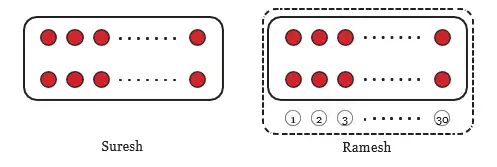
Use a relationship to find both unknowns
- Express one unknown using the other.
- Substitute this expression into the total equation and solve.
- Find the second unknown using the relationship and check the total.
Ramesh and Suresh have 60 marbles altogether. Ramesh has 30 more marbles than Suresh. How many does each have?
- Let Suresh have y marbles; then Ramesh has y+30. Use the total of 60.
- Combine like terms and subtract 30 from both sides.
- Divide by 2 to find Suresh's marbles.
- Use the difference to find Ramesh's marbles and check the total.
Solve .
Maya has Rs. 1200 and saves Rs. 200 each month. Ravi has Rs. 600 and saves Rs. 300 each month. After how many months will their savings be equal?
Two children have 50 stickers altogether. Asha has 10 more than Ben. How many stickers does each child have?
Quick recap
- Write a growing amount as initial amount plus monthly saving times the number of months.
- To find when two amounts match, equate their expressions and solve.
- An equation remains balanced when the same operation is applied to both sides.
- Translate each step in a number trick into an expression, then equate it to the final result.
- For two unknowns, use a relationship to substitute one unknown into the total equation.
- Check answers by substituting them into the original conditions.
Generating Equations
Forming Equations from a Known Solution
Generate an Equation
- Substitute the chosen value into an expression.
- Choose an operation and make an equal expression.
- Simplify to write the equation.
Write two equations whose solution is .
- For a chosen solution of , add to both sides.
- Simplify the right side to get one equation.
- Multiply both sides of by to get another equation.
Equivalent Equations and Inverse Operations
If , then adding or subtracting the same quantity from both sides, or multiplying both sides by the same quantity, preserves equality. Dividing both sides is valid only by a non-zero quantity.
Use the same operation on both sides of an equation.
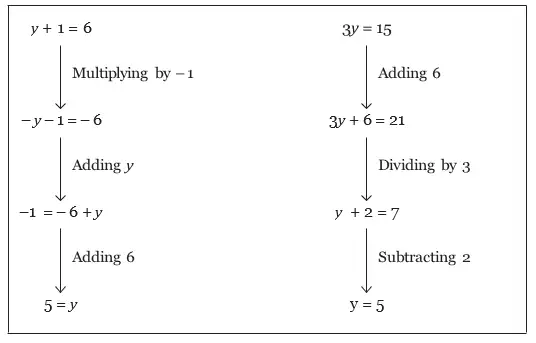
Solve by Reversing Operations
- Undo addition or subtraction first, using the opposite operation.
- Undo multiplication or division next.
- Check the value in the original equation.
Solve .
- Add to both sides.
- Divide both sides by .
- Substitute to verify the solution.
Modelling Real-Life Situations
Translate a Situation into an Equation
- Choose a variable for the unknown quantity.
- Express each part of the total in terms of the variable.
- Set the expression equal to the total and solve.
Give a real-life situation modelled by , and find .
- Let be the cost of one plate of snacks; plates cost , and the delivery charge is Rs. .
- Subtract from both sides.
- Divide both sides by .
Write five equations whose solution is .
The weight of a brick is kg more than half its weight. Find its weight.
A three-digit number has its hundreds digit less than its tens digit, its tens digit less than its units digit, and its digits sum to . Find the number.
Quick recap
- Generate equations by making two expressions equal at a chosen value of the unknown.
- Preserve equality by performing the same valid operation on both sides.
- Solve chains by undoing operations in reverse order with inverse operations.
- Model situations by assigning a variable and expressing fixed and changing amounts.
- Example model: gives .
Mine The Mistake Mend The Mistake
Checking and Repairing Equation Steps
Equivalent equations — Equations are equivalent when they have the same solution; keep them equivalent by doing the same operation to both sides.
Adding, subtracting, multiplying or dividing both sides by the same number preserves equality; division is allowed only by a non-zero number.
Rules for Checking Each Step
- Like terms: Combine only terms with the same variable part; for example, .
- Brackets: Multiply the outside factor by every term inside the brackets.
- Inverse operations: When moving a term across the equals sign, apply the same inverse operation to both sides.
- Check: Substitute the proposed answer into the original equation.
Use this form after identifying the coefficient and constant.
How to Find and Mend a Mistake
- Check whether the same valid operation was applied to both sides.
- Expand brackets and combine like terms correctly.
- Use inverse operations to isolate the variable.
- Substitute the result into the original equation to verify it.
Find and correct the error in solving if the next line is .
- Subtract from both sides.
- Simplify, then divide both sides by .
- Check by substituting into the original equation.
| No. | Mistake | Correct work and solution |
|---|---|---|
| 1 | The was not undone correctly. | . |
| 2 | The sign of was mishandled, and was evaluated incorrectly. | . |
| 3 | Dividing by must apply to the whole left side; alternatively, first isolate . | . |
| 4 | The term should be subtracted from both sides; the should be subtracted too. | . |
| 5 | The step is valid, but cannot be simplified to . | . |
| 6 | Dividing by must apply to the entire left side, including . | . |
| 7 | The factor must multiply both terms inside the brackets. | . |
| 8 | The product is positive, not negative. | . |
| 9 | Dividing by requires dividing every term on both sides; expanding first avoids the error. | . |
Do not change only one part of an equation or divide only selected terms; apply the operation to both complete sides, and distribute factors across every bracket term.
Solve .
Solve .
Solve .
Quick recap
- Apply the same operation to both sides to preserve equality.
- Undo addition or subtraction with the corresponding inverse operation.
- Distribute a factor to every term inside brackets.
- Combine only like terms; do not combine a number and a variable term.
- Divide every term on both sides when dividing an equation.
- Check a solution by substituting it into the original equation.
Pinch Of History Part-1
The Origins and Growth of Algebra
Bījagaṇita — Bījagaṇita, now called algebra, uses letter symbols to express unknown quantities and solve mathematical problems.
Key historical contributions
- Meaning: *Bīja* means “seed”; like a tree hidden in a seed, an answer can be hidden in an unknown number.
- Brahmagupta: Chapter 18 of *Brāhmasphuṭasiddhānta* (628 CE) explained operations on unknowns represented by letters; it was among the earliest known works in algebra.
- Al-Khwarizmi: Indian mathematical ideas reached the Arabic-speaking world in the 8th century and influenced this mathematician, who lived in present-day Iraq.
- His book: Around 825 CE, Al-Khwarizmi wrote *Hisab al-jabr wal-muqabala*, meaning “calculation by restoring and balancing.”
- Spread and name: The book was translated into Latin in the 12th century; *al-jabr* gave us the word “algebra.”
- One-unknown method: Aryabhata (499 CE) first proposed a systematic method for solving problems with one unknown; Brahmagupta outlined it in 628 CE.
Ancient Indian Algebraic Notation
Symbols for unknown and known quantities
- Unknowns: Ancient Indian mathematicians used distinct symbols such as yā, kā, nī, pī and lo for unknown quantities.
- Yā: Short for *yāvat-tāvat*, meaning “as much as needed.”
- Colour-based symbols: Kā and nī came from the first letters of *kālaka* (black) and *nīlaka* (blue).
- Known quantities: A known number was called a *rūpa* (“form”) and denoted by rū.
| Modern notation | Ancient Indian notation | How it was written |
|---|---|---|
| yā 2 rū 1 | The unknown or known indication came before each number. | |
| yā 2 rū 8, with a dot over 8 | A dot over a number indicated that it was negative. | |
| yā 3 rū 4; yā 2 rū 8 | The two sides of the equation were written one below the other. |
Solving an Equation with One Unknown
Equation — An equation states that two expressions have equal value; an unknown can represent a quantity to be found.
One man has Rs. 300 and 6 horses. Another has 10 horses and owes Rs. 100. If their fortunes are equal and each horse has the same price, find the price of one horse.
- This problem is mentioned in Bhāskarāchārya’s *Bījagaṇita* (1150 CE). Let the price of one horse be rupees.
- Equal fortunes give the equation:
- Add to both sides:
- Subtract from both sides:
- Divide both sides by :
For an equation of the form , the solution is obtained by subtracting the constants and the coefficients in matching order. It applies when .
Use the formula
- Match the equation with and identify , , and .
- Substitute these values in Brahmagupta’s formula.
- Simplify to find the unknown.
Solve using the formula.
Solve using the formula.
Solve .
Why Algebra Is Useful
Uses of algebra
- Generalises: Describes patterns in numbers, shapes and situations.
- Justifies: Helps explain why mathematical claims are true, such as the sum of two odd numbers always being even.
- Solves: Provides systematic ways to find unknown quantities.
Quick recap
- Bījagaṇita is the ancient Indian name for algebra; *bīja* means “seed.”
- Brahmagupta discussed operations on unknowns in *Brāhmasphuṭasiddhānta* (628 CE).
- Aryabhata (499 CE) proposed a systematic one-unknown method; Brahmagupta outlined it later.
- Al-Khwarizmi’s *al-jabr* helped give algebra its modern name.
- Ancient Indian notation used symbols such as yā for unknowns and rū for known quantities.
- For with , use .
- Algebra expresses patterns, justifies claims and solves problems.
Pinch Of History Part-2
Forming and Solving Equations
Equation — An equation says that two expressions have the same value and can be used to find an unknown number.
Adding, subtracting, multiplying, or dividing both sides of an equation by the same number preserves equality. Division is allowed only by a non-zero number.
Use when the unknown appears in an equation of this form.
Building an equation from a situation
- Equal notes: If there are notes of each value, the total is .
- Hidden dots: Three blobs covering dots each, plus four visible dots, give .
- Related numbers: If one number is and the other is three times it, their sum is .
- Price comparison: If a milkshake costs rupees and juice costs less, the total-cost equation is .
- Linked amounts: Amounts , twice that, three times the second, and four times the third give .
- Self-reference: A height two and a half metres more than half itself is represented by .
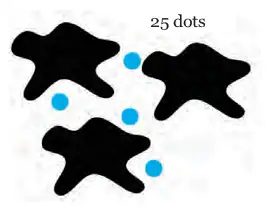
Undoing Operations and Checking Solutions
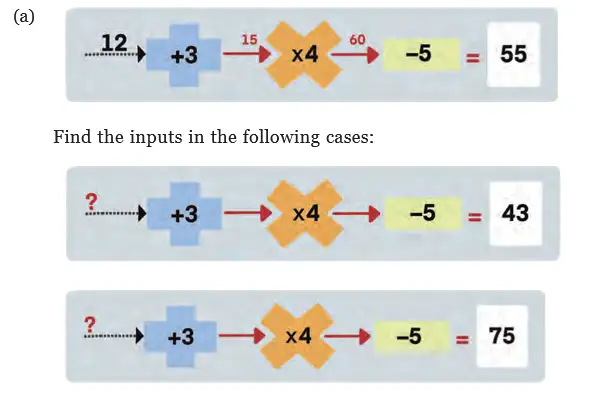
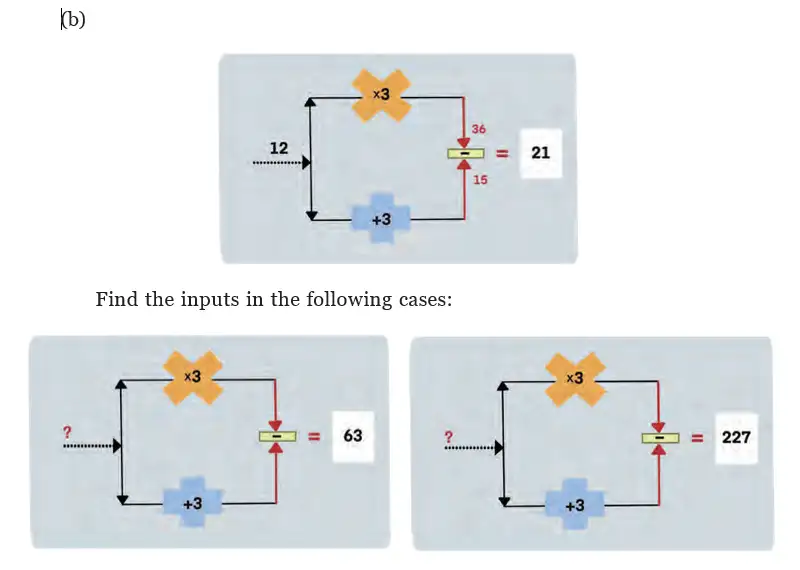
Useful equation-solving ideas
- Undo operations: Reverse the order of operations: undo addition with subtraction, multiplication with division, and vice versa.
- Brackets: Apply the outside multiplier to every term inside, or divide both sides first when appropriate.
- Check: Substitute the answer into the original equation; both sides must have the same value.
- Geometry: For triangle-angle problems, use the angle sum along with any equal-angle or equal-side information.
- Patterns: Write a rule for the number of items or sticks in position ; set the rule equal to the requested total to test whether a position exists.
- Constructing equations: Many different equations can have the same solution; for example, satisfies and .
- Using a known equation: From , first find ; this gives and .
Solving a word problem
- Choose a variable and state what it represents.
- Translate the given relationships into an equation.
- Use equal operations on both sides to isolate the variable.
- Solve, then check that the result fits the situation.
How many kilometres did the taxi travel?
- A taxi costs Rs. 800 plus Rs. 20 per kilometre. Form an equation for a total fare of Rs. 2,200.
- Subtract the fixed fee from both sides.
- Divide both sides by 20.
- Check the fare using the distance found.
Do not divide only one term or change a sign incorrectly while rearranging. For , subtract first, then divide by . For , the correct rearrangement gives , so .
Solve .
A juice costs Rs. 15 less than a milkshake. Four juices and seven milkshakes cost Rs. 600. Find each price.
There are children and donkeys with 28 heads and 80 feet altogether. How many of each are there?
Quick recap
- Represent the unknown with a variable and translate each relationship into an equation.
- Keep equations balanced by performing the same operation on both sides.
- Undo operations in reverse order and expand brackets carefully.
- Check a solution by substituting it into the original equation.
- Use equations to model costs, number relationships, measurements, and counting problems.
- For patterns, express the count in position and compare it with the required total.
Summary
Equations and Their Solutions
Doing the same operation on both sides of an equation preserves equality.
Use the same operation on both sides of an equation.
Solving an equation
- Perform the same operation on both sides so the value of the unknown becomes clear.
Explaining the Magic Trick
Why does the magic trick always give eight?
- Let the number thought of be .
- Multiply it by two, then add ten.
- Divide the result by two.
- Subtract the original number, then add three.
Do not perform an operation on only one side of an equation; that can change the equality.
What does it mean to find a solution to an equation?
Show algebraically why the magic trick gives the same result for any starting number.
Quick recap
- An equation states that two algebraic expressions are equal.
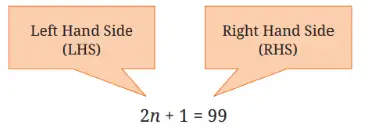
- A solution makes an equation’s LHS equal its RHS.
- The same operation on both sides preserves equality.
- Perform the same operation on both sides to make the unknown’s value clear.
- In the magic trick, the unknown cancels and the final result is always .
Formula sheet
Mathematics — ALL CHAPTERS
1
Large Numbers Around Us
2
Arithmetic Expressions
3
A Peek Beyond the Point
4
Expressions using Letter-Numbers
5
Parallel and Intersecting Lines
6
Number Play
7
A Tale of Three Intersecting Lines
8
Working with Fractions
1
Geometric Twins
2
Operations with Integers
3
Finding Common Ground
4
Another Peek Beyond the Point
5
Connecting the Dots
6
Constructions and Tilings
7
Finding the Unknown