Class 7 . Mathematics . Ganita Prakash Part I . Arithmetic Expressions
Chapter 2: Arithmetic Expressions
Ch 2
Mathematics
Class 7
Simple Expressions
Expression values and equivalent forms
Arithmetic expression — A mathematical phrase made from numbers and operations such as addition, subtraction, multiplication or division.
Key points
- Value: The value of an expression is the number it evaluates to; for example, .
- Reading: can be read as “13 plus 2” or “the sum of 13 and 2.”
- Operation words: Addition gives a sum; subtraction a difference; multiplication a product; division a quotient.
- Equivalent expressions: Different expressions can have the same value, such as , , and ; each equals .
The equality sign connects an expression to its value.
Write a total as an expression
- Identify how many equal amounts are being added.
- Write the number of amounts multiplied by the amount in each one.
- Evaluate the expression if the total value is needed.
Write the expression for Mallika’s lunch spending in a school week and find its value.
- Mallika spends Rs. 25 each school day from Monday to Friday, making five equal daily amounts.
- Write the total as the number of days multiplied by the daily amount, then evaluate.
Comparing expressions
Comparing expressions — Compare two expressions by their values, then use , or to show whether they are equal, smaller or greater.
For expressions and , write if the value of is greater, if it is smaller, and if the values are equal.
Compare by tracking changes
- Addition: Compare changes in both the starting number and the amount added.
- Subtraction: Compare changes in both the starting number and the amount taken away.
- Equal remainders: Raja starts with one more marble but also loses one more than Joy, so their remainders are equal: .
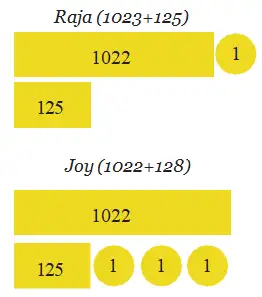
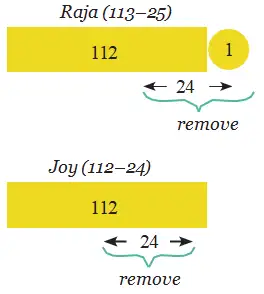
The comparison sign between expressions matches the comparison of their values.
Compare without lengthy calculations
- Identify how the terms in the two expressions differ.
- Track whether each difference increases or decreases the total.
- Decide which value is greater, or whether the changes cancel; write the correct comparison sign.
Which is greater: or ?
- Raja starts with one more marble than Joy, but Joy receives three more marbles than Raja.
- Joy’s advantage from the extra marbles exceeds Raja’s starting advantage by two.
- Therefore, Joy has more marbles in total.
Fill the blanks: (a) ; (b) ; (c) ; (d) .
Arrange in increasing order: , , , , .
Insert , or : (a) ; (b) ; (c) ; (d) ; (e) .
Quick recap
- An arithmetic expression is a number phrase built using operations; its value is the result.
- Use the equality sign to connect an expression with its value.
- Different expressions can have the same value, such as and .
- Compare expressions by their values using , or .
- For quick comparisons, track how changes to the terms affect the total.
- If the starting number and the amount subtracted both increase equally, the difference stays equal.
Reading and Evaluating Complex Expressions
Brackets and the order of operations
Calculate the bracketed part first; the brackets specify which operations belong together.
Use brackets to show which calculation must be done first.
Evaluate an expression with brackets
- Find the value of the operation or expression inside the brackets.
- Replace the bracketed expression with its value.
- Complete the remaining calculation.
Irfan pays Rs. 100 for items costing Rs. 15 and Rs. 56. How much change should he receive?
- Irfan's total cost is the sum of the two purchases.
- Subtract the total cost from the amount paid.
Do not write the change calculation as : it gives . The correct grouping is .
Terms in expressions
Subtracting a number is equivalent to adding its opposite: . Thus, the terms of are and .
| Expression | As a sum of terms | Terms |
|---|---|---|
The order of terms being added can be changed without changing the sum.
Find the terms of an expression
- Rewrite every subtraction as addition of the opposite.
- Separate the expression at each plus sign.
- Treat each resulting part as one term; keep any multiplication within that term.
Identify the terms of and find its value.
- Rewrite subtraction as addition of a negative term.
- Read the three terms, then evaluate the product.
- Add the resulting terms.
Do not treat and as separate terms in : there is no plus sign between them, so is one term.
Evaluate and state its terms.
Find the value of .
Rewrite as a sum of terms and evaluate it.
Quick recap
- Brackets show which part of an expression must be evaluated first.
- Evaluate the bracketed expression before carrying out operations outside it.
- Rewrite subtraction as addition of the opposite: .
- Terms are separated by plus signs after subtraction has been rewritten.
- A product with no plus sign inside it remains a single term.
- Changing the order of terms being added does not change the sum.
Swapping and Grouping
Swapping Addends
Commutative property of addition — Swapping the order of addends does not change their sum.
For any two numbers, and , has the same value as .
Key points
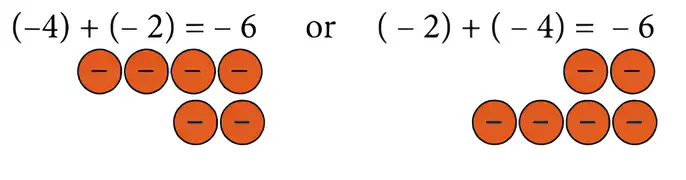
- Applies to integers: The order can be swapped when addends are positive, negative, or mixed.
- Drone example: Moving m up and m down gives m; swapping gives .
- Token model: The same positive and negative counters are combined in either order, so the total is unchanged.
Use this property to add in a convenient order.
Check a swapped sum
- Reverse the order of the addends.
- Evaluate either arrangement; both have the same sum.
Show that swapping the addends in the drone example gives the same result.
- Add the drone’s upward and downward movements.
- Swap the addends and check the sum.
Grouping Addends
Associative property of addition — Changing how addends are grouped does not change their sum.
For any three numbers, changing the grouping leaves the sum unchanged.
Key points
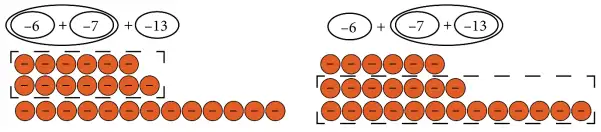
- Either grouping works: Add the first two terms first, or add the last two first.
- Negative addends: whichever pair is grouped first.
- Token model: Grouping the counters differently still leaves the same total number of counters.
Choose a convenient pair to add first.
Evaluate by regrouping
- Choose which adjacent pair to add first.
- Evaluate the pair, then add the remaining term.
Evaluate using two groupings.
- Group the first two terms.
- Now group the last two terms.
Adding Terms in Any Order
Order-independent addition — In a sum containing only addition, the addends can be reordered and regrouped without changing the value.
By using the commutative and associative properties, addends in an addition-only expression may be rearranged and regrouped.
Key points
- Why it works: Swapping uses the commutative property; regrouping uses the associative property.
- Four-term example: , whether is added first or last.
- Missed addend: Manasa can add the omitted to her total of ; she need not start over.
- Corrected total: .
Use this when adding a list of terms in a convenient order.
Add a sum efficiently
- Reorder addends to make convenient pairs or sums.
- Regroup and add the terms.
- If an addend was missed, add it to the total already found.
Evaluate in two orders.
- Add the first two terms, then continue.
- Reorder the terms and add again.
Evaluating Terms Before Adding
Evaluating an expression with addition and multiplication — Evaluate bracketed parts and operations within each term before adding the resulting terms.
Evaluate brackets first, then multiplication or division in the terms, and finally add the evaluated terms.
Key points
- Multiplication before addition: .
- Evaluate each term: In , first find the bracketed sum and the product .
For sums of terms involving brackets or multiplication, find each term’s value before adding.
Evaluate an expression with terms
- Evaluate expressions inside brackets.
- Carry out multiplication or division in each term.
- Add the evaluated terms.
Evaluate .
- Evaluate the brackets and multiplication.
- Add the evaluated terms.
Swapping the Order of Things in Everyday Life
| Situation | Does order matter? | Reason |
|---|---|---|
| Wearing a hat and shoes | No | Either can be put on first; the final appearance is the same. |
| Wearing socks and shoes | Yes | Socks should be worn before shoes. |
Evaluate using two groupings.
Manasa found a total of but forgot to include . What is the corrected total?
Evaluate .
Quick recap
- Swapping addends does not change a sum: .
- Regrouping addends does not change a sum: .
- Addition-only expressions can be reordered and regrouped to make calculation easier.
- If an addend was missed, add it to the total already calculated: .
- Evaluate brackets and multiplication or division within terms before adding.
- In everyday tasks, order may or may not matter: hats and shoes can be swapped, but socks go before shoes.
More Expressions and Their Terms
Expressions and Their Terms
Terms are separated by addition. For subtraction, first write the expression as a sum of signed terms; keep products and quotients together as single terms.
Use this form to identify the negative term.
Find the terms and value
- Rewrite subtraction as addition of a negative term, if needed.
- Separate the expression at its addition signs; keep each product or quotient intact.
- Evaluate using the order of operations, then combine the terms.
A group orders 7 dosas at Rs. 23 each and gives a Rs. 5 tip. Write the expression and find its value.
- A group orders 7 dosas at Rs. 23 each and gives a Rs. 5 tip. Write the expression and find its value.
- Multiply the number of dosas by the cost per dosa, then add the tip.
- The terms are the dosa cost and the tip; evaluate the multiplication first.
- Add the tip to find the total.
A class has 33 students playing a grouping game. If groups of 5 form, express the number of students as full groups plus extras, and identify the terms.
Identify the terms and find the value of .
Brackets and Different Ways to Group
Multiplying a sum by a number multiplies each addend by that number: .
Use either form to describe equal groups.
Translate a grouping situation
- Decide what one group contains.
- Put the contents of one group inside brackets.
- Multiply the bracketed sum by the number of groups, or expand it by multiplying each addend.
- Evaluate each expression while preserving its grouping.
Find the value of two groups, each containing 5 yellow squares and 3 blue squares.
- Find the value of two groups, each containing 5 yellow squares and 3 blue squares.
- Write the contents of one group in brackets and multiply by two.
- Add the quantities within each group.
- Multiply to get the total number of squares.
A family buys four adult metro tickets at Rs. 40 each and three child tickets at Rs. 20 each. Write the expression, identify its terms, and find the total cost.
More Applications and Expression Values
- Gold coins: Elsa doubles her 100 coins and Anna keeps half of hers: ; terms are and ; total: 250 coins.
- Metro groups: Two groups of three adults cost .
- Window height: The measurements give ; terms are , , and ; total: 53 cm.
- Evaluate: ; terms: .
- Evaluate: ; terms: .
- Evaluate: ; terms: .
- Evaluate: ; signed terms: and .
- Write a situation: can represent 89 books, 21 added, and 10 borrowed. Also, and .
Do not treat a subtracted product as a positive term: in , the second signed term is .
Quick recap
- Terms are separated by addition; subtraction creates a negative signed term.
- Keep a product or quotient together when identifying terms.
- Use the situation to build expressions from groups, leftovers, costs, or quantities.
- Brackets show which quantities belong together as one group.
- describes multiplying equal groups.
- Follow the order of operations when evaluating expressions.
Removing Brackets Part-1
Brackets preceded by a minus sign
Use these rules to remove brackets preceded by a minus sign.
Removing brackets
- Look at the sign immediately before the bracket.
- If it is a minus sign, change the sign of every term inside.
- If it is a plus sign, keep every term's sign unchanged.
- Simplify the resulting expression.
Remove the brackets and evaluate: .
- Change the signs of both terms inside the bracket.
- Calculate from left to right.
Do not change only the first sign inside a bracket preceded by a minus. For example, , not .
Brackets preceded by a plus sign
A plus sign before brackets does not alter the signs inside.
Remove the brackets and evaluate: .
Irfan pays Rs. for items costing Rs. and Rs. . Find his change using an expression.
Evaluate the coins left: .
Quick recap
- A minus sign before brackets changes the sign of every term inside.
- .
- .
- A plus sign before brackets leaves all signs unchanged.
- Evaluate the simplified expression to check your answer.
Removing Brackets Part-2
Multiplication over sums and differences
The multiple of a sum or difference equals the sum or difference of the multiples: and .
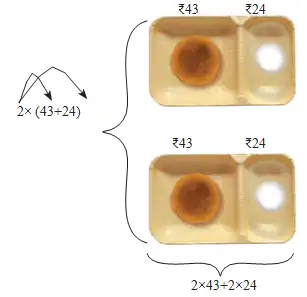
Use these forms to expand brackets or collect terms with a common factor.
Examples and checks
- Two equal orders: Each person’s cost is ; for two people, write , not .
- Three equal orders: If Sangmu joins, the total is .
- Equal-sized rows: .
- Do not change the grouping: , but ; these are not equal.
- Factor order: .
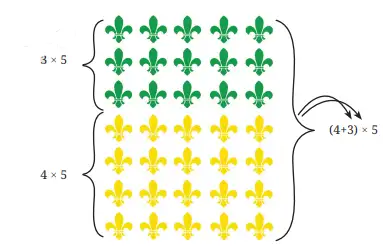
Expand or factor using the distributive property
- For expansion, identify the factor outside the brackets.
- Multiply that factor by every term inside the brackets.
- Join the products using the operation shown inside the brackets.
- For factoring, identify the common factor and place the remaining terms inside brackets.
What is the total amount they must pay?
- Lhamo and Norbu each order a cutlet costing Rs. 43 and a rasgulla costing Rs. 24. Write the cost for two identical orders.
- Distribute the multiplier across both terms.
- Calculate the total.
There are scouts in rows and guides in rows, with children in each row. Find the total number of children using the distributive property.
Simplify by taking out the common factor.
Are and equal? Evaluate both.
Quick recap
- Brackets show that a multiplier applies to the entire sum or difference.
- .
- .
- Take out a common factor: .
- Keep the grouping unchanged: is not the same as .
Tinker the Terms Part-1
How Changing Terms Changes a Value
If the addends change by and , the sum changes by .
Find a new sum without recalculating
- Find how much each addend changed.
- Add the changes, including their signs.
- Adjust the original sum by that total change.
Without adding from scratch, find given that .
- Start with the known sum.
- The first addend decreases by and the second increases by ; the net change is zero.
- So the new sum stays the same.
Removing Brackets
Use these rules to remove brackets correctly.
Remove brackets in an expression
- Check whether the bracket is preceded by a plus or minus sign.
- Keep the inner signs after a plus; reverse every inner sign after a minus.
- Simplify the resulting expression.
Remove the brackets and evaluate .
- A minus before the bracket changes both inner signs.
- Add the terms.
Do not change only the first sign inside brackets after a minus. Reverse every sign: .
Equivalent Expressions and Subtraction Strategies
Replacing subtraction with addition of the opposite gives an equivalent expression.
Rewrite subtraction using a nearby multiple of ten.
Compare expressions by their terms
- Remove brackets, paying attention to each sign.
- Rewrite subtraction as addition of a negative where needed.
- Compare the signed terms; reorder or regroup only addition terms.
Show that and are equal.
- Remove brackets from the first expression.
- The second expression already has the same signed terms.
- Both expressions have the same value.
Given that , find without recomputing the whole sum.
Remove brackets and evaluate .
Use a mental subtraction strategy to find .
- A change in an addend changes the sum by the same signed amount.
- A minus before brackets reverses every sign inside them.
- Rearrange terms only after expressing the calculation as addition of signed numbers.
Quick recap
- An addend's change affects the sum by the same amount.
- Changes to multiple addends combine to give the total change.
- A plus before brackets preserves inner signs; a minus reverses them.
- Subtraction can be rewritten as addition of the opposite.
- Addition terms may be reordered or regrouped, but subtraction cannot be rearranged carelessly.
- For quick calculations, and .
Tinker the Terms Part-2
Using the Distributive Property to Multiply
For numbers , and , multiplication distributes over addition and subtraction.
Use these identities to expand products.
Choose a nearby convenient number
- Rewrite one factor as a convenient number plus or minus a small amount.
- Distribute the other factor to both terms.
- Calculate the simpler products and combine them.
Given that , find .
- Write as and distribute .
- Substitute the known product and calculate the added product.
Useful products near convenient numbers
- Near : .
- Near : .
- Near : .
- Near : .
- Other examples: ; ; .
Expanding Brackets and Comparing Expressions
Expand a product term by term; subtraction can also be viewed as adding a negative.
Compare without fully evaluating
- Check which operations are inside brackets and apply multiplication before addition.
- Expand brackets where useful and compare corresponding terms.
- Check whether a negative factor or reversed subtraction changes the sign.
Compare and using , or .
- The first bracket is positive, while reversing the subtraction makes it negative.
- Multiplying both values by the same positive number preserves their order.
Do not distribute across addition or subtraction without multiplying every term: , not .
Expressions in Everyday Situations
Let be the total, the number of periods, and the amount per period.
Translate a situation into an expression
- Identify the amount for one period and the number of periods.
- Use addition for amounts combined in one period and multiplication for repeated periods.
- Calculate and include the correct units or currency.
Binu earns Rs. 20,000 per month and spends Rs. 5,000 on rent, Rs. 5,000 on food and Rs. 2,000 on other expenses. Find her savings in one year.
- Subtract Binu's monthly expenses from her monthly income.
- Multiply the monthly savings by months.
More situations to model
- Weekly supply: Rahim and Shyam supply kg and kg daily; in seven days, kg.
- Reading: Melvin reads on five days each week; in eight weeks, stories. This is also .
- Snail: It gains cm per full day-night cycle. After seven cycles it is at cm, then reaches the cm top on day eight: .
Regrouping Terms and Preserving Value
Addition may be regrouped; rewrite subtraction as addition of a negative so the signs remain attached to their terms.
Evaluate by regrouping.
- Pair each positive odd number with the negative even number that follows it.
- Each pair equals negative one, and there are five pairs.
Equivalent forms and patterns
- Alternating ones: .
- Preserve terms: ; the multiplication term stays intact.
- Array sums: Different groupings give and .
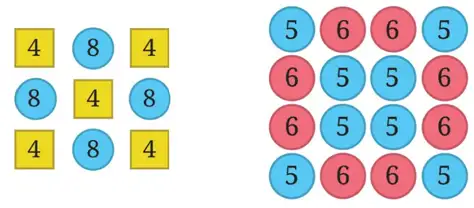
Use a nearby multiple to find .
Compare and using , or .
A student reads one story each day except Tuesdays and Saturdays. How many stories are read in eight weeks?
Quick recap
- Use and to expand products.
- For faster multiplication, rewrite a factor near a convenient number such as or .
- Follow the order of operations; brackets can change which terms are multiplied together.
- Model repeated amounts with multiplication and combined amounts with addition inside brackets.
- Regroup sums carefully, keeping each negative sign attached to its term.
- Compare or simplify expressions by rewriting them into equivalent forms.
Summary
Expressions, Terms and Brackets
Arithmetic expression — A mathematical phrase made from numbers and operations; its value is found by carrying out the operations.
Reading expressions
- Terms are parts of an expression separated by addition or subtraction signs at the outer level.
- Brackets group parts of an expression and help show how to read and evaluate it without confusion.
Evaluate an expression with brackets
- Evaluate the expression inside the brackets.
- Carry out the remaining operations, keeping their signs.
Find the value of .
- Evaluate inside the brackets first.
- Multiply, then subtract.
Changing the Order or Grouping of Addends
Changing the order of addends does not change their sum.
Changing the grouping of addends does not change their sum.
Using addition properties
- Reasoning Use these properties to compare or simplify sums without evaluating them in their original order.
- Convenient pairs Rearrange or regroup addends to make easy sums.
Evaluate efficiently.
- Reorder the addends using the commutative property.
- Group the convenient pair using the associative property.
Removing Brackets After a Negative Sign
When brackets preceded by a minus sign are removed, every term inside changes sign.
Remove a negative bracket
- Keep the terms in the same order.
- Change the sign of each term, then simplify.
Evaluate by removing the brackets.
- Change the sign of each term inside the brackets.
- Subtract the terms.
Do not change only the first term’s sign: the minus sign applies to every term inside the brackets.
Distributive Property
Multiplying a number by an expression in brackets is equivalent to multiplying it by each term inside the brackets.
Use the distributive property
- Multiply the outside number by each term inside the brackets, keeping each term’s sign.
- Add or subtract the resulting terms.
Evaluate using the distributive property.
- Multiply by both terms inside the brackets.
- Calculate the products and subtract.
Do not multiply the outside number by only the first term; distribute it to every term inside the brackets.
Practice
Evaluate .
Evaluate efficiently.
Evaluate using the distributive property.
Quick recap
- An arithmetic expression combines numbers and operations; terms are separated by outer addition or subtraction signs.
- Brackets group parts of an expression and help make it easier to read and evaluate.
- Changing the order or grouping of addends does not change their sum.
- Removing a minus sign before brackets changes the sign of every term inside.
- The distributive property multiplies the outside factor by every term inside the brackets.
Formula sheet
Mathematics — ALL CHAPTERS
1
Large Numbers Around Us
2
Arithmetic Expressions
3
A Peek Beyond the Point
4
Expressions using Letter-Numbers
5
Parallel and Intersecting Lines
6
Number Play
7
A Tale of Three Intersecting Lines
8
Working with Fractions
1
Geometric Twins
2
Operations with Integers
3
Finding Common Ground
4
Another Peek Beyond the Point
5
Connecting the Dots
6
Constructions and Tilings
7
Finding the Unknown